 WA bushfire a threat to homes and lives https://www.sbs.com.au/news/wa-bushfire-a-threat-to-homes-and-lives 26 Jan 19 Authorities in Western Australia say a bushfire burning in Perth’s northern suburbs is a threat to lives and homes. An emergency warning has been issued for a bushfire burning out of control in Perth’s northern suburbs with authorities warning of a threat to lives and homes.
The fire at Jandabup is burning in an area near Sydney Road and Ross Street and a nearby pine plantation.
“The bushfire is moving fast in a north-westerly direction. It is out of control and unpredictable,” Emergency WA says.
Spot fires are also starting up to 300 metres ahead of the fire front.
Authorities say the best escape route is to the southwest, using Badgerup Road but anyone still planning to leave should follow the directions of fire crews.
January 27, 2019
Posted by Christina Macpherson |
climate change - global warming, Western Australia |
Leave a comment
 Adelaide now hottest capital city on record as temperatures soar throughout SA, ABC News, By Sarah Scopelianos and Camron Slessor– 26 Jan 19 Adelaide now hottest capital city on record as temperatures soar throughout SA, ABC News, By Sarah Scopelianos and Camron Slessor– 26 Jan 19
Adelaide has hit a sweltering 46.6 degrees Celsius, surpassing the previous record set in Melbourne a decade ago to officially become the hottest capital in the country.
Key points:
- More than 20 locations hit record temperatures in South Australia on Thursday
- Meteorologist Hilary Wilson said records had been broken right across the state
- The CFS warned communities were at risk during extreme heat
Earlier on Thursday, Adelaide topped its 1939 heat record after hitting 46.2C.
The temperature then climbed up to 46.6C, topping the previous capital city record of 46.4C set in Melbourne in 2009.
More than 20 locations hit record temperatures in South Australia on Thursday, including Adelaide Airport, Minlaton, Noarlunga, Snowtown and Port Lincoln.
Ceduna set a record for the second day in a row, reaching 48.6C.
Meteorologist Hilary Wilson said records had been broken right across the state……….
‘Incredibly high’ temperatures overnight for Victoria
BOM Victoria’s Richard Russell said temperatures in parts of the state were going to be “nothing short of oppressive”, particularly in northern Victoria where it was expected to reach the mid-40s………https://www.abc.net.au/news/2019-01-24/sa-heating-up-with-records-expected-to-be-broken/10745220
|
|
|
January 26, 2019
Posted by Christina Macpherson |
climate change - global warming, South Australia |
Leave a comment
Newer coal-fired power stations break down more often per gigawatt than older power generators, the Australia Institute has found. https://www.sbs.com.au/news/reliability-of-newer-coal-power-questioned Reliability of newer coal power questioned
Newer coal-fired power stations break down more often per gigawatt than older power generators, the Australia Institute has found.
The reliability of “high efficiency low-emissions” coal fired power plants is being questioned, with a new report finding they break down more often per gigawatt than older generators.
Australia’s newest coal power station, the 12-year-old Kogan Creek Power Station in Queensland, broke down six times last year, the Australia Institute found.
“These new supercritical coal plants are touted by proponents as ‘high efficiency, low emissions’ coal plants, but this could not be further from the truth … they are more emissions-intensive than renewable energy and even gas,” the Australia Institute’s Richie Merzian said.
January 26, 2019
Posted by Christina Macpherson |
AUSTRALIA - NATIONAL, climate change - global warming |
Leave a comment
‘It’s like hell here’: Australia bakes as record temperatures nudge 50C , Fears rise for homeless and vulnerable people as communities brace for another week of relentless hot weather , Guardian, Naaman Zhou, @naamanzhou, Sun 20 Jan 2019
It was 48.9C last Tuesday in
Port Augusta, South Australia, an old harbour city that now harvests solar power. Michelle Coles, the owner of the local cinema, took off her shoes at night to test the concrete before letting the dogs out. “People tend to stay at home,” she said. “They don’t walk around when it’s like this.”It’s easy to see why: in the middle of the day it takes seconds to blister a dog’s paw or child’s foot. In Mildura, in northern Victoria, last week gardeners burned their hands when they picked up their tools, which had been left in the sun at 46C.
Fish were dying in the rivers.
Almost every day last week a new heat record was broken in Australia. They spread out, unrelenting, across the country, with records broken for all kinds of reasons – as if the statistics were finding an infinite series of ways to say that it was hot.
The community of Noona – population 14 – reached the highest minimum ever recorded overnight in Australia – 35.9C was the coldest it got, at 7am on Friday. It was 45C by noon.
A record fell on Tuesday in Meekatharra in Western Australia – the highest minimum there ever recorded (33C). Another fell on Wednesday, 2,000 miles away, in Albury, New South Wales – their hottest day (45.6C).
It was 45C or higher for four consecutive days in Broken Hill – another record – and more than 40C for the same time period in Canberra, the nation’s capital. Nine records fell across NSW on Wednesday alone. Back in Port Augusta, Tuesday was the highest temperature since records began in 1962………..
In South Australia, they declared a “code red” across Adelaide, the state capital. Homelessness services were working overtime and the Red Cross started calling round a list of 750 people who were deemed especially vulnerable
At the Australian Open in Melbourne, only the sea breeze kept the temperature below 40C. At Adelaide’s Tour Down Under, a bike race, it was 41C.
On Monday last week the hottest spot in New South Wales was Menindee, a river town that feeds the country’s largest water system, the Murray-Darling basin. It was 45C. It climbed to 47C on Wednesday, and by Thursday the fish were gasping.
Australia’s native Murray cod can live for decades under normal conditions, growing all the while. The oldest are a metre long, with heavy white bellies that have to be held with both hands. Last week, hundreds died, choked of oxygen due to an algal bloom that fed and grew in the heat, and collapsed when temperatures dipped.
Blue-green algae flourishes in hot, slow-moving water. Then, when temperatures inevitably drop, the algae dies and becomes a food source for bacteria, who multiply and starve the river of oxygen. The fish rise to the surface.
The mass fish death has reignited a debate over water management in the region, where cotton farmers upstream have been accused of taking more water than they should.
The heat is not the root cause, the locals stress. But the five punishing days settling over the river have not made it better. Last Thursday the cod were up near the surface and struggling. On Friday, it was 45C again. In Menindee, the locals believe the fish kill will happen again, with temperatures in the 40s expected to continue into this week. The water will be running hot……….https://www.theguardian.com/australia-news/2019/jan/19/australia-swelters-as-relentless-hot-weather-smashes-records
January 21, 2019
Posted by Christina Macpherson |
AUSTRALIA - NATIONAL, climate change - global warming |
Leave a comment
Australia faces ‘new normal’ of year-round bushfires ,Greg Mullins, Daily Telegraph
Extreme bushfire conditions in Australia are becoming worse, fires are burning in areas that should never burn at times when there should not be fire, former Fire and Rescue NSW commissioner Greg Mullins says to describe our now unpredictable fire seasons….. (subscribers only)
January 21, 2019
Posted by Christina Macpherson |
AUSTRALIA - NATIONAL, climate change - global warming |
Leave a comment
 Roads melt as temperatures break records across NSW, SMH, By Jenny Noyes, 17 January 2019 As temperature records continue to be broken across NSW, residents from Sydney to Menindee are warned the heatwave melting the state is yet to hit its peak, and in some parts is forecast to continue into next week without respite.
On Wednesday and Thursday, new maximum temperature records were set at 27 sites across NSW and the ACT, while some of the hottest overnight temperatures on record worsened the impact of the ongoing hot spell.
The conditions were so extreme that the bitumen on the Oxley Highway near Wauchope, just west of Port Macquarie, began melting about midday.
Walcha Council is using water from a nearby river to cool the pavement.
“Roads and Maritime Services acknowledge water is a scarce resource at this time, however it is required to ensure the safety of motorists and keep the road open,” a spokeswoman said in a statement.
Meanwhile, the NSW Rural Fire Service was battling more than 50 fires across the state – 20 of them are uncontained.
Deputy Commissioner Rob Rogers said 61 new fires were ignited on Wednesday alone, 31 of them started by lightning.
“We’re still trying to capture some of these fires and get them contained,” he told 2GB radio.
Total fire bans were in place across much of central NSW, stretching from the Victorian border up to Queensland……….
January 19, 2019
Posted by Christina Macpherson |
climate change - global warming, New South Wales |
Leave a comment
 Australian coal is killing the Pacific, Fiji PM tells Scott Morrison, Fiji has firmly told Australia to shift away from coal and fossil fuels because climate change is hurting Pacific island nations. SBS 18 Jan 19
 Australia must not put the interests of a single industry above the lives of Pacific nations battling climate change, Scott Morrison has been firmly told.At an official dinner in Fiji to mark a newly announced partnership between the two nations, Fijian Prime Minister Frank Bainimarama explicitly told Australia to do better.
He said the only way to guarantee the survival of Pacific island countries was for Australia to shift away from fossil fuels.
“I urged your predecessor repeatedly to honour his commitment to clean energy,” Mr Bainimarama said on Thursday night in Suva.
“From where we are sitting, we cannot imagine how the interests of any single industry can be placed above the welfare of Pacific peoples and vulnerable people in the world over.
“Rising seas threaten whole communities, forcing them to endure the trauma of relocating from land they’ve endured for generations.
“Fijian farmers are watching their crops perish in soil that has been spoiled by the heightened salinity that is associated with sea level rise.”
Mr Bainimarama said the evidence of climate change was clear in the disappearing coastlines in Bangladesh and worsening flooding in the United States.
“And in Australia as well, where soaring temperatures have reached record highs in several major cities just this week,” he said.
“This cannot be written off as a difference of opinion.
“Consensus from the scientific community is clear and the existential threat posed to Pacific island countries is certain.”
Mr Morrison responded in his speech, praising Mr Bainimarama for Fiji’s global leadership on climate change…….https://www.sbs.com.au/news/australian-coal-is-killing-the-pacific-fiji-pm-tells-scott-morrison
January 19, 2019
Posted by Christina Macpherson |
AUSTRALIA - NATIONAL, climate change - global warming, politics international |
Leave a comment
|
Climate change preparation key as Canberra beats heatwave record, Canberra Times, By Jasper Lindell, 18 January 2019 Canberra has experienced its longest run of days above 40 degrees, with the temperature hitting 40.1 at 3.41pm on Friday afternoon, while experts say the city needs to quickly adapt to more extreme heat driven by climate change.A cool change is expected to bring closer to average temperatures on Friday night or early on Saturday morning – but the capital still sweltered through four days at 40 degrees or above, the worst heatwave since January 1939.
Bureau of Meteorology Senior Climatologist Blair Trewin said the current heatwave was striking to people of his generation who grew up in Canberra and never experienced a day above 40 degrees……..
There was only a five degree average temperature difference between present climate conditions and the Ice Age, he said.
Canberra could expect extreme hot weather more frequently and in longer spells, along with a reduction in autumn, winter and spring rainfall, Prof Howden said.
We’d also expect to see a lot more fires and fire frequency, and the fire season and the intensity of those fires going up.”
“Canberra is probably one of the more climate change aware and climate change active cities and that’s particularly because the current government has been leaders in terms of climate change,” Professor Howden said.
The ACT government’s 2016 Climate Change Adaptation Strategy requires the impacts of climate change to “mainstreamed” and incorporated into government, household and business practice.
Dr Peter Tait, an Australian National University lecturer and general practitioner who spent 32 years in Alice Springs, said many of his Canberra patients didn’t have heatwave contingency plans and that needed to change as the city experienced more periods of extreme heat.
But Dr Tait said the emphasis needed to be on building heat resilience into the “fabric of society”, including enforcing heat appropriate building codes.
“We need to be doing that active infrastructure planning now,” he said…….https://www.canberratimes.com.au/national/act/climate-change-preparation-key-as-canberra-beats-heatwave-record-20190118-p50s66.html
|
|
January 19, 2019
Posted by Christina Macpherson |
ACT, climate change - global warming |
Leave a comment
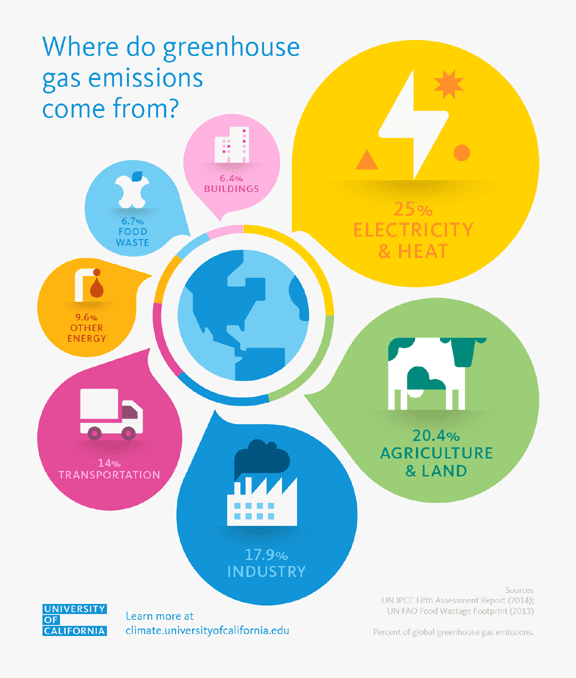
Can a growing city cut carbon emissions to zero? https://www.canberratimes.com.au/politics/act/can-a-growing-city-cut-carbon-emissions-to-zero-20190118-p50s9m.html,By Penny Sackett, Frank Jotzo & Will Steffen, 19 January 2019 How can Canberrans keep cutting their greenhouse-gas emissions as their city grows quickly and spreads out? And how will the ACT benefit from going low-carbon? Having adopted stringent emissions targets for 2025 onwards, these questions are becoming front of mind for the ACT government.
The new targets include net zero emissions on or before 2045, with interim targets of 50 to 60 per cent emissions reduction by 2025; 65 to 75 per cent by 2030; and 90 to 95 per cent by 2040, all compared to the ACT’s emissions in 1990. The 2020 target, which has been in place for several years, is a 40 per cent reduction.
Meeting an emissions trajectory like this would mean the ACT does its fair share to cut greenhouse-gas emissions in line with the Paris agreement of holding global warming below 2 degrees. The ACT would help lead the way in Australia by respecting the boundaries set by its “carbon budget”, and demonstrating how to make deep reductions in an urban economy.
The idea behind setting a clear trajectory to zero emissions is that business, government and the ACT community can invest in modern, low-emissions technology with confidence about the overall goal, knowing that policy will support the shift. Climate action is part of creating a healthier, better-connected, more resilient and prosperous city. Positive change can occur in nearly every aspect of life in Canberra.
As one of Australia’s richest communities, we should find it easier than elsewhere to invest in the necessary change. And taking a lead in climate-friendly modernisation helps attract highly skilled people to Canberra, which is what is needed for continued economic success in the ACT. Canberra has a national, and growing international, reputation for innovation in the low-carbon economy, and ACT energy and climate policy programs have already attracted global renewable-energy companies.
The targeted reductions are steep, but they can be achieved if government, businesses and the community all make a sustained effort.
The ACT is on track to have 100 per cent of its electricity sourced from renewables by about 2020. This will make possible the targeted 40 per cent reduction in emissions (as they are accounted in the ACT). Carbon-free power supply gives us emission-free options for other sectors, notably transport – electric cars and buses, as well as light rail – and the use of electricity instead of gas for heating, cooking and in industry. This is critical because transport and natural gas use account for the lion’s share of Canberra’s direct emissions outside of electricity generation, at about 65 per cent and 20 per cent respectively.
The vision is clear: a transport system where public transport, as well as biking and walking, play a bigger role; where almost all cars, buses and trucks run on electricity or hydrogen; and where almost no gas is used. Quite aside from climate change, this means even cleaner air in Canberra and much less noise. The shift to higher-density living and the rapid progress with electric cars will help make it possible. Electric bicycles are already an alternative.
The first step is to stop investment that locks in carbon use into the future. We need electric cars and buses rather than petrol and diesel, and electric heating systems, not gas. Extra investment to improve energy efficiency in houses, apartments and public buildings is needed, too.
In all of this, the ACT government can and should lead by example. And climate policy must go hand-in-hand with social policy, ensuring that the shift to a truly clean city does not put some groups at a disadvantage. That means a keen eye on energy costs and the needs of commuters in the suburbs, and increased engagement by all of us during the transition.
Penny Sackett, an honorary professor at the ANU, is a former Australian chief scientist; Frank Jotzo is a professor at the ANU’s Crawford school of public policy; and Will Steffen, an emeritus professor at the ANU, is on the Climate Council of Australia. The authors are on the ACT Climate Change Council, an independent statutory body that advises the ACT government on emissions targets. This is the first of several articles exploring how Canberra can transition to carbon neutrality.
January 18, 2019
Posted by Christina Macpherson |
ACT, climate change - global warming |
Leave a comment
 Adani cleared of wrong doing by Federal Government over bores but Qld investigation continues, ABC News By Josh Robertson , 18 Jan 19, Adani remains under investigation by the Queensland Government for alleged illegal works on its Carmichael mine site, despite federal authorities ruling out any wrongdoing.
State officials have confirmed the ongoing probe into whether the company breached its environmental authority by sinking six dewatering bores last year.
The ABC revealed in September the department had launched an investigation into whether Adani sunk the groundwater bores in breach of its approval under the state Environmental Protection Act. …….
Queensland Greens senator Larissa Waters said she had reviewed documents relating to the Federal Environment Department’s inquiries and “unfortunately it seems that there wasn’t a thorough investigation”.
Ms Waters is a former lawyer at Queensland’s Environmental Defenders Office (EDO), which has provided the State Government evidence of the alleged breach, including drone footage of the bores.
State Government investigation still underway
A spokesman for the Queensland Department of Environment and Science (DES) said the Government was aware of the Commonwealth findings.
“DES is undertaking a more comprehensive investigation under separate state legislation, and has made several information requests to Adani, and has also carried out site inspections,” he said.
“If non-compliances are identified during the course of the investigation, DES can move to enforcement action.”
Adani still needs approval for its groundwater dependent ecosystem management plan to carry out mining operations.
Last month, the ABC revealed the Queensland Environment Department was examining evidenceincluding specifications of groundwater bores registered by Adani on a government website.
Queensland’s EDO and a university groundwater expert argued the bores construction, materials and depth are consistent with dewatering bore standards but incompatible with groundwater monitoring…….. https://www.abc.net.au/news/2019-01-17/adani-cleared-of-wrong-doing-by-federal-government-over-bores/10724086
January 18, 2019
Posted by Christina Macpherson |
climate change - global warming, Queensland |
Leave a comment

The world’s 15 hottest sites on Tuesday were all in Australia, Brisbane Times, By Peter Hannam16 January 2019 Australia was home to all 15 of the world’s hottest temperatures on Tuesday, a feat it may well repeat on Wednesday and beyond as a huge swath of the nation bakes in 45-degree-plus heat.A slew of records have already fallen during the current heatwave and more are likely to be broken before a cool change breaks up the furnace later this week.
According to the El Dorado Weather site, the warmest 15 places on the planet in the past 24 hours were all in Australia. These ranged from Tarcoola in inland South Australia, which reached 49.1 degrees, to Yulara in the Northern Territory at 46.1 degrees in 15th slot.
The Bureau of Meteorology said the 49.1 degrees at Tarcoola was a record reading for that site.
Australia often dominates heat temperatures in summer, given that rival southern hemisphere sites are mostly in South America and South Africa where readings above 40 degrees are not so common.
The world’s hottest places in the 24 hours to 11am (AEDT) on January 16:
- Tarcoola (Australia) 49.1°C
- Port Augusta Aws (Australia) 49°C
- Woomera Aerodrome (Australia) 48°C
- Olympic Dam Aerodrome (Australia) 47.9°C
- Hay Airport Aws (Australia) 47.8°C
- Oodnadatta Airport (Australia) 47.7°C
- Marree Aero (Australia) 47.6°C
- Coober Pedy Aws (Australia) 47.5°C
- Warburton Airfield (Australia) 47.3°C
- Ivanhoe Aerodrome Aws (Australia) 46.9°C
- Wilcannia Aerodrome Aws (Australia) 46.6°C
- Leigh Creek Airport (Australia) 46.3°C
- Wulungurru (Australia) 46.2°C
- Moomba Airport (Australia) 46.1°C
- Yulara Aws (Australia) 46.1°C
50 degrees?
Jacob Cronje, a senior meteorologist with Weatherzone, said he “wouldn’t be shocked” by a 50-degree reading during the current spell, given the scale and intensity of the heat.
Certainly the duration of this event and the spatial extent of the heatwave across the southern half of Australia seems to be quite significant,” he said.
“By the end of the week, we should see many records broken across NSW,” Mr Cronje said, adding that northern Victoria might have to rewrite the records too…….
For Canberra, temperatures may reach 40 degrees for four days in a row, a series not recorded before for the nation’s capital. No days of 40 degrees were recorded in Canberra between 1973 and 1998, the bureau said. The city reached 41.6 degrees on Wednesday…….
Hot years
The Bureau of Meteorology and the CSIRO’s State of the Climate report identified rising temperatures as among the clearest indications of climate change in Australia.
Globally, last year was the world’s fourth-hottest year, according to the Japan Meteorological Agency. All of the five warmest years on record have happened since 2014, the agency reported this week. https://www.brisbanetimes.com.au/environment/weather/the-world-s-15-hottest-sites-were-all-in-australia-amid-significant-heatwave-20190116-p50rmr.html
January 17, 2019
Posted by Christina Macpherson |
AUSTRALIA - NATIONAL, climate change - global warming |
1 Comment
SBS News 16 Jan 19, Scorching summer temperatures have seen some regions reaching close to 50C with records crumbling as the week long heatwave continues. Summer heat records have been smashed with South Australia’s Port Augusta hitting a scorching 48.9C, as the rest of the country sweltered though a heatwave.
The Bureau of Meteorology forecast daytime temperatures of up to 12C above average and 10C higher than usual at night from Monday to Friday…….https://www.sbs.com.au/news/heat-records-smashed-across-australia
January 17, 2019
Posted by Christina Macpherson |
AUSTRALIA - NATIONAL, climate change - global warming |
Leave a comment
Drought, climate change and mismanagement’: What experts think caused the death of a million Menindee fish, ABC Science, By environment reporter Nick Kilvert, – 16 Jan 19
The sight of more than a million fish floating belly up on the Darling River at Menindee has thrown doubt over the management of the Murray-Darling Basin.
Experts say irrigators are taking too much water from the system, and the Murray-Darling Basin Authority has mismanaged water flows.
But New South Wales Water Minister Niall Blair says drought is to blame.
With more fish likely to die, here’s what we know about the mass deaths and what some independent experts have had to say.
Where are fish dying?
A million fish were found dead at Menindee Lakes last week.
It’s a series of seven lakes fed by the Darling River, about 90 kilometres south-east of Broken Hill in western New South Wales. It’s believed to be one of the largest fish kills ever recorded in Australia.
Then a smaller kill of about 60 fish was reported at Lake Hume yesterday, on the NSW-Victoria border.But the cause of that kill is still unclear.
What killed the fish?
A variety of factors were at play at Menindee. Water levels were very low, the system had stopped flowing, and temperatures were high after a long spell of hot weather.
This created ideal conditions for blue-green algae (cyanobacteria) to grow, and it “bloomed” out of control.
But it wasn’t the algae that killed the fish.
A cold front hit the region, which dropped the water temperature in the river, killing the algal bloom.
The bacteria that feeds on dying algae then exploded out of control, and sucked all the oxygen from the water.
When the oxygen levels dropped too low, the fish drowned.
So who or what is to blame?
The blame game began almost immediately after the Menindee fish kill was reported.
January 17, 2019
Posted by Christina Macpherson |
AUSTRALIA - NATIONAL, climate change - global warming |
Leave a comment

Record-breaking heatwave to hit every state and territory, https://www.sbs.com.au/news/record-breaking-heatwave-to-hit-every-state-and-territory Every state and territory in Australia will experience heatwave conditions on Monday, forecasters say. A cyclone is brewing off Western Australia’s Kimberley coast while much of the country is set to swelter in heatwave conditions.
Every state and territory will cop the heat on Monday when temperatures soar with some regions to experience severe and extreme hot weather.
The Bureau of Meteorology forecasts low intensity heatwave conditions in parts of central WA to southern parts of the Northern Territory, southwestern Queensland and across NSW, Victoria, Tasmania and South Australia.
It will be worst in South Australia where multiple days of temperatures above 40C, an unusual event even for summer, meteorologist Dean Narramore said on Sunday.
Particularly northern South Australia, they’re looking at maybe five days in a row above 45 and normally they might only get five or 10 a year,” he said.
Melbourne can expect to see a few days in the mid to high 30s, while temperatures in Sydney’s west will peak above 40C for four or five days.
January 14, 2019
Posted by Christina Macpherson |
AUSTRALIA - NATIONAL, climate change - global warming |
Leave a comment
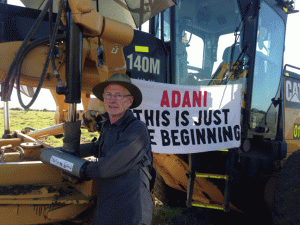
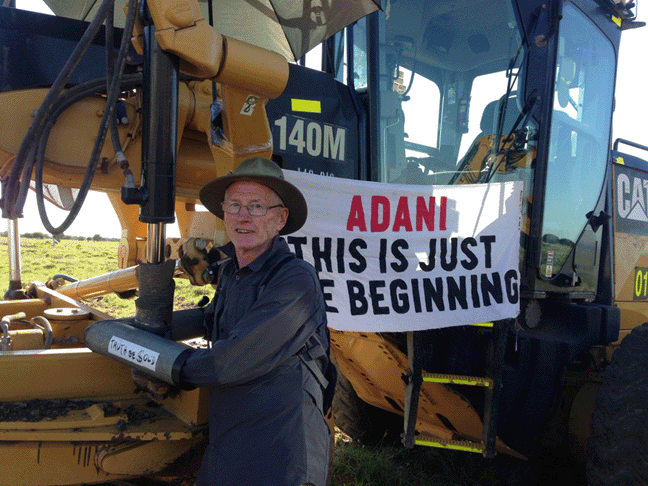
New Adani contractor Eastern Tree Services found themselves locked out of five premises in three states this morning, with citizens blocking work trucks at another two premises.
Additional locks and chains, as well as signs calling for ETS to ‘get out of bed with Adani’, meant staff needed angle grinders to get into work. Trucks wanting to leave industrial sites in Brisbane & Townsville were blocked by concerned citizens.
ETS, a large privately-owned company, operates tree clearing services from 20 sites across the country. They start tree clearing work at Abbott Point Coal Terminal this week and sources confirm ETS have accepted a contract to clear the rail corridor from Adani’s controversial Carmichael Coal Mine to link in with the existing railway travelling to Abbott Point. Jai, a spokesperson for Frontline Action on Coal said:
“ETS must listen to the majority of Australians who do not want Adani’s coal mine to go ahead and completely rule out destroying precious bushland for the proposed Adani rail corridor.”
This is not the first Adani contractor to be the target of long-running protests, with prior campaigns leading to banks, insurers and contractors ruling out supporting the mine. Emma from the Brisbane blockade protest said:
“Big businesses need to understand that if they work with Adani they will be held accountable for the damage to the reef, land, culture and climate that will ensue if Adani’s dirty coal mine goes ahead. Adani contractors like ETS will find themselves targets of ongoing protests until they rule out working with Adani.”
“Adani fail to get approvals and keep their promised work deadlines time and time again. They cannot be trusted and should not be allowed to build a climate wrecking coal mine that Australia doesn’t want, and the world doesn’t need.” SourceDoc Frontline Action on Coal: mailchi.mp/frontlineaction.org/adani-contractor-locked-out-as-warning-to-cut-ties-with-the-unpopular-carmichael-coal-mine
January 14, 2019
Posted by Christina Macpherson |
climate change - global warming, Queensland |
Leave a comment





 Antinuclear