Australia’s extreme heat is sign of things to come, scientists warn https://www.theguardian.com/australia-news/2019/feb/01/australia-extreme-heat-sign-of-things-to-come-scientists-warn-climate
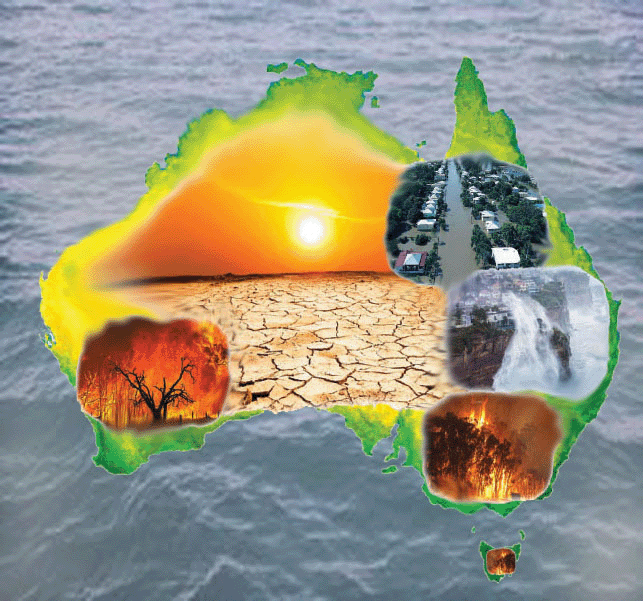
Hottest month ever shows temperatures rising faster than predicted, say climate experts Australia sweltered through the hottest month in its history in January, spurring mass deaths of fish, fire warnings and concerns among climate scientists that extreme heat is hitting faster and harder than anticipated.
For the first time since records began, the country’s mean temperature in January exceeded 30C (86F), according to the Bureau of Meteorology (BoM), which said daily extremes – in some places just short of 50C – were unprecedented.
“There’s been so many records it’s really hard to count,” said Andrew Watkins, a senior climatologist at BoM, after January registered Australia’s warmest month for mean, maximum and minimum temperatures.
This followed the country’s warmest December on record, with heatwaves in every Australian state and territory. With colour-coded heat maps of the country resembling blazing red furnaces for much of the month, the authorities have recently issued a special report on the extraordinary heat.
A persistent high-pressure system in the Tasman Sea that blocked cold fronts and cooler air from reaching the country’s south, and a delayed monsoon in the north, contributed to the heatwave.
Climate change is the long-term driver. “The warming trend which has seen Australian temperatures increase by more than 1C in the last 100 years also contributed to the unusually warm conditions,” Watkins said.
The bureau’s monthly report said the heatwaves were unprecedented in their scale and duration. The highest temperatures of the month were recorded in Augusta on the south-west coast, where thermometers registered 49.5C , but the most relentless heat was in Birdsville, Queensland, which endured 10 consecutive days above 45C.
Tasmania, where emergency services have been
battling bushfiresthroughout the past month, had its driest ever January. Watkins said Borrona Downs in north-west New South Wales broke the record for hottest minimum temperature, registering one night at 36.6C. This has a major impact on ecosystems that have not been able to cool down during the night as is normally the case.
This was compounded by drought. Large parts of Australia received only 20% of their normal rainfall, particularly throughout the south-east in Victoria and parts of NSW and South Australia.
Menindee in far-west NSW had four days in a row of temperatures above 47C. This was the site of December and January’s mass fish kills on the Darling River. Hundreds of thousands of native fish, including Murray cod, golden perch and bony bream, died around the Menindee weir. The authorities blamed “thermal stratification” as sudden shifts in temperature – first hot, then cold – caused algae blooms and choked the water of oxygen.
After the most recent fish die-off on 27 January, the Labor leader, Bill Shorten, said the Murray-Darling was “facing the makings of an ecological disaster”. He said: “This is not standard, this is not normal. This is a disaster.”
In parts of western Queensland and western NSW, there have been long strings of more than 40 days of temperatures above 40C.
Cloncurry had 43 days in a row that exceeded 40C. Birdsville had 16 days in January of temperatures higher than 45C including 10 days in a row.
NSW, the Australian Capital Territory, Victoria and the Northern Territory all had their warmest January on record.
The meteorological agency has warned that temperatures are set to rise further in the years ahead as a result of climate change. In its report last month, it said warming was contributing to a long-term increase in the frequency of extreme heat, fire weather and drought.
“Australia is already experiencing climate change now and there are impacts being experienced or felt across many communities and across many sectors,” said Helen Cleugh, the director of the Commonwealth Scientific and Industrial Research Organisation, which collaborated on the report.
The study, which is updated every two years, found that Australia’s fire seasons have lengthened – in places by months – and become more severe. From April to October, there has been a broad shift to more arid conditions in south-eastern and south-western Australia. Sea levels have already risen by 20cm and ocean temperatures are up by 1C, which is causing acidification – 10 times faster than at any time in 300m years – which has damaged the corals of the Great Barrier Reef.
February 2, 2019
Posted by Christina Macpherson |
AUSTRALIA - NATIONAL, climate change - global warming |
Leave a comment
 Australia is counting on cooking the books to meet its climate targets , The Convesation, Alan Pears, Senior Industry Fellow, RMIT University, January 31, 2019
 A
new OECD report has warned that Australia risks falling short of its 2030 emissions target unless it implements “a major effort to move to a low-carbon model”.
This view is consistent both with official government projections released late last year, and independent analysis of Australia’s emissions trajectory. Yet the government still insists we are on track, with Prime Minister Scott Morrison claiming as recently as November that the 2030 target will be reached “in a canter”.
What’s really going on? Does the government have any data or modelling to serve as a basis for Morrison’s confidence? And if so, why doesn’t it tell us?……..
The government is indeed poised to deliver on the “letter of the law” of its Paris commitment if two things play out. First, if it claims credit from overdelivering on Australia’s 2010 and 2020 commitments. And second, if the “low demand” scenario is the one that eventuates.
To reach our Paris target, the government estimates that we will need to reduce emissions by the equivalent of 697 million tonnes of carbon dioxide before 2030. It also calculates that the overdelivery on previous climate targets already represents a saving of 367Mt, and that low economic demand would save a further 571Mt. That adds up to 938Mt of emissions reductions, outperforming the target by 35% – a canter that would barely work up a sweat.
How would this scenario actually eventuate?
Let’s leave aside the technical question of whether it’s legitimate to count past performance towards future emissions targets, and focus for now on how the low-demand economic scenario might become reality.
The government’s report contains no discussion on the basis of the “low demand” scenario. But history suggests the annual baseline estimates of 2030 emissions have overestimated future emissions, with revisions downwards over time. For example, the 2018 projection for 2030 emissions is 28% lower than the 2012 projection for the same date (see figure 2 here).
In the real world, meanwhile, change is evident. Households and businesses are installing solar panels, not least to guard against high power bills. Businesses are signing power purchase agreements with renewable energy suppliers for much the same reason. State and local governments are pursuing increasingly ambitious clean energy and climate policies. Some energy-intensive industries may be driven offshore by our high gas prices.
New technology such as electric vehicles, ongoing improvement in energy efficiency, and emerging business models that break the power of big energy companies are transforming our economy. Investment in low-emission public transport infrastructure means its share of travel will increase. Farmers are cutting methane emissions by installing biogas production equipment.
Other studies also support the idea that Australia may indeed outperform its baseline emission scenario. ANU researchers recently predicted that “emissions in the electricity sector will decline by more than 26% in 2020-21, and will meet Australia’s entire Paris target of 26% reduction across all sectors of the economy (not just “electricity’s fair share”) in 2024-25”.
The government’s baseline electricity scenario uses the Australian Electricity Market Operator’s “neutral” scenario. But AEMO’s “weak” scenario would see 2030 demand in the National Electricity Market 18% lower than the neutral scenario (see figure 13 here).
Of course, many of these changes are happening in spite of the government’s policy settings, rather than because of them. Still, a win’s a win!
Emissions in context
But is hitting the target in purely technical terms really a win? In truth, it would fall far short of what is really necessary and responsible.
This is partly because of the plan to use prior credit for previous emissions targets to help get us across the line for 2030. This may be allowed under the international rules. But we would be leveraging extremely weak earlier commitments.
For example, Australia’s 2010 Kyoto Protocol target of an 8% increase in emissions was laughably weak in comparison with the developed world average target of a 5% cut. Our 2020 5% reduction target is also well below the aspirations of most other countries. What’s more, several major nations have declared that they will exclude past “overachievements” from their 2020 commitments.
The government has obfuscated the issue further by deliberately conflating our electricity emission reductions target, which will be easily met, with our overall economy-wide target, which presents a much tougher challenge.
There’s more. Australia’s Paris pledge to reduce emissions from 2005 levels by 26-28% between 2021 and 2030 is inconsistent with our global responsibilities and with climate science. The target was agreed to by the then prime minister Tony Abbott in 2015 as the minimum needed to look credible. But as the Climate Change Authority pointed out, a 2030 target of 40-60% below 2000 levels is more scientifically responsible. https://theconversation.com/australia-is-counting-on-cooking-the-books-to-meet-its-climate-targets-110768
February 2, 2019
Posted by Christina Macpherson |
AUSTRALIA - NATIONAL, climate change - global warming, politics |
Leave a comment
 Climate key in Olympian’s bid for NSW seat, SBS News 28 Jan 19,
 Climate change will be one of Olympian Zali Steggall’s main policies as she contests Tony Abbott’s Sydney seat of Warringah in the federal election.The barrister and former world champion skier on Sunday launched her campaign to run as an independent in the upcoming election in a seat she described as socially progressive and caring.
The 1998 Winter Olympics bronze medallist said Sydney’s northern beaches need a voice from “the sensible centre”……..Ms Steggall will make climate change policy a key issue, one which Mr Abbott dismissed saying locals cared about a northern beaches tunnel, lowered living costs, border security and power prices……https://www.sbs.com.au/news/climate-key-in-olympian-s-bid-for-nsw-seat
January 28, 2019
Posted by Christina Macpherson |
AUSTRALIA - NATIONAL, climate change - global warming, politics |
Leave a comment
“Full Bench Federal Court Appeal against ‘rent a crowd’ ILUA to proceed, 28 Jan 19
UN demands Australia explain why Adani’s project has not been suspended over rights concerns
Bankruptcy threat to W&J leader to be resisted nationally and internationally”
 “W&J Traditional Owner and lead spokesperson Adrian Burragubba said: “Adani is attempting to invade, occupy and plunder our land, contravening our human rights and denying us our property, under the cover of a bogus land use agreement. Their rent-a-crowd ILUA is not supported by the legitimate W&J Traditional Owners from the Carmichael Belyando native title claim area.
“We have made sure our Federal Court appeal can proceed because we are determined to prove that Adani does not have our consent for its mine, and to ensure it is never allowed to destroy our country and our future.
“Our people have survived 230 years since the start of colonisation in this continent, and we can survive this onslaught from Adani. We are determined to defend our country from destruction”, he said.
The confirmation of the appeal comes as the UN CERD has intervened under its early warning and urgent action provisions to demand Australia answer concerns about breaches of the W&J People’s internationally protected rights. The UN expressed concern over the ‘Adani amendments’ to the Native Title Act in 2017, as well as alleged breaches of the International Convention on the Elimination of All Forms of Racial Discrimination, and the failure to obtain the genuine “free, prior and informed consent” of the relevant Traditional Owners.
Ms Linda Bobongie, Chairperson of the W&J Council said: “We have called on the UN CERD to highlight our plight and to bring pressure onto the Australian and Queensland Governments to prevent these threats from Adani to our people and to our traditional lands and waters.
“The legal system is being used as a weapon against us because we have chosen to stand up to defend our lands and waters, and our rights. Discriminatory legislation, such as the Native Title Act, and punishing costs, are allowed to override our rights and leave us open to ruthless suppression by an increasingly desperate and farcical Adani”, she said.
Ms Bobongie, is writing on behalf of the Council to Mr. Michel Forst, United Nations Special Rapporteur on the Situation of Human Rights Defenders, and Ms. Victoria Tauli-Corpuz, United Nations Special Rapporteur on the Rights of Indigenous Peoples, over ongoing abuses in relation to the Carmichael project and Adani’s recent move to bankrupt W&J leader, Mr Adrian Burragubba.
Ms Bobongie said: “We are requesting interventions from the UN Rapporteurs, and we will be calling on social justice groups and our hundreds of thousands of supporters around Australia to back our demands.
“We ask the Queensland Government to provide protection from bankruptcy to Mr Burragubba and the other appellants. We demand Adani cease its harassment and undermining of Mr. Burragubba and cease its bankruptcy proceeding. And we call on the Commonwealth Government and Opposition to ensure that access to equal justice to defend our rights is not undermined by punitive cost orders and the kind of aggressive corporate conduct Adani is allowed to engage in.
“Australia’s legal system does not recognise that human rights defenders, such as Mr Burragubba, are acting in the public interest and we are therefore subject to potentially crippling costs. This is a recognised problem with serious consequences.
“UN Rapporteur Tauli-Corpuz has reported that ‘a global crisis is unfolding. The rapid expansion of development projects on indigenous lands without their consent is driving a drastic increase in violence and legal harassment against Indigenous Peoples… The root of this global crisis is systematic racism and the failure of governments to recognize and respect indigenous land rights’”, she said.
Mr Burragubba concluded: “Adani will not stop us by trying to silence our voice with their awful bankruptcy tactic, which is intended to intimidate us. They will not succeed. They cannot have our lands, our heritage and our children’s futures, which are worth far more than they could ever compensate us from their ill-conceived mine.” … “wanganjagalingou.com.au/traditional-owners-continue-to-resist-adanis-invasion/
January 27, 2019
Posted by Christina Macpherson |
aboriginal issues, AUSTRALIA - NATIONAL, climate change - global warming, legal |
Leave a comment
 WA bushfire a threat to homes and lives https://www.sbs.com.au/news/wa-bushfire-a-threat-to-homes-and-lives 26 Jan 19 Authorities in Western Australia say a bushfire burning in Perth’s northern suburbs is a threat to lives and homes. An emergency warning has been issued for a bushfire burning out of control in Perth’s northern suburbs with authorities warning of a threat to lives and homes.
The fire at Jandabup is burning in an area near Sydney Road and Ross Street and a nearby pine plantation.
“The bushfire is moving fast in a north-westerly direction. It is out of control and unpredictable,” Emergency WA says.
Spot fires are also starting up to 300 metres ahead of the fire front.
Authorities say the best escape route is to the southwest, using Badgerup Road but anyone still planning to leave should follow the directions of fire crews.
January 27, 2019
Posted by Christina Macpherson |
climate change - global warming, Western Australia |
Leave a comment
 Adelaide now hottest capital city on record as temperatures soar throughout SA, ABC News, By Sarah Scopelianos and Camron Slessor– 26 Jan 19 Adelaide now hottest capital city on record as temperatures soar throughout SA, ABC News, By Sarah Scopelianos and Camron Slessor– 26 Jan 19
Adelaide has hit a sweltering 46.6 degrees Celsius, surpassing the previous record set in Melbourne a decade ago to officially become the hottest capital in the country.
Key points:
- More than 20 locations hit record temperatures in South Australia on Thursday
- Meteorologist Hilary Wilson said records had been broken right across the state
- The CFS warned communities were at risk during extreme heat
Earlier on Thursday, Adelaide topped its 1939 heat record after hitting 46.2C.
The temperature then climbed up to 46.6C, topping the previous capital city record of 46.4C set in Melbourne in 2009.
More than 20 locations hit record temperatures in South Australia on Thursday, including Adelaide Airport, Minlaton, Noarlunga, Snowtown and Port Lincoln.
Ceduna set a record for the second day in a row, reaching 48.6C.
Meteorologist Hilary Wilson said records had been broken right across the state……….
‘Incredibly high’ temperatures overnight for Victoria
BOM Victoria’s Richard Russell said temperatures in parts of the state were going to be “nothing short of oppressive”, particularly in northern Victoria where it was expected to reach the mid-40s………https://www.abc.net.au/news/2019-01-24/sa-heating-up-with-records-expected-to-be-broken/10745220
|
|
|
January 26, 2019
Posted by Christina Macpherson |
climate change - global warming, South Australia |
Leave a comment
Newer coal-fired power stations break down more often per gigawatt than older power generators, the Australia Institute has found. https://www.sbs.com.au/news/reliability-of-newer-coal-power-questioned Reliability of newer coal power questioned
Newer coal-fired power stations break down more often per gigawatt than older power generators, the Australia Institute has found.
The reliability of “high efficiency low-emissions” coal fired power plants is being questioned, with a new report finding they break down more often per gigawatt than older generators.
Australia’s newest coal power station, the 12-year-old Kogan Creek Power Station in Queensland, broke down six times last year, the Australia Institute found.
“These new supercritical coal plants are touted by proponents as ‘high efficiency, low emissions’ coal plants, but this could not be further from the truth … they are more emissions-intensive than renewable energy and even gas,” the Australia Institute’s Richie Merzian said.
January 26, 2019
Posted by Christina Macpherson |
AUSTRALIA - NATIONAL, climate change - global warming |
Leave a comment
‘It’s like hell here’: Australia bakes as record temperatures nudge 50C , Fears rise for homeless and vulnerable people as communities brace for another week of relentless hot weather , Guardian, Naaman Zhou, @naamanzhou, Sun 20 Jan 2019
It was 48.9C last Tuesday in
Port Augusta, South Australia, an old harbour city that now harvests solar power. Michelle Coles, the owner of the local cinema, took off her shoes at night to test the concrete before letting the dogs out. “People tend to stay at home,” she said. “They don’t walk around when it’s like this.”It’s easy to see why: in the middle of the day it takes seconds to blister a dog’s paw or child’s foot. In Mildura, in northern Victoria, last week gardeners burned their hands when they picked up their tools, which had been left in the sun at 46C.
Fish were dying in the rivers.
Almost every day last week a new heat record was broken in Australia. They spread out, unrelenting, across the country, with records broken for all kinds of reasons – as if the statistics were finding an infinite series of ways to say that it was hot.
The community of Noona – population 14 – reached the highest minimum ever recorded overnight in Australia – 35.9C was the coldest it got, at 7am on Friday. It was 45C by noon.
A record fell on Tuesday in Meekatharra in Western Australia – the highest minimum there ever recorded (33C). Another fell on Wednesday, 2,000 miles away, in Albury, New South Wales – their hottest day (45.6C).
It was 45C or higher for four consecutive days in Broken Hill – another record – and more than 40C for the same time period in Canberra, the nation’s capital. Nine records fell across NSW on Wednesday alone. Back in Port Augusta, Tuesday was the highest temperature since records began in 1962………..
In South Australia, they declared a “code red” across Adelaide, the state capital. Homelessness services were working overtime and the Red Cross started calling round a list of 750 people who were deemed especially vulnerable
At the Australian Open in Melbourne, only the sea breeze kept the temperature below 40C. At Adelaide’s Tour Down Under, a bike race, it was 41C.
On Monday last week the hottest spot in New South Wales was Menindee, a river town that feeds the country’s largest water system, the Murray-Darling basin. It was 45C. It climbed to 47C on Wednesday, and by Thursday the fish were gasping.
Australia’s native Murray cod can live for decades under normal conditions, growing all the while. The oldest are a metre long, with heavy white bellies that have to be held with both hands. Last week, hundreds died, choked of oxygen due to an algal bloom that fed and grew in the heat, and collapsed when temperatures dipped.
Blue-green algae flourishes in hot, slow-moving water. Then, when temperatures inevitably drop, the algae dies and becomes a food source for bacteria, who multiply and starve the river of oxygen. The fish rise to the surface.
The mass fish death has reignited a debate over water management in the region, where cotton farmers upstream have been accused of taking more water than they should.
The heat is not the root cause, the locals stress. But the five punishing days settling over the river have not made it better. Last Thursday the cod were up near the surface and struggling. On Friday, it was 45C again. In Menindee, the locals believe the fish kill will happen again, with temperatures in the 40s expected to continue into this week. The water will be running hot……….https://www.theguardian.com/australia-news/2019/jan/19/australia-swelters-as-relentless-hot-weather-smashes-records
January 21, 2019
Posted by Christina Macpherson |
AUSTRALIA - NATIONAL, climate change - global warming |
Leave a comment
Australia faces ‘new normal’ of year-round bushfires ,Greg Mullins, Daily Telegraph
Extreme bushfire conditions in Australia are becoming worse, fires are burning in areas that should never burn at times when there should not be fire, former Fire and Rescue NSW commissioner Greg Mullins says to describe our now unpredictable fire seasons….. (subscribers only)
January 21, 2019
Posted by Christina Macpherson |
AUSTRALIA - NATIONAL, climate change - global warming |
Leave a comment
 Roads melt as temperatures break records across NSW, SMH, By Jenny Noyes, 17 January 2019 As temperature records continue to be broken across NSW, residents from Sydney to Menindee are warned the heatwave melting the state is yet to hit its peak, and in some parts is forecast to continue into next week without respite.
On Wednesday and Thursday, new maximum temperature records were set at 27 sites across NSW and the ACT, while some of the hottest overnight temperatures on record worsened the impact of the ongoing hot spell.
The conditions were so extreme that the bitumen on the Oxley Highway near Wauchope, just west of Port Macquarie, began melting about midday.
Walcha Council is using water from a nearby river to cool the pavement.
“Roads and Maritime Services acknowledge water is a scarce resource at this time, however it is required to ensure the safety of motorists and keep the road open,” a spokeswoman said in a statement.
Meanwhile, the NSW Rural Fire Service was battling more than 50 fires across the state – 20 of them are uncontained.
Deputy Commissioner Rob Rogers said 61 new fires were ignited on Wednesday alone, 31 of them started by lightning.
“We’re still trying to capture some of these fires and get them contained,” he told 2GB radio.
Total fire bans were in place across much of central NSW, stretching from the Victorian border up to Queensland……….
January 19, 2019
Posted by Christina Macpherson |
climate change - global warming, New South Wales |
Leave a comment
 Australian coal is killing the Pacific, Fiji PM tells Scott Morrison, Fiji has firmly told Australia to shift away from coal and fossil fuels because climate change is hurting Pacific island nations. SBS 18 Jan 19
 Australia must not put the interests of a single industry above the lives of Pacific nations battling climate change, Scott Morrison has been firmly told.At an official dinner in Fiji to mark a newly announced partnership between the two nations, Fijian Prime Minister Frank Bainimarama explicitly told Australia to do better.
He said the only way to guarantee the survival of Pacific island countries was for Australia to shift away from fossil fuels.
“I urged your predecessor repeatedly to honour his commitment to clean energy,” Mr Bainimarama said on Thursday night in Suva.
“From where we are sitting, we cannot imagine how the interests of any single industry can be placed above the welfare of Pacific peoples and vulnerable people in the world over.
“Rising seas threaten whole communities, forcing them to endure the trauma of relocating from land they’ve endured for generations.
“Fijian farmers are watching their crops perish in soil that has been spoiled by the heightened salinity that is associated with sea level rise.”
Mr Bainimarama said the evidence of climate change was clear in the disappearing coastlines in Bangladesh and worsening flooding in the United States.
“And in Australia as well, where soaring temperatures have reached record highs in several major cities just this week,” he said.
“This cannot be written off as a difference of opinion.
“Consensus from the scientific community is clear and the existential threat posed to Pacific island countries is certain.”
Mr Morrison responded in his speech, praising Mr Bainimarama for Fiji’s global leadership on climate change…….https://www.sbs.com.au/news/australian-coal-is-killing-the-pacific-fiji-pm-tells-scott-morrison
January 19, 2019
Posted by Christina Macpherson |
AUSTRALIA - NATIONAL, climate change - global warming, politics international |
Leave a comment
|
Climate change preparation key as Canberra beats heatwave record, Canberra Times, By Jasper Lindell, 18 January 2019 Canberra has experienced its longest run of days above 40 degrees, with the temperature hitting 40.1 at 3.41pm on Friday afternoon, while experts say the city needs to quickly adapt to more extreme heat driven by climate change.A cool change is expected to bring closer to average temperatures on Friday night or early on Saturday morning – but the capital still sweltered through four days at 40 degrees or above, the worst heatwave since January 1939.
Bureau of Meteorology Senior Climatologist Blair Trewin said the current heatwave was striking to people of his generation who grew up in Canberra and never experienced a day above 40 degrees……..
There was only a five degree average temperature difference between present climate conditions and the Ice Age, he said.
Canberra could expect extreme hot weather more frequently and in longer spells, along with a reduction in autumn, winter and spring rainfall, Prof Howden said.
We’d also expect to see a lot more fires and fire frequency, and the fire season and the intensity of those fires going up.”
“Canberra is probably one of the more climate change aware and climate change active cities and that’s particularly because the current government has been leaders in terms of climate change,” Professor Howden said.
The ACT government’s 2016 Climate Change Adaptation Strategy requires the impacts of climate change to “mainstreamed” and incorporated into government, household and business practice.
Dr Peter Tait, an Australian National University lecturer and general practitioner who spent 32 years in Alice Springs, said many of his Canberra patients didn’t have heatwave contingency plans and that needed to change as the city experienced more periods of extreme heat.
But Dr Tait said the emphasis needed to be on building heat resilience into the “fabric of society”, including enforcing heat appropriate building codes.
“We need to be doing that active infrastructure planning now,” he said…….https://www.canberratimes.com.au/national/act/climate-change-preparation-key-as-canberra-beats-heatwave-record-20190118-p50s66.html
|
|
January 19, 2019
Posted by Christina Macpherson |
ACT, climate change - global warming |
Leave a comment
Can a growing city cut carbon emissions to zero? https://www.canberratimes.com.au/politics/act/can-a-growing-city-cut-carbon-emissions-to-zero-20190118-p50s9m.html,By Penny Sackett, Frank Jotzo & Will Steffen, 19 January 2019 How can Canberrans keep cutting their greenhouse-gas emissions as their city grows quickly and spreads out? And how will the ACT benefit from going low-carbon? Having adopted stringent emissions targets for 2025 onwards, these questions are becoming front of mind for the ACT government.
The new targets include net zero emissions on or before 2045, with interim targets of 50 to 60 per cent emissions reduction by 2025; 65 to 75 per cent by 2030; and 90 to 95 per cent by 2040, all compared to the ACT’s emissions in 1990. The 2020 target, which has been in place for several years, is a 40 per cent reduction.
Meeting an emissions trajectory like this would mean the ACT does its fair share to cut greenhouse-gas emissions in line with the Paris agreement of holding global warming below 2 degrees. The ACT would help lead the way in Australia by respecting the boundaries set by its “carbon budget”, and demonstrating how to make deep reductions in an urban economy.
The idea behind setting a clear trajectory to zero emissions is that business, government and the ACT community can invest in modern, low-emissions technology with confidence about the overall goal, knowing that policy will support the shift. Climate action is part of creating a healthier, better-connected, more resilient and prosperous city. Positive change can occur in nearly every aspect of life in Canberra.
As one of Australia’s richest communities, we should find it easier than elsewhere to invest in the necessary change. And taking a lead in climate-friendly modernisation helps attract highly skilled people to Canberra, which is what is needed for continued economic success in the ACT. Canberra has a national, and growing international, reputation for innovation in the low-carbon economy, and ACT energy and climate policy programs have already attracted global renewable-energy companies.
The targeted reductions are steep, but they can be achieved if government, businesses and the community all make a sustained effort.
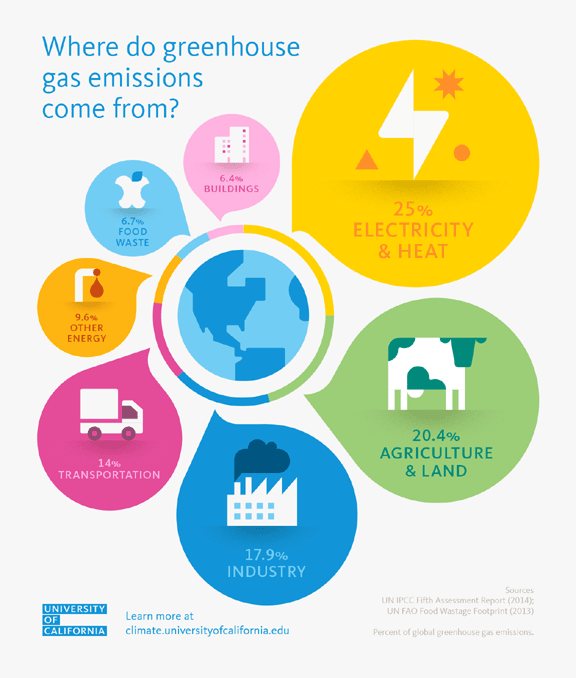
The ACT is on track to have 100 per cent of its electricity sourced from renewables by about 2020. This will make possible the targeted 40 per cent reduction in emissions (as they are accounted in the ACT). Carbon-free power supply gives us emission-free options for other sectors, notably transport – electric cars and buses, as well as light rail – and the use of electricity instead of gas for heating, cooking and in industry. This is critical because transport and natural gas use account for the lion’s share of Canberra’s direct emissions outside of electricity generation, at about 65 per cent and 20 per cent respectively.
The vision is clear: a transport system where public transport, as well as biking and walking, play a bigger role; where almost all cars, buses and trucks run on electricity or hydrogen; and where almost no gas is used. Quite aside from climate change, this means even cleaner air in Canberra and much less noise. The shift to higher-density living and the rapid progress with electric cars will help make it possible. Electric bicycles are already an alternative.
The first step is to stop investment that locks in carbon use into the future. We need electric cars and buses rather than petrol and diesel, and electric heating systems, not gas. Extra investment to improve energy efficiency in houses, apartments and public buildings is needed, too.
In all of this, the ACT government can and should lead by example. And climate policy must go hand-in-hand with social policy, ensuring that the shift to a truly clean city does not put some groups at a disadvantage. That means a keen eye on energy costs and the needs of commuters in the suburbs, and increased engagement by all of us during the transition.
Penny Sackett, an honorary professor at the ANU, is a former Australian chief scientist; Frank Jotzo is a professor at the ANU’s Crawford school of public policy; and Will Steffen, an emeritus professor at the ANU, is on the Climate Council of Australia. The authors are on the ACT Climate Change Council, an independent statutory body that advises the ACT government on emissions targets. This is the first of several articles exploring how Canberra can transition to carbon neutrality.
January 18, 2019
Posted by Christina Macpherson |
ACT, climate change - global warming |
Leave a comment
 Adani cleared of wrong doing by Federal Government over bores but Qld investigation continues, ABC News By Josh Robertson , 18 Jan 19, Adani remains under investigation by the Queensland Government for alleged illegal works on its Carmichael mine site, despite federal authorities ruling out any wrongdoing.
State officials have confirmed the ongoing probe into whether the company breached its environmental authority by sinking six dewatering bores last year.
The ABC revealed in September the department had launched an investigation into whether Adani sunk the groundwater bores in breach of its approval under the state Environmental Protection Act. …….
Queensland Greens senator Larissa Waters said she had reviewed documents relating to the Federal Environment Department’s inquiries and “unfortunately it seems that there wasn’t a thorough investigation”.
Ms Waters is a former lawyer at Queensland’s Environmental Defenders Office (EDO), which has provided the State Government evidence of the alleged breach, including drone footage of the bores.
State Government investigation still underway
A spokesman for the Queensland Department of Environment and Science (DES) said the Government was aware of the Commonwealth findings.
“DES is undertaking a more comprehensive investigation under separate state legislation, and has made several information requests to Adani, and has also carried out site inspections,” he said.
“If non-compliances are identified during the course of the investigation, DES can move to enforcement action.”
Adani still needs approval for its groundwater dependent ecosystem management plan to carry out mining operations.
Last month, the ABC revealed the Queensland Environment Department was examining evidenceincluding specifications of groundwater bores registered by Adani on a government website.
Queensland’s EDO and a university groundwater expert argued the bores construction, materials and depth are consistent with dewatering bore standards but incompatible with groundwater monitoring…….. https://www.abc.net.au/news/2019-01-17/adani-cleared-of-wrong-doing-by-federal-government-over-bores/10724086
January 18, 2019
Posted by Christina Macpherson |
climate change - global warming, Queensland |
Leave a comment