Australia silent, as New Zealand rules out using ‘Kyoto credits’ for Paris
New Zealand rules out using ‘Kyoto credits’ for Paris, Australia shtum, (shtum means silent, non-communicative), Brisbane Times ,By Peter Hannam, 11 December 2018 New Zealand’s Climate Change Minister James Shaw has ruled out his nation using carryover credits to count against its Paris climate target, saying such a move would make it challenging for the world to meet the important goal of reducing emissions.Australia silent
Mr Shaw made the comments to Australasian journalists in a conference call on Tuesday after meeting his Australian counterpart Melissa Price during the climate talks in Katowice, Poland.
As the Herald has reported, Ms Price and her environment department have refused to exclude use of any surplus credit generated during the soon-to-be concluded Kyoto Protocol against Australia’s Paris emissions pledges.
Federal Labor also said it won’t rule out the use of Kyoto credits until it has received advice………
Low ranking
Mr Shaw’s comments come as Australia was named 55th out of 60 nations on a Climate Change Performance Index compiled by Germanwatch, a non-government agency. Saudi Arabia and the US occupied the bottom rankings, while Sweden and Morocco topped the list.
Australia scored particularly poorly for its national climate policy and per capita greenhouse gas emissions – at more than 16 tonnes of CO2 a year – both ranked second-worst.
The Paris target – in which the Abbott government set at reducing 2005 levels of carbon pollution to 26 per cent by 2030 – was rated 12th among the 60 nations.
Bushfire threat to vital koala habitat
 Salamander Bay bushfire threatens homes, vital koala habitat in Port Stephens, ABC 11 Dec 18 An entire koala population in Port Stephens could be wiped out after a fire devastated their habitat near Port Stephens, an animal rescue group fears.
An estimated 16 hectares of the Mambo Wetlands, north of Newcastle, was scorched on Monday night, according to Port Stephens Koalas.
The reserve is about 40 per cent of the vital koala habitat.
The blaze broke out near the Salamander Bay shopping centre about 6:30pm and dozens of firefighters spent the night backburning to protect homes.
It burnt away more than 80 hectares of swampy scrub, which made access difficult for fire crews.
The fire flared up to a watch and act level at 3:00am, but weather conditions eased in the early hours and the blaze was brought under control.
Carers from the rescue group today surveyed the damage and fielded calls about stranded and injured wildlife.
Simone Aurino, senior carer at Port Stephens Koalas, said the reserve was one of the most important areas in the Tomaree Peninsula.
“It has a viable breeding population and its central to all the other habitats,” she said.
“It’s a really, really essential habitat.”
Ms Aurino said the blaze would lead to significant flow-on effects which may not be known for some time.
“It has the potential to wipe out the population in this area, it’s really quite devastating,” she said.
“The habitat’s been changed, so the animals are going to move…….https://www.abc.net.au/news/2018-12-11/bushfire-threatens-vital-koala-habitat-in-port-stephens/10605160
Australia’s Liberal Coalition govt cosying up to coal megaminer Adani
 Adani met with environment department 40 times in six months
Coalition ‘holding Adani’s hand’ through mine approvals, Greens senator says, Guardian, Lisa Cox and Ben Smee, Tue 11 Dec 2018
The environment minister, Melissa Price, and energy minister, Angus Taylor, met the company once each in Canberra. The meetings occurred between 7 May and 7 November this year and were tabled by the department in response to questions on notice from the Greens senator Larissa Waters.
Waters had asked at an estimates hearing in October if the department, minister or assistant minister had “met with Adani representatives or lobbyists in the past six months”.
She said on Tuesday the number of meetings suggested the department was “holding Adani’s hand through the approvals process”.
The number of meetings was evidence of the “cosy relationship” Adani had with the federal government, Waters said.
“The environment department is supposed to be a regulator and protector of our environment yet it’s holding Adani’s hand through the approvals process to get this mega coalmine off the ground.
“It shouldn’t be facilitating the development of a new dirty coalmine, it should be standing up for the best interests of our people and planet.”
The company announced late last month it would self-finance its controversial coalmine but it still requires approvals from state and federal governments for its groundwater-dependent ecosystem management plan and its management plan for the black-throated finch before significant work can start at the site.
The Queensland government is also under renewed pressure to rule out two potential subsidies to Adani.
The Mackay Conservation group released polling of marginal central Queensland electorates on Tuesday that showed 60% of people oppose any form of government subsidy. Only 22% supported subsidies, and 18% were unsure.
An Australia Institute report has found a potential royalties deferment deal would effectively be a low-interest loan to Adani, worth up to $385m.
The report also looked at $100m in road upgrades being considered by the Queensland government. It analysed approval plans for the Carmichael mine and found Adani’s vehicles “would be nearly all of the traffic on the road”.
Researcher Tom Swann, the author of the report, said: “The Queensland government has said repeatedly that it will not provide taxpayer funds to Adani, but Queenslanders are on the hook for hundreds of millions of dollars because of these deals.”
The state government’s public statements on Adani have been sceptical in recent weeks since the announcement it would self-fund a slimmed down version of Carmichael.
The premier, Annastacia Palaszczuk, said last month, “We will believe it when we see it”.
The royalties deal, which has not yet been signed, was premised as support for the “first mover” in a coal basin………. https://www.theguardian.com/environment/2018/dec/11/adani-met-with-environment-department-40-times-in-six-months
Australia’s ambassador for environment, Patrick Suckling ridiculed as he joins USA pro coal panel in Poland

A Trump administration presentation extolling the virtues of fossil fuels at the UN climate talks in Poland has been met with guffaws of laughter and chants of “Shame on you”.Monday’s protest came during a panel discussion by the official US delegation, which used its only public appearance to promote the “unapologetic utilisation” of coal, oil and gas. Although these industries are the main source of the carbon emissions that are causing global warming, the speakers boasted the US would expand production for the sake of global energy security and planned a new fleet of coal plants with technology it hoped to export to other countries.
The event featured prominent cheerleaders for fossil fuels and nuclear power, Continue reading
Australia quietly sabotages UN climate change message, in Poland
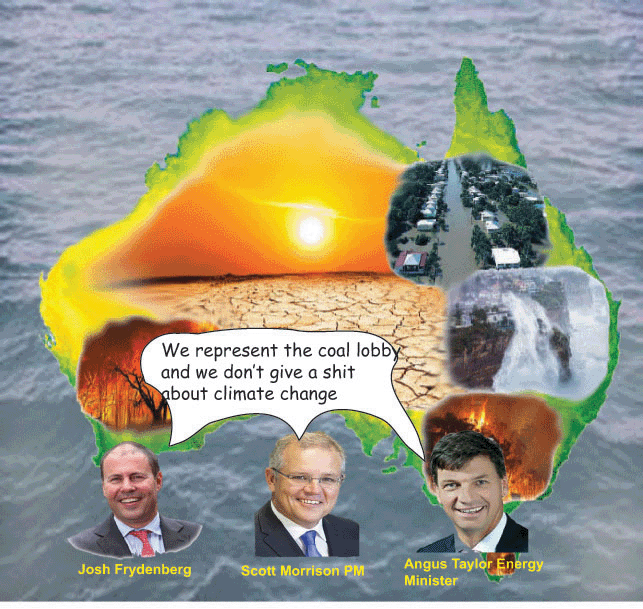 Australia’s silence during climate change debate shocks COP24 delegates, Guardian, Ben Doherty in Katowice, Poland@bendohertycorro, Mon 10 Dec 2018
Country accused of tacitly supporting oil allies’ rejection of the latest science As four of the world’s largest oil and gas producers blocked UN climate talks from “welcoming” a key scientific report on global warming, Australia’s silence during a key debate is being viewed as tacit support for the four oil allies: the US, Saudi Arabia, Russia and Kuwait.
The end of the first week of the UN climate talks – known as COP24 – in Katowice, Poland, has been mired by protracted debate over whether the conference should “welcome” or “note” a key report from the Intergovernmental Panel on Climate Change.
Negotiators spent two and a half hours trying to hammer out a compromise without success.
The apparently minor semantic debate has significant consequences, and the deadlock ensures the debate will spill into the second critical week of negotiations, with key government ministers set to arrive in Katowice.
Most of the world’s countries spoke out in fierce opposition to the oil allies’ position. The push to adopt the wording “welcome” was led by the Maldives, leader of the alliance of small island states, of which Australia’s Pacific island neighbours are members.
They were backed by a broad swathe of support, including from the EU, the bloc of 47 least developed countries, the Independent Association of Latin America and the Caribbean, African, American and European nations, and Pacific countries such as the Marshall Islands and Tuvalu.
Australia did not speak during the at-times heated debate, a silence noted by many countries on the floor of the conference, Dr Bill Hare, the managing director of Climate Analytics and a lead author on previous IPCC reports, told Guardian Australia.
“Australia’s silence in the face of this attack yesterday shocked many countries and is widely seen as de facto support for the US, Saudi Arabia, Russia and Kuwait’s refusal to welcome the IPCC report,” Hare said.
Richie Merzian, climate and energy program director at the Australia Institute, said widespread goodwill across the Katowice talks was being undermined by “a handful of countries” trying to disconnect the science and urgency from the implementation of the Paris agreement.
“It is disappointing but not surprising that Australia kept its head down during the debate … by remaining silent and not putting a position forward, Australia has tacitly supported the US, Russia and Saudi Arabia’s rejection of the latest science on climate change.”
Merzian said Australia’s regional neighbours, including New Zealand and Pacific islands, had voiced strong support for the IPCC’s report, which was a key outcome of the Paris agreement.
“A number of delegates privately shared their frustration that countries like Australia stood on the sidelines while Trump’s, Putin’s and King Salman’s representatives laid waste to the fundamental climate science.”
Hare said the interests of the fossil fuel industry were seeking to thwart the conference’s drive towards larger emissions cuts.
“The fossil fuel interest – coal, oil and gas – campaign against the IPCC 1.5 report and science continues to play out in the climate talks, but even those countries [opposing welcoming the report] are being hit by the impacts of only one degree of warming.
“The big challenge now is for the Polish presidency to set aside its obsession with coal, get out of the way and allow full acknowledgement of the IPCC 1.5C report, and its implications for increasing the ambition of all countries, in the conclusion of COP24 later this week.”
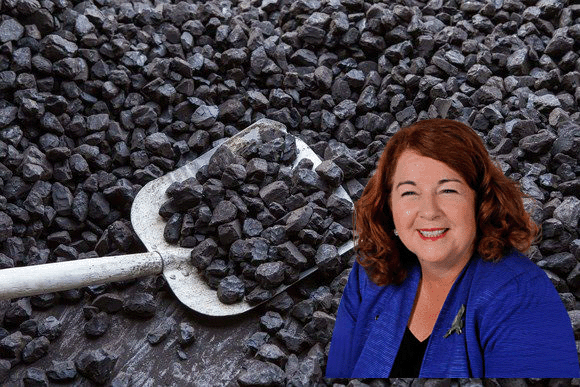 Australia’s environment minister, Melissa Price, arrived in Katowice on Sunday, with negotiations set to resume Monday morning……..
Australia’s emissions, seasonally adjusted, increased 1.3% over the past quarter. Excluding emissions from land use, land use change and forestry (for which the calculations are controversial), they are at a record high. https://www.theguardian.com/environment/2018/dec/10/australias-silence-during-climate-change-debate-shocks-cop24-delegate
Australia’s dirty tricks in Poland: getting away with no reduction in greenhouse emissions
|
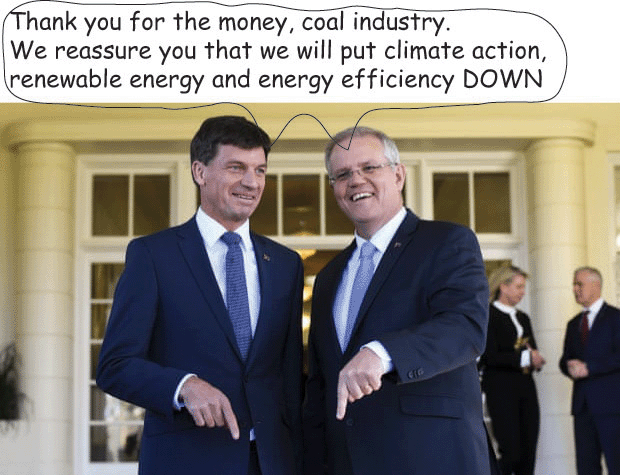
‘Fake action’: Australia’s secret path to hitting Paris climate goals, Brisbane Times, By Peter Hannam,– 10 December 2018 Australia could use a little-known loophole to help meet up to half its Paris climate commitments in a move that analysts warn could undermine the global accord. Neither Environment Minister Melissa Price nor Labor will rule out counting Australia’s expected credits from beating its 2020 goal under the soon-to-be-superseded Kyoto Protocol against its 2030 Paris pledge. The analysts say such a move by Australia would encourage other nations to follow suit. One ex-member of Australia’s negotiating team said the government had considered using the credits for some time even though it went against the spirit of the Paris accord signed in 2015. While not formally on the agenda at the current climate talks in Poland, the issue of Kyoto credits is expected to be discussed in coming days. Continue reading |
Health risks due to high salt content in water, in a drought town
|
Health expert warns residents are at risk from high sodium in water in drought-stricken NSW town of Walgett, ABC News, By Rachel Carbonell, National Regional Reporting Team, Jessie Davies and Danielle Bonica, 10 Dec 18, Walgett has always been a river town, perched near the junction of the Barwon and the Namoi rivers.But with the drought biting hard, the water from those rivers isn’t making it to this northern New South Wales town.
With nothing to pump from the local weir, Walgett is the latest town forced to go underground for water, a move that health experts say could have potentially serious health implications. Many locals are worried the emergency supply of bore water is damaging their health. Dharriwaa Elder, Thomas Morgan, said the water was no good for drinking. “Too much salt in it,” he said. “The kids, my grandkids, they’re starting to spit it out, they don’t like it.” Continue reading |
Climate change now brings bushfires to Australia’s Northern rainforests
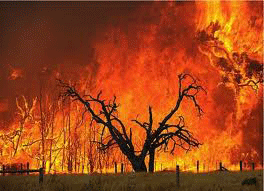 ‘Like opening a fan oven’: Australia’s rainforest threatened by bushfires, Guardian, Lisa Cox, 9 Dec 18 ‘Like opening a fan oven’: Australia’s rainforest threatened by bushfires, Guardian, Lisa Cox, 9 Dec 18Typically, rainforest should be able to self-protect during fire, with closed canopies that allow little sunlight to the forest floor and that keep the vegetation moist. But the cyclones have shredded the canopies, leaving an excess of fuel from debris on the ground, and a lack of rain meant the forest was dry. Since 22 November, more than 1m hectares has been burnt across Queensland, much of which lies in the tropics. Since the beginning of its bushfire season in August, more than 3.6m hectares have been destroyed. The most recent fires occurred on a magnitude never before seen in the state. Over a period of 12 days, the Queensland fire and emergency service said it had attended more than 1,200 fires, with help from crews from every state and territory in Australia. Andrew Piccone, a nature campaigner with the Australian Conservation Foundation, who did his studies in rainforest ecology, said that Australia would have to consider the future impact of warming conditions on a range of plant, animal and insect species in the wet tropics. “If catastrophic fire conditions are going to burn the rainforest in Queensland, what that means for the future of the wet tropics world heritage area could be quite concerning,” he said……… Philip Stewart, a fire ecologist with Queensland University’s school of earth and environmental sciences, agrees. He said governments and communities would need to become more proactive in fighting fires and that current processes were too reactive. “We do need to look at firefighting in a different light,” Stewart said. “We are a fire-prone country and more people are moving into fire-prone areas. We need to have an understanding of the danger of that and look at fighting fire with fire. He pointed to traditional burning used by Indigenous communities as a model, where prescribed burning occurs on a larger scale than hazard-reduction burns, which focus on reducing fuel in specific areas. Stewart said areas of rainforest impacted could take decades or even centuries to recover, adding that the next possible threat to those areas was mudslides as the wet season sets in. “High-intensity fire tends to create a layer within the soil that is hydrophobic and therefore water repellent causing mass soil erosion,” he said. “We are seeing this very phenomenon in the USA at Malibu where mass soil movement has taken place due to the heavy rains that followed the high-intensity and severe fires there.” https://www.theguardian.com/australia-news/2018/dec/09/australias-rainforest-under-threat-as-bushfires-rage-in-the-tropics |
|
Northern Territory – legal case over climate change
|
Key points:
Paul Vogel gave evidence this week in a landmark challenge brought against the EPA’s decision to not require an environmental impact assessment of a proposal to clear 20,000 hectares at the Maryfield cattle station south of Darwin. The case is considered to be the first in the Northern Territory to challenge the approval of land clearing on the basis of climate change impacts. Lawyers for the Environmental Defenders Office NT argued the authority was wrong in regarding itself unable to consider the impact of the clearing’s emissions because the Northern Territory had no climate policy and because the emissions would not have a nationally significant environmental impact. The Supreme Court heard that estimates of the likely emissions were not provided to EPA members in the briefing papers prepared for them, despite officers from the Department of Environment and Natural Resources calculating an estimate of 2.3 megatonnes or 18.5 per cent of the NT’s total annual emissions for 2015. Dr Vogel said while the EPA seeks to ensure that proponents keep emissions as low as possible, the impact of activities from individual projects on climate change is not measurable……….. Proposal raised ‘flashing red’ concerns: EPA member The Environmental Defenders Office (EDO) lawyers also argued the authority’s decision was invalid because the EPA had not followed its own meeting procedures nor voted on the final decision. Emails discussed in court between the EPA decision-makers, who mostly live outside the Territory, revealed concerns raised by a number of members. “For many projects with a much smaller area involved we have required extensive flora and fauna surveys.” Mr Wallis said the land-clearing proposal should be exposed to public scrutiny through an assessment process. Another EPA member suggested the authority clear the project for approval only on the basis that it ensure recommended conditions were met. Recommendations were made but some of the conditions were then rejected by the Pastoral Land Board, which ultimately approved the clearing. The matter will return to court later in December. https://www.abc.net.au/news/2018-12-08/nt-land-clearing-climate-change-legal-stoush-supreme-court/10590808 |
|

Students lead anti-Adani protests, vow to remove Liberal Party from power
Stop Adani protesters gather in cities, take aim at Scott Morrison’s activism comments, ABC News, 9 Dec 18 By Kevin Nguyen Student activists who felt the Prime Minister was condescending last week over climate issues have vowed to remove the Liberal Party from power — and keep it out — as long as it maintains its current policies.
Key points:
- A national survey showed a majority of respondents supported student protests on climate change
- Rallies took place in Sydney, Melbourne, Brisbane and Cairns
- Junior activists said the Prime Minister’s comments compelled them to march
Thousands of protesters gathered in capital cities on the east coast on Saturday in a coordinated march against Indian energy giant Adani’s Carmichael mine and rail project.
At the end of last month, Adani announced the scaled-back $2 billion controversial coal mine in the Galilee Basin would go ahead and would be 100 per cent self-financed, with work starting before Christmas.
While the attendees at the rally were diverse, it was school-aged students who were leading the crowds.
“It’s awful to see our leader feels like we shouldn’t have opinions and we shouldn’t care and they shouldn’t listen to us,” 14-year-old Jean Hinchliffe said in response to Mr Morrison’s calls last week for “less activism in schools”.
“It’s just atrocious. As students we are very informed and very educated and that’s why we’re taking action.
“We’re fighting for our own futures.”………
PM’s comments galvanised students
Like Jean, many young students who appeared at the rallies on Saturday were part of the thousands of Australian students who defied Scott Morrison’s call to stay in school.
While school-aged students will not be eligible to vote in next year’s federal and state elections, they are becoming the face of the Stop Adani and climate strike movements determined to make it a persistent election issue.
Daisy Jeffrey, 16, from Conservatorium High School in Sydney, said she was interested in a future in politics and Mr Morrison’s comments had galvanised her, and dozens of her peers, to take to the streets.
“It wasn’t disheartening, it made us more angry and more determined to go out on the streets,” Daisy said.
In addition to Sydney, rallies were held in Brisbane, Melbourne and Cairns.
n Melbourne, hundreds of people sat down in the middle of the busy Flinders Street intersection, blocking traffic in a bid to draw attention to their cause………https://www.abc.net.au/news/2018-12-08/adani-student-protesters-vow-to-keep-liberals-out-of-power/10597022
Students lead thousands in nationwide protests against Adani coal mine
SBS, 9 Dec 18 Thousands of people have marched through Australia’s capital cities in protest of Adani’s Queensland coal mine project. Thousands of people have protested Indian mining giant Adani’s plans to dig a new thermal coal mine in Queensland and have called on state and federal governments as well as the federal opposition to stop it going ahead.
Protesters marched the streets in Melbourne, Sydney, Brisbane and Cairns just a week after upwards of 15,000 school students demonstrated against government inaction on climate change.
It follows the announcement last month by Adani it would self-fund the controversial project after scaling back its size and scope.
The coal project is being downsized from a 60-million-tonnes a year, $16.5 billion mega-mine to a more manageable 10-to-15 million tonnes a year costing around $2 billion.
“No longer will we sit back and be lectured to by people who are outdated and out of touch,” Thomas Cullen told hundreds of protesters gathered in Brisbane on Saturday.
The 17-year-old was one of the thousands of students criticised by Prime Minister Scott Morrison for skipping school to stage national strikes calling for immediate action on climate change just over a week ago…….https://www.sbs.com.au/news/students-lead-thousands-in-nationwide-protests-against-adani-coal-mine
Cash-strapped UN climate fund needs Australia to continue contributing
Australia has been asked to reconsider its decision to withdraw support for a multi-billion-dollar Green Climate Fund, as finance has emerged as a key stumbling block to progress in talks in Poland on implementing the Paris Agreement. ... (subscribers only)
Bushfires near Kimba, proposed site for nuclear waste dump
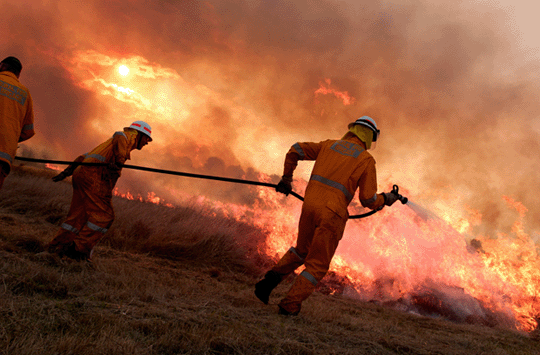
Adelaide weather: Another scorcher as KI bushfire continues to burn, Adelaide Now Gabe Polychronis, Mitch Mott, The Advertiser, December 7, 2018 A large bushfire continues to burn on Kangaroo Island, as the CFS bring in dozens of reinforcement firefighters and trucks ahead of expected wind charges later today.
No Australian policy on climate change as Melissa Price, Minister For Coal, heads off to U.N. climate talks
No climate consensus at ministers meeting https://au.news.yahoo.com/no-climate-consensus-ministers-meeting-033707782–spt.html, Angus Livingston, , Australian Associated Press, 7 December 2018
Australia’s state environment ministers are refusing to agree to a joint statement on climate change until the federal minister comes up with a plan to tackle it.
Melissa Price met with her state counterparts in Canberra on Friday and asked them to endorse a statement for her to take to a climate meeting in Katowice, Poland, on Saturday.
They refused because the government has no plan to tackle the problem.
“What I had suggested was that we had an agreed statement that we would all work together to determine an action plan with respect to climate, with respect to things that we can do individually and collectively,” Ms Price told reporters on Friday.
“Sadly that was not agreed. There was not an agreement on the words that I proposed, and no one proposed alternative words.”
The Labor governments of Queensland, Victoria, Western Australia, the Northern Territory and the ACT released a joint statement condemning the lack of action.
“The science is frightening, unequivocal and clear – we are running out of time,” the statement said.
“Yet the response of successive Liberal prime ministers has been one of delusion and deliberate inaction.
“It is unacceptable that any action on climate change has again been left off the agenda at today’s meeting.”
The states demanded a boost to Australia’s overall output of renewable energy, stronger energy efficiency targets, and action on emissions across all sectors.
“It is time for the federal government to stop ‘noting’ the science around the impacts of climate change, and actually step up and take action,” Queensland Environment Minister Leeanne Enoch said.
“It is unacceptable that there has been no progress on climate change by the federal government.”
Ms Enoch said she asked Ms Price to come back to the next meeting with an action plan of how to respond to the Intergovernmental Panel on Climate Change report’s findings about the dangers of 1.5 degree global warming.
“Unfortunately, the federal environment minister would not agree to undertake that important work,” she said.
1 This month
7 April – WEBINAR – Australia and the Doomsday Clock – Preventing nuclear war through NoFirstUse and other policies
Online | Tuesday April 7, 4:00-5:30pm, Australian Eastern Time / 8:00-9:30am Central Europe Time
– Access the registration link
15 April – Zoom –Nuclear Power is Not the Solution
Apr 15, 2026 01:00 AM in Canberra, Melbourne, Sydney

Join the International Physicians for the Prevention of Nuclear War (IPPNW) on Tuesday, April 14th for a timely webinar exploring the risks associated with nuclear power and challenging the myth that it offers a simple, safe, carbon-free solution to the climate crisis

21 April Webinar: No Nuclear Weapons in Australia
Start: 2026-04-21 18:00:00 UTC Canberra, Melbourne, Sydney (GMT+10:00)
End: 2026-04-21 19:30:00 UTC Canberra, Melbourne, Sydney (GMT+10:00)
Event Type: Virtual
A virtual link will be communicated before the event.
Host Contact Info: australia@icanw.org

of the week – Australians for War Powers Reform (AWPR)
To see nuclear-related stories in greater depth and intensity
 Antinuclear