The fightback against Adani and Aurizon steps up
Margaret Gleeson, December 6, 2018, Issue 1206, www.greenleft.org.au/content/fight-back-against-adani-and-aurizon-steps
“A reported 20,000 students, many of them with their parents and grandparents in tow, took to the streets with a powerful message to Adani and policymakers: ignore us at your peril.
This was followed by a sit-in at Parliament House in Canberra on December 5.
Another round of #StopAdani rallies has been called in Brisbane, Cairns, Melbourne and Sydney on December 8. …
Adani has jumped the gun and started work illegally. Its use of groundwater is also the subject of a federal investigation. …
“The Supreme Court must decide if Aurizon, an enormously powerful and well connected corporation, should have the power to deny a small community group the right to inform Australians how to help to prevent this climate crisis.
“Obviously the people who make up FLAC have a direct interest in the outcome, but should this corporation succeed in gagging free speech to this degree, we will all be the worse for it.
“Finally, Aurizon’s action is based on the assumption that if FLAC stops training concerned citizens on how to take non-violent, safe, direct action, people will stop taking action. Unfortunately what may well happen is that people continue to act to prevent a climate catastrophe, but do so without the training, discipline or principles of non-violence.” … ‘
ReadMuchMuchMore of Margaret Gleeson‘s comprehensive article at the #GreenLeft Source: www.greenleft.org.au/content/fight-back-against-adani-and-aurizon-steps
Queensland Supreme Court hearing Big Coal’s case aimed to shut down climate activism
 Big Coal And Friends On Track To Shut Down Your
  Climate Activism https://newmatilda.com/2018/12/04/big-coal-friends-track-shut-climate-activism/ By Julie Macken on December 4, 2018 A major case opening today in a Queensland court could have profound implications for climate activists around the country. Julie Macken explains.
The term, “climate crisis” is now the most commonly used descriptor when discussing global warming. Extreme weather events, firestorms, heat waves, flooding rain, loss of ice, snow and species are rightly seen within the frame of an emergent climate crisis. But if we are really witnessing a climate crisis – one with the potential to destroy our way of life and end our lives – how should we respond as a community?
This is a question being tested in Australia’s classrooms and Parliament right now and later today, in fact. The Queensland Supreme Court will be asked to decide whether, despite this crisis, it is reasonable for a large corporation to dictate how the community should be allowed to use social media to try and prevent this crisis.
The background to the case is this. Aurizon, the rail freight company formerly owned by the Government of Queensland, has been targeted by a number of individuals and communities because it plays a key role in the coal industry managing the 2,670 km Central Queensland coal network. It is also critical to Indian mining company Adani’s plans to ship coal from the proposed Carmichael mine to Abbott Point, as Adani plans to build a 200km line that will connect to Aurizon’s existing Goonyella and Newlands rail network.
Without Aurizon there is no Adani mine.
One of those groups protesting the proposed Adani mine, and Aurizon’s involvement in the expansion of the coal industry, is a small community group called FLAC – Front Line Action on Coal. Unlike the large environmental NGO’s, FLAC is still committed to supporting people who take direct action to prevent the expansion of the coal industry and they have had some serious successes of late.
So much so that Aurizon has taken the extraordinary action of getting interim orders against FLAC. Those orders include prohibiting FLAC from inciting anyone by Facebook, website, and Twitter to enter rail corridors across Aurizon’s network or interfering with any of the company’s coal trains.
On Tuesday the Supreme Court will be asked to make these interim orders permanent thus preventing FLAC from using social media to inform people and to be prohibited from going within 20 meters of the entire Queensland rail corridor. That’s a lot of rail corridor.
But there are concerns Aurizon will want more than just clear corridors. For many in the climate movement FLAC has become a touchstone as a moral force and an inclusive community that takes seriously the discipline and commitment to non-violent, safe, direct action. And this is what Aurizon is keen to shut down.
The company wants to prevent this small community group from encouraging, supporting or training anyone to take non-violent action to prevent this crisis. The less there are of these kinds of communities the better things are for large corporations like Aurizon.
These are extraordinary days climatically and politically. On Friday there was the sight of thousands of Australian school kids leaving their classrooms to demand governments – State and Federal – take the action necessary to secure their future. It was an action that happened with blessing of the Australian Senate.
Globally the divestment campaign has seen billions divested from companies involved in the fossil fuel business. While banks with a high exposure to fossil fuel companies have been forced to either rule out further investment or explain their plan to manage the escalating risk posed by stranded assets.
Then there’s the science. According to the most recent Intergovernmental Panel on Climate Change report the world is confronting the real risk of mass wildfires, food and water shortages, super storms and dying coral reefs by as soon as 2040. The last week alone in Australia has seen Sydney experience a one in 100-year rain event, while Queensland continued to burn.
These are extraordinary times and the science tells us they will get even more extreme as the global political leadership fails to materialise to prevent it. It is in this context that Aurizon’s request to the Supreme Court to gag FLAC must be viewed.
The Supreme Court must decide if Aurizon, an enormously powerful and well connected corporation, should have the power to deny a small community group the right to inform Australians how to help to prevent this climate crisis.
Obviously the people who make up FLAC have a direct interest in the outcome, but should this corporation succeed in gagging free speech to this degree, we will all be the worse for it.
Finally, Aurizon’s action is based on the assumption that if FLAC stops training concerned citizens on how to take non-violent, safe, direct action, people will stop taking action. Unfortunately what may well happen is that people continue to act to prevent a climate catastrophe, but do so without the training, discipline or principles of non-violence.
Labor backs Greens plan to block Coalition from underwriting coal power
Guardian, Katharine Murphy Political editor@murpharoo, Tue 4 Dec 2018
Crossbenchers are being asked to support a bill preventing the signing of contracts before the next election Labor and the Greens will attempt to prevent the Morrison government from underwriting new coal-fired power as the energy policy battle moves into its next phase.
Labor on Tuesday resolved to support a Greens bill stopping the commonwealth from providing financial assistance to coal-fired power plants, and there is an effort to secure the requisite parliamentary numbers for an upset as the Morrison government moves ahead with its controversial energy package. Negotiations are under way with crossbenchers in both chambers.
The government secured a rubber stamp from the Coalition party room on Tuesday for policy measures aimed to reduce power prices, including a contentious divestiture power, but Guardian Australia revealed on Monday night ministers had to rework the original proposal substantially to head off a backbench revolt…….
The energy minister, Angus Taylor, who has signalled coal will be in the mix, with a possible indemnity against the risk of a future carbon price, declined to answer questions from journalists on Tuesday about whether the government would enter binding contracts with proponents before the next election, which would be difficult to unwind if the Morrison government loses next year.
The Greens, with support from Labor, are attempting to head that sortie off at the pass with the new private members’ bill. Discussions with the crossbench are under way in both chambers – but it is unclear whether the foray will succeed.
Greens MP Adam Bandt, who could be a crucial vote for the government on the divestiture package because the party is not opposed to the idea, warned the Coalition not to “rely on support from the Greens on energy issues while … trying to sign contracts for new coal-fired power stations”. …….. https://www.theguardian.com/australia-news/2018/dec/04/labor-backs-greens-plan-to-block-coalition-from-underwriting-coal-power
Students left hanging during Canberra trip to confront Morrison on climate change
Guardian, 5 Dec 18, Group rallies outside Parliament House after being told they needed to have a prearranged meeting organised. High school students from across Australia calling for emergency action on climate change have travelled to Canberra to confront the prime minister after he criticised them for skipping school to stage national strikes.
Students from Scott Morrison’s southern Sydney electorate of Cook – as well as Townsville, Melbourne and Brisbane – arrived at Parliament House on Wednesday morning to meet with him.
Morrison said he would sit down with the school students……..
But one group of 11 students gathered out the back of Parliament House in the hope of speaking to Morrison had not yet had any luck.
Fourteen-year-old Tully Bowtell-Young travelled solo from Townsville for the chance to share her concerns with the prime minister – using her own pocket money to help cover costs.
“I think it’s worthwhile because nothing I have now is going to mean anything if I don’t have a future in this world,” she said.
The striking students want federal policymakers to stop the Adani coalmine and move Australia from fossil fuels to 100% renewable energy.
Total fire ban South Australia – a dangerous place to put a nuclear waste dump?

Total fire bans declared for most of South Australia, The Advertiser, December 1, 2018 Total fire bans have been issued for most of South Australia on the first day of summer.
The Country Fire Service’s state operation centre is ready to react to any large fires today as the mercury soars to 30C across the state before a possible storm late in the afternoon.
A severe fire danger rating has declared for the following regions:
West Coast, Eastern Eyre Peninsula, Lower Eyre Peninsula, Flinders, Mid North, Yorke Peninsula, Riverland, Murraylands, Upper South East, Lower South East and Mount Lofty Ranges
The official bushfire season has also begun today for Kangaroo Island and will run until April.
When total fire bans are declared, well prepared and actively defended houses can offer safety during a fire.
But the Country Fire Service warns that if residents do not have a bushfire survival plan, leaving early before a fire start is the safest option.
CFS State Duty Commander Nick Stanley told ABC radio certain activities that could cause a fire risk are banned during the fire danger season…..
Multiple bushfires on Yorke Peninsula South Australia
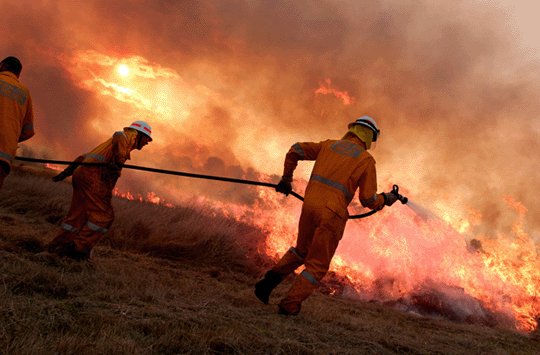 Bushfires in SA after lightning hits https://www.sbs.com.au/news/bushfires-in-sa-after-lightning-hits
A band of lightning moving across South Australia is believed to be the cause of multiple bushfires, in particular on the Yorke Peninsula at Minlaton. 2 Dec 18 Multiple fires are burning in South Australia and are believed to have been caused by a band of lightning moving across the state.
The most serious fire is on the Yorke Peninsula at Minlaton, the SA Country Fire Service said.
Just before 3pm, the CFS was telling nearby residents to “leave if the path is clear to a safer place” however the authority now says the rate of spread of the fire has halted.
However the CFS says it’s concerned that could change when the wind changes in a few hours.
“The CFS has concern that when the wind change arrives, there may be an increase in fire behaviour,” a warning message said.
“People east of the fire ground need to remain alert to this wind change and enact their Bushfire Survival Plan.”
There are smaller grass fires near Ettick in the Murraylands district, the Globe Derby Trotting track in the northern Adelaide metro area, Kangaroo Island, Hindmarsh Island, Kanmantoo, Barabba and Long Plains.
There is a total fire ban for most of the state.
Michael West shows the obstacles to Adani actually starting the Carmichael coal project
 Desperate Adani’s bid to kick-start Carmichael before election, Michael West, Dec 2, 2018 The press release does not say they are starting the mine. It says they are starting the mine imminently. They have been starting the Carmichael coal mine imminently for many years. We maintain the view that this mine will not proceed, but the Adani family does have a special new inducement to proceed, besides risk-free income routed to family-controlled entities in tax havens, and that inducement comes from India. Michael West reports.The bankers have long fled the scene, mine “approvals risk” remains, the thermal coal price has tanked, the Carmichael Coal project is more on the nose than ever as Queensland burns.
Yet, last Thursday, Adani chief executive Lucas Dow told the Bowen Basin Mining Club lunch in Mackay that Carmichael would proceed imminently. Adani would now finance the mine itself.
It remains the view of this observer that it won’t happen and that Lucas Dow is jawboning, trying to get something going before the Federal Election next year. There is some urgency to this – an urgency supported by other Galilee Basin coal players Gina Rinehart and Clive Palmer – because a Labor government is less likely to look favourably upon Adani’s aspirations to open up a new coal province.
Officially, Labor still supports the project proceeding, and some unions are in favour, but there is no hard-core coal lobby in the party, unlike in the Coalition Government, pushing it.
This is a project whose ambitions have fallen from $20 billion to $2 billion in project finance for its latest slimmed-down version.
These are the “nays”. The “yays” are few but one significant factor has swung in Adani Australia’s favour.
* The price of high-quality Newcastle coal has fallen to two-year lows at $US58/tonne.
* Adani has no rail access agreement with Aurizon to ship the coal to Abbot Point coal terminal.
* It does have a legitimate ILUA (Indigenous Land Use Agreement) but this has been challenged and may take months to resolve.
* There is no final approval of water rights and the heatwave and fires in Queensland have hardened local opposition to the plan.
* Adani Group in India has not come up with $2 billion yet.
* Sources say that EFIC (Export Finance & Insurance Corporation) has discarded the idea of financing or guaranteeing Adani’s loans.
* Aurizon withdrew its application to NAIF (Northern Australia Infrastructure Facility) earlier this year for finance to build a 388k rail line from the Galilee to the coast.
The Yays
As the project is “vertically integrated”, that is, the coal goes straight to feed the Adani Group’s plants in Indonesia, the price of coal is not absolutely critical to whether it proceeds.
Here is the catch. The poor people of Gujurat Province in India have bizarrely been put on the hook to subsidise coal projects in India for the next thirty years. Why this has happened, one can only guess, but the effect of the deal appears to be to guarantee coal supply to three Indian coal magnates via “cost-plus” arrangements.
This from the Press Trust of India, October 11:
The recommendations of a high-powered committee on stranded power projects set up by the Gujarat government can bring a combined relief of Rs 1.29 trillion for Tata, Adani and Essar’s power plants in the state over the next 30 years, according to a source.
If the recommendations are implemented, the consumers will have to face the brunt of high power tariffs………..
In light of the Indian subsidies, Gautam Adani can probably borrow the $2 billion in project finance. Bear in mind that, thanks to the way the port terminal, and perhaps the rail, corporate entities are structured, the Adani family takes little risk on those revenues. Shipping coal will deliver per-tonne income to Adani family companies.
If the Adani group itself finances the mine – as opposed to external banks – it will bear the mine risk. Gautam Adani is yet to publicly say the deal is financed.
Given the remaining “approvals risks” as detailed above, there are still plenty of obstacles for the project to overcome.https://www.michaelwest.com.au/desperate-adanis-bid-to-kick-start-carmichael-before-election/
Antarctica – the Thwaites glacier is losing ice

Portrait of a planet on the verge of climate catastrophe As the UN sits down for its annual climate conference this week, many experts believe we have passed the point of no return, Guardian, by Robin McKie, 2 Dec 18 “……. Antarctica
It is hard to get a grip of the sheerscale of the Thwaites glacier in west Antarctica. It’s more than 300 miles long and 200 wide – and more than a mile thick. It drains an area of ice that is larger than England and stealthily slides towards the sea by several metres every day. Only from satellite images have we understood the shape and power of this ice monster.
These now show the beast is waking up. Thwaites’s uptake of falling snow was once matched, fairly finely, by snow and ice being lost as icebergs. Now it has begun to flow faster, along with some of its neighbouring glaciers. More ice is being lost into the ocean than is being replaced, speeding up global sea-level rise.
The cause of the disruption at Thwaites is straightforward, researchers have discovered. Increasing amounts of warm ocean water coming from the north have been melting the floating parts of the glacier and this, in turn, is letting the inland glacier run more quickly into the sea. This much we know, but we have still to understand how this process is likely to accelerate. At present, Thwaites contributes around 4% of observed sea-level rise, but it is widely agreed that this could grow exponentially. Indeed, some glaciologists believe that a complete collapse of the Thwaites glacier over coming centuries is now inevitable – and that would raise global sea level by several metres, drowning coastal ecosystems around the world, damaging coastal investments and displacing millions of people………. https://www.theguardian.com/environment/2018/dec/02/world-verge-climate-catastophe
Climate change and the Great Barrier Reef
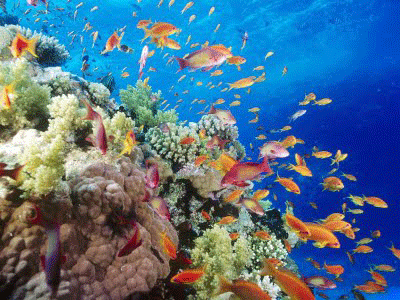 Portrait of a planet on the verge of climate catastrophe As the UN sits down for its annual climate conference this week, many experts believe we have passed the point of no return, Guardian, by Robin McKie, 2 Dec 18 “…………Great Barrier Reef Coral reefs cover a mere 0.1% of the world’s ocean floor but they support about 25% of all marine species. They also provide nature with some of its most beautiful vistas. For good measure, coral reefs protect shorelines from storms, support the livelihoods of 500 million people and help generate almost £25bn of income. Permitting their destruction would put the planet in trouble – which is precisely what humanity is doing.
Rising sea temperatures are already causing irreparable bleaching of reefs, while rising sea levels threaten to engulf reefs at a faster rate than they can grow upwards. Few scientists believe coral reefs – which are made of simple invertebrates related to sea anemones – can survive for more than a few decades.
Yet those who have sounded clear warnings about our reefs have received little reward. Professor Terry Hughes, a coral expert at James Cook University in Queensland, Australia, recently studied the impact of El Niño warmings in 2016 and 2017 on Australia’s Great Barrier Reef, the world’s largest coral reef and its largest living entity – and wept when he saw the damage.
“The 2016 event killed 30% of corals, the one a year later killed another 20%. Very close to half the corals have died in the past three years,” he said recently.
For his pains, Hughes has faced demands from tourist firms for his funding to be halted because he was ruining their business. “The Australian government is still promoting new developments of coal mines and fracking for gas,” Hughes said, after being named joint recipient of the John Maddox prize, given to those who champion science in the face of hostility and legal threats. “If we want to save the Great Barrier Reef, these outdated ambitions need to be abandoned. Yet Australia’s greenhouse gas emissions are rising, not falling. It’s a national disgrace.”
This grim picture is summed up by the ethnographer Irus Braverman in her book Coral Whisperers: “The Barrier Reef has changed for ever. The largest living structure in the world has become the largest dying structure in the world.” https://www.theguardian.com/environment/2018/dec/02/world-verge-climate-catastophe
Australia’s climate action schoolkids – more intelligent, better informed, than Australia’s government
“I think what’s striking in Matt Canavan’s comments is how demeaning he is about young people and what they actually know, and how he underestimates their understanding,”
“I heard students today at the rally talking about the IPCC report, talking about the 700 odd days until emissions can peak before we exceed 1.5 degrees.
“These are kids that actually understand the science in a way that I think most of parliamentarians don’t.”
Organiser Deanna Athanosos, who is in year 10, said Mr Morrison’s rhetoric towards the strike made her laugh.
“If you were doing your job properly, we wouldn’t be here,” she said.
Students strike for climate change protests, defying calls to stay in school ABC News Thousands of Australian students have defied calls by the Prime Minister to stay in school and instead marched on the nation’s capital cities, and some regional centres, demanding an end to political inertia on climate change.
Key points:
- Students called for politicians to act on climate change warnings
- Thousands of young people were inspired by 15-year-old Swedish pupil Greta Thunberg’s protest in Stockholm
- Resources Minister Matt Canavan criticised demonstrators for missing out on school
Protests were held in Melbourne, Sydney, Brisbane, Perth, Coffs Harbour, Bendigo and other cities, as students banded together to pressure the Morrison Government in the lead-up to a federal election.
“The politicians aren’t listening to us when we try to ask nicely for what we want and for what we need,” said Castlemaine student Harriet O’Shea Carre.
“So now we have to go to extreme lengths and miss out on school.”
It follows similar protests in Canberra and Hobart earlier this week, which have spurred on the junior activists……. Continue reading
Australia’s Resources Minister Matt Canavan scorns children who protest for climate action
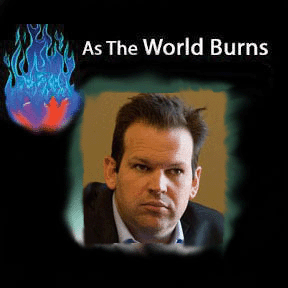 A Deadshit Senator Says Students Striking Today Are Headed For The Dole Queue ,Pedestrian,
 Matt Canavan, the federal minister for resources, has a considered take on today’s student protests against climate change that currently remain on-going across major Australian cities. Unsurprisingly, it’s a piss-awful one.
Canavan, a Liberal senator representing Queensland which is currently being belted by catastrophic and unprecedented bushfires, took to 2GB earlier this morning to make his thoughts on the Strike 4 Climate Action protests, in which thousands upon thousands of school children are literally screaming at politicians like Matt Canavan, abundantly clear.
Chiefly, the big dumbass reckons that students who attend today’s protests are only going to learn one thing: How to join a dole queue………The Minister for Resources then followed that up by suggesting activism solves nothing and instead the students should be in school learning how to build mines and drill for gas which, again in his words, “is one of the most remarkable science exploits in the world.” Incredibly wild that he quite literally used the word “exploits” there……..https://www.pedestrian.tv/news/matt-canavan-looks-like-someone-rigged-a-blobfish-to-a-car-battery/
Western Australia set for a scorching summer

Perth cruises through dry, ‘benign’ November as BOM flags glimpse of hot summer to come, ABC  News, By Irena Ceranic 30 Nov 18 As Queensland sweltered through heatwave conditions which fuelled catastrophic bushfires, and torrential rain flooded New South Wales, Perth cruised through a mild November, recording its driest in 61 years and coolest in a decade.
Key points:
- Perth’s spring rainfall totalled 78.4mm, compared to the average of 148.9mm
- The average temperature in Perth in November was a cooler-than-usual 25.3C
- The temperature in the city on Monday is forecast to soar to 36C
There were only two wet days in the month and between them, they delivered just 3.2 millimetres of rain to the Perth metro gauge — far less than the 23.2mm average — making it the driest November since 1957.
Bureau of Meteorology (BOM) spokesman Neil Bennett said the days were also cooler than usual, with an average of 25.3 degrees Celsius………
Get set for a summer scorcher
Perth had an unusually cool summer in 2017-18 and did not record a single day over 38C. But above-average temperatures are expected over much of WA this time around, according to the outlook for December to February from BOM.
“We don’t have a strong signal one way or the other for the rainfall, so that sort of suggests that we’re likely to see average rainfall for the next three months,” said Mr Bennett.
“Temperature-wise though, it does look as if the odds are favouring warmer-than-average temperatures.”
Perth will get a glimpse of what is to come on Monday, when the temperature is forecast to soar to 36C. https://www.abc.net.au/news/2018-11-30/perths-cool-benign-november-the-driest-in-more-than-six-decades/10571178
Schoolkids say -Climate change is the biggest threat to our futures, not striking from school
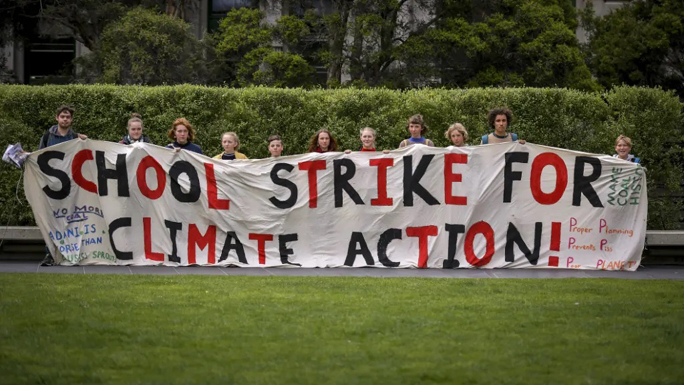
Climate change is the biggest threat to our futures, not striking from school https://www.theguardian.com/commentisfree/2018/nov/29/climate-change-is-the-biggest-threat-to-our-futures-not-striking-from-school Milou Albrecht, Harriet O’Shea Carre and Jean Hinchcliffe, 29 Nov 2018
We are walking out for a day to send the Australian government a message: you can no longer pretend we are not here. his month, hundreds of children are going on strike from school to demand urgent action on climate change. From rural Victoria to Townsville, we are walking out of school for a day or more to tell our politicians to listen to us and protect our futures.
We are Milou, Jean and Harriet and we are 14 years old.
Two of us – Milou and Harriet – live in rural Victoria. Throughout our lives, we’ve witnessed the impacts that drought, bushfires and extreme weather have on a community. We have been forced to evacuate when a bushfire came through our town. It was scary. But it is something that will happen more and more as climate change gets worse.
We feel frustrated and let down when we think about the climate crisis and our future. There is so much our politicians could be doing that they aren’t. It seems they are in denial. Our government is supposed to protect us, not destroy our chances of a safe future. Continue reading
With bushfires and floods, Australia now ranks in the top 10 world’s natural disaster counntries
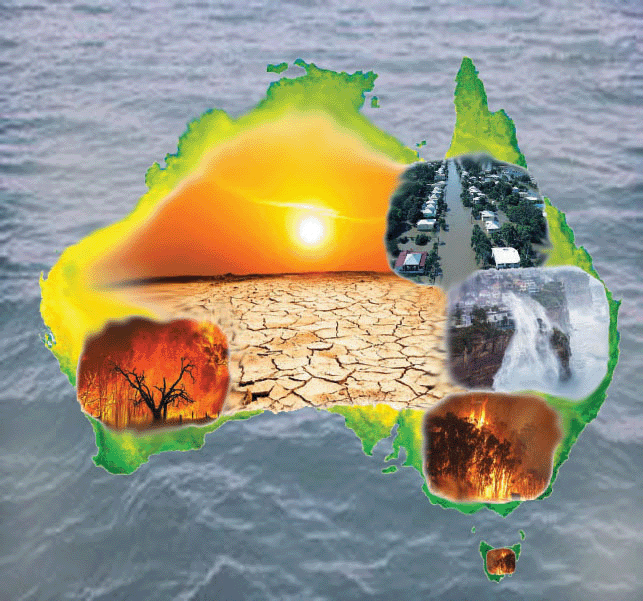 Chart of the day: Bushfires, cyclones and floods put Australia in the world’s natural disaster top 10 https://www.abc.net.au/news/2018-11-30/natural-disaster-economic-impact-chart/10499688 By business reporter Stephen Letts The annual cycle of summer bushfires, cyclones and floods, all too evident this week, has pushed Australia into the global top 10 for economic damage caused by natural disasters.
The 2018 International Federation Red Cross and Red Crescent Societies’ World Disasters Reportfound Australia’s damage bill over the past decade came in at $37 billion (or $US27 billion).
That ranks us 10th in terms of the cost of natural disasters, but still a fair way behind the big three disaster zones: the US, China and Japan which together account for about two-thirds of the total financial cost the IFRC added up between 2008 and 2017.
Our Asia-Pacific region seems to be the most disaster-prone on the planet, being bit by around 40 per cent of the 335 disasters recorded worldwide in 2017 and suffered almost 60 per cent of disaster-related deaths.
The report notes that in a changing climate, small-scale weather disasters are becoming more frequent and more intense, and in many cases “exceed the coping capacities of households and of authorities”.
The IFRC’s definition of natural disasters includes storms, floods, earthquakes, volcanic activity and droughts, but not epidemics.
Research on Australia’s climate history
RETHINKING AUSTRALIA’S CLIMATE HISTORY https://www.adelaide.edu.au/news/news103762.html, 27 November 2018
Researchers at the University of Adelaide have found evidence of climate change that coincided with the first wave of European settlement of Australia, which effectively delivered a double-punch of drying and land clearance to the country.
The research, published in Quaternary Science Reviews, suggests that eastern Australia, including Melbourne, Sydney and Brisbane, was much drier after 1890 than the Little Ice Age period that preceded it. Continue reading
1 This month
7 April – WEBINAR – Australia and the Doomsday Clock – Preventing nuclear war through NoFirstUse and other policies
Online | Tuesday April 7, 4:00-5:30pm, Australian Eastern Time / 8:00-9:30am Central Europe Time
– Access the registration link
15 April – Zoom –Nuclear Power is Not the Solution
Apr 15, 2026 01:00 AM in Canberra, Melbourne, Sydney

Join the International Physicians for the Prevention of Nuclear War (IPPNW) on Tuesday, April 14th for a timely webinar exploring the risks associated with nuclear power and challenging the myth that it offers a simple, safe, carbon-free solution to the climate crisis

21 April Webinar: No Nuclear Weapons in Australia
Start: 2026-04-21 18:00:00 UTC Canberra, Melbourne, Sydney (GMT+10:00)
End: 2026-04-21 19:30:00 UTC Canberra, Melbourne, Sydney (GMT+10:00)
Event Type: Virtual
A virtual link will be communicated before the event.
Host Contact Info: australia@icanw.org

of the week – Australians for War Powers Reform (AWPR)
To see nuclear-related stories in greater depth and intensity
 Antinuclear