Major Korean banks rule out any lending for Adani’s Queensland mega-mine,
 Korean banks tell traditional owners they won’t back
  Adani’s Queensland mega-mine, ABC by Josh Robertson 5 Nov 18 Major Korean lenders have ruled out any role in funding Adani’s contentious Australian coal project, just months after the miner was reportedly in talks to win backing from lenders in Seoul.
Key points:
- Adani is trying to get funding for a its proposed Queensland coal project
- Traditional owners opposed to the mine will lobby Korean lenders to not back the project
- Three major Korean lenders have written to the group saying they won’t help fund it
Traditional owners fighting the mine have secured pledges from a trio of lenders including the Export-Import Bank of Korea, a critical conduit for Korean lenders, which said it believed there was no longer any interest in the mega-mine.
Anti-Adani representatives of the Wangan and Jagalingou (W&J) traditional owners will today fly to Korea to continue lobbying lenders, including Mirae Asset Daewoo, which refinanced Adani’s Queensland coal port in July……..
The W&J Adani opponents said they would seek meetings and hold “media events” at the offices of other institutions including Mirae Asset Daewoo, Korea’s National Pension Service and NH-Amundi.
A similar lobbying roadshow by W&J representatives in the US and Europe in 2015 saw major lenders, including Britain’s largest investment bank Standard Chartered, back away from Adani.
The ABC understands financial industry sources recently confirmed with Australia’s big four banks that none would have a role in the Carmichael project.
A media report in September suggested Adani was seeking to partly fund the Carmichael project by selling a stake in its Abbot Point coal port to Korean interests.
The Queensland government has said Adani must reach “financial close” before it will permanently wipe out native title claims to the mine site to hand over tenure to the miner.
But it has also asked Adani to put up security for a royalties deal that would allow the miner to defer hundreds of millions of dollars of state payments — which Adani is yet to sign after 18 months.
Traditional owners have made formal complaint to UN
The W&J mine opponents are battling to retain their native title rights and have formally complained to the United Nations.
“Whoever assists Adani financially at this crucial time will become complicit in a grave breach of our rights, and the destruction of our lands and waters and sacred places,” W&J elder Adrian Burragubba said.
“They are also exposing themselves to financial risk because success in our Federal Court appeal due next year would deliver great uncertainty to investors.”
Another W&J anti-Adani representative travelling to Korea, Murrawah Johnson, said 33 major institutions had now ruled out funding Adani.
“The interest in Adani from Korean banks or potential equity financiers needs to be made clear after reports that Adani has held talks with Korean finance companies,” she said.
“We are seeking to close the door on this financing avenue.”
An Adani spokeswoman said the company had been “working with the traditional owners of the Carmichael project area, the Wangan and Jagalingou, Juru, Birriah and Jangga, since 2010”.
“Indigenous Land Use Agreements are in place with all four claim groups and are registered by the National Native Title Tribunal,” the spokesperson said. https://www.abc.net.au/news/2018-11-05/korean-banks-rule-out-backing-adani-mine/10463838
The world does not need Australia’s ‘toxic’ coal -Christiana Figueres
 Former UN climate chief says world doesn’t need Australia’s ‘toxic’ coal, Canberra Times, By Nicole Hasham, 3 November 2018 Former United Nations climate chief Christiana Figueres has repudiated Australian mining giant BHP for its refusal to stop mining coal, suggesting the decision is uneconomic and poor nations do not need the “toxic” and “expensive” fossil fuel.BHP chief executive Andrew Mackenzie said this week the company is “not going to move away from coal mining”.
His position comes despite a warning last month by the Intergovernmental Panel on Climate Change that coal must be virtually phased out by 2050 if the world is to keep global warming below the 1.5 degree threshold, beyond which the effects of climate change would be catastrophic and, in many cases, irreversible. …….
Ms Figueres, the former executive secretary of the United Nations Framework Convention on Climate Change, said poorer nations did not need Australia’s coal.
“Developing nations will unlock the solutions to poverty with renewable energy. Not with toxic, expensive coal,” she said.
Solar and wind power were already cheaper than fossil fuels in many markets and “renewable energy will out-compete fossil fuels everywhere by 2020”, she said, adding that investors were “withdrawing from coal on all fronts”.
The World Bank, among other financiers, has largely ruled out funding new coal plants. It says coal contributes to poverty through air pollution, which causes illness, and climate change, to which the poor are particularly vulnerable.
Ms Figueres, who led the Paris climate talks in 2015, said as well as the health impacts, global warming was hurting the environment and “contributing to the die-off of the beloved Great Barrier Reef”………
Veteran physicist and climate scientist Bill Hare, founder of international think tank Climate Analytics, said renewable hydrogen could replace coal in steel production.
Such use of hydrogen is at the experimental stage, however, the capture and storage of carbon is also unproven at large scale.
“By backing coal only weeks after the world scientific community has spoken on the urgent need to phase this out, [BHP] is turning its back on the future,” Dr Hare said, adding that claims coal was needed to overcome poverty was “a denial of science”.
Meantime, the ACT is nearing its goal of sourcing all electricity from renewable sources by 2020. The Crookwell 2 wind farm, near Goulburn, has begun feeding electricity into the grid and is expected to produce enough electricity to power about 42,000 Canberra homes.
Federal Energy Minister Angus Taylor, who has campaigned against wind farms, did not attend a launch event on Saturday despite the project being located in his electorate. A spokesman said Mr Taylor had a “prior engagement”.
ACT Climate Change Minister Shane Rattenbury said the wind farm was “a key milestone as we progress towards our ambitious clean-energy future” and would provide significant flow-on benefits to the region. https://www.canberratimes.com.au/politics/federal/former-un-climate-chief-says-world-doesn-t-need-australia-s-toxic-coal-20181103-p50dt5.html
Australian Conservation Foundation encourages all voters to recognise the coming CLIMATE ELECTION
 Sector Action Needed For the ‘Climate Election’ https://probonoaustralia.com.au/news/2018/10/sector-action-needed-
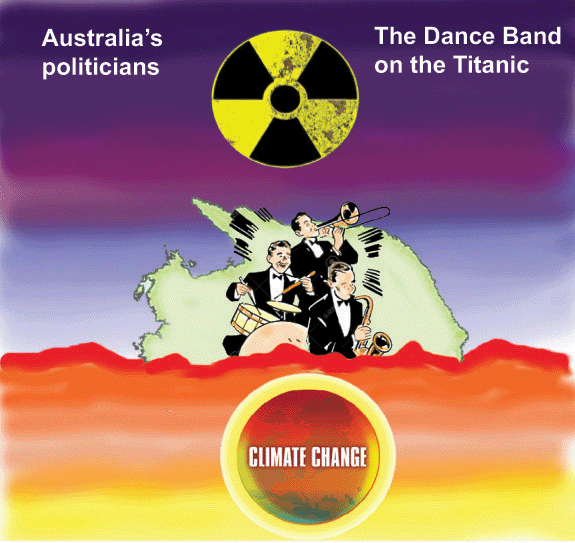 climate-election/ The environmental sector needs to step up efforts to ensure serious action on climate change is part of all political parties’ federal election platform, a sector leader says. Wednesday, 31st October 2018 Maggie Coggan, Journalist Kelly O’Shanassy, Australian Conservation Foundation (ACF) CEO, spoke to Pro Bono News following an address to the National Press Club on Tuesday, where she expressed her concern over the impact of climate change, and the inaction of politicians.O’Shanassy said the ACF, along with other environmental organisations, were tired of the climate dysfunction coming out of Canberra, and titled the upcoming election the “climate election”.
“For decades ACF has knocked on the doors of Parliament House with climate policy solutions, supported by community and business, only to see them vanish into thin air because of weak political leadership,” O’Shanassy said on Tuesday.
“We are tired of government after government at the national level, failing Australians on climate change, and so, we decided to do something about it.”
O’Shanassy said the lack of action from politicians on climate change, combined with an increased awareness from the public on the damage it had already done, meant it was the perfect time to focus attention and energy on the issue.
She encouraged environmental groups involved in the election to start conversations with voters about climate change, and the solutions that were out there that politicians were yet to take action on.“We would encourage everyone in the environment sector to make climate a focus, to be part of our million conversations, to talk about climate damage that is here now, but also the solutions that are here now,” she said.
“This upcoming election matters, and people can create a safer future through their vote.”
She said polling data showed about 70 to 80 per cent of the Australian community did want government action on climate change, and so it was important for the sector to harness those views in order to push change.
Severe fire danger as heat hits New South Wales East coast
 NSW east coast now in ‘severe’ fire danger as mercury soars SMH , 2 Nov 18 Drier than expected conditions have put Sydney and much of the NSW east coast in severe fire danger, as the city experiences a “low intensity heatwave” on Friday afternoon.
A large mass of hot air moving across the state is driving temperatures up towards 40 degrees in some parts, fanned by strong winds above 30km/h.
At the peak, the mercury had hit 38.9 degrees at Sydney Airport, 37.6 degrees in Camden, 37.1 degrees at Observatory Hill and 38.8 degrees at Horsley Park. Statewide, White Cliffs in the far west, notched 43.3 degrees……..
Fires burn near Canberra and Newcastle
Firefighters were already battling an out-of-control blaze south-west of Canberra on Thursday night and continue to fight it today. The fire is burning erratically at Pierces Creek, about 8km from the nearest suburb……..
Exceptionally warm Australia was “exceptionally warm” last month, with mean temperatures 1.83 degrees above the 1961-90 average, making it the fourth warmest October on record, the bureau said.
While Sydney’s October rainfall was twice the average at 167.6 millimetres, evaporation rates were almost as high at 160.6 millimetres meaning the rainfall deficient barely budged.
Elsewhere, the big dry has expanded beyond NSW and Queensland, with Tasmania recording its third-driest October on record as rainfall dived 60 per cent below average for the month.
Victoria was also dry, continuing its run this year of below-average monthly rainfall totals with less than half the usual October rain. By mean temperatures, it was also that state’s fifth warmest October on record. https://www.smh.com.au/environment/weather/nsw-east-coast-now-in-severe-fire-danger-as-mercury-soars-20181102-p50dn1.html?promote_channel=edmail&mbnr=MTM2NDAwMjM&eid=email:nnn-13omn655-
New member of Parliament, Kerryn Phelps, will push for strong role for Climate Change Authority
First thing’: Phelps set sights on reviving fortunes of climate body, Brisbane  Times, By Peter Hannam, 27 October 2018 Kerryn Phelps, the likely new member for Wentworth, will push for the revival of the near-defunct Climate Change Authority as part of her efforts to advance action on global warming at a federal level.
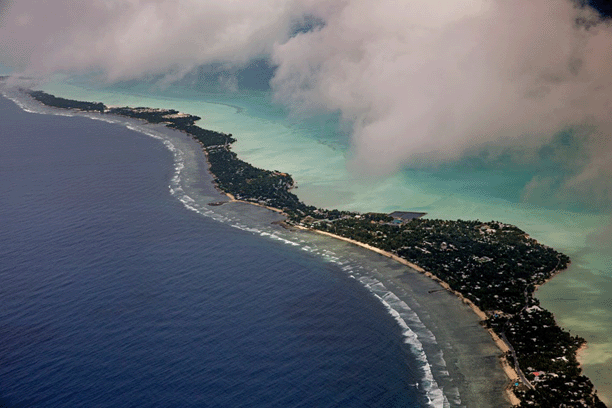
Dr Phelps, who appears to hold an unassailable lead of 1783 votes for the seat vacated by former prime minister Malcolm Turnbull, said her determination to emphasise cutting carbon emissions and advancing renewable energy was reinforced by a meeting in Sydney on Saturday with ex-Kiribati president Anote Tong.
Dr Phelps said that while Mr Tong’s island nation faced immediate threats from rising sea-levels, the former leader stressed that “sooner or later everyone will be on the frontline” from threats wrought by a warming world.
The independent candidate said it was clear from this month’s byelection that climate change – and the lack of federal policies – was among the highest concerns for Wentworth voters.
If she takes her seat in Parliament as expected next month, Dr Phelps said an early target will be to restore the Climate Change Authority.
It’s the first thing that we could actually do – to reinstate the funding and the scientific credibility of the Climate Change Authority,” Dr Phelps told Fairfax Media. “It’s very important that we do have an independent authority looking at the evidence and providing advice to governments.”……
Many Pacific islands are low-lying or have populations clustered to coasts that facing inundation from rising sea levels. Salt water intrusion into groundwater and exposure to more powerful cyclones are other risks.
Earlier this month, environment minister Melissa Price was accused of disrespecting the Pacific leader by telling him during a chance meeting in a Canberra restaurant that the region was “always” seeking cash and she had her chequebook ready. Ms Price denied she made such comments but she did ring later to say she wished no offence……. https://www.brisbanetimes.com.au/environment/climate-change/first-thing-phelps-set-sights-on-reviving-fortunes-of-climate-body-20181027-p50cd3.html
Climate change policy – the wrecking ball that destroys Australia’s prime ministers
What has been clear is that the task is hugely difficult for reasons Kevin Rudd recently underlined.
One is the daunting task of convincing a current generation to make sacrifices for a future one.
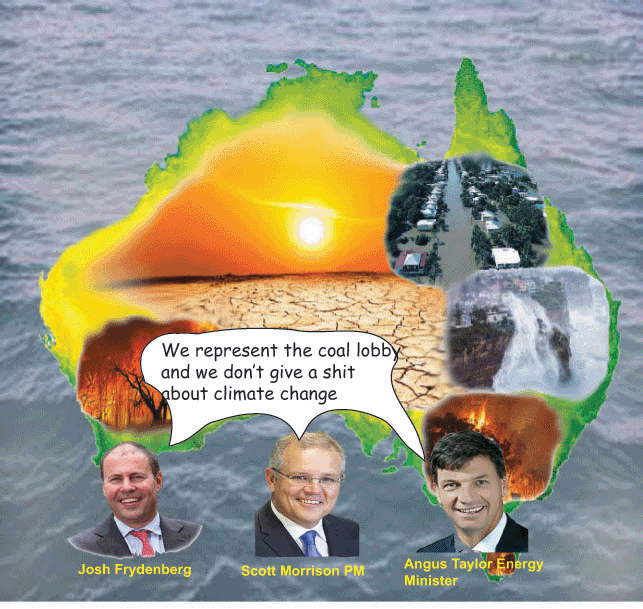
Australian politics an unwieldy wrecking ball claiming PM’s careers, IT HAS already destroyed four Aussie prime ministers, and now the very same wrecking ball is about to smash Scott Morrison as well. News.com.au 29 Oct 18 Malcolm Farr@farrm51
IT’S the uncontrollable wrecking ball of Australian politics which so far has smashed the careers of four prime ministers.
And now it could be swinging Scott Morrison’s way, just as it had towards Kevin Rudd and Julia Gillard from Labor, and his Liberal colleagues Tony Abbott and Malcolm Turnbull.
This demolition beast is climate change policy and the inability of politicians to present coherent schemes of their own or to resist misrepresenting those of rivals.
To dodge the ball of policy destruction Prime Minister Morrison is attempting to please everyone.
He wants a system which will lower emissions, encourage coal-fired power stations, force private power companies to divest assets, promote new generating technologies, and cut household electricity bills.
It’s a political strategy more than a global warming response, constructed to appease the array of cemented positions on energy policy within the Liberal Party rather than the wishes of consumers, including business.
It has a touch of former prime minister Tony Abbott’s unsuccessful Direct Action scheme and a taste of former prime minister Malcolm Turnbull’s National Energy Guarantee. Continue reading
As Antarctica thaws, China, Russia and others move in

|
China and Russia are eyeing up Antarctica — and experts say Australia should be more concerned, ABC, 28 Oct 18 By Holly Robertson Australia is spending $2 billion on a new Antarctic icebreaker — the biggest single investment in the history of our Antarctic program.
Key points:
The state of the art RSV Nuyina — which was floated last month — will primarily support Australia’s scientific research team in Antarctica, but it also has another purpose: shoring up our territorial claim to 42 per cent of the icy continent, where countries including China and Russia have been ramping up their presence…….. What is Australia’s role in Antarctica? The Australian Antarctic Territory covers a whopping 5.9 million square kilometres, making it nearly 80 per cent of the size of Australia and the largest Antarctic claim of any country, according to the Australian Antarctic Division. Australia has three year-round research stations on Antarctica, as well as one on Macquarie Island, and conducts dozens of scientific research programs. But in recent years Antarctic experts have been critical of the Australian Government’s commitment to our efforts on the icy continent, both in terms of funding and attention. “Australia’s standing in Antarctic affairs is eroding because of historical underinvestment at a time when new players are emerging in Antarctica,” expert Tony Press warned in a 2014 Government-commissioned report.
Who are the new players and what are they doing there? Six other countries lay claim to parts of Antarctica — Argentina, Australia, Chile, France, New Zealand, Norway, and the United Kingdom — while many more also have research stations there and take part in joint scientific projects. In the past decade, China and Russia in particular have both ramped up their presence in Antarctica. China in particular has become a “leading polar player” in just 10 years and now spends more in Antarctica than any other country, according to a report by Anne Marie Brady, an expert on China and the Antarctic at the University of Canterbury in New Zealand………. there remains a divide between the countries that want to keep it pristine, such as Australia and New Zealand, and the ones that hope to eventually exploit its potential, like China and Russia, as global resources decline and a ban on mining comes up for renegotiation in 2048. But even more crucial, according to Dr Brady, is that Antarctica has emerged as a site of global strategic importance……… What does this mean for Antarctica’s future — and ours? The Antarctic Treaty of 1959 does not necessarily guarantee Australia’s claim to territory on the icy continent, as many people seem to think. In fact, La Trobe University’s Daniel Bray says that the treaty “essentially set aside all claims to Antarctica in order to create a legal [framework] to manage human activity on the continent”.
|
|
Australia losing all credibility with Pacific neighbours, as Morrison pulls out of global climate fund
 Poor nations castigate Australia for abandoning global climate fund, Canberra Times, By Nicole Hasham, 24 October 2018 Developing nations say a Morrison government snub of the world’s biggest climate change fund hampers efforts to cut global carbon pollution and erodes Australia’s international reputation…… Poor nations castigate Australia for abandoning global climate fund, Canberra Times, By Nicole Hasham, 24 October 2018 Developing nations say a Morrison government snub of the world’s biggest climate change fund hampers efforts to cut global carbon pollution and erodes Australia’s international reputation……
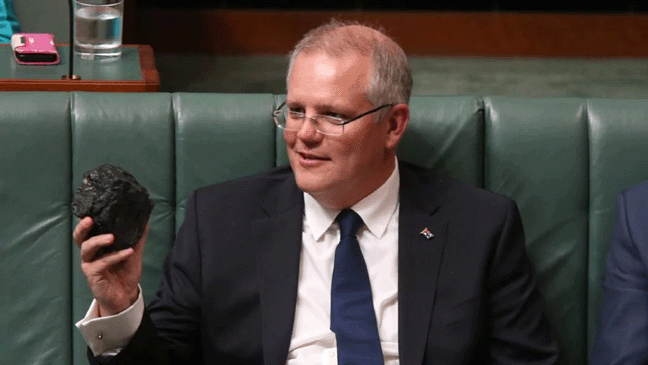
Prime Minister Scott Morrison announced Australia will cease payments to the United Nations-backed Green Climate Fund, a mechanism under the Paris treaty to help poor nations cut emissions and respond to extreme weather and rising seas. Australia’s high per-capita emissions and coal dependence mean it was expected to be a generous benefactor. However, One Nation leader Pauline Hanson has pressured the government to abandon the fund and it is unpopular with conservative Coalition MPs, including Tony Abbott. Australia contributed $200 million in the first funding round and took a leadership role in 2016 when it co-chaired the fund. But in a radio interview last month Mr Morrison, when asked if Australia would be bound to its climate targets under the Paris agreement, said: “No, we won’t … nor are we bound to go and tip money into that big climate fund. We’re not going to do that either. I’m not going to spend money on global climate conferences and all that nonsense.” Fund board member Tosi Mpanu-Mpanu, of the Democratic Republic of Congo, said Australia’s stance was “beyond frustrating”, particularly in the wake of the Intergovernmental Panel on Climate Change report that this month warned of devastating planetary damage without radical action. “This backtracking from [the] previous commitment by Australia is disappointing,” he told Fairfax Media. “Australia is the world’s biggest coal exporter … it has a major responsibility to provide financial support for developing countries to adapt to and mitigate climate change.” Mr Mpanu-Mpanu suggested abandoning the fund was in contravention of the Paris accord and said commitments by developing nations to lower emissions under the treaty relied on financial support from nations such as Australia. Parties to the Paris deal will meet in Poland in December to finalise the rules of the treaty and “this decision by Australia will cast a shadow on the process of reaching an agreement”, he said……. The condemnation from the developing world further cements Australia’s position as a global outlier on climate action after the government indicated it would not ramp up emissions reduction efforts under the Paris treaty and rejected the IPCC’s call for a coal phase-out by 2050. Developed countries originally pledged $US10 billion to the fund but it was left short after US President Donald Trump withheld $US2 billion of the $US3 billion his nation promised…… https://www.canberratimes.com.au/politics/federal/poor-nations-castigate-australia-for-abandoning-global-climate-fund-20181023-p50beh.html |
|
Liberal moderates to demand $1 billion for climate change fund
Liberal moderates concerned at the Coalition’s lack of climate change policy are set to demand Scott Morrison revitalise the ailing direct action policy with a $1 billion injection into the Emissions Reduction Fund.
Warning that the climate change lesson from Saturday’s Wentworth …. (subscribers only) https://www.afr.com/news/liberal-moderates-to-demand-1-billion-for-climate-change-fund-20181021-h16xaq
Climate change now firing up raging fight in Australia’s Morrison govt, after Wentworth byelection fiasco

Wentworth byelection backlash reignites tensions inside the Morrison government over climate policy, Canberra Times, By David Crowe & David Wroe, 21 October 2018 A ferocious voter backlash has inflamed the Morrison government’s internal row on climate change as Liberal MPs call for stronger policies to assure voters that Australia can meet the Paris agreement to cut carbon emissions.
The government is reeling from a savage swing in the Wentworth byelection, sparking renewed argument over decisions including a sudden shift in foreign policy on Israel, and deepening fears of a wipeout at the federal election due by May.
As Parliament resumes on Monday, the Liberal Party was on track to lose Wentworth to independent candidate Kerryn Phelps, with an update on Sunday night giving her almost 51 per cent of the vote.
Dr Phelps had a lead of 1626 votes in the update posted by the Australian Electoral Commission at 6.45pm on Sunday. Even the best postal vote scenario for the Liberal Party over coming days would still see the independent win Wentworth.
The result represents an extraordinary 18 per cent swing against the federal government, one of the biggest in Australian history, but the Australian Electoral Commission is yet to count thousands of postal votes that could favour Liberal candidate Dave Sharma.
Government ministers and backbenchers told Fairfax Media they believed one lesson from the Wentworth result was to develop a stronger message on cutting emissions in order to win back voters concerned about climate change.
“I think we will, by the time of the next election, have to have a more credible answer on how we meet our targets,” one minister said.
“I don’t think it’s viable to remain silent on this between now and the next election.”
Liberal MP Trent Zimmerman said the Liberal Party’s own research showed climate change and the removal of Malcolm Turnbull as prime minister were the two biggest concerns for Wentworth voters……
The government believes the latest advice from the Energy Security Board is that generation from wind and solar will grow by 256 per cent over the next three years. ……..
Treasurer Josh Frydenberg brushed aside suggestions the Morrison government needed to overhaul its  climate policies, saying they were “settled” and were enough to “meet and beat” Australia emissions reduction pledges.
“It’s clearly an important issue for the people of Wentworth, but our policies have been settled for some time,” he told the Sky News.
An exit poll of 985 Wentworth voters commissioned by the left-leaning Australia Institute on Saturday found that climate action and replacing coal with renewable energy was the top issue that decided how they voted.
Among people who had abandoned the Liberal Party since the last election in 2016, the top reason why was the toppling of Mr Turnbull at 40 percent of voters, but climate change came second at 31 percent. https://www.canberratimes.com.au/politics/federal/wentworth-byelection-backlash-reignites-tensions-inside-the-morrison-government-over-climate-policy-20181021-p50b2d.html
Australian govt abandons promotion for dubious climate group
Fairfax Media has learned the government has scrapped the $10 million reef communication campaign outlined in this year’s federal budget.
The campaign would have sought to give the public hope that the reef can be saved and outlined action being taken to protect it, after devastating back-to-back coral bleaching events brought on by climate change.
The government had been skittish about the spending measure, as reported last month when it emerged the Department of the Environment and Energy instructed officials to avoid revealing its true price tag.
In response to questions from Fairfax Media, the department confirmed the campaign “is not going ahead”. ……..
A major report by the Intergovernmental Panel on Climate Change this month warned that an average global temperature rise of 1.5 degrees would substantially and irrevocably damage the world’s coral reefs, and a 2 degree rise would virtually destroy them. The world is currently on track for a global temperature rise of 3 to 4 degrees by 2100.
The Great Barrier Reef Foundation is supported by corporations including those from the polluting fossil fuel industry. It does not lobby for emissions reduction, despite recognising that climate change is the biggest threat facing the reef…….https://www.canberratimes.com.au/politics/federal/government-ditches-10m-promotion-blitz-amid-great-barrier-reef-furore-20181020-p50av5.html
Wentworth election – a preview of climate change issue for Australia’s coming federal election
|
Wentworth becomes test bed for how federal election will treat climate change, Coalition of green groups has been working hard to ensure voters realise they have a chance to give Liberals a wake-up call, Guardian, Anne Davies@annefdavies19 Oct 2018
|
|
Kiribati’s Anote Tong, (slighted by Minister Melissa Price says Australia must act on climate change
Liberal Party moderates blame climate policy for Wentworth by-election debacle
Moderates blame climate policy for Wentworth by-election debacle THE AUSTRALIAN 21 Oct 18 GREG BROWN, Moderate Liberal MPs have urged Scott Morrison to take action on climate change and embrace the “broad church” of its voters after the mammoth swing in the Wentworth by-election.Trent Zimmerman, Jason Falinski and Tim Wilson — who represent blue-ribbon electorates that are affluent and socially progressive — say the government needs to do more to show it is serious about combating climate change and working to meet the Paris targets.
Climate change denial – this forms the Morrison government’s biggest economic problem?
The Morrison government’s biggest economic problem? Climate change denial, The Conversation, Emeritus Professor of Politics, La Trobe University, October 19, 2018 “…………. the heart of the problem, which is the inability of the Coalition to face the reality of climate change and its stubborn determination to live in a parallel universe of business as usual. It is climate change denial that is preventing the government from developing a coherent economic narrative. …..
As an identity issue, it is largely impervious to evidence, as we saw in government ministers’ hasty dismissal of the recent Intergovernmental Panel on Climate Change report – before they had even read it, one suspects. Identity issues are also resistant to the normal processes of bargaining and compromise with which many political conflicts are resolved. The National Energy Guarantee was the last of the government’s energy policies to founder on the suspicion that a market mechanism might damage coal. Chief Scientist Alan Finkel’s Clean Energy Target met the same fate.
To state the obvious, the stubborn commitment to coal is pulling the government’s economic policy towards the sort of state socialism it is supposed to abhor. No wonder it is having difficulty developing a coherent economic narrative.
because climate policy has become an identity issue for some members of the Coalition, and they fight on it tooth and nail, is has been removed from the normal processes of policy formation.
1 This month



Help Aunty Sue Protect Her Land and Sacred Sites From Destructive Rocket Testing.
.

Australians deserve the truth
about
AUKUS – https://aukuspublicinquiry.com/

PETITION – To: Prime Minister Anthony Albanese and the Australian Labor Government

of the week – Australians for War Powers Reform (AWPR)
To see nuclear-related stories in greater depth and intensity

