Adani coal mine project headed to be a big issue at next Federal election?
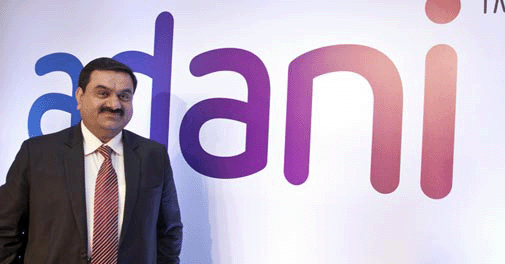 The future of the Adani mine, Overwhelming public opposition to the Adani coalmine in northern Queensland tipped the scales in state election campaigning. But now that’s over, what influence does it have at a federal level and on the mine’s future? The Saturday Paper, By Alex McKinnon. 2 Dec 17,
“……Palaszczuk’s explanation for abandoning her long-time support of the loan was to avoid a potential conflict of interest, arising from her partner’s work on Adani’s Northern Australia Infrastructure Facility (NAIF) loan application as a consultant for PwC. But state treasurer Curtis Pitt admitted during the campaign that the real reason for Palaszczuk’s about-face was the overwhelming public opposition to taxpayers’ money being used to fund a private mine.
Queensland’s Labor government supports the Adani mine going ahead, to provide jobs in struggling regional areas. But GetUp! environmental justice co-director and Stop Adani campaigner Sam Regester points to the huge swings to the Greens in a swath of inner-Brisbane electorates as proof Labor recognised anti-Adani sentiment was hurting them enough to force a response. Counting still under way in Maiwar could lead to the Greens winning their first seat at a general election, and candidate Amy MacMahon came close to knocking over Labor deputy premier Jackie Trad in South Brisbane.
ON THE ISSUE OF THE NAIF LOAN, AT LEAST, PUBLIC OPINION IS EMPHATIC ENOUGH TO PRESSURE PALASZCZUK INTO KEEPING HER WORD.
“The Greens’ strong position on Adani was directly responsible for their strong showing in the inner city,” Regester says. “Labor tried to have it both ways for three years, and they offset some of the damage by deciding to veto the NAIF loan, but voters rewarded the party that had a consistent stance.”
Given Labor will most likely form a majority government, that balancing act appears to have worked for now. What comes next – for the mine, those opposing it, and the government that could make or break it – is less clear. As counting continues and the Palaszczuk government prepares to go back to work with whatever parliament the voters have given it, anti-Adani campaigners are planning their next moves.
The Stop Adani Alliance, the umbrella organisation of environmentalists, climate scientists, traditional owners and civil society groups that formed to campaign against the mine in March, largely regards the election result as a win. Nicholls’ Liberal National Party, which has backed the mine to the hilt, remains in opposition. One Nation’s promised windfall of seats failed to materialise………
Palaszczuk’s Labor government will likely hold 47 or 48 seats in Queensland’s 93-member, single-house parliament. Once it nominates a speaker, the government will have the barest of majorities, provided every Labor MP stays in line. Given the record of Palaszczuk’s previous government, which lost Pyne and former Cook MP Billy Gordon to the crossbench, that may be too much to hope for. If Labor is forced to negotiate with the KAP’s three parliamentarians, One Nation’s Stephen Andrew, or Noosa independent Sandy Bolton, it may find the competing interests over the Adani mine can’t be finessed away.
On the issue of the NAIF loan, at least, public opinion is emphatic enough to pressure Palaszczuk into keeping her word. ReachTel polling conducted for the Stop Adani Alliance during the campaign found 70 per cent of Queenslanders oppose directing public funding towards the Carmichael project, with voters across political lines expressing strong support for the government using its veto power.
Queenslanders are more evenly split on the larger question of the mine itself, but losing the NAIF loan will compound Adani’s difficulties in securing the $3.3 billion it needs to fund the first stage of the project, and could sink the mine altogether. While Adani has made noises about seeking financing from Chinese banks, such a move would likely require construction materials and infrastructure contracts to be sourced from Chinese firms, further souring the project in the public eye and undermining the argument that the mine will bring local jobs.
So much attention has been devoted to Palaszczuk’s manoeuvring, it’s easy to forget how much of Adani’s ultimate fate lies in Canberra. The federal opposition leader, Bill Shorten, stayed far away from Queensland during the campaign, not least to avoid awkward questions about where he stands. Shorten tied himself in knots trying to articulate his various positions on the mine earlier this year, sometimes changing his mind mid-sentence……..
With the state election over, Shorten and federal Labor no longer have the luxury of dithering. Regester says the anti-Adani movement’s top post-election priority, “besides ensuring the veto goes through” and “working to ensure Adani can’t secure funding from anywhere else”, will be recentring the campaign on the national stage.
“Unless a major party moves on Adani, we’ll be making it an issue at the next federal election,” Regester says, highlighting “marginal seats in Sydney, Melbourne and Brisbane” where support for Adani could prove costly. Labor’s Terri Butler and the Liberals’ Trevor Evans will be looking nervously at the huge upswing in the Greens’ vote across territory their inner-Brisbane seats cover, while the Stop Adani movement’s large Melbourne presence could see the thumping Greens victory in the Victorian Northcote byelection repeated in Batman, Wills, Higgins and Melbourne Ports…….. https://www.thesaturdaypaper.com.au/news/politics/2017/12/02/the-future-the-adani-mine/15121332005585
Immense glacier in Antarctica is melting – NOW!
“The majority of the heat that has gone into the global climate system has gone into the ocean, about 90 percent over the last few decades of measurements,” he said. “The hypothesis is ocean temperatures around Antarctica will keep warming and drive the melting of the glaciers. If the glaciers flow faster, sea levels will rise, and that has profound implications for global civilisation.”……..“Climate change is a reality. There’s the whole debate around how we deal with it, and the work we do in Antarctica is influencing our ability to look forward and genuinely understand how much things are going to change,” Australian Antarctic Division director, Dr Nick Gales told HuffPost Australia from Hobart, the base of operations for the AAD.
“It is alarming. There is huge change going on there.
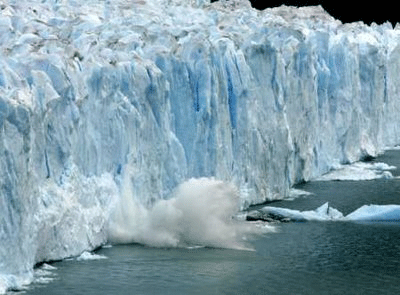
UNFROZEN IN TIME, Huffington Post, Video and Pictures: Tom Compagnoni | Words: Josh Butler, 1 December 17 There’s a glacier in Antarctica so immense that, if it melted, would raise sea levels globally by 3.5 metres.
It’s melting. Right now.
“The facts around climate change are undeniable. It’s happening,” Australian glaciologist Ben Galton-Fenzi told The Huffington Post Australia. “The research we do now isn’t about trying to convince ourselves it’s real, because it’s irrefutable. What we’re trying to do is understand what the response time of the system is going to be into the future, so we can adapt to it.”
The Totten glacier is the biggest in east Antarctica. The glacier itself is around 120 kilometres long, 30 kilometres wide and drains some 538,000 square kilometres of the continent. That’s an area bigger than California. The ice is kilometres thick, but it’s melting at 70 metres a year in some spots. A study released in December reported warmer water was melting the Totten ice from below. Continue reading
Banks warned of ‘regulatory action’ as climate change bites global economy
Australian Prudential Regulation Authority says it is quizzing companies about their actions to assess climate risks, Guardian, Michael Slezak, 1 Dec 17, Australia’s financial regulator has stepped-up its warning to banks, lenders and insurers, saying climate change is already impacting the global economy, and flagged the possibility of “regulatory action”.
Geoff Summerhayes from the Australian Prudential Regulation Authority (Apra) revealed it had begun quizzing companies about their actions to assess climate risks, noting it would be demanding more in the future.
Apra also revealed it has established an internal working group to assess the financial risk from climate change and was coordinating an interagency initiative with the corporate watchdog Asic, the Reserve Bank of Australia (RBA) and federal Treasury to examine what risks climate change was posing to Australia’s economy…….https://www.theguardian.com/australia-news/2017/nov/29/banks-warned-of-regulatory-action-as-climate-change-bites-global-economy
Chinese Government denies receiving application to fund Adani’s Carmichael coal mine
 Adani: Chinese Government denies receiving application to fund Carmichael mine, ABC News, 30 Nov 17, By Stephen Long, As Adani angles for Chinese money for its giant coal mine in North Queensland, China’s Australian embassy has made clear that any backing from Chinese state enterprises would need central government approval.
Senior embassy officials have also told opponents of the mining venture that no applications for funding have been made, despite Adani insiders claiming recently that finance from China had been secured.
Over the past month, businessman and environmentalist Geoff Cousins and prominent investment banker Mark Burrows, AO, have held talks with Chinese embassy officials in Canberra to lobby against Adani’s Australian project, amid reports Adani was close to finalising a deal for Chinese backing.
“Myself and Mark Burrows went to see senior officials from the Chinese embassy; we explained that China might think that Australians supported the Adani mine and we gave them a lot of evidence that that was not the case,” Mr Cousins told the ABC.
“The Chinese embassy was very forthright in saying that investment from a Chinese corporation would require the approval of the central government and that also no such proposal had been put.”……….
Chinese funding for the project is becoming more critical as prospects for a subsidised loan of up to $1 billion from the Northern Australia Infrastructure Facility for the mine railway fade.
The Labor Party, which looks likely to form a government in Queensland, has pledged to effectively veto the loan.
Pauline Hanson’s One Nation Party, which has secured at least one seat in the state parliament, is also opposed to the loan.
Banks across the globe have refused to fund the Carmichael coal mine because of doubts about its financial viability and its potential to worsen global warming. http://www.abc.net.au/news/2017-11-30/adani-china-government-would-have-to-sign-off-on-loans-for-mine/9209188
Adani coal mine ‘fundamentally not in Australia’s interests’ – could be a financial disaster
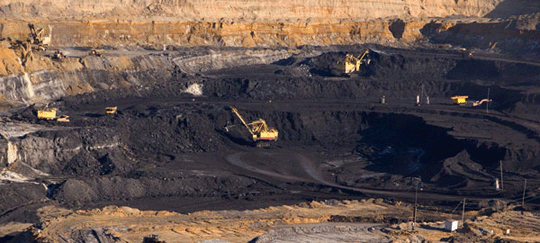 The ‘Kodak moment’ for coal, and why the Adani mine could be a financial disaster, ABC Radio, The World Today By Stephen Long 27 Nov 17, The woman who led the world to a global climate change agreement has a message for Australia: “You really do have to see that we are at the Kodak moment for coal.”
Christiana Figueres, until last year the executive director of the United Nations Framework Convention on Climate Change, doesn’t mean happy snaps for the family album.
Rather, the decimation of the once dominant photographic company Kodak by digital change — in the same way that coal-fired power is being eclipsed by renewable energy.
She hopes to see coal, like those sentimental moments in time captured in photographs, confined to history — with the world remembering the contribution the fossil fuel has made to human development, while recognising the need to retire it as a fuel source because of its contribution to global warming.
And, she says, it’s happening.
“We just had 25 countries come together [at the latest international climate change talks] in Bonn to say that they are moving out of coal in the short term.
“That does not include Australia or India or China, but you can begin to see the trend.
“India is headed for peaking its coal consumption by the year 2027.”
Adani ‘fundamentally not in Australia’s interests’
Which makes arguments that India needs the coal from Adani’s planned mega-mine in North Queensland — and the Federal Government’s determination to see the mine ahead — baffling to Ms Figueres.
The Government’s Northern Australia Infrastructure Facility, or NAIF, is considering Adani’s request for a subsidised loan of up to $1 billion to help it build a railway to connect the Carmichael mine in outback Queensland to the Abbot Point Coal Mine near Mackay, which Adani also owns.
By law, the NAIF is not permitted to make loans for projects that would damage Australia’s international reputation……..
this issue of the Carmichael coal mine which, if it goes ahead, would frankly blow completely out of the water any emissions reductions that Australia has committed to.
“Admittedly, those emissions from that coal will not be on Australian territory but they will affect the atmosphere and directly affect the livelihoods and the survival of Pacific islands around Australia.”…….
Various parties are considering court action against the NAIF should it grant the loan to Adani, including NGOs and commercial parties in other coal-mining regions……..
Lest climate change not be a concern, Ms Figueres has a warning to those considering investing in Adani’s Carmichael project that appeals to self-interest — she says it could be a financial disaster.
“I put it to you: do we not have here a financial house of cards?” she said.
Her assessment is based on various considerations.
These include the huge debts Adani’s Australian operations are carrying; the financial plight of Adani’s giant power plant at Mundra, which is meant to take much of the coal, but is on Adani’s own admission financially unviable — losing money and barely covering interest payments on its debt.
Adani Group is trying to flog the power plant to the Gujarat state government for just 1 rupee (about 2 Australian cents) with no guarantees that the Government would use coal from the Queensland mine if it were to take over the ailing plant.
Then there is the possibility that the giant mine, with a license to extract 60 million tonnes of coal a year, would become a stranded asset as the world introduces tougher measures to limit climate change…….http://www.abc.net.au/news/2017-11-27/the-kodak-moment-for-coal,-and-why-adani-could-be-a-disaster/9197134
Queensland election result – an ill omen for the Adani coal megamine project
I suspect that the Adani project is already a stranded asset, and definitely not worthy of either Australian taxpayer support or Chinese investment.
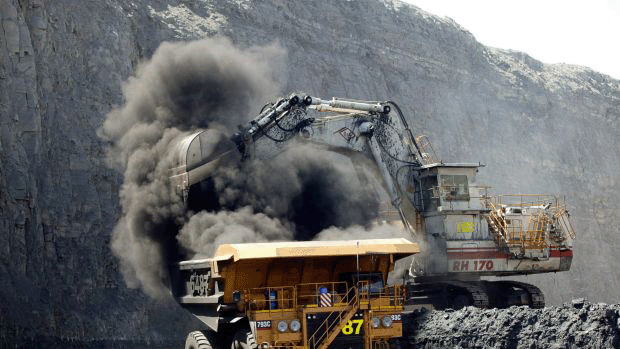 The Queensland election outcome is a death knell for Adani’s coal mine https://theconversation.com/the-queensland-election-outcome-is-a-death-knell-for-adanis-coal-mine-88148 The coal mine proposed for Queensland’s Galilee Basin by Indian mining giant Adani has been a moveable feast, with many stories about its scale, purpose, financing, job prospects, and commerciality. The prospect of a return of the Palaszczuk government in Queensland is effectively the death knell for the project.
Centre for Policy Development urges companies to tell shareholders of climate change risks
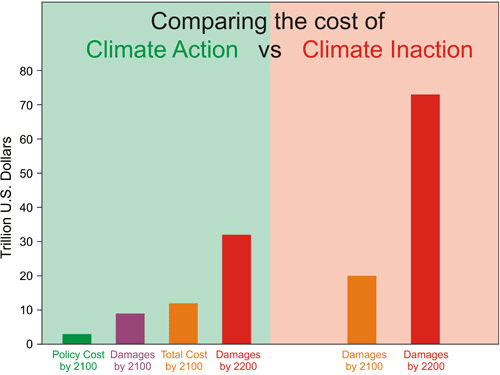 Australian shareholders should be told of climate risk to profits, says thinktank
Centre for Policy Development urges companies to adopt standardised analysis of climate’s impact on business, Guardian, Gareth Hutchens, 29 Nov 17, Australian companies need to start developing sophisticated scenario-based analyses of climate risks, and incorporating them into their business outlooks so shareholders know how climate change will affect profitability, a thinktank has said.
However, the Centre for Policy Development (CPD) said companies needed to do so in a standardised way, so investors and regulators were able to easily understand economy-wide risks to whole industries.
The progressive thinktank urged Australia’s biggest businesses to use the Paris climate agreement as the centrepiece for their scenario planning, saying it provided a credible, long-term anchor for policies that limit global warming to well below 2C.
The groups has released a discussion paper, called “Climate horizons: next steps for scenario analysis in Australia”, explaining the best way to do so.
Australia’s financial regulator warned in February that climate change posed a material risk to the entire financial system and urged companies to start adapting. Geoff Summerhayes, from the Australian Prudential Regulation Authority (Apra), told the Insurance Council of Australia’s annual forum in Sydney in February that Apra wanted companies to start incorporating “scenario-based analysis” of climate risks into their business outlooks.
He said Apra intended to start running stress tests of the financial system to see if it would survive various climate shocks, and all Apra-regulated entities would need to adapt to the coming regulatory changes. “I think the days of viewing climate change within a purely ethical, environmental or long-term frame have passed,” Summerhayes said.
The CPD’s new discussion paper suggested how Australian businesses could be consistent with the country’s international climate commitments under the Paris agreement and with the leading international framework for robust climate disclosures, the Financial Stability Board’s taskforce on climate-related financial disclosures (TCFD).
It said businesses ought to try to develop a standardised approach to scenario-based analysis, and that all scenario analyses should include:
- A scenario that is genuinely consistent with Paris targets. It should therefore incorporate a high probability of limiting warming to below 2C, and towards 1.5C
- A scenario that includes the physical impacts of climate change, not just transition risks
- Engage with the most relevant sectoral or regional scenarios and resources available
- Be transparent about assumptions and parameters used to develop the scenarios, in line with the TCFD disclosure framework
- Show evidence that management is overhauling their business models in response to scenario analysis results…….
- The CPD discussion paper will be discussed at a public forum in Sydney on Wednesday. Summerhayes will be speaking at the event, along with Steven Skala, the chair of the Clean Energy Finance Corporation, Christina Tonkin, the managing director of specialised finance at ANZ, and new CPD board member Sam Mostyn. https://www.theguardian.com/business/2017/nov/29/australian-shareholders-should-be-told-climate-risk-to-profits-says-thinktank
Support for Adani coal mine damaged Liberal-Nationals in Queensland election
 Queensland election: how Adani helped undo the LNP’s push to regain power
Exit polls in the state’s south-east found up to 70% of respondents were against the billion-dollar rail line loan for Adani, Guardian, Amy Remeikis, 27 Nov 17, It was the sleeper issue that ended up dominating the Queensland election campaign – and, in the end, activists believed, may have saved government for Labor.
Labor sits the closest to the majority needed to take government in Queensland, 47 seats, after receiving gains in the south-east, largely helped by a drop in support for the Liberal National party.
Among those were Maiwar, the electorate held by the shadow treasurer, Scott Emerson, who looks to have lost largely due to Greens preferences, along with other LNP-held inner-city seats such as Mount Ommaney and Mansfield, which both look to have fallen to Labor.
Exit polls commissioned by GetUp in those electorates found up to 70% of respondents were against the billion-dollar rail line loan for Adani, while another 30% said Labor’s decision to veto the loan helped decide how they would vote.
“We already know the majority of voters from every single party at play opposed the Naif loan, including LNP and One Nation voters,” the GetUp environmental justice director, Sam Regester, told Guardian Australia. “Taking a stronger position against Adani clearly contributed to the swing in south-east Queensland. Just as tellingly, Labor held on to the regional seats that folks like conservative analysts predicted would fall because of the veto.”…….
Regester said that..voters in the south-east, particularly, saw a point of difference.
“The strong showing of the Greens, particularly in south Brisbane and Maiwar, showed more than anything the value of having the clearest, strongest policy on Adani,” he said. “ For most of the last term of government, the two major parties were equally bad on this key issue, so it’s no wonder they picked up a swag of votes.
“Labor was able to offset this somewhat with the Naif veto but this election made it clear that the Greens can be a threat to both major parties when they’re not up to scratch, particularly on Adani.”……..
Under the Naif rules, the states need to give approval for the loan. On Sunday, Palaszczuk confirmed she would stand by the veto decision. She also committed Labor to not allowing any taxpayer funds to flow to the mine, or its associated infrastructure, although has refused to give details of the royalty holiday granted to Adani, worth about $350m, which she said would be paid back with interest.
“We will veto the loan, they said on the 6th of June that they had the green light that they would build the mine and the rail line and we expect them to get on with it,” a Palaszczuk spokesman said.
The future of Adani now rests on whether it can receive financing to begin construction in the Galilee Basin, with some reports it may be close to securing Chinese money to open the mine. That has the potential to create another issue for the Queensland government, be it the LNP or Labor, as both have said they remain in support of the mine for the jobs it will create, with the Chinese funds potentially coming with Chinese labourer and steel strings attached.
GetUp have not finished fighting the project and Regester said Labor’s position was “still nowhere good enough” and a potential issue for the next federal election.
“After watching Adani dominate the state election, there will be folks in federal Labor keen to not see the next federal election nearly de-railed in the same way,” Regester said. “It’s in their interest to get on the right side of this extraordinary movement and oppose the entire Adani [mine] outright. https://www.theguardian.com/australia-news/2017/nov/27/queensland-election-how-adani-helped-undo-the-lnps-push-to-regain-power
Climate change could make some Australian cities virtually ‘uninhabitable’
 Deadly mix of heatwaves and humidity could make some Australian cities virtually ‘uninhabitable’http://www.news.com.au/technology/environment/climate-change/deadly-mix-of-heatwaves-and-humidity-could-make-some-australia-cites-virtually-uninhabitable/news-story/f90ff75e2f982e741efc714a1b7cf0a6, 26 Nov 17,
WITH temperatures nudging 70, this CBD has already been dubbed a “river of fire”. Deadly heatwaves could make it no-go zone. Benedict Brook@BenedictBrook CENTURIES-old heatwave records have been shattered all over Australia in the past week as cities from Hobart to Sydney have been hit by prolonged stretches of temperature far above normal.
Hobart’s recent run of six consecutive November days above 26C hasn’t been equalled for 130 years.
While it may have been warm, though, it was manageable.
However, climate scientists are warning the conditions in another of Australia’s capitals could get so bad it may become “not viable” to live there in decades to come.
A combination of debilitating humidity and what’s known as the “urban heat island effect” mixed in with a good dose of climate change could leave Darwin off-limits to all but the hardiest.
Already, surface temperatures in parts of Darwin’s CBD have been recorded nudging 70C.
And regional cities in Queensland might not be far behind.
Towards the end of November, Darwin locals look forward to the end of the “build-up”, the hot and sticky weather that precedes the wet season.
It’s been a tough few months. Earlier this year, the Bureau of Meteorology warned 2017’s build-up would be “brutal”.
“Everything is hotter than normal,” said the Bureau’s Greg Browning.
Australian National University’s Dr Elizabeth Hanna, an expert on the effects of climate change on health, told news.com.au it was the Top End’s tropical humidity that was the big problem. Continue reading
Heating oceans make South East Australian hot spots
 Global hot spot: Exceptional heat pushes up ocean temperatures off Australia http://www.theage.com.au/environment/weather/global-hot-spot-exceptional-heat-pushes-up-ocean-temperatures-off-australia-20171125-gzsrey.html, Peter Hannam
Australia is home to a global hot spot for sea-surface temperatures, with a record burst of prolonged heat in the country’s south-east helping to make conditions several degrees warmer than average.
Daily weather charts generated by the US National Oceanic and Atmospheric Administration show the unusual warmth is almost unmatched around the world, compared with normal temperatures.
Only patches off Greenland and New York in the US are as abnormally warm compared with long-run averages. (See chart below.)
“It’s clear sea-surface temperatures around south-eastern Australia, and Tasmania in particular, are well above average,” Blair Trewin, senior climatologist for the Bureau of Meteorology, told Fairfax Media.
Record warmth
Australian Government’s White Paper warns on climate change dangers in our region
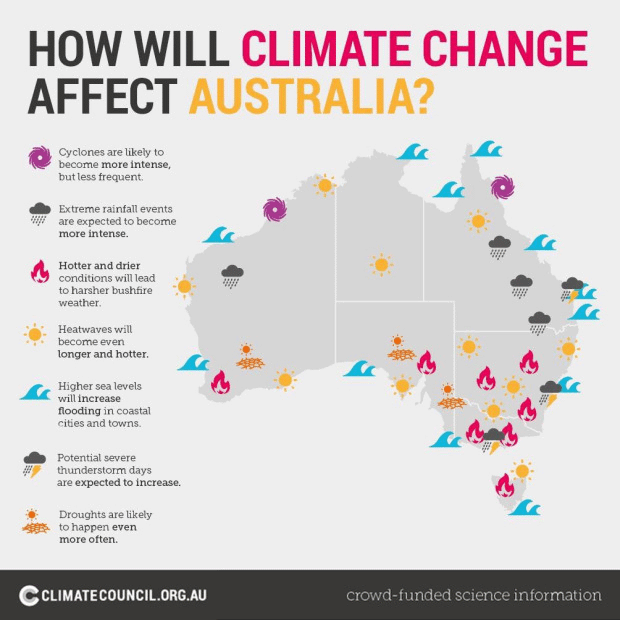
Australia facing climate disaster on its doorstep, government’s white paper warns
Foreign policy paper says climate-related conflict and migration could put Australia’s economic interests under pressure, Guardian, Katharine Murphy, 23 Nov 17, Climate change is creating a disaster on Australia’s doorstep, with environmental degradation and the demand for sustainable sources of food undermining stability in some countries, especially “fragile states”, according to the Australian government’s first foreign policy white paper in more than a decade.
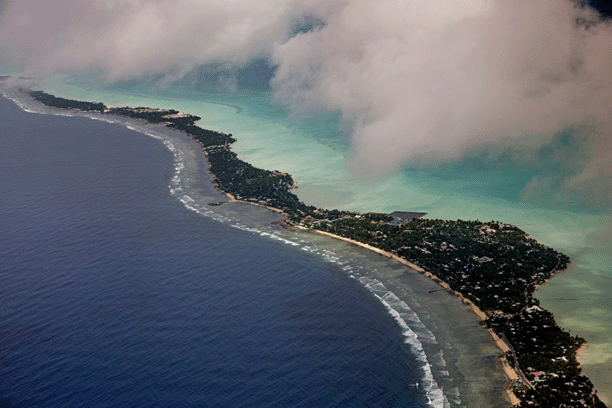 The new white paper, released on Thursday, contains warnings over the disruptive effects of climate change in Australia’s immediate region, noting that many small island states will be “severely affected in the long term”, and the coming decade will see increased need for disaster relief.
The white paper notes the demand for water and food will rise, with the world’s oceans and forests under intense pressure. It notes climate change and pressure on the environment could contribute to conflict and irregular migration, impacting specifically on Australia’s economic interests.
Despite the obvious challenges for Australia and the world posed by Donald Trump’s presidency, and a live debate in this country about whether Australia needs to rethink the American alliance, the white paper makes a strong case for the United States to remain engaged in the region to counterbalance China’s increasingly assertive posture.
It notes that the postwar alliance with the US “is central to Australia’s security and sits at the core of our strategic and defence planning”.
Australian government lending to Adani? A bad look internationally!
Australia’s reputation faces ‘serious’ risks if Adani loan goes ahead: Figueres, http://www.smh.com.au/environment/climate-change/australias-reputation-faces-serious-risks-if-adani-loan-goes-ahead-figueres-20171118-gzo8fh.html Providing a $1 billion loan to underwrite Adani’s proposed mega coal mine in Queensland would have “serious negative impacts” for Australia’s international reputation and “unpick the progress” of the Paris climate agreement, according to Christiana Figueres, a former United Nations climate chief.
Ms Figueres has written to the Turnbull government’s Northern Australia Infrastructure Facility (NAIF), which is considering a concessional loan for a rail link from the mine to the coast
The former executive secretary of the UN’s Framework Convention on Climate Change
sought to highlight that under the NAIF’s own enabling legislation, it “must not act in a way that is likely to cause damage to the Commonwealth government’s reputation, or that of a relevant State or Territory”.
Ms Figueres warned the expected total lifetime carbon emissions from burning coal from the proposed Carmichael in the Galilee basin would be 4.64 billion tonnes of carbon-dioxide, according to details of the letter obtained by Fairfax Media.
At its peak, the mine’s product would trigger emissions of 120 million tonnes of CO2-equivalent, roughly equal to what Australia has pledged to cut by 2030 from current pollution levels under its Paris pledges.
“Based on these numbers, emissions that would result from burning Carmichael coal in one peak production year would completely cancel out the total emissions reduction effort Australia has committed to for the 13 years from now until 2030 under the Paris Agreement,” she said.
The rail loan, now being considered by NAIF, has been a key point of debate in Queensland’s state elections, with polls indicating little support for concessional finance for Adani, a mining conglomerate owned by Indian billionaire Gautam Adani.
Queensland Premier Annastacia Palaszczuk said her government, if re-elected at Saturday’s elections, would have no role in assessing the NAIF loan, effectively blocking it. Oppositional leader Tim Nicholls supports the loan and has blasted the premier’s stance as putting thousands of regional jobs at risk.
Ms Figueres said her intervention was prompted by a “deep concern for planetary well-being, I cannot, in all good conscience, remain silent on an issue that threatens to unpick the progress represented by the Paris Agreement”.
“A decision by the NAIF (and the Australian Government) to financially support the Adani project would be likely to have serious negative impacts on Australia’s reputation, in particular that of the Commonwealth Government,” Ms Figueres said, highlighting Australia’s commitment to “refrain from acts which would defeat” the Paris accord’s object and purpose.
Ms Figueres’ letter to the NAIF was dated November 17, the final day of the Bonn climate talks aimed at nudging nations to increase their commitments to cut emissions two years on from the Paris accord.
Australia copped criticism at the gathering for its promotion of coal, with Hilda Heine, president of the Marshall Islands calling for a change of government in Canberra and urging nations to stop burning the intensive-heavy fossil fuel.
Dean Bialek, a former Australian diplomat and advisor to small island states threatened by the rising sea levels driven by climate change, said Ms Figueres had been “utterly shocked to learn the government was considering a huge subsidy” for Adani during a recent visit to Australia.
“She felt compelled to explain to the NAIF Board how dangerous and irresponsible this project would be in global environmental terms, and the serious damage it would do to Australia’s international reputation and standing in the world,” said Dr Bialek, who now works with Ms Figueres on her Mission 2020.
The project is attempting to accelerate climate action to get global emissions peaking and then trending lower by 2020. A report out last week by the Global Carbon Project estimated emissions will jump this year by 2 per cent after flatlining for three years, to a record 41 billion tonnes of CO2.
Gautum Adani has India’s government under control, – now Australia’s, too?
Adani’s push to build a mega coal mine in Queensland has polarised opinions nationwide. It should come as no surprise: the billionaire behind the project has long been a focus of controversy in his native India.Tim Elliott
To Australians, however, he is best known for his proposed $16.5 billion Carmichael coal mine, to be built in central Queensland’s Galilee Basin. Construction was scheduled to start in October, but has been delayed due to political and financing issues. Should the mine proceed, it will be one of the largest in the world – roughly five times the size of Sydney Harbour – and produce up to 60 million tonnes of coal per year for anywhere between 50 and 60 years, all of which will be exported, the bulk of it to India…….
Companies in the Adani Group are being prosecuted in Delhi’s High Court for allegedly inflating the price of capital equipment imports, allowing the company to charge electricity consumers higher prices while diverting profits into tax havens in the Cayman Islands and Mauritius. (Adani denies any wrongdoing.)
“Adani should have been prosecuted for so many offences,” says Prashant Bhushan, a Delhi-based public interest lawyer who co-filed the High Court case. “There’s cheating the public and electricity consumers and shareholders; there are violations of the Foreign Exchange Management Act. There are probably corruption cases involving the banks.”
And yet investigations into Adani’s companies have a habit of being shelved indefinitely, being resolved in his favour or simply disappearing. “Mr Adani has a lot of influence in high places,” Bhushan tells me. “It is obvious, for instance, that he is very good friends with [the Indian Prime Minister] Narendra Modi.” …….
Saysthe energy consultant Tim Buckley, “Adani is getting exactly the same sort of treatment from Australian politicians to that which he is used to back in India. He has been offered a $1 billion subsidised loan from the Northern Australian Infrastructure Facility [NAIF], and a $600 million royalty holiday and free water from Queensland taxpayers. And as if that wasn’t enough, we’ve now learnt that the Queensland Government has compulsorily acquired prime agricultural land to make way for the Adani railway. It’s farcical.”…….. http://www.theage.com.au/good-weekend/carmichael-coal-mine-magnate-gautam-adani-from-school-dropout-to-12bn-empire-20171106-gzfobl.html
Among 56 countries studied – Australia is close to worst on climate change action
 ‘Ringing alarm bells’: Australia near the bottom of the heap for climate action http://www.smh.com.au/environment/climate-change/ringing-alarm-bells-australia-near-the-bottom-of-the-heap-for-climate-action-20171115-gzm063.html Peter Hannam
Australia ranks as one of the world’s worst performing nations when it comes to climate action, with only South Korea, Iran and Saudi Arabia faring worse among 56 countries scrutinised by 300 international analysts.
The annual Climate Change Performance Index, led by Germanwatch and other groups, listed Australia as “very low-performing” for its greenhouse gas emissions, energy use and climate policy. It scored a “low’ rating for renewable energy.
The results were released as talks in Bonn, Germany, aimed at shoring up support for the 2015 Paris climate accord enter their final few days.
As in the past three years, Australia has foundered near the bottom of the major tables, prompting the commentators to call on the Turnbull government to “sufficiently implement credible policies” to meet its Paris targets.
Environment and Energy Minister Josh Frydenberg, now in Germany, earlier this week declared Australia remains committed to its pledgeto slice 2005-level emissions by 26-28 per cent by 2030.
Kelly O’Shanassy, chief executive of the Australian Conservation Foundation, said Australia had the highest per capita greenhouse gas emissions of those assessed, and was also one of the world’s largest exporters of fossil fuels.
“Australia’s continued failure to put in place a robust and comprehensive national plan to cut pollution is raising alarm bells around the world,” Ms O’Shanassy said, noting emissions have been increasing since 2013.
“This is a national embarrassment for a wealthy nation with so much at risk from climate change and such abundant sun and wind that could be harvested for clean energy,” she said.
Sweden was the top-ranked nation, marked highly for its efforts to boost low-carbon sources of electricity and its increasing forest cover.
The US was among the big movers in the ranking, sliding from 35th two years ago to just one slot above Australia this year.
It got marked down for its declaration to exit the Paris agreement – a move that left it isolated after Syria – the last nation holding out – recently signed up to the accord.
The Adani Carmichael Coal Mine: Introduction To A Special Five-Part Series
By Kristen Lyons, Morgan Brigg & John Quiggin , New Matilda, on November 16, 2017 newmatilda.com/2017/11/16/adani-carmichael-coal-mine-introduction-special-five-part-series/
‘Per head of population, Australia is already one of the world’s worst carbon polluters.
‘Despite this, our two major political parties – Labor and the Liberal-Nationals – are pushing ahead
with the approval of a coal mine in Queensland that will exponentially increase our carbon emissions.
‘The Carmichael mine, proposed by Indian mining giant Adani, will be the largest of its kind in the southern hemisphere and annually produce more carbon emissions than a small country.
‘In this special five-part New Matilda series, researchers from the University of Queensland,
along with the Wangan and Jagalingou Traditional Owners Council, and Australian Lawyers for Human Rights look at the ‘who, what, when, where and why’ of the proposed Adani Carmichael coal mine,
its impact on Traditional Owners, the terrible economics that surround it, and our inexplicable march towards climate oblivion.

‘This first introductory piece – the first in our series
– is written by University of Queensland researchers Kristen Lyons, Morgan Brigg and John Quiggin.’
Read more of this well-researched, informative and insightful article here:
newmatilda.com/2017/11/16/adani-carmichael-coal-mine-introduction-special-five-part-series/
1 This month
7 April – WEBINAR – Australia and the Doomsday Clock – Preventing nuclear war through NoFirstUse and other policies
Online | Tuesday April 7, 4:00-5:30pm, Australian Eastern Time / 8:00-9:30am Central Europe Time
– Access the registration link
15 April – Zoom –Nuclear Power is Not the Solution
Apr 15, 2026 01:00 AM in Canberra, Melbourne, Sydney

Join the International Physicians for the Prevention of Nuclear War (IPPNW) on Tuesday, April 14th for a timely webinar exploring the risks associated with nuclear power and challenging the myth that it offers a simple, safe, carbon-free solution to the climate crisis

21 April Webinar: No Nuclear Weapons in Australia
Start: 2026-04-21 18:00:00 UTC Canberra, Melbourne, Sydney (GMT+10:00)
End: 2026-04-21 19:30:00 UTC Canberra, Melbourne, Sydney (GMT+10:00)
Event Type: Virtual
A virtual link will be communicated before the event.
Host Contact Info: australia@icanw.org

of the week – Australians for War Powers Reform (AWPR)
To see nuclear-related stories in greater depth and intensity
 Antinuclear