Officials considering tax-payer loan to Adani have known for months of Adani’s bad financial and environmental standing
Market Forces executive director Julien Vincent said more than a dozen commercial banks had ruled out involvement in the Carmichael mine and rail project due to its “financial and reputational risk”.
“To know that NAIF and EFIC are aware of these risks should underscore the argument against giving a $900 million loan to Adani,” he said.
Mr Vincent pointed to the Infrastructure Facility’s investment mandate, which says it “must not act in a way that is likely to cause damage to the Commonwealth government’s reputation”.
 Emails reveal officials probing environmental and financial concerns with Adani super-mine http://www.theage.com.au/federal-politics/political-news/emails-reveal-officials-probing-environmental-and-financial-concerns-with-adani-supermine-20171102-gzdc5h.html, Nicole Hasham , 3 Nov 17 Senior officials considering lending public money to develop Australia’s biggest coal mine have known for months of environmental and financial concerns surrounding the proponent Adani, internal emails reveal.
The emails, obtained under freedom of information laws, have fuelled the mine’s opponents, who say granting the $900 million loan would pose unacceptable risks to taxpayers and the Commonwealth.
Indian mining giant Adani has proposed a $16.5 billion Carmichael coal mine in Queensland’s Gallilee Basin, sparking legal challenges and widespread protests.
Australia’s big four banks have ruled out funding the project, and Adani has sought a federal government loan to build a railway line from the mine to the Abbot Point coal terminal, near the Great Barrier Reef.
The loan is being considered by the Turnbull government’s Northern Australia Infrastructure Facility, a taxpayer-funded concessional loan scheme. Critics have derided the facility as a Turnbull government slush fund.
Much of the content of the emails has been redacted. However one dated November 24 last year has the subject line “NGBR [North Gallilee Basin Rail] Project – Proponent’s environmental track record”.
Attached to the email is a Greenpeace briefing paper titled Adani’s record of environmental destruction and non-compliance with regulations.
The email was sent between senior officials at Australia’s export credit agency, Export Finance and Insurance Corporation, which is providing support to the Infrastructure Facility. Continue reading
The $16-billion Adani coal mine project is dividing the Australian public

Adani’s Australia Story: How a Massive Coal Mine is Sparking a New Wave of Environmental Concerns ‘With the $16-billion Adani coal mine dividing the Australian public, The Wire looks at the country’s environmental concerns and how the Carmichael project adds to them.’
thewire.in/193156/adanis-australia-story-massive-coal-mine-sparking-new-wave-environmental-concerns, Kabir Agarwal on 01/11/2017 thewire.in/author/kabir-agarwal
‘This is the third story in a five-part series that examines the controversial Adani and Carmichael coal mine.
Read the first thewire.in/188092/adanis-australia-story-whats-the-fuss-all-about
and second part. thewire.in/189547/adanis-australia-story-thousands-people-protesting-16-billion-coal-mine ‘
‘ … The Wangan and Jagalingou people, who are also fighting a court battle to retain their right over their land, are of the view that if the Adani coal mine is built, their cultural heritage will be destroyed beyond repair.
‘“The land, the springs, the waterways, the mountain ranges, are not just physical forms for us.
They are remnants of our ancient culture.
‘If the mine is built, there will be no record of us ever having been there”,” said Adrian Burragubba, spokesperson of the Wangan and Jagalingou Traditional Owners Family Council.
‘They said that they are prepared to battle it out for as long as it takes.
‘“Every inch of that land is mine. Every blade of grass, every drop of water, each leaf on a tree, each bird, each animal, is mine. And I am going to fight for it. I want to tell Adani – I am not your slave,” an animated Burragubba said when I met him in Brisbane in late July. … ‘
Read more of Kabir’s comprehensive and informative article:
thewire.in/193156/adanis-australia-story-massive-coal-mine-sparking-new-wave-environmental-concerns
‘Kabir Agarwal is an independent journalist whose writings have appeared in
The Kashmir Walla, The Times of India, Mint, Al Jazeera English and The Caravan.
He can be found on twitter @kabira_tweeting.’
thewire.in/author/kabir-agarwal
Australian tourism industry must develop an effective climate change policy
Australian tourism policies fail to address climate change https://phys.org/news/2017-11-australian-tourism-policies-climate.html November 2, 2017 Australia’s Federal and State governments are failing to produce effective long-term tourism policy to address climate change, according to the findings of new QUT-led research.
Tourism policy on climate change in Australia is inconsistent and ineffective
Federal and state governments are not collaborating on best practice approaches to tourism policy on climate change
The tourism industry can contribute to the sustainable management of climate changeDr Char-lee Moyle, from QUT’s Australian Centre for Entrepreneurship Research, and her co-authors from Griffith University and James Cook University analysed 477 relevant documents for their paper – Have Australia’s tourism strategies incorporated climate change?
Just published in the international Journal of Sustainable Tourism, it reveals only 21% of Australia’s tourism strategies mention climate change, with most simply acknowledging it as an issue.
“Despite the fact tourism is worth billions of dollars to our economy and has been found by scientists to accelerate climate change, only five Australian tourism strategies analysed by us (one per cent of the entire sample) even recognised the sector’s impact,” Dr Moyle said.
“Looking at policy documents from 2000-2014, we have seen Australia’s tourism strategies increasingly focus on adaptation strategies, with mitigation appearing to have fallen off the policy agenda in recent years.
“Even certification and accreditation schemes are essentially viewed by industry as adaptation measures and a way to reduce climate change induced costs such as rising electricity bills.”
Dr Moyle emphasised the link between tourism climate change rhetoric and federal government election cycles.
“We found significantly more tourism climate change strategies were produced during the years the Australian Labor Party was in power at the federal level, with a peak in 2007,” she said.
“State Governments appear to be far less proactive in considering climate change in relation to tourism and, conspicuously, New South Wales did not even mention climate change in any state-level tourism strategies.”
Dr Moyle said there was significant room for the tourism sector to improve and step up action, particularly in developing tangible adaptation and mitigation policies.
“There are opportunities for the tourism industry to contribute to the sustainable management of climate change, including through the development of more ‘green’ products and implementing more environmentally-friendly practices,” Dr Moyle said.
She added that many initiatives proposed and subsequently implemented no longer exist, indicating an extremely dynamic climate change policy environment, as well as a lack of long-term consistent support and planning for tourism climate change response.
“On a positive note, there has been an increased focus on identifying opportunities, strategic needs, barriers, challenges and potential actions in relation to climate change since 2008,” Dr Moyle said.
 Explore further: Climate change action focuses on tourist traps, say researchers
More information: Char-lee J. Moyle et al, Have Australia’s tourism strategies incorporated climate change?, Journal of Sustainable Tourism (2017). DOI: 10.1080/09669582.2017.1387121
Provided by: Queensland University of Technology
Don’t fund Adani coal project: Pacific Islanders’ call to Australian government
Pacific Islanders call for Australia not to fund Adani coalmine, Caritas says thousands face threats to their wellbeing, livelihoods and ‘their very existence’ due to rising sea levels, Guardian, Naaman Zhou, 1 Nov 17, Pacific Islanders whose homes face eradication by rising sea levels have called on Australia to not fund the Adani Carmichael coalmine, as a new report reveals the worsening impact of climate change across Oceania.
Residents of the endangered islands have described their forced displacement as like “having your heart ripped out of your chest” as they called on the Australian government to do more to combat climate change.
A report released by international aid group Caritas on Wednesday found that thousands of Pacific people across the region faced “threats to their wellbeing, livelihoods and, in some places, their very existence” due to rising sea levels, king tides and natural disasters brought about by climate change.
n Papua New Guinea, 2,000 households across 35 coastal communities were displaced by coastal erosion over the past year. In Samoa, 60% of the village of Solosolo was relocated to higher ground.
In the Torres Strait, 15 island communities were identified as at risk over the next 50 years.
The mayor of the Torres Straight Island regional council, Fred Gela, described the forcible removals as like having your heart ripped out “because you are told you’re not able to live on your land”.
Erietera Aram, a resident of Kiribati who works for the Department of Fisheries, said he decided to visit Australia to ask its government to take action.
“We talk about the Adani coalmine,” he said. “That’s a new one. I think it’s not a good idea – it makes the world worse for all of us. It is inconsiderate of other humans on this planet.
“We didn’t think of Australia as a country that would do that. We looked at it as our bigger brother. Proceeding with that new mine is a sad move. We live together in the environment but it’s like they are ignoring us.
“We’re two metres above sea level. With the sea level rise, most of our lands have been taken by coastal erosion. We love our country and we want our children to live there as well, hopefully forever. It’s hard to talk about leaving the place where you belong.”
According to the report’s authors, the impact of coastal erosion and flooding reached “severe” levels in 2016, upgraded from “high” the year before. Climate change also made it “increasingly difficult to maintain the health and integrity” of food and water sources. Water scarcity was deemed a “serious slow-onset problem throughout Oceania”…… https://www.theguardian.com/environment/2017/nov/01/pacific-islanders-call-for-australia-not-to-fund-adani-coalmine
Australian emissions to ‘far exceed’ 2030 Paris pledge
 Australian emissions to ‘far exceed’ 2030 Paris pledge as need for action rises: UN http://www.smh.com.au/environment/climate-change/australia-to-far-exceed-2030-paris-climate-pledge-as-need-for-action-rises-un-20171030-gzbiwj.html, Peter Hannam, 31 Oct 17
National pledges to cut carbon emissions fall well short of what’s needed to avoid dangerous climate change, with Australia likely to miss its 2030 commitment by a wide margin, a United Nations body said.
The UN Environment Programme’s Emissions Gap 2017 report found pledges to cut pollution made at the Paris climate summit two years ago are only about one-third of what’s needed to be on a “least-cost pathway” to stopping the worst effects of climate change.
The target is to stop global average temperatures rising two degrees or more above pre-industrial levels. Change on the scale is expected to cause major droughts, food shortages and damaging sea level rise.
The emissions gap to keep with a 1.5-degree goal is 16-19 gigatonnes of carbon-dioxide equivalent, while the 2-degree target would need an extra 11.13.5 gigatonnes of CO2-e of cuts by 2030 to be attained, the report said.
“There is an urgent need for accelerated short-term action and enhanced longer-term national ambition, if the goals of the Paris Agreement are to remain achievable,” the report said.
The positive news is that global emissions have largely flatlined for the past three years, thanks in large part to a plateauing in China. Still, other potent greenhouse gases such as methane are rising, and carbon dioxide emissions could accelerate if global economic growth picks up.
Frank Jotzo, a professor at the Australian National University’s Crawford School and a contributor to the report, said tumbling costs of renewable energy and other low-carbon technologies suggest nations could increase their emissions cuts “and it won’t be terribly hard”.
“More climate action and deeper commitments are needed, but it’s eminently possible to achieve [the Paris climate goal] from the economic and technical perspective,” Professor Jotzo said. “It’s the politics that get in the way.” Continue reading
What High Court ruling means for climate, renewables
 Joyce out, Canavan in, Roberts out – What High Court ruling means for climate, renewables, http://reneweconomy.com.au/updated-joyce-out-canavan-in-roberts-out-what-high-court-ruling-means-for-climate-renewables-20175/ By Sophie Vorrath on 27 October 2017 Australia’s deputy prime minister and leader of the National Party, Barnaby Joyce, is headed for a by-election, after the High Court ruled him ineligible to hold his seat due to his dual Australia-New Zealand citizenship.
The ruling – which has also disqualified fellow “citizenship 7” members, Nationals Deputy Fiona Nash, Greens Senator Scottt Ludlam, Greens Deputy Larissa Waters, and Pauline Hanson’s One Nation party senator, Malcolm Roberts – leaves the Turnbull government without its one seat majority in the House of Representatives. At least until the result of the December by-election.
But what does it mean for the clean energy and climate policy debate in Australia?
For starters, the Court’s decision removes Parliament’s chief flat-earther, in Malcolm Roberts – although he is not the only federal parliamentarian to deny climate change (see Fiona Nash, below).
On energy, Roberts – like Hanson’s One Nation – is broadly anti-renewables and pro-fossil fuels. He notably anointed the Turnbull government’s National Energy Guarantee as both “atrocious”, but also in line with the his party’s desire for the RET to be scrapped and its support of “clean coal.”
In a speech to the Minerals Week Seminar, the deputy PM painted a picture of a nation under attack from a sort of economy destroying “green peril” that would shut down coal power plants, kill coal exports and – of course – turn the lights out.
“Around about January, ladies and gentlemen, families are going to come back from holiday, mum and dad are going to go back to work, mum’s going to turn on the air conditioner, get the kids ready for school, school’s going to turn on the power, and if we don’t watch out, the lights are going to go out,” Joyce said.
“And this will be a salutary lesson on how economics really work. A salutary lesson against the fatuous economics that’s being peddled.
(“In the) Galilee Basin, we are in the fight of our lives trying to open up a mechanism that will create wealth for this nation. Total insanity!” he said. “What’s one of our biggest exports, or our biggest export? Coal. And what are we making the argument against? That we should use coal. It’s absurd. …I just don’t get it.”
Joyce also doesn’t get climate science, and like his compatriot, Fiona Nash, is skeptical about the research credentials of global warming. Look….I just – I’m always skeptical of the idea that the way that anybody’s going to change the climate – and I’m driving in this morning and we’re driving through a frost – is with bureaucrats and taxes,” he told conservative commentator and noted climate denier Andrew Bolt in an interview in 2015.
“All that does is….it’s a self-fulfilling prophecy. I make you feel guilty so I can get your money and put it in my pocket and send reports backwards and forth to one another,” he said.
But Joyce may not be gone for long. The by-election is expected to be held very soon, probably December 2, and Joyce is expected to win,
And Joyce’s brief absence should be countered by the safe return of Matt Canavan, the Queensland Nationals Senator who, along with SA independent Nick Xenophon, was cleared by the High Court, despite having dual Italian citizenship. The Court ruled that Canavan did not know about his Italian citizenship, and so could not have taken all reasonable measures to renounce it.
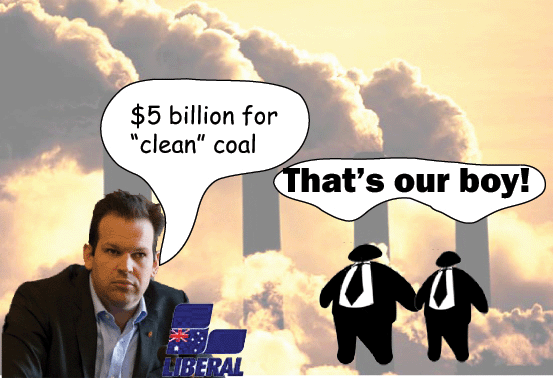 Canavan, who has already been reinstated as the federal minister for resources and northern Australia, was recently dubbed the “minister for the mining sector”, after his heartfelt farewell to the sector when the citizenship scandal first reared its ugly head in July and he stepped aside.
“It has been such an honour to represent the Australian mining sector over the past year,” he wrote on Facebook. “From the small, gambling explorers and prospectors to the large, world-beating multi-nationals, the industry provides rich and diverse experiences that can take you to the smallest towns of outback Australia to the biggest cities in the world.”
The note sparked instant outrage from readers, who noted Canavan was “supposed to represent the people of Queensland, and not private mining companies.” We will see whether his priorities have changed any when he returns to work.
The disqualification of Nationals Senator number three – and deputy leader of that party – NSW Fiona Nash (minister for regional development) could be chalked up as a small win for climate policy. Nash, like Joyce, is skeptical about the science, telling Sky News last year “I don’t think it is certainly necessarily settled.”
To Malcolm Roberts, it is farewell, after just one year in Parliament. During this short period of time, Roberts has distinguished himself by repeatedly denying the human influence on climate change; by introducing a hoax “conceptual penis” research paper to Parliament in an effort to undermine the validity of peer reviewed science; and asked Chief Scientist Alan Finkel if it was important for scientists to have an open mind, to which Finkel responded: “yes, but not so much that your brain leaks out.”
In a statement on Friday afternoon, Roberts said he was sad to leave federal parliament, but accepted the High Court decision entirely. Probably because it’s not based on science. Roberts will now run for the seat of Ipswich – the “heart of One Nation” – in Queensland state politics.
One Nation, meanwhile, still holds four seats in federal parliament. Next in line for Roberts’ seat is Fraser Anning – a publican from the Queensland coal region of Gladstone, who attracted just 19 first preference votes last year. His stance on renewables and climate is not immediately clear – neither his Facebook page nor his One Nation profile were accessible at the time of publication – but he is a fan of a good conspiracy theory.
For the Turnbull government, it is a blow, and an embarrassment, whether the PM likes to admit it or not.
n an upbeat address to reporters on Friday afternoon, Turnbull said the Coalition had remained focused on the business of government pending the Court’s decision, and pointed to his National Energy Guarantee as evidence of that. Never mind that the NEG has been widely derided as non-policy; at best an outline of one possible framework among many.
Turnbull even took the opportunity to do some energy politicking, telling reporters “we all know that Labor’s (energy policy) would see prices rising as far as the eye can see.”
Tony Windsor, who has confirmed he will not be contesting the by-election, said one of the main things that kept him interested in federal politics was the “discgraceful” short-term politics Coalition members like Abbott and Joyce, who supported climate and energy policies that “do nothing” to solve the problems of the future.
And he also noted that, despite Joyce’s position as the front runner for New England, the by-election would open up a key seat to other candidates, who could campaign on some of the key, long0-term political issues that he felt the Turnbull government had fudged.
“The government has a majority of one,” he told the ABC on Friday afternoon. “Now that ‘one’ is going to be out of town for a while. … so if people want to get up there and talk about the significant issues that affect New England, I’ll be right up there supporting them,” Windsor said.
Australian Productivity Commission (hardly radicals!) wants clean energy target
What the National Energy Guarantee lacks though is a formal clean energy target, which, in the absence of a carbon pricing scheme, would at least be a market-based mechanism that provides incentives for low emissions and renewable generation.
the report concludes that advocates of coal-fired generating capacity who oppose carbon pricing are doing themselves a disservice, as investors are unlikely to commit to the investment needed, given future regulatory risks.
 Report throws book at ‘energy mess’ saying governments must get serious on carbon emissions http://www.couriermail.com.au/news/opinion/opinion-report-throws-book-at-energy-mess-saying-governments-must-get-serious-on-carbon-emissions/news-story/b121d3e13e10d74cfce74b8816de2e88, Paul Syvret, The Courier-Mail, October 28, 2017
THE Australian Productivity Commission – the Federal Government’s economic advisory body that recommended cuts to weekend penalty rates – is not renowned as a hotbed of left-wing activism.
On Tuesday Treasurer Scott Morrison released the first of the commission’s five-year reviews, using the document as a platform to mount a case for continuing economic reforms to lift Australia’s productivity rate.
The ideas in the 1200-page document – ranging across the full spectrum of the Australian economy – should have dominated debate at a time when the Government is trying to wrest back control of the political agenda.
The Michaelia Cash trainwreck put paid to that, despite Morrison’s best efforts to warn that “the price of a generation of Australians growing up without ever having known a recession is that reform comes more stubbornly and incrementally”.
What Morrison didn’t highlight though was Chapter 5 of the Productivity Commission report, titled “Fixing the energy mess”.
In this section, the commission says Australian governments “must stop the piecemeal and stop-start approach to emission reduction and adopt a proper vehicle for reducing carbon emissions that puts a single effective price on carbon”. Continue reading
Anti Adani coal project protestors lock themselves to heavy machinery
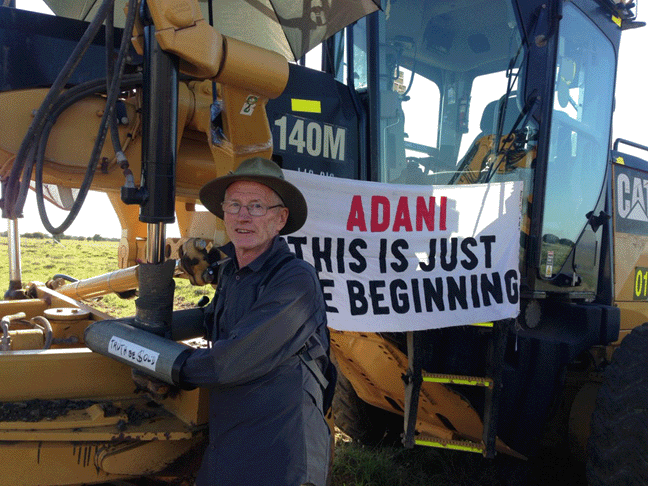
Protesters strap selves to Adani machines, AAP http://www.theage.com.au/business/mining-and-resources/protesters-strap-selves-to-adani-machines-20171024-p4ywmv.html Anti-coal activists have locked themselves to heavy machinery to protest Adani’s mega mine in central Queensland. Three members of the Frontline Action on Coal group have used a sleeping dragon technique – which involves wrapping their arms around equipment then locking their hands inside metal pipes so they can’t be removed by outsiders – to attach themselves to a grader, excavator and front-end loader near one of the workers’ camps at Belyando.
Protesters have vowed to “do whatever it takes to peacefully stop” the $21.7 billion coal mine and rail project.
Chief Scientist contradicts Liberal Senator – says far fewer coal-fired power stations being planned
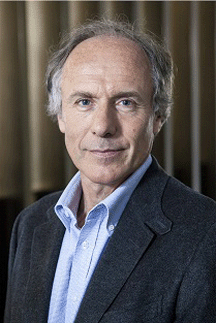 Alan Finkel disputes figures used by supporters of coal power https://www.theguardian.com/australia-news/2017/oct/26/alan-finkel-disputes-figures-used-by-supporters-of-coal-power
Chief scientist says far fewer coal-fired power stations being planned around the world than previously projected The chief scientist, Alan Finkel, has challenged figures used by supporters of coal-fired power stations in a Senate estimates hearing.
Liberal senator Ian Macdonald suggested there were more than 600 coal plants under way around the world, which would undermine any emissions reduction achieved by Australia.
Finkel told the hearing on Thursday he had seen a range of figures. However, he understood the number of coal plants in China and India in the initial planning stage or being built was “far less than what was projected a year ago”.
[China] has a commitment as a country to reduce emissions. They are finding they are reaping the benefits of their commitments to wind and solar at a faster rate than they thought,” he said.
Asked about developments in Europe, Finkel said he was aware of only one high-efficiency coal plant currently being built and it was in trouble.
Finkel said the modelling he produced in his review of Australia’s electricity sector had been provided to the Energy Security Board as it put flesh to the bones of the proposed national energy guarantee policy.
He believed the national energy guarantee modelling could be produced in time for a Council of Australian Governments energy council meeting in late November.
But he said the states and electricity sector needed to be properly consulted. “The ramifications of getting any aspect of the rules wrong are very serious,” he said.
Fossil fuel lobby now dictates Australia’s energy policy: Energy Security Board instructed to ignore Paris climate commitments
 ESB told to ignore climate, as lobby groups muscle in on policy http://reneweconomy.com.au/esb-told-to-ignore-climate-as-lobby-groups-muscle-in-on-policy-54636/
25 October: John Pratt on Adani coal mine plan
-
1.5C Climate Change Threshold #StopAdani
In Defense of the 1.5°C Climate Change Threshold
Loren Legarda Oct 23, 2017MANILA – The Earth today is more than 1°C hotter than it was in pre-industrial times, and the terrible symptoms of its fever are already showing.
-
Why thousands are protesting to #StopAdani #Auspol #Qldpol
Adani’s Australia Story: Why Thousands of People Are Protesting a $16-Billion Coal MineKabir Agarwal23/10/2017
From environmentalists to politicians to indigenous groups, there is strong local opposition to the Adani project in Queensland.
The Wire examines the factors at play and how the Adani Group is responding.
Note: This is the second story in a five-part series that will examine how the Adani and Carmichael coal mine has divided the Australian public and in the process, sparked fierce debate on issues such as coal-based energy, energy financing, jobs and the rights of indigenous people.
On March 17, Annastacia Palaszczuk, the premier (head of government) of the north-eastern Australian state Queensland, was walking out from the Bhuj airport’s single terminal in Gujarat.
Bob Brown: High Court decision ensures free speech against environmentally polluting companies, like Adani

 High court proves we have free speech against environmental wreckers https://www.theguardian.com/environment/commentisfree/2017/oct/22/high-court-proves-we-have-free-speech-against-environmental-wreckers, Bob Brown
Adani and the loggers should watch out – we have a right to peaceful protest to protect our environment, The high court has drawn a line in the sand against laws which burden the right of Australians to peaceful protest.
The court made no judgement on Tasmanian premier Will Hodgman’s decision to flatten the Lapoinya state forest in northwest Tasmania against the wishes of the local community. But it struck down his Workplaces (Protection from Protesters) Act 2014 aimed at stopping people from protesting effectively against such forests being logged.
Lapoinya is a huddle of farms southwest of the Bass Strait city of Burnie. Its rolling hills have a patchwork of lush pastures, ploughed fields and copses of trees. At the heart of the district was the Lapoinya forest, a couple of hundred hectares of wildlife-filled rainforest, eucalypts and ferneries with the crystal-clear Maynes Creek, a key nursery for the world’s largest freshwater crayfish, running through it.
When Forestry Tasmania revealed plans for the forest to be clearfelled for the distant wood-processing factory owned by Malaysian logging company Ta Ann, the people of Lapoinya remained confident that common sense would prevail. They called on the state government to intervene and ran a colourful but respectful public campaign to prevent the logging.
Neither the premier nor his minister for forests visited or intervened. Instead, draconian anti-protest laws were enacted and by early 2016 the logging was imminent.
The locals prepared for a peaceful stand. If the public could see how beautiful the Lapoinya forest was then surely, even at this eleventh hour, the resulting political pressure would cause the government to back off.
The bulldozers and chainsaws arrived in January 2016, with a cavalcade of police.
While premier Hodgman assured Tasmanians his new laws were aimed at “radical” environmentalists and not “mums and dads”, the first two people arrested were a grandfather and a mother of two. That mother, also a neurosurgery nurse, was Jessica Hoyt. Her parents, Stewart and Barbara, have a farm adjoining the forest. In her teenage years Jessica, along with her siblings, had enjoyed riding along the forest’s bridle trail. The two were charged and faced first-offence fines of $10,000.
The next day, reeling from the destruction, Jessica took friends back into the doomed forest. She was arrested again while walking through the trees and ferns. This second arrest put her in danger of being jailed for four years.
A few days later, along with several others, I was also arrested after going back to Lapoinya to make video clips, intended for public distribution, about the sheer bloody-mindedness of the government’s operation. I was standing in an adjacent forest reserve. A bulldozer had backed off and the screech of the chainsaws and roaring thud of the trees coming down was close and confronting.
The incongruity of laws stifling such a reasonable protest against the destruction of the public commons, in a democracy with a long history of advancement through peaceful protest, was compelling. This was underscored when, after our arrests, I received a number of messages from experienced legal experts from around Australia suggesting the laws breached the constitution’s implied right to freedom of political expression.
Guided by Hobart solicitor Roland Browne and joined as co-plaintiff by Jessica, I engaged Melbourne barrister Ron Merkel QC to challenge the constitutional validity of the Hodgman laws in the high court. A public appeal by my foundation raised more than $100,000 to affray the costs, especially in case we lost.
On Wednesday the high court ruled that those laws do infringe the freedom to peaceful protest inherent in the Australian constitution.
“It is necessary to keep firmly in mind that the implied freedom is essential to the maintenance of the system of representative and responsible government for which the Constitution provides. The implied freedom protects the free expression of political opinion, including peaceful protest, which is indispensable to the exercise of political sovereignty,” they said. by the people of the commonwealth. It operates as a limit on the exercise of legislative power to impede that freedom of expression.”
The Hodgman government had breached the limit of legislative power. Tasmania already had the usual array of laws to prevent dangerous or damaging behaviour. It also had a Forest Management Act which, besides guaranteeing the public its time-honoured access to the forests, empowers the police to arrest people who interfere with logging operations. The draconian new laws were not necessary for that purpose. They were designed to stymie effective environmental protests, like that at Lapoinya, which could draw public support and be politically embarrassing. The high court found the laws out, noting the deterrent effect on peaceful protest of their provisions: “The combined effect … can bring the protest of an entire group of persons to a halt and its effect will extend over time. Protesters will be deterred from returning to areas around forest operations for days and even months. During this time the operations about which they seek to protest will continue but their voices will not be heard.” It is for premier Hodgman, a lawyer, to say; but just as he did not see the unconstitutionality of these laws, so I doubt he was their origin.
It should be a warning to the other environmental wreckers.
We are in a world of gross, rapid and escalating environmental damage. Corporations profiting from exploiting non-renewable resources face growing public scrutiny and antipathy.
They cannot win the argument for wrecking ecosystems, so their alternative is to wreck environmentalists. Elsewhere in the world, scores of environmentalists are being killed each year by rampaging profiteers. But Australia is a peaceful democracy and the effective option is to lobby weak governments to clamp down on protests.
The high court’s decision does not directly affect laws in states or territories other than Tasmania. But it draws that line in the sand and will be a benchmark for more challenges if other governments pass laws to protect environmental destruction from peaceful public reaction. More widely, it bolsters that right for people standing up for any good cause.
There are growing calls for governments, already falling over themselves to grant concessions to the coral-killing Adani coalmine proposal in Queensland, to enact more draconian anti-protest laws than those already in place. The extreme right voices making those calls had better go read this judgment for democracy.
The Lapoinya forest was razed, but it has proved to be a pyrrhic victory for the destroyers. Out of the peaceful but heartfelt stand of the handful of people in Lapoinya has come a high court ruling upholding the right to peaceful protest for every Australian
Turnbull lies – calling coal a “dispatchable”power source
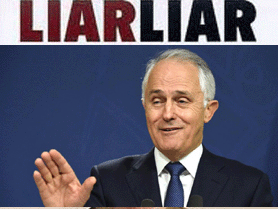 The new policy redefines coal as dispatchable, despite it having the opposite technological characteristics.
This is not an entirely new approach. Before the government  decided to abandon the proposed Clean Energy Target it put a lot of effort into redefining coal as “clean”.
The government’s energy policy hinges on some tricky wordplay about coal’s role https://theconversation.com/the-governments-energy-policy-hinges-on-some-tricky-wordplay-about-coals-role-85843?utm_source=twitter&utm_medium=twitterbutton, The Conversation, The most important thing to understand about the federal government’s new National Energy Guarantee is that it is designed not to produce a sustainable and reliable electricity supply system for the future, but to meet purely political objectives for the current term of parliament.
Those political objectives are: to provide a point of policy difference with the Labor Party; to meet the demands of the government’s backbench to provide support for coal-fired electricity; and to be seen to be acting to hold power prices down.
Meeting these objectives solves Prime Minister Malcolm Turnbull’s immediate political problems. But it comes at the cost of producing a policy that can only produce further confusion and delay.
The government’s central problem is that, as well as being polluting, coal-fired power is not well suited to the problem of increasingly high peaks in power demand, combined with slow growth in total demand.
Coal-fired power plants are expensive to start up and shut down, and are therefore best suited to meeting “baseload demand” – that is, the base level of electricity demand that never goes away. Until recently, this characteristic of coal was pushed by the government as the main reason we needed to maintain coal-fired power.
The opposite of baseload power is “dispatchable” power, which can be turned on and off as needed.
Classic sources of dispatchable power include hydroelectricity and gas, while recent technological advances mean that large-scale battery storageis now also a feasible option. Continue reading
Queensland government to take over agricultural land for Adani coal mine rail line
Government resume land for Adani
A FARM group – partly backed by the Tim Flannery-led Climate Council – has hit out over the State Government resumption of agricultural land for the Adani rail line.
http://www.couriermail.com.au/news/queensland/palaszczuk-government-resume-emerald-farmland-for-adani-rail-link/n
Townsville and Rockhampton councils could pay at least $31 million for Adani coalmine airstrip
Queensland councils to pay at least $31m for Adani coalmine airstrip
Townsville and Rockhampton councils may pay millions more if company’s bid to sew up deal with traditional owners fails, Guardian, Joshua Robertson, 20 Oct 17, Two local councils are paying $31m to build an airstrip for Adani’s Queenslandcoalmine – and could fork out millions more if the energy giant’s bid to sew up a deal with traditional owners hits a stumbling block.
Townsville and Rockhampton councils last week announced they would spend $15.5m each on the airport – hundreds of kilometres away – in a deal to secure Adani’s guarantee of 2,200 construction jobs for their residents.
And Townsville has agreed to pay up to $18.5m if the airport is shifted to a second location outside Wangan and Jagalingou land, where Adani’s right to build Australia’s largest coalmine is tied up in a drawn-out legal battle with a traditional owners group.
Rockhampton, which originally put up $20m for the airport in a bid to gain Adani’s guarantee, may also invest up to $18.5m but this has not been made clear.
Despite the Carmichael mine having broad support in both communities, there is some backlash to ratepayers providing infrastructure for a transnational corporation.
Councillors from both cities voted in favour of paying for the airport for Adani’s workforce in closed discussions of confidential reports, recorded in minutes that did not mention the company……….
Rockhampton councillors met on 26 September for a confidential discussion about “economic development opportunities” and an update from council’s general manager of “regional development and aviation”.
The minutes make no mention of Adani but note a confidential report contained information “for which a public discussion would be likely to prejudice the interests of the local government or someone else, or enable a person to gain a financial advantage”.
Councillors unanimously voted for their chief executive to “execute the terms sheets as discussed at the meeting” but did not put a figure on the cost to ratepayers.
Neither the Townsville mayor, Jenny Hill, nor the Rockhampton mayor, Margaret Strelow, responded to a request for comment. https://www.theguardian.com/business/2017/oct/20/adani-coalmine-queensland-councils-to-pay-at-least-31m-for-airstrip
1 This month
Chernobyl: The Lost Tapes – A good documentary on Chernobyl on SBS available On Demand for the next 3 weeks– https://www.sbs.com.au/ondemand/tv-program/chernobyl-the-lost-tapes/2352741955560
15 April – Zoom –Nuclear Power is Not the Solution
Apr 15, 2026 01:00 AM in Canberra, Melbourne, Sydney

Join the International Physicians for the Prevention of Nuclear War (IPPNW) on Tuesday, April 14th for a timely webinar exploring the risks associated with nuclear power and challenging the myth that it offers a simple, safe, carbon-free solution to the climate crisis

21 April Webinar: No Nuclear Weapons in Australia
Start: 2026-04-21 18:00:00 UTC Canberra, Melbourne, Sydney (GMT+10:00)
End: 2026-04-21 19:30:00 UTC Canberra, Melbourne, Sydney (GMT+10:00)
Event Type: Virtual
A virtual link will be communicated before the event.
Host Contact Info: australia@icanw.org

of the week – Australians for War Powers Reform (AWPR)
To see nuclear-related stories in greater depth and intensity
 Antinuclear