On the face of it a twin-pronged system focusing on reliability and environmental outcomes could have appeal. But we just don’t know because the details of Malcolm Turnbull’s National Energy Guarantee (NEG), and even the basics of how it will work, have not been explained.As one clean energy advocate said on Tuesday: “We’re still trying to understand whether we love or hate the NEG”. Part of that hesitation is based around the oft-made assumption that it might be better to have something, rather than nothing. But that remains to be seen.
The mainstream media certainly embraced it, but analysts see red flags all over the place – it is potentially bad news for renewables, bad news for emissions, and bad news for prices. It is potentially Turnbull’s energy trilemma turned upside down.
Most of all, the proposal appears to be the most ill-considered, poorly detailed and potentially useless policy that anyone can remember – the work of Australia’s so-called “energy mafia” hungry to defend the power of the incumbent oligopoly, commercial interests and their ideology.
The emissions reduction target that the ESB was asked to work with – a 26 per cent cut in electricity emissions from 2005 levels by 2030 – is manifestly inadequate, for even Australia’s current climate commitment (it loads a lot of effort on to other sectors), but also to the ultimate goal of capping global warming well below 2°C.
Even Origin Energy recognises this, noting the cavernous gap between the Paris target and the current emissions trajectory, a trajectory made worse by the government’s hint that any emissions targets will be “back-ended” to 2030. Continue reading →
Abbot Point coal terminal: Westpac may not refinance Adani loan, Guardian, Michael Slezak, 12 Oct 17 Report reveals Adani needs to refinance $2bn of loans for Abbot Point coal terminal, which is more than it paid for it in 2011. Adani’s financing for its proposed Carmichael coalmine could face a further hurdle, with Westpac appearing to indicate it will not refinance its existing loan to Adani’s coal terminal at Abbot Point.
A recent report by the Institute for Energy Economics and Financial Analysis (Ieefa) revealed Adani needed to refinance more than $2bn worth of loans for its Abbot Point coal terminal in the coming year – an amount that is more than it paid for the port in 2011. That means the company has negative equity on the facility – owing banks more than it is worth.
Moreover, the two projects are entirely linked, meaning any bank that decides to support one project is supporting the other and taking a bet on its success: the Port’s financial viability depends on coal coming from the mine, and the mine will not be able to be built without the port operating.
The news that one of Adani’s major existing lenders is likely to withdraw support for Abbott Point therefore adds to ongoing doubts about the ability of the company to find financing for the controversial coalmine, and could jeopardise any potential loan it might get from the government’s $5bn Northern Australia Infrastructure Facility.
Westpac’s revelation came under questioning by Greens climate and energy spokesman Adam Bandt at a House of Representatives standing committee on economics.
In April Westpac released its new climate policy, in which it revealed it would only lend money to projects supporting existing coal basins – not ones that opened up new coal basins. It also said it would only lend to projects that supported mining of coal that had energy content “in at least the top 15% globally”.
Both rules would rule out Westpac lending to the Carmichael mine. But Westpac already lent hundreds of millions of dollars to Adani for its Abbot point terminal, and questions remained whether it would refinance that loan at the end of its term…….
Julien Vincent from financial activist group Market Forces said all eyes will now be on the refinancing arrangements with Commonwealth Bank, with whom Adani has borrowed more money for Abbot Point.
Former president Anote Tong compares Kiribati’s future to the sinking of the Titanic, ABC News By Sarah Hancock , 13 Oct 17 Anote Tong is the former president of the Republic of Kiribati and his island home, in the central Pacific Ocean, is already suffering from the effects of climate change.
Rising sea levels are causing land to be engulfed by tidal waters, driving people away from their homes and leaving them displaced.
Anote Tong is the former president of the Republic of Kiribati and his island home, in the central Pacific Ocean, is already suffering from the effects of climate change.
Rising sea levels are causing land to be engulfed by tidal waters, driving people away from their homes and leaving them displaced.
“What I have seen in my lifetime over the years has been villages, communities, who have had to leave … because it is no longer viable,” he said. “The sea is there and there is nothing. Everything has been taken away so they have had to relocate.”……..
“As a grandfather I have got to think beyond that, as a leader I have to think beyond what will happen today, and knowing what we know today, what will happen to the next generation,” he said.
Mr Tong compared Kiribati’s future to the sinking of the Titanic.
“We are the people who will be swimming,” he said.
Bishop slaps down Abbott’s climate speech, THE AUSTRALIAN Australian Associated PressDeputy Liberal Leader Julie Bishop has slapped down Tony Abbott’s changing opinions on climate change following his controversial key-note speech to sceptics in London this week.
Ms Bishop, who is in South Korea for security talks, said the former prime minister was entitled to express his views on global warming but pointed out they were vastly different to when he was in power.
Mr Abbott supported the Paris Climate Agreement while he was prime minister, set national emissions targets and established the Renewable Energy Target.
“I think the question that has to be asked of Tony Abbott is why does he have a different view now than when he was prime minister,” Ms Bishop told the ABC on Thursday evening.
“He is entitled to change his mind, but I am sure that is why there is a deal of interest in what he has to say.”
Ms Bishop steered clear of questions about whether Mr Abbott was going to lose the next election for the coalition with his constant undermining of Malcolm Turnbull, or whether he ought be expelled.
The foreign minister’s intervention came after former Liberal leader John Hewson urged Mr Turnbull to stand up to Mr Abbott.
Dr Hewson believes the prime minister should call out his predecessor, especially over energy policy, which Mr Abbott focused on during his London speech.
“How long do you want to sit back and be beaten up, because that’s what (Mr) Abbott’s doing,” he told Fairfax Media on Thursday.
Mr Turnbull should draw a line in the sand in adopting a progressive clean energy target in the full knowledge that Mr Abbott would fight back, he said.
Dr Hewson thinks Mr Abbott would “make a bit of noise” and “a few that would back him”, but ultimately voters would appreciate the prime minister standing up for his beliefs.
Tony Abbott says climate change is ‘probably doing good’
Former Australian PM delivers speech in London comparing global warming action to ‘killing goats to appease volcano gods’, Guardian, Karl Mathiesen 10 Oct 17 Former Australian prime minister Tony Abbott has suggested climate change is “probably doing good” in a speech in London in which he likened policies to combat it to “primitive people once killing goats to appease the volcano gods” .
Abbott delivered the annual lecture to the London-based Global Warming Policy Foundation (GWPF), a climate sceptic thinktank on Monday evening. The Guardian and several other media outlets were blocked from attending the event but a copy of the speech was later circulated.
Abbott told the group the ostracisation of those who did not accept climate science was “the spirit of the Inquisition, the thought-police down the ages”. He also reprised his 2009 assertion that the “so-called settled science of climate change” was “absolute crap”.
Measures to deal with climate change, which Abbott said would damage the economy, were likened to “primitive people once killing goats to appease the volcano gods”.
“At least so far,” he said, “it’s climate change policy that’s doing harm. Climate change itself is probably doing good; or at least, more good than harm.”
“There’s the evidence that higher concentrations of carbon dioxide – which is a plant food after all – are actually greening the planet and helping to lift agricultural yields. In most countries, far more people die in cold snaps than in heatwaves, so a gradual lift in global temperatures, especially if it’s accompanied by more prosperity and more capacity to adapt to change, might even be beneficial.”
When he was prime minister, Abbott said he took the issue of climate change “very seriously”. But since he was deposed as prime minister by his Liberal party colleague and bête noire Malcolm Turnbull in 2015, Abbott has returned to many hardline views he had tempered as leader……..
The GWPF is chaired by Nigel Lawson, who served as Margaret Thatcher’s treasurer. Lawson has been an outspoken critic of climate science and recently incorrectly told the BBC the global temperature had slightly declined in the past decade. The BBC was heavily criticised for leaving his assertions unchallenged.
John Hewson, who led the Liberal party from 1990 to 1994, said Abbott’s speech to Lawson’s group “sees him in like-minded, if disturbingly deluded, company”.
“Tony Abbott has had a long history of playing short-term politics, for his own political benefit, with the existential threat posed by a rapidly changing climate,” Hewson said.
“Abbott was effective in opposition – a man of nope rather than hope. His basic thrust is that if you can’t understand it, don’t believe it, or accept it. When it comes to climate, and the magnitude and urgency of the challenge, Abbott is prepared to deny the undeniable, and to ignore the risks and costs if left to future generations. History will undoubtedly judge Abbott and Howard and their small band of deniers harshly. When they could have acted on climate and emissions they failed as leaders, miserably.”Abbott’s speech – titled Daring to Doubt – contained echoes of his mentor and prime ministerial predecessor John Howard, who gave the same annual lecture to the GWPF four years ago. In 2013 Howard said climate “zealots” had turned the issue into a “substitute religion”.
Abbott, who trained to be a Catholic priest, called climate change a “post-Christian theology” and said the decline of religion in society had left a hole in which other forms of “dogma” could take root.
A Lancet study in 2015 supports Abbott’s claim that more people die from cold weather than hot. But the World Health Organisation has found that by 2050, climate change will cause 250,000 extra people to die each year from malnutrition, malaria, diarrhoea and heat stress.
Abbott went on to deny many of the central findings of the UN’s climate science body and claimed, without providing evidence, that climate records had been “adjusted” and data sets “slanted”…….
The Guardian asked repeatedly for an invitation to attend the event. Abbott’s spokesperson said the speech was “not considered a media event”. The Guardian understands the Times of London was invited to attend and excerpts of the speech were distributed to News Corp newspapers in Australia.
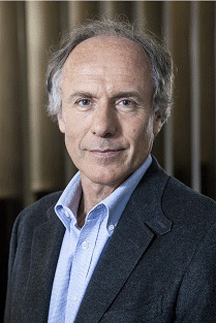
Chief Scientist Alan Finkel makes last ditch plea for clean energy target, SMH, James Massola, Cole Latimer, 9 Oct 17 Australia’s Chief Scientist Alan Finkel has made a last-ditch plea to save the proposed clean energy target, even as the Turnbull government signalled it will reject the proposal by the end of the year.
South Australian premier Jay Weatherill responded on Monday to the apparent standstill, saying the states should “bypass the federal government and provide investment certainty for the electricity sector” by adopting their own target.
The Turnbull government asked Dr Finkel to review Australia’s electricity market to set a policy path that would ensure reliability in the electricity system while also providing clear policy settings to drive investment in generation – something the business community has been demanding.
But in the face of strong opposition from sections of the Coalition backbench to the clean energy target, the Turnbull government delayed any decision on the target while adopting the other 49 recommendations in the Finkel review.
Now, it appears all but certain the target is dead in the water. The expectation is that by the end of the year, an alternative policy proposal that will focus on energy affordability and reliability – and removes incentives for renewable energy – will be brought by Energy and Environment Minister Josh Frydenberg to the cabinet and party room for approval.
That proposal could be put forward as soon as next week, when Parliament returns, though government insiders said that was unlikely at this stage.
Speaking at the Australian Financial Review‘s energy summit on Monday, Dr Finkel said his proposal offered a mechanism to solve the energy crisis and was still needed, while arguing that going back to coal was not the answer as Australia was making the transition away from fossil fuel energy………
Abbott went for the whole canon of tired climate science denial talking points – carbon dioxide is just food for plants, the climate has always changed, it’s the sun –
Abbott’s speech was also chock-full of internal contradictions. He suggested a conspiracy to tamper with temperature readings, but admitted the globe was warming. He described carbon dioxide as a “trace gas” and dismissed its role in warming, but elsewhere thought warming (which might not be happening) would be good. And the “trace gas” is insignificant, but not when it comes to its ability to “green the planet” and help plants grow.
Tony Abbott titled his London speech on climate change “Daring to Doubt” – a challenge, if you will, to reject mountains of evidence and instead lick your fingers and shove them into the plug socket of denial.
But what would constitute bravery for a conservative politician like Abbott? Changing your mind when the evidence tells you you’re dead wrong, or saying what you’ve always said, using the logical fallacies that you’ve always used? One step is brave, the other is cowardly.
Nobody should be surprised that what we got was an absolute crap speech from a man who confessed he still thinks climate science is “absolute crap”. Continue reading →
Adani: Thousands turn out across Australia to protest against Carmichael coal mine, ABC News 8 Oct 17 A national day of action to oppose the proposed Carmichael coal mine has seen thousands of protesters turn out in locations across Australia.
Rallies in locations including Sydney, Brisbane, Melbourne, the Gold Coast and Port Douglas in North Queensland heard messages against Indian company Adani’s proposed mine in the Galilee Basin.
Adani has promised thousands of local jobs but opponents say the project will fuel global warming and destroy the Great Barrier Reef.
“If this mine does go ahead it drives us into a dirty future and Australia is a country that’s smarter than that,” said Simon Fosterling, a Bondi surf life saver at the Sydney protest, which attracted about 2,000 people.
Protesters spelled out ‘#STOP ADANI’ by standing in formation on the sand………
Sydney Stop Adani campaigner Isaac Astill called the construction of the mine an international issue.
“It’s going to be the biggest coal mine in the southern hemisphere at a time when our climate is crumbling,” Mr Astill said.
It’s an international issue and that’s why we’re seeing people around the world and in Australia coming out in their thousands to say no to Adani.”
About 2,000 people rallied in Melbourne’s Princes Park carrying placards reading ‘Coal=CO2!!!’ and ‘Protect Our Future’.
Australian Conservation Foundation CEO Kelly O’Shanassy said she hoped the “big day of action” would send a strong message that taxpayers did not want their money subsidising the project…..
At Miami on the Gold Coast around 200 people turned out to oppose the mine.
“We know how important this is and we know there’s a growing movement and more and more people are realising how desperately we need this to stop,” said Shane Primrose of the Stop Adani Gold Coast group…….
Thousands of Australians also participated in protests against Adani at 45 locations across the country
Most Australians don’t want work on the Adani Group’s coal mine to go ahead, a new poll commissioned by Australia Institute has found.
As per the poll findings released on Saturday and Sunday, even more Australians oppose the proposed government assistance of $1 billion to the Adani Group. The borrowed money would reportedly be used to build a railway line to nearby Abbott Point coal port.
The poll findings were published in Guardian Australia.
The survey, conducted by market research agency ReachTel, interviewed 2,200 people across Australia. While 55.4 per cent opposed the mine, 18.4 per cent of the respondents remained undecided.
Meanwhile, thousands of Australians on Saturday across 45 locations also protested against Adani’s mine, forming human signs reading “Stop Adani.” The protests were reportedly organised by Stop Adani Alliance, a community group comprised of at least 31 environment organisations aimed at keeping the Carmichael Coal Mine from operating. The group has cited destructive environmental impact that the proposed mine could have on the waters of the Great Barrier Reef as a primary reason behind its reservations about the mine.
According to the Australia Institute survey, the opposition to Adani’s mine cut across political persuasions, with the findings showing that majority of Liberal and Labor voters opposed the project. While the Liberals are in power at the national level in a coalition, a Labor government is at the helm in Queensland.
Nearly 65.8 per cent of those polled stated that Annastacia Palaszczuk, Premier of Queensland, the state where the mine is proposed to come up, should veto the $1 billion loan being mulled for Adani’s project.
The Adani Group has been saying that the mine would generate thousands of jobs and help the troubled economy of Queensland, a claim endorsed by both the state and national governments. Critics, on the other hand, say that the claims are overrated, and the mine would spell disaster for the environment besides hitting the tourism revenue.
Slow progress on key $12 million Queensland climate change policy, SMH, Tony Moore , 7 Oct 17, Progress appears slow on one of Labor’s key climate change policies to encourage coastal Queensland councils to formally adopt a 0.8-metre higher sea level to combat beach erosion and storm surge problems.
The state government cannot say how many of the 41 coastal councils in Queensland have formally adopted the higher sea level, despite two departments being given four days to answer.
However, funds from the $12 million set aside by the state government has now gone to 21 of the 41 oceanside councils to develop plans.
Gold Coast City Council last week formally adopted the higher sea level when they updated their Gold Coast City Plan last week, as part of Queensland’s Climate Adaption Strategy.
Fairfax Media believes Cairns and Townsville councils have adopted the 0.8-metre higher sea level but it remains unclear if Moreton Bay Regional Council has accepted the higher sea level.
The policy allows coastal communities to better prepare homes and businesses for sea erosion and storm surge damage from increasingly frequent storms and cyclones as temperatures warm by 2100.
Gold Coast City Council last week formally adopted the higher sea level when they updated their Gold Coast City Plan last week, as part of Queensland’s Climate Adaption Strategy.
Maps produced by Geoscience Australia for the Australian government show localised flooding in three scenarios: a 50-centimetre sea level rise, an 80-centimetre rise and a 1.1-metre rise.
The Geoscience maps show a considerable flood impact on the Gold Coast’s northern suburbs and in the canal estates…….
Earlier this year Local Government Association president Mark Jamieson said more than 30 Queensland councils would be gradually affected by rising sea levels.
“More than half of Queensland’s 77 councils will be exposed to coastal hazards in the future,” Cr Jamieson said.
“It’s vital that local governments work together to assess risks and identify practical solutions that will help coastal communities prepare for serious issues such as storm tide flooding, coastal erosion and sea level rise.”
That means that places such as Perth, Adelaide and various regional towns could conceivably hit that mark even sooner.
This trend is worrying, but not particularly surprising given the fact that Australia is setting hot weather records at 12 times the pace of cold ones. But it does call for an urgent response.
Most of us are used to hot weather, but temperatures of 50℃ present unprecedented challenges to our health, work, transport habits, leisure and exercise.
Humans have an upper limit to heat tolerance, beyond which we suffer heat stress and even death. Death rates do climb on extremely cold days, but increase much more steeply on extremely hot ones.
While cold weather can be tackled with warm clothes, avoiding heat stress requires access to fans or air conditioning, which is not always available……….
Reinstating climate and health research, health workforce training and health promotion are key recommendations.
There is much more to be done, and the prospect of major cities sweltering through 50C days escalates the urgency.
Two key messages arise from this. The first is that Australia urgently needs to adapt to the extra warming.
Heat-wise communities (or “heat-safe communities” in some states) — where people understand the risks, protect themselves and look after each other — are vital to limit harm from heat exposure.
The health sector must have the resources to respond to those who succumb. Research, training and health promotion are central.
Can We Save the Reef? #Catalyst #Science #StopAdani #ClimateChange
Off Australia’s northeast coast lies a wonder of the world; a living structure so big it can be seen from space, more intricate and complex than any city, and so diverse it hosts a third of all fish species in Australia. John Pratt 3 Oct 17
The Great Barrier Reef as we know it — 8,000 years old and home to thousands of marine species — is dying in our lifetime.
Can We Save the Reef?
The epic story of Australian and international scientists who are racing to understand our greatest natural wonder, and employing bold new science to save it. VisitJohn,
IEEFA’s Tim Buckley told Four Corners a potential $1.5bn loss on any decision to walk away from the mine proposal explained why the Adani Group remained focused on securing Australian taxpayer support through a Northern Australia Infrastructure Facility loan
Adani needs Carmichael mine to stave off income crash, report says
The Indian mining giant faces plummeting revenue and risks losing the Abbot Point coal terminal, while new questions have arisen about its ownership structure, Guardian, Joshua Robertson, 3 Oct 17, Adani’s ambitions face a grave new risk in Australia, where its grip on its only operating asset, a Queensland coal port, is threatened by a crash in income unless its contentious Carmichael mine becomes a reality, a new report says.
Adani must refinance more than $2bn in debt on the Abbot Point coal terminal – more than it paid for the port in 2011 – despite earning $1.2bn in revenue and paying virtually no tax in Australia since, according to the Institute for Energy Economics and Financial Analysis.
And Adani must gain fresh lender backing at a time when the port faces plummeting revenue that only its $5bn mine proposal, itself yet to secure finance, can make up for, the analysis says.
IEEFA’s analysis was included in an ABC Four Corners program on Adani on Monday that also featured a former Indian environment minister saying he was “appalled” by Australia’s approval of the mine.
Jairam Ramesh told the program Adani’s environmental history in India “leaves a lot to be desired” and questioned whether the Australian and Queensland governments had properly considered this or its financial conduct, including allegations of large-scale fraud.
“There’s no reason for me to believe that Adani would be a responsible environmental player globally,” he said.
The IEEFA report found new links between Adani’s Australian corporate structures and a Caribbean tax haven, the port in particular having a “complex and opaque ownership structure [that] appears well-suited to minimising tax”.
It was previously thought that local companies relating to Abbot Point and a proposed rail link with the Carmichael mine – for which Adani is seeking a concessional loan of up to $900m from Australian taxpayers – were owned by an Adani family company in the Cayman Islands, Atulya Resources Limited.
But Singapore corporate filings show Atulya is owned by another Adani family company in the British Virgin Islands, ARFT Holding Ltd.
And two trusts related to the Carmichael rail project are potentially held by another BVI-registered company called Carmichael Rail Australia Ltd, according to the IEEFA analysis. One of the trusts holds a $2/tonne royalty deed that would net the Adani family income from the Carmichael mine, which is expected to yield up to 60m tonnes a year.
Contracts that force Abbot Point’s coalmining customers to pay for using the port’s full capacity have begun to expire, with the port actually running at just over half its capacity as the bullish predictions of a coal boom gave way to a downturn.
To refinance the port, Adani needed to “convince financiers that [Abbot Point] will be fully utilised into the future” with its own Carmichael mine the only candidate to pick up this looming shortfall of about 25 million tonnes a year, IEEFA said.
The port thus ran “the risk of becoming a stranded asset” if the Carmichael mine, itself a $5bn greenfield project that represented a “high-risk gamble”, did not secure financial backing overseas, it said.
Adani Australia: Investigation uncovers tax haven ties to British Virgin Islands, Four Corners ,By Stephen Long, Wayne Harley and Mary Fallon , ABC News, 3 Oct 17 An investigation by the ABC’s Four Corners program has uncovered previously unknown tax haven ties for Adani Group’s Australian operations, with key assets ultimately owned in the British Virgin Islands.
Key points:
Adani Group’s filings with ASIC fail to mention a company registered in the British Virgin Islands
Vinod Adani, older brother of Adani Group chairman Gautam Adani, has been under investigation in India
Vinod Adani also a substantial shareholder in Adani Enterprises Limited
Adani Group has promised a $22 billion windfall in taxes and mining royalty payments for Australia over the life of the giant Carmichael coal mine it has been given approval to build in outback Queensland.
But experts say an opaque web of companies and trusts behind its Australian assets gives it ample opportunity to minimise the tax it pays.
Adani Group’s assets in Australia include the Abbot Point Coal Terminal near Mackay in Queensland, a terminal expansion project it has approval to undertake at Abbot Point, and a planned railway line of nearly 400 kilometres from the port to the giant mine it wants to build in the Galilee Basin — aided by a subsidised loan of up to a $1 billion it is seeking from the Federal Government’s Northern Australia Infrastructure Facility.
It was previously thought that Atulya Resources, a Cayman Islands domiciled company controlled by members of the Adani family, was the ultimate holding company for Abbot Point, the expansion project, and the railway.
However, filings in Singapore by privately-owned Adani companies show that a company registered in another notorious tax haven, the British Virgin Islands, sits behind Atulya Resources.
Vinod Adani investigated over alleged scam
It is variously described in the offshore company filings as ARFT Holding Limited, AFRT Holding Limited and Atulya Resources Family Trust.
Adani Group’s filings with Australia’s corporate watchdog, ASIC, fail to mention this company, instead continuing to list Atulya Resources as the owner.
The British Virgin Islands’ company’s apparent position at the apex of the structure is disclosed in the financial reports of a series of Adani companies controlled by Vinod Adani, also known as Vinod Shantilal Adani or Vinod Shah.
Australia’s most populous cities could be hit by heatwaves of up to 50 degrees by the year 2050 even if the world succeeds in limiting global warming to two degrees above pre-industrial levels, climate scientists have warned.
Under the Paris climate agreement 166 countries, including Australia, pledged to stop global average temperatures rising more than two degrees over the levels before the Industrial Revolution.
But the researchers warn a global rise of two degrees on average could see the hottest Australian days get 3.8 degrees hotter than current records. ANU co-author Dr Sophie Lewis said a certain amount of global warming was already “locked in”, and Australia would need to take steps to prepare.
“If we have the globe warming by 1.5 degrees we’re going to get very extremely hot days in Australia and they do have very serious consequences,” Dr Lewis said.
“We’re going to end up where we really have to be prepared and have alert systems for those hot days, just as people do in North America or Europe in terms of blizzards.”
She said the hotter temperatures would take a toll on human health, infrastructure and delicate ecosystems like the Great Barrier Reef. Heatwaves would be more intense and longer-lasting, she said.
Schoolkids would likely need to stay home on more hot days, and adult workers may also find the heat preventing them from working more frequently.
The study was published in ‘Geophysical Research Letters’ by researchers from the Australian National University and the University of Melbourne.
Dr Lewis said 50-degree heatwaves for the major cities could come between the year 2040 and 2050, depending on the rate of global carbon dioxide emissions.
“We’ll only be ready for those if we take that seriously and start planning for them now, just like we would for bushfires.”
Dr Lewis said the exact amount of global warming would make a big difference to maximum temperatures. The difference between 1.5 degrees and two degrees might sound insubstantial but would cross various environmental thresholds, she said.
Apr 15, 2026 01:00 AM in Canberra, Melbourne, Sydney
Join the International Physicians for the Prevention of Nuclear War (IPPNW) on Tuesday, April 14th for a timely webinar exploring the risks associated with nuclear power and challenging the myth that it offers a simple, safe, carbon-free solution to the climate crisis
21 April Webinar: No Nuclear Weapons in Australia
Start: 2026-04-21 18:00:00 UTC Canberra, Melbourne, Sydney (GMT+10:00)
End: 2026-04-21 19:30:00 UTC Canberra, Melbourne, Sydney (GMT+10:00)
Event Type: Virtual A virtual link will be communicated before the event.








 Antinuclear