Anti Adani coal project- action is seriously hotting up in Queensland
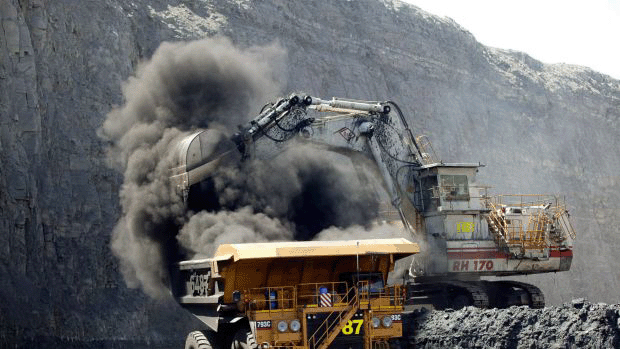 Anti-Adani protesters promise week-long action against Queensland mine https://www.brisbanetimes.com.au/national/queensland/qld-adani-protesters-promise-week-long-action-20170916-p4yvy9.html 16 September 2017
Saying goodbye to coral reefs
If we continue to have warm summers like we had in ’16 and this year, the next one could wipe out the remaining coral. Now, I don’t want to sound doomsday, but that’s where we’re at right now. It’s still a wonderful place to visit. But if we continue on this trajectory it won’t be, very soon – within our lifetime. I think that this is the wake-up call that we need. If losing the Great Barrier Reef isn’t serious stuff, what is?
 Farewelling coral reefs The Saturday Paper, Karen Middleton, 16 Sept 17 We hear much about trying to contain temperature rises to 2 degrees above pre-industrial levels. Why is that the magic number?
Ove Hoegh-Guldberg The 2-degree guardrail came out of the 2009 Copenhagen meeting. When you looked at how ecosystems were responding, you got into an unmanageable area at 2 degrees above the pre-industrial period, which was where the CO2 concentration had been stable for a long time. The trajectory we’re on today could raise temperatures by as much as 5 or 6 degrees on history.
One of the problems with 2 degrees is that generally people have the idea that it’s a guardrail. You go up to the edge of 2 degrees and look over it and see where you don’t want to go and it’s all very safe here. But it’s more like a slippery slope. Things get progressively worse until they become unmanageable. At the latest Conference of the Parties, the UNFCC [United Nations Framework Convention on Climate Change ] governing framework started to say, “well actually we want to keep things well below 2 degrees, and hopefully aim for 1.5 in the long term”.
KM And where are we now? Continue reading
Carbon capture shown to be uneconomic and impractical
Why Nuclear Energy May Not Be Our Best Alternative Option To Fossil Fuel, Forbes, 9 Sept 17 , Michael Barnard, low-carbon innovation analyst, on Quora: “… From a carbon capture and sequestration perspective, there’s exactly one sequestration project associated with a coal generation plant which is actually sequestering any reasonable amount of carbon. It’s in Saskatchewan, Canada. It was operating at 40% of targets for months and nobody noticed. It’s very expensive.
I did an assessment of all sequestration efforts in Australia over the past 19 years recently and found that they had spent $4,300 AUD per ton to sequester a vanishingly tiny fraction of Australia’s emissions.
The US CCS projects have gone vastly over forecasts and are abandoned and no new ones are projected. The UK government has stopped funding them………
Are environmentalists saying that CCS doesn’t make sense? Yes, because 20 years of work has shown that CCS related to fossil fuel generation has failed to progress, deliver to milestones or show that it is capable of providing any useful contribution. It’s just not economically or practically possible. …….https://www.forbes.com/sites/quora/2017/09/09/why-nuclear-energy-may-not-be-our-best-alternative-option-to-fossil-fuel/#25ec6e8375d0
Australia’s greenhouse gas emissions have risen
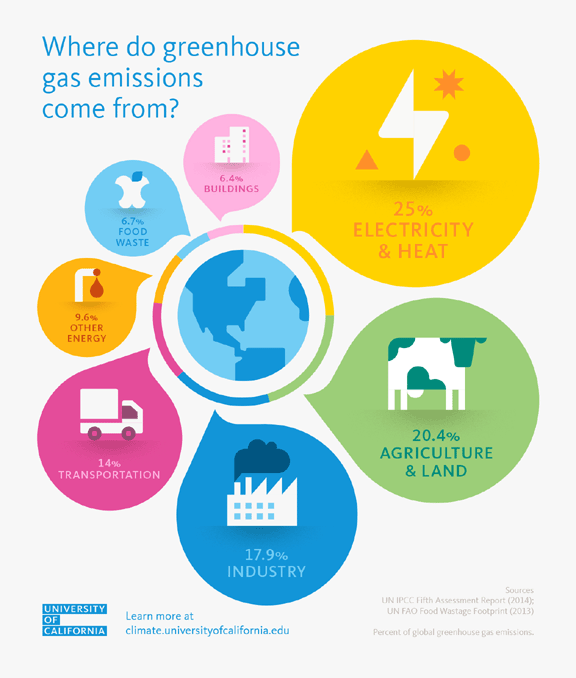 Australian emissions have actually increased since we closed our biggest coal-fired power plant http://www.news.com.au/technology/environment/climate-change/australian-emissions-have-actually-increased-since-we-closed-our-biggest-coalfired-power-plant/news-story/14107f5632844d3ffca1f35e5685b3c6
DESPITE the fact we closed our grubbiest coal-fired power plant in March, Australia’s emissions have actually grown to the highest level since 2011. Kirrily Schwarz , 8 Sept 17 AUSTRALIAN greenhouse gases last year were the highest since 2011, despite the closure of our grubbiest coal-fired power plant.
The electricity sector had its biggest drop on record in the three months to June, following the closure of Victoria’s Hazelwood power station, which burned brown coal deposits from an open-cut mine in nearby Morwell.
However, even that wasn’t enough to stop Australia’s overall greenhouse gas emissions from rising, with increases recorded in every other sector. That’s according to new projections reported in the Guardian, which take stock of quarterly emissions across the country.
According to environmental experts, Australia has now consumed 24 per cent of the carbon budget set by the government’s Climate Change Authority. The budget represents the total amount of carbon Australia can release from 2013 while keeping global warming under two degrees. The alarming revelation comes as new modelling shows South Australia and Victoria both risk four-hour blackouts this coming summer.
The Australian Energy Market Operator released its annual stocktake this week, showing there’s a heightened risk of a shortfall over the next decade if nothing is done. “The power system does not have the reserves it once had,” Audrey Zibelman, chief executive of the Australian Energy Market Operator, told AAP.
The South Australian government’s energy plan includes extra diesel generation, and is working with entrepreneur Elon Musk to develop much-hyped battery storage.
Victoria, meanwhile, is rolling out a large-scale storage plan the government says will boost storage capacity by 100 megawatts by the end of 2018.
Both states will ask consumers to use less electricity during peak times.
Mr Turnbull seized on the report to highlight the vulnerability of the nation’s electricity supply, but said measures were in place to cover the immediate gap.
The Prime Minister also revealed he and Energy Minister Josh Frydenberg were in talks with energy company AGL about keeping open the Liddell power station in NSW at least five years beyond 2022, while the Snowy Hydro 2.0 project is completed.
However, AGL is working on shutting down all its coal-fired plants, and in August ruled out extending the Liddell plant’s life.
Meanwhile, Labor has offered to work with the government for a “constructive compromise” on energy policy so something can actually be done to drive down power prices.
But the Greens are angry the two major parties agree on subsidies for coal.
Mr Turnbull has set a deadline of developing a clean energy target — as recommended by Chief Scientist Alan Finkel — before Christmas.
Opposition Leader Bill Shorten called on the government to just get on with its job. “The number one problem contributing to energy prices in this country, out-of-control energy prices, is the absence of proper national policy,” he told reporters in Canberra.
The figures come at a time when electricity is more expensive than ever. Power prices jumped on July 1 after three major retailers announced increases of up to 20 per cent and $600 a year for the average customer in several states.
CSIRO a paid-up member of Minerals Council, which fights climate change action
 Science agency stands in contrast to Australia’s biggest polluter, AGL, which parted ways with MCA over climate change, Guardian, Michael Slezak, 6 Sept 17, The Australian government’s science agency, the CSIRO, has paid tens of thousands of dollars to peak mining lobby group the Minerals Council of Australia, which fights against government action on climate change.
The CSIRO has been listed as an “associate member” of the Minerals Council of Australia (MCA) since at least 2004 and new documents obtained by the Australian Institute, under freedom of information laws, show that in 2017 the “annual subscription” for membership was just under $10,000.
The mining lobby plays a vocal role in Australian climate change policy debates and the positions it takes are on the extreme end of the spectrum and include pushing for more coal power stations to be built.
The CSIRO continues to be a member of the MCA despite even Australia’s biggest climate polluter, AGL, publicly parting ways with the Minerals Council of Australia in 2016, saying it did so because of the positions the MCA took on climate change.
“AGL’s positions on climate change and renewable energy differed from those held by the Minerals Council of Australia … and AGL has elected not to renew its membership,” the company said in its 2016 sustainability report.
CSIRO declined to answer specific questions about how long it had been a member, what the cost had been and what the CSIRO got in return for membership. A CSIRO spokesman instead gave a statement, published in full below. [on original] …….
CSIRO has come under fire in recent years for a perception it has not been giving fearless advice to the public and to government on climate-related issues. At the same time, the organisation has cracked down on employees who themselves seek to speak publicly on policy issues……
ohn Church, a world-leading climate scientist who was made redundant in the organisation’s 2016 job cuts and who was one of the disgruntled employees in the leaked emails, told the Guardian CSIRO’s membership of the MCA was in contradiction to its refusal to engage in policy debates.
“I would definitely say there was a conflict,” Church said. “CSIRO is putting itself in a position where it is implicitly supporting particular policy positions by being a member of the Minerals Council.
“They should not only be independent but be seen to be independent.”
A senior climate scientist still at the CSIRO told the Guardian that currently it is almost impossible for climate scientists there to speak publicly about policy…….
Other public organisations with associate membership of MCA include ANSTO Minerals and the University of Western Australia……ANSTO Minerals, part of the government-owned Australian Nuclear Science and Technology Organisation is also an associate member of the Minerals Council and a spokesman said ANSTO was a member of the Uranium Forum of the MCA and also sits on the radiation protection working group…..https://www.theguardian.com/australia-news/2017/sep/06/csiro-member-minerals-council-which-fights-climate-change-action
Climate change and the link to Australia’s record-breaking winter warmth
 Australia’s record-breaking winter warmth linked to climate change https://theconversation.com/australias-record-breaking-winter-warmth-linked-to-climate-change-83304 Climate Extremes Research Fellow, University of Melbourne, September 1, 2017 On the first day of spring, it’s time to take stock of the winter that was. It may have felt cold, but Australia’s winter had the highest average daytime temperatures on record. It was also the driest in 15 years.
Back at the start of winter the Bureau of Meteorology forecast a warm, dry season. That proved accurate, as winter has turned out both warmer and drier than average.
While we haven’t seen anything close to the weather extremes experienced in other parts of the world, including devastating rainfalls in Niger, the southern US and the Indian subcontinent all in the past week, we have seen a few interesting weather extremes over the past few months across Australia.
Drier weather than normal has led to warmer days and cooler nights, resulting in some extreme temperatures. These include night-time lows falling below -10℃ in the Victorian Alps and -8℃ in Canberra (the coldest nights for those locations since 1974 and 1971, respectively), alongside daytime highs of above 32℃ in Coffs Harbour and 30℃ on the Sunshine Coast.
During the early part of the winter the southern part of the country remained dry as record high pressure over the continent kept cold fronts at bay. Since then we’ve seen more wet weather for our southern capitals and some impressive snow totals for the ski fields, even if the snow was late to arrive.
This warm, dry winter is laying the groundwork for dangerous fire conditions in spring and summer. We have already had early-season fireson the east coast and there are likely to be more to come.
Climate change and record warmth Continue reading
Tony Abbott to join Britain’s Nigel Lawson in climate denial lecturing in Britain
 Tony Abbott to lecture leading climate-change sceptic think tank, http://www.theaustralian.com.au/news/nation/tony-abbott-to-lecture-leading-climatechange-sceptic-think-tank/news-story/ce897ce09992d942256245dd08edf0fd, GRAHAM LLOYD, 1 Sept 17, Former prime minister Tony Abbott will give the annual lecture to one of the world’s leading climate change sceptic think tanks, the Global Warming Policy Foundation in London.
The title of Mr Abbott’s address will be “Daring to doubt”.
The invitation-only lecture will be held at the Institution of Mechanical Engineers in Birdcage Walk, London, on October 9. Mr Abbott will follow John Howard who addressed the foundation’s lecture in 2013 with a speech “One religion is enough”.
The foundation is chaired by former Thatcher government treasurer Lord Nigel Lawson.
The foundation is one of the world’s most active groups promoting debate about the state of climate change science.
It republishes articles and material both supportive and against the mainstream science view and commissions research on climate change-related issues.
The foundation is funded by private donations and does not accept gifts from energy companies or anyone with a significant interest in an energy company.
Mr Abbott’s spokeswoman said the trip would be privately funded by the foundation
Australian government watering down the climate recommendations of the Finkel energy report
 Coalition watering down Finkel review climate ambitions, leaked document reveals
Draft implementation plan lacks electricity emissions trajectory, Paris agreement alignment and low-income subsidies, Guardian, Michael Slezak 31 Aug 17, The climate ambitions of the Finkel review appear to be being watered down by the government as it is implemented, according to a draft Coag Energy Council implementation strategy obtained by the Guardian.
The draft implementation plan removes a key recommendation for an agreed emissions trajectory for the electricity system, alignment with the Paris agreement and subsidised solar and batteries for low-income houses.
Sources tell the Guardian the document was prepared by the federal government and distributed to state and territory representatives on the morning of the meeting, leaving little time for state representatives to analyse it…..
At a teleconference on Friday last week, state and territory energy ministers were presented with a draft implementation plan for discussion.
That document, obtained by the Guardian, appears to water down those recommendations in relation to climate change, and removes some altogether.
One key recommendation in the Finkel review that has been severely weakened in the draft implementation document is a change that would force the electricity market to align efforts to meet government emissions reduction commitments made as part of the Paris agreement.
But the draft implementation document removes the reference to international emissions reduction commitments, instead saying merely that the agreement will “reaffirm Australian governments’ commitment to the [national electricity market] and a national, integrated approach to energy and emissions reduction policy”.
Among Finkel’s key recommendation for an “orderly transition”, he called for three things: the clean energy target; a three-year notice of closure for existing large generators; and “an agreed emissions reduction trajectory”. All three moves were part of one recommendation, numbered 3.2.
The Coalition has not agreed to adopt the clean energy target but it has agreed to the three-year notice-of-closure rule, which appears in the implementation plan. However, the plan does not contain any mention of an agreed emissions reduction trajectory…….
Another Finkel recommendation calls for low-income households to be given subsidised access to “energy efficient appliances, rooftop solar photovoltaic and battery storage systems”.
Explicit references to renewable energy has been removed in the draft implementation plan and replaced with “energy efficiency and demand management technologies”.
Sources say representatives of the ACT raised the question of the trajectory being removed, and asked for it to be included. Representatives of Queensland and Victoria also apparently raised concerns about some of the other changes.
Sources said the document, which was prepared by the federal government, was circulated to state energy ministers only hours before the meeting was held, leaving little time for proper scrutiny.
The document is expected to be finalised and sent to heads of government today. https://www.theguardian.com/australia-news/2017/aug/31/coalition-watering-down-finkel-review-climate-ambitions
The Finkel clean eneergy target will not meet Australia’s goals in Paris climate agreement
 Finkel clean energy target too weak for Paris climate goal,
  analysis shows Target will transfer pressure to other sectors of the economy to reduce their emissions, research shows, Research commissioned by the Australian Conservation Foundation on the clean energy target says the trajectory of emissions reduction is not strong enough. Guardian, Katharine Murphy, 29 Aug 17
The clean energy target recommended by Australia’s chief scientist, Alan Finkel, won’t deliver Australia’s obligations under the Paris agreement and will only transfer pressure to other sectors of the economy to reduce their emissions, according to new analysis.
The new research comes as the Coalition’s difficult internal deliberations over the Finkel review are set to resume, with a report due from the Australian Energy Market Operator about the dispatchable power requirements of the electricity grid after the closure of two ageing coal-fired power stations.
And it comes as the prime minister will on Wednesday hold a second meeting with Australia’s major energy retailers in an attempt to make it easier for consumers to switch their power provider – a response to acute political pressure over rising electricity bills.
Discussions between the government and the companies in the lead up to Wednesday’s talks have centred on whether energy companies can offer monthly billing to try and prevent bill shock, and whether more can be done to communicate with hardship customers to ensure they aren’t locked in to inflated power contracts.
The new research on the clean energy target has been commissioned by the Australian Conservation Foundation.
The modelling says the Finkel trajectory would see Australia’s electricity emissions being phased out between 2095-2101 – a timeframe that is inconsistent with the Paris goal of limiting warming to two degrees, and of reaching carbon neutrality by mid-century.
It also points out that if the electricity sector does comparatively less of the heavy lifting on emissions reductions, the burden will fall more heavily on other sectors, with the largest reductions then falling on high emissions growth sectors, rather than the sectors with the largest share of total national emissions……..https://www.theguardian.com/australia-news/2017/aug/30/finkel-clean-energy-target-too-weak-for-paris-climate-goal-analysis-shows
Australian govt -‘no plans’ to build or fund coal power, says PM Malcolm Turnbull
 Malcolm Turnbull says Government has ‘no plans’ to build or fund coal power, ABC 28 Aug 17 By political reporter Henry Belot ,
Key points:
- The Coalition has accepted 49 of the 50 recommendations from the Finkel Report
- Barnaby Joyce, Tony Abbott among MPs wanting the CET to allow more coal power plants
- PM Malcolm Turnbull says his Government has funded green energy “to a large degree”
Prime Minister Malcolm Turnbull says his Government has no plans to build a new coal-fired power station, and he wants to resolve a fractious debate over a clean energy target (CET) by the end of the year.
What is to be done about Climate Change? – theme for August 17
 Frogs are smarter than we are? We insult frogs when we say that they would stay in a pot of water, to die, as it was slowly heated to boiling point. Dr. Victor Hutchison, at the University of Oklahoma, dispelled that myth when he studied frogs’ reaction to temperature changes in water. He followed the procedure outlined for a proper frog-boiling; put a frog in cold water, and gradually warmed the water up. (He stopped well before the boiling point.) The frogs most definitely did jump out when the water got too warm for them.
So – the message to human society surely should be – act like a frog – and don’t let global warming keep on creeping up on us!
Current approaches to the climate change crisis:
- Some climate scientists now warn that it is probably too late.
- Some advocate geoengineering solutions.
- Climate scientists are in agreement that actions must be taken to adapt to climate change.
- Drastic reduction in greenhouse gases is necessary, whatever other actions are taken.
Al Gore’s controversial new film carries a powerful message of hope.I hope that he’ s right.
Meanwhile the tragic main point of climate change is that it is affecting those who least deserve this. Rural populations in India, China and Africa , who have contributed very little to the cause of climate change are already afflicted with unusual heat, and drought. Pacific islanders, and South Asian coastal communities are already experiencing sea surges, as sea levels rise.
The challenge for this 21st century is surely for environmental justice – for meeting the plight of environmental refugees with help and compassion, rather than with barriers and conflict.
The image below is by courtesy of the arti st Ricardo Levins Morales www.RLMArtStudio.com
Australia’s coastal communities already vulnerable to climate change
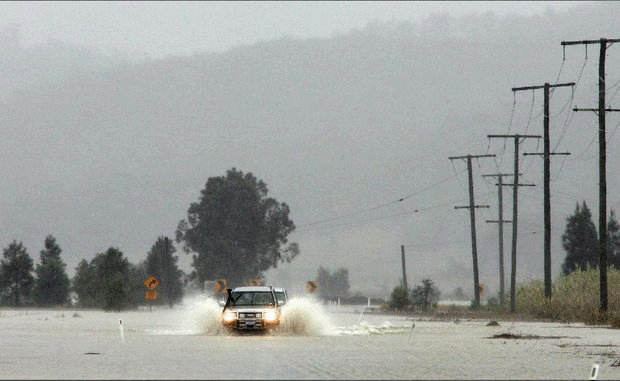 Flooding proved how vulnerable Coast is to climate change, Sunshine Coast Daily, Bill Hoffman | 26th Aug 2017 THE Sunshine Coast received a taste Monday night of the future normal for low-lying coastal communities everywhere when, in the middle of a drought-like winter, water flooded through storm water outlets and over the top of revetment walls and onto key streets across the region.
The cause wasn’t an intense east coast low, a cyclone or intense rain event normally associated with flooding of low-lying areas across the region. If it had occurred during daylight, particularly at peak hour, Mooloolaba would have been left grid-locked and Bradman Avenue, Maroochydore, reduced to one-lane along the river.
Twin Waters residents would have seen water up into the parks and footpaths along Twin Waters Drive and the river spilling into bushland for more than 100 metres along Nojoor Road.
At Caloundra the vulnerability of Tay and Maloja Avenues at Bulcock Beach would have been fully exposed.
What occurred required no more than a couple of days of strong southerly winds blowing up the NSW and Victorian coasts to set off the Ekman Transport Effect which lifted the Highest Astronomical Tide for the season at Mooloolaba from 2.03metres by additional 0.4 of a metre.
While for many the resulting impact of that degree of sea level rise went largely unnoticed, scientists at the University of the Sunshine Coast and hydrologists took note.
They are in agreement that Monday night’s short-term increase in sea levels afforded a glimpse of the future impact of the best-case 0.8 metre permanent rise now locked in by 2100 because of climate change.
The Ekman Transport Effect refers to the shift leftward that occurs when sustained winds blow in a consistent direction over the ocean moving the top 30m layer of water. The resultant upwelling is most likely to occur along New South Wales, south-east Queensland and the Bonney Coast (South Australia) coastlines.
Professor Tim Smith, director of the University of the Sunshine Coast Sustainability Research Centre, says the region has received a wake-up call in terms of what it needs to prepare for. “We are pretty lucky it was not combined with other things to intensify the situation like a low-pressure system or a high-intensity rainfall event or it would have been a much more devastating outcome,” Prof Smith said.
“We have to think about the design and placement of infrastructure and assets. We can’t continually defend and protect ad finitum. “Alternative adaptation strategies will be needed.”
He says the options are limited. The first is to try to protect assets without changing their location. Professor Smith said the approach was the emphasis of local authorities across Australia who don’t want to change but preferred to protect investments made in calm weather 40 years ago.He said the problem was that the environment was not static and could not be controlled.
The second strategy was to accept there were going to be impacts and to retrofit existing settlement and infrastructure to experience less damage. “You could raise houses to protect from periodic impacts if you were willing to live with them,” Prof Smith said.
The other option was to retreat in the process relocating settlement and assets out of harm’s way. “That’s a taboo subject, he said. “People don’t want to talk about it but eventually we will need to have a serious discussion.”
Hilo in Hawaii, Grantham in Queensland’s Lockyer Valley and Twin Rivers in New Zealand all provide limited examples of communities that have bitten the bullet and shifted their communities out of harm’s way.
“We can’t keep building walls higher and higher,” Prof Smith said. “The longer we leave it the more difficult it will become. The sooner we act the better.” He says the danger of protecting assets is that the protection gives confidence to put more in harm’s way, doubling the risk.
He takes issue with the failure of governments to be explicit about the planning time horizons of capital spending. If it’s 20 years it doesn’t matter. Longer than that may become problematic. What won’t cut it is a piecemeal response to climate change…… https://www.sunshinecoastdaily.com.au/news/how-flooding-provided-a-window-to-the-future/3216185/
Bundaberg MP insists that coastal communities must prepare for climate change.
 MP says preparing for climate change is vital for the Bundaberg region https://www.news-mail.com.au/news/mp-says-preparing-for-climate-change-is-vital-for-/3216829/, Jim Alouat | 26th Aug 2017 LOWER house insurance premiums could be on the cards if Bundaberg home owners take steps to embrace climate and weather-resilient designs.
Preparing for climate change is important for communities like Bundaberg where flooding is already a significant threat, says Bundaberg MP Leanne Donaldson.
According to the Queensland Climate Adaptation Strategy report, Queensland already experiences climate extremes such as floods, droughts, heatwaves and bushfires and climate change is likely to exacerbate the frequency and/or severity of these events.
Ms Donaldson said the government was having ongoing discussions with the insurance industry to see how actions to reduce exposure to climate hazards could reduce insurance premiums.
“However, the Queensland Climate Adaptation Strategy identifies the need to improve access to information on insurance options as a method to manage climate risk, and to investigate how we can improve access to finance for priority activities that improve our readiness and resilience to climate change,” she said.
Ms Donaldson said the suggestion of building ground floors that were ready for floods, was raised as just one example of many innovative solutions the sector might consider when adapting to changed weather patterns and greater climate risk.
“Whether it’s finding innovative solutions to make homes more flood resistant, or choosing to build in locations that are less prone to flooding, it is important that these risks are considered when planning our infrastructure,” Ms Donaldson said.
“There is a lot of work going into this area at the moment, particularly on how these climate risks can be better incorporated into planning guidelines.
“It’s also important to note that flooding is just one of many climate hazards identified in the sector adaptation plan that need to be considered when planning for changes in the climate.”
Ms Donaldson said the Built Environment and Infrastructure Sector Adaptation Plan will not affect the 10-year Flood Action Plan for the Bundaberg region.
“However, adapting to climate change is complimentary to building resilience and fulfilling the actions included in the Burnett River Floodplain,” she said.
A band of right-wing religious politicians are stopping climate action in Australia
The fact is that the great majority of religious leaders – from the Pope to the Dalai Lama – share Pickard’s views about the urgency of addressing climate change.
Yet in this country the resistance to any meaningful action to ameliorate climate change by reducing emissions of greenhouse gases is led to a substantial degree by those politicians who claim Christian faith.
Last year 350.org released a list of the most implacable opponents to climate change action. At or near the top of the list were the following names: Tony Abbott, Barnaby Joyce, Kevin Andrews, Cory Bernardi, Eric Abetz, George Christensen and Zed Seselja. These politicians are bound together by their strong and frequently touted religious belief.
How the religious right stall climate action, While most religious leaders accept climate change, the Christian right in Australia and the US make scepticism a tenet of their politics. Saturday Paper, By Mike Seccombe. 26 Aug 17 It has been more than three years now since Stephen Pickard penned his letter to the religious believers among our federal parliamentarians, arguing the case for action on climate change. Continue reading
As climate change intensifies, Australia’s farmers will be hard hit
Climate change will hit our farmers harder and hotter https://www.qt.com.au/news/climate-change-will-hit-our-farmers-harder-and-hot/3216205/ Geoff Egan | 25th Aug 2017 A LEADING commodity trader has warned increasingly common extreme and volatile weather conditions will cause havoc for Queensland’s agricultural producers.
Commodities trader Jonathan Barratt has warned record wet and dry periods will become more common as climate change intensifies and will dramatically impact primary producers.
Mr Barratt said July 2017 was the driest July in 118 years – and as a result of climate change similar records were being set more often.
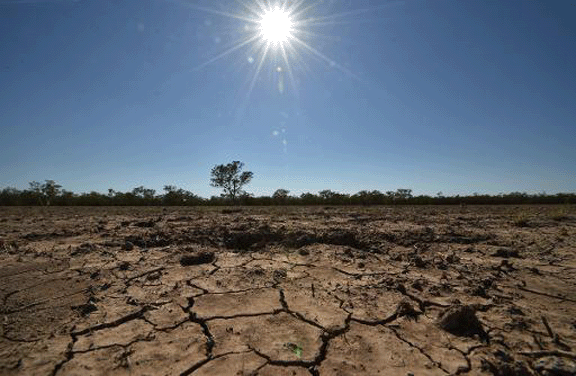
“The volatility we have experienced in the climate in the last three years has been unprecedented. I have been predicting that climate change will shift regional weather patterns and that adverse events not only occur but be more frequent. Now it’s happening,” he said.
“The combined deficits of rain and higher than normal temperatures in some areas this season have sapped what moisture profiles farmers had and, as some growers close the chequebook on crops, others are contemplating if it is worth adding another layer of costs to an already thirsty crop.”
Mr Barratt’s warning comes just days after University of NSW research found farmland would get drier and cities flood more often under climate change.
The research paper found as global temperatures rise more evaporation would occur from moist soils in farming lands, drying them out quickly. In contrast, urban areas with more limited exposed expanses of soil would retain the moisture and become vulnerable to intense rain events.
UNSW researcher Conrad Wasko said the change was a “double whammy”.
“People are increasingly migrating to cities, where flooding is getting worse. At the same time, we need adequate flows in rural areas to sustain the agriculture to supply these burgeoning urban populations,” he said.
1 This month



Help Aunty Sue Protect Her Land and Sacred Sites From Destructive Rocket Testing.
.

Australians deserve the truth
about
AUKUS – https://aukuspublicinquiry.com/

PETITION – To: Prime Minister Anthony Albanese and the Australian Labor Government

of the week – Australians for War Powers Reform (AWPR)
To see nuclear-related stories in greater depth and intensity

