‘One of the biggest threats to Australia’s beloved Great Barrier Reef, Adani’s Carmichael coal mine is weeks away from being finalised. Concerned citizens have no time to lose in opposing it, say activists.’Vaidehi Shah
While those who want to argue whether climate change is real or some sort of Chinese conspiracy, those with real money at risk have moved on. The science is accepted, they have plenty of evidence to back up their own concerns, and now they want to find a way to deal with the financial repercussions.
Last year, after some extreme weather, a string of houses were left hanging in mid-air. The beach, and backyards, of these homes had simply disappeared.
It grabbed our attention. But it also grabbed the attention of the banks that had lent money to those homeowners and tens of thousands of others who like to live next to the beach.
If you’re a bank, you want to make sure that the people who you lend cash to can repay it.
That means taking into account their income levels as well as the value of the asset they’re purchasing.
There’s not much sense in giving someone a $500,000 mortgage that may be falling in value. In the case of a problem with repayments, and the bank is forced to sell the property, then there’s no chance it will get its money back.
Perfect banking sense. And so it is perfect banking sense to start taking into account the threat posed by climate change.
In the case of the homes on that Sydney beach, if climate change is washing away part of the property then — by definition — the value of that property is falling. Indeed, the property is actually getting smaller as it is swept out to sea.
So you would not be surprised to know that the nation’s banks are starting to look at what climate change might mean to the values of the assets that underpin the best part of $1.5 trillion in mortgages.
There is a growing risk that if your home loses value due to climate change — it’s in a flood-prone area, it’s not very high above sea level, it’s surrounded by increasingly bushfire-prone forests — then how much you can borrow could be curtailed.
You also shouldn’t be surprised that the insurance sector is also looking very closely at what climate change-induced events may mean for its coverage and its fees. Continue reading →
Queensland Cyclone Debbie: Economic impact, Courier Mail, April 2, 2017 QUEENSLAND coal exports may have taken a $1.5 billion hit from Cyclone Debbie as more than 22 mines were forced to halt production while roads and ports were shut.
Economists also tip a hit to the state Budget, with a temporary loss of coal royalties and lost agricultural production. But they also warn that negative talk about the impact on resorts could hurt tourism operators unaffected by the weather.
Energy analysts IHS said about 10 million tonnes of coal production was lost as buyers went elsewhere.
Mines will also be affected by impassable roads and flooded pits, but the losses aren’t expected to be anywhere near those incurred by Cyclone Yasi, when about 40 million tonnes of production was lost.
Labor to drop renewable energy target in favour of emissions scheme
RET will come to a natural end as emissions intensity scheme can reach goal of 50% renewable energy by 2030, says Andrew Leigh , Guardian, Paul Karp, 2 Apr 17, Labor will abandon the renewable energy target after 2020 because an emissions intensity scheme will be sufficient to reach the goal of 50% renewable energy by 2030, Andrew Leigh has said.
On Sky News on Sunday the shadow assistant treasurer firmed the opposition’s plan to reach the 50% goal without a hard target in comments that appeared to rule out extending the existing renewable energy target (RET).
“We’ve committed to getting 50% renewables but the mechanism that we’ve used in the past has been a renewable energy target. That comes to an end and we believe an [emissions intensity scheme] EIS can take us to the point of having 50% renewables … without the RET,” Leigh said.
Asked to confirm that meant Labor would not support the RET when it expired in 2020, Leigh responded: “We believe that the emissions intensity scheme does that job … without a RET.”……..
Leigh noted that an EIS was supported by experts across the field, including the Business Council of Australia and many energy regulators. He noted renewables account for the majority of new investment in electricity generation in the last decade.
“One of the government’s favourite backers, Bjørn Lomborg, not somebody Labor would usually support, says that every $1 invested in renewables gives you a pay back of $11.”
Why Koalas Are Suddenly Drinking Extra Water, National Geographic, 30 Mar 17, Koalas usually get the water they need from their food—but hotter, drier weather is making some koalas desperate. March 31, 2017 – Koalas have been showing an uncharacteristic behavior: drinking water. Koalas typically meet most of their daily need for water just by eating leaves. But researchers from the University of Sydney have documented an increase in sightings of koalas looking for water. Cameras near watering spots around the New South Wales, Australia town of Gunnedah showed koalas coming to drink, a cute sight that nonetheless may signal increased pressure from climate change……..http://news.nationalgeographic.com/2017/03/koala-bears-water-eucalyptus-leaves-trees-australia/
Australia will not dump Paris climate deal if Trump does: Frydenberg, AFR, by Laura Tingle,30 Mar 17 Energy Minister Josh Frydenberg has rejected suggestions from some Coalition MPs that Australia will need to review its participation in the Paris agreement on climate change following Donald Trump’s new executive order on the environment
The chair of the government’s backbench committee on environment and energy, Craig Kelly, repeated on Wednesday his earlier predictions that the Paris climate deal was “cactus” if the US President followed through with his threat to withdraw from the treaty.
President Trump signed a new “energy independence” executive order on Tuesday to undo a range of regulatory measures to combat climate change by his predecessor Barack Obama, including eliminating the clean power plan, which sets limits on the amount of greenhouse gases that power plants emit.
Mr Trump said his plan would launch “a new energy revolution” that will put “miners back to work”.
While the executive order does not withdraw the US from the Paris agreement, the possibility remains open amid reports the Trump administration has yet to decide whether it intends to withdraw from the international climate change deal
Mr Kelly told Guardian Australia on Wednesday that he was aware of the new executive order, and if President Trump went the extra step and withdrew from the Paris agreement: “I think we have to review it.”……..
Asked whether a majority of his Coalition colleagues would be in favour of quitting the Paris deal in the event Mr Trump pulled out, Mr Kelly argued “it would be a close-run thing”….. http://www.afr.com/news/politics/australia-will-not-d
Hazelwood exits, taking with it myth of cheap fossil fuels, REneweconomy By Giles Parkinson on 30 March 2017 The giant Hazelwood brown coal generator shut down the last of its 8 units at 4pm yesterday, the latest and the most powerful symbol of the vast and rapid change in our energy system.
Conservatives and the fossil fuel lobby might have wanted to describe the closure of the western world’s most polluting power plant as a futile act, given the attempts by the Trump government to jump back into last century’s technology and ignore climate science.
Indeed, solar projects are popping up everywhere. Concannon, the former head of Hazelwood – once a staunch critic of Australia’s renewable energy target – has switched camps, heading up a large-scale solar company and plans 300MW of solar, possibly with storage, in South Australia.
He’s not the only one, with Lyon Solar’s announcement and Zen Energy and others, including Adani and DPP Energy, all planning major solar projects in South Australia.
In Queensland, the push to solar is even more rapid. One major energy user, Sun Metals, is building its own 116MW solar plant because the cost of electricity in a grid almost entirely dependent on coal and gas is too expensive.
Meanwhile, the incumbents have got other things to think about, particularly SAPN’s prediction that the cost to households and business of solar and storage will be around 15c/kWh within a few years.
Think about what that means. That is cheaper than just the transport cost of delivering electricity down the poles and wires.
Few in the industry doubt that we are shifting rapidly to a faster, cleaner, smarter and cheaper energy system. The imponderable is that no one knows what the business model looks like.
Networks are convinced that they will remain essential, because someone has to connect the homes, business, and communities. But they, too, are worried that things will move so fast that consumers – having been badly treated by utilities in the past decade – will simply take matters into their own hands.
If SAPN’s forecast are right, they will have an overwhelming economic incentive to do so. To deal with that, it is hard to see how networks will avoid any other action than to write off the value of their networks so they can compete.
The outlook for traditional gentailers, is more bleak. The cosy oligopoly that dominated supply, and accounted for virtually all demand, is starting to unravel……..
The Finkel Review will not, as the conservatives hope, recommend the sort of fantasy dance back into the last century that Donald Trump is trying to achieve in the US. Already, the conservatives sense this and are beginning to attack.
“What would he know,” they say, “he’s only an electrical engineer and the chief scientist.”
And the tribal politics won’t help either. The Greens appear to be the only ones who “get” what is happening, and don’t have vested interests in business and unions to protect. The final report into the Senate inquiry into the retirement of coal-fired power stations split three ways. Only the Greens seemed to understand the need for an orderly transition.
Indeed, denial is the last refuge of the incumbents and the ideologues. Technology marches on, and because it is so readily available to consumers, so will they. This is not about ideology any more. It is about simple economics. The rest is just detail, and politics. http://reneweconomy.com.au/hazelwood-exits-taking-myth-cheap-fossil-fuels-15425/
When Hazelwood stops generating electricity this week, it will be the first Australian power station to close, at least in part, because of climate change. Hazelwood’s owner, French energy giant Engie, has said it is “making climate a priority” and has committed to retiring its most outdated coal plants worldwide.
Hazelwood’s closure will bring the total to nine coal power stations in Australia that have retired in the last five years – including the Port Augusta power stations in South Australia, the Munmorah and Wallerawang power stations in New South Wales and the smaller Energy Brix and Anglesea power stations in Victoria. It’s a clearindication the global industrial transition from coal to renewable energy across the world has reached our shores.
Like all such transitions, this one will involve a big upheaval for the affected workers, but never before has an industrial transition had so much else at stake. Never before has the end of one industry been so essential to the wellbeing of the rest of society. Continue reading →
It takes a very special person to label the photographed, documented, filmed and studied phenomenon of mass coral bleaching on the Great Barrier Reef“fake news”.
You need lashings of chutzpah, blinkers the size of Donald Trump’s hairspray bill and more hubris than you can shake a branch of dead coral at.
It also helps if you can hide inside the bubble of the hyper-partisan Breitbart media outlet, whose former boss is the US president’s chief strategist.
So our special person is the British journalist James Delingpole who, when he’s not denying the impacts of coral bleaching, is denying the science of human-caused climate change, which he says is “the biggest scam in the history of the world”.
Delingpole was offended this week by an editorial in the Washington Post that read: “Humans are killing the Great Barrier Reef, one of the world’s greatest natural wonders, and there’s nothing Australians on their own can do about it. We are all responsible.”
Like the thriving polar bear, like the recovering ice caps, like the doing-just-fine Pacific islands, the Great Barrier Reef has become a totem for the liberal-left not because it’s in any kind of danger but because it’s big and famous and photogenic and lots and lots of people would be really sad if it disappeared. But it’s not going to disappear. That’s just a #fakenews lie designed to promote the climate alarmist agenda.
Now before we go on, let’s deal with some language here.
When we talk about the reef dying, what we are talking about are the corals that form the reef’s structure – the things that when in a good state of health can be splendorous enough to support about 69,000 jobs in Queensland and add about $6bn to Australia’s economy every year.
The Great Barrier Reef has suffered mass coral bleaching three times – in 1998, 2002 and 2016 – with a fourth episode now unfolding. The cause is increasing ocean temperatures.
“Is the Great Barrier Reef dying due to climate change caused by man’s selfishness and greed?” asks Delingpole, before giving a long list of people and groups who he thinks will answer yes, including “the Guardian” and “any marine biologist”.
“Have they been out there personally – as I have – to check. No of course not,” says Delingpole.
Yes. James Delingpole has been out there “personally” to check, but all those other people haven’t. He doesn’t say when he went but he has written about one trip before. It was back in late April 2012. Everything was fine, he said, based on that one visit. I can’t find any times when he has mentioned another trip since.
So here’s the rhetorical question – one that I can barely believe I’m asking, even rhetorically.
I mean, come on? Why can those two things – Delingpole making a boat trip with mates and a coordinated and exhaustive scientific monitoring and data-gathering exercise – not be the same?
So it seems we are now at a stage where absolutely nothing is real unless you have seen it for yourself, so you can dismiss all of the photographs and video footage of bleached and dead coral, the testimony of countless marine biologists (who, we apparently also have to point out, have been to the reef ) and the observations made by the government agency that manages the reef.
Senator Pauline Hanson and her One Nation climate science-denying colleagues tried to pull a similar stunt last year by taking a dive on a part of the reef that had escaped bleaching and then claiming this as proof that everything was OK everywhere else…….
Government ministers at federal and state levels, of both political stripes, claim they want to protect the reef.
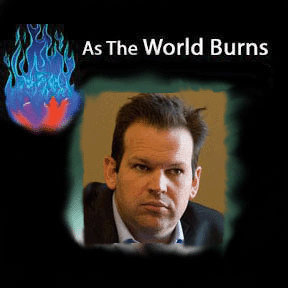
Canavan wants $1b for Adani, limits to green tax lurks, AFR, 26 Mar 17,Resources Minister Matt Canavan says it is time for the government to consider restricting the tax-deductible status of politically active green groups………
Stop Bob Brown
The Turnbull government is still considering whether the tax-deductibility of environmental groups should be administered by the Australian Taxation Office instead of the Register of Environmental Organisations and no less than 25 per cent of green group donations should be spent on environmental remediation rather than protests, after a House of Representatives inquiry reporting last May.
The Stop Adani Alliance, a collection of 13 green groups headed by former Greens leader Bob Brown, came to Parliament House last week calling for more scrutiny of a proposed $1 billion taxpayer-funded loan to build a railway line for the Adani Carmichael coal mine in North Queensland.
Senator Canavan told The Australian Financial Review the main opposition to the Adani mine came from “fly-in, fly-out” protesters who did not live in the region……..
$1b for Adani
There is growing scrutiny of the government agency, the North Australia Infrastructure Facility, responsible for assessing the proposed $1 billion taxpayer loan to Adani and championed by Senator Canavan and Deputy Prime Minister Barnaby Joyce.
Libs looking to Asia to build new coal-fired power station in north, THE AUSTRALIAN, DAVID CROWE, 26 Mar 17, THE TURNBULL GOVERNMENT HAS OPENED TALKS WITH ASIAN INVESTORS TO BUILD A COAL-FIRED POWER STATION BACKED BY ITS $5 BILLION NORTHERN AUSTRALIA FUND……..
Resources Minister Matt Canavan is fast-tracking the plan amid a growing fight with Labor and the Greens over support for coal power, as cabinet ministers prepare to decide how to encourage big investors into the market.
Senator Canavan told The Australian there was a “high degree of interest” from Asia helping to develop the new power station in northern Queensland, arguing that finance from the Northern Australia Infrastructure Fund would be needed to give the project long-term certainty…….
As the imminent close of the ageing Hazelwood power station reignites debate about electricity shortages and price spikes, Labor climate change spokesman Mark Butler has declared there is no support from industry to build new coal-fired power stations in Australia.
The Australian Energy Council, which represents companies supplying electricity to 10 million homes, warns it has become “very difficult” to finance coal-fired power stations when investors are ramping up wind and solar projects as well as gas generators that provide baseload power with lower greenhouse gas emissions than coal.
But the government is determined to keep the coal proposal on the agenda by raising the prospect of funding from the northern Australia fund, which is also a potential source of support for the controversial coalmine planned for central Queensland by Indian company Adani.
Senator Canavan said there was “no doubt” of the rudimentary economic and commercial case for a coal-fired power station in northern Queensland but that the government’s challenge was to set the energy market rules to offer certainty…..
A Senate inquiry led by a Labor and Greens majority last year argued for an “orderly retirement” of the nation’s coal-fired power stations but the government believes there is strong support in northern Queensland for a new coal project at a time of rising electricity price
Senator Canavan is examining options for a new power station near the Adani coalmine in the Galilee Basin, in Collinsville, to add to an existing power station or in Gladstone near an existing power station and taking advantage of transmission lines that are already in place.
The Resources Minister, who is also the Minister for Northern Australia and oversees the infrastructure fund, rejected suggestions that the help for a coal-fired power station would be a “subsidy” that meddled with the market….
Mr Butler is warning against the use of taxpayer funds for the rail line to the Adani mine or a new power station, claiming the long-term future for coal is one of decline.
This energy may be clean but banks won’t back coal-fired plants, THE AUSTRALIAN, 26 Mar 17 “…..It is no wonder that the government is looking at ways to allow the Clean Energy Finance Corporation to invest in “clean coal”-fired power stations because the banks and the local financial sector are unlikely to do so.
The simple reason for this is that investments in such technologies are too risky for any self-interested bank credit officer to give any proposed clean-coal project the thumbs up…..
The Australian Prudential Regulation Authority’s Geoff Summerhayes effectively put banks and other financial institutions on notice that he now expects them to take into account “transition” climate risks……
offshore banks would face the same risk hurdles as local banks…
What other forms of funding might be available for a clean coal plant? Offshore banks are a possibility and they have backed syndicates investing in local infrastructure, particularly Chinese and Indian banks. The State Bank of India was slated as a potential provider of a $1bn loan for the Adani coalmine in Queensland, but prospects of that loan being approved dimmed when Reuters reported a bank source as saying “the credit guys are not comfortable with the project”.
This is a salient reminder that offshore banks would face the same risk hurdles as local banks.
Another possibility is that private sector superannuation funds or the federal government’s Future Fund could provide backing. But they need to confront the big stick from APRA or the Australian Securities & Investments Commission about the need to take into account climate change and associated sovereign risk.
That seems to leave only the government to finance any such projects and, hence, the idea of changing the Clean Energy Finance Corporation legislation to allow it to invest in clean coal.
But let’s take stock here: haven’t we just imposed a whole swag of new regulations on banks to stop them from getting involved in lending that is too risky? If the risks around clean coal are too daunting for those irritating banks to take on, why on earth would the taxpayer do so?
Taking into account all of these risks, coupled with the difficulty in offsetting them via the market or through portfolio diversification, and the multitude of uncertainties surrounding any proposals for a clean-coal generator, we should assume that no bank funding will be forthcoming for clean coal- fired power stations.
” … The Adani corporation’s dirty coalmine is an impending disaster with effects which will reach far beyond Australia.
“Everywhere I go people ask me about it. They cannot believe that, at a time when we should be drastically cutting the pollution which drives global warming, Australia’s authorities would even consider building the world’s biggest export coalmine.
“Lending Mr Adani, a billionaire, a billion dollars of taxpayers’ money to carry this project into reality would be the political mistake of the decade. The Turnbull government would be literally paying Adani
to ride roughshod over Indigenous rights, to contaminate the groundwater of the Galilee Basin, to consign threatened species to the dustbin of history and to increase the already disastrous impact of coral death worldwide. … “
But the publication of the discussion paper – almost two months behind schedule and amid claims from the federal government’s own Climate Change Authority that it “doesn’t take the issue seriously” – does not immediately inspire confidence. Continue reading →










 Antinuclear