Scott Morrison’s ‘net zero plan’ includes small nuclear reactors
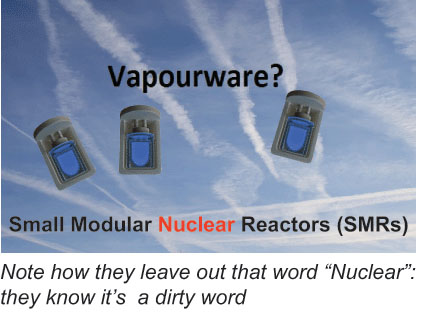
Australia’s net zero plan includes ‘small, modular nuclear reactors’ Paul Osborne, 27 Oct 21, Australia will closely watch the development of small modular nuclear reactors as the government seeks to achieve net-zero emissions by 2050. The Morrison government’s emissions plan released on Tuesday said “all technologies” were on the table.
…….. The plan noted that Australia was working with the UK on low emissions technology, including research into small modular reactors.
Prime Minister Scott Morrison told Perth radio 6PR on Tuesday he did not intend to lift the current ban on nuclear power in Australia…….https://inqld.com.au/news/2021/10/27/australias-net-zero-plan-includes-small-modular-nuclear-reactors/
Australia will closely watch the development of small modular nuclear reactors as the government seeks to achieve net-zero emissions by 2050. The Morrison government’s emissions plan released on Tuesday said “all technologies” were on the table.
National Party did a secret climate deal with Morrison, but nuclear power was not included.

Some Nationals had been pushing for nuclear to be included as part of Australia’s clean energy mix. But ahead of the meeting, Nationals deputy leader David Littleproud indicated it would not be part of the plan.
Nationals provide in-principle support for a net zero 2050 target, nuclear not part of plan, ABC News, By political reporter Stephanie Borys 24 Oct 21, The Nationals have given their in-principle support to back a target of net zero emissions by 2050, just days before Prime Minister Scott Morrison is due to fly to Glasgow for global climate talks.
Key points:
- Mr Joyce says a majority of Nationals members and senators are on board with the plan
- He says most concerns with the climate plan have been allayed
- Cabinet will meet to sign off on the plan, which Mr Morrison will take to Glasgow
The party met on Sunday afternoon to discuss its ongoing concerns about adopting the policy, with some worried it could result in job losses in regional areas…….
The Nationals met for just over two hours and all 21 members and senators spoke on the matter but no formal vote was held…..
………Federal Cabinet will meet within days to formally sign off on the plan, which the Prime Minister will then take to the Glasgow climate summit.
What did the Nationals get inserted into the climate plan?
There are conditions attached to the Nationals backing net zero emissions by 2050, but those details remain a secret.
Just days ago, the junior Coalition partner presented a list of demands to the Prime Minister about the proposed climate change policy.
The Nationals have not publicly outlined the changes they want. Mr Joyce again refused to provide details about what Mr Morrison had offered or agreed to.
……….. Opposition Leader Anthony Albanese said Australians deserved to know the details of the deal.
Some Nationals had been pushing for nuclear to be included as part of Australia’s clean energy mix. But ahead of the meeting, Nationals deputy leader David Littleproud indicated it would not be part of the plan.
“You have got to educate before you legislate and we’ve got to bring the community with us,” he said
“They are not there with us at this stage; unfortunately, they are getting their education from Chernobyl and The Simpsons.
“That takes time to build that education up,” he said.
New South Wales Liberal Treasurer Matt Kean said the proposal did not stack up on practical or economic grounds, and that his government had been told by experts it would take at least 15 years to train the workforce.
“People talking about nuclear to solve our current needs are chasing a unicorn,” he said…… https://www.abc.net.au/news/2021-10-24/nationals-provide-in-principle-support-for-net-zero-2050-target/100564192
National Party may demand that nuclear power be part of Scott Morrison’s ”net zero by 2050” aim.

Nationals may put nuclear energy on the agenda as the party negotiates Scott Morrison’s net zero proposal, The Nationals could put nuclear power on the agenda as part of Scott Morrison’s proposed net zero by 2050 target, the chair of the Environment and Energy Committee said. Sky News Tyrone Clarke, Digital Reporter, October 21, 2021 – Liberal MP Ted O’Brien has flagged the possibility of the Nationals pushing nuclear energy on the agenda as the Coalition debates Prime Minister Scott Morrison’s net zero proposal.
The Nationals party room met again on Thursday afternoon to finalise a set of climate demands to be presented to Mr Morrison as the Prime Minister hopes to take a net zero target to the upcoming COP26 summit in Glasgow.
Deputy Prime Minister Barnaby Joyce has remained tight-lipped about his party’s preferences towards the policy, but has categorically ruled out committing to a more aggressive 2030 emissions reduction target.
But Mr O’Brien said nuclear power had the backing of many Nationals members and could be on a list of demands set to head to the Prime Minister’s desk…………………. https://www.skynews.com.au/australia-news/politics/nationals-may-put-nuclear-energy-on-the-agenda-as-the-party-negotiates-scott-morrisons-net-zero-proposal/news-story/0d476f4bbec9af57ecfb6eab864b8930
Nuclear power? It’s of zero use to Australia’s emissions plan
I have no problems with nuclear power. But the only way it would be viable is with an extremely high carbon price. I say bring that on!
Except a high carbon price makes renewables an even better investment, and thus nuclear less needed.
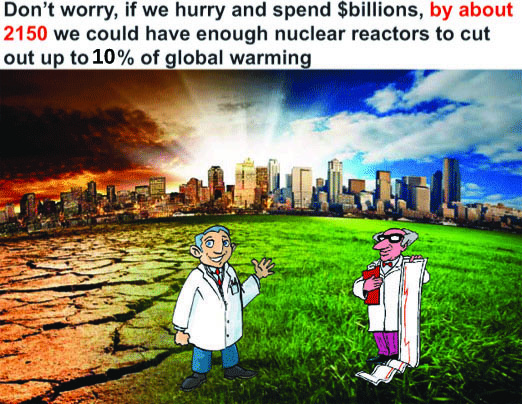
And even a high carbon price won’t get enough nuclear plants built soon enough to prevent temperatures rising above 2C.
Nuclear power is too costly, too slow, so it’s zero use to Australia’s emissions plan, EXCELLENT GRAPHS Guardian, Greg Jericho 18 Oct 21, With a 20-year development timeline, nuclear plants won’t be built soon enough to stop temperatures rising above 2C. So why are we wasting precious time debating them?
The catch-22 of nuclear power in Australia is that you would only consider it if you wanted to reduce emissions because of climate change, but if you agree climate change is real and we need to reduce emissions, you would not consider nuclear power.
Currently Australia burns a lot of coal – more than other comparable economies with nuclear power.
Even worse, Victoria relies greatly on the dirtiest and least-efficient brown coal.
But if you think climate change is a load of bunk then, as current head of charging with ChargeFox, Evan Beaver, puts it in his excellent blog post on the issue, “we might as well burn all the coal we have. And we have a lot.”
But if you do agree climate change is real then what we need to do is reduce emissions as fast as possible. As I noted last month, at a certain point there will be so much CO2 in the atmosphere that we won’t be able to limit temperatures rising above either 1.5C or 2C above pre-industrial levels, no matter when we get to net zero afterwards.
Projected cumulative emissions between 2021 and 2050
6,161Gt is the carbon budget to stay below 2C; 3,521Gt is the carbon budget for 1.5C
We must cut emissions fast – at least 50% below 2005 levels by 2030, and probably by about 75% if we want to limit temperature rises to less than 1.5C.
Nuclear power is of zero use on that score.
We know this because nuclear power has already been examined a lot.
One excellent study was in 2006 under the Howard government, by Ziggy Switkowski. It noted that “the earliest that nuclear electricity could be delivered to the grid would be 10 years, with 15 years more probable”.
Alright then. Firstly, not even the National party is insane enough to make nuclear power an election promise.
So let’s assume if the Coalition wins next year’s election, but announces a move to legalise nuclear power, that even with the best intentions, given the task of getting the votes, it’d be lucky for that to happen until the end of 2022.
Now all that has to happen is choose the type of reactor, and oh, pick a spot (have fun).
Ignore the coming election in 2025 and assume everything gets in place by 2024 (not a hope, but hey, let’s play pretend). That means at best we’re looking at 2035 but more likely 2040 before the first nuclear plant comes on line.
That is already too late to help prevent temperatures reaching 2C, and by then an overwhelming amount of our electricity will already be generated by renewables.
That means the need for such a plant is gone. Markets know this, which is why no one will ever invest in such a plant here.
The CSIRO’s latest “GenCost” report suggests the capital costs of small modular reactor (SMR) nuclear power plants by 2030 and even out to 2050 will be greater than renewables, including solar thermal plants.
But perhaps rather surprising is that nuclear becomes even less viable when the CSIRO projects the world getting to net zero by 2050.
The reason is that, under such a scenario, the push for renewables accelerates so greatly that the development of nuclear power effectively stalls, meaning Australia would have to be a leading investor in new plants – thus paying the first mover costs.
As the CSIRO notes, “a major source of discomfort” for nuclear stakeholders is that the high cost estimate of nuclear power “is of theoretical value only” because “a nuclear SMR plant is not planned to be built in Australia anytime soon”………………….
I have no problems with nuclear power. But the only way it would be viable is with an extremely high carbon price. I say bring that on!
Except a high carbon price makes renewables an even better investment, and thus nuclear less needed.
And even a high carbon price won’t get enough nuclear plants built soon enough to prevent temperatures rising above 2C.
Nuclear power: too costly, and too slow. https://www.theguardian.com/business/grogonomics/2021/oct/19/nuclear-power-too-costly-too-slow-so-its-zero-use-to-australias-emissions-plan
Australia set to disappoint key allies on 2030 emissions target.

Australia set to disappoint key allies on 2030 emissions target, SMH, By Mike Foley October 18, 2021 Australia’s decision not to boost its 2030 emissions reduction target will disappoint key allies that have called on Prime Minister Scott Morrison to do more ahead of next month’s United Nations climate summit in Glasgow.Mr Morrison told Parliament on Monday he would stick with the target that he took to the 2019 election, which was set by former prime minister Tony Abbott in 2015, to reduce emissions by at least 26 per cent from 2005 levels. His decision comes after Nationals leader Barnaby Joyce on Sunday all but ruled out support for a higher 2030 commitment.
British cabinet minister Alok Sharma, who will head the COP26 climate change conference, has called on Australia to set a 2030 emissions reduction target of up to 50 per cent. The United Kingdom has committed to cut emissions 68 per cent by 2030 while the United States has set a goal to reduce emissions by 50 per cent and urged Australia to increase its near-term target. Japan is targeting 46 per cent. South Korea 40 per cent and the European Union 55 per cent.
Climate scientists say deep emissions cuts by 2030 are needed to achieve the goal of the Paris Agreement to limit global warming to less than 2 degrees, and as close to 1.5 degrees as possible to avoid the worst damage from climate change. Waiting longer to
reduce greenhouse gases will allow too much carbon to build up in the atmosphere and cause heating long after 2050, even if net zero is achieved by then.
The government’s “technology not taxes” policy is focused on investment in low-emissions technologies to replace current carbon-intensive systems…………….
A report released on Monday by the Asian Investor Group on Climate Change, Ceres and the Investor Group on Climate Change, which represent investors with a cumulative $62 trillion in assets, called for G20 leaders including Australia to set ambitious 2030 targets. It said Australia was among the least attractive countries for green investment, alongside Argentina, India, Indonesia, Mexico, Russia and Saudi Arabia.
Investor Group on Climate Change policy director Erwin Jackson said global investors, which Australia relies on for foreign investment, would flow away from countries without ambitious 2030 targets………https://www.smh.com.au/politics/federal/for-the-love-of-god-act-now-church-leaders-join-chorus-urging-government-to-boost-2030-climate-target-20211018-p590uy.html
Prince Charles urges Australian Prime Minister Scott Morrison and other leaders to attend COP26
Prince Charles urges Australian Prime Minister Scott Morrison and other leaders to attend COP26 ABC By Jack Hawke in London 11 Oct 21, Prince Charles has urged Prime Minister Scott Morrison and other world leaders to attend the UN’s climate change conference, calling it a “last chance saloon” to save the planet.
Key points:
- Prince Charles appeared surprised to learn Prime Minister Scott Morrison may not attend the COP26 UN climate change conference
- More than 100 world leaders, including US President Joe Biden, the Queen and the Pope will attend the summit
- Prince Charles also said he shared the concerns of younger generations that not enough is being done to combat cliamte issues
World leaders including Joe Biden, Boris Johnson, the Queen and the Pope will be at the event, but Mr Morrison has not yet made a decision on whether he will attend.
The Prince of Wales was giving an interview to the BBC when he was pressed about Australia’s action on climate change ahead of the COP26 UN Climate Change Conference in Glasgow at the end of this month.
Prince Charles seemed genuinely surprised when told by the BBC’s climate editor Justin Rowlatt that Mr Morrison was still on the fence about coming.
“Is that what he says?” Charles asked……… https://www.abc.net.au/news/2021-10-12/prince-charles-scott-morrison-climate-change-cop26/100531092
Scott Morrison gets a mention on global summary of climate change leaders – and it’s not good!
Who’s who at Cop26: the leaders who hold the world’s future in their hands, Guardian 11 Oct 21,
”……..Scott Morrison
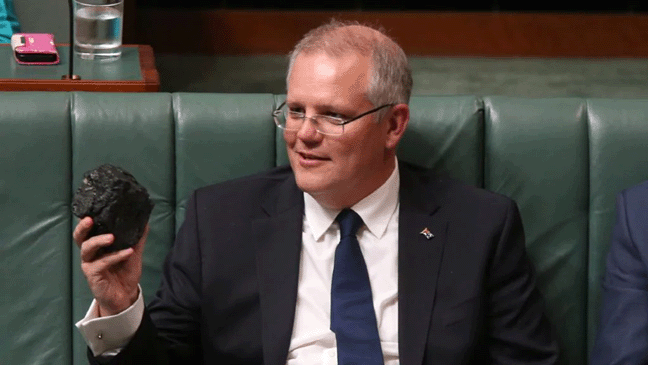
“A rogue nation on the climate” is how one Cop expert describes Australia, urging other countries to ostracise the coal exporter, which under Morrison has refused to take on new commitments on emissions. But if anything the Aukus deal appears to have buoyed the Australian prime minister’s sense that he can get away with it – he may not even attend……..” https://www.theguardian.com/environment/2021/oct/11/whos-who-at-cop26-the-leaders-who-hold-the-worlds-climate-in-their-hands
Scott Morrison confirms he’s unlikely to attend UN climate summit in Glasgow
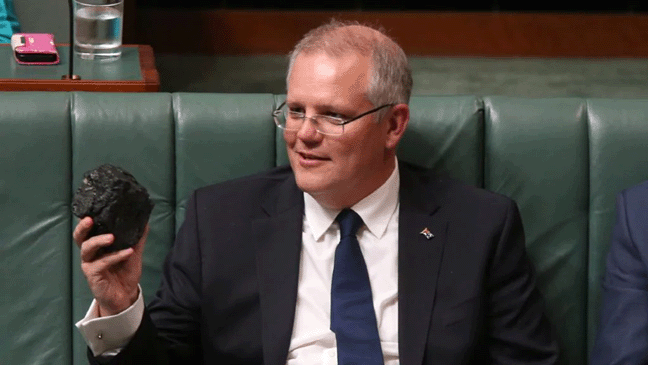
Scott Morrison confirms he’s unlikely to attend UN climate summit in Glasgow, SBS, 2 Oct 21, Scott Morrison says attending COP26 would require him to go into quarantine for a fourth time, disrupting his ability to “engage in my normal duties” as prime minister.
Scott Morrison has given the strongest indication yet he will not attend United Nations climate talks in Glasgow, blaming coronavirus quarantine requirements……
“I will have spent, if I do that, a total of four times 14-day quarantine, basically, in this building, not being able to engage in my normal duties around the country as much as I would like to.”
“That’s a long time for a prime minister to be in quarantine in a six-month period.”
More than 100 world leaders have so far indicated they will attend the summit in person………
Meanwhile, Nationals resisting coalition attempts to get a 2050 net zero emissions target over the line before Glasgow say they are yet to see the government’s plan for how to achieve it……… https://www.sbs.com.au/news/scott-morrison-confirms-he-s-unlikely-to-attend-un-climate-summit-in-glasgow/6649bcbf-6bcc-4ae5-8572-70e988624437
Liberal Coalition prepares for greenwashing at the Glascow climate summit
Right faction hardheads will accept greenwashing ahead of Glasgow if that’s required to keep the Coalition in power, Guardian Katharine Murphy 2 Oct 21, But even if Scott Morrison lands net zero he would rather market his climate pivot at home rather than abroad – there’s an election to prepare for……………………………………….. Right now, Morrison is trying to land new climate commitments ahead of the Cop26 in Glasgow. While senior people insist Morrison’s net zero plane is going to land, on a runway, with zero casualties, either in the second or third week of October, climate policy can be lethal territory for Australian prime ministers, and not just prime ministers called Malcolm Turnbull (as Kevin Rudd and Julia Gillard can attest).
Morrison’s current trouble seems to be confined to a handful of Queensland Nationals as opposed to the entire right faction of the Liberal party, which was Turnbull’s cross to bear during rounds one and two of his internal climate wars.
Thus far, the right has been quiet. People say the majority view is grudging acceptance because of the shifting politics – although some conservatives report a growing backlash bubbling up from the base about a net zero commitment.
Morrison referenced the shifting politics when he met a deputation of mainly moderate Liberals earlier this week. This group of MPs was given some face time with Morrison after they asked to see him. The objective was to send a clear message: the group wanted a commitment to the net zero target. They did not want a handful of Queensland Nationals writing the government’s climate change policy.
…… If the centre of political gravity has shifted in favour of climate action in parts of the country where the Liberals need to hold or win seats, then the Liberal party will need to act, or (more pertinently) at least look like it’s acting.
If that’s the electoral reality, political hard heads in the right faction of the Liberal party can hold their noses about net zero if they believe greenwashing ahead of Glasgow is what’s required to keep Labor out of power.
But for some hardcore conservatives, Morrison revisiting the Coalition’s climate crime scene will be a provocation. It will be yet more proof of his obnoxious dictatorial pragmatism. It is not clear yet whether or not conservative feet will be stamped or rhetorical punches thrown. Perhaps they won’t, because there are always consequences for picking fights. But wise prime ministers prepare for all contingencies………..
Assuming the prime minister can land his net zero deal with Barnaby Joyce, Morrison would rather market his climate pivot at home rather than abroad……….https://www.theguardian.com/australia-news/2021/oct/02/right-faction-hardheads-will-accept-greenwashing-ahead-of-glasgow-if-thats-required-to-keep-the-coalition-in-power
Australia’s nuclear submarine deal a distraction from international climate action
the main focus of Australia’s government has remained on the continuing mining and export of fossil fuels (for reasons I’ve detailed in The Hill previously). Even while Australian Prime Minister Scott Morrison was in Washington his government was attempting to persuade the Australian States to adopt a “Coalkeeper” policy that seemingly would continue to protect the fossil fuel industry and constrain new renewable energy projects
 |
Is Australia’s nuclear submarine deal a distraction from international climate action? The Hill, BY DAVID SHEARMAN, — 09/28/21 Climate warming and environmental degradation are damaging humanity each and every day and all the decisions we make must be questioned for their human health and survival implications.
The fundamental issue at the UN climate conference COP26 is not the distant target of zero emissions by 2050 but the need to focus on the huge task of delivering emission reductions of 45 percent or more by 2030 to limit a temperature rise to 1.5 degrees Celsius. Currently, the contribution of nations in the Paris Agreement will lead to an emissions rise of 16 percent and a 2.7 degree Celsius rise.
Australia and indeed some other countries must ask themselves if nuclear submarines will be relevant to their likely plight in 2050 or whether the $90 billion (AUD) should be a small down payment on the huge ongoing costs of survival from the predicted climatic ravages which have already commenced worldwide.
One positive has arisen from Australia’s shameful diplomatic treatment of France, whose earlier defense deal with Australia was abruptly canceled and replaced with AUKUS. There will now be much greater scrutiny of the proposed Australia-EU trade deal to ensure Australia complies with climate and environmental needs, as well as with means to assess compliance. Such pressure on Australia’s trading future is already having an impact on policy.
Impact on Australia’s Pacific policy
Trust and cooperation between Australia and France are essential for the needs of the Pacific Island nations. It had been expected that the French through their Pacific territories and commitment to climate change would encourage Australia to recognize its responsibilities.
Over many years, Australia has continued to dismiss the pleas of the islands for a climate policy that would help them avoid inundation. At the time of the 2019 Pacific Island Forum in low-lying Tuvalu, Australia’s Deputy Prime Minister Michael McCormack infamously said that Pacific island nations affected by the climate crisis will continue to survive “because many of their workers come here to pick our fruit.”…………
Even more shaming is Australian indifference to the needs of the Torres Strait Islanders who are the Indigenous peoples of this Australian territory. They have claimed before the UN Human Rights Committee that Australian inaction infringes their human rights. Australia has opposed their claim………
In 2050, conflicts will likely be within countries and between close neighbours over resources such as water and productive land — not based on nuclear threat. Defense services including those of the United States and China will be engulfed in saving lives and infrastructure from fire, flood, storm and drought.
Such conflicts are already with us and U.S. Secretary of State Antony Blinken has cited war in Syria, Mali, Yemen, South Sudan and Ethiopia due to water shortages.
Currently, Australia spends $45 billion (AUD) or 2.1 percent of GDP on defense. It has spent $130 billion on the economic recovery from COVID-19 much by increasing gas mining for export, but less than 2 percent of which has been spent on solutions to reduce emissions and even less on climate adaptation. Indeed, Australia does not have a national coordinated national adaptation policy.
The relevant questions are whether the defesnse agreement between the U.S., UK and Australia to provide nuclear submarines, dubbed AUKUS, has encouraged or coerced Australia to accept and deliver even a 2050 emission target —and how Australia can now cooperate on emission reduction within the Asian Pacific region and particularly the Pacific Island States.
Impact on Australian climate policy
The AUKUS agreement has already resulted in the re-examination of climate policy but discussion has been distracted by worries about AUKUS compromising our sovereignty in the event of armed conflict — and by the diplomatic failure to discuss the issue with Pacific neighbours. There are also concerns about the weakness of U.S. democracy and the possible irrationalities of any future president that could lead to Australian involvement in unnecessary conflict.
However, the main focus of Australia’s government has remained on the continuing mining and export of fossil fuels (for reasons I’ve detailed in The Hill previously). Even while Australian Prime Minister Scott Morrison was in Washington his government was attempting to persuade the Australian States to adopt a “Coalkeeper” policy that seemingly would continue to protect the fossil fuel industry and constrain new renewable energy projects
No wonder many Australian eyebrows were raised when U.S. House Speaker Nancy Pelosi (D-Calif.) hailed Australia as a global leader on climate change.
Currently, Australia is ranked 15 highest of 90 countries for domestic emissions and fifth or sixth if exports of fossil fuels are included. Clearly, Australia is the world’s laggard when the country has the wealth and expertise to take action.
AUKUS and talk of conflict with China could torpedo COP26 climate summit
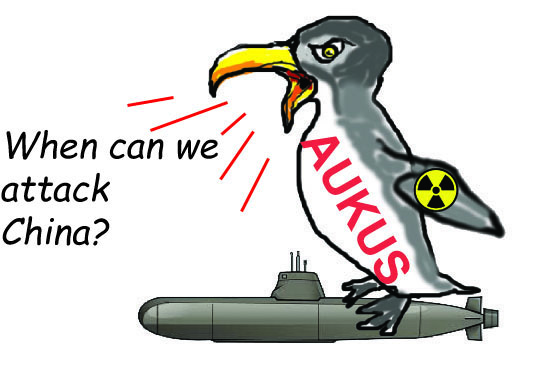
What role will Australia play in Glasgow? Will we go in good faith, promising bold action on climate change and preparedness to help our neighbouring countries in mitigation and adaptation, in recognition of our shared interests, or will we go as a spoiler?
History suggests the latter —
U.S.-China talk could torpedo climate conference https://independentaustralia.net/environment/environment-display/us-china-talk-could-torpedo-climate-conference,15558 By Graeme McLeay | 26 September 2021 If the focus favours an uncertain future threat of U.S.-China conflict when world leaders meet in six weeks to address the real danger of climate emergency at COP26, the summit will likely fail, writes Dr Graeme McLeay.

“In the councils of government, we must guard against the acquisition of unwarranted influence, whether sought or unsought, by the military-industrial complex.”
WHEN “IKE” spoke those words in his 1961 valedictory speech as U.S. President, he would not have dreamt that Australia, 60 years later, would become part of the military-industrial complex of the United States. As someone who understood the horrors of war, he understood the dangers of an arms race while at the same time acknowledging the need for defence at a time when America faced a belligerent adversary. He was cautious.
No such caution is evident in Canberra. In the space of a few days, we have been told we are to have nuclear-powered submarines, a larger presence of American armed forces based in Australia and missiles – presumably of the intercontinental variety – if all the China-talk is to be believed.
The very idea of Australia getting into an arms race with China is risible and preposterous. It will take at least 20 years for Australia to have something like the military capability that China has now and the massive spending involved will impoverish the next generation.
We have not been told whether our neighbours in Indonesia, Papua New Guinea, Malaysia, Singapore, India and the Pacific Islands have been consulted about the AUKUS deal, which brings a whiff of colonialism about it. New Zealand was quick to make it clear nuclear-powered subs will not be welcome there. It is likely they will also not be welcome in Port Adelaide.
The $90 billion French submarine deal is to be scrapped and bigger, more capable, and almost certainly, more expensive submarines will be built in Adelaide. An uncertain future threat of U.S.-China conflict is the justification for this 20-year program — about the time the world will have tipped into runaway, unstoppable climate change if the world’s present emissions trajectory continues.
In six weeks, world leaders come together in Glasgow to address the existential threat of climate emergency. As the war drums beat louder it appears unlikely they will meet in a spirit of cooperation and harmony. Without both China and the United States on board, there is the possibility of a disastrous failure, much worse than the Copenhagen fiasco because the urgency for action is so much greater.
Climate change and conflict are not unrelated. In a recent report from the Climate Council, ‘Rising to the Challenge: Addressing Climate and Security in Our Region’, authors describe climate change as a driver of insecurity.
Conflicts will arise over water, rising seas, salination, fisheries and crop failures. India, Pakistan and China – not always the best of pals – rely on meltwater from Himalayan glaciers for the survival of millions and internal conflicts over water have the potential to trigger war among neighbours which could drag the United States in, and Australia with it.
Much of Bangladesh, a country with a population of 166 million, is low lying and already experiencing inundation and salination from sea level rise. Food shortages are almost certain to occur when climate-related crop failures happen in multiple regions at the same time.
According to Climate Council spokeswoman and former Australian Defence Department Head of Defence Preparedness Cheryl Durrant:
‘Australia’s unwillingness to deal with climate change is already affecting our security, leading to a loss of geopolitical influence, particularly in the Pacific.’
What role will Australia play in Glasgow? Will we go in good faith, promising bold action on climate change and preparedness to help our neighbouring countries in mitigation and adaptation, in recognition of our shared interests, or will we go as a spoiler?
History suggests the latter — a history that goes back to the last century and the first Kyoto agreement. A belated promise of zero emissions by 2050 with no change to our weak 2030 target, with talk of future technology fixes, will convince no one.
The World Health Organization has described climate change as the greatest global health threat. Disruption of Earth’s stable climate and the biodiversity which protects us is an immediate health and security risk. A sober assessment of the risk which China poses to Australian security is common sense but failure to address the real and present danger of climate emergency, clearly set out in the Intergovernmental Panel on Climate Change (IPCC) Sixth Assessment Report, is negligence — negligence which will not go unnoticed by our young.
In his 1961 farewell speech, President Eisenhower also said:
“The potential for the disastrous rise of misplaced power exists and will persist.”
$1.4 million election war chest, here’s how it will be spent for climate action with genuinely clean energy
$1.4 million election war chest, here’s how it will be spent
Climate 200 is an initiative co-founded by Simon Holmes a Court, clean energy advocate and son of corporate raider Robert and philantropist and businesswoman Janet. It will support progressive independents at the next federal election, building on the success of the likes of Zali Steggall.
What is Scott Morrison doing in New York? Nothing on climate, it seems.

While other world leaders arrive in New York to discuss cooperation on Covid and climate, Morrison will trying to patch up his submarine blunder. The post What is Scott Morrison doing in New York? Nothing on climate, it seems appeared first on RenewEconomy.
What is Scott Morrison doing in New York? Nothing on climate, it seems — RenewEconomy
Scott Morrison has landed in New York for a week of meeting with international leaders, but the prime minister is likely to spend the time trying to mend damaged diplomatic relationships rather than engaging with other world leaders on climate issues.
World leaders are convening in New York this week for the next session of the UN General Assembly, which will largely be focused on the ongoing response to the Covid pandemic, fostering economic recovery, and preparations for the next round of climate change negotiations that will be held in Glasgow in a few weeks time.
Several critical meetings have already been held, including a call from the UN for leaders to “stop ignoring the science.” But, like his last visit to New York, when Morrison avoided a UN climate meeting in favour of dinner with Donald Trump, he has other priorities.
Morrison major focus now will be dealing with the ongoing fallout from the cancellation of Australia’s submarine deal with France. This self-inflicted blunder has seen relations sour with the broader European community while implicating allies the United States and the United Kingdom, and possibly putting a climate deal with China at risk.
The mishandling of that deal means Morrison arrives in New York with a new level of unpopularity amongst world leaders, and now needing to navigate a frosty diplomatic relationship with European leaders threatening to scuttle a free-trade agreement between Australia and the EU that has been years in the making.
Morrison will meet with leaders from Sweden and Austria and European Commission president Ursula von der Leyen, who has already described Australia’s treatment of France as “unacceptable”.
The European leaders could look to punish Australia on two fronts – to send a message over the cancelled $90 billion submarine deal, as well as following through with the introduction of export tariffs on Australia’s carbon intensive exports to account for Australia’s virtually non-existent price on carbon pollution.
While in the US, Morrison will meet with other leaders of the “quad” strategic dialogue, which includes US president Joe Biden, Japanese prime minister Yoshihide Suga and Indian prime minister Narendra Modi to discuss regional security measures.
However, it is unlikely that Morrison will engage in any discussions that relate to climate change policy – with Australia already on the outer of international talks due to a refusal to adopt stronger climate change targets.
Morrison is not listed to address the UN General Assembly, and Australia was not invited to participate in a climate change roundtable convened by UN secretary-general António Guterres and UK prime minister Boris Johnson……………… https://reneweconomy.com.au/what-is-scott-morrison-doing-in-new-york-nothing-on-climate-it-seems/
1 This month


Help Aunty Sue Protect Her Land and Sacred Sites From Destructive Rocket Testing.
.

Australians deserve the truth
about
AUKUS – https://aukuspublicinquiry.com/

PETITION – To: Prime Minister Anthony Albanese and the Australian Labor Government

of the week – Australians for War Powers Reform (AWPR)
To see nuclear-related stories in greater depth and intensity

