Australia’s greenhouse gas emissions increasing, government admits
 Turnbull government confirms Australia’s greenhouse gas emissions are rising, SMH,
The department analysis shows the increase largely came from electricity generation – the country used more power without much change in its reliance on fossil fuels – and new liquefied natural gas projects.
In per capita terms, emissions per person continued to fall – to less than 23 tonnes of carbon dioxide, down from about 26 tonnes a decade ago – as population growth outpaced the rise in pollution……
Australian Conservation Foundation economist Matt Rose said the government was failing to cut climate pollution, and was holding back evidence of its poor performance from the public.
Documents released to the foundation after a Freedom of Information request showed it had been sitting on the data since September, but chose to release it just three days before Christmas…….
The government is reviewing climate policies next year, but has already ruled out any form of carbon pricing that would penalise big emitters.
Business and environment groups are urging the government to keep all options, including a form of carbon pricing known as an emission intensity scheme, open to ensure cuts are made as cheaply as possible. http://www.smh.com.au/federal-politics/political-news/turnbull-government-confirms-australias-greenhouse-gas-emissions-are-rising-20161222-gtgolq.html
Conflict of interest as Northern Australia Infrastructure Fund (NAIF) board members approve $1bn to Adani coal project
five of the seven Northern Australia Infrastructure Fund (NAIF) board members have what it calls “strong ties” to the mining industry.
Adani’s Carmichael coalmine doesn’t meet infrastructure fund criteria, says Greenpeace https://www.theguardian.com/business/2016/dec/21/adanis-carmichael-coalmine-doesnt-meet-infrastructure-fund-criteria-says-greenpeace
Analysis says $1bn of commonwealth funding would amount to paying $683,000 for each job generated, Guardian, Michael Slezak, 21 Dec 16, Adani’s coal infrastructure should not be given money from the Northern Australia Infrastructure Fund since it does not meet at least two of the mandatory criteria, according to analysis by Greenpeace. Continue reading
Resources Minister Matt Canavan attacks Australian Broadcasting Corporation (ABC)
 Federal resources minister accuses ABC of ‘fake news’ over Adani coalmine Matt Canavan attacks the broadcaster for being one-sided and says Australia’s biggest coalmine would improve the environment, Guardian, Gabrielle Chan, 22 Dec 16, The federal resources minister has accused the ABC of reporting fake news and thrown his weight behind the energy giant Adani, amid Indian finance ministry investigations into the company.
Matt Canavan attacked the ABC for what he described as one-sided coverage of Adani’s plans to build Australia’s biggest coalmine and accused the national broadcaster of having a massive blindspot when it came to the project.
The Liberal National party senator from Queensland also said the Adani Carmichael coalmine would improve the environment in central Queensland by setting aside land for birdlife and returning water to the Great Artesian basin……..
The Greens leader, Richard Di Natale, said Canavan’s comments showed the “lunatic fringe” was in power.
“For Matt Canavan to suggest that Adani’s Carmichael coalmine will be good for the environment, in contrast to all scientific evidence, shows that the lunatic fringe of the Turnbull government is running the show,” Di Natale said.
“Matt Canavan’s comments are an embarrassment and if [the prime minister] Malcolm Turnbull is serious about tackling dangerous climate change he will give Australia an early Christmas present by stopping the Adani coalmine from opening and stopping Matt Canavan from opening his mouth.”…… https://www.theguardian.com/environment/2016/dec/22/federal-resources-minister-accuses-abc-of-fake-news-over-adani-coalmine
Turnbull govt agreed to grant $640,000 to climate denialist centre
Federal grant to Bjørn Lomborg centre made in Turnbull era, documents show
Department agreement to provide $640,000 grant dates from March 2016, according to documents obtained under freedom of information, Guardian, Paul Karp, 23 Dec 16, The Turnbull government signed an agreement to make a $640,000 grant to Bjørn Lomborg’s Copenhagen Consensus Centre nine months after plans to establish the centre had been abandoned.
The education department may have been under no legal obligation to make the grant, documents suggest.
The funding was used to support the centre’s post-2015 UN development goals project that found limiting global temperature rises to 2C was a poor investment.
A breakdown of costs released on Thursday shows that $482,000 of the Australian funding was spent on professional fees and services including research, “outreach” and forums.
About $146,000 was spent on travel in an ambitious global project convening seminars to discuss the UN development goals in Bangladesh, Brazil, Colombia, India, Indonesia, Kenya, Mexico, Nigeria, South Africa and New York.
The project formed the basis of Lomborg’s book The Nobel Laureates’ Guide to the Smartest Targets for the World, which is not widely available in Australian shops.
Documents released under freedom of information show the department only entered a formal agreement to fund the project as late as 21 March 2016. Based on those documents and answers provided by the education department it appears the government did not have any ongoing commitment to the project when the Australian Consensus Centre was canned in June 2015……..
Labor’s innovation, industry, science and research shadow minister, Kim Carr, called on the government to provide a full explanation of the grant.
“The government must explain how and why this grant was still awarded, even after it had terminated the agreement with the university for the Australian Consensus Centre following pressure from the opposition and the research community,” Carr said.
“Malcolm Turnbull cannot hide behind a prior deal made by Tony Abbott – his government signed a fresh contract on 21 March 2016.”
“This use of taxpayers’ money to promote an anti-science conservative agenda shows that Malcolm Turnbull is still beholden to the right wing of the Liberal party.”
At Senate estimates on 20 October, Birmingham said the government had made a “special purpose” decision to allocate funding to the consensus centre, a process that was “terminated”……. https://www.theguardian.com/australia-news/2016/dec/23/federal-grant-to-bjrn-lomborg-centre-made-in-turnbull-era-documents-show?CMP=share_btn_tw
Warning from UNESCO on Great Barrier Reef
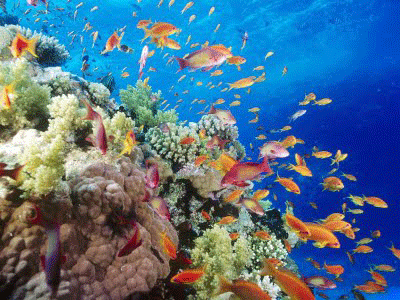 UNESCO says Great Barrier Reef is back in the danger zone
 (includes videos)
 Greens urge Queensland government to reject $1 billion taxpayer-funded loan for Adani coal rail line
 NAIF funding: Greens call for Queensland government to put stop to Adani loan, SMH. Felicity Caldwell, 12 Dec 16. Premier Annastacia Palaszczuk should reject a $1 billion taxpayer-funded concessional loan for the Adani Carmichael mine’s rail line, the Queensland Greens say.
The Greens say the Premier has the power to reject funding under the federal government’s Northern Australia Infrastructure Facility………Last week, Ms Palaszczuk met with Mr Adani and announced Townsville would be home to the Carmichael mine’s regional headquarters.
The Greens’ statewide campaign calling on the government to reject the NAIF loan and protect the reef will start in the electorate of Mount Coot-tha, targeting Environment Minister Steven Miles’ seat.
Billboards will be erected in the electorate and will be accompanied with online videos and a doorknocking campaign. http://www.smh.com.au/business/mining-and-resources/naif-funding-greens-call-for-queensland-government-to-put-stop-to-adani-loan-20161212-gt9erv.html
Sydney Lord mayor Clover Moore orders decisive action on climate change
 Sydney mayor Clover Moore orders urgent action on climate change http://www.smh.com.au/nsw/sydney-mayor-clover-moore-orders-urgent-action-on-climate-change-20161212-gt98ly.html Lisa Visentin
 The Paris Agreement commits signatories, including Australia, to “hold average temperature increase to well below 2 degrees and pursue efforts to keep warming below 1.5 degrees above pre-industrial levels”.
“It was clear from the conference that we need bolder action at a faster rate if we are to play our part in meeting the Paris Agreement,” Cr Moore stated in her report from the summit, which was tabled at Monday night’s council meeting.
At the meeting, she called on council staff to come back to council in February “with actions to accelerate our emissions reductions over the next four years”.
Fast-tracking the city’s move towards zero-carbon buildings, including developing a clear target date by which building standards should be in place, were key priorities, she said. She also called on City of Sydney chief executive Monica Barone to bring forward the city’s Draft Environmental Action Plan to the council’s first meeting in 2017 with a clear list of priorities in line with the C40 Summit.
Cr Moore said research presented at the summit provided cities with clear targets which, if adopted, would deliver 40 per cent of the savings need to achieve the ambition of the Paris Agreement.
Cr Moore’s report and recommendations were adopted unanimously by council.
The focus of Monday night’s council meeting on climate change policy comes after the Turnbull government’s beleaguered week in the policy arena, which culminated in a fractious meeting with state premiers at Friday’s Council of Australian Government meeting.
The week was dominated by Coalition intransigence on climate change, even as a report by chief scientist Alan Finkel warned Australia had no clear path to meeting the 2030 emissions target taken to the Paris climate deal under existing policies.
This report was preceded by a policy capitulation by Environment Minister Josh Frydenberg, who promptly dumped plans for a review of the Coalition’s direct action policy to examine whether to introduce an emissions intensity scheme for the electricity industry – a form of carbon pricing – after vocal opposition from the Coalition backbench.
Fairfax Media then revealed the Turnbull government had been sitting on advice that an emissions intensity scheme would save households and businesses up to $15 billion in electricity bills over a decade. The Paris Agreement commits signatories, including Australia, to “hold average temperature increase to well below 2 degrees and pursue efforts to keep warming below 1.5 degrees above pre-industrial levels”.
The Australian tax-payer is the sole investor in Adani’s coal export plans.
Aside from the culture, environment and cost, is Adani a good investment?, The Age, Julien Vincent , 13 Dec 16,
The Australian public is the sole investor in Adani’s coal export plans.
Adani is an Indian conglomerate that wants to build the largest thermal coal mine in Australia, a rail line of almost 400 kilometres connecting it to the coast, and a coal export terminal in the Great Barrier Reef World Heritage Area. The coal would be shipped out through the reef, giving it a perfect view of the bleaching and mortality that has been decimating our valuable natural icon recently before being burned in power stations overseas, only to further contribute to climate change and ocean acidification, considered the greatest long-term risks to the reef.
Given that the reef sustains 60,000 jobs and provides $6 billion per year of economic benefit to Australia, investors may want to consider conflicts of interest before moving ahead.
Some other niggling environmental risks investors might want to consider is the drainage of 12 billion litres per year of water from the Great Artesian Basin and the impacts of coal dust on people’s health along the transport corridor, along with particulate matter from the power stations as the coal is burned.
We’d also want to be content with supporting a mine that has not received free, prior and informed consent from traditional owners, potentially making this a major human rights issue.
But enough of the existential threats posed to culture, people, sites of natural World Heritage and the climate.
Let’s look at the numbers. Last week’s proposal by the Australian government of a $1 billion loan from the Northern Australia Infrastructure Fund means as investors we need to understand the business case.
First of all, don’t be put off by Adani’s corporate debt, which is two-and-a-half times the size of the company. Or the fact that Adani’s share price is down 20 per cent this year. This loan would actually be going to Adani’s private family company, based in Singapore and ultimately owned by Atulya Resources in the Cayman Islands, where we can be sure the money will be totally secure.
The mine will supply new coal power stations in India, whose power minister said yesterday would not be required until 2022, and who wants to get India off imported coal within the next few years. The power will only cost twice that of new renewable energy, and so an exciting market has been identified among those living in energy poverty.
Should the India option fail, the coal could be sold onto the seaborne market, which has declined by 10 per cent in recent years, Goldman Sachs, Deutsche Bank, Bernstein and others declaring it in structural decline.
Conditions like these have frightened off a few more faint-hearted commentators, such as the Queensland Treasury under the Newman government, which described the project as unbankable. Or Wood Mackenzie, which still considers the project as having a negative net present value.
Should the India option fail, the coal could be sold onto the seaborne market, which has declined by 10 per cent in recent years, Goldman Sachs, Deutsche Bank, Bernstein and others declaring it in structural decline.
Conditions like these have frightened off a few more faint-hearted commentators, such as the Queensland Treasury under the Newman government, which described the project as unbankable. Or Wood Mackenzie, which still considers the project as having a negative net present value…….
It’s clear that our investment is going to make a major difference. But will it be enough? $1 billion is a huge lifeline but depending on what assumptions you make about the scale of the project or who you’re prepared to believe, this project is going to cost anywhere from $7 billion to $21 billion……http://www.theage.com.au/business/mining-and-resources/aside-from-the-culture-environment-and-cost-is-adani-a-good-investment-20161213-gta0nq.html
Heatwaves are killers – and they are getting worse
 Heatwaves are more deadly than bushfires and they’re going to get worse, Canberra Times, Karl Kruszelnicki , 13 Dec 16 In 2009, the terrible Black Saturday bushfires killed 173 people. What most Australians don’t realise is that the crippling heat around the horrendous bushfires killed 374 people.
In the European heatwave of 2003, 50,000-70,000 people died between June and August. The Russian heatwave of 2010 killed about 55,000 people.
A bushfire leaves obvious signs of the cause of death (burns, blisters, etc), but a heatwave does not. Deaths from heatwaves are revealed indirectly. In Victoria in 2009, the first sign that the heatwaves were killing people was the morgues filling up. The unexpected extra corpses had to be stored in universities, mortuaries, funeral parlours and the like.
There are many definitions of a heatwave. The one from the World Meteorological Organisation (WMO) is widely accepted. According to the WMO, a heatwave happens when you have five days in a row, each with a daily maximum temperature five-or-more degrees higher than the average maximum temperature……..
The science is quite clear that climate change (which has been accepted as real since in 1988, and yes, we caused it) is worsening heatwaves. Dr Thomas Knutson and colleagues from the US Geophysical Fluids Dynamics Laboratory in Princeton University wrote a paper showing that (with a very high degree of confidence) climate change caused the extreme heat Australia experienced in 2013.
In Australia, heatwaves now arrive earlier, are hotter, and last longer……http://www.canberratimes.com.au/comment/heatwaves-are-more-deadly-than-bushfires-and-theyre-going-to-get-worse-20161212-gt9fyl.html
Local councils, consumers, energy companies lead the way to clean energy
Fossil fuel divestment is worth $7tn globally yet Australia still clings to coal, Guardian,
Blair Palese, 13 Dec 16 While the Australian government lags behind on climate change action, consumers, local councils and energy companies lead the way to clean energy. The Turnbull government has been an utter disappointment on so many things but nowhere as much as on the biggest issue of our time: climate change.
Unable to shrug off the legacy of the climate-denying Abbott government, it has been bullied out of any climate change ambition by science-denying fringe elements on the right.
The list of dishonourable mentions are long. Despite signing the Paris agreement last year, the Australian government has consistently undermined any efforts to keep the world below the safe level of 2C. Last week’s backflip on the idea of a carbon-intensity emissions trading scheme – supported by most of the banks and the energy sector as the best way to reduce emissions and provide a level-playing field – is just the latest in a long line.
But the biggest worry is seeing Turnbull’s coal-loving ministers push through the Adani mega coalmine in Queensland, replete with the offer of a $1bn taxpayer-funded loan to build a railway line through rich farmland to a coal terminal on the Great Barrier Reef. If constructed, the Adani mine will almost certainly condemn the Great Barrier Reef to the annals of history, not to mention blowing almost any chance of us living in a safe climate future.
But while climate change is mired in partisanship and cheap political point-scoring on a federal level, Australian organisations, driven by a strong market shift away from polluting fossil fuels, particularly coal, are leading the way towards the clean economy.
On Tuesday a report by global financial outfit Arabella shows that fossil fuel divestment is now worth an astounding A$7tn globally. It spans almost 700 organisations as diverse as the Norwegian Sovereign Wealth Fund, the City of Newcastle and the Australian National University.
This $7tn that is not invested in coal, oil and gas provides a significant financial indicator to back up what we already know: fossil fuels are on the nose.
While Australia may be lagging on a government level, many of our businesses are leading the world in waking up to the risks posed by fossil fuels and the opportunities of the new clean economy.
The Arabella report highlights that Australia has the most divestments per capita of any developed nation. And these organisations that have divested are by no means radical. It is groups such as the Australian Capital Territory’s government, Australian Academy of Science, the Royal Australasian College of Physicians and the National Tertiary Education Union. Add to the mix almost 30 local government councils, 10 super funds, a handful of our top universities and you get the picture.
There is even a chance you live in a fossil-free council considering that more than one in 10 Australians now live in a council area that has sworn off fossil fuels…….https://www.theguardian.com/sustainable-business/2016/dec/13/fossil-fuel-divestment-is-worth-7tn-globally-yet-australia-still-clings-to-coal
Prime Minister Malcolm Turnbull talks complete rubbish on climate policy
Turnbull’s two key political messages since Frydenberg’s unseemly capitulation to conservatives earlier in the week – that we won’t do carbon pricing lest it inflate power bills, and that governments have a fundamental obligation to keep the lights on – are entirely inconsistent with the actions the government is taking
 On climate policy and power prices Turnbull is talking rubbish. Here are some facts, Guardian, Katharine Murphy, 9 Dec 16
An emissions trading scheme is the cheapest way meet Australia’s climate commitments – which will be news to anyone listening to the Coalition. I just want to be very, very clear that energy prices are too high already. We will do everything that we can to put downward pressure on energy prices. We will not impose a carbon tax, or an emissions trading scheme – that is our position.
This is the prime minister, Malcolm Turnbull, talking to the Melbourne radio host, Neil Mitchell, on Thursday, talking nonsense as it turned out – which is what the government has been doing all week on the subject of climate change.
How do I know he was talking nonsense?
There are any number of reports we can draw on to call out what can only be described as unmitigated, lowest common denominator, political crap emanating from the mouth of the prime minister – but I’ll just pick a couple.
Let me share with you the findings of a report that lobbed into the public domain at the start of the week, sandwiched between the government opening what could have been a rational and productive conversation about climate change and energy policy, and the government melting in a small puddle of panic. Continue reading
Traditional Owners construct ‘legal line of defence’ against Adani and Qld Govt
 http://wanganjagalingou.com.au/traditional-owners-construct-legal-line-of-defence-against-adani-and-qld-govt/ 7 December 2016:
“Announce Full Bench Supreme Court Appeal – natural justice sought
“Express Anger at Gautam Adani’s Failure to Meet
“The Wangan and Jagalingou (W&J) Traditional Owners Council have today announced a further action in their legal line of defence of their lands and rights against the imposition of Adani’s “mine of mass destruction”. They have also expressed offence at multi-billionaire Mr Gautam Adani’s failure to meet with them during his visit to Australia to spruik the Carmichael project.
“Leading Aboriginal rights advocate, primary W&J Traditional Owner and Council spokesperson, Mr. Adrian Burragubba, says, “We are constructing a legal line of defence because the Queensland Government and Adani are trying to bulldoze us aside. We will not stand by while they sing from the same song sheet about their grandiose but hollow plans.
We are acting in the courts to stop this destructive project. Our people, the Australian community, and the world deserve better than this cavalier, unjust and outdated approach to our shared future” …
“W&J youth leader and council spokesperson, Ms. Murrawah Johnson, says,
“It is our obligation as Traditional Owners to safeguard the future for our people and secure our lands and waters against this ‘mine of mass destruction’.
The W&J Council members have vowed to do everything in our power to stop the mine proceeding,
and we will take our concerns to the High Court if necessary.
““We are not easily intimidated. We will fight this mine until Mr Adani and his people pack their bags and head home”, she said.
“Lawyer for the Supreme Court Appeal and other matters, Mr. Colin Hardie says,
“There are reasonable grounds for my clients to argue that they were denied natural justice
by the Minister for Mines in the issuing of the mining leases for the Carmichael Mine.
The denial of natural justice can create significant costs and cause distress to Traditional Owners,
leading to a profound devaluing of their native title to land and waters. … “
Australian govt’s honest advertisement on climate and Adani coal mine
Honest Government Advert – Carmichael Coal Mine
Australia’s gutless Minister for Environment and Energy – Josh Frydenberg
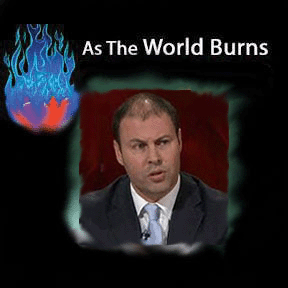 What an extraordinary, gutless capitulation by Josh Frydenberg Forget climate policy intricacies – through this pathetic retreat the government has again revealed its true nature, Guardian, Katharine Murphy, 9 Dec 16, What an extraordinary capitulation.
Just 24 hours of controversy from entirely predictable quarters and a carefully calibrated process to try to engineer a truce in Australia’s utterly wretched climate politics has been all but abandoned by its architects.
Josh Frydenberg has gone in the space of 24 hours from saying quite clearly the government would consider an emissions intensity trading scheme for the electricity sector to trying to pretend he said no such thing.
The retreat is, frankly, unseemly.
Actually, the retreat is more than unseemly, it’s pathetic – and the consequences of it stretch far beyond yet another apparent failure to do what needs to be done to ensure our economy makes an orderly transition to the carbon-constrained world that the Turnbull government willingly accepted when it signed Australia up to the Paris international climate agreement this time 12 months ago……
On climate policy the Coalition has backed itself into a tight corner of its own making – and it shows no sign of finding the courage, the steadiness or the integrity to try to manage its way out. https://www.theguardian.com/australia-news/2016/dec/07/what-an-extraordinary-gutless-capitulation-by-josh-frydenberg
Not justified, not financially viable – Adani’s huge coal mine project
Adani’s mega mine neither financially viable nor justified, says energy analyst, ABC News, By Casey Briggs, 8 Dec 16, Adani’s mega coal mine in north Queensland is neither “financially viable nor strategically required” an energy commentator claims.
The mining giant will begin construction on its $22 billion Carmichael coal mine in the Galilee basin in central Queensland next year.
This week, Adani announced the mine’s regional headquarters will be in Townsville, and the State Government is promoting an “ironclad” handshake deal with the company to source workers from regional Queensland.
Despite the announcements, energy analyst Tim Buckley from the anti-coal think tank The Institute for Energy Economics and Financial Analysis (IEEFA) said there is still doubt over whether the mine is even viable.
“All of my financial analysis over the last four years says the mine is neither financially viable nor strategically required or justified,” Mr Buckley said.
“Financial closure is going to be a major obstacle, I have absolutely no doubt.”
“As the company has admitted, they have not been talking to any financial institutions about this project”
Federal government should study India first
A number of Australian and international banks have reportedly ruled out financing the mine. Adani has also applied for public financing for a $1 billion rail link from the Commonwealth Government, but it’s unclear if the loan will be granted.
Mr Buckley said the Indian Government’s plans to reduce and potentially end coal imports threatens the justification for the project. “[The Australian Government should] go and study what’s happening in India … before they give a billion dollars in taxpayer subsidy to a foreign billionaire who made an investment decision at the height of the coal boom in 2011 and hasn’t progressed the project for six years,” said Mr Buckley.
At the Paris climate summit in November 2015 India’s prime minister Narendra Modi declared that in the 21st century “the world must turn to the sun to power the future”…….http://www.abc.net.au/news/2016-12-08/adani-mega-mine-neither-viable-nor-required-says-analyst/8100906
1 This month



Help Aunty Sue Protect Her Land and Sacred Sites From Destructive Rocket Testing.
.

Australians deserve the truth
about
AUKUS – https://aukuspublicinquiry.com/

PETITION – To: Prime Minister Anthony Albanese and the Australian Labor Government

of the week – Australians for War Powers Reform (AWPR)
To see nuclear-related stories in greater depth and intensity

