South Australia bushfires: crazy to suggest nuclear waste dump there!
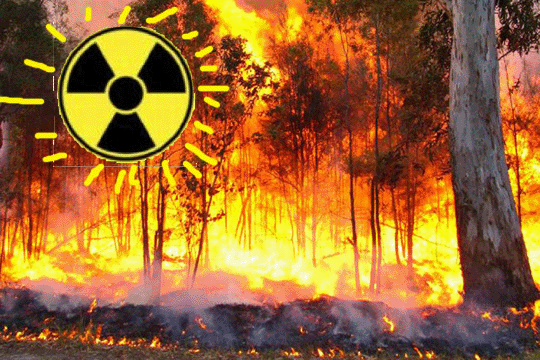
Bushfires threaten South Australia. After the hottest October on record, in what will be the hottest year on record, South Australia already faces an extraordinarily dangerous fire season.
 Is it sane for the South Australian government and its Nuclear Fuel Chain Royal Commission to be contemplating setting up this State as the world’s radioactive trash dump?
Are they not aware of the agonies that went on in Ukraine over the forest fires threatening Chernobyl region. and radioactive waste sites in California?
It is simply crazy, in view of climate change and increasingly hot, dry , long bushfire seasons to suggest placing dangerous radioactive trash in South Australia
Catastrophic fire danger warning as SA faces extreme heat http://www.abc.net.au/news/2015-11-18/hot-weather-forecast-sa-change-later/6952632 Another day of extreme heat has been forecast across South Australia for Thursday and total fire bans have been imposed for 10 districts, with catastrophic ratings in four of them.
Adelaide is expecting a high of 35 degrees Celsius, after the mercury peaked above 40C on Wednesday….. The Education Department said catastrophic fire danger ratings meant it would close some state schools and preschools in bushfire-prone areas of the Riverland, mid-north, Flinders and North-West Pastoral regions on Thursday.
Some national parks and reserves would remain closed on Thursday, the Environment Department said, on eastern Eyre Peninsula, in the far north, and through the mid-north, Flinders Ranges, Riverland and Murraylands.
Firefighters will be on high alert and crews are still at a blaze south of Adelaide, which first broke out on Tuesday.
The Country Fire Service said the scrub fire at Yundi on the Fleurieu Peninsula was yet to be controlled.
Country Fire Service crews continue to tackle fires as South Australia goes on full alert for 2015 bushfire season, Advertiser, 18 Nov 15 POLICE are patrolling bushfire-prone areas and aerial bombers remain on standby as extreme fire conditions are forecast across the state just days into the fire-danger season.
Operation Nomad patrols and other police will target known firebugs and ask that anyone who notices suspicious activity or people in fire danger areas to contact the police assistance line on 131 444.
“Landowners are also asked to adhere to local harvest codes of practice which are available from your local council,’’ a police spokeswoman said.
Total fire bans are in place across most of the state as the temperature is tipped to soar into the 40s in the north and west of the state……. Continue reading
Malcolm Turnbull “browns down” OECD deal to limit coal subsidies
According to the Australian Greens, the Turnbull government’s deal could allow the development of up to 16,000MW of extra coal plants – already in the planning pipeline – to be financed.
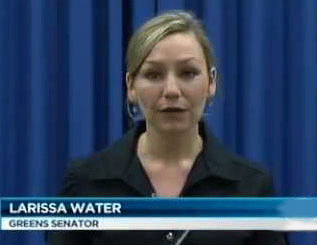 Greens Senator and climate spokesperson, Larissa Waters, said the Turnbull government’s “grubby gambit” had tipped the scales against clean energy in these developing countries, and towards coal – a situation that would benefit Australia’s resources sector.
Turnbull accused of “browning down” OECD coal subsidy 
 cuts, http://reneweconomy.com.au/2015/turnbull-accused-of-browning-down-oecd-coal-subsidy-cuts-44371 By Sophie Vorrath on 18 November 2015 The Turnbull government has been accused of “browning down” the deal to limit global coal plant subsidies, struck this week by the Organisation of Economic Cooperation and Development, after the compromise it proposed alongside South Korea was worked into the agreement. Continue reading
Bega climate activist Philippa Rowland to speak at UN summit in Paris
 Community projects lead to world stage: Bega climate change activist to speak at UN summit in Paris ABC South East NSW Ian Campbell, 17 Nov 15 Philippa Rowland, one of the founding members of a regionally-based climate action group, is Paris-bound, keen to play a role in shaping a safer climate future for the world.
The United Nations Conference on Climate Changeruns from November 30 to December 11, and Ms Rowland will be there as a voice from rural Australia.
Motivated by her connection with Clean Energy for Eternity (CEFE), based in the Bega Valley of New South Wales, Ms Rowland said she would bear witness at a pivotal time in the world’s response to a warming atmosphere.
“If we turn the corner now we still have time,” she said.
Since 2006 CEFE has championed a range of renewable energy projects that have resulted in solar panels being installed on community buildings, and culminating in the Tathra Solar Farm coming online earlier this year……..http://www.abc.net.au/news/2015-11-17/bega-activist-to-address-un-climate-change-paris/6947248
Australia making ’empty promises’ on phasing out fossil fuel subsidies – report
Australia and its fellow G20 nations are “paying fossil fuel producers to undermine their own policies on climate change”, a British think tank says.
In a report released on Thursday, the Overseas Development Institute questioned why the Australian government continued to provide more than $5 billion a year to support fossil fuel production, despite a G20 commitment to phase out subsidies six years ago.
The report, titled Empty Promises: G20 subsidies to oil, gas and coal production, comes ahead of the G20 summit in Turkey on November 15, and says that G20 governments collectively spend more than $640 billion a year to support the production of fossil fuels – almost four times the total of global subsidies for renewable energy. http://www.smh.com.au/environment/australia-making-empty-promises-on-phasing-out-fossil-fuel-subsidies-report-20151111-gkwbrb.html
Australia two-faced at OECD discussions on coal and climate change
In addition, taking a blocking position at the OECD has the potential to damage Australia’s credibility in other international negotiations and particularly as its role as co-chair of the Green Climate Fund. Overall, to address climate change, our policies on energy and climate change will need to align. As the US, EU and China step up their leadership on climate change, Australia will come under increasing pressure to reconcile its different positions.
OECD coal discussions highlight tensions in Australia’s position on climate change, The Conversation, Katherine Lake November 13, 2015 While the UN Paris talks approach at the end of November, attention is currently focused on another forum, the Organisation of Economic Cooperation and Development (OECD), where member countries are negotiating a deal to limit public finance to overseas coal projects in emerging and developing countries.
Australia and South Korea are reportedly opposed to an agreement struck by the US and Japan and supported by other member countries, notably Germany and France, to prevent public finance to all but the very cleanest power plants.
How will these discussions at the OECD impact on the UN Paris negotiations? Australia’s approach to these international meetings would seem to be inconsistent……..
Australia is walking a fine line in climate diplomacy
Are Australia’s positions on climate change in the UN and the OECD inconsistent?
On the one hand, Australia supports the objective of keeping the global temperature rise within 2℃ and is willing to make some domestic emission reductions to assist in achieving this.
On the other hand, it is not yet willing to place any real limits on its coal exports to developing countries. It justifies this position on the basis that coal is required by developing countries to alleviate poverty and that it is not for Australia to decide how other countries allocate their public finance. Continue reading
Australia’s obligations to Pacific climate migrants
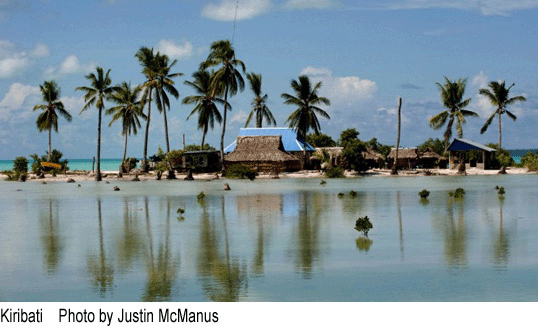 Australia must not be afraid of its obligations to Pacific climate migrants, Guardian,
Richard Marles, 12 Nov 15 Australia’s humanitarian intake is from distant countries; as climate change leads some islanders to migrate, that will change. So must our approach “……While land is a necessary precondition for life, people live on these atolls because of the sea. It is the source of food, culture and legend. These are marine people whose ancient understanding of the wind and the waves still often transcends what modern equipment has to offer.
Yet as the greenhouse effect starts to take hold these winds are beginning to change. Predictable weather patterns in equatorial environments which produced constant temperatures, regular rains and seasonal storms are no longer behaving. Life is being disturbed.
Of all the climate change threats to coral atolls the most pressing is water security. On Tarawa atoll in Kiribati, half the fresh ground water supply is now permanently salty.
On Funafuti in Tuvalu there is no groundwater, which leaves people dependent on water tanks next to their homes – many of which have been provided by Australian aid. But even with extra tanks the water supply of the atoll amounts to about six weeks worth of water.
In November 2011 reduced rainfall brought the atoll to a point where the water supply was down to just a few days. Drastic water restrictions were imposed which essentially allowed for little more than the bare minimum of drinking water. Australian and New Zealand mercy flights had to airlift an emergency supply of water on to the island.
This community had lived on the atoll for centuries relying on highly predicable rainfall in order to have a supply of fresh water. Just a small shift in weather patterns had suddenly overwhelmed even the enhanced infrastructure to a point where there was almost no water. When winds and rain change, the conditions of life are thrown into question.
This question raises another for Australia. Kiribati and Tuvalu are in a region where Australia has enormous influence and great obligations. We are for both countries the natural development partner and by far the largest aid donor. In large measure it is this work which sits atop our calling card as a good global citizen. And we derive much from that reputation.
If climate change is beginning to raise the existential question in the Pacific then this also has implications for our obligations.
To be sure, the desire for the peoples of the Pacific to migrate because of climate change will not happen tomorrow. The focus of all these communities right now is naturally on how they maintain their homes, lives and cultures. And currently they see the critical role for Australia as playing its part in reducing greenhouse emissions and in supporting them with adaptation efforts.
But if climate change is placing the viability of communities in question, then inevitably some people will move as a result. So Australia being a destination for climate change migrants surely has to be up for discussion……..http://www.theguardian.com/commentisfree/2015/nov/11/australia-must-not-be-afraid-of-its-obligations-to-pacific-climate-migrants
Australia’s ’empty promises’ on phasing out fossil fuel subsidies
 Australia making ’empty promises’ on phasing out fossil fuel subsidies: report, SMH, Lucy Cormack November 12, 2015 Environment Reporter Australia and its fellow G20 nations are “paying fossil fuel producers to undermine their own policies on climate change”, a British think tank says.
In a report released on Thursday, the Overseas Development Institute questioned why the Australian government continued to provide more than $5 billion a year to support fossil fuel production, despite a G20 commitment to phase out subsidies six years ago.
The report, titled Empty Promises: G20 subsidies to oil, gas and coal production, comes ahead of the G20 summit in Turkey on November 15, and says that G20 governments collectively spend more than $640 billion a year to support the production of fossil fuels – almost four times the total of global subsidies for renewable energy.
“The G20 committed for the first time in 2009 to phase out fossil fuel subsidies. Six years later, very little has happened,” said Shelagh Whitley of the Overseas Development Institute, which jointly published the report with US-based Oil Change International.
According to the report, “production subsidies” are national subsidies delivered through direct spending and tax breaks, investments by majority state-owned enterprises and public finance from majority government-owned banks and institutions.
The report specifically excludes support to consumption of fossil fuels and consumption of fossil fuel-based electricity.
“We’ve done this work to focus on production subsidies, because [they] are what is driving the exploitation of reserves that we know we have to keep in the ground to avoid dangerous climate change,” Ms Whitley said.
“We’re putting this inventory together – which we shouldn’t really be doing, it should be governments doing it themselves … It’s potentially a precedent for what governments can do and it allows policy makers looking at this for reform.”
The report placed Russia at the top of the list for production subsidies, averaging around $23 billion each year, followed by the US providing more than $20 billion, Britain providing $9 billion, China giving just over $3 billion and Brazil about $5 billion.
“Without government support for production and wider fossil fuel subsidies, large swaths of today’s fossil fuel development would be even less profitable,” the report said, pointing to the Isaac Plains mine in the Bowen Basin of northern Queensland, which, valued at $628 million in 2012, sold for $1 in June this year.
Australian Conservation Foundation economist Matthew Rose said the report’s findings about Australia were shocking but unsurprising.
“It’s in the budget every year. The fuel tax credit scheme is a majority of that money, but it’s usually over $5 billion every year that we use to subsidise fuel of large corporations,” he said.
“Malcolm Turnbull, Greg Hunt and Julie Bishop can go to the Paris climate conference and say what they like, but looking ahead if they haven’t started phasing out subsidies in the budget in May and if they haven’t laid out a plan for what is happening to renewables past 2020, there is a problem.”
The Australian Conservation Foundation estimates that federal budget handouts that encourage pollution will amount to $47 billion in the four years between 2014-15 and 2017-18………. http://www.smh.com.au/environment/australia-making-empty-promises-on-phasing-out-fossil-fuel-subsidies-report-20151111-gkwbrb.html#ixzz3rKHM7RZj
Malcolm Turnbull all tied up over Climate Change and Paris Conference
 Malcolm Turnbull: Verbal acrobatics required for Paris climate
  talks, Independent Australia, 8 November 2015, Malcolm Turnbull will need to utilise his obvious talent for rhetoric to convince a global audience at the Paris climate talks in November, as there is no substance to the Government’s “Direct Action” climate policy, says Noel Wauchope.
Australia’s new Prime Minister Malcolm Turnbull has an appealing and glib turn of phrase. He’s going to need that talent when he speaks at the United Nations Paris Climate Conference in late November.
The thing is, Malcolm has to sell to the conference Australia’s current policy on climate change. The Government’s “Direct Action” climate policy is unchanged, despite the departure of climate sceptic Tony Abbott. Its flagship is the Emissions Reduction Fund (ERF).
The ERF boils down to tax-payer handouts to polluting companies that volunteer to cut their greenhouse emissions. There is no enforcement policy, meaning that the companies get the money, and for a year or more, do not need to show that they have reduced emissions.
After a year, the government proposes a ‘safeguards mechanism’, to be explained fully then, so allowing the companies plenty of leeway to lobby to make it meaningless. ……..
What happened to Turnbull? Mark Kenny & James Massola wrote in The Age in February:
‘Amid feverish speculation over the leadership, unconfirmed reports also claimed Mr Turnbull had moved to assuage fears in the conservative wing of the party that his return to the leadership would see a reprise of the carbon tax or an emissions trading scheme. It was claimed Mr Turnbull had promised, in a secret deal, that there would be no such reprise if elected.’
More recently, Kenny expressed it in this way:
‘Turnbull has his hands tied, having lost the leadership in 2009 to Abbott for supporting emissions trading, and then having regained it in 2015 on the express condition of opposing it. Release from such Houdini-esque chains will take some doing.’…….
Turnbull’s support for nuclear waste dumping in Australia might go down okay at the Paris talks. There will be a strong push there for nuclear power to be portrayed as cure for a climate change. At present, “new nuclear” is hamstrung in the U.S. because there has to be a waste solution before it can go ahead. ……
However, to persuade the world on Australia’s entire climate inaction package is a task that will demand Turnbull’s very best linguistic acrobatics.
Malcolm Turnbull faces an epic task to keep faith with Liberal Coalition climate denialists, while making Australia’s pathetic climate policy look at all reasonable to the global audience. https://independentaustralia.net/politics/politics-display/malcolm-turnbull-verbal-acrobatics-required-at-the-paris-climate-talks,8356
Banks NAB and CBA support climate action (but watch out for nuclear investment)
 This is a good start. But use of the words “low carbon”always needs to be taken with a grain of salt, as it is often code for “nuclear”
Would these banks back nuclear power as a “low carbon” option?
Banking On Climate Action, NAB And Commonwealth Bank Move To Support Paris Talks, New Matilda, By Thom Mitchell on November 6, 2015 The move has drawn praise from green groups, who are still warning both institutions need to back away from investments in coal. Thom Mitchell reports.
Two of Australia’s biggest banks stepped up their commitments to climate action, outlining how they will support the international push to limit the rise in average global temperatures to two degrees or less ahead of a major United Nations summit in Paris this December.
The Commonwealth and National Australia Banks confirmed they support the two degree target, with NAB even going as far as to committing to spending at least $18 billion by 2022 “to help address climate change and support the transition to a low carbon economy”. “NAB believes the financial sector has an important role to play in assisting the transition to a low carbon economy, through both the energy we purchase directly and through financing,” the institution said in a statement.
The $18 billion will be spent on “new lending, debt market activity, provision of risk management products, development of financing solutions and advisory activity”.
“Finance will be provided to our customers to undertake climate change mitigation such as renewable energy and energy efficiency including low carbon property, low emission transport, and climate change adaptation activities,” the statement reads. Continue reading
Adelaide’s January heatwave attributed to climate change
The findings are reported in the fourth issue of the American Meteorological Society’s report into extreme weather. The report looked at 33 extreme weather events around the world and analysed which could be attributed to human activity and which were the result of natural variability in weather patterns.

As David Mark reports, detecting the human hand in climate change is a developing area of climate science.
Continue reading
Australian insurance companies must come clean about climate change
 Australian insurers keep customers in the dark about climate risks, report finds, Guardian, Lenore Taylor, 3 Nov 15 A WWF study shows Australian insurers tell customers far less than overseas insurers about the risks climate change could pose to their businesses Australians are in the dark about the risks climate change poses for the local insurance industry because Australian insurers don’t disclose enough information, a new report claims.
Climate change poses risks for the insurance industry through increased claims and potential impacts on investments held by the insurer to pay on future claims, and could cause premium increases so steep that homes in some fire, flood or cyclone prone areas could become uninsurable.
A study presented to the Actuaries Institute last year, “Can actuaries really afford to ignore climate change?” found claims were likely to rise but that it was difficult to predict by exactly how much. Bushfire claims were calculated to rise by between 29% and 116% by the end of the century, cyclones by up to 230% and river flooding by between 7% and 54%.
“Global warming will have significant impacts on the insurance industry through increased claims, reputational damage, decline in insurance affordability, and an increase in uninsurable sectors or geographies,” WWF spokeswoman Monica Richter said.
“Without full public disclosure of their climate-related risks and management strategies, Australian consumers and shareholders are left vulnerable to unexpected costs and regulatory shifts.”…….http://www.theguardian.com/environment/2015/nov/02/ausralian-insurers-keep-customers-in-the-dark-about-climate-risks-finds-report
Ozone hole over Antarctica expands to near-record levels, now four times size of Australia
Ozone hole over Antarctica expands to near-record levels, now four times size of Australia, ABC News The World Today , 3 Nov 15 By Lucy Carter The hole in the ozone layer over Antarctica has expanded to near-record levels this year, covering an area almost four times the size of Australia.
Scientists from the UN said the increase was due to colder-than-usual temperatures, rather than any extra damage being done to the Earth’s protective layer.

But that could still mean extra UV radiation and the risk of more people getting sunburnt in Australia’s southern states this summer. Continue reading
Doctors warn on health effects of climate change on children
Australian doctors call for Health Minister to attend Paris climate talks, SMH November 2, Lucy Cormack The “increasingly unmanageable” threat of climate change on children’s health has prompted an open letter from doctors around Australia to the government, calling for Federal Health Minister Sussan Ley to attend the United Nations Paris climate summit this December.
In the letter, from independent organisation Doctors for the Environment Australia, leading doctors warn of the “health emergency” climate change presents for children, who have the least capacity to act. “More bushfires, floods and storms have already had severe and ongoing psychological effects on Australian children,” said the letter, which was released on Monday.
“Higher temperatures, which we are now seeing, have been linked to increases in premature births and hospital attendances for infectious diarrhoea, fever, asthma, dehydration and heat exhaustion.”…….Beyond two degrees of warming, health impacts threaten to become increasingly unmanageable.”
Professor Fiona Stanley, a former Australian of the year and a signatory to the letter, said she strongly supported the call for Ms Ley to go to Paris, because Australia desperately needed a national strategic plan for handling the health impacts of climate change…….Professor Kingsley Faulkner, AM, chair of DEA and former president of the Royal Australasian College of Surgeons, said Australia risked remaining “a laggard, rather than a leader on climate change”.
“Australia must prove to the world that it can protect the health of its own citizens in Paris, especially its children,” he said.
The 2015 Paris COP21 climate summit will host leaders from more than 190 countries and runs from November 30 to December 11. http://www.smh.com.au/environment/australian-doctors-call-for-health-minister-to-attend-paris-climate-talks-20151101-gknvym.html#ixzz3qIcipVs1
Seed – Indigenous Youth Declaration for Climate Justice
 http://www.seedmob.org.au/indigenous_youth_declaration
“As Aboriginal and Torres Strait Islander young people we are a part of the oldest continuing culture in the world and have lived in harmony with our land for generations.
Right now climate change is disproportionately affecting Aboriginal and Torres Strait Islander people. We are experiencing rising sea levels in the Torres Strait, the loss of sacred country, diminishing food and water accessibility.
For Aboriginal and Torres Strait Islander people the injustices go beyond the climate impacts. The fossil fuel industry has been putting stress on our land, our culture and our communities for decades.
Our vision is for a just and sustainable future with strong cultures and communities, powered by renewable energy. Our vision and the fossil fuel industry cannot coexist. … “
Fijian PM slams Turnbull for giving in to climate denialists
 Fiji PM decries Australia’s ‘climate change deniers’ in Turnbull cabinet, Guardian, Oliver Milman, 28 Oct 15, Frank Bainimarama says: ‘The Australian government, in particular, seems intent on putting its own immediate economic interests first’ The prime minister of Fiji has delivered a blistering broadside at his Australian counterpart, Malcolm Turnbull, over the “climate change deniers” in his government who are helping doom Australia’s “unlucky island neighbours”.
Frank Bainimarama criticised Australia and New Zealand for failing to back Pacific island nations over climate change, claiming that the entire region risked being wiped out by rising sea levels, extreme weather and ruined agriculture.
“The Australian government, in particular, seems intent on putting its own immediate economic interests first,” Bainimarama said in a speech delivered in Nadi, Fiji. “The ‘lucky country’ determined to stay lucky, at least for the short term, at the expense of its unlucky island neighbours.
“To Malcolm Turnbull, the new Australian prime minister, I want to send a special plea. Make good on your previous strong stance in favour of deep and binding cuts in carbon emissions. Do not do deals with those who have enabled you to gain high office and betray your principles and our position.”
Bainimarama said Turnbull should halt new coalmines in Australia and embrace an economy based on clean energy. Such a ban has been proposed by a coalition of Pacific nations in the recent Suva declaration. Continue reading
1 This month

of the week – Australians for War Powers Reform (AWPR)
To see nuclear-related stories in greater depth and intensity
 Antinuclear