Barrier Reef to become a fossil fuel highway – Senator Larissa Waters
 Qld Senator Larissa Waters, Greens Deputy Leader & climate change spokesperson:
Abbot Point EIS confirms Palaszczuk Government’s agenda to turn Reef into a coal highway http://larissa-waters.greensmps.org.au/content/media-releases/abbot-point-eis-confirms-palaszczuk-government%E2%80%99s-agenda-turn-reef-coal-highwa 27 Oct 15:
“The Palaszczuk Government’s lodgement of the Abbot Point coal port expansion final Environmental Impact Statement with Minister Hunt today, confirms it’s forging ahead with its agenda to turn the Great Barrier Reef into a fossil fuel highway.
“The Palaszczuk Government is continuing to do Adani’s dirty work for it,” Qld Senator Larissa Waters Australian Greens Deputy Leader and climate change spokesperson, said. “Labor has paid for this environmental impact statement with taxpayers money, when usually the company itself foots the
bill.
“And now Labor is set to pay for the dredging in this World Heritage Area to create one of the biggest coal ports in the world, which will turn the Reef into a highway for coal ships.
“There’s no guarantee we will get this money back – Adani is mortgaged to the hilt and hasn’t attracted any finance for its Carmichael coal mine. In fact 14 banks internationally have ruled out financing it. …
“Queenslanders care deeply about our Great Barrier Reef and halting global warming. The unprecedented amount of public submissions to the EIS, at 55 000, is testament to
Queenslanders’ love for the Reef. “So many Queenslanders are deeply disappointed that the
Palaszczuk Government has turned out to be just as bad as the Newman Government when it comes to treating our Reef as a highway for climate-destroying fossil fuels,” Senator Waters said.”
Senator Larissa Waters,
Australian Greens Deputy Leader & environment spokesperson
http://larissa-waters.greensmps.org.au/
Australia’s PM Malcolm Turnbull will attend Paris UN climate conference
 Turnbull to attend UN climate conference Prime Minister Malcolm Turnbull is expected to attend December’s United Nations climate change conference in Paris. http://www.sbs.com.au/news/article/2015/10/25/turnbull-attend-un-climate-conference Source: AAP
He has told the Guardian Australia he will head to Paris for the December conference after the Commonwealth Heads of Government meeting in Malta, armed with the coalition’s 2030 emissions reduction target of 26 to 28 per cent on 2005 levels.
His predecessor Tony Abbott was not expected to attend the conference after he scrapped the carbon tax, reduced Australia’s renewable energy target and criticised wind farms for being ugly.
Before Turnbull became prime minister, Foreign Minister Julie Bishop had been expected to represent Australia at the UN meeting instead of Abbott.
With its heavy use of coal-fired power, Australia is considered one of the world’s worst per capita greenhouse gas polluters.
Australia’s carbon emission targets criticised Continue reading
Australia’s military not up to date on climate change threats
 Australia’s military stuck in the ‘wilderness’ over climate change, former ADF chief says, The Age, October 24, 2015 Peter Hannam Australia’s military planners have neglected climate change threats to the country and neighbours, leaving forces under-prepared for imminent and far-ranging challenges, say two retired senior officers – including a former Australian Defence Force chief………..
Michael Thomas, an army major who retired in June after 22 years of service, said the politicisation of climate change had been “a huge distraction to defence”.
“There are pockets of interest within the military on the subject but it’s not something that has captured the attention of our senior leadership,” Major Thomas said.
Both former military leaders outlined concerns in a recent report they wrote for the Climate Council and will lead a two-day panel at the Australian Defence Force Academy next week. They also detect a change of policy under new Prime Minister Malcolm Turnbull.
A Defence spokesperson said the department “has been actively monitoring and addressing the impacts of climate change for a number of years”.
The upcoming Defence White Paper – originally due for completion last September – will address the full ranges of challenges facing the ADF out to 2035 “including the security implications of climate variability and extreme weather events in our region and beyond”, the spokesperson said.http://www.theage.com.au/environment/climate-change/australias-military-stuck-in-the-wilderness-over-climate-change-former-adf-chief-says-20151023-gkgl20.html#ixzz3piGfAcFI
Hallelujah! Political Oblivion for climate villains Abbott and Harper
 Canada’s Harper follows fellow “climate villain” Abbott into political oblivion, REneweconomy, By Giles Parkinson on 20 October 2015
It is good news for the upcoming Paris climate change talks. Both countries, under their former leaders, ranked at the bottom of the 34 countries in the Organisation for Economic Co-operation and Development (OECD) for their efforts on climate change. Among G20 countries, only Saudi Arabia ranked lower than them.
Since their elections – Harper in 2006, and Abbott in 2013 – they had applied the brakes on climate change and renewable energy policy, despite some strong efforts at sub-national levels (the provinces in Canada and states and territories in Australia).
During a visit to Canada last year, Abbott and Harper decided to create a “conservative alliance among ‘like-minded’ countries” to try to dismantle global efforts on climate change.
At a press conference, Harper applauded Abbott’s efforts to dump Australia’s carbon tax. Indeed, Abbott had borrowed the “axe the tax” slogan from an earlier Canadian campaign.
Now, both have gone…….http://reneweconomy.com.au/2015/canadas-harper-follows-fellow-climate-villain-abbott-into-political-oblivion-43745
Australian government withdraws funding offer to Bjorn Lomborg’s anti climate action centre
Bjorn Lomborg: Government withdraws $4 million funding offer for controversial research centre, ABC News, By political reporter Francis Keany and Sara Phillips 22 Oct 15 The Federal Government says it has withdrawn a $4 million offer to help establish a research centre headed by Danish academic Bjorn Lomborg.
Education Minister Simon Birmingham has told a Senate estimates hearing the proposal was quietly dropped in the week when Malcolm Turnbull became Prime Minister.
“Certainly, a specific incentive from the Government for such an institute is no longer available,” Senator Birmingham said……..
Greens Senator for South Australia Robert Simms described the withdrawal of funding as “welcome” and said it was “in response to a really strong campaign that’s been run across the community”.
“It’s good to see the Turnbull Government making a break with the Abbott era and dumping Dr Lomborg,” he said…… http://www.abc.net.au/news/2015-10-21/govt-withdraws-funding-from-lomborg-centre/6873238
Malcolm Turnbull won’t back Clean Energy Finance Corporation
 Malcolm Turnbull refuses to back Clean Energy Finance Corporation Labor uses question time to attack the prime minister and the Coalition over its climate change policies, Guardian, Lenore Taylor, 20 Oct 15 Malcolm Turnbull says the need for the Clean Energy Finance Corporation remains an “open question” and has dismissed emissions trading schemes as simply another “piece of economic plumbing”, as Labor attacked the credibility of the Coalition’s climate policies.
Turnbull lost the Liberal leadership in 2009 over his backing for the former Rudd government’s emissions trading scheme, and was forced to pledge to retain the current Direct Action climate plan in order to win support from conservative and climate-sceptic colleagues before becoming prime minister, despite having once described it as “bullshit” and a “recipe for fiscal recklessness on a grand scale.”
Under Tony Abbott, the coalition unsuccessfully tried to abolish the corporation, which the former prime minister derided as the “Bob Brown bank”.
The CEFC lends to clean energy projects on commercial terms and has so far lent $1.4bn, which will reduce emissions by 4.2m tonnes annually and also achieve a positive return on the commonwealth’s investments.
Under Turnbull the CEFC has been transferred to the environment department and the government has apparently dropped plans to hobble its mandate by banning investments in wind farms and small scale solar and has suggested it plays an important role in its climate plans.
But despite this, during question time on Tuesday, Turnbull refused to say he backed the institution – instead hedging his answer and pointing out the government had been unable to get the Senate to agree to the CEFC’s abolition…….http://www.theguardian.com/australia-news/2015/oct/20/malcolm-turnbull-refuses-to-back-clean-energy-finance-corporation
Adani coal mine approval ‘grossly irresponsible’
Australian Conservation Foundation, October 15, 2015 Federal environment minister Greg Hunt’s approval of what could become one of the world’s largest coal mines sets back global efforts to combat climate change, the Australian Conservation Foundation said today.
“To approve a massive coal mine that would make species extinct, deplete 297 billion litres of precious groundwater and produce 128.4 million tonnes of CO2 a year is grossly irresponsible,” said ACF President Geoff Cousins.

“At a time when the world is desperately seeking cleaner energy options this huge new coal mine will make the effort to combat climate change all the more difficult.”
If it goes ahead the Carmichael mine would be the largest ever dug in Australia. It would take up five times the area of Sydney Harbour. The climate pollution resulting from burning its coal would be more than New Zealand’s entire annual emissions.
In August the Federal Court set aside Minister Hunt’s original approval of Adani’s controversial proposal to dig the massive coal mine in Queensland’s Galilee Basin.
Minister Hunt’s re-approval of the Carmichael coal mine flies in the face of rising public opposition to the proposal and scientific evidence that shows the mine would destroy 10,000 hectares of habitat for endangered species, including the largest known population of the southern black-throated finch.
“Tens of thousands of ACF supporters from all over Australia have written to Greg Hunt, asking him to reject the Carmichael mine once and for all,” Mr Cousins said.
“Just as Woodside lost its social license to build a gas factory at James Price Point in the Kimberley, most Australians do not want Adani to dig a massive coal mine and export the coal across the Great Barrier Reef.
“ACF will scrutinise this approval decision and carefully consider our options.
“We will use all appropriate means to stop this mine,” Mr Cousins said.
ACF and other environment groups ran ads in major newspapers in August urging Minister Hunt not to re-approve Adani’s Carmichael proposal.
To meet climate goals, Australia must double decarbonisation
Australia must double decarbonisation rate to meet 2030 goals, report finds, Guardian, Oliver Milman, 13 Oct 15 Coalition claims nation is making good progress towards cutting emissions by 26% by 2030, but report by PricewaterhouseCoopers shows more is needed The federal government has said it is making good progress in cutting greenhouse gases after a new report found that Australia will have to double its historic rate of decarbonisation if it is to meet its climate goals.
Australia will have to slash its carbon intensity by 4.4% each year if it is to meet its goal of reducing emissions by at least 26% by 2030, based on 2005 levels, according to the PricewaterhouseCoopers (PwC) analysis.
This rate of required emissions reduction is nearly double the average 2.4% cut managed by Australia annually since 2000.
Australia’s rate of decarbonisation is among the best of the world’s largest economies, PwC said. If Australia maintained its 4.7% reduction in carbon intensity in 2014, it could hit the 2030 target. However, the 2014 figure includes six months during which the former Labor government’s carbon price of $24 a tonne was in place…….
According to the PwC analysis, the global economy has reduced its carbon intensity, which is emissions related to economic growth, by 1.3% a year since 2000. Last year saw the biggest drop yet, at 2.7%.
But these reductions are still not enough to meet the 2C target, which, if exceeded, will result in runaway climate change associated with punishing drought, damaging sea level rises and extreme weather events.
If current emissions cuts are maintained, the world will spew out enough heat-trapping gases to exceed the 2C limit by 2036, PwC said. The European Commission has said that national pledges to further cut emissions ahead of climate talks in Paris in December will still result in a 3C rise in average temperatures.
The federal government has said Australia’s emission reduction target places it among comparable nations although independent analysis suggests it lags at the back of the pack.
Australia still lacks a comprehensive plan to reduce emissions beyond a $2.55bn emissions reduction fund that hands out money to businesses that wish to reduce their greenhouse gas output. Analysts believe this plan will fall well short of the target without major modification, potentially including emissions trading, which the government has previously ruled out.
Australia’s energy is still overwhelmingly fossil fuel based, with coal, oil and gas accounting for 94% of the country’s energy demands, PwC said. However, coal consumption has slipped 18% since 2009 and energy from renewables such as wind and solar has increased by 72% over the same period.
Greens senator Larissa Waters said: “The Abbott government’s attacks on renewable energy are continuing under Malcolm Turnbull who has made a deal with the Nationals to retain the low 2030 target and not bring back an emissions trading scheme.
“We’re missing out on clean energy jobs because the Turnbull government is holding us back from this exciting transition that we need to save our environment and very way of life.”……… http://www.theguardian.com/environment/2015/oct/13/australia-must-double-decarbonisation-rate-to-meet-2030-goals-report-finds
Australia’s doctors campaign for action on climate change
 Doctors urge climate action http://www.sbs.com.au/news/article/2015/10/11/doctors-urge-climate-action One of Australia’s peak medical bodies says political leaders must act on climate change to reduce serious health impacts. AAP
 The Royal Australasian College of Physicians will hold a Global Day of Climate Action to put pressure on leaders at the coming United Nations climate talks in Paris in December.
Infectious diseases physician and senior lecturer at the Australian National University medical school, Dr Ashwin Swaminathan, said doctors are trying to raise awareness of serious health impacts caused by climate change. “Doctors want the community and our government representatives to know that health is at stake with climate change,” Dr Swaminathan said.
“The college recognises that climate change poses a risk to the health of all Australians across all regions.”
Health professionals have seen a spike in ambulance call-outs, hospital admissions and deaths during heatwaves, which are projected to increase further without checks on global emissions.
Dr Swaminathan said there will also be increases in water-borne and mosquito-borne diseases, with Australian disease specialists worried in particular about diarrhoea-causing bacteria and disease-carrying mosquitoes. Higher temperatures expand the areas in which these disease carriers can thrive.
Dr Swaminathan said the species of mosquitoes that can carry dengue fever, Ross River fever and Barmah Forest virus will be able to move further south in Australia under changed climate conditions.
Disease and climate change is attracting more attention from doctors. “It’s something that is becoming more discussed at infectious diseases forums,” Dr Swaminathan said.
The Royal Australasian College of Physicians has begun a Doctors for Climate Action campaign which, with the support of 50 medical organisations, is calling on world leaders to commit to meaningful targets for emissions reduction at the United Nations COP 21 Climate Change Conference in Paris.
AUSTRALIA’S SHAME: getting UN climate draft to drop action to help climate refugees
 UN drops plan to help move climate-change affected people, Guardian, Oliver Milman, 7 Oct 15 Australia opposed the plan for a group to assist migration, and it has been left off the draft agreement for UN climate talks in Paris Australia’s opposition to the creation of a body to help people escaping the ravages of climate change appears to have paid off, with the idea dropped from the draft agreement for the crucial UN climate talks in Paris.
A previous draft of the deal to be thrashed out by nations included a “climate change displacement coordination facility” that would provide “organised migration and planned relocation”, as well as compensation, to people fleeing rising sea levels, extreme weather and ruined agriculture.
However, this reference has been removed in a revised text ahead of the December climate conference negotiations. Australia opposed the facility, although Guardian Australia understands the prime minister, Malcolm Turnbull, has shown interest in the issue of displacement.
“Australia does not see the creation of the climate change displacement coordination facility as the most effective or efficient way to progress meaningful international action to address the impacts of climate change,” a Department of Foreign Affairs and Trade spokesman said. “Australia is already working closely with our Pacific partners on these important issues.”
Australia had spent more than $50m in climate resilience projects in the Pacific and contributed another $200m to the Green Climate Fund.
Opposition to the coordination facility is not shared by Australia’s traditional allies, with representatives from the US, British and French governments indicating they were open to the idea……..
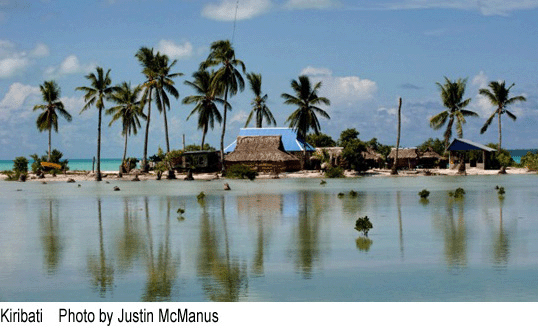
The impact of climate change is anticipated to displace up to 250 million people worldwide by 2050, including many in low-lying Pacific islands such as Tuvalu, the Solomon Islands and Kiribati.
In areas of the Pacific, sea level is rising by 1.2cm a year, four times faster than the global average. For coral-based islands two to three metres above sea level this has resulted in communities being relocated, and drinking water and crops are threatened by salt water inundation. Recent research suggests islands will not be submerged but will change shape and height, posing difficulties for fixed infrastructure.
“Why on earth would Australia not support a coordination facility?” said Phil Glendenning, president of the Refugee Council. “We are talking about the most vulnerable people on the planet who are facing threats to their food security, seeing their water supplies diminish and their entire cultures at risk.
“The world is going to have to deal with this displacement. We need to get on the front foot. Australia can’t say we are doing enough. People in Kiribati and Tuvalu are the canaries in the coalmine and they are looking to Australia.”
Last year the Kiribati government bought 20 sq km of land on Vanua Levu, one of the Fiji islands, in case its people cannot be moved internally. It has a policy called “migration with dignity” if its cluster of 33 coral atolls becomes inhabitable…….
Relocation of people is occurring across the Pacific region. Dozens of villages in Fiji will be moved, and 2,000 people from the Carteret atoll of Papua New Guinea will be transferred to mainland Bougainville, a three-hour trip on a wooden boat, because of salt intrusion and destructive tides. http://www.theguardian.com/environment/2015/oct/07/un-drops-plan-to-create-group-to-relocate-climate-change-affected-people
Displacement Solutions NGO for climate refugees targets Australia as worst climate offender
UN drops plan to help move climate-change affected people, Guardian, Oliver Milman, 7 Oct 15 “………Advocates for displaced people argue that a new international framework needs to be created to help them, given that the UN refugee convention does not cover them because they are not fleeing persecution.
“I’d hope the UN would put a new apparatus in place. At the moment this is being dabbled in – there’s nothing systemic,” said academic Scott Leckie, founder of Displacement Solutions, an NGO that facilitates moving people displaced by climate change within their countries.
Leckie’s organisation focuses its work in five countries – Bangladesh, Colombia, Fiji, Panama and the Solomon Islands – but said climate displacement was a global problem, even in wealthy nations such as the US where people in Alaskahave had to move and Boston faces a future of being a “city of canals” because of sea level rises.
“Successful relocation is very complicated and there’s a real gap in how governments do this internally,” he said. “It may seem simple to move 30,000 people within Panama, for example, but when you get into it there is a variety of land and ethnic tensions.
“The question for people on small islands is whether to stay or go, which is almost impossible to answer because the stakes are so high. Once you have people leave, you get a brain drain, investment dries up and you get into a vicious cycle of despair and poverty.
“This is solvable with political will and resources. There needs to be a coordinated human rights approach. Just as Australia takes in 12,000 Syrian refugees, there’s nothing stopping a further 1,000 places earmarked for people who have nowhere else to go in the Pacific islands.
“I think every country in the world responsible for CO2 emissions have some measure of responsibility for the predicament they’ve caused. Top of that list is Australia, given it is the worst per capita emitter in the world.” http://www.theguardian.com/environment/2015/oct/07/un-drops-plan-to-create-group-to-relocate-climate-change-affected-people
Climate draft for Paris leaves Australia further behind in its lack of climate plan
“The Turnbull government’s Paris targets are so bad that they not only isolate Australia from the trade and job opportunities of the clean energy future but they could have a wrecking effect on global ambition at these pivotal talks,”
The climate summit is scheduled to run from November 30 to December 11, although France’s climate ambassador Laurence Tubiana last week told reporters a special pre-summit may be arranged for 8 to 10 November so leaders can agree on the key details of the deal ahead of the main gathering.
Paris 2015: Draft flags five-year climate reviews, leaves Australia ‘flat-footed’, SMH, October 6, 2015 Peter Hannam Environment Editor, The Sydney Morning Herald Countries should agree to review their carbon emission reduction policies every five years to ensure dangerous global warming can be avoided, according to a draft United Nations agreement being circulated before the Paris summit due to start late next month.
The provision for regular revisions in the draft accord – which has been slashed from 80 to 20 pages – is a sign UN organisers are increasingly resigned to the fact any pledges in Paris will not be enough to keep temperature rises to less than 2 degrees of pre-industrial levels.
Even so, the first “comprehensive draft” by the event’s co-chairmen for some 200 nations demonstrates “the inevitable trend to stronger action” that will be strengthened over time, said Erwin Jackson, the deputy chief executive of the Climate Institute……. Continue reading
Australia’s climate policy does not measure up to the UN draft Paris climate pact
“The inevitable trend to stronger action is embedded in the draft agreement with countries needing to progressively strengthen action through time.
“Core details still need to be resolved, but this again just highlights that Australia’s lack of stable, scalable and credible domestic policy to moderise our economy is leaving us flat footed in a world turning to clean energy,”
UN draft Paris climate pact released – Australian policy under pressure http://reneweconomy.com.au/2015/un-draft-paris-climate-pact-released-australian-policy-under-pressure-12427 By Sophie Vorrath on 6 October 2015 A new draft of the global climate change pact due to be signed in Paris this December has been released by the UN, calling on all nations to commit to mitigation policies that reflect their highest possible ambition, and to toughen these commitments every five years.
The 20-page draft, released by the co-chairs of the UN climate negations in Bonn on Monday, increases the pressure on countries like Australia, whose low-ball emissions reduction target has been roundly criticised for lacking ambition and not having a sufficient policy framework. Continue reading
Coming refugee crisis as sea levels rise on Pacific Islands
 Fiji PM Warns Of Syria-Style Refugee Crisis If Rich Nations Don’t Do More On Climate, Thom Mitchell, New Matilda, 2 Oct 15 Frank Bainimarama has taken aim at advanced nations for ignoring the plight of Pacific Islanders in pursuit of short-term economic growth. Thom Mitchell reports.
The Fijian Prime Minister Frank Bainimarama has hit out at developing nations for their “unacceptable” progress in reducing carbon emissions as part of a speech to the United Nations General Assembly, in which he warned of a humanitarian refugee crisis on the scale of the current migration out of Syria if more is not done.
The talks come as Foreign Minister Julie Bishop seeks a place for Australia on the UN Security and Human Rights Councils, but Bainimarama warned that developed nations like Australia are not listening to the voice of Pacific Island nations, whose human rights are threatened by rising seas and hostile weather patterns.
“It is simply not acceptable for advanced economies to build a high standard of living on the degradation of the earth and the seas,” Bainimarama said.
The choices we face may be politically difficult in the short run, but the consequences we are already seeing – environmental degradation, unbearable heat, drought, powerful tropical storms and unpredictable weather patterns – are simply unacceptable,” he said.
“[Fiji] plans to move some 45 villages to higher ground, and we have already started.
“We have committed to resettle people from other low-lying, South Pacific Island States that face the prospect of being swallowed up by the rising ocean and falling inexorably to oblivion.
“Should that happen, the people of those Island States would be refugees as desperate and lost as the hundreds of thousands fleeing conflict in Syria and Iraq,” he said.
As New Matilda reported in June, experts in migration law, like those at the University of New South Wales’Kaldor Centre for International Refugee Law, are already warning that the “disasters on steroids” climate change will bring is likely to create a need for special refugee visas.
It is clear by now that international pledges nations have made through the United Nations climate change process will not be enough to keep the global rise in temperature to less than two degrees, which is the level accepted as ‘safe’ by Australia and around 200 other nations: https://newmatilda.com/2015/10/01/fiji-pm-warns-syria-style-refugee-crisis-if-rich-nations-dont-do-more-climate#sthash.hk0kghO3.dpuf
At least Turnbull is getting rid of Maurice Newman as govt adviser
Climate sceptic Maurice Newman not reappointed as government adviser, Guardian
Newman, whose term as chairman of PM’s business advisory council has expired, repeatedly questioned climate science in columns for the Australian Lenore Taylor 29 Sept 15 Outspoken climate sceptic Maurice Newman’s term as chairman of the prime minister’s business advisory council expired last week and he has not been reappointed, a spokesman for prime minister Malcolm Turnbull has confirmed.
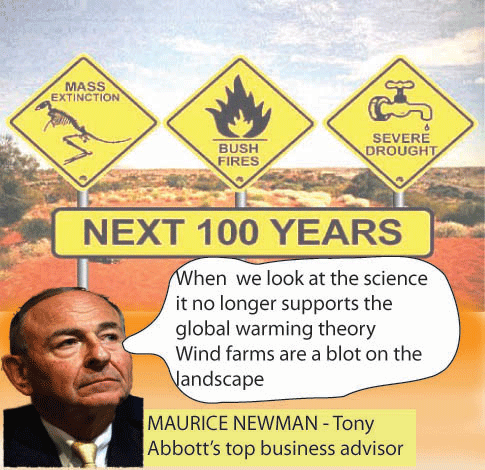
Former prime minister Tony Abbott appointed Newman as one of his first acts after winning government in 2013.
Newman has used a weekly column in the Australian to expound private views on climate change, including that the world was ill-prepared for a period of global cooling and that the United Nations was using debunked climate science to impose a new world order under its own control.
He also called for a government-funded review of the Bureau of Meteorology (BoM) to “dispel suspicions of a warming bias” in its temperature record-keeping, something freedom of information documents have recently revealed was under consideration by the prime minister’s department.
Turnbull’s spokesman said the new prime minister, who has strong personal links to the business community, was still considering whether he needed a formal business advisory council. He said Newman had not been reappointed.
The two-year terms of the other 11 members of the council expire in December because they were appointed by Abbott after he had named the chairman…….http://www.theguardian.com/australia-news/2015/sep/28/climate-sceptic-maurice-newman-not-reappointed-government-adviser
1 This month

of the week – Australians for War Powers Reform (AWPR)
To see nuclear-related stories in greater depth and intensity
 Antinuclear
