Australia’s Resources Minister Josh Frydenberg will help Adani’s coal mine with tax-payer money
 Frydenberg signals $5 billion taxpayer frolic with Adani’s unwanted fossil flop https://independentaustralia.net/environment/environment-display/frydenberg-signals-5-billion-taxpayer-frolic-with-adanis-unwanted-fossil-flop-,8193
IF AUSTRALIA’s new Prime Minister and refreshed front bench are showing signs of being more progressive about renewable energy investment and R&D, it looks like they are also going to be far more candid about coal, and their plans to invest heavily there, too.
In an interview with Fairfax media on Wednesday, the newly sworn in energy and resources minister Josh Frydenberg was crystal clear on the government’s intent to use taxpayer money from its $5 billion Northern Infrastructure Fund to help get the Adani-owned Carmichael coal mining project off the ground.
And he was equally clear that the Turnbull Government’s attitude to developing new coal projects – despite the smart money being on all untapped fossil fuel resources staying in the ground, and despite the fact that most banks and institutional investors won’t touch the Galilee Basin project with a 10 foot barge pole – remains the same as the Abbott Government’s. Frydenberg told the AFR, repeating the mantra of his former boss:
[Carmichael coal mine is] a very important project, which will see significant investment in Australia and provide electricity to millions of people in the developing world,”
Anti-development activism can create major delays in projects and send investment offshore, and you have to be very conscious of that when there are such large time frames involved and we are competing internationally for investment in this country.
Australia’s PM Turnbull under firm control of right wing on climate change
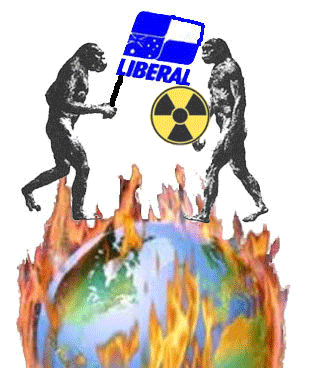 Liberal right wing’s climate warning to Malcolm Turnbull: don’t touch Direct Action, The Age, September 25, 2015 Mark Kenny and Philip Wen Malcolm Turnbull has been warned by his party’s right wing not to attempt changes to beef up the Abbott government’s Direct Action program in response to China’s introduction of an economy-wide emissions trading scheme by 2017.
West Australian Liberal Dennis Jensen welcomed the assurances 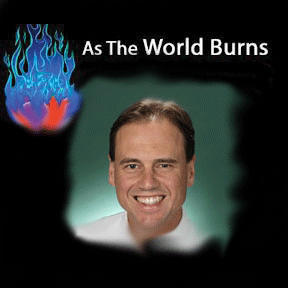 of Environment Minister Greg Hunt, who said Australia would not be altering its climate change abatement measures in response to the Chinese development.
“It’s one of the conditions of the leadership change that we are sticking with the policy we had,” he told Fairfax Media………
While Mr Turnbull declined to comment, Mr Hunt was sent out to reassure nervous Liberals that the development out of Beijing would not lead to a similar move from Canberra. http://www.theage.com.au/federal-politics/political-news/liberal-right-wings-climate-warning-to-malcolm-turnbull-dont-touch-direct-action-20150925-gjv73s.html#ixzz3mnbYTxSM
Malcolm Turnbull disappoints on Climate Change Policy
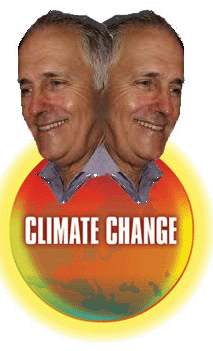 Malcolm Turnbull’s Faustian pact on climate change is heartbreaking, Guardian,
Mark Butler, 19 Sep 15 Many Australians hoped the new PM would drag the Coalition back to the sensible centre on climate change – but he has swallowed Abbott’s Direct Action hook, line and sinker…………..Many Australians held out very high hopes that Mr Turnbull’s return to the leadership of the Liberal party would see him drag the party back to the sensible centre on climate change — that there would be the hope of Australia again regaining a bipartisan consensus that would allow us to move forward in the way that so many of our sister nations around the world are doing……
The old Malcolm Turnbull was clear in his advocacy of an emissions trading scheme as the cheapest and most effective means of reducing carbon pollution. We have heard him say, so many times, particularly in that critical period of debate in 2009 and 2010, that a policy like Tony Abbott’s emissions reduction fund would be “a recipe for fiscal recklessness on a grand scale”.
Well, apparently it’s all different now. Tony Abbott’s Direct Action policy is apparently now a “very, very good piece of work”. In parliament, the new prime minister praised the emissions reduction fund’s first auction, which spent about $650 m of taxpayer funds. Forty seven million tonnes of carbon pollution reductions were purchased under this first auction. What the prime minister has not said is that of those 47 m tonnes, three quarters, or 34 m tonnes, were from projects that already existed and in some cases had existed for more than 10 years, including with big companies like AGL — the largest polluter in Australia. Taxpayers are paying for things that those companies were already doing.
The second element of Tony Abbott’s Direct Action policy, the safeguards mechanism, was released earlier this month, and it exceeded everyone’s worst expectations. RepuTex, the leading modelling agency in this area, has provided very clear advice that, under this safeguards policy, the biggest 20 polluters in Australia will not be touched whatsoever. And the biggest 150 polluters in this country will increase their emissions by 20% over the next 15 years. The Grattan Institute said in response to the release of the safeguards policy: “It is called a safeguard, but it is not an environmental safeguard. Greg Hunt is not actually constraining emissions; if it is going to work it is going to have to have teeth, but all we have got is gums.”
It’s not surprising then that we’ve seen emissions starting to rise again. Under Direct Action, 2020 levels of carbon pollution will be substantially higher than they are today, and substantially higher than they were in 2000 or in 2005.
The government’s own projections suggest that, in 2020, carbon pollution levels in Australia will be 655 m tonnes against 559 m tonnes in 2000 — so, not 5% below 2000 levels, 17% above 2000 levels. RepuTex was more generous to the government than the government’s own modelling. It said only last month that, in 2020, carbon emissions will be 613 m tonnes against 559 m tonnes — so 10% above 2000 levels………..http://www.theguardian.com/australia-news/commentisfree/2015/sep/18/malcolm-turnbulls-faustian-pact-on-climate-change-is-heartbreaking
Malcolm Turnbull – two-faced on climate change
Is new Australian prime minister Malcolm Turnbull already a climate change turncoat?
Malcolm Turnbull once endorsed common sense positions on climate change. Then he became prime minister, Guardian, Graham Readfearn , 18 Sept 15 During the first few days of being prime minister, Malcolm Turnbull seems to be doing his best to argue about climate change with a former version of himself.
I know I might have already given the game away here, but who do you think said this only five years ago?
We are as humans conducting a massive science experiment with this planet. It’s the only planet we’ve got…. We know that the consequences of unchecked global warming would be catastrophic. We know that extreme weather events are occurring with greater and greater frequency and while it is never possible to point to one drought or one storm or one flood and say that particular incident is caused by global warming, we know that these trends are entirely consistent with the climate change forecasts with the climate models that the scientists are relying on…. We as a human species have a deep and abiding obligation to this planet and to the generations that will come after us.
Stirring stuff eh?
That was Turnbull in August 2010, speaking at the launch of a report demonstrating the technical feasibility of moving Australia to a 100 per cent renewable energy nation.
During his first Question Time as PM earlier this week, Turnbull was asked if he would join Labor in its aspiration (and that’s about the extent of Labor’s policy on this right now) that Australia should be generating 50 per cent of its electricity from renewables by 2030.
Turnbull’s response?
[Opposition leader Bill Shorten] is highlighting one of the most reckless proposals the Labor party has made. Fancy proposing, without any idea of the cost of the abatement, the cost of proposing that 50 per cent of energy had to come from renewables! What if that reduction in emissions you needed could come more cost-effectively from carbon storage, by planting trees, by soil carbon, by using gas, by using clean coal, by energy efficiency?
What did the Turnbull of 2010 make of a plan to move away from fossil fuels that was twice as ambitious as Labor’s, that actually explained how it could be done and that proposed doing it faster?
But now it seems, Turnbull wants to ridicule an idea that he enthusiastically supported five years earlier. Turnbull once described the government’s Direct Action climate change policy as “fiscal recklessness on a grand scale” but now thinks the policy is a “resounding success”.
During his Question Time response, Turnbull also listed “clean coal” and “carbon capture” as viable responses to the problem……..
now, Turnbull is defending his government’s weak targets on climate change that, if they were replicated by other countries around the world, analysts saywould likely see the planet warm by 3C or more.
Not only is Turnbull abandoning the science, he is abandoning his previous common sense position on climate for what a former Turnbull described as a policy that was no more than fig leaf…… http://www.theguardian.com/environment/planet-oz/2015/sep/18/is-new-australian-prime-minister-malcolm-turnbull-already-a-climate-change-turncoat
Climate hypocrites – survey findings on Rio Tinto, Business Council of Australia
 Rio Tinto, Business Council of Australia among ‘climate hypocrites’, survey says SMH, September 16, 2015 Peter Hannam Environment Editor, The Sydney Morning Herald BHP Billiton, Rio Tinto and the Business Council of Australia are among the world’s largest companies and industry groups holding back action on climate change, according to a new survey.
The research, based on methodology developed by the US-based Union of Concerned Scientists and applied by UK-based non-profit group InfluenceMap, found 45 per cent of the 100 biggest industrial companies were “climate hypocrites” that obstruct action on global warming. Some 95 per cent of the delaying firms were also members of trade associations that demonstrated “the same obstructionist behaviour”.
BHP Billiton was rated a “D”, keeping it just outside the lower 45 per cent of companies that were ranked as “hypocrites”.
“More and more, we’re seeing companies rely on their trade groups to do their dirty work of lobbying against comprehensive climate policies,” Gretchen Goldman, lead analyst at the Union of Concerned Scientists, said. “It is unacceptable that companies can obstruct climate action in this way without any accountability.”
Google topped the list of best performers, along with Unilever and Cisco Systems, each of which received a “B” rating for their relatively positive involvement on tackling greenhouse gas emissions and backing laws that supported such action.
Unilever, which has consumer brands including Dove and Flora, gained kudos for “strongly” supporting the introduction of a carbon tax in Australia in 2012.
The Abbott government scrapped the policy two years later and newly installed Prime Minister Malcolm Turnbull indicated in his first speech after toppling Tony Abbott that he would stick to the replacement direct action policy to pay polluters to curb emissions.
BHP Billiton, which has coal and oil interests, received its “D” for having a “low level but negative engagement on climate regulation”, including supporting the repeal of the carbon price. “The company appears to be supportive of [greenhouse gas] intensive energy sources, supporting continued use of coal,” the survey said.
BHP also lost marks for its membership of the International Association of Oil and Gas Producers and the Business Council of Australia (BCA), “both of which appear to be opposing climate policy”, the report argued. http://www.smh.com.au/environment/climate-change/rio-tinto-business-council-of-australia-among-climate-hypocrites-survey-says-20150915-gjn3rz.html#ixzz3m2HDgRjw
Malcolm Turnbull – not really going to act on climate chnage
I don’t think Labor has a hope of defeating Malcolm Turnbull as things currently stand—unless we change our politics.
Our only hope of defeating Malcolm Turnbull is also our only hope of seriously tackling climate change. We have to come together across divides to articulate a different way of doing things, to mount a cohesive, comprehensive, and strategic campaign for a better, fairer, greener world.
Malcolm Turnbull’s elevation to the Prime Ministership will change very little on its own. But it could be the stimulus we need to work with the new recruits brought to us by Tony Abbott to change everything.
 The Fall of Tony Abbott Changes…Not What You Think It Might http://theleap.thischangeseverything.org/the-fall-of-tony-abbott-changes-not-what-you-think-it-might/
September 15, 2015 by Tim Hollo Australia’s climate vandal Prime Minister is no more.
Tony Abbott, elected under two years ago after a lie-filled, Murdoch-fuelled anti-climate campaign, has been deposed by his own party.
Abbott, who famously declared that “coal is good for humanity,” led the first government in the world to reverse a price on carbon or slash a renewable energy target. He rejected funding for mass transit and increased it for roads; he attacked wind farms as ugly and pandered to the junk science of “wind turbine syndrome.” He took Australia’s treatment of refugees to new depths of depravity, even banning doctors from reporting on abuses in the detention camps; begged Barack Obama to let Australia join the bombing of Syria; slashed funding for universities, research and the arts; and escalated the “war on terror” rhetoric.
Tony Abbott’s political demise is cause for celebration.
But what can we expect of his replacement, Malcolm Turnbull, a man seen by some as Australia’s climate saviour? My expectation is: far too little to make a difference, but just enough to threaten to defuse the growing radicalization that Abbott’s clumsy approach was fomenting. We may have just replaced our movement’s most unlikely recruitment tool with someone more dangerous. Continue reading
Giles Parkinson gives Malcolm Turnbull 5 pieces of good advice
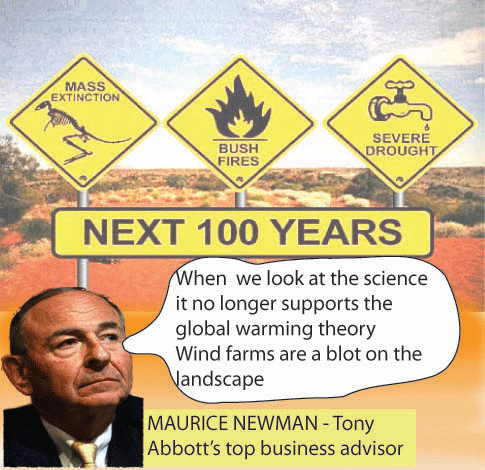 Sweep out the dead wood:………… This includes the likes of climate deniers such as Maurice Newman, Dick Warburton, David Murray and Tony Shepherd, and shake the Cabinet from the grim grasp of the Institute of Public Affairs and its policy wish-list.
Remove the threat to dismantle CEFC, ARENA and the CCA:…..
Find a new environment minister, or tell Greg Hunt to stop saying silly things: Greg Hunt likes to tell people how hard it was to push a progressive line in an Abbott government. Many people wondered how hard he tried. Hunt came up with some of the Abbott government’s worst whoppers on climate change, coal, and renewable energy. Turnbull cannot afford to have such rhetoric repeated under his leadership
 Eight things Malcolm Turnbull should do on climate, renewables, REneweconomy By Giles Parkinson on 15 September 2015 Malcolm Turnbull’s dramatic replacement of Tony Abbott as prime minister of Australia has raised hopes of a change in direction for the Coalition government, particularly on climate change and renewable energy, and thereby the shape of its economic future……..
Paul Gilding, author and corporate advisor, describes a collective sigh of relief for those arguing for progressive climate and renewable energy policies.
“For climate advocates PM Turnbull is a “Nixon to China” moment,” Gilding said today. “We will never get on track as a country on this issue without genuine bipartisan support – and because of the way Rudd and Abbott made this a Left/Right issue, only the Liberal Party shifting can deliver the change we need.
“That’s why Turnbull’s arrival as PM is a game changer for Australia’s approach, but the impact will be medium to long term rather than sudden policy shifts. While Abbott had to say he supported action on climate policy, everyone knew he was faking it because the politics demanded he do so.
“Turnbull actually supports climate action and has long understood the economic implications of the transition required. And rather than being fearful of those implications he embraces them – seeing the inherent opportunity in a transition away from coal and towards a technology driven transformation of the energy system……..
What will Turnbull do? Over the next few days, weeks, months, we will find out. But here are eight things he could do right now: Continue reading
Malcolm Turnbull would be no better than Abbott on Climate Change

originally published 9 Feb 2015
Coalition needs a heart transplant, not a facelift, The Age, Waleed Aly. 6 Feb 15 The public has been focused on policy and that’s precisely why the Coalition’s in trouble. “…..the government’s in trouble precisely because we have been focussing on policy.
That was true for Labor, whose collapse in public support occurred the moment Kevin Rudd decided he no longer thought climate change mattered that much, and it is perhaps even truer for Abbott…..”http://www.smh.com.au/comment/coalition-needs-a-heart-transplant-not-a-facelift-20150205-136hjx.html
Here’s how Mark Kenny & James Massola saw it, writing in The Age 5 February 15 – “Amid feverish speculation over the leadership, unconfirmed reports also claimed Mr Turnbull had moved to assuage fears in the conservative wing of the party that his return to the leadership would see a reprise of the carbon tax or an emissions trading scheme.
It was claimed Mr Turnbull had promised, in a secret deal, that there would be no such reprise if elected”
Turnbull in climate change shift, West Australian, Andrew Probyn Federal Political Editor February 5, 2015, Malcolm Turnbull would make no change to the Government’s climate change policy in a major concession designed to extinguish lingering doubts about a return to him as Liberal leader….. https://au.news.yahoo.com/thewest/a/26199682/turnbull-in-climate-change-shift/
Where now for Australia’s Climate Change Authority?
Ignored by the government, shrunk by resignations – where now for Australia’s Climate Change Authority?, https://theconversation.com/ignored-by-the-government-shrunk-by-resignations-where-now-for-australias-climate-change-authority-47366 The Conversation, Clive Hamilton
Professor of Public Ethics, Centre For Applied Philosophy & Public Ethics (CAPPE) at Charles Sturt University September 11, 2015 Bernie Fraser’s resignation as chairman of Australia’s Climate Change Authority has left many wondering what is left of it and what its future might be.
Established three years ago as part of the climate change package negotiated by the previous parliament’s Multi-Party Climate Change Committee, the Authority was formed to serve as the principal source of climate policy advice to the federal government, particularly on the issue of emissions targets. Championed by the then Greens deputy leader Christine Milne, it was modelled closely on Britain’s Committee on Climate Change.
The Authority is legislated to have nine part-time members, including the Chief Scientist ex officio. When the Abbott government was elected two years ago it expressed its intention to abolish the Authority along with the rest of the Labor government’s climate policy architecture. Continue reading
Tony Abbott has ‘a very good story to tell’ Pacific Islanders, about climate change
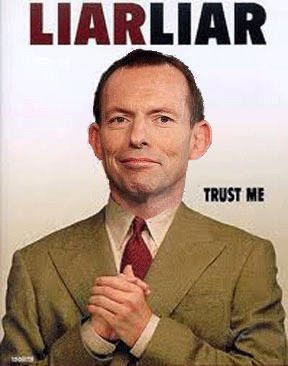 ‘I’ve got a very good story to tell’: Tony Abbott confident of placating island leaders on climate change September 10, 2015 Michael Gordon Political editor, The Age Tony Abbott has entered a retreat with leaders from Pacific island nations confident he can reassure those who say their survival is threatened without a stronger commitment to reduce carbon emissions.
“I think I have got a very good story to tell on climate change to tell the Pacific Islands Forum,” the Prime Minister said before entering a day-long meeting with 15 Pacific island leaders.
Led by the president of Kiribati, Anote Tong, several of the leaders have warned that anything short of a commitment to limit the average global temperature rise to 1.5 per cent would represent a betrayal of their people.
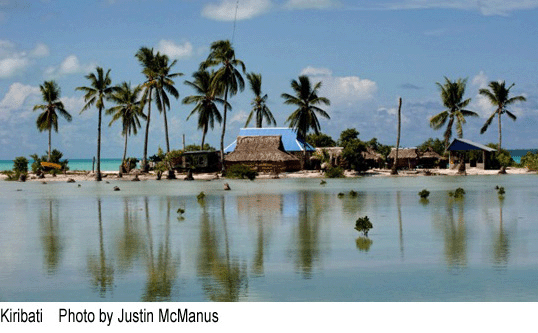
…..Both Mr Abbott and New Zealand Prime Minister John Key will resist the push led by the smaller island states to go beyond a commitment to the goal of limiting the global rise to 2 degrees.
Fairfax Media has seen successive drafts of the leader’s declaration where a reference to a 1.5 degree commitment is removed. The final draft will be released after the leaders’ retreat. http://www.theage.com.au/federal-politics/political-news/ive-got-a-very-good-story-to-tell-tony-abbott-confident-of-placating-island-leaders-on-climate-change-20150910-gjj93v.html#ixzz3lOo0rT8H
Pacific Island Forum will be dominated by Australia’s Inaction on Climate Change
Australia’s inaction on climate change set to dominate Pacific Island talks, Guardian, 6 Sept 15 Australia and New Zealand are expected to face strong criticism from Pacific Island leaders disappointed the nations are not doing more to combat climate change.
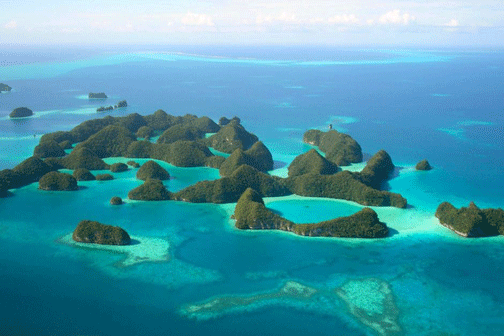
The issue will likely dominate this week’s Pacific Islands Forum leaders summit in Port Moresby, ahead of the United Nations climate change conference in Paris later in the year.
Pacific leaders want the world to work on restricting the global warming temperature rise to 1.5C, fearing a 2C target will risk the survival of many tiny islands.
Natural disaster recovery will be fresh on their minds. The summit starts on Monday, six months after Cyclone Pam, which flattened much of Vanuatu and caused heavy flooding on Tuvalu, Kiribati and the Marshall Islands.
Host nation Papua New Guinea is grappling with the opposite problem – what could be its worst drought in 20 years and a potential food crisis.
The prime minister, Peter O’Neill, has said El Niño conditions have been exacerbated by the effects of climate change.
The Solomon Islands and Vanuatu are also experiencing a dry spell………
The Pacific Island Forum runs from 7-11 September. http://www.theguardian.com/world/2015/sep/06/australias-inaction-on-climate-change-set-to-dominate-pacific-island-talks
Climate system changing more rapidly than expected: new report

 A STUNNING new Climate Council report that reveals the climate system is changing more rapidly than expected and with larger and more damaging impacts paints a stark picture of the urgent need for action, Professor Tim Flannery said today.
Climate Change 2015: Growing Risks, Critical Choices provides the most up-to-date, comprehensive synthesis of climate science in Australia and exposes the extent of the dramatic changes in the climate system worldwide.
“In short, the more we know about climate change, the riskier it looks,” Prof Flannery said.
“Heatwaves, sea level rise and ice loss are all increasing as the air, the ocean and the land continues to warm strongly. Extreme weather events like dangerous bushfire weather are becoming more severe and frequent.
“But this is a future we don’t have to have. Tackling climate change and moving to clean, renewable energy is the right thing to do. It’s the right thing to do to protect our health and wellbeing. The right thing to do to protect us from economic shocks from worsening extreme weather and opening new opportunities for jobs and investment in new industries. Unfortunately the barriers to action are political.”
The report found:
Australia:
- SEA LEVEL RISE: Australian sea levels are projected to continue to rise through the 21stcentury at a rate faster than that over the past four decades or over the 20th century as a whole. More than $226 billion of buildings and infrastructure are vulnerable to 1.1m of sea-level rise.
- EXTREME HEAT: Hot days have doubled in the last 50 years and heatwaves have become hotter, longer and happen more often. The number of deaths in summer in Australia has steadily increased over the last 40 years. In the future extreme heat increases are very likely with more frequent and hotter hot days and longer and more severe heatwaves.
- BUSHFIRE: Extreme bushfire weather has increased in the south east of Australia in the last 30 years and a “Catastrophic” category was added following Black Saturday bushfires. Longer and hotter fire seasons in eastern and southern Australia are likely in the future.
SOUTH AUSTRALIA:
- HEATWAVES: In Adelaide, the number of heatwave days has nearly doubled since 1950 and the average intensity of the peak heatwave day has increased by 4.3°C. In 1995, Adelaide experienced 20 days above 35°C. By 2090 it could experience up to 47 per year. Deaths from heatwaves in Australian cities are projected to double over the next 40 years.
- BUSHFIRES: Climate change is already increasing the risk of bushfires in southern South Australia; extreme fire weather has increased over the last 30 years in South Australia. The fire season in South Australia is starting earlier and lasting longer. In 2014 the bushfire season started earlier in seven of 15 districts in South Australia. By about mid-century, the total economic costs of South Australian bushfires are projected to almost double, potentially reaching $79 million.
- COASTAL FLOODING: In Adelaide, today’s 1-in-100–year flooding event would occur every year or so by 2100 under a high emissions scenario. A sea level rise of 1.1 m exposes a significant amount of infrastructure to the impacts of flooding and erosion in South Australia, including between $5 billion-$8 billion worth of residential buildings
Globally:
- Arctic sea ice retreat over the past three decades was unprecedented in at least the last 1,450 years.
- The 1980s, 1990s and 2000s were all hotter than any other decade in recorded history.
- Sea level rise is accelerating – the average rate of sea-level rise between 1901 and 2010 was 1.7 mm per year, increasing to 3.2 mm per year between 1993 and 2010.
The report underscored that Australia’s post 2020 emissions reduction targets were too weak to protect Australians from worsening climate change impacts, Professor Will Steffen said.
“As the escalating risks of climate change have become clearer and more disturbing, other countries have started to heed the warnings, putting in place tangible and ambitious policies,” he said.
“But Australia’s response to meeting the challenge of Paris is disappointingly weak; it is out of step with the science and out of step with most of the developed world.”
Professor Lesley Hughes said Australia had critical choices to make as country.
“We can embrace the range of solutions to climate change, which are more feasible and less costly than ever before, and build a healthier and more economically viable future or we can continue to pay the many costs that come from delaying action on climate change,” she said.
The Climate Council is an independent, crowd-funded organization providing quality information to climate change to the Australian public. For media enquiries, please contact Senior Media Advisor Jessica Craven on  0400 424 559.
Australia’s bushfire and flood danger, as climate change accelerates
 Climate system changing faster than expected: Climate Council, ABC Radio Angela Lavoipierre reported this story on Tuesday, August 25, 2015
MICHAEL BRISSENDEN: The Climate Council says the case for the link between climate change and severe weather events has become much stronger. In a new report the Council states that the world’s climate system is changing more rapidly than expected.
ANGELA LAVOIPIERRE: The Climate Council’s report gives a snapshot of the changes so far to Australia’s climate, as well as changes it expects over the coming century.
The Council’s professor Will Steffen paints a grim picture.
WILL STEFFEN: One of the things that we can say is that we’re already seeing some impacts. Heat waves are lasting longer and starting earlier.
We’re seeing in the south-east of the country high bushfire danger weather has increased significantly over the last 30 years. We’ve seen that sea level has risen about the global average around Australia. That’s led to a threefold increase in coastal flooding.
ANGELA LAVOIPIERRE: And then, there’s what’s to come.
WILL STEFFEN: If we keep, if the globe keeps emitting fossil fuel emissions like we are now, we could see up to a metre of sea level rise around Australia. That could for example make a one in a hundred year flooding event in Sydney a daily event……..http://www.abc.net.au/am/content/2015/s4299445.htm
Australia likely to cop it bigtime with extreme weather events
Global warming to drive quadrupling of extreme weather trifecta, study finds August 18, 2015 Peter Hannam Environment Editor, The Sydney Morning Herald The worst combination of extreme weather patterns in the Indian and Pacific oceans will likely rise four-fold this century if greenhouse gas emissions continue on their current trajectory, leading researchers have said.
Australia’s already variable climate may be particularly susceptible to a punishing sequence of events. This starts with reduced rainfall sourced off the nation’s north-west, combining with a strong El Nino in the Pacific to intensify drought over the food bowl regions of south-eastern Australia, only to be followed by floods during a powerful La Nina event the following year.
That extreme and rare trifecta – similar to the combination that occurred during 1997-99 – will happen about once every 48 years compared with about once every 187 years in the past, research published on Tuesday in Nature Climate Change says. The research is based on more than 20 climate models.
But even weaker versions of the three elements are likely to have an amplified impact as background warming from climate change makes rainfall shifts and heatwave conditions easier to generate.
http://www.smh.com.au/environment/climate-change/global-warming-to-drive-quadrupling-of-extreme-weather-trifecta-study-finds-20150816-gj0f4o.html#ixzz3jD5l1Z42
Australia will have to improve on its inadequate greenhouse gas emission pledge
 UN climate expert warns Australia’s emissions target should not be final offer, The Age, August 13, 2015 Nicole Hasham Environment and immigration correspondent Australia should not attend global talks in Paris refusing to budge on its greenhouse gas emission pledge, the UN’s scientific body on climate change has said, ahead of expected international pressure on the Abbott government to do better……….
In Canberra on Wednesday, Professor Jean-Pascal van Ypersele, vice-chairman of the UN Intergovernmental Panel on Climate Change, said the December talks in Paris were negotiations.
“No country can go to negotiations knowing or thinking, really, that the [emissions target] numbers cannot be touched,” he said. Professor van Ypersele said targets from each nation would be collated and assessed, adding the collective efforts may not be enough to keep warming below 2 degrees. That would lead to “a discussion on how to increase the level of ambition and who needs to increase it first”, he said.
While pledges from nations may not be formally negotiated at Paris, leaders will probably be urged to increase their ambitions, either during the conference or afterwards……….
On Wednesday Labor leader Bill Shorten said he would attend the Paris talks.
The Marshall Islands, a Pacific nation highly vulnerable to the effects of climate change, has decried Australia’s pledge as a “weak target” that erodes our international reputation.
Mr Abbott said the Minerals Council of Australia, which represents the mining industry, called the target is “ambitious”.
The target has been interpreted as an effort to placate climate sceptics in the community and the government, while doing the minimum needed to meet Australia’s international obligations.
Climate Institute deputy chief executive Erwin Jackson said Australia’s target was “not the end of the story”. “Countries in Paris will be under pressure to lift their ambitions,” he said.
“Both diplomatic and economic pressure is [also] going to build through time after Paris for countries to get in line with where the world needs to go, which is towards net zero emissions.” http://www.theage.com.au/federal-politics/political-news/un-climate-expert-warns-australias-emissions-target-should-not-be-final-offer-20150812-gixa98.html#ixzz3ijcqRmdX
1 This month

of the week – Australians for War Powers Reform (AWPR)
To see nuclear-related stories in greater depth and intensity
 Antinuclear