Abbott snubs UN climate talks in December
 Abbott won’t attend UN climate change talk http://www.heraldsun.com.au/news/breaking-news/abbott-wont-attend-un-climate-change-talk/story-fni0xqi4-1227478782154 PRIME Minister Tony Abbott won’t attend the United Nations climate change summit at the end of the year.
INSTEAD, he will send Foreign Minister Julie Bishop to Paris for the talks to nut out a post-2020 global approach to dealing with climate change.
Labor says if world leaders like US President Barack Obama can find time to attend there is no excuse Mr Abbott can’t as well.
Australian govt’s emissions target is flimsy, but Abbott has no intention of meeting even that
Never mind the target – can the government actually deliver? No.
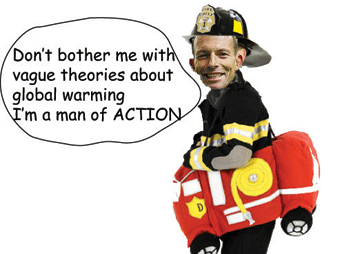 The government plans to meet the 2030 target essentially on a wing and a prayer. There were graphs galore at today’s media conference, but the crucial one from Greg Hunt committed the government to extending Direct Action all the way out to 2030……..That’s the sort of obfuscation we’ve come to expect from the Abbott government when it comes to climate. This is a government viscerally opposed to meaningful action on climate change on any level beyond the symbolic.
To see why, judge the government not by its words, but by its actions.
Tony Abbott Has No Intention Of Reaching His Flimsy Emissions Target, New Matilda, Ben Eltham, 11 Aug 15 The combination of policies being deployed by the government will not help them achieve even the weak target announced today, writes Ben Eltham.
The news that the Abbott government has settled on an emissions reduction target for Australia out to 2030 heralds a new turn in climate politics in this country. The target, announced by Prime Minister Tony Abbott today, is a 26 per cent reduction on 2030 levels compared to 2005. It would put Australia at the back of the international pack – offering less than Canada, the United States or Europe. Only Japan is offering a smaller target.
On the one hand, of course, this target is manifestly inadequate. Continue reading
Climate Change: What Australia Knew – and Buried
Taylor’s book shows how Australia could have acted on climate change a quarter of a century ago, but how corporate interests and economic ideologies not only stopped the clock on action, but wound it back
Australia was ready to act on climate 25 years ago, so what happened next?, Guardian, Graham Readfearn, 7 Aug 15 New book investigates how corporate interests and ideologues worked to make Australia doubt what it knew about climate change and its risks.
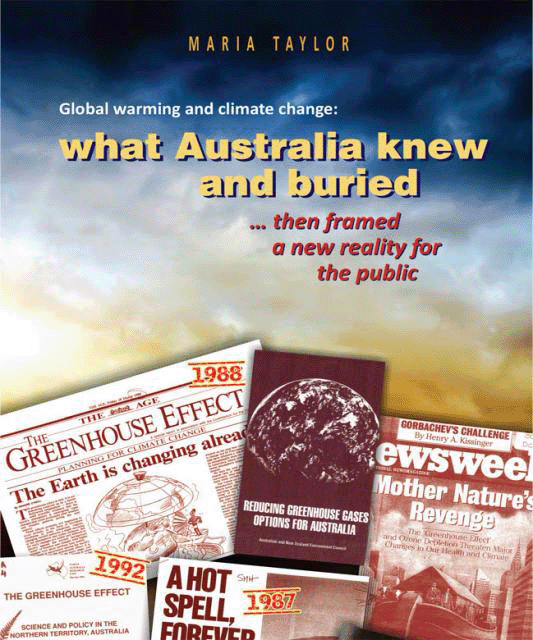
There’s something about climate change that almost everyone in Australia has either forgotten or never knew in the first place.
In 1990 Bob Hawke announced his government wanted the country to cut greenhouse gas emissions by 20% by the year 2005.
For a fleeting moment, it seemed the Australian public, politicians and the media were in agreement with the science.
But a new book investigates how the industries that stood to lose the most worked to undermine the science and entirely reshape the story being told to the public.
“We have been propagandised,” says the author, Maria Taylor. Continue reading
Nuclear facilities in South Australia would be at grave danger from bushfires
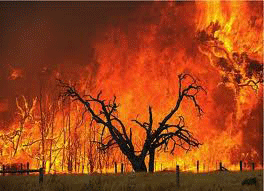 Dangers of Bushfires-Wildfires & Nuclear Business miningawareness, 3 August 15 “………
According to the South Australia Country Fire Service, nearly 1/2 of people living in bushfire prone areas don’t understand the threat. This is apparently true of those proposing adding nuclear
 anything in Australia.
circumstances.
What’s Australia’s water security under future climate?
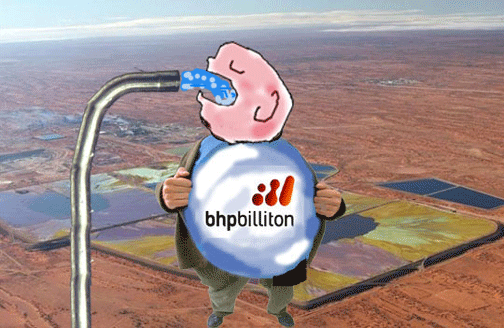 The role of water in Australia’s uncertain future, The Conversation Amgad Elmahdi Manager Water Resources Assessment Section at Australian Bureau of Meteorology Matthew Hardy Manager, Urban Water at Australian Bureau of Meteorology August 3, 2015 “…….Water security is threatened by a number of factors. These include climate change, rainfall variability, population growth, economic development, and drought.
For instance, across southern Australia climate change is projected to decrease winter and spring rainfall by up to 15% by 2030 regardless of whether greenhouse gas emissions are reduced.
Rainfall declines are amplified in reduced streamflow and in turn the water in storages. Southwestern Australia has seen streamflow declines of 50% since 1970, while streamflow during the Millennium Drought (1996-2010) in southeastern Australia was half of the long-term average………
Australia also has naturally highly variable rainfall influenced by events such as El Niño and La Niña. An El Niño was declared in May 2015.
The El Niño’s likely impact will be drier and warmer conditions across inland eastern Australia. Importantly the strength of an El Niño does not always indicate how severely Australia may be affected.
 These dryer conditions, should they arise, will place increased pressure on the water supply of effected regions. In particular, increased water demands and reduced stream flows will see declining surface water storage volumes. This could mean we need to develop and use more climate resilient sources………https://theconversation.com/the-role-of-water-in-australias-uncertain-future-45366
Fire tornadoes a risk to nuclear facilities, as climate change continues
Turn and burn: the strange world of fire tornadoes December 17, 2012 Rick McRae, ACT Emergency Services Agency and Jason Sharples, UNSW Australia Rick McRae is Researcher at ACT Emergency Services Agency. Jason Sharples is Lecturer, School of Physical, Environmental and Mathematical Sciences at UNSW Australia.
We’ve all seen footage of out-of-control bushfires sweeping the Australian landscape, burning out hectares of native forest in their wake. But you might not have heard of a fire tornado, let alone seen one.
For many years now researchers have theorised that fire tornadoes could be possible. Now, in studying the 2003 Canberra bushfires, our colleagues and us have shown fire tornadoes do indeed exist.
So what are fire tornadoes? Where do they come from? And what sort of damage can they cause?
Fire thunderstorms
To answer these questions, we first need to understand a separate – but related – phenomenon: fire thunderstorms, also known as pyro-cumulonimbus clouds……….
Tracing the tornado
We showed that the weather conditions the fires were burning in were also suitable for tornado formation. We mapped the damage path, from the air and on the ground and could track the tornado in weather radar data………..
The 2003 Canberra fire tornado
Unlike the fire whirls observed by firefighters, the 2003 Canberra fire tornado was linked to the base of a thunderstorm, lifted off the ground, and then touched down again, three times.
What made this fire different to other fires was the wide range of observations being made as the edge of Australia’s capital was threatened.
They included:………
Let’s not pretend that nuclear power is “low emission”
The technology trap Could new types of nuclear power station solve the problem? “Fast breeder reactors” produce more nuclear fuel than they use and so would theoretically have much lower life-cycle CO2 emissions than existing “burner” reactors. But in practice breeders are even more complex, dangerous and expensive than burners. As a result they have been stuck at the demonstration stage for decades and even some nuclear proponents admit that breeders are unlikely to be commercialized for at least another two decades, if ever.
The government’s issues paper mentions the possibility of nuclear reactors based on the thorium fuel cycle, but these are also more complex than uranium-based nuclear energy and there are no commercial systems operating as yet.
To sum up, based on existing commercial technology, nuclear energy is not a solution to the global climate crisis, because it will soon become too emissions-intensive. It is also not a short-term solution, because it is a very slow technology to plan and construct. It is dangerous and very expensive.
Sure, let’s debate nuclear power – just don’t call it “low-emission”,
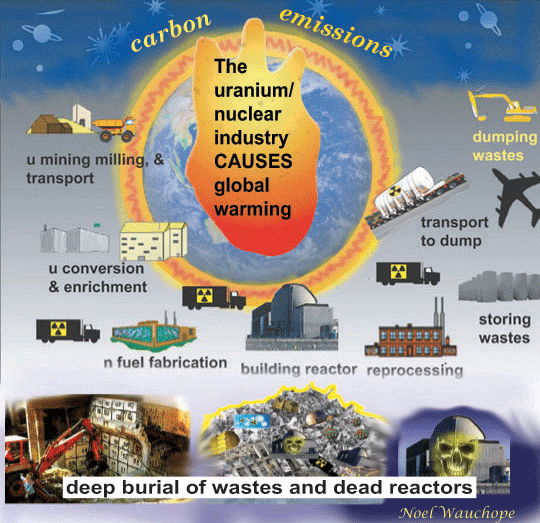
miningawareness Mark Diesendorf, UNSW Australia, 31 July 15 Nuclear power is back on Australia’s radar. In its recent issues paper released as a preface to September’s Energy White Paper, the Abbott government reopened the debate thus:
With environmental considerations constraining the further development of hydro-electric sources, nuclear technologies continue to present an option for future reliable energy that can be readily dispatched into the market.
This sentence appears in a passage dealing with the “move to low-emissions energy”, and although nuclear is not explicitly described as a low-emission option, it certainly looks as if the government is prepared to consider embracing nuclear power as part of an alleged move away from fossil fuels.
Is nuclear energy really low-emission?
Unfortunately, the notion that nuclear energy is a low-emission technology doesn’t really stack up when the whole nuclear fuel life cycle is considered.
In reality, the only CO2-free link in the chain is the reactor’s operation. All of the other steps – mining, milling, fuel fabrication, enrichment, reactor construction, decommissioning and waste management – use fossil fuels and hence emit carbon dioxide.
Several analyses by researchers who are independent of the nuclear industry have found that total CO2 emissions depend sensitively on the grade of uranium ore mined and milled. The lower the grade, the more fossil fuels are used, and so the higher the resulting emissions. Continue reading
Cut through the politics: a carbon tax is the best method to cut greenhouse emissions
Was carbon taxation ever given a fair go?……..
Pricing carbon: the simpler, the better..….. If we are to reduce carbon-emitting activities, the prices of those activities must be increased. Appropriate prices are the key here, and one way to make people happier about paying them is to make them as simple and transparent as possible. That’s what a carbon tax does
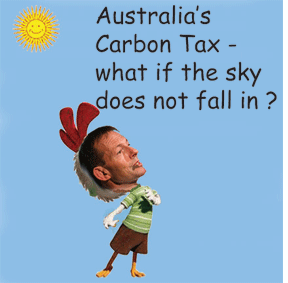 Politics aside, a simple carbon tax makes more sense than a convoluted emissions trading scheme, The Conversation, David Hodgkinson Associate Professor at University of Western Australia Rebecca Johnston Adjunct Lecturer, Law School at University of Notre Dame Australia July 31, 2015 Writing recently on The Conversation, Clive Hamilton correctly pointed out that an emissions trading scheme (ETS) can in no sense be called a tax – the two are fundamentally different. Under an ETS, the amount of emissions is fixed by the government and the market then sets the price; under a carbon tax, the price of emissions is fixed and polluters decide how much to emit.
In this sense, Hamilton is right to opine that “emissions trading is the opposite of a carbon tax”. But during Australia’s fractious debate about climate policy in recent years, the two have often been conflated together, and we have generally been starved of sober analysis of the contrasting merits of different policy instruments.
To put it more succinctly, what are the actual merits of a carbon tax, specifically as opposed to an ETS?
Start small
Climate change causing island to vanish – ecomigration is necessary
Vanishing Paradise Kiribati – A Case of Ecomigration : Dr Abe V Rotor http://avrotor2.blogspot.com.au/ 31 July 15 Kiribati main island is formerly Atoll Christmas, named by Captain Cook when he arrived on Christmas Eve in 1777. The island, like most islands in the region, faces irreversible submergence and sea water intrusion as a result of rising sea level brought about by global warming. The island was used as nuclear testing ground by the United States in the fifties and sixties.
Aerial view of the Kiribati group of islands. Rising sea level is forcing inhabitants to leave permanently their home islands, a classical example of modern day exodus – ecomigration. Displaced inhabitants are being settled mainly in Australia, New Zealand and Papua New Guinea.
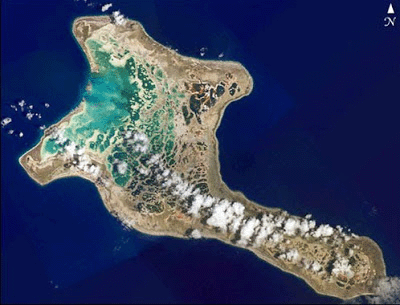
Kiribati (pronounced /ˈkɪrɨbæs/ ( listen) KIRR-i-bas;[4] Gilbertese: [ˈkiɾibas]), composed of 32 atolls and one raised coral island, dispersed over 3.5 million square kilometres, (1,351,000 square miles) straddling the equator, and bordering the International Date Line at its easternmost point. Kiribati is the only country in the world located on both hemispheres and lying on both sides of the 180th meridian.
The groups of islands are:
* Banaba: an isolated island between Nauru and the Gilbert Islands
* Gilbert Islands: 16 atolls located some 930 miles (1,500 km) north of Fiji
* Phoenix Islands: 8 atolls and coral islands located some 1,100 miles (1,800 km) southeast of the Gilberts
* Line Islands: 8 atolls and one reef, located about 2,050 miles (3,300 km) east of the Gilberts.
Caroline Atoll channel between west side of Long Island and Nake Island.
Used for nuclear testing in the 1950s and 1960s, the island is now valued for its marine and wildlife resources. It is particularly important as a seabird nesting site—with an estimated 6 million birds using or breeding on the island, including several million Sooty Terns.
According to the South Pacific Regional Environment Program, two small uninhabited Kiribati islets, Tebua Tarawa and Abanuea, disappeared underwater in 1999. The islet of Tepuka Savilivili no longer has any coconut trees due to salination. The UN Intergovernmental Panel on Climate Change predicts that sea levels will rise by about half a metre (20 in) by 2100 due to global warming and a further rise would be inevitable. It is thus likely that within a century the nation’s arable land will become subject to increased soil salination and will be largely submerged.
Rising level level is also being felt in many countries, particularly island-countries like the Philippines.
Australian Youth Climate Coalition calls for NO Bjorn Lomborg Climate Centre at Flinders University
 Open Letter to Flinders Uni – Keep Us Bjorn-Free http://www.aycc.org.au/bjorn_free
To Flinders University Vice Chancellor Colin Stirling and Deputy Vice Chancellor (Research) Robert Saint,
We, the below signatories, object to controversial Danish academic Bjorn Lomborg being offered $4 million to set the Australian Consensus Centre at Flinders University. We are students, teachers, academics, alumni, and the general public. We are concerned that Flinders would consider such a reputationally risky and academically damaging appointment.
Lomborg’s “Consensus Centre” has already been kicked out of Denmark for its dangerous opinions that don’t align with scientific consensus . Flinders should learn from the decision of the University of Western Australia, where Lomborg was ousted because of his outdated views on climate change and record of poor academic integrity.
In a time when young people are attending university to equip themselves with the skills they need to make a positive impact on the world, there is no place for Lomborg’s backwards views at Flinders University.
This funding allocation sits outside of the competitive research grant process – an insult to students and researchers who are facing hefty cuts and job losses, doing important scientific research.
Lomborg’s views are dangerous. He trumpets the same ideology as the fossil fuel lobby – that we can solve energy poverty with coal, that Pacific Islanders don’t care about climate change, and that climate action should not be a priority for governments.
Bjorn Lomborg’s views on climate change, fossil fuels and economics are outdated and have been repeatedly discredited.
We will not stand by while ideologically motivated fossil-fuel industry mouthpieces are invited onto university campuses for political gain.
In the name of science, academic integrity and a safe future, we are calling on the Vice Chancellor to reject the appointment of Bjørn Lomborg.
Climate change brings bushfires – a terrible risk to nuclear facilities
If the radiation leak lasts more than a few hours, there is no viable safe plan. If the radiation plume passes, the ground will probably still be contaminated
Wildfires also threaten Nuclear Waste and Nuclear Waste Shipments
 Wildfires and Nuclear Don’t Mix: Lessons from San Onofre and Chernobyl to Australia https://wordpress.com/read/post/feed/4410547/762849951 [good photos] miningawareness 27 July 15 As the deadline looms (3 Aug.) for comments regarding the risks of the nuclear fuel chain for South Australia – whether uranium mining, which is already occurring, or any proposed additions (uranium enrichment, nuclear energy, nuclear waste), foremost in everyone’s minds should be the risk of Bushfires (Wildfires), as well as endangerment to the Great Artesian Basin (GAB) aquifer, upon which so much of Australia is dependent for water, and which is being depleted, and most assuredly contaminated, by uranium and other mining:https://miningawareness.wordpress.com/2015/07/25/nuclearcommissionsaust-have-your-say-for-the-future-of-south-australia-submissions-close-soon-july-theme/ (Australia’s uranium mining “generates less than 0.2 per cent of national export revenue and accounts for less than 0.02 per cent of jobs in Australia.”http://www.conservationsa.org.au/images/Nuclear_Royal_Commission_issues.pdfMeanwhile it is laying waste to the land and provided nuclear fuel for Fukushima)
“The Australian climate is generally hot, dry and prone to drought. At any time of the year, some parts of Australia are prone to bushfires with the widely varied fire seasons reflected in the continent’s different weather patterns. For most of southern Australia, the danger period is summer and autumn.” http://www.ga.gov.au/scientific-topics/hazards/bushfire/basics/where
2015 Wildfires Near Chernobyl http://www.mns.gov.ua/news/40286.html
In April of this year, and again from the end of June into mid July, hundreds of firefighters in the Ukraine bravely battled fires in the area of the Chernobyl nuclear power station. Smoldering peat fires were the hardest to put out.
http://www.mns.gov.ua/news/40286.html
While this represents a serious danger to Europe, it received shockingly little media coverage. Continue reading
Al Gore’s visit and Victoria’s Climate Charter proposal
 Al Gore is visiting Australia to promote action on climate change. Still, we have to watch out that he is not on the “nuclear for climate” bandwagon.
A good sign is that Gore has recently been criticised by the pro nuclear front group Breakthrough Institute for being “sceptical” about nuclear power’s future. http://thebreakthrough.org/index.php/programs/energy-and-climate/al-gores-nuclear-hypocrisy
On Monday, Environmental Justice Australia will release a proposal for a Victorian Climate Charter, which it says is modelled on the state’s existing Human Rights Charter.
 Al Gore flies into Australia to push momentum towards Paris climate summit July 27, 2015 Tom Arup Environment editor, The Age Former United States vice-president Al Gore has flown into Australia for a whistlestop tour that includes meetings with state government ministers and senior business figures as part of efforts to build global momentum towards the Paris climate change summit later this year.
Mr Gore arrived in Melbourne on Sunday afternoon, heading to a speaking engagement and then dinner with Victorian ministers and senior executives from major companies, including BHP, National Australia Bank and Qantas, to discuss climate change and the importance of the Paris meeting, at which it is hoped a new international agreement to curb global warming will be signed……..
Ministers from Labor-led Victoria, Queensland and South Australia will attend Monday’s meeting with Mr Gore. Conservative-led NSW will send a senior public servant, as will Labor-led ACT. Tasmania, Northern Territory and Western Australia will not be represented. Continue reading
Climate change harming wine industry (nuclear power would, too)
I think that it is criminal of Australia’s government to deny action on climate change. And for a “pro business” government, what can they be thinking? Abbott’s “go slow” policy on climate action is harming so many businesses, and so many jobs. Now it’s the wine industry! Sacré bleu !
When Abbott finally decides that climate change matters, (i.e when he openly touts nuclear power), let’s not forget that nuclear power endangers the wine industry, too!
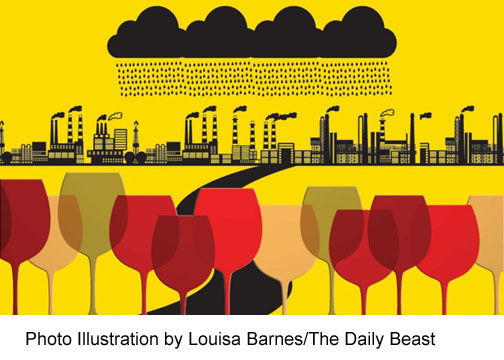
Climate change hitting where it hurts: your wine, The Age, 27 July Michael Pascoe BusinessDay contributing editor Spend a day at a wine grape growers’ summit and, among many other things, you’re left with no doubt about the reality of climate change.
Spend another day with a savvy grape grower touring the Barossa and you’re left with no doubt about the cost of it and the uncertainty about where it’s heading.
That’s not news for those who follow the wine industry closely at the production level, but for those of us who concentrate on consumption, the matter-of-factness of the change is rather startling.
Grapes ripening a month earlier, the compression of what were the usual different ripening times of different varieties, the search for varieties capable of handling hotter weather, the hunt for new terroir as climate bands move, the threat to traditional varieties in regions whose reputations depend on them.
Sweden, an important customer for Australian wine makers, now has a fledgling wine industry as a result of longer, warmer summers.
But you don’t have to go to the other end of the earth to see the story. Turns out climate change is a force in developing the Tasmanian industry as warmer weather leads mainland producers to invest in the island’s cooler climate. There’s no end of science on the issue, if that counts any more……….
And this is climate change, not just global warming. The heat is there, but the Scholz fields copped a frost that they hadn’t seen before, wiping out the crop. OK, it was a 1-in-100-year event – except that it happened again the next year. Now giant $55,000 electric fans increasingly dot vineyards, automatically triggered into action by a thermometer to suck in higher, warmer air and blow it across the vines to fight the killing drop of cold air. http://www.smh.com.au/business/the-economy/climate-change-hitting-where-it-hurts-your-wine-20150726-gikmuc.html#ixzz3h334o3XH
Labor leader Bill Shorten foresees a climate change election
 Bring on a climate change election, says Bill Shorten, SMH, July 24, 2015 Michael Gordon Political editor, The Age
Bill Shorten has challenged Tony Abbott to fight the next election on the issue of climate change, declaring: “I’ve got a three-word slogan for him: Bring it on.”
Describing climate change as “an economic and environmental cancer”, the Labor leader has vowed to build an emissions trading scheme and not be intimidated by “ridiculous scare campaigns”.
In a speech to be delivered at the party’s national conference in Melbourne, Mr Shorten says only Labor can save Australia’s renewable energy industry. While Tony Abbott has been a scathing critics of wind farms, Mr Shorten will tell the conference: “I want more Aussie farmers earning more money by putting wind turbines on their land.” Continue reading
Bjorn Lomborg’s Climate Consensus Centre for Flinders University?
The Abbott government has held talks with Flinders University about hosting a major policy centre in Adelaide based on the methodology of controversial Danish academic Bjorn Lomborg.
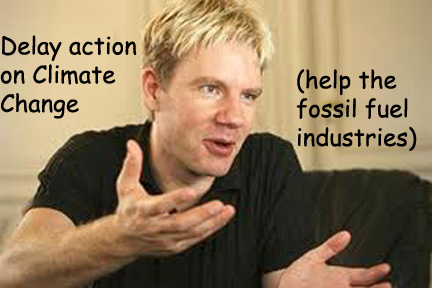
Education Minister Christopher Pyne has been searching for an institution willing to host the so-called Australia Consensus Centre, with $4 million in federal funds, since the University of Western Australia pulled out of its contract in May………
Dr Lomborg has attracted controversy for suggesting that the dangers of climate change have been overstated and that the world faces more pressing challenges, such as poverty.
A spokesman for Mr Pyne confirmed last night that talks with Flinders were at an early stage.
He said that the Adelaide-based university had recently approached the government about the establishment of the Copenhagen Consensus methodology in Australia.
A Flinders spokeswoman confirmed the approach and said the university was yet to make a decision……..
Flinders is led by vice-chancellor Colin Stirling, who took up the position in January. Professor Stirling was formerly the senior deputy vice-chancellor at Curtin University in Perth and a research fellow at the University of California, Berkeley.
The university’s chancellor — or chairman of the board — is leading Adelaide businessman Stephen Gerlach, a former chairman of oil company Santos……..
The federal opposition has questioned the political motivation of the $4 million government grant to set up the centre. It questioned how the centre was given the grant at a time when other universities were facing significant funding cuts.
In May, Professor Johnson said that many UWA academics had complained about Dr Lomborg’s integrity in the area of climate change research and were concerned that these alleged shortcomings might extend into other policy fields to be examined. http://www.theaustralian.com.au/higher-education/flinders-university-in-talks-on-lomborg-plan-for-consensus-centre/story-e6frgcjx-1227454548253
1 This month

of the week – Australians for War Powers Reform (AWPR)
To see nuclear-related stories in greater depth and intensity
 Antinuclear