Will the lights go out if we don’t have baseload? “No, absolutely not,” say those whose job it is to keep them on

Giles Parkinson, ReNewEconomy, Dec 12, 2025
Australia’s green energy transition is continuing apace – not as quickly as many would hope, and possibly not as fast as we could. But it is certainly happening more quickly than nearly everyone imagined a decade ago, and at a speed some still find hard to digest.
The release of the Australian Energy Market Operator’s latest multi-decade blueprint, the draft 2026 Integrated System Plan, underlines what nearly everyone now accepts to be true – that the lowest cost option to replace Australia’s ageing fleet of coal generators is with wind, solar, battery storage, a bit more gas capacity and some transmission.
It’s been the case since the first ISP was produced in 2018, at the instigation of the then Coalition government, and the main thrust of the ISP has varied little since then (three were produced under the Coalition and this is the second under Labor).
Nicola Falcon, now the executive general manager of system design at AEMO, has been working on the ISP since the first was finalised in 2018, and points to its remarkable consistency, despite – or even perhaps because of – the technology changes that have occurred in that time.
“Even with those changes that are going on around us, it continues to be that that least cost mix is renewable generation, connected with networks firmed by storage and backed by gas,” Falcon tells Renew Economy in the latest episode of its weekly Energy Insiders podcast.
See: Energy Insiders Podcast: A blueprint to quit coal, and go green
Yet the biggest hurdle to the ISP’s success remains political – whether it be the political rhetoric and misinformation from the Coalition at the federal level that proves a lightning road for local opposition, or the destructive acts of new conservative state governments such as the LNP in Queensland.
The basis of this is almost entirely dependent on a red herring – that the future of Australia’s economy and the reliability of its electricity supplies can only be guaranteed by what they call “baseload”, by which they mean existing coal and future nuclear.
That’s not what the energy industry says, unless they have a particular vested interest in perpetuating that myth. The future is now focused on bulk renewables – wind and solar – supported by storage, mostly batteries but also some pumped hydro and other technologies – and some peaking gas as the last fall-back.
The big energy players, and the market operator itself, have been consistent with this line, but on Energy Insiders we wanted to hear it again, and asked Falcon if the absence of “baseload” means the lights will go out.
“No, absolutely not,” Falcon replied.
………………………………………………………………………………….. the plunging cost of battery storage has had profound implications – both for its ability to store excess power and send it into the grid in the evening peaks, create demand in the middle of the day, and provide lower cost “virtual transmission” instead of new power lines.
The latest ISP models more battery storage, more solar and battery hybrids, more household PV (backed by more batteries), and less wind, less gas, and fewer new transmission lines.
But the fundamental story remains the same.
“There’s still going to be in a five fold increase in solar and wind that we need from now, where we’ve got about 23 gigawatts on the system to 120 gigawatts by 2050,” Falcon says……………………………………………………………………………………………………….
Then, of course, are the customers themselves, with households expected to host some 87 gigawatts of capacity.
“By 2050 the consumer energy resources that we call them, which is your rooftop PV, your batteries and your electric vehicles, combined, will be providing half of the capacity supplied for the entire NEM, so, you know, a huge role,” Falcon says.
“They’re really at the heart of the transition. And to be fair, they’re setting the pace at the moment. As Australians, we’ve got 4 million households with rooftop PV on them.
We’ve seen with their household home batteries, huge uptake in the amount of CzeR storage and so forth. We’ve got, from a power system perspective, there’s opportunity through those investments, opting in to really provide value, not just for themselves, but also for all Australians……………….. https://reneweconomy.com.au/will-the-lights-go-out-if-we-dont-have-baseload-no-absolutely-not-say-those-whose-job-it-is-to-keep-them-on/
Solar and wind reach 100 pct of demand in biggest isolated grid, as batteries allow it to keep its thermals on.
Solar and wind reached a remarkable new milestone in Western Australia’s
isolated grid over the weekend, reaching 100 per cent of demand at various
occasions on Sunday morning, as the state’s growing fleet of batteries
allowed coal and gas generators to keep running in the background. The W.A.
grid, with no links to other states, is becoming a fascinating focal point
for the green energy transition, largely because of the huge impact of
rooftop solar and the high levels of variable renewables seen on almost a
daily basis.
Renew Economy 2nd Dec 2025, https://reneweconomy.com.au/solar-and-wind-reach-100-pct-of-demand-in-biggest-isolated-grid-as-batteries-allow-it-to-keep-its-thermals-on/
South Australia averages 100 pct wind and solar over week, 90 pct over last 28 days
South Australia – the country’s most advanced renewables grid – has
average more than 100 per cent net renewables (compared to state demand)
over the past week, and more than 90 per cent renewables over the last 28
days. It is not the first time that South Australia has reached 100 per
cent renewables – it has done so previously over the Christmas/New Year
period – but it marks a significant milestone, given that its mix of
renewables is made up entirely of variable wind and solar, and with no
hydro or even biomass to speak of.
Renew Economy 2nd Dec 2025, https://reneweconomy.com.au/south-australia-averages-100-pct-wind-and-solar-over-week-90-pct-over-last-28-days/
Australia’s most advanced renewable grid is its most secure, but NSW must scramble as it nears “no coal” scenario.
South Australia, the most advanced renewable grid in the country and even
the world – thanks to its unrivalled near 75 per cent share of wind and
solar – is also the most secure, according to a major new report on the
state of the energy transition.
The Transition Plan for System Security,
published on Monday by the Australian Energy Market Operator, identifies
South Australia as the only state grid which is not facing a system
strength deficit in coming years.
That’s largely because South Australia
went first, and it went hard and fast. Its last coal fired power station
closed in 2016, and because it has such a high percentage of wind and
solar, as well as rooftop PV, it has had to deal with the issues around
frequency control, inertia and system strength before other states. South
Australia, the most advanced renewable grid in the country and even the
world – thanks to its unrivalled near 75 per cent share of wind and solar
– is also the most secure, according to a major new report on the state
of the energy transition.
When the new transmission link to NSW is complete in 2027, South Australia will
be the first in the world to be able to run its gigawatt scale grid at
times with “engines off” – i.e. no gas plant required for bulk power
or system security – as it nears or even achieves its target of reaching
100 per cent net renewables.
Renew Economy 1st Dec 2025, https://reneweconomy.com.au/australias-most-advanced-renewable-grid-is-its-most-secure-but-nsw-must-scramble-as-it-nears-no-coal-scenario/
We must embrace reality with cheap green energy.
Critics will say we can’t afford to transition away from fossil fuels.
When you come face to face with the impacts, it’s reasonable to argue
that we can’t afford not to. But something interesting is starting to
happen. Around four or five years ago, it became cheaper to generate
electricity from the sun and wind than it is by setting things on fire.
Renewable energy has been getting so plentiful, to the point that some
governments are literally giving it away. In Australia, where almost 40% of
homes have solar panels on their roof, the government announced that they
have so much solar energy that from January next year, Australians will get
three free hours of electricity every single day. Whether you have a solar
panel or not, for those three hours, you can charge your car, run the
washing machine or even store up your home battery and run the house for
free all night.
At a time when it was announced that the energy price cap
is set to rise slightly here in the UK, and when the average cost of
heating and running a home is close to £1800, it’s hard not to feel
jealous of those Australians who can look forward to free power for three
hours a day.
Even more astonishingly it’s China which is driving this
change towards cleaner energy. When I lived in China back in the early
2000s, we had toxic smog so thick you couldn’t see the apartment block
across the road. Chinese cities used to dominate the top 10 most-polluted
cities in the world, today they barely feature in that most grubby of
lists.
In May of this year, China installed new solar and wind energy
systems that generated as much electricity as Poland generates all-year
round, from all available sources, and while they continue to construct
more coal-fired power stations, those stations run at most at 50% capacity,
and the country’s carbon emissions are thought to have peaked.
These power stations are used almost as back-up power, because they’re more
expensive to run than solar or wind farms, and once the next breakthrough
comes in the form of battery storage, experts argue that dirty power
stations will grow obsolete. China has figured out that clean energy and
renewables are the way forward, because they will ultimately prove to be
cheaper and more profitable.
They’ve made more money exporting green tech
in the past 18 months than the US has made in exporting oil and gas in that
same period. While America is betting the house on AI being the future,
China has gambled on renewable energy and clean tech being the way forward.
In Europe, people are nipping down to their equivalent of B&Q to pick up
plug-in solar panels they can hang off their balconies. These cheap and
cheerful solutions can provide up to 25% of an apartment’s energy usage,
and are as easy to use as plugging in a toaster. It’s such an innovative
– and useful – development that the UK Government has launched a study
to see if it could be rolled out here.
Regulations would need to be
reformed, but if this could be achieved, we could soon access the kind of
cheap and convenient solution that close to 1.5 million Germans enjoy.
It’s easy to feel overwhelmed when faced with the challenge of a warming
planet, and dither and delay from those in power. But ultimately we’ve
got more power than we think. Environmentalist Bill McKibben argues that
economics dictate that in 30 years’ time we’ll be running this planet
on solar and wind energy anyway. It’s up to us to determine how long we
want to wait to embrace reality, and cheaper energy bills.
The National 26th Nov 2025,
https://www.thenational.scot/politics/25650532.must-embrace-reality-lower-bills-cheap-green-energy/
Australia is getting free electricity – will other countries follow?
As one of the most advanced solar nations in the world, Australia is well placed to experiment with giving people free power – and if it succeeds, other countries may look to copy its approach
By James Woodford, New Scientist 7th Nov 2025
Australians received a welcome surprise this week with the news that every household will soon receive 3 hours of free electricity every day, as part of a world-first initiative to share the benefits of solar power. If successful, it could be a model for other to follow in a future that will increasingly be powered by sunshine.
The Australian electricity grid is zinging with excess capacity during the day thanks to solar power, but it is strained at night when people return from work and use most of their appliances. To address this, the Australian government says its “Solar Sharer” scheme will be rolled out from July 2026 in three states – New South Wales, South Australia and the south-east corner of Queensland – with the rest of the country joining in 2027…………………..(Subscribers only)..…………………. https://www.newscientist.com/article/2503532-australia-is-getting-free-electricity-will-other-countries-follow/
World’s biggest isolated grid hits new peak of 89 per cent renewables, led by rooftop solar
Western Australia’s South West Interconnected System – the world’s
biggest isolated grid – has reached a remarkable new record high of 89
per cent renewables, led by rooftop solar.
The new peak – 88.97 per cent
to be precise – was reached at 11am on Monday, beating the previous
record of 87.29 per cent set just a day earlier, and the previous peak of
85.36 per cent set on October 23. “Another milestone for WA’s clean
energy future,” Sanderson wrote. “It’s another strong sign of the
transformation underway in our energy system as we become a renewable
energy powerhouse.”
The Australian Energy Market Operator says the record
share was led by rooftop solar, which accounted for 64 per cent of
generation at the time. Large scale wind accounted for just over 16 per
cent, with the rest from large scale solar, solar battery hybrids, biomass
and battery storage.
Renew Economy 5th Nov 2025,
https://reneweconomy.com.au/worlds-biggest-isolated-grid-hits-new-peak-of-89-per-cent-renewables-led-by-rooftop-solar/
Cheaper, greener power is on the way.
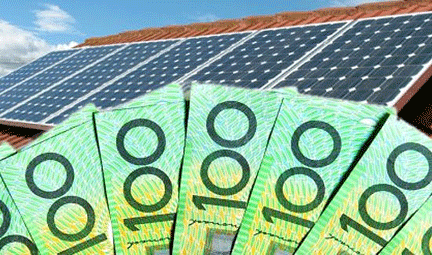
Cheaper, greener power is on the way. As long as anti-net zero populists
don’t throttle it in the cradle. Not that long ago, Mark Purcell, a retired
rear admiral in the Australian navy, was paying about A$250 a month for
electricity in his roomy family home on the Queensland coast.
Today, he says he makes as much as A$300 a month, or nearly $200, from the
electricity he makes, stores and sells with his solar panels and batteries.
“This is the future,” he told me. “This is what the energy transition
could look like for a lot of folks.” Purcell is one of the 58,000-plus
customers of Amber Electric, an eight-year-old Melbourne business that
gives householders access to real-time wholesale power prices so they can
use power when it’s cheap and sell what is stored in their batteries when
it’s expensive.
The company is adding 5,000 customers a month, putting it
among a new generation of fast-growing energy tech start-ups aiming to make
electricity cheaper and greener, and not just in Australia. Amber’s dynamic
pricing technology is due to launch soon in the UK, where the company has
done licensing deals with the energy suppliers Ecotricity and E.On.
Norway’s Tibber offers similar services to the 1mn customers it has gained
since launching in 2016 and expanding to Germany, Sweden and the
Netherlands. In Germany, the market share of companies including Tibber,
Octopus Energy and Rabot Charge has grown from 0.1 per cent in 2023 to 2.4
per cent in 2025, says the Kreutzer Consulting group. Between them they
have more than 1mn customers, 77 per cent of whom are particularly or very
happy with their provider, far more than the industry-wide figure of 57 per
cent.
Remember those figures the next time you hear a rightwing populist
condemn allegedly unaffordable net zero policies. In fact, this new class
of energy tech entrepreneurs is showing how electricity can become more
affordable precisely because of the renewables, batteries and electric cars
that net zero efforts drive.
It is no accident Amber Electric began in
Australia, long a world leader in rooftop solar systems that sit atop more
than 4mn of its homes and small businesses. Its population of 28mn is now
undergoing a home battery boom, following the July launch of a A$2.3bn
government subsidy scheme. Industry estimates show rooftop solar can save
households up to A$1,500 a year on energy bills, a figure that nearly
doubles if you add a battery, and rises further with dynamic pricing. Is
there a catch?
Right now, the upfront costs of green tech can be
considerable. Queensland’s Purcell is a superuser who has spent tens of
thousands of dollars on solar panels, batteries and a home energy
management system that makes everything from his pool heater to his air
conditioners price-responsive. His family also has two Teslas with even
bigger batteries.
This is clearly unaffordable for many, but maybe not for
long. Big home hardware retailers have begun to launch financing plans that
let people pay monthly fees of less than A$150 for solar and battery
packages rather than a big initial outlay.
FT 29th Oct 2025, https://www.ft.com/content/8bf14af2-8c22-4731-ad06-4a36277dff74
Australian Capital Territory went first and fastest to 100 per cent renewables: It now looks like the smartest policy of all
The ACT government continues to reap the rewards for its early and bold
push to 100 per cent renewables, which is now looking like the smartest
policy of all – shielding its residents from the ravages of largely
fossil-fuelled electricity price hikes.
The latest quarterly data assessing
the cost of the ACT government’s commitment to sourcing the equivalent of
its annual demand from wind and solar – which it met on schedule in 2020
– shows the additional cost of the policy in the latest quarter was just
$3 a megawatt hour. Indeed, three of the wind farms contracted by the ACT
government returned significant sums of money (a total of $4.4 million) to
the ACT because the contract prices they agreed to are significantly lower
than current wholesale electricity prices.
Renew Economy 8th Oct 2025, https://reneweconomy.com.au/act-went-first-and-fastest-to-100-per-cent-renewables-it-now-looks-like-the-smartest-policy-of-all/
South Australia unveils first auction as world’s most advanced renewables grid seeks long duration storage
The South Australia state government has appointed ASL to run its first
auction for long duration storage, as the world’s most advanced wind and
solar grid seeks around 700 MW of new firm capacity over the next six
years.
South Australia leads the world in the uptake of wind and solar –
which together accounted for 75 per cent of its local electricity demand
over the last 12 months – and has set a world-leading target of reaching
100 per cent “net” renewables by the end of 2027. It already has seven
big battery projects operating in the state, and another dozen under
construction or contracted, but it is now seeking longer duration storage
through the Firm Energy Reliability Mechanism (FERM) that it announced
earlier this year.
Renew Economy 8th Oct 2025,
https://reneweconomy.com.au/south-australia-unveils-first-auction-as-worlds-most-advanced-renewables-grid-seeks-long-duration-storage/
Australia rooftop solar hits 26.8 GW as home battery uptake surges
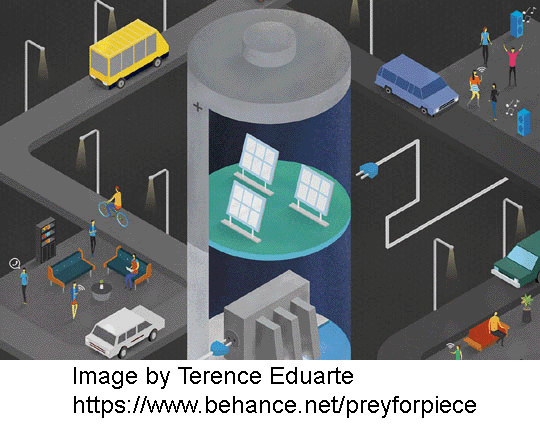
Australia is on track to exceed its 2030 rooftop solar targets with a combined 1.1 GW of new capacity installed across 115,584 households and businesses in the first half of 2025.
September 15, 2025 David Carroll, https://www.pv-magazine.com/2025/09/15/australia-rooftop-solar-hits-26-8-gw-as-home-battery-uptake-surges/
A new report from the Clean Energy Council (CEC) shows that at the end of June there was a combined 26.8 GW of rooftop solar capacity deployed across 4.2 million homes and small businesses in Australia.
The CEC’s Rooftop Solar and Storage Report reveals that 115,584 rooftop solar units were installed nationwide in the first six months of the year, down 18% on the same period 12 months prior, while the total installed capacity of 1.1 GW was 15% lower than the 1.3 GW installed over the same period in 2024.
Despite the slowdown, the CEC said Australia is likely to exceed the Australian Energy Market Operator’s (AEMO) 2030 target for rooftop solar.
AEMO’s Integrated System Plan, which underpins the federal government’s 82% by 2030 renewable energy target, expects rooftop solar to contribute 36 GW to the National Electricity Market by the end of the decade.
The CEC said based on current trends, it expects the rollout of rooftop solar in Australia will reach 37.2 GW by June 2030, beating projections by 3.3%.
CEC Distributed Energy General Manager Con Hristodoulidis said the figures highlight the pivotal role of rooftop solar in keeping Australia’s energy transition on track.
“Australian consumers and small businesses are delivering the transition at breathtaking speed, turning suburban roofs into one of the biggest power stations in the country,” he said.
Rooftop solar contributed 12.8%, or 15,463 GWh, of Australia’s total energy generation in the first six months of the year, up from 11.5% in the same period 12 months prior.
The report also shows that Australians are embracing home batteries at record pace, with 85,000 battery units sold in the first half of 2025, representing a 191% increase from the same period last year.
The uptake has surged again since the introduction of the federal government’s Cheaper Home Batteries program with government data revealing more than 43,500 installations installed in July and August alone.
“Just as Australians have long understood the value of solar in lowering household energy bills, we are now seeing a surge in battery adoption, which allows households to store their own clean energy and maximise savings,” Hristodoulidis said.
Queensland added the most rooftop solar in the first half of 2025, with 326 MW of installed capacity, followed by New South Wales (NSW) and Victoria with 321 MW and 230 MW, respectively.
NSW has the highest level of total installed rooftop solar capacity in the nation at 7.5 GW, with Queensland second at 7.2 GW, ahead of Victoria with 5.4 GW. Queensland remains the state with the most installations, with 1.1 million.
Albanese government substantially expands renewable energy scheme amid 2030 target concerns
Albanese government substantially expands renewable energy scheme amid
2030 target concerns. Chris Bowen says Labor will increase size of its main
climate and energy program by 25% to capitalise on falling cost of solar
panels and batteries. The Australian government will substantially expand a
renewable energy underwriting scheme as it aims to capitalise on the
falling cost of solar panels and batteries and combat concerns it may
struggle to meet its 2030 climate target.
Guardian 29th July 2025,
https://www.theguardian.com/australia-news/2025/jul/29/australia-expands-renewable-energy-scheme-2030-target
“We can do that:” Australian Energy Market Operator says the country’s power system can be run on 100 pct renewable energy.
The head of the Australian Energy Market Operator says he confident that
the country’s main grid – and its smaller ones for that matter – can
be run on 100 per cent renewable energy. “At AEMO, I set an ambition in
2021 for us to understand what it takes to run a power system on 100%
renewable energy,” Westerman said in an address to the Clean Energy
Summit in Sydney on Tuesday. “And today, we’re confident that with
targeted investments in system security assets, we can do just that. I’m
incredibly proud of this, but the future is coming at us fast and those
system security investments are needed urgently run a power system on 100%
renewable energy.”
Renew Economy 29th July 2025,
https://reneweconomy.com.au/we-can-do-that-aemo-says-power-system-can-be-run-on-100-pct-renewable-energy/
Plunging cost of solar batteries ensures renewables remain lowest cost option for Australia, CSIRO says
The plunging cost of battery storage has ensured that integrated
renewables remain the lowest new build generation option for Australia,
while the western world’s first small modular reactor contract has
confirmed the CSIRO’s view that nuclear is by far the most expensive.
The final version of the 2024/25 CSIRO’s GenCost report has been released on
Tuesday and once again confirms – despite the extraordinary attacks from
critics over the last few years – that integrated renewables is easily
Australia’s best option as it looks to replace its ageing and heavily
polluting coal fired generators. This is despite inflationary pressures on
civil construction works, and the additional costs of worker camps for
large wind projects that have been included in its calculations for the
first time, adding around 4 per cent to the costs of wind energy.
Renew Economy 29th July 2025, https://reneweconomy.com.au/plunging-cost-of-solar-batteries-ensure-renewables-remain-lowest-cost-option-for-australia-csiro-says/
‘Fork in the road’: How a failed nuclear plot locked in Australia’s renewable future

The Age By Nick Toscano, June 1, 2025
hen Australians went to the polls and voted Anthony Albanese back as prime minister, they also voted for something that will outlive the next election: the power industry’s guaranteed switch from coal to renewable energy.
What they didn’t vote for were state-owned nuclear reactors, forced delays of coal-fired power station closures and a slew of other Coalition promises widely viewed as threats to the country’s era-defining challenge of cutting harmful emissions while keeping electricity supply and prices steady.
Although times remain testing in the energy sector, a feeling of relief is clear. “The nuclear conversation is dead and buried for the foreseeable future,” said an executive at one of Australia’s biggest power suppliers, who asked not to be named. Even as the Nationals keep arguing for a nuclear future, any genuine suggestion that atomic facilities could still be built in time to replace retiring coal plants after the next election rolls around was now downright “ridiculous”, said another, adding that renewable energy was on track to surpass 60 per cent of the grid by 2028. “That’s great for the energy sector – it simplifies the path forward,” they said.
Make no mistake, a seismic shift across the grid has been well under way for years now. Australia’s coal-fired power stations – the backbone of the system for half a century – have been breaking down often and closing down earlier, with most remaining plants slated to shut within a decade.
At the same time, power station owners including AGL, Origin Energy and EnergyAustralia are joining a rush of other investors in piling billions of dollars into large-scale renewables and batteries to expand the share of their power that comes from the sun, wind and water. The federal government has an ambitious target for renewable energy to make up 82 per cent of the grid by 2030.
Moving to a system dominated by less-predictable renewables will not be easy. It will take much greater preparation to match supply and demand and require the multibillion-dollar pipeline of private investment in the transition to continue. But ousted opposition leader Peter Dutton, before losing the May 3 federal election and his own seat, hatched a plan to change the course dramatically. A grid powered mainly by renewables would never be able to “keep the lights on”, Dutton insisted.
Instead, he declared, a Coalition government would tear up Australia’s legislated 2030 emissions-reduction commitments, cut short the rollout of renewables, force the extensions of coal-fired generators beyond their owners’ retirement plans and eventually replace them with seven nuclear-powered generators, built at the taxpayer’s expense, sometime before 2050
For Australians who wanted to see urgent action to tackle climate change – and investors at the forefront of the shift to cleaner power – the campaign to dump near-term climate targets in favour of nuclear energy came at the worst possible time. Some likened it to a “near-death experience” for the momentum of the shift to a cleaner, modern energy system that would have wiped out investor confidence and killed off billions of dollars of future renewable projects.
“When you reflect on the significance of energy in the campaign, it’s reasonable to say this was a fork in the road,” said Kane Thornton, outgoing chief executive of the Clean Energy Council……………………………………………..
Dutton argued for months that nuclear plants would be the best way to keep prices down, even though almost no one agreed with him.
“I’m very happy for the election to be a referendum on energy – on nuclear,” he said.
In the end, the idea proved too toxic for voters. It delivered big swings against Dutton’s candidates in electorates chosen to host reactors, while support for Labor grew in many of the places selected to develop massive offshore wind farms, which the Coalition had planned to scrap.
The decisive election result “locks in” the government’s ambitious push for an electricity grid almost entirely powered by renewables, said Leonard Quong, the head of Australian research at BloombergNEF.
“The Labor Party’s landslide victory … is a win for climate, clean energy and the country’s decarbonisation trajectory,” he said…………………………………………..https://www.theage.com.au/business/the-economy/fork-in-the-road-how-a-failed-nuclear-plot-locked-in-australia-s-renewable-future-20250523-p5m1qa.html
1 This month
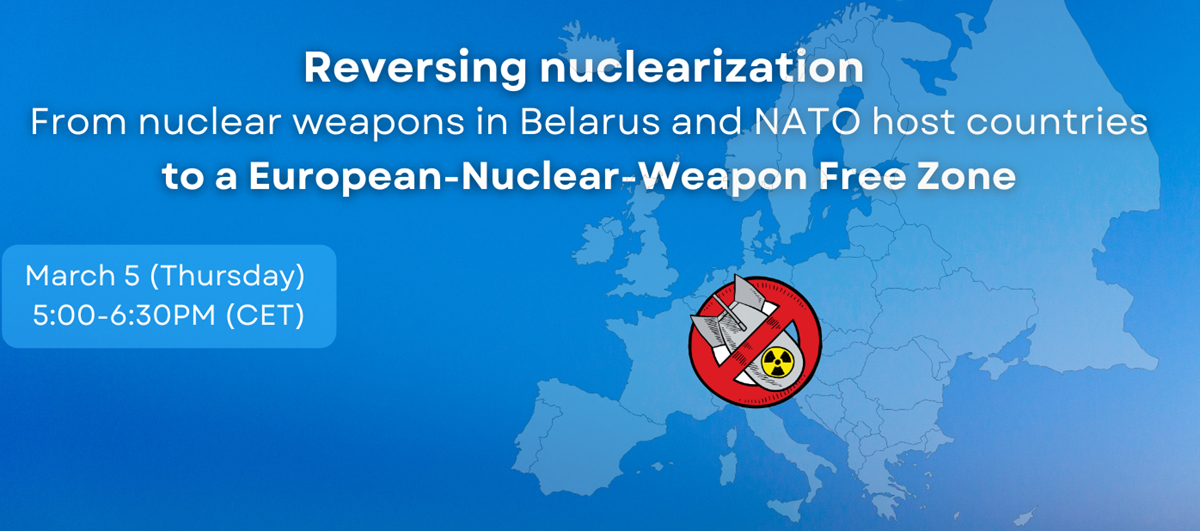
6 March -Online – Reversing nuclearization:
From nuclear weapons in Belarus and NATO host countries to a European-Nuclear-Weapon Free Zone
Mar 6, 2026 03:00 AM in Canberra, Melbourne, Sydney

of the week – Australians for War Powers Reform (AWPR)
To see nuclear-related stories in greater depth and intensity
 Antinuclear