National survey on energy affordability
Aussies Want Cheaper Power – But Hands Off Renewables http://www.energymatters.com.au/index.php?main_page=news_article&article_id=4056 3 Dec 13 While not the largest cost-of-living expense, electricity bills are the bogeyman that concern Australians most.
A national survey on energy affordability carried out by CHOICE, the Brotherhood of St Laurence and Energy Efficiency Council revealed 84 per cent of Australian households are concerned or very concerned about energy costs. The same percentage felt it was important or very important for their State Government to help rein in these costs.
However, instead of screaming for renewable energy support to be hit to cut the cost of power – a default choice it seems for many politicians – this was the least popular action in the survey. In fact, knee-capping renewables had a negative net approval rating in every state.
Nearly double the percentage of respondents strongly opposed such action compared to those who strongly supported it. This is a message Australia’s government would be well-advised to heed; particularly given it appears to have its sights set on the Renewable Energy Target next year.
Energy Efficiency Council’s chief executive officer, Rob Murray-Leach, said there was also a danger the national debate about the carbon bill meant other expenditures that have an even bigger impact on energy costs, like poles and wires, could be ignored or overlooked.
The most popular methods for reducing power costs emerging from the survey were:
– Government helping homes and businesses save energy
– The introduction of time of use pricing
– The use tax revenue to subsidise energy bills for low-income households
While many Australians spend far more on petrol than electricity, CHOICE says the fear stirred up by power bills could be due to several factors – electricity costs jumping far more rapidly than transport costs over the past two years, the “sticker shock” aspect of larger than expected bills and that electricity bills tend to be a significant outlay given they are received quarterly.
The summary results of the Survey of Community Views on Energy Affordability for Australia can be viewed here (PDF).
Trial of electric cars shows they can be effective for Australia
 Trial complete: electric vehicles can work in Australia The Conversation, 3 Dec 13 Australia’s first electric vehicle trial has been completed. It ran from early 2010 to the end of 2012 with 11 electric Ford Focus and 23 fast-AC charging bays (Level-2). We found few technological barriers to the adoption of electric vehicles (EVs) in Australia, but government incentives for early adopters and government programs for the roll-out of fast-DC charging stations would help Australia fully embrace these cars……..
When are cars charged?
We were particularly interested in what time of day drivers charged their cars. This determines how much renewable energy can be used for charging (to make an EV really emission-free) and whether electricity utilities have to worry about an increase of peak demand in the future, when there might be millions of EVs.
The fleet EVs did most of their charging in the morning until mid-day, so most of the charging energy could be supplied by solar photovoltaics. This finding is significant, as company fleets are not only an early adopter of new car technology, but are also the largest customer segment for the new vehicles market in Australia………
Recommendations We found:
EVs can function as regular fleet pool cars for most applications. Continue reading
Solar Citizens a formidable lobbying force in Australia
 Sun Tax’ Petition Hits 25,000 Signatures http://www.energymatters.com.au/index.php?main_page=news_article&article_id=4054 2 Dec 13 20 advocates associated with Solar Citizens will be travelling to Canberra on Monday to present a petition signed by more than 25,000 Australians who are demanding politicians to not tax the sun.
The group will be meeting with dozens of federal politicians, dispelling the myths and highlighting the need for positive measures to help the growth of solar throughout Australia. Prime Minister Abbott signalled he had renewable energy in his crosshairsrecently and incorrectly stated that the RET was contributing significantly to electricity bills. That certainly isn’t the case, even with home solar.
“Solar is a small portion – less than 6%. So, why is solar being blamed?” said Adrian Brown, a spokesperson for Solar Citizens. “The simple answer is that it appears that big energy companies are trying to dictate our energy future, attempting to salvage their profit margins and investment in the network – and penalising solar along the way.”
Mr. Brown stated the ‘sun tax’ concept may have just been a recommendation and is by no means set in stone, but slugging solar seems to be the default solution for politicians.
More than 1.1 million Australian households have invested $8 billion to take power over their bills says the group; saving families collectively many hundreds of millions of dollars on energy bills annually. “Making the move to solar is a real way for families to take power over their bills and do their part for our environment,” Mr Brown says.
In addition to the substantial power bill savings, the solar revolution in Australia has created many thousands of jobs. Geoff Bragg, NSW Chairman of the Solar Energy Industries Association (SEIA), says the industry could continue to grow; however, stability must be ensured. The trip to Canberra is only another step in the anti-sun tax campaign, not the end. Later this month, the group intends presenting the petition to State Premiers and Energy Ministers.
Solar Citizens is a grassroots initiative bringing together existing and future solar owners to ensure their rights are protected and to help see solar panels on every rooftop in Australia.
Citizen donations fund New South Wales solar energy project
 Australian Solar Project Loan Funded By Citizen Donations http://www.energymatters.com.au/index.php?main_page=news_article&article_id=4052 29 Nov 13, CORENA (Citizens Own Renewable Energy Network Australia Inc.) has provided Tulgeen Disabilty Services an interest-free loan of $12,000 to install solar; with the loan funded entirely by donations from the public.
Two rooftop solar PV systems have been installed for Tulgeen; located in Bega, New South Wales. The Tulgeen cheese packaging facility, which employs people with disabilities, has a 4kW system that will supply 58% of its electricity needs. A 3kW solar panel array installed at the Training and Education Services day programs centre will provide 21% of that building’s requirements.
CORENA uses donations from the public to fund projects; then electricity sales and loan repayments from completed projects to help finance future projects, thus continuously recycling donated money. “Eventually, when we have funded around 120 such projects, repayments from earlier projects will be enough to continue funding one new project per month forever, without ever needing more donations,” said CORENA spokesperson Margaret Hender.
Operating on a shoe-string budget, 100% of the money donated is spent the projects themselves. Currently the group relies on volunteers’ time for administrative functions. “It enables everyone who wants more renewable energy now to collectively get on with the job, rather than just waiting on government action,” states the CORENA web site. Patron of the organisation is Monica Oliphant, who, among many other roles, was President of the International Solar Energy Society (ISES) in 2008/09.
Community-serving organisations are encouraged to apply for funding underCORENA’s Small Projects scheme.
Community-funded solar; both under an investment model or donation basis, has generated a great deal of interest in Australia; with dozens of communities and initiatives attempting to set the wheels in motion.
Government support for such initiatives has been scant to date, although a new ARENA-supported project due to commence early next year will delve into how to best realise the potential of community-owned renewable energy projects in Australia.
The power of suggestion in attitudes to wind power and health
 The results showed that the experience of symptoms and mood during exposure to audible windfarm sound and infrasound was influenced by the type of expectations provided before exposure periods.
The onus falls on the media to report on health fears about wind farms cautiously, particularly given strong evidence that it is the discussion itself that may be creating and perpetuating health complaints.
 Wind turbines don’t make you feel sick or healthy, but spin can http://theconversation.com/wind-turbines-dont-make-you-feel-sick-or-healthy-but-spin-can-20845 Fiona Crichton PhD candidate in psychological medicine at University of Auckland 29 Nov 13
Despite at least 19 reviews of the scientific evidence universally concluding that exposure to wind farm sound doesn’t trigger adverse health effects, people continue to report feeling unwell because they live near wind turbines.
We’ve known for some time that exposure to negative messages about wind farms makes people more likely to report feeling sick after exposure to turbines. And new research, published by my colleagues and I this week in the journal Health Psychology, shows positive messages about wind farms may have the opposite effect – improve perceptions of health.
Infrasound
Speculation in the media and on the internet often attributes the symptoms to sub-audible sound produced by operating wind farms (infrasound). But the reality is that infrasound (sound below 16 hertz) is consistently present in the environment and is caused by wind, ocean waves and traffic. Importantly, research demonstrates there is nothing unusual about the levels of infrasound produced by wind farms. Continue reading
A win for local communities as Tribunal finds wind farms are not harmful to health
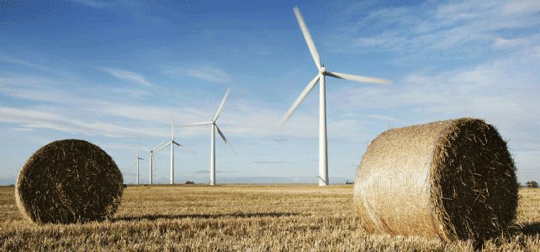 Wind farm ruling a win for communities: Clean energy group http://www.abc.net.au/news/2013-11-27/wind-farm-health-findings-a-win-for-communities/5120036 ABC Rural By Babs McHugh The Clean Energy Council says the latest rejection of claims of negative health effects of wind farms is adding more certainty to the future of the industry for investors.
The Victoria Civil and Administrative Tribunal (VCAT) has approved a 16-turbine wind farm at Trawool, north of Melbourne, after finding there’s no evidence they have adverse effects on health and well being. Director of policy with the Clean Energy Council, Russell Marsh, says he wasn’t surprised by the findings. “Pretty much every wind farm that’s been proposed in recent years has been opposed on grounds of adverse health effects.
“What we’ve seen in the last 24 hours is that there’s yet more evidence to show that those claims are unfounded. “New South Wales and Victorian state health bodies, and federal departments also, have found there’s no scientific evidence to back up claims of ill- health effects, physical and psychological.
“And this is backed up by a noise study for the Waterloo wind farm released yesterday by the South Australian Environmental Protection Agency. “That found the noise from the wind farm fell below the thresholds set under the planning conditions.
“Also, the rumbling noise that some residents complained about (in diaries they were asked to keep) was present at times when the wind farm was switched off.” Mr Marsh says it’s not only wind farm operators who these findings benefit. “It is a significant win for the industry, but also for communities who live near wind farms. “Yet again, this is showing that when these adverse health (claims) are tested, they don’t stack up.
“So communities shouldn’t be concerned about a wind farm being located near them.”
South Australian Environment Protection Authority (EPA) finds Wind Farm Not Harming Residents
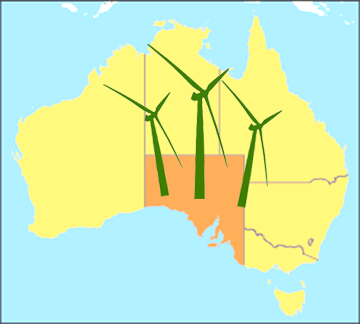 EPA study finds no evidence wind farm noise impacting residents ABC News, 27 Nov 2013, A study into the Waterloo Wind Farm, south-east of Clare, has found there is no evidence linking noise from the farm to any adverse effects on local residents.
The study was undertaken by the Environment Protection Authority (EPA) during April and June.
It has found noise produced does not breach authority guidelines and that low frequency infrasound levels are below internationally-accepted thresholds for perception.
The authority also says in some situations there was no association between events described by residents in noise diaries with audio records and data.
The authority’s Peter Dolan says he cannot say why local residents are complaining about health effects…….http://www.abc.net.au/news/2013-11-27/epa-study-finds-no-evidence-wind-farm-noise/5119556
Victorian Wind Farm gets the All Clear to Go Ahead
 Cherry Tree wind farm gets go ahead in Victoria ABC Rural By Babs McHugh 27 Nov 2013, The Victoria Civil and Administrative Tribunal (VCAT) has approved a wind farm after finding there’s no evidence wind farms have adverse effects on health and wellbeing. Infigen Energy’s proposal for a 16-turbine wind farm near Seymour, north of Melbourne, was rejected by the Mitchell Shire Council, which said there were widespread health concerns.
The council said it had received more than 100 objections to the project in the Trawool Valley, which also raised concerns about disruption to the landscape.
Infigen appealed the decision to the VCAT, and the Cherry Tree Wind Farm is now the first to be given the go-ahead under the Victorian Government’s new planning laws for wind farms which were introduced in 2011.
The Tribunal used information from the New South Wales and the Victorian health departments that shows there’s no scientific evidence to link wind turbines with adverse health effects or support claims that inaudible sound can have psychological effects……. http://www.abc.net.au/news/2013-11-27/wind-farm-go-ahead-victoria/5119518
Tasmania on track for 100% renewable energy
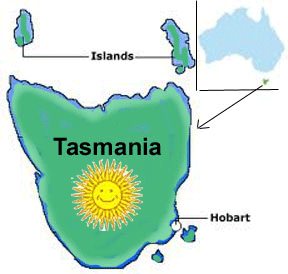 Tasmania aims for 100 pc renewable energy use in seven years http://au.news.yahoo.com/a/20024300/tasmania-aims-for-100-pc-renewable-energy-use-in-seven-years/ BY LUCY SHANNON -November 26, 2013 The Tasmanian Government has released a climate change strategy aimed at 100 percent renewable power usage by 2020.
The Climate Smart Tasmania plan includes energy reduction targets across government, land use, infrastructure, transport and waste systems. The Climate Change Minister, Cassy O’Connor, says its the most comprehensive plan by any Australian Government to reduce carbon emissions as well as adapt to a changing climate.
The strategy sets a new interim 2020 target to reduce carbon emissions to 35 percent below 1990 levels. Ms O’Connor says its about showing leadership on climate change. “We now have in Australia a climate denialist Government that is taking us backwards on climate change” she said.
“Tasmania here has extraordinary advantages with our Hydro power, with the carbon in our forests and we do need to show leadership; it’s also the economically sensible thing to do.”
Strong financial case for home solar energy, despite government disincentives
 Home Solar in Australia : Study http://www.energymatters.com.au/index.php?main_page=news_article&article_id=4043 25 Nov 13 13 per cent of homes in Australia now have a solar panel system and 3 million Australians live in a solar household – and the RET is costing far less than some would have us believe.
A report by Green Energy Markets for the REC Agents Association (RAA) shows Australians installed more than 1 gigawatt of solar panels last year, but during the last 12 months, installations have dropped 22% as a result of winding down of rebates and incentives.
The report also reveals a very important point about the costs of that support.
While the Federal Government appears to have Australia’s Renewable Energy Target in its sights, when taking into consideration the impact solar has had onreducing wholesale power costs, the real cost of the SRES to all households will be just $1.90 per quarter by 2016 – or just 0.38% of a typical household quarterly bill. Continue reading
Individual energy choices are steadily driving the renewable energy revolution
China’s romance with coal has ended. Recent announcements, including a cap on coal use and a reduction in coal burning around Chinas largest population centres of 5% in the next four years, signal a dramatic turnabout. Chinese investment in renewables reached $63bn in 2011.
There is little individuals can do about global negotiations, but a huge amount they can do about renewable energy. . One million Australian households now generate their own electricity with solar power, and two community owned wind-farms have been set up, supplying electricity to thousands. Energy efficiency is also having an impact.
 Cleaner energy: a revolution that ordinary people can drive http://www.theguardian.com/commentisfree/2013/nov/22/cleaner-energy-revolution-warsaw There will be no decisive moment in the climate battle. Rather, it’s a war of attrition, being won one solar panel, one wind turbine, and one electric car at a time Tim Flannery theguardian.com, Friday 22 November 2013
The fully electric Tesla S sedan. Electric vehicles are to oil what solar panels and wind turbines are to coal – disruptive technologies that even in small volume present a severe challenge to the fossil fuel industries.
All too often people judge progress on climate change by treaties.Warsaw marks the 19th year of negotiation of a global climate treaty, and with nations in charge the prospect of brokering a strong treaty in 2015 seems limited. It would appear that there will be no decisive moment in the climate battle. Rather, it’s a war of attrition, being won one solar panel, one wind turbine, and one electric car at a time.
Government policy is important in setting the pace. The Cancun agreements in 2010 saw 98 countries representing 80% of global emissions, set their own targets to reduce emissions by 2020, have been vital in fostering the uptake of renewables. But so too has the astonishing cost reductions that have occurred in wind and solar. The cost of production of solar panels has reduced 80% in the past four years, while the cost of electricity from wind will half in the next five years. Continue reading
Tasmania’s electricity fully supplied by renewable energy
Renewables completely supply Tasmania’s electricity https://www.engineersaustralia.org.au/news/renewables-completely-supplies-tasmania-s-electricity According to the latest Carbon Emissions Index (Cedex) released by pitt&sherry, Tasmania’s electricity is now virtually 100% provided from renewable sources.
Prior to July, hydro was already producing the majority of the state’s electricity at about 11TWh, followed by gas and wind, both around 1TWh. However, the state’s major gas fired generator – the Tamar Valley Power Station – was shut down for an indefinite period in July. Hydro output is now at its highest ever annual level and wind is growing, while gas output has fallen essentially to zero.
Dr Hugh Saddler, principal consultant, energy strategies at pitt&sherry said: “There are striking changes in Tasmanian generation. Prior to the commissioning of BassLink in 2005, hydro output was constrained to the level of demand within the state. While energy regularly flows in both directions across BassLink, the net flow is now strongly from Tasmania to Victoria.”
In addition, there is evidence the impact of higher wholesale gas prices, triggered by the linkage of eastern Australia gas markets to international prices through the LNG export projects in Queensland, is beginning to be felt in the national electricity market. The decline in gas fired generation appears to be accelerating throughout Australia, Saddler added, and is particularly marked in South Australia and Tasmania.
As has been the case for some months, all growth in the national energy market generation came from hydro, wind and other renewables; their combined share of total energy send out generation was over 17% in October, and for the year to October was approaching 14%.
The report is a monthly benchmark for Australia’s carbon emissions from the energy sectors based on electricity, petroleum and natural gas data. The report is available here.
Air conditioning costs becoming unaffordable for many Australians
Australians Sweating On Air-Conditioning Electricity Costs 20 November, 2013: Despite the majority of Australian households now owning an air conditioner, solar energy advocate Nick Brass of Energy Matters warns many people will swelter in their furnace-like homes this summer rather than switch on the cool. The reason – electricity sourced from the mains grid has simply become an unaffordable luxury. http://www.energymatters.com.au/index.php?main_page=news_article&article_id=4033
“Electricity prices have risen by a whopping 72% in real terms since 2004[1] and the rise of air conditioners is partly to blame,” commented Mr Brass. “There will be 750,000 more air-con units installed this year alone, bringing the total number of household units to over 9.2 million[2].
“For many people, powering their air conditioner has become unaffordable due to the high cost of electricity. Ironically, it’s because of air conditioners that electricity prices have spiralled out of control. Continue reading
It turns out that W.A.’s ‘Poles and Wires’ (not renewable energy) are the culprit in high electricity costs
The news is cold comfort to those who have been fighting myths and misinformation for years regarding the true villains of electricity price rises and extolling the benefits of clean, distributed energy generation – including a reduction in infrastructure spending. Sadly, it appears the message still may not be getting through to some.
$1 Billion Power Pole Price Blowout For Western Australia http://www.energymatters.com.au/index.php?main_page=news_article&article_id=4039 21 Nov 13 ‘Poles and wires’ have been the major culprits behind electricity price increases in recent years – and there’s more bad news on this front for Western Australia. Western Power’s 5 year maintenance plan for its wood pole network may have originally been just a little optimistic on the expense and time side of things. It was initially estimated to cost $1.35 billion. Continue reading
Off grid solar for Australia’ s remote area mining industries
 Miners investigating off grid solar, PV Magazine 20. NOVEMBER 2013 BY: JONATHAN GIFFORD Australia’s mining industry is investigating solar to supply some of its energy needs in off-grid and remote locations. In the resource rich state of Western Australia, estimated savings could reach an excess of AUD$2 billion……..
Australia’s mining industry may finally be making moves towards renewables, as evidenced by strong interest in the recent technology forum. The Australian Renewable Energy Agency (ARENA) is leading the way in supporting such development. ARENA hosted the recent event in the Western Australian capital city of Perth in partnership with the Chamber of Minerals and Energy to promote renewables for mining installations.
ARENA’s support scheme, the Regional Australia’s Renewables – Industry Program (I-RAR), assists the industry with such mining applications. The program, which is accepting proposals until the end of the year, offers support for such projects in diverse ways. “We’re actually looking at a variety of support mechanisms, everything from upfront capital grants to revenue based support to what I would call contingent or risk-sharing grants on the backend,” ARENA CEO Ivor Frischknecht told pv magazine……..
Frischknecht told pv magazine that ARENA had already received a number of applications for funding and support under the regional renewables program, including mineral and natural gas extraction ventures. He said that the body has a project pipeline worth “several billion dollars” that it is currently evaluating. “In terms of technologies we’re currently looking at projects that could include solar thermal or PV, or wind,” said Frischknecht…….
The Chamber of Minerals and Energy, ARENA and Austrade are currently working on a publication to share some of the challenges to realizing mining industry renewable projects featuring case studies from existing installations.http://www.pv-magazine.com/news/details/beitrag/miners-investigating-off-grid-solar_100013493/#axzz2lJMBH8HE
1 This month



Help Aunty Sue Protect Her Land and Sacred Sites From Destructive Rocket Testing.
.

Australians deserve the truth
about
AUKUS – https://aukuspublicinquiry.com/

PETITION – To: Prime Minister Anthony Albanese and the Australian Labor Government

of the week – Australians for War Powers Reform (AWPR)
To see nuclear-related stories in greater depth and intensity

