No new renewable energy for Western Australia – says State government
 WA government says no to new renewable energy REneweconomy, By Giles Parkinson on 8 October 2013 Western Australia has some of the best solar and wind resources in the world. But for the foreseeable future they are likely to go largely undeveloped because the state government has indicated that it will not support any new large scale renewable energy developments on its main grid. It will prefer instead to subsidise the construction of wind farms and solar farms in the eastern states.
The admission came in a series of speeches delivered recently by WA Energy Minister Mike Nahan which highlighted what a dog’s breakfast – and a very expensive dog’s breakfast at that – the state’s electricity grid had become. Continue reading
Shadowing becoming a legal issue, in Melbourne’s solar rooftop boom
The Clean Energy Council said it was the perfect time for new laws to be introduced so new buildings did not hamper the energy efficiency of their neighbours.
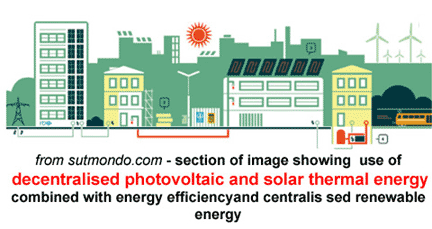
Solar review casts shadow on high-rises http://www.theage.com.au/victoria/solar-review-casts-shadow-on-highrises-20131007-2v4bs.html October 8, 2013 Aisha Dow Developers may be prevented from building high-rises that block sunlight from hitting solar panels on buildings in central Melbourne, under new rules being considered by the state government.
The Department of Transport, Planning and Local Infrastructure is reviewing planning and building provisions that affect solar panel placement and overshadowing. A department spokesman said the review would decide whether there is need for reform, with any changes to be part of the new Metropolitan Planning Strategy.
The move comes as a new study shows Melbourne’s inner-city rooftops could host enough solar panels to power 10,000 houses.They found that even if only 20 per cent of roof space was covered by panels it would be enough to host the equivalent of 100 large solar parks.
Councillor and sustainable business expert Arron Wood said the figure would be much higher if they had also audited high-rise towers and business and apartment buildings in the central city. But concerns about the sun being blocked by new construction in the CBD led the council to limit its scoping study. Cr Wood said there needed to be stronger government policy on the shadowing of solar panels.
”It’s also another reason why we should stick to the mandatory building height limits, and that’s something we have considered,” he said.
Last year a proposal to build two double-storey houses in Kensington was rejected by the Victorian Civil and Administrative Tribunal after a neighbour complained the structure would partially eclipse his rooftop panels. VCAT called for clearer guidelines for determining acceptable levels of overshadowing. Continue reading
Australian Renewable Energy Agency ‘s strategy for hybrid renewable energy
ARENA looks to accelerate renewable hybrid power plants http://reneweconomy.com.au/2013/arena-looks-accelerate-deployment-renewable-hybrid-generators-21110 By Giles Parkinson on 4 October 2013 The Australian Renewable Energy Agency says it will soon unveil its strategy for a widespread “hybridisation” of Australia’s fleet of fossil fuel power plants.
ARENA chair Greg Bourne says a report conducted by Parsons Brinkerhoff will be released later this month which will look at how quickly and widely renewable fuels such as geothermal, solar thermal and biomass can be added to existing plants, or used to exploit the infrastructure of plants which have closed.
Bourne sees hybridisation as a key strategy for the deployment of renewables in Australia, even if some argue that it may extend the life of dirty and inefficient coal plants. It is part of what he sees as a cautious and gradual approach to the greening of Australia’s electricity grid.
“We expect this study will inform the design of a new program in 2013/14 to encourage the broader deployment of utility scale, grid connected renewable energy in existing power stations,” he said in a speech to the Australian National Conference on Resources and Energy in Canberra. Continue reading
Community owned energy – the success story of Hepburn Wind farm, Victoria

”We’ve developed a model for community wind and a model for community solar energy,” she explains. ”There are about 70 different groups [in] Australia interested in developing … projects.”
Hepburn co-op sailing with the wind September 29, 2013 Michael Green There’s lots of energy behind locally owned wind power. http://theage.domain.com.au/real-estate-news/hepburn-coop-sailing-with-the-wind-20130928-2ula1.html Late last summer, Melbourne artist Ghostpatrol spent a week manoeuvring a crane in a paddock in Leonards Hill. With a small team, he painted a huge image of a girl dressed in green on one of the two wind turbines that comprise the Hepburn Wind farm, near Daylesford.
The artists camped under the turbine. They had to rise early to paint before the wind picked up, and for good reason: the girl’s name – and the turbine’s, too – is Gale. .The community-owned wind farm has now been operating for more than two years. It has produced more than 22 million kilowatt-hours of renewable energy, which more than matches the amount used by households in Daylesford and Hepburn.
Taryn Lane, Hepburn Wind’s community officer, conducts regular tours for school groups and university students. ”We’re the closest wind farm to Melbourne,” she says. ”We believe we’ve got a big role to play in helping to demystify wind power.”
Giving Gale a personality has helped with that, and so, too, will a new sign on the road at the front of the wind farm, which will click over with every kilowatt-hour the turbines produce. ”It will address the myth that wind energy is unreliable. Although it’s intermittent, it is really predictable,” she says. As well as electricity, the turbines generate money for the community. So far, more than three-dozen projects – from solar streetlights to public seating – have received a total of $72,000. Continue reading
Western Australia’s Mumbida Wind Farm officially opened
The WA Water Corporation will purchase 100 percent of the wind farm’s output for its Southern Seawater Desalination Plant near Binningup. That plant is also powered by the 10 megawatt Greenough River Solar Farm – Australia’s first utility-scale solar farm.
“In a typical year electricity production from the wind farm will be equivalent to the electricity consumption of 35,000 homes and will displace 200,000 tonnes of greenhouse gas emissions,” says Verve Energy.
The Mumbida Wind Farm has been designed to be expanded to 85MW in the future.
All Systems Go For Mumbida Wind Farm http://www.energymatters.com.au/index.php?main_page=news_article&article_id=3964 1 Oct 13 The 55MW Mumbida Wind Farm in Western Australia has been officially opened. A joint venture of Verve Energy and Infrastructure Capital Group (ICG), the facility is located on farmland situated approximately 40km southeast of Geraldton in the mid-west of Western Australia. Continue reading
Visy group seeks funding grant for waste to energy plan, but will proceed anyway
Visy Group backs waste plan as funding flees http://www.theaustralian.com.au/business/companies/visy-group-backs-waste-plan-as-funding-flees/story-fn91v9q3-1226724734376 DAMON KITNEY SEPTEMBER 23, 2013
THE Pratt family’s Visy Group will not rule out proceeding with a revolutionary $300 million project to turn household garbage into energy that would generate 3000 jobs across the economy, despite federal government moves to slash funding for clean energy projects.
The government last week scrapped the Climate Commission and has previously indicated it wants to wind up the $10 billion Clean Energy Finance Corporation created by Labor to fund renewable energy projects that would otherwise struggle to get commercial backing.
Visy is seeking $100m in government funding for the $200m waste-to-energy plant from the Australian Renewable Energy Agency, or ARENA, the independent statutory body established to provide financing assistance for projects that strengthen renewable energy and energy efficiency technologies. Continue reading
Quality evidence for Victoria- that wind farms do not damage health
 Our own Victorian Department of Health published its findings on the matter in Wind farms, sound and health in April 2013. It rules out the potential for wind farms to have damaging effects…..Wind farm infrasound is at levels well below the hearing threshold, and evidence does not support claims that inaudible sounds can have direct physiological effects. Put simply: what we can’t hear can’t harm us.
Wind farms: What we can’t hear, can’t harm http://reneweconomy.com.au/2013/wind-farms-what-we-cant-hear-cant-harm-34870 By Sarah Durrant on 27 September 2013 In a new analysis, the Australian Energy Market Operator estimates Victoria will have 4,090 MW of new wind energy capacity installed by 2020. Those who support more renewables in the energy mix will welcome the forecast, yet it may be optimistic.
Today (Friday September 27), the Victorian Civil Administration Tribunal (VCAT) will resume the decision making process on the Cherry Tree Range wind farm proposed for central Victoria. Despite meeting the world’s strictest wind farm planning laws and laying outside the multitude of no-go zones imposed by the Baillieu government, the project could be thwarted. By what? The self interest and pseudo-science trumpeted by anti-wind farm groups.
The fate of the Cherry Tree Range wind farm is a test case for wind energy in Victoria. If it’s approved then there’s hope Victoria will achieve the high-penetration of wind energy AEMO predict by the end of the decade.
VCAT adjourned with an interim determination in April, finding the permit application was in accordance with all the planning considerations that the Mitchell Shire had contested. However the Tribunal decided it would await the outcome of an EPA SA study into alleged noise complaints at Waterloo wind farm, and also a newreview by the National Health and Medical Research Council.
VCAT left us to ponder the question: whether there is a causal link between sound pressure emissions from wind turbines and adverse health effects of a physiological nature.
BEAM Mitchell Environment Group – a local community group of which I’m a member – has taken a look at some of the most recent Australia/NZ sourced evidence to demonstrate that our support for the Cherry Tree project is backed up by quality evidence. Continue reading
Investors warming to Western Australia’s Wave Energy Project
 Wave Energy wins over wary investors CRITERION THE AUSTRALIAN SEPTEMBER 27, 2013: “……….a jack-up rig is being towed from the North West Shelf to Perth’s naval base, to put in place Carnegie’s wave-power installation at Perth’s Garden Island naval base.
The 720-kilowatt plant will be the first manifestation of Carnegie’s CETO wave technology, which employs bulbous sub-sea structures anchored to the sea floor.
With the funding, an offtake deal and pesky state approvals in place, Carnegie is winning over hitherto wary investors.
While the construction aspect is not new — it’s akin to installing an oil rig — CETO technology is novel.
Carnegie so far has sunk $70 million into the technology, $50m sourced from its 7000-odd holders (whose patience and passion exceeds that of even the Dockers’ member base).
French utility EDF has chipped in $10m and is funding a joint pilot plant at Reunion Island, where power is generated from expensive diesel.
Carnegie has drawn down only $4m of $22m of federal and WA government grants. The federal money is sourced from the Australian Renewable Energy Agency, which the Coalition has no plans to gut (unlike the Clean Energy Finance Corporation). http://www.theaustralian.com.au/business/opinion/wave-energy-wins-over-wary-investors/story-e6frg9lo-1226727885953#sthash.yuNFQiqh.dpuf
At least Queensland government is now TALKING about renewable energy
 Renewable Energy Options Discussed http://www.mysunshinecoast.com.au/articles/article-display/renewable-energy-options-discussed,31608#.UkN-kNJwonE
Energy Minister Mark McArdle is encouraging the development of new energy generating technologies that offer cost savings to electricity users.
Speaking today at the first annual OnSite Energy conference in Brisbane, Mr McArdle said an increasing number of solutions combining multiple technologies were entering the market.
“Emerging technologies have the potential, if implemented and managed correctly, to save electricity users money, address peak demand issues and defer the need to build network infrastructure,” he said.
“Positive outcomes can be achieved through the grouping of multiple technologies and the Newman Government supports these technologies where they are commercially viable.”
Mr McArdle said the three-day OnSite Energy conference would raise awareness of developing renewable energy sources. Continue reading
Forbes, New South Wales, – concentrated solar power project goes ahead
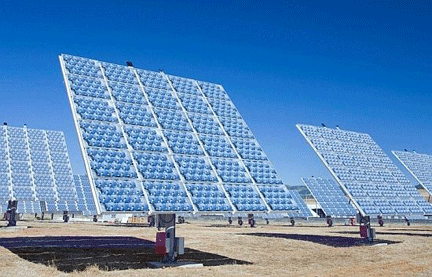 Australian Concentrating Solar Thermal Trial To Proceed http://www.energymatters.com.au/index.php?main_page=news_article&article_id=3954 24 Sept 13 The first Australian trial of concentrating solar thermal (CST) technology has been given the green light by Forbes Shire Council. ABC News states Vast Solar aim to have the demonstration 1.2MWth solar array with high temperature receivers and integrated thermal storage operating by March next year.
“This project will provide Vast Solar with data on system performance that will support the continued development and commercialisation of CST technology that can break the $100/MWh barrier,” says James Fisher, Principal Investigator and Chief Technology Officer of Vast Solar. Continue reading
Full shine ahead for the GoSun solar stove
Cook Dinner In 20 Minutes Using The Sun http://www.energymatters.com.au/index.php?main_page=news_article&article_id=3953 23 Sept 13 The classic Australian barby could look very different soon – a new Kickstarter project seeks to finance commercial release of the GoSun Stove. Claiming to cook a meal in as little as 20 minutes in moderate sunlight, the GoSun Stove offers an efficiency of 80 – 90%.
Now in its 30th iteration, what will be the go-to-market versions of the appliance use parabolic reflection, evacuation and the greenhouse effect to create what its makers say is “the most advanced solar cooking device to date”. Food is placed inside the evacuated tube, which acts as a thermos; continuing to provide heat should the sun be obscured by clouds.
The GoSun stove can reach temperatures up to 550°F (approximately 287 degrees Celsius) and unlike many other forms of solar cookers; once positioned, the GoSun doesn’t require continual adjusting.
While designed to some degree with developing nations in mind, the GoSun Stove will also be available in developed nations.
Among the societal and environmental benefits listed for the device is the tongue in cheek “No Child Left Inside – getting outdoors to stop Nature Deficiency Disorder”.
Backers pledging USD $79 will receive a GoSun Mini and a pledge of $179 will provide a full-scale GoSun Stove. The GoSun Mini is a featherweight at just 700 grams, but only provides a volume of 300ml for food – not exactly a huge capacity. It has a very small footprint when assembled – 32cm long x 15cm high and 20cm wide.
The full scale GoSun Stove weight 1.5kg, offers a 1.4kg food capacity and its dimensions when assembled and fully opened are 61cm long, 41cm high and 30cm wide. The makers have already far exceeded their funding target. While the goal was to raise $40,000; at the time of writing, $111,309 has been pledged.
Australian Renewable Energy Agency backed award winning wave energy project
Even before completion of the Port MacDonnell demonstration project, funded by the federal government’s Australian Renewable Energy Agency and private backers, Greenwave has caused a stir worldwide. Mr Baghaei said the company was in talks with governments and businesses in Asia, Europe and the US on deployment of the technology under licence. “We feel we are one of the leaders in this sector,”
Oceanlinx award buoys wave-energy’s future http://www.theaustralian.com.au/business/companies/oceanlinx-award-buoys-wave-energys-future/story-fn91v9q3-1226724729334 CHERYL JONES THE AUSTRALIAN SEPTEMBER 23, 2013
A CONCRETE structure taking shape at the Techport facility in Adelaide is helping to lay the foundations of a new Australian export industry — wave power technology.
The structure, a one-megawatt “wave energy converter” — the most powerful such unit in the world and capable of powering about 1000 households — is being built by Oceanlinx to demonstrate technology developed by the small Sydney company. Continue reading
Release of New South Wales Renewable Energy Plan
 Final NSW Renewable Energy Action Plan released http://ecogeneration.com.au/news/final_nsw_renewable_energy_action_plan_released/083533/ Fri, 20 September 2013
The final New South WalesRenewable Energy Action Plan has been launched, detailing three goals and 24 actions to grow renewable energy generation in the state.
The Plan’s three key goals are:
- Attract renewable energy investment and projects
- Build community support for renewable energy
- Attract and grow expertise in renewable energy technology.
The Plan positions New South Wales to increase the use of energy from renewable sources at the least cost to the energy customer.
Key actions of the plan include: Continue reading
South Australia’s renewable energy success, as its electricity prices fall
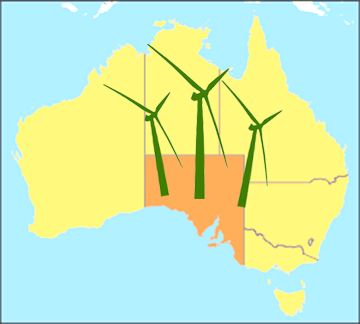
The Australian Energy Market Operator has predicted that the amount of rooftop solar could triple by 2020. Depending on how much wind energy is built between now and 2020 – and that will depend on whether the new government retains the current renewable energy target – the state’s renewable energy capacity is expected to soar well above 50 per cent by then.
South Australia’s perfect energy mix: Cleaner, greener, cheaper REneweconomy, By Giles Parkinson on 18 September 2013 Not only has South Australia achieved the highest level of wind energy and rooftop solar in the country, and has cut its emissions by a third in the last few years, its consumers have also had a windfall in generation costs: they are paying generators much less for their electricity than they did before the boom in wind farm and household solar began in 2009.
A study by energy analyst firm Pitt & Sherry finds that in 2012/13, the average South Australian paid generators $88 a year less for the electricity he or she consumed than they did in 2009-10.
And that is even after the introduction of a carbon price. If the impact of the carbon price is taken out, the average price paid per capita to generators in South Australia has fallen by $188 over the last four years – during which time the wind industry has grown from virtually nothing to more than 1,200MW, and rooftop solar has done the same (it is now 400MW). Continue reading
Australia’s power utilities losing money because of falling electricity demand, not because of carbon pricing
lower demand and the impact of renewables is actually delivering cheaper electricity, even if it means that generators are suffering because of lower profits
South Australia’s perfect energy mix: Cleaner, greener, cheaper REneweconomy, By Giles Parkinson on 18 September 2013 “……..Of the other states, Tasmania (because it is mostly hydro) had the lowest carbon impact of just $43 per capita, while Victoria had the highest courtesy of its brown coal generators, and Queensland and NSW, which both rely heavily on black coal generation, also had high impacts.
However, the impact of falling demand and renewables offset much of these price impacts. In Victoria, which takes a lot of the excess South Australian generation, and where the local energy efficiency program has also had a signficant impact (household consumption is down 10 per cent over the last year according to EnergyAustralia), the fall in wholesale prices represented $124 per capita. That means, even with a carbon price, average payments to generators rose only $55 over the four years. Continue reading
1 This month

of the week – Australians for War Powers Reform (AWPR)
To see nuclear-related stories in greater depth and intensity
 Antinuclear