It turns out that renewable energy is no more costly than fossil fuels
So it seems that Canberra bureaucrats, if not the politicians, are conceding that there is little difference in costs between the relatively modest climate and clean energy goals proposed by the current government, and the more ambitious targets proposed by The Greens, and environmental groups.
 Renewables future no more costly than fossil fuels REneweconomy, By Giles Parkinson on 21 August 2013 The Australian government appears to have made a remarkable concession following the release of the 100% renewables report by the country’s energy market operator – a renewables future will be no more costly than the largely fossil fuel alternative.
As we reported earlier this month, after the release of the Australian Energy Market Operator’s 100% renewables scenario, the estimated wholesale cost of electricity from a system based largely around wind, solar, geothermal and biomass would cost around $110/MWh and $130/MWh between 2030 and 2050 – depending on the speed of that transition.
A “community summary” posted on the Department of Climate Change website, highlights the fact that the various scenarios painted by Treasury, the CSIRO, the UNSW, and now the AEMO modeling suggests that wholesale prices – whatever the scenario – will fall in a generally narrow range of around $100/MWh to $130/MWh in 2030, and $110/MWh to $150/MWh in 2050.
Here is the relevant piece from the document: Continue reading
Coalition election win would mean $4 billion in private funding sucked away from Australia’s renewable energy industry
 Climate of uncertainty August 19, 2013 SMH, Ben Cubby, Tom Arup About $4 billion in private funding would be sucked away from Australia’s solar power and renewable energy industries over the next three years if the Coalition wins government, confidential data obtained from banks and financial analysts shows. Continue reading
Australian Capital Territory’s two new large scale solar energy projects
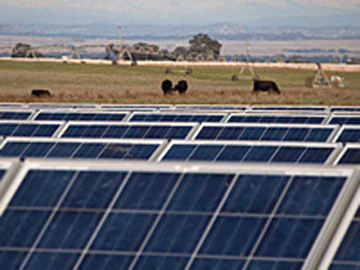 More Solar Farms For The ACT http://www.energymatters.com.au/index.php?main_page=news_article&article_id=3896 Two new solar projects for the ACT combined with the 20 MW Royalla Solar Farm will generate enough power to supply 10,000 homes. 20 aug 13,
The two new projects are Zhenfa Solar’s 13-megawatt Mugga Lane Solar Park near the Mugga Lane Resource Management Centre, and Elementus’ 7-megawatt OneSun Capital Solar Farm in Coree.
Large-scale projects are chosen via the ACT’s auction process; which is operated under a tender-like process where companies compete for the right to a feed-in tariff and proposals are evaluated in terms of their overall value-for-money.
“The ACT Solar Auction is delivering large scale renewable energy at an affordable price,” said the Territory’s Minister for the Environment and Sustainable Development, Simon Corbell. Continue reading
Victorian farmers part-owners in Wimmera’s new wind farm
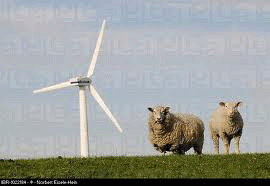
hopes Coonooer Bridge will be the first of many other small projects involving groups of farmers.
Coonooer Bridge locals win with wind farm http://www.weeklytimesnow.com.au/article/2013/08/16/579559_national-news.html 16 Aug 13, THESE new turbines will help the locals, writes CHRIS McLENNAN To call them mountains would be a stretch: the highest peak on the Yawong Hills rises only to 434 metres.
This formerly unremarkable sheep-grazing country is suddenly hot property.
Wind whistles across the Wimmera plains. The inland side of the Great Divide has nothing to block this steady breeze which is forced up and over this low range at Coonooer Bridge between Charlton and St Arnaud.
Scientists have studied this phenomenon for years and find the average wind speeds of more than eight metres a second amount to some of the best renewable energy resources in the world. Far from the Roaring Forties of Australia’s southern coast, where wind farms jostle for space in western Victoria, the search for green energy has found a new home.
The first wind farm to pass Victoria’s myriad planning obstacles for two years has just won approval at Coonooer Bridge. There are only five turbines, but they are the first in Australia to be part-owned by the neighbouring farmers through Windlab. Continue reading
Electricity retailers may be ripping off solar households

 Solar Households May Be ‘Ripped Off’ By Electricity Retailers http://www.energymatters.com.au/index.php?main_page=news_article&article_id=3893 16 Aug 13, For solar households, it really pays to shop around for the best electricity retailer deals.
According to a new report commissioned by the Alternative Technology Association (ATA), there is potential for solar households to be ‘ripped off’ by electricity retailers as solar customers can be treated as second-class citizens.
The report, Retail Offers and Market Transparency for New Solar Customers, states depending on the region; the difference between the best and the worst offer may translate to between $150 to $300 per year.
It’s not just about feed in tariff rates says the ATA – other factors may have a more substantial financial impact on the overall economics of a household solar installation. “There’s been a lot of attention and publicity about feed-in tariffs for solar, but very little about retail consumption tariffs and other aspects of retail deals, including where retailers take away pay-on-time discounts when someone installs solar,” said Damien Moyse; the ATA’s energy projects and policy manager. Continue reading
Australia not getting new coal power investment any time soon
New Coal Power Investment To Be Deferred – AEMO by Energy Matters, 15 Aug 13 Thanks in part to Australia’s home solar power revolution, the prospects for new fossil fuel based power generation investment look rather bleak over the next decade in much of the nation.
The recently published Electricity Statement of Opportunities (ESOO) from the Australian Energy Market Operator AEMO says the rise of residential rooftop solar, increasing energy efficiency in response to electricity price hikes and more large scale renewable energy development “is expected to defer new thermal electricity generation investment.”…….
Rooftop solar panels are treated as a demand offset for supply–demand balance, and are not included in the 522.7MW figure. However, in 2012-13, the AEMO estimates 774 MW of rooftop PV generation capacity was installed in the NEM. ….. Of the 1,000 MW in new large scale generation committed since last year’s ESOO; 95% consists of wind generation and 5% solar generation…… http://www.energymatters.com.au/index.php?main_page=news_article&article_id=3889
Heathcote locals unhappy with Victoria’s anti-wind farm laws

 Heathcote locals question Victoria’s anti-wind farm laws http://yes2renewables.org/2013/08/13/heathcote-locals-question-victorias-anti-wind-farm-laws/ August 13, 2013 by Leigh Ewbank
Yes 2 Renewables visited Heathcote recently to present to the local U3A (university of the third age) about wind energy technology. Given that Heathcote is located in the hearth of the McHarg/Macedon Ranges ‘no-go zone’ for wind farms, we took the opportunity to brief attendees about the Victorian government’s anti-wind farm laws. The presentation prompted U3A member, Louise Joy, to submitted the following letter to the editor to The McIvor Times:
Heathcote U3A “Understanding New Technology” group heard Leigh Ewbank from Friends of the Earth speak on “Wind Power” at the Guide Hall for an illuminating and entertaining two hours on Wednesday 3 July 2013 from 10 am.
Such a simple solution to the problems of pollution where unfortunately Victoria leads the way in developed countries. Renewable energy has strong public support with 94% opting for Solar and 87% for wind power. There have been Wind Power community projects planned for Woodend, Surf Coast and Anglesea with opportunities for job creation in manufacturing, construction, maintenance and computer programming. Farms in drought areas benefit, a lid is kept on Electricity prices, communities gain control over their own clean and safe energy future.
So what is stopping implementation with so much community support and so many advantages? There are strong lobby groups with vested interests against Wind Farming. In Victoria, Amendment VC 82 has created no go zones in the Yarra and McHarg Ranges, among others. Heathcote U3A members left the meeting encouraged to make known the advantages of Wind Farming and to lobby politicians to rescind Amendment VC 82.
Why Energy Australia opposes renewable energy and energy efficiency
EnergyAustralia says solar PV causing rapid structural change By Giles Parkinson on 13 August 2013 EnergyAustralia, one of the big three utilities operating in Australia, says that rooftop solar PV and energy efficiency measures are causing “unprecedented structural change” to the national electricity market.
It says rooftop solar and energy efficiency are causing a significant fall in household energy consumption, more than offsetting any gains from population growth. It says these factors, combined with an increase in renewable energy generation due to the Renewable Energy Target (RET), has caused wholesale electricity prices to fall. “This is likely to continue,” it says. “These factors are impacting the industry as a whole, providing difficult trading conditions for ourselves and our major competitors alike.”
The comments came as EnergyAustralia, which owns the Yallourn coal-fired generator – and recently purchased coal-fired generators in NSW and a range of gas and wind energy assets, along with a retail arm – recorded a loss of $HK45 million in the first half of 2013. That compares with earnings of HK$268 million for the same period the previous year. Operating profits fell to HK$55 million from HK$807 million.
“The Australian energy market is facing unprecedented structural changes that are taking place at a rapid pace,” the company noted in a statement.
“In particular, the past two years have seen a pronounced decline in residential electricity demand in response to rising prices, and the deployment of rooftop solar photovoltaic systems and energy efficiency savings have more than offset any increase in demand from population growth.”
EnergyAustralia has been one of the most vocal opponents of both the RET and energy efficiency measures, because of the impact on its generation assets. It has been joined by Origin Energy and many state-owned coal fired generators in pushing for the RET to be diluted or halted…….
Despite the problems and the losses, Richard McIndoe, the managing director of EnergyAustralia, received total remuneration of $HK15.4 million ($2.2 million) million in the six month period, with nearly two thirds of this coming from performance bonuses. He was the best paid in the last six months of all senior executives of CLP, the Hong Kong-based parent company, including group CEO Andrew Brandler. http://reneweconomy.com.au/2013/energyaustralia-says-solar-pv-causing-rapid-structural-change-83521
Solar Citizens bring about Government U-turn in Western Australia – national repercussions?
 Barnett Backs Down From Solar Backflip http://www.energymatters.com.au/index.php?main_page=news_article&article_id=3885 13 Aug 13, Solar supporters rejoiced after the Western Australian State Government yesterday reversed its decision to slash the feed in tariff rate for tens of thousands of solar households.
“Quite simply, we got this decision wrong and we have to fix it,” Premier Colin Barnett said in a short statement.
“We understand that this measure would have had an unfair impact on one section of the community and it has to be reversed.”
Within hours of the original decision to slash the incentive, solar households and supporters mobilized. Mainstream and social media was buzzing with condemnation. A Solar Citizens petition was launched that very quickly attracted over 9,000 signatures protesting the reduction.
Even within the State Government’s ranks, there was dissent. Overall, the backlash was such that it had the potential to impact results in the Federal Election. Continue reading
International win for University of Wollongong’s fibro solar energy cottage
University of Wollongong’s fibro cottage wins international renewable energy competition http://www.abc.net.au/news/2013-08-12/fibro-cottage-wins-international-eco-prize/4880032 By Nick McLaren A team from the University of Wollongong has won a worldwide competition to design a zero-emissions solar house by refitting a humble Australian fibro cottage.
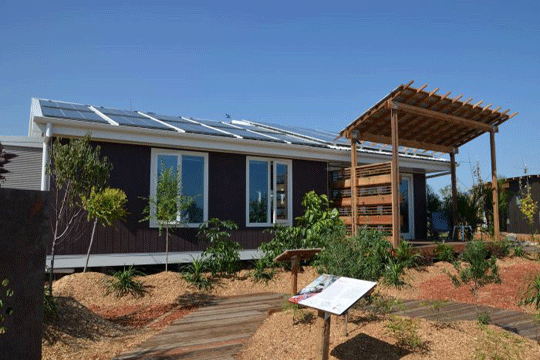
It is the first time an Australian team has entered the Solar Decathlon, which has been held in Datong, China since 2002.
The 51-strong team built the Flame House – a retrofitted fibro cottage designed to appeal to older clients nearing retirement.
The Australians beat 20 other finalists to place first in the engineering, solar and architecture categories, with a team from China second and Sweden third.
Project Manager Lloyd Niccol says the competition is about producing a home that is comfortable and generates more energy than it consumes. “We’re trying to find some way to make an immediately and positive impact on our environment,” he said.”There are eight million homes existing in Australia, and quite a few hundred thousand fibro homes.
“Only 2 per cent of those are replaced every year, so if we do want to make a real impact…we thought the best way to do that is to retrofit our homes. “So it’s showing how you can bring the typical home built in the 1950s into the current modern age so its comfortable, its got all the amenities you require, and it produces more energy than it consumes.”
Mr Niccol says the team used a range of technologies to modernise the cottage………… “In terms of the rest of the world…there are a lot of Chinese people that have actually asked whether we can just build them in Australia, so rather than actually retrofitting, just building the timber frame from scratch, essentially, and building this home.
“So there’s a market and a desire out there.” Mr Niccol says the competition home would cost approximately $300,000 to build in Australia.The prize-winning pad is set to be pulled apart before being shipped back to the University of Wollongong to be used for education and research.
Electricity prices will rise if carbon tax is scrapped

 http://www.abc.net.au/radionational/programs/breakfast/axing-carbon-price-will-hit-power-prices/4882394 AUDIO: Scrapping the carbon tax will lead to electricity price rises: report 13 August 2013 A new report out today says that the Coalition’s promise to ending carbon pricing in Australia would lead to higher wholesale energy prices. The report’s author told RN Breakfast that the policy would be a blow to renewable energy and household power bills, asJames Bourne reports.
An independent report released today has found that ditching the carbon price in Australia will hit investment in the renewable energy sector—and almost certainly lead to an increase in electricity prices.
Bret Harper, the Director of Research at advisory firm RepuTex which was commissioned by the World Wildlife Fund to write the report, says that without proper investment in renewable energy—made possible by a carbon price—wholesale electricity prices could rise by between five to ten percent by 2020.
And while the findings of today’s Renewable Energy and the Carbon Price report appear to be counter intuitive, Mr Harper says the potential price hikes are already common knowledge among government and business.
‘Renewable energy, when it’s put onto the system, tends to cut household electricity bills, not push them up,’ he told RN Breakfast.
‘It represents a very low-cost form of energy that displaces other fossil fuel generators which have very high fuel costs.’………..
Renewable energy revolution having an impact on energy prices
EnergyAustralia hurt by falling prices August 12, 2013 – SMH, Brian Robins EnergyAustralia, one of the country’s largest energy groups, has fallen into the red, hit by the downturn in wholesale electricity prices with little prospect of a quick revival in its fortunes……
The Australia energy market is facing unprecedented structural changes,” the Hong Kong-based parent said.
“The past two years have seen a pronounced decline in residential electricity demand in response to rising prices, and the deployment of rooftop solar photovoltaic systems and energy efficiency savings have more than offset any increase in demand from population growth……. Commercial and industrial demand has also been impacted … by a difficult manufacturing environment, in part due to rising energy costs, a highly valued Australian dollar and a slowing global economy.”
Wholesale electricity prices are also being pressured by a high level of output from renewable energy sources, it said, which is “likely to continue”. http://www.smh.com.au/business/earnings-season/energyaustralia-hurt-by-falling-prices-20130812-2rry3.html#ixzz2bt6ZK8vH
Western Australia: Liberals rebel against govt reneging on solar energy deal
Liberal rebellion on solar heats up, The West, Gareth Parker and Daniel Mercer, The West Australian August 12, 2013, 2 Colin Barnett is facing a backbench revolt over the State Government’s decision to halve its rooftop solar panel subsidy, with a pair of Liberal MPs accusing the Government of lacking integrity.
The growing rebellion came as a letter from Synergy sent in 2011 emerged as a key piece of evidence in any potential legal fight over
the changes. The letter – sent soon after the Government cut the tariff in a previous revision to the scheme – says that customers entitled to the
40 cent payment would get it “for the full term of your 10-year contract”.
Government MPs have been flooded with complaints from irate voters about the decision to cut to the so-called solar feed-in tariff from
40 cents to 20 cents, with the issue spilling over to the Federal election campaign as a vote turn-er against Liberal candidates.
Maverick Hillarys MLA Rob Johnson threatened to cross the floor for the first time in his 20-year career to vote against the measure,
while Southern River MLA Peter Abetz said the Government had acted unethically.
Mr Johnson said the Government was acting with a “lack of integrity” by reneging on a deal with 75,000 solar panel owners in a bid to save
$51.2 million over the next four years. Continue reading
Cutting Renewable Energy target would make customers pay more
Cut to renewable target would cost power consumers http://www.businessspectator.com.au/news/2013/8/9/renewable-energy/cut-renewable-target-would-cost-power-consumers By a staff reporter 9 Aug, Bloomberg New Energy Finance has released a study finding that cutting the Large-scale Renewable Energy Target to levels recommended by some energy retailers would increase costs to consumers by $1.3 billion.
The study analyses the effects of reducing the target from the current legislation of 41,000GWh down to 27,000GWh, which Origin Energy and Energy Australia have advocated would be consistent with 20% of Australia’s like electricity demand in 2020.
It finds that while there would be savings from retailers having to buy less renewable energy certificates, this is outweighed by an increase across all electricity sold in the wholesale market of $5 per megawatt-hour. This is because extra renewable energy supply tends to depress the overall electricity market price because of its low operating costs.
In addition Bloomberg believe that if the government were to cut the target this would heighten financiers perceptions of investment risk leading to a finance premium of 0.75%. This would increase the cost of the remaining renewable energy projects required to meet the reduced the target.
Solar energy in Australia heading for big commercial applications?
 Solar PV projects can be rolled out within months, not years. The experience from the Australian residential solar sector illustrates that solar PV can scaled-up very quickly. While grid connection is a more involved process for commercial rooftop solar than residential, each system involves tens of kilowatts instead of just two or three. So it seems reasonable to expect that if the market conditions are conducive, there would be no physical constraints to commercial solar rolling out a few hundred megawatts in 2014, and a gigawatt in 2015.
There would still be a need for new wind farm development under such scenario, but it would buy time for wind farm projects to scale-up, and ensure enough supply to meet the Renewable Energy Target.
Market could blindside Origin and Energy Australia Climate Spectator Tristan Edis 9 Aug, “……So far Origin Energy and Energy Australia have been holding out on signing onto long-term power purchase agreements for wind farms, because they’re hoping the Coalition will water down the level of the Renewable Energy Target. AGL has also put a halt to further development concerned that it might come true.
This can create a self-fulfilling phenomenon, because waiting to develop projects makes the target more difficult to achieve. This then encourages government to intervene to water down the target.
However there’s some interesting wrinkles that could mean solar becomes a bigger player in the large-scale renewable energy target, producing substantial numbers of large-scale renewable energy certificates known as LGCs.
1) Non-traditional buyers for renewable energy certificates may emerge and the price will rise……..
2) Commercial rooftop solar developers will begin producing LGCs……..
3) Finance products are emerging to support commercial solar………… Continue reading
1 This month

of the week – Australians for War Powers Reform (AWPR)
To see nuclear-related stories in greater depth and intensity
 Antinuclear