New solar energy company opens in Sydney
 China’s quiet achiever makes mark on energy’s new frontier SMH, August 10, 2013 Peter Hannam Carbon economy editor “…….Yingli Green Energy, has knocked Suntech off its rank as the world’s biggest producer of solar photovoltaic panels and its breakneck growth – along with an array of other Chinese firms – has driven PV prices down by about three-quarters in four years.
“He’s China’s Richard Branson,” said Daman Cole, commercial director of Yingli Solar, speaking of his boss at the opening of the company’s Australian office this week in Sydney……..
The opening of the Sydney office is also part of Yingli’s search for new markets. The company aims to grab 10 per cent of the Australian market within a couple of years, with a focus on commercial customers. Orders secured include a 1.25-megawatt deal to supply the panels for 30 buildings for the City of Sydney worth $3.4 million, while it has also signed a distribution pact with L&H Group, a major electrical wholesaler in Australia and New Zealand.
Solar-powered smartphone batteries and broader “energy solutions” with customers are expected to feature in the future…… http://www.smh.com.au/business/chinas-quiet-achiever-makes-mark-on-energys-new-frontier-20130809-2rn5n.html
King Island shows the way towards 100% renewable energy

“The way these technologies are being used and integrated is world-leading and another example of the clever solutions to real-world problems that have been developed in Tasmania and can be exported globally.”
100% renewables: The King Island example, Business Spectator Laurie Guevara-Stone 9 Aug 13, Halfway between Tasmania and mainland Australia, in the heart of the Bass Strait, is rugged, windswept King Island. With a population of just under 2,000 and an area of just over 400 square miles, tiny King Island is becoming a big leader in electricity generation, demonstrating that a high-renewables future is possible.
King Island, and especially greater Tasmania, face many challenges due to climate change including water availability, flooding of coastal settlements, a rise of bushfires, and decreased agriculture and aquaculture industries. Although Australia’s contribution to global greenhouse gas emissions is small – and Tasmania’s even smaller, largely due to singificant amounts of hydro – the island has a goal of reducing carbon emissions by 60 per cent from 1990 levels by 2050.
Tasmania is on track to meet that target, thanks in part to lessons learned and the success at King Island. King Island is providing a significant demonstration of the potential opportunities for Tasmania through its King Island Renewable Energy Integration Project (KIREIP). Initiated by the government-owned electricity provider,Hydro Tasmania, KIREIP’s goal is to not only reduce dependence on fossil fuels, but also to help constrain power prices on the island. Continue reading
Australian buildings can go gas free, AND halve their energy use
Aust buildings could halve energy use in decade – gas free http://reneweconomy.com.au/2013/aust-buildings-could-halve-energy-use-in-decade-gas-free-81837 By Sophie Vorrath on 6 August 2013 A nationwide plan to transform Australia’s existing building stock into models of energy efficiency and renewable power generation has found that residential and commercial energy use could be cut in half, and could reach zero emissions from their operations, within 10 years.
Launched on Tuesday, the The Zero Carbon Australia Buildings Plan – a joint effort from climate think-tank Beyond Zero Emissions and The University of Melbourne Energy Institute – sets out a strategy to retrofit Australia’s buildings, to reduce energy bills, generate renewable energy, increase comfort levels, and make workplaces more productive.
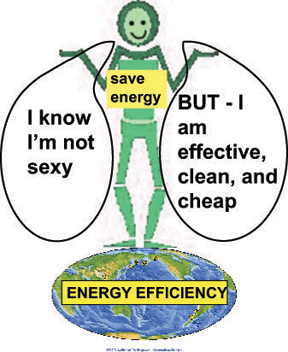
The plan finds the residential building sector would be able to achieve a 53 per cent energy use reduction overall, with some typical home categories seeing over 70 per cent reduction. Commercial buildings are estimated to be able to reduce energy use by 44 per cent overall.
A key element of the plan involves buildings going gas-free, with gas appliances deemed “too inefficient and polluting” compared to modern electric appliances which can replace them – namely heat pumps, or split-system airconditioners, as they are more commonly known. Continue reading
Australia’s solar energy revolution in outer suburbs
Solar revolution led by outer suburbs, SBS World News, 5 AUG 2013, Households across the country are putting solar panels on their roofs at a rate that has exceeded all expectations, By Tim Flannery
 Households across the country are putting solar panels on their roofs at a rate that has exceeded all expectations. This year we hit 1 million rooftops with photovoltaic (PV) solar panels, up from just 8,000 in 2007. This means that a staggering 2.6 million Australians, 11% of the population, are now using the sun to power their homes.
The solar energy revolution is being led in suburbs and towns like Dubbo and Campbelltown in NSW, Bundaberg in Queensland, Hoppers Crossing in Melbourne, and Mandurah in Western Australia. This increase is being driven by ordinary Australians. It is the modest outer metropolitan suburbs across the country, with high concentrations of mortgages, which show the greatest uptake.
The cost of installing a PV panel today is less than a quarter of what it was in 2002. The decision to install solar panels is no longer just about global responsibility – it makes financial sense. As global momentum for solar continues to grow, the technology is advancing and manufacturing is being up-scaled in countries like China. Together these factors are rapidly driving down costs, making solar increasingly competitive even without subsidies. Businesses are watching the drop in technology costs keenly as payback periods become increasingly cost competitive.
Smart investors are realising that this trend is here to stay and that the future of energy is renewable. …. http://www.sbs.com.au/news/article/1796353/Comment-Solar-revolution-led-by-outer-suburbs
Australian solar households generate over $2 million in electricity, daily
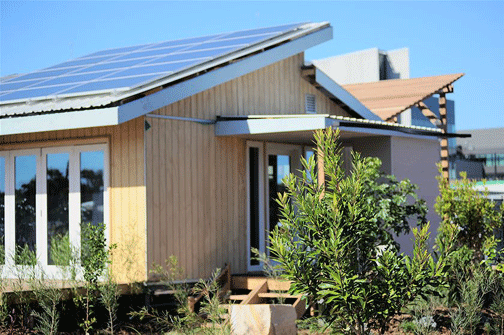 Climate Commission Lauds Solar Power http://www.energymatters.com.au/index.php?main_page=news_article&article_id=3874 6 Aug 13, Solar power in Australia is a ‘revolution that nobody saw coming’ says the Climate Commission in its latest report, The Critical Decade – Australia’s Future: Solar Energy.
‘Nobody’ is probably over-generalising. There are many Australians who understood its potential; however, ‘nobody’ could probably be more accurately applied to Big Energy and the fossil fuel industry. It’s certainly taken those sectors by surprise; having morphed from a mildly amusing novelty to an irritation, to a serious disruption to the energy status quo.
The Climate Commission report states it was only 4 years ago the Australian Bureau of Agricultural and Resource Economics estimated it would take at least a decade for Australia’s solar capacity to reach a stage where it would be able generate 3,500,000 megawatt hours annually. We reached that point this year; thanks to the early adopters who kicked off the revolution, government support and a massive reduction in the price of solar equipment.
With over 1 million solar panel systems installed; around 11% of our population now live in a solar household. In April this year, we estimated Australian solar households to be generating $2 million plus in electricity daily. The Climate Commission report states around a third of all solar PV systems in Australia were installed in 2012 and during last year, approximately 3.4 million tonnes of emissions were avoided. 70% of all new electricity generation capacity installed in Australia in 2012 was solar PV.
Rather than revealing anything new, the Climate Commission’s report gives an overall summary of where we’ve been, where we are and where we might head as a solar nation; providing an overview of the technology and issues, plus a range of interesting statistics gathered from various sources.
For example, while our 2012 figures are stunning and despite having vastly superior solar resources, Australia installed less than a third of the solar capacity that Germany did last year. On sunny days, solar PV now accounts for up to 35% of electricity consumed in Germany.
For new arrivals to the solar party or others wanting a handy guide to refer to for fairly current facts and figures, The Critical Decade – Australia’s Future: Solar Energy (PDF) is recommended reading.
South Australia’s renewable energy success, despite planned cutbacks in solar feed-in tariff
SA’s love affair with renewables isn’t just solar-focused; the state also has the largest wind power capacity in the nation. According to the Australian Energy Market Operator, approximately 29% of South Australia’s electricity came from renewable energy sources in 2012.
South Australia Solar Feed In Tariff Countdown http://www.energymatters.com.au/index.php?main_page=news_article&article_id=3872 5 Aug 13, South Australia’s feed in tariff will be slashed for new applications soon. To avoid the inevitable applications rush; households intending going solar may want to make a move now.
South Australia’s current solar feed in tariff for surplus exported electricity is comprised of two parts- a retailer contribution of 9.8c and a 16 cent component paid by SA Power Networks. Continue reading
Australians saving money by going solar
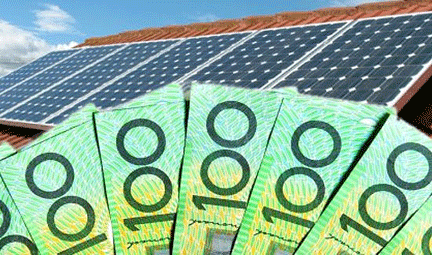 Going Solar Now Cheaper Than A Daily Cup Of Coffee http://www.energymatters.com.au/index.php?main_page=news_article&article_id=3865 31 July 13 Australian solar solutions provider Energy Matters is currently offering fully installed 3kW solar panel systems from under $3 a day; with no up-front payment required.
With Energy Matters’ Save As You Go Solar initiative and depending on installation location; repayments are as little as $20.55 week for a 3kW system that can return a financial benefit of up to $1,215 year – meaning the amount saved on electricity bills can be more than the repayments.
After the payment period, electricity produced by the system is essentially free. Continue reading
Western Australian wind farm will benefit farmers across twp shires
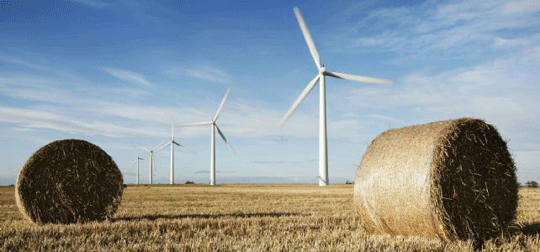 Conditional Approval For Western Australian Wind Farm http://www.energymatters.com.au/index.php?main_page=news_article&article_id=3866 1 Aug 13, The Great Southern Joint Development Assessment Panel has given Moonies Hill Energy conditional approval for a stage of the proposed Flat Rocks Wind Farm.
Moonies Hill Energy director Sarah Rankin saysconstruction of the wind farm could commence in late 2014, early 2015. Construction had originally been intended to commence in 2012/13.
If fully developed, the Flat Rocks Wind Farm will be a 150 MW project. Situated 25km south east of Kojonup, in the Great Southern region of Western Australia, the facility will produce 562,000 GWh of electricity annually – enough to power 90,000 homes – and avoid up to 451,000 tonnes of carbon dioxide equivalent each year. Moonies Hill Energy says the project would inject $130 million into the local community over its lifespan – $30 million during construction and $5 million a year during operation.
The Flat Rocks Wind Farm will host 74 wind turbines perched on 84m towers and will be compatible with existing agricultural activities such as stock grazing and broadacre crops. After construction, the facility will occupy less than 1% of productive farmland.
The wind farm will spread over 6 farming operations and across two shires. The five landowners involved will all be financial beneficiaries of the project. The wind farm will be patched into the South West Interconnected System (SWIS) via the proposed 330kV Muja-Wellstead transmission line, construction of a 132kW line into the Kojonup substation or via the existing 132kV line that traverse the southern part of the project area.
Electricity produced by the Flat Rocks wind farm will be sold into the SWIS under a commercial agreement.
As part of the project, Moonies Hill Energy will establish a Sustainable Communities Fund to operate during the life of the wind farm that will provide support for surrounding community programs.
Large scale solar power project for Western New South Wales
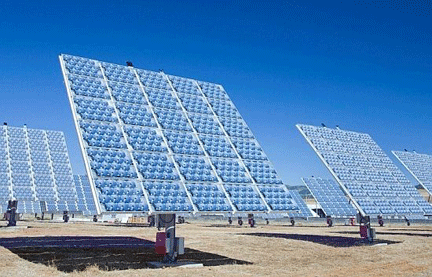 Largest solar power station in the southern hemisphere News International, 31 July 2013 11:16 Gary Gray Canberra , Federal Minister for Climate Change, Mark Butler today announced construction will start in January on the largest solar power station in the southern hemisphere after the Australian Renewable Energy Agency (ARENA) reached financial close with AGL Energy Limited (AGL).
Mr Butler said the project will be built across two sites in Western NSW and will cover a combined area four times the size of the Sydney CBD.
“Australia has the highest average solar radiation per square metre of any continent in the world and we should take advantage of that natural asset,” Mr Butler said.
“This project is 15 times larger than any other solar power station in Australia and represents a big step forward towards making solar a bigger part of Australia’s energy mix.
“The Rudd Government is committed to transitioning Australia to a clean energy future and this combined 155 megawatt solar project helps make renewable energy cost competitive for more Australians.”
Minister for Resources and Energy Gary Gray said this was a major milestone for AGL and the Government and would help boost investor confidence in large utility-scale solar.
“Reaching financial close and progressing to construction is a major achievement paving the way for future investment and meaning that, in a short time, an additional 50,000 homes across New South Wales will be powered by clean energy each year,” Mr Gray said. Continue reading
Wind energy company wins award, but still faces problems on King Island
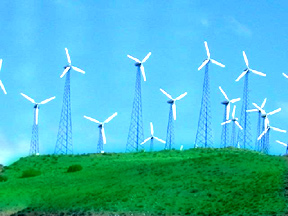 Hydro Tasmania wins engagement award http://www.weeklytimesnow.com.au/article/2013/07/26/577753_national-news.html
Shannon Twomey | July 26, 2013 HYDRO Tasmania has won the Community Engagement Award at the Clean Energy Council Awards.
The awards are hosted by the Clean Energy Council as part of Clean Energy Week.
Hydro Tasmania won the award for their community engagement on the Musselroe Wind Farm Project in the north east of Tasmania.
The Musselroe Wind Farm is a 56-turbine, 168-megawatt wind farm that provides power to 50,000 homes and prevents the emission of 450,000 tons of greenhouse gas emissions.
Project director Andrew Hickman said from the start Hydro Tasmania have worked closely with communities in the area.
“Many members of the project team have lived and worked in the north east region over the entire construction period and have become a real part of that community,” Mr Hickman said.
“Hydro Tasmania have engaged with local schools, tourists bodies, indigenous elders and business groups to build the relationships that have resulted in genuine community ownership of this project.”
Friends of the Earth and Yes 2 Renewables spokesperson Leigh Ewbank said Hydro Tasmania have a good reputation for strong community engagement.
Hydro Tasmania are currently working on another wind farm development, the TasWind Project, on King Island. Continue reading
Australia’s right wing in a right mess about policy on wind energy
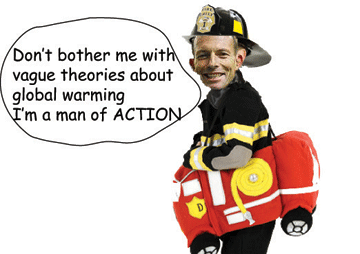 The debate over climate change has been an intellectual debacle for the political right. Their tribal hatred of environmentalists has driven them into a position of denouncing any technology favoured by their enemies. The only invisible substance with which Abbott and his backers should be concerned about is their disappearing intellectual credibility.
The right’s anti-wind campaign is pure scaremongering http://www.guardian.co.uk/commentisfree/2013/jul/23/abbott-wind-turbines-health-effects by John Quiggan, 25 July13 Climate change is a debacle for the Australian right. Their tribal hatred of environmentalists has driven them to denounce any technology favoured by their enemies Tony Abbott’s quip that emissions trading schemes represent “a so-called market in invisible stuff” has been rightly derided as a dog-whistle to climate denialists, unsuccessful only in that it was not pitched high enough to escape detection by the rest of us. Critics have had plenty of fun pointing out the many examples of “invisible stuff” that is, like carbon dioxide, critically important despite the fact that we can’t see it – electricity, financial risk, and so forth.
 A point that has attracted rather less attention is the extent to which the views of Abbott’s team on climate are being driven by claims about something that is not only invisible and inaudible, but indeed non-existent – namely the supposed health effects of wind farms. The belief that wind farms are dangerous to human health has been widely propagated on the political right, despite the absence of supporting scientific evidence.
The leading Australian promoters of wind paranoia are the Waubra Foundation, the Australian Landscape Guardians and 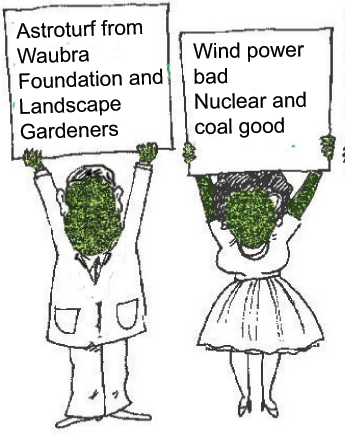 the Australian Environment Foundation (AEF). These groups are often linked with each other and with rightwing organisations like the Institute of Public Affairs (IPA). The AEF in particular is a straightforward front group – it was set up by former IPA senior fellow Jennifer
  Marohasy and originally operated out of the IPA offices in Melbourne.
The supposed health risks of wind turbines have also been pushed byGraham Lloyd in The Australian newspaper, other rightwing columnists like Miranda Devine, and conservative politicians including Craig Kellyand John Madigan.
To get the boring scientific facts out of the way, the National Health and Medical Research Council investigated the issue in 2009 and 2010. The review considered the potential health impacts of infrasound, noise, electromagnetic interference, shadow flicker and blade glint produced by wind turbines and concluded that, “at the time of writing, there was no published scientific evidence to positively link wind turbines with adverse health effects.” Continue reading
100% Renewable Energy Supply From Off-grid achieved by King Island
Australia’s King Island Achieves 100% Renewable Energy Supply From Off-grid System http://cleantechnica.com/2013/07/24/australias-king-island-achieves-100-renewable-energy-supply-from-off-grid-system/ July 24, 2013 Mridul Chadha
The island, which otherwise would be dependent on imported electricity and fuel, now seems well equipped to generate its usual as well as back up electricity through renewable energy sources.
Hydro Tasmania used its own automated power control systems and flywheel technology to supply uninterrupted power last month. For the first time, the company did not use diesel backup systems to keep the power supply going. Of course, the ample availability of wind and solar energy resources on the small island to the north of Australia’s island state helped the company achieve this milestone.
Currently, according to the company, the backup system could be diesel free when there is sufficient wind and solar energy available or during the off-peak demand hours (night and dawn). But Hydro Tasmania is working to make this system foolproof.
Demand side management and energy storage solutions are being planned to make the backup system completely diesel free at all times.
The automated diesel-free system, accompanied with demand side management and energy storage, could prove to be a blessing for small island nations and remote regions across the world. Island nations in the South Pacific cannot afford to be dependent on imported diesel nor can they have extensive transmission systems spanning hundreds of kilometres across open seas.
Hydro Tasmania is implementing these systems under the King Island Renewable Energy Integration Project (KIREIP).
Among the many renewable energy, energy efficiency, and energy storage solutions implemented under this project is a 100 kW solar PV project. This project was installed in 2008 and uses dual-axis tracking, making it more efficient than conventional solar PV projects. The project will soon see increased use of biodiesel produced from recycled cooking oil and tallow and installation of Australia’s largest energy storage battery system.
Australia could replace coal energy by solar energy by 2040 – Energy expert
 Solar energy growth could drive out coal by 2040, expert says SMH, July 24, 2013 Peter Hannam Carbon economy editor Australia could phase out almost all its fossil-fuel sourced electricity by 2040 if it doubled the current rate of take-up of solar energy and wind energy maintained its current growth pace, said Professor Ken Baldwin, director of ANU’s Energy Change Institute….. to shift the energy sector away from carbon-intensive coal and gas sources to avoid dangerous climate change, renewable energy could provide all but a couple of per cent of Australia’s electricity in under three decades, he said, citing data from ANU’s Centre for Sustainable Energy Systems. Continue reading
Western Australian Goldfields ready to lead on solar thermal energy
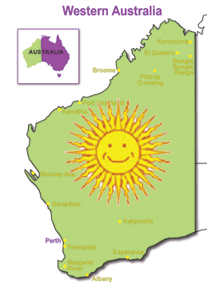 Solar Thermal Touted For Western Australia’s Goldfields http://www.energymatters.com.au/index.php?main_page=news_article&article_id=3858 25 July 13, Greens Senator Scott Ludlam was in the gold mining city of Kalgoorlie in Western Australia on Tuesday; convening a meeting to plan the Goldfields’ renewable energy future.
Senator Ludlam says the Australian Greens’Connecting Clean Energy plan (PDF) was a perfect fit for the Goldfields. The plan focuses on the identification and creation of new Renewable Energy Zones to help remove investment and infrastructure barriers.
“The community and business sector in the Goldfields are showing they are ready to take the leadership on solar energy,” said Senator Ludlam. Continue reading
Australian politicians not keeping up with the renewable energy trend
 Australia’s large-scale renewables ambition dashed by policy vacuum REneweconomy, By Giles Parkinson on 24 July 2013 If the Australian renewables industry was looking for affirmation from Australia’s two mainstream parties at the industry’s major annual conference this week, then it might have been disappointed. Instead, it appears destined for yet more uncertainty and a less ambitious conclusion.
An industry that is craving some level of “policy certainty” may have to wait another year or 18 months, depending on the result of the upcoming election, and there is growing concern that the ability of Australia to meet its minimum 20 per cent renewable energy target is becoming increasingly difficult. So much so that some in the industry appear ready to accept a delay in the target’s deadline.
Over the next seven years, more than $20 billion is expected to be spent on new wind farms, solar farms and other large-scale renewable energy projects – not counting the billions of dollars that are expected to be invested by households in rooftop solar.
All this was to be built to meet the fixed renewable energy target of 41,000GWh, which is supposedly a bi-partisan goal. Right now, however, while households continue to invest heavily in rooftop solar because it saves them money from their electricity bills, a lot of the large-scale investment is at a standstill.
This is due to the uncertainty created by the upcoming election, the insistence of the Coalition in having yet another review of the renewable energy target in 2014, and the failure of Labor to legislate for that review to be held in 2016 – as was recommended by the Climate Change Authority’s review of the RET, which was completed just seven months ago.
Further adding to the problems for renewables is the decision to move more quickly to an emissions trading scheme, which will result in a higher price for renewable energy certificates, and a complication of the politics around renewables, if the carbon price stays low…….
David Green, the CEO of the Clean Energy Council, said earlier that the two-year review was a recipe for instability for the market. One wonders if the industry regrets not pushing Labor to take on the Opposition and put the four-year review to a parliamentary test, given the uncertainty that is now created, and the growing possibility that a target will be diluted or deferred.
But Green, and Fraser, noted how the energy industry is changing – mostly as a result of the rooftop solar and the growth of “distributed generation”.
“The structure of the energy industry is changing,” Green said. It was moving from large-scale investment in pipes and poles to more active engagement with consumers, and more smaller-scale investments, embedded in the system. “We are beginning to shift the way we use electricity and the other fuels in the industry,” he said.. http://reneweconomy.com.au/2013/australias-large-scale-renewables-ambition-dashed-by-policy-vacuum-26250
1 This month

of the week – Australians for War Powers Reform (AWPR)
To see nuclear-related stories in greater depth and intensity
 Antinuclear