A warning that some solar panels are inferior
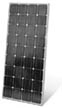 Inferior Solar Panels Invade Australia Energy Matters 9 JULY, 2013: Inferior solar panels are being sold to unsuspecting Australians, with the cost in lost energy production calculated for the first time at $3,261* per household.
It is estimated 397,545 Australian homes have inferior ‘Tier 3’ solar panels installed, which are generally considered lower-grade due to the way they are manufactured. Three tiers of solar panel manufacturers were defined in an independent report by Pike Research in 20112.
Energy Matters’ Nick Brass explains why so many people have installed these ‘Tier 3’ solar systems.
“Unfortunately, people don’t realise they’ve purchased a second rate system. Unlike many consumer electronics that have brands famous for quality, the solar market in Australia is dominated by unknown brands – even though premium Tier 1 panels such as REC and Panasonic exist 3. Tier 2 panels can also be solid performers, but performance can vary wildly between the various brands2.” Continue reading
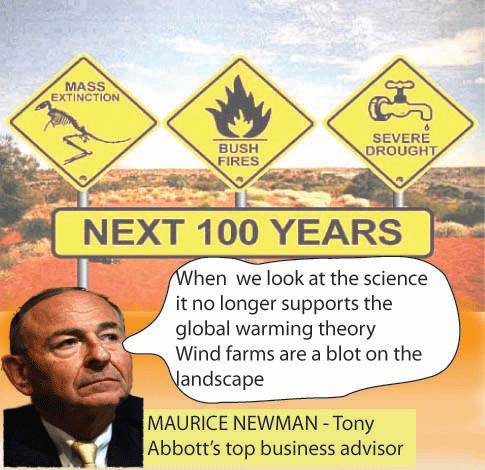
Maurice Newman and fossil fuel front group stop New South Wales wind farm
 Protests stop wind farm plan BY:HARRY EDWARDS The Australian July 08, 2013 A LARGE wind farm proposed for near Goulburn in NSW has been shelved after protests from local landholders including Maurice Newman, the former head of the Australian Securities Exchange who has been anointed to chair a new business advisory council if the Coalition wins this year’s federal election.
The planning application for the 100-turbine Golspie wind farm, lodged by renewable energy developer Wind Prospect CWP, lapsed last week, with the company citing “wind resource, land security and grid connection issues”.
Mr Newman, who opposes wind farms and has pledged to lobby against subsidies for them, argues that fluctuations in output from renewable energy sources have increased power costs for consumers by requiring the construction of expensive backup generators.
Mr Newman belongs to Landscape Guardians, a community lobby group that actively campaigns against all wind farms in the Upper Lachlan shire, where he owns land. In January Tony Abbott announced that Mr Newman — appointed by the Howard government to chair the ABC — was his choice to head a new business advisory council for a Coalition government……
Labor’s Renewable Energy Target aims to have 20 per cent of electricity generated from renewable sources by 2020. The Coalition intends to review the RET next year if it wins the election, and could rely on Mr Newman’s advice to scrap the target.
Climate Change Minister Mark Butler said the system was working. “Labor stands by our unprecedented investment in clean, renewable energy which is driving a transformation of the Australian economy with a 30 per cent increase in renewable energy generation in the last 12 months and a 7 per cent drop in carbon pollution in the national electricity market,” he said……. http://www.theaustralian.com.au/national-affairs/climate/protests-stop-wind-farm-plan/story-e6frg6xf-1226675644019
Solar energy storage being developed in a big way in Nevada
 Solar towers and storage – about to change the energy game? http://reneweconomy.com.au/2013/solar-towers-and-storage-about-to-change-the-energy-game-91721, By Giles Parkinson on 4 July 2013
The $1 billion Crescent Dunes project near Tonopah in the Central Nevada Desert, some 300kms north of Las Vegas, was developed by the Santa Monica-based SolarReserve and features the company’s market leading molten salt power tower technology with fully integrated energy storage.
What makes it unique and a potential game changer in the electricity industry is the flexibility and dispatchability of its power, meaning that it can deliver electricity whenever it is needed by customers; and its cost, which already beats diesel, is competitive with new build coal and gas generation.
The Crescent Dunes facility will have 10 hours of molten salt storage, which on average will allow it to deliver 110MW of baseload capacity to Las Vegas between the hours of 12 noon and midnight each day, when the city needs it most to power the lights and air conditioning of its casinos and entertainment palaces. It has signed a 25-year power contract with NV Energy, Nevada’s largest utility, to do that.
Tom Georgis, SolarReserve’s senior vice president of development, says the unique capabilities of the technology means that the plant could have been configured in any number of ways. With a 180MW turbine, for instance, it could have produced power for 10 hours each day, which was the original intention. With a smaller turbine, and more than 20 hours storage, it could have delivered 50MW of base-load power 24/7.
In the end, Nevada pitched for midday to midnight to suit its needs. In effect, the plant is providing baseload power for a fixed period each day – delivering the benefits of coal-fired power without the downsides, which is of course heavy pollution and an ability to be switched off at will or at regular intervals.
‘You can’t do that with a coal fired facility,” Georgis says of the Nevada contract. But the technology also allows it to compete with gas-fired generation, both in the ability to provide baseload and as a peaking plant.
Next year, SolarReserve begins construction of the 150MW Rice Solar Energy Plant in Southern California, which will act more like a peaking power station to suit that state’s needs. Proposals the company will take to Chile, Australia and the Middle East will likely be for baseload power. (We will explain more about those plans in the next two days).
“This should be the winning technology. It has all the attributes you looking for to displace conventional generation,” Georgis says. “It’s not just fulfilling renewable energy targets, you are displacing any new build fossil plants – from nuclear, gas and coal. This is going to change the discussion in energy markets, certainly around the idea that renewables are variable.”
Georgis says there is a lot of confusion about storage and what it means. He says the way to think about it is in the amount of electricity produced by a solar tower plant over a year……….

The Crescent Dunes plant will not be the first of its type, but it will be the biggest to date, and the first built to what Georgis describes as “utility scale”. The 18MW Gemasolar plant (pictured) has been operating in Spain for the last 18 months, and the 10MW Solar Two demonstration facility near Barstow in California’s Mojave Desert was operated by the Department of Energy in the 1990s.
Australian Government helps Tonga change from costly diesel to cheaper solar energy
ADB And Australian Government Helping Tonga Go Solar, http://www.energymatters.com.au/index.php?main_page=news_article&article_id=3823 4 July 13 The Asian Development Bank (ADB) and the Australia Government are kicking in to fund the construction and installation of solar power systems on nine of Tonga’s outer islands.
Tonga is comprised of 176 islands scattered over 700,000 square kilometres of the southern Pacific Ocean and is home to 103,000 people. Tonga currently depends on expensive and polluting imported diesel for 90% of its electricity generation. In some areas, the cost of electricity can be as high as 74 cents per kilowatt hour.
The Outer Islands Renewable Energy Project will help to change that by funding solar power systems on Eua, Vava’u and Ha’apai, along with four outer islands in the Ha’apai group as well as on Niuatoputapu and Niuafo’ou. The solar arrays will be connected to state and community owned power distribution networks on most of the target islands.
ADB will provide a $2 million (currency unknown at the time of publishing) grant from its concessional Asian Development Fund, while the Australian Agency for International Development (AUSAid) will provide a $4.5 million grant, to be administered by ADB.
The Government of Tonga will contribute $300,000 equivalent; for a total investment cost of $6.8 million.
The total installation will be reasonably small; around 1.25 megawatts capacity, but it will reduce diesel imports by an estimated 0.48 million litres a year. A litre of diesel generates approximately 2.6 kilograms of carbon emissions; so the project will offset around 1,248 tonnes of CO2 a year.
The Outer Islands Renewable Energy Project will be executed by Tonga’s Ministry of Finance and National Planning and will be implemented over 6 years with an estimated completion date of December 2019. Consultants will provide training on the operation and maintenance of the facilities along with management services that will extend for at least 5 years after completion of the training.
Tonga’s interest in solar goes beyond cheap electricity – the multiple effects of climate change pose a significant threat to the nation
Another wind farm for New South Wales’ Upper Lachlan
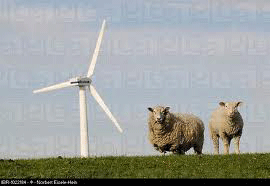 Plans for Upper Lachlan windfarm http://www.abc.net.au/news/2013-07-01/plans-for-upper-lachlan-windfarm/4790626 Natalie Whiting Jul 1, 2013 There are plans to set up another wind farm in the Upper Lachlan Shire Council area. Newtricity is proposing to build up to 40 turbines at the proposed Biala Wind Farm, outside Crookwell.
The 30 million dollar project would be spread over two adjacent sites. Two options have been identified to connect the windfarm to an existing electricity terminal.Newtricity says it could connect to the existing Goulburn to Yass transmission line or to the line being used by the near by Gullen Range wind farm, which is being constructed.
The development would also involve building a substation and control buildings on site.The company’s submitted its proposal and its preliminary environmental assessment to the Department of Planning.
Solar energy in Victoria continues to soar
 Victoria’s Solar Electricity Production Soars http://www.energymatters.com.au/index.php?main_page=news_article&article_id=3819, 2 July 13 Solar energy supplied 550 gigawatt-hours to Victoria in 2012 – 14 per cent of all renewable electricity – says the Clean Energy Council.
The CEC recently released its Renewable Energy in Victoria 2012 report; which provides an overview of Victoria’s electricity generation from renewable energy sources last year.
According to the report, the 550 gigawatt-hours figure was more than double solar’s contribution in 2011; which was 225 gigawatt-hours. In 2009, output was just 18 gigawatt-hours.
Installed solar panel capacity in 2012 in Victoria jumped from 270 megawatts to 418 megawatts. This was due to the uptake of home solar power, which accounted for all but 1 megawatt of installed capacity.
Uptake was spurred on by rapidly ballooning domestic power bills – and with more electricity price rises on the way; solar will likely continue to see solid gains.
While commercial solar installations were still a bit player last year, the CEC says low solar panel prices may see further uptake by the commercial sector during 2013.
The other renewable energy technology that saw significant increases in capacity and production last year was wind power. In 2012, Victoria’s wind farms generated 1674 gigawatt-hours, of clean electricity; up from 1280 gigawatt-hours in 2011.
The state’s 11 commercial wind farms over 1 MW in capacity generated enough electricity last year to provide the power needs of over 230,000 average Australian homes. Wind energy accounted for more than 27 per cent of Victoria’s renewable electricity generation capacity last year.
The report states Victoria’s installed renewable energy capacity has almost tripled since 2000, increasing from 668 megawatts to more than 1860 megawatts by the end of last year.
Victoria’s total renewable energy electricity generation was 3825 gigawatt-hours, in 2012; an increase of 874 gigawatt-hours, or nearly 30 per cent more than in 2011. The Renewable Energy in Victoria 2012 report was created with assistance from Sustainability Victoria. The full report can be downloaded here (PDF).
Productivity Commission agrees: solar energy not the cause of high electricity prices
 Productivity Commission Says ‘Go West’ For Solar http://www.energymatters.com.au/index.php?main_page=news_article&article_id=3818 2 July 13, The Productivity Commission’s Electricity Network Regulatory Frameworks final inquiry report laments that not enough small scale solar power systems have been installed facing west.
The report states average electricity prices across Australia have risen by 70 per cent in real terms from June 2007 to December 2012 – but doesn’t point the finger at solar. It acknowledges what has been known for years; network costs in most states are the main culprit and offers a series of recommendations for addressing the issues. Continue reading
Victorian Electricity Distributors quietly move to sabotage new home solar installations
 Electricity Distributors Cast Shadow over Solar 1 July 13, Victorian Electricity Distributors have quietly introduced new hurdles to the installation of grid connected solar systems. CitiPower and Powercor have both introduced a pre-approval process and criteria which are likely to result in many customers’ applications to install grid connected solar systems being rejected.
NECA Victoria Executive Director, Philip Green said “these criteria are likely to result in many rural customers being unable to connect to the grid while in urban areas customers will have their applications knocked back on the basis that there are too many existing solar systems in their area.”
“Your neighbours may all have grid connected solar, however the electricity distributors can knock you back – it seems to be a matter of first in, best dressed” said Mr Green. “In addition, these policies appear designed to hamper the spread of solar into the commercial and industrial sectors.”
The distributors justify their policies on the basis that grid connected solar has effects on power quality and network integrity issues.
“The community has suffered massive increases in electricity prices over recent years with much of this increase going to upgrade (some would say gold plate) the network” said Mr Green. “Unsurprisingly many consumers are looking to mitigate the high cost of electricity by installing solar and yet they’re being told that can’t connect to the network that they’ve helped pay to upgrade.”
“Distributors should not be at liberty to proceed and introduce restrictive policies that
will impede the community’s best efforts to help reduce its impact upon the environment,” said Mr Green.
The policies have not been widely communicated to either the community or sellers and installers of solar systems meaning that some customers who enter into sales contracts may never be able to conn ect to the grid. NECA also understand that other electricity distributors are likely to introduce similar policies.
Only last year, the Victorian Competition and Efficiency Commission released its Inquiry into Feed-in Tariffs & Barriers to Distributed Generation Final Report Power from the People. Neither this report nor the Victorian Government’s response to it canvassed or proposed policies like these. “We call upon the Victorian Government to intervene” said Mr Green.
–
Solar energy storage could be revolutionised by Australian invention
 Australian Invention Could Revolutionise Solar Energy Storage http://www.energymatters.com.au/index.php?main_page=news_article&article_id=3816 1 July 13, ANU researchers have developed a material that can store large amounts of power rapidly – and with very little energy loss. Based on the mineral rutile, it is a ‘dielectric’ material; which are used in the construction of capacitors.
The researchers say their material is superior to current capacitors in energy absorption, is cheaper to manufacture and can function effectively in a massive temperature range: -190°C to 180°C.
“With further development, the material could be used in ‘supercapacitors’ which store enormous amounts of energy, removing current energy storage limitations and throwing the door wide open for innovation in the areas of renewable energy, electric cars, even space and defence technologies,” says Associate Professor Liu of the ANU Research School of Chemistry. Continue reading
Australia’s electricity demand falls, as more direct solar systems established
Demand forecasts slashed again as consumers turn to solar REneweconomy, By Giles Parkinson on 28 June 2013 The Australian Energy Market Operator has again slashed its demand forecasts for the coming year and over the coming decade, as households and business turn increasingly to rooftop solar PV, and as energy efficiency efforts also take bite.
The latest AEMO National Electricity Forecasting Report – released on Friday – cited rooftop solar and energy efficiency regulations in buildings as the main reasons cutting its forecast demand across the National Electricity Market (which includes all states except WA and Northern Territory) for 2013/14 by 2.4 per cent. Lower than expected industrial demand also played a role.
This comes a year after AEMO slashed its forecasts for 2012/13 by nearly 10 per cent. As it is, demand for 2012/13 looks to have come in 1.1 per cent below event that forecast…….
One of the reasons for the revised estimates is that AEMO has introduced new modeling techniques, including those that better recognize the impact of solar and energy efficiency. Up to two years ago, it relied heavily on forecasts given to it by state-owned network operators, who had a self-interest to give bullish demand forecasts because it would justify greater infrastructure investment and bigger profits for the networks.
Consumers are now paying heavily for those forecasts, and for network assets that may not have been required. But those same network operators, along with other incumbent generators and retailers, are now likely to use the pared down forecasts for their own benefit, this time by resuming their campaign to have the renewable energy target diluted, or even removed…..
ncreased use of solar PV, where consumers generate some, or even a large part of their own energy needs, and increased energy efficiency (which also reduces demand), are two of the central planks of policy measures taken by the US and China to reduce their emissions. It is also part of the central policy recommendations of the International Energy Agency. http://reneweconomy.com.au/2013/demand-forecasts-slashed-again-as-consumers-turn-to-solar-78062
Australia’s Clean Energy Finance Corporation launches investment, but Coalition opposes it
 The Coalition has vowed to axe the CEFC, along with the carbon price.
It has also written to the corporation saying any contracts it signs will not be honoured by the Coalition if it forms government.
Clean Energy $100m deal gets Coalition cold shoulder http://www.theage.com.au/environment/clean-energy-100m-deal-gets-coalition-cold-shoulder-20130628-2p2q9.html#ixzz2XgCLAQWO June 29, 2013 Tom Arup Environment editor, The Age Australia’s Clean Energy Finance Corporation has launched its first investment, committing to a joint $100 million energy efficiency loan program with the Commonwealth Bank.
The deal sets up a stand-off with the Coalition which has vowed not to honour any contracts signed by the $10 billion corporation if it wins office later in the year.
The corporation’s chief executive, Oliver Yates, said on Friday it would co-finance loans for medium-sized businesses for energy efficiency projects such as energy saving lighting, solar panels, and cogeneration and trigeneration plants.
The CEFC and the Commonwealth Bank will each chip in $50 million to the program, which will hand out loans between $500,000 to $5 million. It builds on an existing scheme put in place by another government agency, Low Carbon Australia – now folded into the CEFC – which has so far delivered $10.2 million to projects in manufacturing firms.
The CEFC is also working on a number of other larger deals, and it is understood some could be introduced as early as next week. It is reportedly negotiating to help New Zealand company Meridian Energy increase its debt in the massive Victorian Macarthur wind farm with a $100 million-plus loan, before it sells its share in the project. Continue reading
New New South Wales wind farm at Gullen Range
 EnergyAustralia signs PPA for Gullen Range wind farm REneweconomy, By Sophie Vorrath on 27 June 2013EnergyAustralia has signed a Power Purchase Agreement with the China-based developer of a 165.5MW wind farm in NSW, to buy electricity and renewable energy credits generated by the 73-turbine project.
The Australian utility announced its latest PPA for Goldwind Australia’s Gullen Range wind farm on Thursday, hot on the heels of news that Boco Rock – another NSW wind farm EnergyAustralia is supporting through a PPA – has reached financial close.
Xinjiang Goldwind Science & Technology Co – China’s largest wind turbine manufacturer, and second largest globally – will use a mix of its 1.5MW and 2.5MW permanent magnet direct drive (PMDD) turbine technology for the Gullen Range project; the company’s largest outside China and the first in Australia to use Goldwind’s “next generation” 2.5MW turbine.
Gullen Range, located in the NSW Southern Tablelands, is currently under construction, with the first export of electricity generated by the wind farm slated for late 2013.
EnergyAustralia’s group executive manager of energy markets, Mark Collette, said this latest PPA was strong evidence of the utility’s intention to pursue investment in renewable energy in order to meet the its obligations under the federal government’s Renewable Energy Target……http://reneweconomy.com.au/2013/energyaustralia-ppa-wind-farm-75104
Renewable energy power generation no more expensive than gas
“A mix of large-scale renewable energy generation, including solar and wind, together with consumer action to use power more efficiently, will deliver the most resilient Australian power market by 2035,”
New UQ research sheds light on coal seam gas versus renewable energy http://www.uq.edu.au/news/?article=26404 A shift from coal-fired to gas-fired power generation will not significantly lower carbon dioxide emissions, new research by the Global Change Institute at The University of Queensland has found.
“The findings contradict a widely-held view that renewable energy is too expensive compared to fossil fuels, and too unreliable to be a major component of Australia’s future energy generation by 2035,” he said.
“There is no justification for the claim that a high proportion of energy sourced from renewables will drive up wholesale costs, in comparison to a power system heavily dependent on coal seam gas,” Professor Foster said.
This finding comes as the Australian government deepens its commitment to developing coal seam gas resources in order to supply lucrative export markets and transition domestic power generation. Continue reading
Australia’s wind generation is cost effective, says International Energy Agency
Renewable energy use gaining worldwide:IEA http://www.theaustralian.com.au/business/breaking-news/renewable-energy-use-gaining-worldwideiea/story-e6frg90f-1226670621465 AAP June 27, 2013 RENEWABLES like solar and wind power represent the fastest-growing source of energy generation and will make up a quarter of the global power mix by 2018, the International Energy Agency IEA says.
The IEA said that in 2016 renewable energy will overtake natural gas as a power source and will be twice that of nuclear, and second only to coal as a source of power.
The growth of renewables has been bolstered by increased competitiveness with conventional energy.
It is “a bright spot in an otherwise bleak assessment of global progress towards a cleaner and more diversified energy mix,” said IEA Executive Director Maria van der Hoeven.
The report listed Australia as one of several countries where renewable energy was becoming more competitive.
It said Australian wind generation is cost-effective next to new coal and gas-fired plants with carbon pricing. Continue reading
Anti wind farm lobby has not given up, on King Island wind project
Clean Energy Council policy director Russell Marsh said scaremongering by groups such as the “deceptively-named” Australian Environment Foundation created stress and division in the communities they claimed to be helping.
“There are more than 200,000 wind turbines at wind farms all over the world, many of them much closer to people’s houses than is possible under Australia’s strict planning regulations,” Mr Marsh said.
 Wind farm issue smolders The Mercury HELEN KEMPTON | June 26, 2013 THE mood on King Island is still tense as residents mull over news Hydro Tasmania will move on to the next stage of its proposal to build a 200-turbine wind farm.
Mayor Greg Barratt said the community was still fiercely divided on the issue and he did not expect that division to ease any time soon.
Hydro Tasmania expects it will take two years to conduct a feasibility study into its $2 billion wind project, which will need outside investment. Cr Barratt said he hoped the community could come back together as it learned more about the project.
“I encourage people to quieten down and take a deep breath and see what the feasibility study brings,” he said “I understand the ‘no’ people are very disappointed that the study is going on despite Hydro Tasmania not quite achieving the 60 per cent support they were seeking.”
A poll of residents and off-island property owners on whether Hydro Tasmania should take the project to the feasibility stage showed 58.77 per cent were in support. The company’s board decided that was close enough to proceed.
More than 400 people who were eligible to have their say did not bother…………….. Continue reading
1 This month

of the week – Australians for War Powers Reform (AWPR)
To see nuclear-related stories in greater depth and intensity
 Antinuclear