Movement for Community Energy in Australia
Community Energy Push In Australia http://cleantechnica.com/2013/06/02/community-energy-push-in-australia/#bgWwJ0mK4m8lm50T.99 June 2, 2013 Giles Parkinson Community energy and pro renewable NGOs are calling for the Federal government to establish a $50 million fund that would seek to leverage up to half a billion dollar of investment in community-owned renewable energy projects.
The call for a Community Energy Grant Fund is an attempt to offer a catalyst for growing community interest in renewable energy projects, and to fill in a gap in the country’s portfolio of renewable energy projects of between 10kW and 50MW According to a proposal led by the Community Power Agency, Yes2Renewables and other NGOs and community energy groups, the funding could cover early stage development costs for around 75 projects and bring them to the stage of being investment ready and able to release share offerings to the community.
This would include feasibility studies, resource assessment (such as wind monitoring), community engagement, planning studies, business case development, and legal advice.
The proposal seeks to tap into growing interest in the community renewables space, as outlined in RenewEconomy last week. On Thursday, Continue reading
$billions of investment money on hold due to Federal Opposition’s anti renewables policies
 Political Uncertainty Puts Billions in Renewables on Hold Design Build, by By Marc Howe 3 June 13 Uncertainty surrounding environmental policy in the wake of a likely Coalition victory this September has obscured the outlook for renewable energy and led to billions in potential investment being placed on hold.
The Federal Election, slated for September 14, appears increasingly likely to usher in a Coalition government, whose policies could be a setback for Australia’s decade-long shift toward clean renewable energy.
A key issue will be the fate of Labor’s controversial carbon trading scheme should the Coalition be elected. The policy provides a pivotal boost to renewables by striving to reduce greenhouse gas emissions, yet the coalition has pledged “in blood” that it will cancel the carbon tax.
The Coalition has also said that it will cut power costs, pointing to the abundance of cheap coal in Australia, and reconsider renewable energy policy.The uncertainty surrounding the fate of the carbon tax and the policy environment for renewable energy has impeded many projects in a $20 billion pipeline of investment.
“We don’t see any clear long-term policy direction on the climate or energy sector from the opposition,” says Nathan Fabian, of Australia’s Investor Group on Climate Change.
“Until that is clear, capital is sitting on the sidelines.” The Investor Group on Climate Change represents a group of institutional investors located in Australasia, including pensions funds and major international banks, with around $900 billion in funds under its management……
The development of Australia’s renewable energy sector could also be hampered by the efforts of established power suppliers such as Origin Energy and EnergyAustralia, who are currently pushing for the Renewable Energy Target (RET) and carbon tax to be scaled back or scrapped completely. Earlier this year, Origin’s Grant King launched a attack against the the government’s green energy policy, saying the RET would further increase power costs to the detriment of end consumers.
Members of the renewable energy sector such as Infigen managing director Miles George say the opposition of leading energy companies to RET is motivated by self-interest and, in Origin’s case, the desire to protect billions of dollars in gas investments. http://designbuildsource.com.au/political-uncertainty-puts-billions-in-renewables
Queensland Competition Authority (QCA) clears solar households as cause of higher electrcity charges
Queensland Solar Households Vindicated http://www.energymatters.com.au/index.php?main_page=news_article&article_id=3772 3 June 13 Plans by Queensland Premier Campbell Newman and Energy Minister Mark McArdle to whack solar households with higher electricity charges appear to have been scuttled.
On Friday, the Queensland Competition Authority (QCA) released its Final Determination on regulated retail electricity prices for 2013-14. A typical Queensland customer’s annual bill will increase from $1,184 to $1,451. However, it has not recommended an extra charge for solar users.
Prior to the QCA’s final determination, Premier Newman was pushing a proposal to charge all solar homes an extra $200 a year; even though the Government had promised in December last year that there would be no fixed charge of any sort on people using solar.
Queensland Energy Minister Mark McArdle also launched an attack on solar households, placing the blame for power price increases primarily on green schemes.
This has not been echoed by the QCA, which says the increases are being primarily driven by increases in network charges. The QCA also points out the freezing of electricity rates by the Newman Government in 2011/12 has resulted in a bigger jump now.
The Clean Energy Council has applauded the QCA for moving away from the proposal to levy an extra charge on solar power users, an issue the CEC had heavily lobbied on.
“The QCA’s rigorous and comprehensive analysis of power price rises in Queensland has made it clear that renewable energy was a much smaller contributor to electricity bills than most other factors,” said Clean Energy Council Chief Executive David Green.
Mr. Green pointed out when anyone installs an air-conditioner, it costs all electricity users an estimated $7000 to pay for network upgrades. He also addressed the myth that solar users were “rich”; stating Queensland’s solar hotspots were Bundaberg, Hervey Bay, Ipswich, Toowoomba and Beenleigh. Even though the QCA has made it clear that network charges are the major culprit in upcoming electricity price rises, the Queensland Government’s demonising of solar has continued since the Final Determination was released.
Following the Queensland Competition Authority’s announcement; Solar Citizens, an advocacy group representing current and future solar users, has written to Premier Newman and Mark McArdle asking them to address a number of critical questions about what it says are Mr McArdle’s misleading statements on the impact of solar on energy costs in Queensland.
Spurred on by threats to solar households such as those recently issued by the Queensland Government, Solar Citizens is in a recruitment drive to bolster its numbers to ensure Australian solar users are well represented under a united front – and the group’s numbers are rapidly growing.
There are now over 300,000 solar users in Queensland, who have invested over $2.2 billion dollars of their own money into reducing their electricity costs and carbon emissions impact. The upcoming electricity rate increases will see that number grow.
According to national solar provider Energy Matters, a good quality 4kW solar power system installed in Brisbane can return a financial benefit of up to $1,960 a year. Energy Matters now also offers Queensland households a zero deposit payment plan option.
Farming the sun – Australia’s first community-run solar farm at Lismore?
 North coast looks at sustainable energy alternatives, By ABC North Coast, 31 May 13, “………… Lismore could host Australia’s first community solar farm, as part of the new Farming the Sun project. Adam Blakester is in charge of the project which has received funding to establish seven or more community-owned solar farms around the country.
Mr Blakester said Farming the Sun is about bringing the community together and strengthening the local economy. It would mean local people would invest in the project and then on-sell the energy to a local organisation. “It’s really a community building project and particularly about learning and understanding electricity and energy which is an increasingly significant issue for all of us on a local scale and a global scale.
“That solar farm is owned by a local company; which is local people as shareholders – so that’s the community ownership.”……. He said while community-run solar farms haven’t been viable in the past, solar energy has just recently become more affordable than grid power. “Now, it’s financially cheaper to produce your own electricity with a solar panel, than to buy it off the electricity grid.
“By locally owning it, the money we’re spending on electricity starts to be recirculated for the life of this solar farm in the local region and local economy.”
A memorandum of understanding was signed last night by Lismore City Council, and by Starfish enterprises which – along with the NSW Office for Environment and Heritage and The Earth Welfare Foundation – has contributed funding towards the Farming the Sun project. …….
A feasibility study will now be conducted to see if it can go ahead in Lismore. http://www.abc.net.au/local/stories/2013/05/31/3771758.htm?site=northcoast
Investors attracted to Australia because of the Clean Energy Finance Corporation

“The latest analysis by Bloomberg New Energy Finance (BNEF) indicates that new wind power projects in Australia are as much as 18% and 14% cheaper than new gas and oil plants respectively,”
CEFC boosting investor interest in Australian renewables: report REneweconomy, By Sophie Vorrath 30 May 2013Investment in renewable energy projects in Australia has become more appealing since the establishment of the federal government’s $10 billion Clean Energy Finance Corporation, according to the latest edition of Ernst & Young’s Renewable Energy Country Attractiveness Index.
The index, released this week, ranks Australia’s ‘attractiveness’ in the global renewables investment market – a market it says is expected to be worth $US630 billion a year by 2030 – in fourth place, below the US, China and Germany (in first, second and third positions, respectively) and ahead of the UK, Japan, Canada, India, France and Belgium. Continue reading
Australia well on track to beat 2020 renewable energy target
Australia on course to beat 2020 renewable energy target, says study Consultancy forecasts that country will derive 22.5% of its power from renewables by 2020 Guardian UK, Oliver Milman 30 May 13 Australia is on course to surpass its renewable energy target by deriving 22.5% of its power from sources such as solar and wind by 2020, according to a new study. The analysis of government agency data, by consultancy Green Energy Markets, forecast a long-term decline in fossil fuels, with the use of coal for electricity falling by a third over the next 20 years.
Brown coal, the most carbon dioxide-heavy of all coal varieties, is set to be phased out as an energy source completely by 2050, as is oil.Meanwhile, renewables are set to grow from 13% of the energy mix to 51% by 2050, trumping the target of 20% by 2020 along the way.
Green Energy Markets says that changing consumption will also aid the bipartisan renewable energy target, predicting an average annual electricity generation growth rate of 1.47% until 2020 – a figure lower than previously thought. The report states that electricity consumption fell by 5.5% from 2008 to 2012, with half of this reduction driven by solar and energy efficiency schemes. A drop-off in manufacturing activity and energy bill price rises have also played a role.
However, clean energy groups have warned that political uncertainty over the future of the RET is undermining investment in the sector, potentially compromising the 20% target…… Kane Thornton, deputy chief executive of the Clean Energy Council, said that the RET policies needed to remain in place to ensure investment.
“The clean energy industry is tracking along well and the 20% target means there are lots of projects ready to go,” he said. “There are lots of investors looking to Australia and the key question is ‘will the RET stay in place?’ This investment will come to Australia as long as those policy settings are stable.”http://www.guardian.co.uk/world/2013/may/30/australia-2020-renewable-energy-target
Hear this: Clean Energy Finance Corporation will issue contracts to low carbon companies, despite Abbott’s threat
 Clean Energy Finance Corporation told to shelve contracts http://www.abc.net.au/news/2013-05-29/clean-energy-investment-at-stake-if-coalition-wins-election/4720894 AUDIO: Sarah Clarke reports on the clean energy future(The World Today) 29 May 13 The Coalition has already promised to dump the $10 billion Clean Energy Finance Corporation.
It was set up to lend money to firms delivering clean energy and low emissions, to give them a kick-start in the market.The Coalition is now warning it to stop drawing up contracts for new projects until after the election…….
Reserve Bank board member Jillian Broadbent, the chair of the Clean Energy Finance Corporation, says she is disappointed with the Coalition’s plans.
“There’s a lot of confusion about what we are and what the working model is and what kind of costs we’re going to be to the taxpayer, because on our numbers we’re going to be financially self-sufficient in probably within the first two years of our operation,” she said.”Then you start generating dividends which go to the Australian Renewable Energy Agency which can save the Government putting funds into that agency directly.”
The fund is currently considering applicants from at least 50 low carbon and low emission companies with contracts worth up to $2 billion.It plans to start issuing those contracts on July 1, despite calls for them to be shelved until after September.
Fund has ‘obligation to fulfil responsibilities’
Ms Broadbent says shelving the contracts is not possible. “We have an obligation to fulfil those responsibilities and that’s what we’re doing,” she said……..
The parliamentary secretary for Climate Change Yvette D’Ath says the Clean Energy Finance Corporation has a guaranteed future if Labor is re-elected. “These businesses have to meet very strict investment guidelines and criteria to get that finance through the Clean Energy Finance Corporation,” she said.
“So we’re very confident that there’ll be that rigour, there’ll be that transparency and that this will attract a lot of investment in Australia to invest in renewable energy.”
Strict regulations for wind energy, but not for coal and gas plants
“The next logical step would be for the Australian Energy Regulator to require monthly declarations from gas and coal-fired power stations, and their associated coal mines, that they are compliant with all air, water and noise pollution laws and regulations,”
 Wind industry angered over red tape http://www.smh.com.au/business/carbon-economy/wind-industry-angered-over-red-tape-20130529-2na9h.html#ixzz2UpGEFO00 May 29, 2013 Peter Hannam Wind energy producers are in a twist after being forced to demonstrate they are operating within noise limits every time they seek to surrender renewable energy certificates.
As of the start of June, all large-scale power stations accredited under the renewable energy target will have to submit a “standing notice” of ongoing compliance with all local, state and federal planning and approval requirements.
Operators say they were only advised of the change late last week. Power stations, including hydro, will continue to be required to complete an annual electricity generation return as before. Continue reading
Tasmania could become net exporter of renewable energy by 2020
 Blueprint For Renewable Energy Action In Tasmania http://www.energymatters.com.au/index.php?main_page=news_article&article_id=3764 29 May 13 An ambitious plan from the Tasmanian Climate Action Council would see the Apple Isle become a net exporter of renewable energy to the mainland by 2020. The blueprint calls for Tasmania to become Australia’s renewable energy powerhouse, generating 100 percent of its annual stationary electricity needs from renewable sources by 2020 under a Low Carbon Economic Strategy, with the surplus exported via Basslink.
The plan also recommends the implementation of improved feed in tariffs arrangements for small and medium-scale renewable energy generators such as homes and businesses with installed rooftop solar energy systems. More money will go into promoting tidal, geothermal and wind power, along with developing a smart grid power network for the state.
Tasmania has previously identified that climate change will have widespread negative effects on people living in the state and has legislated to cut greenhouse gas emissions by at least 60 per cent by 2050 compared to 1990 levels.
The blueprint states: “By positioning itself as a low carbon, forward looking, renewable electricity producer, Tasmania will help grow its industry sectors, including agriculture and tourism.”
By 2050, the blueprint states, Tasmania’s transport system will be largely decarbonised through the use of public transport, alternative energy vehicles and removing the need to travel by using advanced technology such as the National Broadband Network. The plan employs Tassie’s farmers in the fight against climate change by further research into developing energy-efficient farming technologies to reduce and sequester carbon emissions through farming practices.
The Tasmanian Climate Action Council was established in 2008 to provide high level advice to the Tasmanian Government on emerging climate change issues and propose best practice solutions to the challenges of climate change. A Blueprint For Action can be downloaded here (PDF)
By 2020 renewables will account for 22 per cent of electricity supply – RET is working
Renewable energy on target for 22% by 2020 REneweconomy, By Ric Brazzale 29 May 2013 The Renewable Energy Target (RET) has come under increasing scrutiny as the level of electricity consumption has fallen. There is confusion over how the RET has been calculated, and particularly in relation to how the initial 20 per cent target has been converted into a fixed target. This Research Note explains in detail how the numbers fit together.
A summary of the key points are as follows:
• The RET policy commitment is for at least 20 per cent of Australia’s electricity supply to come from renewable energy. Minister Combet when introducing the legislation to separate the RET in June 2010 made it clear that the government expected renewables to account for 22 per cent market share by 2020. At this time, the legislation which gave rise to the 22 per cent expected market share, had support from all the major political parties.
• We expect that renewables will increase from 10.6 per cent of total generation in 2011 to 22.5 per cent by 2020 (Figure 1). Forecast total generation is based on the Bureau of Resource and Energy Economics (BREE) latest energy projections. Total renewable generation is expected to reach 67.9 TWh by 2020. This incorporates the contribution of large-scale renewables as well as the expected generation from small-scale solar and avoided generation from solar water heaters. Coincidentally BREE also estimates that by 2020 renewables will account for 22 per cent of electricity supply…… http://reneweconomy.com.au/2013/renewable-energy-on-target-for-22-by-2020-2020
King Island community split by influx of anti wind energy campaigners
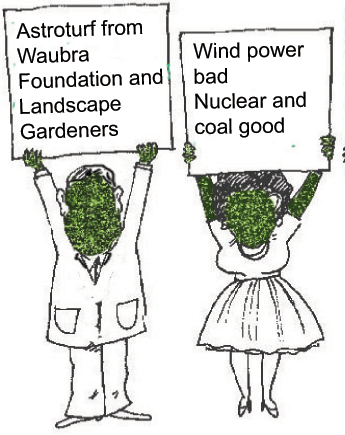 it didn’t take long for the discredited anti-wind group – the so called “Waubra Foundation” and their backers – to line up the locals opposed to the proposal. How this can be called a “Foundation” escapes this correspondent. Sandi Keane has written extensively in Independent Australia about the dubious credentials of this group, their murky sources of finances and clear links to the fossil fuel lobby. A mind-boggling chart of the web of interests can be found in Professor Simon Chapman’s article in Crikey…..
King Island’s collateral damage from anti-wind forces Independent Australia 28 May 13 Part-time King Island resident, David Looker, despairs of what he calls “collateral damage” as TasWind engages with residents in a battle to win support for its $2 billion proposal to build Australia’s biggest wind farm.
KING ISLAND sits at the western end of Bass Strait and is bisected by the 40th degree of latitude, which puts the lower half of the island literally in the Roaring Forties. The weather may be fine and windy, wet and windy, cloudy and windy — but it will be windy……
The consistent winds of the Roaring Forties have attracted TasWind, a division of Hydro Tasmania, to target the Island as the potential site of a 200-tower, 600MW capacity mega wind farm that would include a high voltage, undersea cable, enabling the electricity to be exported to the mainland, probably nearGeelong.
E3 Planning in Hobart prepared a Preliminary Socio Economic Impact Study for TasWind. This is a respected company, well-known on King Island but, of course, in the eyes of critics, suddenly not “independent” as this study was commissioned by Hydro Tasmania. E3 estimates the economic benefits to King Island to be between $255.75 and $310.65 million and points to substantial benefits to Australian renewable energy targets: Continue reading
While millions now have solar energy, Australia’s big utilities step up fight against it
Solar Power In Australia – The Battle Ahead http://www.energymatters.com.au/index.php?main_page=news_article&article_id=3761 27 May 13 It’s no surprise to the renewables industry, but that solar actually works has been a surprise to Big Energy – and this is increasingly making fossil fuel generators very nervous.
Speaking at the Solar 2013 conference in Melbourne, the Australian Photovoltaic Association‘s Muriel Watt warned that incumbent energy businesses will step up their fight against solar in the form of regulatory and tariff protection and campaigns to demonise it.
The latter is by no means a new development – the solar industry has been fighting myths and misinformation for years.
According to an article on RenewEconomy, Ms. Watt says incumbent utilities would attempt to push back on solar using a considerable arsenal of possibilities. Continue reading
A Liberal Tea Party to fight wind energy- June 18, at Parliament House
 Libs defy party on wind farms http://www.theage.com.au/opinion/political-news/libs-defy-party-on-wind-farms-20130525-2n3rn.html#ixzz2UWrz9qhn May 26, 2013 Chris Johnson National Political Correspondent Come clean”: The boldness of the Liberal windfarm opponents is raising suggestions the Coalition is about the back-flip on the renewable energy target. Outspoken Liberal MPs plan to defy publicly the official party line by attending a Tea Party-style anti-wind-farm rally at Parliament House, widening the rift in Coalition ranks over renewable energy targets.
The Canberra rally on June 18 is being promoted through a clandestine group using a website called stopthesethings.com, which conceals the identity of many of its supporters. Broadcaster Alan Jones is named on the site as master of ceremonies for the event, which is being touted as the ”Wind Power Fraud” rally.
NSW Liberal MPs Craig Kelly and Alby Schultz are among the line-up of speakers, as is West Australian Liberal senator Chris Bach. The Coalition’s star candidate to replace the retiring Mr Schultz in the seat of Hume Angus Taylor has also been recruited. The boldness of the Liberal wind-farm opponents is raising suggestions the Coalition is about to backflip on the renewable energy target, a bipartisan commitment to source a fifth of Australia’s power from renewables by 2020.
The shadow environment minister Greg Hunt recently confirmed the party’s commitment to the target and chose not to chastise the MPs who had begun speaking out against it. ”The Coalition is aware of the community concerns regarding wind farms,” Mr Hunt said. ”We have committed to a full medical research into the potential impact if elected. It is important that MPs listen to their communities … there is no change to our support for the 20 per cent target.”
During a post-budget interview with Mr Jones, shadow treasurer Joe Hockey would not be drawn on the issue, saying only that he would have to consult with his colleagues. The rally’s organisers are goading Mr Hockey to ”come clean” over renewable energy.
Victorian senator John Madigan (Democratic Labor) and independent South Australian senator Nick Xenophon will also speak. The pair has co-sponsored of an excessive noise bill in relation to wind farms. Senator Xenophon said he was invited through Senator Madigan’s office and didn’t really know who was behind the rally.
”I don’t look at all my invitations that closely,” he said. ”But I am happy to talk at the event and I will say that, while I do believe something should be done about climate change, the economics of wind farms don’t stack up and neither do the environmental benefits.” Senator Madigan’s office confirmed he was scheduled to address the gathering.
Environmental groups did not wish to comment, but it’s understood plans are being considered to stage a Canberra event in support of renewable energy on the same day.
Energy Savings Agency – a practical proposal by The Greens
 Australian Greens Propose Energy Savings Agency http://www.energymatters.com.au/index.php?main_page=news_article&article_id=3760 27 May 13, Greens Leader Senator Christine Milne says an ‘Energy Savings Agency’ will make Australia’s energy system fairer, cheaper and cleaner.
Announcing the plan on Friday, Senator Milne saidFederal and State Governments had failed to prevent a blowout in spending on poles and wires; accusing some state governments on profiting from their electricity assets.
“Selling less electricity is not in their interest which is why reform of the energy market is too slow and why intervention is vital.”The Greens say the Federal Government had committed to fast-tracking establishment of a National Energy Savings Initiative to replace state-based energy
efficiency trading schemes, but three years on is yet to complete a Regulatory Impact Statement.
The proposed Energy Savings Agency would be an independent agency charged with disseminating information, analysis, advocacy and financial support to break down barriers to cheaper and cleaner energy options; such as solar power.
The Greens believe the Agency would also drive down power bills by achieving $1 billion in energy savings – energy efficiency is not only the low hanging fruit in slashing power bills; but also in reducing greenhouse gas emissions. As a result, a reduction of 3000 MW of peak demand would be achieved and 10 million tonnes of carbon dioxide emissions avoided.
The Energy Savings Agency would also ensure solar power system owners are paid a fair rate for the surplus electricity they export to the mains grid.
According to a paper (PDF) released to coincide with the announcement, “fair value” for solar electricity has been underestimated to date as benefits such as avoided electricity distribution costs and time of production were undervalued.
Targets set under the Agency would initially be ‘collaborative targets’; becoming mandatory targets if networks “do not respond adequately to the targets in this form within 18 months”.
Senator Milne said the proposal has been costed by the Parliamentary Budget Office and will cost $405 million to run each year.
Tasmania’s remarkable renewable energy opportunities
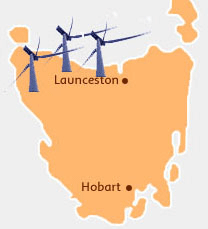 Plug into renewable energy, report urges http://www.examiner.com.au/story/1528260/plug-into-renewable-energy-report-urges/?cs=12 By CALLA WAHLQUIST, May 26, 2013, TASMANIA would become a net exporter of renewable energy by 2020 under a blueprint for climate action due to be released by the Tasmanian Climate Action Council tomorrow.
It suggests a range of measures to ensure Tasmania reaches its target of reducing carbon emissions by 60 per cent of 1990 levels by 2050, including introducing new energy efficiency standards for buildings and establishing fair renewable energy feed-in tariffs to encourage homes and businesses to generate their own electricity.
Homes that feed back into the grid from solar panels currently get 27 cents per kilowatt hour, but that could drop as low as eight cents per hour when Aurora Energy is split and the retail arm privatised in July.
Council chairwoman Lesley Hughes said the council would discuss the impending reduction of the tariffs in a meeting today and make a submission to government.
Climate Change Minister Cassy O’Connor said the council was the government’s peak advisory body on climate change, and its blueprint would inform the development of the government’s own climate plan, to be released later this year.
Ms O’Connor said Tasmania had already reduced its emissions by 30 per cent on 1990 levels. “There’s a huge economic opportunity here for Tasmania if we continue to build resilience into our economy, if we continue to move toward a low-carbon economy, then we can have a prosperous and sustainable future,” Ms O’Connor said.
“We can be a beacon to the world of sustainability and innovation.”
Opposition Leader Will Hodgman said he would not comment on the blueprint until he had seen it, but said the Liberal Party’s priorities were the re-establishment of frontline police, education and health services and revitalising the state’s economy.
1 This month

of the week – Australians for War Powers Reform (AWPR)
To see nuclear-related stories in greater depth and intensity
 Antinuclear