Western Australia: Greens show a practical plan for transition to renewable energy
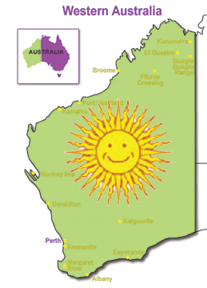 Renewable energy could have a major impact on Western Australia http://www.hydrogenfuelnews.com/renewable-energy-could-have-a-major-impact-on-
 western-australia/859050/ BY
– FEBRUARY 21, 2013
State could reach 100% energy sustainability through solar and windWestern Australia is one of the largest energy consumers in the world. The state relies heavily on fossil-fuels, such as coal, but has been working to adopt renewable energy in recent years. According to the Greens, the state can meet its energy needs in a variety of ways that do not involve the use of fossil-fuels. The document released by the Greens highlights solar thermal and storage technologies as an adequate way for the South West Interconnected System. Western Australia’s expansive energy utility, to break away from fossil-fuels. Another option is to use photovoltaic solar energy systems and wind energy.
Costs of renewable energy considered viableThe cost for solar and wind energy has dropped significantly over the past two years. The Greens suggest that no major advances in technology are required for Western Australia to reap the economic benefits of adopting renewable energy. According to the political party, renewable energy in the region can range from $208 to $221 per megawatt-hour. This estimation represents a $60 billion upfront cost for the state to expand its use of solar and wind energy. The cost may be high, but the Greens suggest that it is significantly lower than the costs associated with a continued focus on fossil-fuels.
Politics likely to dictate future of renewable powerAs Australia’s smallest political party, the Greens have limited influence over the adoption of renewable energy throughout the country. This is particularly problematic because renewable energy is often made into a political issue rather than one of sustainability or economics. The Greens study of renewable energy and its potential to help Western Australia reach 100% energy sustainability has, nonetheless, generated a fair amount of hype in the political space.
Renewable energy yes! including household rooftop solar – says University of Queensland
Renewable energy critical for competitive Australian power system- University of Queensland, 22 Feb 13, An immediate investment in multiple energy technologies is vital for meeting carbon abatement targets and building a robust power system, a new study from the Global Change Institute at The University of Queensland has found.
• The resilience of Australia’s power system is currently poor (better only than India and South Africa) and is not compensated by low electricity costs.
• Even with a high carbon price, the power system is not on-track to cut emissions by 80%, in line Australia’s 2050 emissions targets*.
• There is no cost premium associated with shifting from ‘business-as-usual’ to renewable, distributed generation and carbon capture and storage. There is, however, evidence of a cost premium for shifting away from coal.
• Australia will benefit from investment in large-scale renewable energy projects to operate alongside coal in the foreseeable future and eventually replace the role of coal.
• Consumer action must not be overlooked and will be an integral part of any successful model, however an in-depth study into the effect of distributed generation (eg household rooftop solar panels) on the distribution network is urgent and overdue. ….. http://www.uq.edu.au/news/?article=25857
Engineers Australia (IEAust) wants greater greenhouse cuts, and a big shift to renewable energy
Engineers Australia Advocates 80 Per Cent Reduction in Greenhouse Gas Emissions http://designbuildsource.com.au/engineers-australia-advocates-80-per-cent-reduction-in-greenhouse-gas-emissions By Marc Howe, 19 Feb 13, A submission by Engineers Australia (IEAust) to the Australian Renewable Energy Agency (ARENA) endorses ambitious new targets for reductions in the country’s greenhouse gas emissions by mid-century.
The new benchmarks target a reduction of 25 per cent of greenhouse gas emissions by 2020 and 80 per cent by 2050 based on 2000 levels. These declines are believed to be necessary for Australia to make a meaningful contribution to international efforts to keep emissions within 450 ppm of equivalent carbon dioxide (CO2-e), and ensure that global average temperature gains are kept within two degrees Celsius.
In addition to supporting the new set of targets, the Sustainable Engineering Society strongly advocates a stricter target of 350ppm CO2-e, due to uncertainty over whether the 450ppm target will be sufficient to limit worrying gains in global temperature levels.
The professional engineering body also supports the concomitant shift to renewable energies that such ambitious reductions in CO2 emissions will necessitate. Continue reading
Australia not actually DOING much about solar thermal, but doing Research anyway
 It would be better if Australia were to get going on building solar thermal power plants, rather than stick to just research for 8 years. Sort of a delaying tactic?
Australia’s CSIRO to lead solar thermal research initiative http://www.renewableenergymagazine.com/article/australia-s-csiro-to-lead-solar-thermal-20130218 Dan McCueMonday, 18 February 2013 Australia’s CSIRO is partnering with six Australian universities and the United States’ Department of Energy’s National Renewable Energy Laboratory (NREL), Sandia National Laboratories and Arizona State University on an eight-year solar thermal research initiative, which aims to lower the cost of solar thermal power from 25 to around 10 cents a kilowatt hour. Continue reading
Solar pholtovoltaic energy plant planned for Kalgoorlie, Western Australia
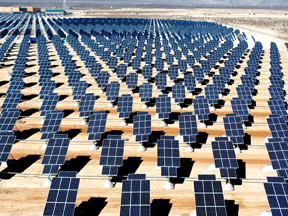 Investec plans 50MW solar PV plant near Kalgoorlie, REneweconomy By Giles Parkinson 13 February 2013 Global banking and asset management group Investec is working on a proposal to build a 50MW solar PV power plant near Kalgoorlie, in what is likely to be the first solar plant of its size in Australia.
Investec is hopeful of sealing land tenure at Mungari, about 26kms from Kalgoorlie, in the next month or so, and then will go to market to seek a power purchase agreement and lock in project finance. Construction on the project could begin next year.
The Mungari project is one of two currently being studied by Investec in WA – the other being the Chapman solar PV project near Geraldton, which was originally billed as a solar hybrid but may emerge as a solar PV only project.
WA is emerging as one potentially of the hottest regions for the utility scale solar industry, thanks to its excellent solar resources and relatively high electricity prices.
Bloomberg New Energy Finance last week said that solar PV plants in WA would have an estimated levellised cost of energy of around $157/MWh, compared to more than $190/MWh for new coal-fired generation in the state, where the cost of coal is expensive. BNEF expects the LCOE of solar PV to fall below $100/MWh by 2020.
Despite this, and helping fund the country’s first utility scale solar plant, a 10MW facility near Geraldton, the conservative state government is focused on new coal-fired generators, and is currently restoring its ageing Muja coal fired generator near Collie (and facing a major cost blow-out).Investec project manager Lynne Lagan said Kalgoorlie made sense because of its excellent solar resources and its location at the edge of the South-West Interconnected System – the grid that services the south west corner of the state.
Lagan said there was a single 220kW line going to Kalgoorlie, so a limited amount of generation could be brought in. “It makes sense to put some generation in this part of the network,” she told RenewEconomyby phone from Kalgoorlie on Tuesday.
“That’s why chosen this location. We been working on project for 18 months on land tenure and we are now looking to finalise those arrangements.”
Lagan said Investec’s numbers on the cost of the solar plant were about the same as Bloomberg New Energy Finance. And she noted there was a huge amount of interest from miners, many who operate on remote locations but are forced to truck in gas or diesel at horrendous costs – often at around 400/MWh or even more. Building this plant could open up further opportunities.
“This sort of project makes sense regardless of whether it considered as a “renewables” project,” she said. “There is a lot of expensive diesel generation here and we are having discussions with some of mining operations. They just want power that makes sense at a sensible price.”……
City of Kalgoorlie Boulder CEO Don Burnett told ABC radio that the region was a perfect and secure location for a large scale solar station because of the guaranteed sunshine.
“It’s a great location for a solar proposal and the benefits to the city and the region would be immense, but also it’s a great opportunity for the state and federal governments to be involved in innovation in sustainable energy.” http://reneweconomy.com.au/2013/investec-plans-50mw-solar-pv-plant-near-kalgoorlie-22039
University of Newcastle linked with coal industry – but it’s time for the Hunter Valley to go renewable energy
 The Greens understand the challenges ahead and have acted responsibly
in negotiating a $10billion clean energy investment fund. This is the
closest we have in Australia to a sovereign wealth fund, to use some
of the considerable wealth we have generated now and invest it in the
future of our children and our communities.
The Hunter has long been a hub of renewable energy innovation and
entrepreneurship. A transition to a clean, renewable energy economy
promises to revitalise Australian manufacturing and create thousands
of new jobs in many rural and regional communities, including the
Hunter’s coal communities.
But we need to shift subsidies away from fossil fuels and towards
renewables if we are to do this.
The writers of Monday’s opinion piece were obviously not aware the
University of Newcastle had commercial links with coalmining.
 Renewable energy Hunter’s best future
http://www.theherald.com.au/story/1296245/opinion-renewable-energy-hunters-best-future/?cs=308
By CATE FAEHRMANN, 14 Feb 13, PEOPLE are rightly sick and tired of the childish
mud-slinging that now plagues Australian politics. So how about a bit
of honesty and even some vision for the future of the Hunter?
Readers would have been left scratching their heads this
week about why a pro-vice-chancellor (Professor Scott Holmes) and
researcher (Sam Bright) at the University of Newcastle would both
misrepresent the energy and mining policies of the Greens and
undermine his own institution’s research program to reduce reliance on
fossil fuels.
The Hunter’s coal communities are proud communities. Over more than a
century, the workers and their families of Cessnock, Muswellbrook,
Maitland and Singleton have created a booming economy for their
communities and for the Hunter.
Along the way, our knowledge about the impacts of coalmining has grown
and we now know that there are significant health and environmental
issues involved, not the least being the insidious clouds of coal dust
now blanketing communities and the very real, worldwide challenge to
reduce greenhouse pollution.
Tackling climate change means our dependency on coal as an export
earner and as a domestic fuel will have to be phased out over the next
few decades, rather than ramped up.
This will mean necessary changes for the whole national economy, and
for coal-affected regions such as the Hunter. The challenges
associated with this change are significant, but not insurmountable. Continue reading
Port Augusta, South Australia – ideal for solar thermal power plant, not for just a cheap solar booster for coal
 What’s really needed is a solar thermal plant with molten storage, in
fact it is the only option if repowering Port Augusta is to be more
than just a green-washing option. The plant needs at least six hours
of storage in order to accommodate the evening peak
CLIMATE SPECTATOR: Don’t waste solar energy on coal, Business
Spectator, Matthew Wright, 14 Feb 2013 Port Augusta is the ideal
location in South Australia for a solar thermal power plant, due to
its very good direct annual solar radiation and its proximity to a
strong piece of grid infrastructure that services the old lignite
burning power plants that are located there, owned by Alinta.
There has been a campaign for some time to repower Port Augusta, after
the town was named as one of 12 key power generation sites in the Zero
Carbon Australia stationary energy plan.
This campaign has garnered a lot of support and gained a great deal of momentum.
But now we’re at a turning point where we may get a type solar thermal
plant that is of little use in promoting a shift away from fossil
fuels. A plant that will not create an inspiring vision, nor support
greater understanding and learning-by-doing that will shift us from a
19th century fossil fuel economy, to a 21st century renewable-powered,
cleantech economy.
The plant being proposed is a cheaper option being proposed by
electricity company Alinta. But buyer beware – you get what you pay
for.
The marketing name sounds alright – it’s a “solar booster”. The idea
is that steam is preheated in a solar thermal mirror field then fed
into the steam cycle of the existing coal fired power plant.The
problems with this are many and varied and it would be far better to
invest in a 100 per cent solar thermal plant independent of coal, with
molten salt energy storage**.
Lock-in of inferior technology Continue reading
Just about a million small solar panel systems in Australia – top solar postcodes
 956,000+ Small Solar Panel Systems In Australia http://www.energymatters.com.au/index.php?main_page=news_article&article_id=3587 12 Feb 13,
The number of small solar power systems installed in Australia has grown by more than 300,000 since the end of 2011.
Recently published data from the Clean Energy Regulator relating to systems installed under the Small-scale Renewable Energy Scheme shows the nation’s rooftops collectively host at least 956,193 solar panel arrays as at January 31 this year. At the end of 2011, there were 644,045 systems.
The true current installation figure is higher – Renewable Energy Target (RET) legislation allows a 12 month creation period for Small-scale Technology Certificates (STCs), so 2013 and 2012 figures will continue to rise due to this 12-month window.
The systems represent 2,308,026 kW of solar power capacity – enough to provide all the power needs for around 461,000 average Australian homes.
Australia’s top 20 solar PV postcodes and number of installations as at January 31, 2013: Continue reading
Indonesia solar power project being developed by Australian solar consortium
Australian solar consortium to develop 250 MW Indonesian project REM , 11 February 2013 SGI-Mitabu, a joint venture between The Solar Guys International and Mitabu Australia, is developing a 250 MW solar power project under an agreement with Indonesia’s Ministry of Energy. What’s more, it says it will finance the whole thing through reliance of a form of Islamic financing.
Western Australia’s opportunity to lead in renewable energy
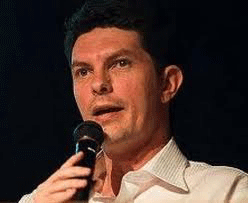 Greens’ plan for clean power by 2029 http://www.watoday.com.au/wa-news/state-election-2013/greens-plan-for-clean-power-by-2029-20130210-2e6in.html#ixzz2KclQE7OS February 11, 2013 Robyn Preston Switching over to 100 per cent renewable energy by 2029 is not only achievable, it will save the average family money, according to Greens’ party leader Scott Ludham. WA Greens’ party leader Scott Ludham launched the Green Energy 2029 proposal on Sunday and said Western Australia cannot afford to wait decades to make the change to renewable energy sources.
The Greens say that with WA’s abundance of sunlight, wind and geothermal resources, changing to renewable energy over the next 16 years will not cost anymore than what has been proposed by the Liberal-National Government he said.
“The state government is actually proposing to spend a quarter of a billion dollars refurbishing the obselete Muja coal-fired power station and that for me is all you need to know about how wrong this government’s prorities are,” said Mr Ludham. Continue reading
The frightening ignorance of Australia’s Liberal/National Party about the science of climate change
 It would be tempting to think that this was just Barnaby Joyce, and attacking renewables with his incoherent gusto would have been laughable – were it not for the fact that he will be a senior minister in an Abbott government, and that his views are shared by the likes of Abbott, finance spokesman Andrew Robb, treasurer in waiting Joe Hockey, and the energy spokesman Ian Macfarlane – and dozens of others.
the Coalition continues to speak from a position of ignorance – or possible from regulatory capture from the industry incumbents.
Barnaby Joyce’s renewables target: 100% ignorance REneweconomy, By Giles Parkinson 7 February 2013 We are barely a week into this seven-and-a-half month election campaign, and it is already clear that the “alternative” government of Tony Abbott is out on a seek and destroy mission on any policy that might serve to promote the development of renewable energy, in particular those emerging renewables that will seal the fate of the incumbent coal generators.
First it was the promise to repeal the carbon price, then the ambiguity over the renewable energy target, and then the attempt to neuter the Clean Energy Finance Corporation even before it was up and running. Then they unleashed Barnaby Joyce in The Senate.
“What is this insane lemming-like desire to go to renewables going to do to our economy?” Joyce told the Senate, before veering off into a rant about wind farms in every back garden, how they were expensive, didn’t work half the time, and will never replace coal, gas, hydro or nuclear.
Again, he betrayed the reason for his antipathy to renewables – the climate, he said, had barely changed despite the introduction of the carbon price six months ago – repeating the idiotic statement made by Tony Abbott in his first address of the year. Continue reading
Senator Scott Ludlam explains Clean Energy Finance Corporation funding for solar thermal energy
“We have the technology, we have the institutional set-up and now we have the funding mechanism to make [concentrated solar thermal] plants like this a reality in Australia largely in part because of the leadership shown by Senator Milne, by Adam Bandt and by our former leader, Senator Bob Brown, in bringing the Clean Energy Finance Corporation into being.
Barnaby Joyce’s renewables target: 100% ignorance REneweconomy, By Giles Parkinson 7 February 2013 “…….the most informed speech came from Ludlam (right) and it’s worth a read. We won’t republish it in entirety, but here is a good excerpt. And here is a link.
“I think that many people, when they consider solar energy, think of rooftop solar panels. That is fine. We have seen huge falls in the cost of that technology as economies of scale kick in, particularly with the research and development leadership that Australia has shown over previous years, coupled with the massive manufacturing capacity of China. This has led to huge falls in the cost of PV. For example, in Perth—the latest figures I have from last September—218 megawatts of peak electricity was generated from the rooftops of the residents of Perth.
It is interesting to note that the largest renewable energy installation in Western Australia is actually the city of metropolitan Perth. Because costs have fallen so fast—with halting policy assistance from both federal and state that comes and goes; rebates that get slashed and reintroduced, different schemes that come and go 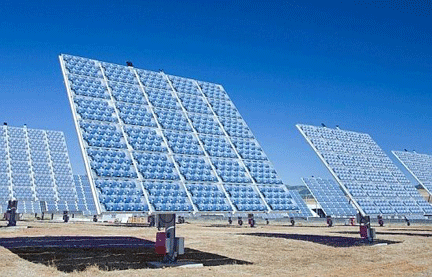 and even so people have done the right thing—we are now seeing large-scale deployment of solar energy in Western Australia and right around the world. So, PV is a big deal.
“But, what we want to raise today—and the reason the motion is worded as it is—is that there are major changes occurring in concentrating solar thermal technology which does not use photovoltaics, it does not require the rare earth minerals, it does not require advanced electronics or miniaturisation or particularly advanced manufacturing technologies. Continue reading
Even without govt subsidy renewable energy in Australia now cheaper than coal and gas
Renewables now cheaper than coal and gas in Australia http://reneweconomy.com.au/2013/renewables-now-cheaper-than-coal-and-gas-in-australia-62268 By Giles Parkinson 7 February 2013 A new analysis from research firm Bloomberg New Energy Finance has concluded that electricity from unsubsidised renewable energy is already cheaper than electricity from new-build coal and gas-fired power stations in Australia.
The modeling from the BNEF team in Sydney found that new wind farms could supply electricity at a cost of $80/MWh –compared with $143/MWh for new build coal, and $116/MWh for new build gas-fired generation.
These figures include the cost of carbon emissions, but BNEF said even without a carbon price, wind energy remained 14 per cent cheaper than new coal and 18 per cent cheaper than new gas.
“The perception that fossil fuels are cheap and renewables are expensive is now out of date”, said Michael Liebreich, chief executive of Bloomberg New Energy Finance.
“The fact that wind power is now cheaper than coal and gas in a country with some of the world’s best fossil fuel resources shows that clean energy is a game changer which promises to turn the economics of power systems on its head,” he said.
But before people, such as the conservative parties, reach for the smelling salts and wonder why renewables need support mechanisms such as the renewable energy target, BNEF said this was because new build renewables had to compete with existing plant, and the large scale RET was essential to enable the construction of new wind and solar farms. Continue reading
NOT using renewable energy will cost Australia dearly
 The Cost Of Not Using Renewable Energy http://www.energymatters.com.au/index.php?main_page=news_article&article_id=3576
5 Feb 13, Not using renewable energy for electricity production is costing future generations over $9 billion a day – and that doesn’t costs associated with health impacts and climate change.
Solar naysayers have often used cost as a reason for not making the switch – an argument rapidly running out of steam given the plummeting prices of solar panels. Something else worth considering is the cost of not going solar.
For example, rapidly increasing electricity prices can make installing solar panelsa better investment than putting money in the bank for many households.
But what about the bigger picture? How much will delaying renewable energy in reaching its potential now cost the world each year in the future? While renewable energy sources such as the wind and sun are comparatively inexhaustible; burning a lump of coal to create power is a single-use affair.
A recently released report from the World Future Council attempts for the first time to calculate the economic loss caused by the use of fossil fuels for energy production.
“Externalised costs from burning fossil fuels are incurred not only through damages from climate change but also through the lack of future availability of fossil raw materials consumed to meet our current energy demands, although alternatives exist,” states political economist Dr. Matthias Kroll.
The report concludes that the future usage loss resulting from our current oil, gas and coal consumption is between 3.2 and 3.4 trillion US dollars per year – conservatively and based on current market prices.
“Protecting the use of increasingly valuable fossil raw materials for the future is possible by substituting these materials with renewables. Every day that this is delayed and fossil raw materials are consumed as one-time energy creates a future usage loss of between 8.8 and 9.3 billion US Dollars.”
The Monetary Cost of the Non-Use of Renewable Energies can be viewed in full here (PDF).
Infrasound is NOT a problem caused by wind turbines
 Wind Farm Infrasound Myth Debunked http://www.energymatters.com.au/index.php?main_page=news_article&article_id=3577 5 Feb 13, South Australia’s Environment Protection Authority has released a report showing infrasound levels at homes near wind turbines is no greater than what is experienced elsewhere. Infrasound is sound that is lower in frequency than 20 Hz (Hertz), which is lower than the “normal” limit of human hearing.
Infrasound is a point seized upon by some anti-wind farm campaigners as a contributor to “Wind-Turbine Syndrome“, a mysterious affliction said to cause psychological issues and physiological problems such as insomnia, headaches, tinnitus, vertigo and nausea.
In the EPA study, undertaken in conjunction with Resonate Acoustics, infrasound levels were recorded at seven locations in urban areas and four locations in rural areas; including two residences approximately 1.5 kilometres away from wind turbines at Bluff Wind Farm and Clements Gap Wind Farm.
The EPA says infrasound levels measured at the two residential locations near wind farms were “within the range of infrasound levels measured at comparable locations away from wind farms”. The report notes the results at one of the houses near a wind farm were the lowest infrasound levels measured at any of the 11 locations included in the study.
“This study concludes that the level of infrasound at houses near the wind turbines assessed is no greater than that experienced in other urban and rural environments, and that the contribution of wind turbines to the measured infrasound levels is insignificant in comparison with the background level of infrasound in the environment.”
Commenting on the report, Clean Energy Council Policy Director Russell Marsh said, “The results of the EPA’s report show that the real contributors to infrasound are things like air-conditioners, traffic and urban office environments – not wind farms. This is great news for clean and safe renewable wind energy and further reassurance for communities near wind farms.”
In January last year, Australia’s Climate And Health Alliance (CAHA) stated“There is no credible peer reviewed scientific evidence that demonstrates a link between wind turbines and direct adverse health impacts in people living in proximity to them.”
The report on infrasound levels near wind farms and in other environments can be viewed in full here (PDF).
1 This month


Help Aunty Sue Protect Her Land and Sacred Sites From Destructive Rocket Testing.
.

Australians deserve the truth
about
AUKUS – https://aukuspublicinquiry.com/

PETITION – To: Prime Minister Anthony Albanese and the Australian Labor Government

of the week – Australians for War Powers Reform (AWPR)
To see nuclear-related stories in greater depth and intensity

