Dramatic fall in greenhouse gases, as Australians, especially Victorians. use less coal-fired power
Yallourn was operating at just 56 per cent last month even after it announced it was mothballing one of its four units.
Emissions sink as consumers turn off coal, SMH, Peter Hannam, December 17, 2012 Carbon economy editor Weak demand for electricity across eastern mainland states has sparked a “dramatic fall” in greenhouse gas emissions from Australia’s power stations, the latest review of data by consultants Pitt & Sherry has found.
While demand for base-load electricity from black coal-fired power stations has been in retreat for about three years, the decline has extended in recent months to two of Victoria’s emissions-intensive brown coal-fired plants, Hazelwood and Yallourn. Changes in demand of electricity on this scale are unprecedented in the entire 120-year history of the electricity supply industry in Australia Continue reading
Windy Flinders Island aims for 100% renewable energy
 Flinders Island’s windy future http://www.abc.net.au/news/2012-12-16/flinders-island27s-windy-future/4430334 Dec 16, 2012 Flinders Island in Bass Strait plans to produce all its power from renewable energy sources.
The plan to put up three or four wind turbines and a mini hydro storage system would cost up to $25 million.
A privately-run turbine is already producing 25 per cent of the island’s energy.
Flinders Island Council general manager Raoul Harper said residents wanted to make that 100 per cent. “Being in the top five wind resource areas on the planet the concept of continuing to burn diesel to power the island does seem absurdreally,” he said.
In the long run Mr Harper said the project would be cost effective because the government would no longer need to pay Hydro Tasmania $3 million a year to supply diesel. The council is seeking Federal Government funding through its new
renewable energy agency.

New South Wales losing investment and jobs, as State govt prolongs anti wind farm rules
“There’s $10 billion worth of investment sitting in the pipeline waiting to find out what Brad Hazzard is going to do with their
future.
“Four thousand jobs, 17 million tonnes a year cut from the state’s greenhouse gas emissions, waiting to see what the O’Farrell Government will do.”
 Guidelines wait blows against NSW wind farms http://www.abc.net.au/news/2012-12-14/guidelines-wait-blows-against-nsw-windfarms/4427964 Dec 14, 2012 The Clean Energy Council says a delay in finalising new guidelines for
wind farms in New South Wales is forcing investors to look to other states for opportunities.
It is a year since the New South Wales Government put draft guidelines out for community consultation.
A spokesman for Planning Minister Brad Hazzard says the policy is still being finalised. In the meantime, no new wind farms have been approved.
The Clean Energy Council’s policy director, Russell Marsh, says that is sending investment elsewhere. Continue reading
Utterly useless Christmas presents are helping to trash the planet
The fatuity of the products is matched by the profundity of the impacts. Rare materials, complex electronics, the energy needed for manufacture and transport are extracted and refined and combined into compounds of utter pointlessness. When you take account of the fossil fuels whose use we commission in other countries, manufacturing and consumption are responsible for more than half of our carbon dioxide
This is pathological consumption: a world-consuming epidemic of collective madness, rendered so normal by advertising and by the media that we scarcely notice what has happened to us.This boom has not happened by accident.
When every conceivable want and need has been met (among those who have disposable money), growth depends on selling the utterly useless.
 Trashing the planet for a talking piggy bank http://www.theage.com.au/opinion/society-and-culture/trashing-the-planet-for-a-talking-piggy-bank-20121212-2b9vh.html#ixzz2F4vYvlY2 December 13, 2012 George Monbiot There’s nothing they need, nothing they don’t own already, nothing they even want. So you buy them a solar-powered waving queen; a silver-plated ice cream tub-holder; a ”hilarious” inflatable Zimmer frame; a confection of plastic and electronics called Terry the Swearing Turtle; or – and somehow I find this significant – a Scratch Off World Map.
They seem amusing on the first day of Christmas, daft on the second, embarrassing on the third. By the 12th day of Christmas they’re in landfill. For 30 seconds of dubious entertainment, or a hedonic stimulus that lasts no longer than a nicotine hit, we commission the use of materials whose impacts will ramify for generations.
Researching her film The Story of Stuff, Annie Leonard discovered that, of the materials flowing through the consumer economy, only 1 per cent remain in use six months after sale. Even the goods we might have expected to hold on to are soon condemned to destruction through either planned obsolescence (wearing out or breaking quickly) or perceived obsolescence (becoming unfashionable).
But many of the products we buy, especially for Christmas, cannot become obsolescent. The term implies a loss of utility, but they had no utility in the first place. An electronic drum-machine T-shirt; a Darth Vader talking piggy bank; an ear-shaped iPhone case; an individual beer can chiller; an electronic wine breather; a sonic screwdriver remote control; bacon toothpaste; a dancing dog. No one is expected to use them, or even look at them, after Christmas day. They are designed to elicit thanks, perhaps a snigger or two, and then be thrown away. Continue reading
Australian Solar Thermal Research Initiative (ASTRI) aims to bring down the cost of Solar Thermal Power
CSIRO to lead push to bring cost of CSP to 10c/kWh REneweconomy, By Giles Parkinson on 13 December 2012 The CSIRO is to lead a major new research initiative in solar thermal (concentrating solar power, or CSP) technologies that will aim to reduce the cost of the technology to between 9c and 12c a kilowatt hour, and be able to compete with fossil fuels – possibly as early as 2016.
The Australian Solar Thermal Research Initiative (ASTRI) was unveiled today, delivering $35 million of funding from the Australian Solar Institute and the Australian Renewable Energy Agency, as part of an $87 million research program that will also draw on money from the private sector. The program brings together Australian and US research institutions, with United States research collaborators and with leading international and Australian CSP companies. Continue reading
Australia’s funding for solar research would be better spent on building solar thermal
Solar Funding Evokes Mixed Reactions, by Energy Matters, 13 Dec 12 $83.5 million for solar research funding as part of the United States- Australia Solar Energy Collaboration (USASEC) was announced by Minister for Resources and Energy Martin Ferguson on Thursday……
While the announcement was generally well received by supporters of renewable energy, not everyone was happy.
Climate think-tank Beyond Zero Emissions labeled the funding a “diversion”.
“While Australia is limiting its large-scale solar energy sector to research, other countries are going ahead and building it – and learning more in the process,” said BZE’s Matthew Wright.
“If Martin Ferguson really supported large scale solar energy, he would have us build it now.”

Beyond Zero Emissions is one of the driving forces behind the push to have Australia’s first large solar-thermal plants with energy storage built at Port Augusta in South Australia.
Early this year, the group released ‘Repowering Port Augusta‘; a blueprint for replacing South Australia’s emissions intensive Northern and Playford B brown coal-fired power stations with wind power and solar energy facilities. http://www.energymatters.com.au/index.php?main_page=news_article&article_id=3514
Australia steps up investment into solar power research projects
Australia takes a shine to solar energy research
http://www.brisbanetimes.com.au/business/carbon-economy/australia-takes-a-shine-to-solar-energy-research-20121212-2bajc.html#ixzz2ExSaP4LQ December 12, 2012 Peter Hannam Carbon economy editor The Gillard government will step up its investment in joint solar energy research with the US, using additional funds from its new $2.2 billion renewable energy agency. Continue reading
South Melbourne’s community owned large solar project
Community solar projects allow people who cannot install solar panels on their own homes for whatever reason to directly participate in the solar revolution.
Community funded solar projects have already been successfully rolled out in the UK and the USA. Closer to home, the communities of Hepburn Springs and Daylesford in Victoria raised $13.5 Million to build the Hepburn Community Wind Park; winner of the 2012 World Wind Energy Award.
Australia’s First Community Owned Large Scale Solar Project http://www.energymatters.com.au/index.php?main_page=news_article&article_id=3513 12 DECEMBER, 2012 | A new community project aims to cover South Melbourne Market’s new roof with solar panels. 150 solar panels have already been installed, funded by Port Phillip Council.

LIVE (Locals Into Victoria’s Environment) wants to cover the remaining 95% of the rooftop with solar (around 3,000 panels) via community investment. “Currently we think a Co-operative structure for LIVE Community Power best matches the principles to which we aspire,” states the group’s web site.
The group envisions selling around 1,000 shares at $1,000 each to the community. Electricity generated by the installation would be sold and provide a return to shareholders. Continue reading
Australia overestimates the cost of Concentrated Solar Power: Saudi Arabia and Qatar race ahead with CSP
Australia has proved unable to construct the right incentives – or political will – to construct CSP plants, and most other developments are occurring in China, South Africa and India.
last week IRENA released an assessment that suggested CSP costs per could be around $140-$180 a megawatt-hour in areas of the best solar resources – such as the Gulf states and Australia, and technologies such as solar towers have the greatest potential for further cost reductions. (That is around half the recent cost assessment of Australia’s Bureau of Resource and Energy Economics).

Gulf riches could supercharge concentrated solar, REneweconomy, By Giles Parkinson 10 December 2012 The concentrated solar power (CSP) sector is expected to finally spring to life – and begin its long-awaited journey down the cost curve – as the oil and gas-rich Gulf nations deploy their massive sovereign wealth in solar technologies.
At the climate change talks in Doha, both Saudi Arabia and the host country Qatar reinforced their intentions to invest tens of billions of dollars into large-scale CSP – which includes solar thermal and concentrated solar PV technologies. The biggest oil and gas exporters in the world want to become, well, the Saudi Arabia and Qatar of the solar industry too. Continue reading
Australia’s new Solar Hall of Fame
 Solar Hall Of Fame For Australia http://www.energymatters.com.au/index.php?main_page=news_article&article_id=3505 by Energy Matters, 10 Dec 12, Australian pioneers of solar power are receiving some well-earned recognition via the new Australian Solar Hall of Fame.
 “The inaugural inductees in the Solar Hall of Fame include some of Australia’s greatest scientists, innovators and entrepreneurs and collectively represent an extraordinary contribution to tackling global climate change,” said John Grimes, Chief Executive of the Australian Solar Council.
Mr. Grimes says Australia has “punched well above its weight” with regard to solar research, development and deployment and last year, Australian households installed more home solar panel systems than any other country in the world.
Some of the inaugural inductees to the Hall of Fame include: Continue reading
Key points from the Solar Power Australia 2011-12 report,
 The report reiterates the busting of the solar is for the rich myth. Over half of system buyers earn less than $100,000 annually and more than a quarter earned less than $65,000 per annum.
Solar Power Australia 2011-12 Report Highlights http://www.energymatters.com.au/index.php?main_page=news_article&article_id=3498, by Energy Matters, 5 Dec 12, The Clean Energy Council has released its Solar Power Australia 2011-12 report, which states solar panel installations now represent 3.2% of all current electricity generation capacity in Australia.
The CEC report describes 2011 as “prophetic in terms of the industry’s impact on where Australia’s electricity industry is headed.”
Other key points from the report: Continue reading
25 anniversary of Australia’s oldest operating wind turbine, and still going strong
 These days, the wind turbine that could delivers around 80,000kWh a year to the grid, with an estimated 90-95 per cent availability
Blow out the candles: Australia’s oldest wind turbine turns 25 REneweconomy, By Sophie Vorrath 4 December 2012 November might have been a milestone month for solar, with cumulative PV installations reaching 2GW, but it also marked a reasonably big milestone for wind: 25 years since the Breamlea Wind Turbine, near Geelong in Victoria, was commissioned. Continue reading
Senate inquiry finds that “infrasound” from wind turbines is not a problem at all
higher sound levels were recorded with turbines turned off versus when the turbines were running. A strong indication that the origin of most infrasound and low-frequency noise was the wind itself which was slowed by running turbines…….
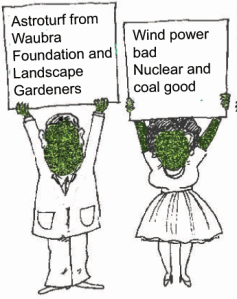 Wind turbine infrasound: What’s all the noise about?, REneweconomy, By Richard Mackie 4 December 2012 On Wednesday the Senate inquiry into excessive noise from wind farms released their report. The inquiry was supposed to focus on audible noise but debate strayed into concerns that wind turbines can cause health problems by producing infrasound (sound of a frequency so low that it is normally inaudible) and low frequency noise.
Wind farm opposition groups such as the Waubra Foundation are prone to making extreme statements about wind turbines such as this from their senate inquiry submission “…characteristic symptom patterns have been reported at distances up 10km away from the nearest wind turbine.” Infrasound is blamed and understandably people get concerned.
So where does this idea come from? The Senate inquiry gives us the answers. Submissions represent a global who’s who in the debate on wind farms and health. Often information provided to support the wind farms-cause-health-problems idea actually demonstrates the opposite. Continue reading
Woodend Integrated Sustainable Energy sets the pace for Victorian community wind energy
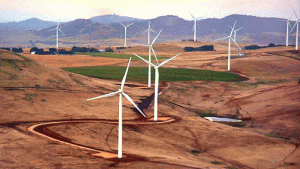 Insight: How communities can take lead in green energy REneweconomy, By Giles Parkinson 30 November 2012 This is the second in a series looking more deeply into issues which affect the development of the clean energy industry in Australia. The first was on the 2kms set-back rule imposed by the Victorian government and at least partially adopted in NSW.
For the past 12 months, a digital display located behind the counter of the newsagent in High Street in the Victorian town of Woodend has logged what Barry Mann describes as a major lost opportunity. Real time data  from a wind mast located in an old timber mill a few kilometres out of town documents the amount of electricity that would have been produced if a proposal to install three wind turbines in a harvested pine forest 6kms from town had been allowed to go ahead.
Before the mast was taken down earlier this month: the data stood at this: 12.6 gigawatt hours of electricity generated over 12 months and four days (12.630 million kilowatt hours) – about enough electricity to satisfy the needs of 2,037 homes and generate $1.5 million in revenue from selling the electrons to the grid. (You can find the data on their website)
Mann is a director of WISE (Woodend Integrated Sustainable Energy) – a local not-for-profit group that says its goal is to ”assist communities to take responsibility for their energy and carbon future.” It is one of dozens of similar groups in Australia that are hoping to implement their own local plans, but don’t have so many electrons to show for it yet.
For the moment, Woodend’s own plans have been frustrated by the election of the Baillieu Conservative government, and the introduction of a 2km setback ruling and the declaration of a “no-go” zone through large slabs of the Mt Macedon ranges – two initiatives that local member Donna Petrovich is proud to take responsibility for. (See addendum below) Continue reading
Australia’s renewable energy development being sabotaged by Victoria, New South Wales and Queensland govts
“South Australia’s wind energy per capita is higher than any major country in the world and wind is now contributing approximately 26% of the state’s total electricity production,” the report said.
“At the state level, we have seen Victoria, NSW and Queensland putting in place policies to hold back renewable energy. In Victoria, it’s now almost impossible to build a new wind farm, so severe are the restrictions on siting,” he said.
“NSW has followed Victoria’s unfortunate lead to some degree and all three states have cut back on feed-in tariffs for residential renewable energy.”
Renewable energy sector grows but barriers remain http://theconversation.edu.au/renewable-energy-sector-grows-but-barriers-remain-10986 Sunanda Creagh, 28 Nov 12 Energy production must shift from fossil fuels to renewable sources within four decades to avoid the most damaging consequences of climate change, a government report has found.
The Climate Commission’s report on the state of the sustainable energy market, titled The Critical Decade: Generating a renewable Australia, was released as world leaders gathered forglobal climate talks in Doha this week. Continue reading
1 This month

of the week – Australians for War Powers Reform (AWPR)
To see nuclear-related stories in greater depth and intensity
 Antinuclear