Australia’s Renewable Energy Target: dubious, unreliable, advice from ACIL Tasman
 TRUenergy RET confessions, CLIMATE SPECTATOR Tristan Edis , 17 Sep 2012 Earlier this month, TRUenergy used modelling work by ACIL Tasman to spearhead an effort to have the Renewable Energy Target watered down.
This analysis suggested that the cost of the RET would be an eye popping $53.3 billion (strangely expressed in nominal dollars when just about everyone normally adjusts for inflation).
Yet why would anyone take analysis from economic consultancy and energy modellers ACIL Tasman seriously?
Let’s consider its track record.
– In a 2010 report for the Department of Climate Change it forecast that cumulative installed capacity for solar PV would reach 1348MW by 2029-2030. We actually reached that amount around the end of 2011.
– In a 2008 report for the oil and gas companies Chevron, ConocoPhillips, Exxon Mobil and Woodside Petroleum, ACIL tried to suggest that the carbon pricing scheme would put at risk LNG project development in the country. Since that report was issued, over $150 billion has been committed to construction of LNG investments including by Chevron, ConocoPhillips and Exxon Mobil.
– In modelling for the ESAA, ACIL Tasman predicted that just about all Latrobe Valley coal generators would shut by 2020 as a result of the emissions trading scheme. Perhaps that should have happened if we were genuinely worried about climate change, but now the government can’t even pay these guys to shutdown……
let’s face it, sometimes it’s hard to know where the polluters end and ACIL Tasman starts.
This is an organisation that used to share the same office as the chief umbrella lobby group for large emitters of greenhouse gases – the Australian Industry Greenhouse Network (aka the Greenhouse Mafia according to ABC’s 4 Corners). In addition, the AIGN’s last two chief executives were also consultants at ACIL Tasman, one of them being a director at the firm.
What I think tops it all off was a story told to me by Ric Brazzale, head of Green Energy Markets. Back when Mark O’Neill was the head of the Australian Coal Association, he was unable to make it to a government-industry stakeholder meeting on climate change policy. Not to worry, an ACIL Tasman staff member attended in his place to represent the coal industry.
http://www.businessspectator.com.au/bs.nsf/Article/renewable-energy-target-australia-climate-change-t-pd20120917-Y82HH?OpenDocument&emcontent_spectators&src=rot
Importance of keeping Australia’s Renewable Energy Target unchanged
Australia’s Renewable Energy Target – Stability Crucial http://www.energymatters.com.au/index.php?main_page=news_article&article_id=3381 by Energy Matters, 14 Sept 12, Flip flops isn’t just an American term for a popular form of Aussie footwear; it also describes our country’s approach to renewable energy at times – and to our detriment.
The Federal Government’s Climate Change Authority is currently undertaking a review of Australia’s Renewable Energy Target, currently set at 20 per cent of Australia’s energy to be gained from renewable sources by 2020. The Clean Energy Council has called for the Federal Government to ensure the Renewable Energy Target remains unchanged, stating that it was crucial to promoting investment, driving job creation and continuing to push down costs for consumers. “The Renewable Energy Target is the single most important policy measure for the entire Australian renewables sector,” said Clean Energy Council Chief Executive David Green.
“Any changes to the Renewable Energy Target will shatter this stability and remove investor confidence in clean energy, negating the industry’s ability to support Australia’s shift to clean energy sources and to reduce energy costs for consumers in the long-term. The fact a review is even being held is already contributing to uncertainty in the market.”
The CEC believes alterations to policy could damage returns on investments already made and consequently, Australia’s reputation with regard to energy infrastructure investment.
The organisation states the Renewable Energy Target has generated around $18.5 billion of investment and thousands of jobs, seen 1.7 million home solar power and solar hot water systems installed and resulted in the equivalent of more than 2.1 million households being powered by large scale renewables to date.
“To date, it has also been the single largest carbon abatement scheme in Australia and without it Australia would not have achieved its emissions reductions target under the Kyoto Protocol,” says Mr. Green.
Left untouched, current policies would see a further $30 billion in investment and a total reduction of 380 million tonnes in carbon emissions over the life of the scheme.
“The cost of the Renewable Energy Target contributes just 7 per cent to the average Australian electricity bill, and this is forecast to drop to just 4 per cent by 2020 – with even greater potential savings as we all become smarter about how we use our energy.”
Submissions in response to an initial issues paper released by the Climate Change Authority are due today. The Clean Energy Council’s submission can be viewed here .
Queensland leads in war against solar energy
War against solar: pricing regulator favours gross tariffs, REneweconomy, By Giles Parkinson on 14 September 2012 The Queensland pricing regulator says it favours the introduction of a gross feed in tariff in the state, in a move that the solar industry say would be devastating for the rooftop solar PV market…..
They argue it effectively reduces competition in the industry, and potentially removes one of the key solutions to the overloading of grids. Numerous independent studies have underlined the important role that solar PV could help in meeting peak demand, but this is rarely acknowledged by the utilities, who are more concerned about protecting revenues by growing their assets. The move comes just months after the Queensland Government slashed its net feed in tariff. Queensland had been the fastest growing state for solar PV, accounting for 40 per cent of national installations by some count.
The introduction of gross tariffs would also likely kill off the emerging commercial-scale solar PV market in Australia. Commercial scale solar is considered one of the most effective options for reducing peak demand because the output from the rooftop or ground mounted panels corresponds with usage by commercial users.
However, Australian solar companies have also expressed fears that the suspension of grants under the Federal government’s $800 million Clean Technology Investment Program for manufacturing groups could threaten many projects, just as the industry was getting started.
The head of one NSW company, who requested anonymity, said he had 15 proposals on the drawing board, ranging in size from 30kW systems to up to 1MW for customers including manufacturers, processors, retailers, and vineyards.
He said if the funding was withdrawn, only a couple of smaller projects were likely to go ahead. That’s because larger commercial customers had the buying power to negotiate lower electricity prices – of around 16c-18c/kWh (instead of 30ckW/h or more) from the utilities which were effectively cross subsidized by other users. RenewEconomy highlighted the other issues surrounding commercial solar in this piece earlier this week, Why new solar tariffs coud drive a man to diesel”….
The situation in Australis is not unique. In the US, for instance, the solar industry is facing similar issues, as highlighted in this piece on Greentech Media this week – where they flagged a potential installation of 75GW of solar PV in the country by the end of the decade – 15 times its current capacity – and massive resistance from utilities.
In Australia, the utilities have become concerned because of recent forecasts that suggest up to 18GW of solar PV could be installed in the country over the next few decades. Some private forecasts suggest that could happen within a decade.
As David Crane, the head of leading US energy generator NRG, said earlier this year, solar PV represents the biggest threat to the conventional energy industry in half a century. In the Greentech Media piece, the solar companies said utilities in the US were so powerful they acted as “a fourth arm of government” and won’t give up easily. Professor Ross Garnaut has commented on the extent of regulatory capture in the Australian industry, hence the ability to “gold plate” networks and extract huge compensation packages for the carbon price. http://reneweconomy.com.au/2012/war-against-solar-pricing-regulator-favours-gross-tariffs-23984
Queensland’s Premier Newman turning that State into renewable energy backwater
 Queensland – Solar Star One Day, Renewables Wasteland The Next, by Energy Matters, 13 Sept 12, “……Campbell Newman appears to have decided Queensland should become a clean energy and climate change backwater in terms of further progress from this point forward.
Queensland’s recent budget was a climate change and renewable energy related massacre. Numerous programs are to be axed – some of which had been previously announced:
– Solar Flagships project.
– Queensland Climate Change Fund
– Queensland Renewable Energy Fund
– Queensland Smart Energy Savings Fund
– Solar Initiatives Package
– Waste Avoidance and Resources Efficiency Fund
– Local Government Sustainable Future Fund
– Climate Smart Home Service
– Solar Hot Water Rebate Scheme
– Solar Atlas
– Cloncurry Solar Thermal Trial Site Remediation
– Bright Thing Campaign
– Renewable Energy Industry Development Plan
– Climate Smart Business Service
– Sustainable Energy Innovation Fund
– EcoBiz program….
Further analysis of the impact of Queensland’s horror budget in relation to climate change and renewable energy initiatives can be viewed on RenewEconomy.
South Australia’s extraordinary wind energy peak – at 85% of the State’s electricity
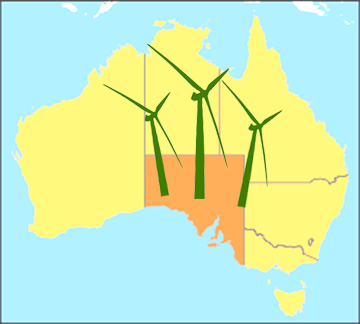 Wind power peaks in SA http://news.ninemsn.com.au/national/8528671/wind-power-peaks-in-sa Sep 6 2012 South Australia’s wind farms briefly provided 85 per cent of the state’s electricity during windy conditions this week, the Clean Energy Council says.
Policy director Russell Marsh said data from the Australian Energy Market Operator showed 55 per cent of all the electricity used by South Australians on Wednesday was generated by wind power.
But it said wind power peaked briefly at 85 per cent on Monday morning. “South Australia has proven once again that wind energy can generate real power and lots of it,” Mr Marsh said. “All this wind is putting South Australia well ahead of the curve on Australia’s 20 per cent renewable energy target.”
Australian Capital Territory leads with big solar, AND decentralised solar energy
 Canberra Goes Solar In A Big Way http://www.energymatters.com.au/index.php?main_pag news_article&article_id=3371 by Energy Matters, 6 Sept 12, Spanish company FRV has been awarded a project to develop a 20MW solar panel based electricity generation facility in the Australian Capital Territory.
The FRV Royalla Solar Farm will be constructed 23 kilometres south of Canberra’s CBD and will consist of approximately 83,000 solar panels – the largest facility of its kind to date in Australia. Royalla Solar Farm will generate enough electricity to supply the power needs of around 4,500 homes and avoid over half a million tonnes of greenhouse gas emissions during its serviceable life.
Country Manager of FRV Australia said the project represents an important step in the company’s long term commitment in Australia. The Australian Solar Council welcomed the announcement by the A.C.T. Government.
“This is a landmark day for Big Solar in Australia”, said John Grimes, Chief Executive of the Australian Solar Council.
“Australia’s clean energy future has arrived in Canberra…Solar is increasingly taking on coal-fired power on price.”
“Big solar plants will increasingly meet Australia’s peak power energy needs, and today’s announcement by the A.C.T. Government is a window into Australia’s solar future.”
Mr. Grimes also congratulated the ACT Government for “delivering Big Solar at low cost and at breakneck speed.”
ACT Environment Minister Simon Corbell said the project would make Canberra the solar capital of Australia – and at a low cost. “The Government’s reverse auction process is about getting the cheapest price for the best amount of renewable energy generation, and today we’ve delivered on that,” he said.
Construction is due to begin in 2013 and is expected to be finished in 2014, subject to relevant approvals. FRV states it has fully developed more than 360 MW of renewables capacity globally and has participated in the development of over 2,750 MW at different stages.
Bidding for the ACT project occurred under a reverse auction model. According to RenewEconomy’s Giles Parkinson, reverse auctions are already being deployed successfully in some of the world’s biggest energy markets, including India.
In addition to support for Big Solar, the ACT also encourages home solar power through a feed in tariff incentive. Surplus electricity generated by home systems is purchased by ActewAGL Retail at the customer’s electricity tariff rate.
According to national solar solutions provider Energy Matters, a 3kW solar panel system installed in Canberra can generate a financial benefit of nearly $800 a year.
South Australia’s wind energy bonanza
Wind accounts for 58% of energy use in South Australia, By Giles Parkinson on 6 September 2012 It’s been another big week for wind production in South Australia – as another spring weather system with high winds makes wind energy the dominant force in local energy production.
According to figures pulled together by consultants Intelligent Energy Systems using data from the Australian Market Operator, wind energy produced accounted for 57.9 per cent of demand in the state on Tuesday, and followed up with 55 per cent of total demand on Wednesday……
exports from South Australia to other states. On Tuesday, the state was exporting almost all day, as the wind output was quite consistent. On Wednesday, it exported for most of the day and there is a bit of pink at the top in the late afternoon to indicate coal imported from Victoria. (South Australia’s coal generators are in mothballs right now due to the impact of wind, and lower demand, and the carbon price)……
These one day graphs, of course, are just snapshots of an overall trend happening in the state, and across the National Electricity Market, that will only become more apparent as the amount of wind and solar installed in the country increases. Indeed drew Reidy, from IES says these days only rank as the 6th and 12th highest in terms of energy produced on a single day, and 5th and 6th in terms of percentage of demand. The highest day in terms of output was on August 17 this year, while the highest in terms of percentage of demand came in February 5, when wind accounted for 64.1 per cent of demand across the day.
The Clean Energy Council’s Russell March said it was proof that wind energy can generate real power – and lots of it. “This type of significant wind generation is common in South Australia,” he said. In 2011/12, according to AEMO data, wind produced 24 per cent of the state’s generation, overtaking coal. And, Russell noted, AEMO data shows that emissions from South Australia’s electricity sector have dropped every year since 2005/06, and have reduced by more than 27 per cent over the last five years.
“All this wind is putting SA way ahead of the curve on the national Renewable Energy Target, helping provide farmers and local business owners in regional areas with extra income. It also means that the state’s residents collectively have a lower carbon price bill, while getting fully compensated from the Federal Government under the scheme.” Indeed, on Tuesday and Wednesday, the state enjoyed not just by far the cleanest energy in the country, but also the cheapest, with average prices over the day at $43/MWh, compared to more than $52/MWh for NSW….. http://reneweconomy.com.au/2012/wind-accounts-for-58-of-energy-use-in-south-australia-75810
University of New South Wales (UNSW)’s solar cell innovation
UNSW, Suntech Power and Hanwha Solar Partner to Improve Solar Cell Efficiency AZOcleantech, September 6, 2012 By Gary Thomas Researchers at the School of Photovoltaics and Renewable Energy Engineering (SPREE) at the University of New South Wales (UNSW) in Australia have developed an advanced processing technology for enhancing the efficiency of silicon solar cells. SPREE has entered into a research partnership with Suntech Power and Hanwha Solar, twomajor silicon solar cell manufacturers.
Thin film The electric insulator in a solar cell is located between the aluminium back-plate and the silicon wafer. The newly developed technology involves “self-patterning” tiny metal contact regions into the electric insulator of a solar cell…..
http://www.azocleantech.com/news.aspx?newsID=17281
The University of NSW a global leader in solar technology research and development.
UNSW, Suntech and Hanwha Solar Collaborate http://www.energymatters.com.au/index.php?main_page=news_article&article_id=3370 by Energy Matters 6 Sept 12, Technology being developed at the University of New South Wales to improve the efficiency of silicon solar cells has grabbed the attention of two of the world’s largest solar panel manufacturers.
The School of Photovoltaics and Renewable Energy Engineering (SPREE) has inked a collaborative research agreement with Suntech Power and Hanwha Solar to further develop experimental technology to automate and speed up patterning of solar cell electric insulators.
“Currently closely-spaced small-area metal contact regions in an insulating layer can only be formed by deliberately patterning the holes with a laser scanning over the surface, which is quite slow,” says Dr Alison Lennon, a senior lecturer from SPREE.
Dr Lennon says other methods such as aerosol and ink-jet printing are at this point too slow and have been unable to demonstrate the required patterning reliability.
Dr. Lennon and her PhD students are investigating the use of aluminium anodisation, a process where a chemical coating is formed on a metal surface to protect against corrosion, which she says can turn an aluminium layer on a silicon solar cell into a dielectric layer with many tiny holes; exactly what is needed.
The team has already constructed prototypes of cells using the process and is now working on improving cell efficiencies and refining the technique to make it commercially viable – and this is where Suntech and Hanwha Solar solar come in.
Dr Lennon says the collaboration is an example of two companies realising they can achieve more as partners than as competitors, which could result in faster commercialisation.
The University of NSW is a global leader in solar technology research and development.
It was announced recently UNSW would be a partner conducting research in connection with two large solar farms projects to be constructed over the next three years in western New South Wales.
UNSW also has a long association with Suntech. Among other achievements, earlier this year collaborative research between the two led to a world record 20.3% efficiency for a production silicon solar cell through further refinements to Suntech’s Pluto cell technology.
Suntech founder Dr. Zhengrong Shi is a graduate of UNSW.
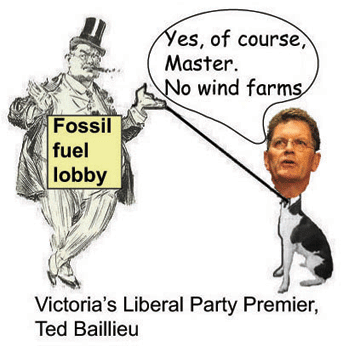
Baillieu governs in the interests of the fossil fuel lobby, damaging the wind farm industry
 Victorian wind farm laws: a blow to Australia’s clean energy future? , The Conversation, Lisa Caripis Research assistant, Centre for Resources Energy and Environmental Law at University of Melbourne Anne Kallies PhD Scholar at University of Melbourne 4 September 2012,
It’s been just over one year since the Baillieu government introduced the second part of its far-reaching planning law reforms to restrict the development of wind farms in Victoria. The results are an example of how state planning law can be a barrier to achieving national renewable energy goals.
With a majority in both houses of Parliament, the Coalition was able to amend Victoria’s planning framework unhindered to deliver on its 2010 election promise to “restore fairness and certainty to the planning process for wind farms”.
In pursuit of this aim, the planning amendments most notably impose a blanket ban on wind farms in many parts of the state. They effectively give the owners of any dwelling within 2km of a proposed wind farm the power to decide whether or not the development should proceed. A July 2012 amendment clarifies that these changes are targeted at wind farms generating electricity for supply to the grid, not for on-site use.
Economically, reports indicate that the impacts of these changes in terms of lost or stalled wind farm investment and employment have been considerable, in a state that has some of Australia’s best wind resources. While promising to “give the community a greater voice” through these changes, the amendments instead render local, pro-wind initiatives, such as community wind farm projects impossible in many locations .
Not only do the planning law changes have the potential to entrench existing fossil fuel power generation in Victoria, they undermine the Victorian Government’s commitment to the federalRenewable Energy Target (RET).
The RET is designed to ensure that 41,000 GWh – close to 20% – of our electricity comes from large-scale renewable energy by 2020. It implicitly relies on implementation through state and territory planning frameworks, because decisions about what kind of development can take place and where rest with the states. The Climate Change Authority , which reviews the RET, notes
State and territory planning regulations may affect the level of renewable energy generation, its mix, and the geographic distribution of renewable power stations.
This can cause problems when state laws are out of step with national targets, as the electricity market rule-maker pointed out last year . It is of some concern that New South Wales draft guidelines also adopt the 2km consent rule and impose a noise assessment regime stricter than in any other jurisdiction in Australia, the United States or Europe….. http://theconversation.edu.au/victorian-wind-farm-laws-a-blow-to-australias-clean-energy-future-9163
Victoria’s Premier Baillieu – out to destroy renewable energy
 Victorian Solar Incentive Cut – Reactions http://www.energymatters.com.au/index.php?main_page=news_article&article_id=3366 by Energy Matters, 3 Sept 12, The new, “fairer” feed-in tariff for roof-top solar panels in Victoria appears to be anything but – and the race is on for households to secure the higher rate before the deadline hits. The new tariff will be slashed from the current 25c + up to 8c electricity distributor contribution to just 8c per kilowatt hour for households lodging the necessary paperwork after September 30. The rate will be adjusted annually in line with the wholesale electricity rate. According to Melbourne-based Energy Matters, the deadline provides little – and in many cases, no time – for households to acquire a system.
The company is urging those considering solar panels to call Energy Matters on 1300 727 151 as soon as possible to discuss what the change will mean to them, as it will vary according to circumstances. Environment Victoria was particularly scathing of the changes, stating the Baillieu Government has broken a key election promise to provide ‘fair reward’ for solar households.
“Ted Baillieu has dumped his promise to support the Mallee solar farm, he’s made it harder to build a wind farm than a new coal-fired power station, and now he’s slashed household and business solar support. At the same time he’s handing out tens of millions in cash to the big coal companies,” said Victoria McKenzie-McHarg. “It’s fair to ask what this government has against clean energy?” she said. The Clean Energy Council stated the rate was too low. We’re obviously disappointed at this decision to reduce support for solar power, which will make it harder for everyday Victorians to reduce their power bills and put industry jobs under pressure,” said Clean Energy Council Policy Director Russell Marsh. Labor’s energy spokeswoman, Lily D’Ambrosio, slammed the decision.
”The Baillieu government has again shown it just doesn’t care about supporting families who want to reduce their energy costs while also doing their bit for the environment,” Ms. D’Ambrosio said according to a report on The Age web site. Information from Energy Matters’ web site shows a good quality 5kW solar power system installed in Melbourne can slash a household’s electricity costs in the region of $1,920 annually under the higher feed in tariff incentive arrangements; an amount that will be significantly eroded under the new system.
Wind farm for Ballarat, Victoria
 Meridian to build third wind farm in Australia TVNZ September 03, 2012 Meridian Energy, one of the state-owned power companies slated for partial sale, is to start construction of its third wind farm in Australia, with the 131 megawatt Mt Mercer project in the state of Victoria.
Mt Mercer is a 64-turbine wind farm 30 kilometres south of the town of Ballarat with a construction cost of about $A260 million. The two-year project will begin in December and the commitment follows chief executive Mark Binns’s recent comments that the company’s best opportunities for investment new generation are offshore.
Mt Mercer will add to the Meridian owned-and-operated Mt Millar wind farm in South Australia and its project with AGL Energy to build the 420 MW Macarthur wind farm in western Victoria, which is touted as the largest in the southern hemisphere…. http://tvnz.co.nz/business-news/meridian-build-third-wind-farm-in-australia-5057752
Wave power could have a very big future in Australia
 The fact that around 80 percent of Australia’s population live in coastal areas , suggests that wave power will play a very significant part in the country’s energy future.
In Australia, oceans could supply 10 percent power Smart Planet, By Lieu Thi Pham | August 8, 2012, MELBOURNE — A new study by the CSIRO (the Commonwealth Scientific and Industrial Research Organization), revealed that Australia’s oceans could supply 10 percent of the country’s electricity by 2050. This is the equivalent of powering a city the size of Melbourne, which has a population of around four million. Continue reading
Country Victoria taking to solar power, ahead of Melbourne
Solar Power – Regional Victoria Gets It http://www.energymatters.com.au/index.php?main_page=news_article&article_id=3361, by Energy Matters, 30 Aug 12, Statistics recently released by the Australian Bureau of Statistics (ABS) show uptake of solar power technology outside of Melbourne to be higher than in the state’s capital city.
In Melbourne, 4% of households had solar hot waterand 5% had solar panel systems in October 2011. However, in the rest of the Victoria, 9% of households had solar hot water installed and 8% had solar panels. Uptake has probably increased substantially since October last year, but these results help quash one of the many myths of solar power – that only well-to-do big city folks can afford it. Continue reading
Australia to co-sponsor Pacific Energy Summit in April 2013
New Zealand to host Pacific energy summit AAP August 29, 2012 INTERNATIONAL energy superpowers could assist Pacific nations to establish renewable energy, with New Zealand set to host a summit bringing all sides together.
New Zealand Foreign Affairs Minister Murray McCully, who is in Rarotonga attending the Pacific Islands Forum, says the Pacific energy summit will take place in April 2013.
It would be co-sponsored by Australia, the World Bank and Asian Development Bank and co-hosted by the European Union.
Renewable energy was a main talking point when New Zealand hosted the forum last year, and Mr McCully says the summit would be its legacy in ensuring the talk turns into action….
http://www.theaustralian.com.au/news/breaking-news/new-zealand-to-host-pacific-energy-summit/story-fn3dxix6-1226460856384
1 This month



Help Aunty Sue Protect Her Land and Sacred Sites From Destructive Rocket Testing.
.

Australians deserve the truth
about
AUKUS – https://aukuspublicinquiry.com/

PETITION – To: Prime Minister Anthony Albanese and the Australian Labor Government

of the week – Australians for War Powers Reform (AWPR)
To see nuclear-related stories in greater depth and intensity

