180,000 homes to be powered by Snowtown wind farm, (South Australia)
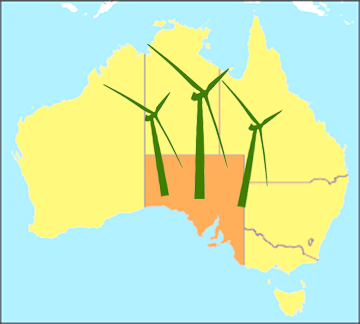 Siemens and TrustPower to build largest wind farm in South Australia, PACE, 3 August, 2012 Kevin Gomez, TrustPower has appointed Siemens as their turn-key supplier to construct South Australia’s largest wind farm at Snowtown using for the first time in Australia, gearless drive wind turbine technology.
With the project formally reaching financial close, the Snowtown II wind farm development will be capable of generating 270 megawatts of renewable energy and powering approximately 180,000 South Australian homes……. South Australia has now set a target of 33 per cent renewable energy by 2020. The new Snowtown II wind farm is set to help achieve this target.
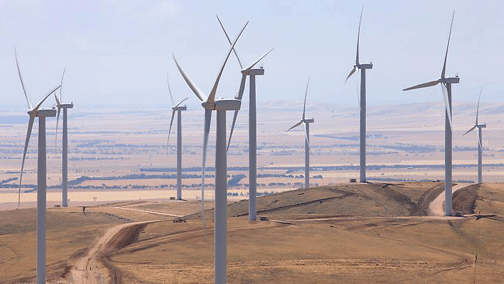
Snowtown II is co-located with the existing Snowtown wind farm, which will more than triple the renewable energy generation of the region. Early preparations have commenced at the site with construction commencing inAugust 2012 to ensure the project is fully operational by the end of 2014…. http://www.pacetoday.com.au/news/siemens-and-trustpower-to-build-largest-wind-farm
Reports indicate that Australia is set for huge change to renewable energy
 Poised for energy game-changer http://www.theaustralian.com.au/business/companies/poised-for-energy-game-changer/story-fn91v9q3-1226441797585 BY: GILES PARKINSON The Australian August 03, 2012 The Bureau of Resources and Energy Economics has found that solar and wind will be less expensive than new coal or gas by 2020
A WEEK ago, the Climate Institute published the results of a survey that showed Australians, despite being largely undecided about climate change, much preferred solar and wind energy over coal power and nuclear.
It was a choice largely driven by the urge to be clean and green, and two key reports delivered in the past year affirm their choice: solar and wind are the cheapest options too. The reports — a study by AECOM and a more detailed, landmark analysis of 40 technology options by the government forecaster, the Bureau of Resources and Energy Economics — suggest we are on the verge of a profound change in sentiment in the debate about renewables.
The studies have effectively blown the argument that the nation’s 20 per cent renewable energy target should be canned or wound back on the basis that it is too expensive.
BREE found that wind and solar will be less expensive than new coal or gas by 2020 and will be the cheapest of all energy options by 2030. Its findings suggest that the RET, because it encourages deployment, simply accelerates the fall in the cost curve. AECOM’s report found that building more renewables generation such as wind and solar would
enable the nation to protect against rising gas prices, which are seen as inevitable as gas is funnelled through the massive liquefied natural gas plants to the export market.
Australia’s energy assessment includes nuclear power, IGNORES DECOMMISSIONING COSTS
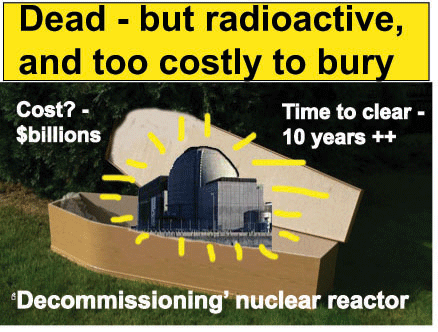 BREE says the cost of building a new nuclear facility 2012 in Australia would be less than A$100/MWh, rising to $126/MWh in 2050. But BREE says it did not factor in decommissioning costs.
Australia sees PV and wind as cheapest sources by 2030  http://www.rechargenews.com/business_area/finance/article319046.ece1 August 12, By 2030, solar PV and onshore wind farms are expected to provide some of the lowest-cost alternatives to coal and gas-fired power stations, with PV likely to be considerably cheaper than all
  other energy forms by 2050, Australia’s chief energy forecasting body says.
In The Australian Energy Technology Assessment (AETA), the Australia’s energy assessment compares the levelised cost of electricity (LCOE) – that is the price at which electricity must be produced from a specific source to break even – of 40 different generation technologies.
It finds the costs of PV have dropped sharply in the past two to three years as a result of a rapid increase in global production of solar modules. Continue reading
Outback Aboriginal company joins forces with solar power company
Aboriginal people to install solar systems in remote WA communities http://www.abc.net.au/rural news/content/201207/s3556353.htm ABC rural news By Babs McHugh , 30/07/2012 An Indigenous mining company has joined forces with a solar power company to build renewable energy systems in remote Western Australia.
Carey Power plans to train and employ local Aboriginal people to install and maintain the power systems, which will also be rolled out to mine sites.
Minnie King is a Torres Strait Islander who’ll run the company, which has already signed a memorandum of understanding (MOU) with an Aboriginal Corporation in the Northern Territory to look at power solutions there.
She says Carey Power will be initially focused on solar energy projects, using panels bought in China.
“We’re interested in looking at perhaps doing hybrids, where there are existing diesel generation systems in communities, looking at installing solar there, perhaps solar farms,” she said. “But in saying that, there are other technologies that we would be interested in exploring down the track.”
Lower income suburbs in Victoria taking to solar energy in a big way
 Tarneit and neighbouring suburbs Hoppers Crossing and Truganina have more solar power installed than any other postcode in the state – 2564 systems, with a capacity of 5.1 megawatts.
Werribee, just a little further down the Princes Freeway, is second on the list of Victorian solar postcodes. The top five are rounded out by other lower-income, outer-suburban areas: Cranbourne, Caroline Springs and Grovedale in Geelong.
”I don’t think the government or public have appreciated just how profound or rapid the change will be in the solar market over the next couple of years.”
Out on the fringe, solar comes of age, The Age, July 28, 2012,  Adam Morton UNTIL recently, Tarneit, about 25 kilometres west of the Melbourne CBD, was mostly grazing paddocks, a place without a post
office. Now there is barely a cow left. Between the 2006 and 2011 censuses, the population of the outer suburb boomed, tripling to more than 20,000 as the city sprawled and first home buyers snapped up new affordable housing.
The residents of Tarneit are much like those in other developing areas on the city’s fringe. As you might expect, they earn less than the average Victorian. Perhaps less predictably, they are also much more likely to have solar panels on their roofs.
While the myth of solar panels as a purely upper-middle-class luxury persists, new data released by the Clean Energy Regulator suggests it is misplaced. Continue reading
Dick Smith promoting CSIRO’s electric car
 the CSIRO test car is designed in such a way that it can be used as a household power source, feeding electricity back into the 240-volt grid, and being charged up again at night when power demand is low.
Dick Smith visits Newcastle CSIRO centre http://www.theherald.com.au/news/local/news/general/dick-smith-visits-newcastle-csiro-centre/2637702.aspx BY IAN KIRKWOOD 28 Jul, 2012 AS an avowed skeptic, entrepeneur and philanthropist Dick Smith says renewable energy is a good thing whether climate change is real or not.
“While I think we could be altering our climate, I think most business people like me are climate change deniers and I think we could be affecting the climate but coal and oil are going to run out one day,” Mr Smith said in Newcastle yesterday. Continue reading
Wind farm at Collector supported, despite one small “astroturf” group’s opposition
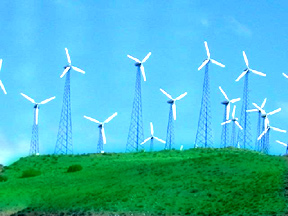 Wind farm claims local supporters, Canberra Times, July 27, 2012, John Thistleton Proponents of a $400 million, 68-turbine wind farm at Collector say most of the village residents support the project, which has moved a step closer to approval.
RATCH-Australia is expected to take two years building the region’s latest wind farm near the Federal Highway at Collector. It will generate up to 228 megawatts of electricity, or enough energy to power around 80,000 homes annually.
Chief executive Steve Loxton said the 60-day public exhibition period represented the culmination of years of research.
”Our surveys of local Collector residents confirm that there is strong support for renewable energy Continue reading
Australians support renewable energy, despite the vitriolic campaign against climate scientists,
 Australians’ strong renewables backing, Climate Spectator, 25 Jul 2012, Lane Crockett As reported yesterday, the Climate Institute launched Climate of the Nation 2012 which is an annual research piece that seeks to understand the attitudes of Australians regarding climate change and energy.
While this year’s report finds that Australians are exhausted by the politics around climate policy and are somewhat confused on climate change science their vision of a low-carbon future is crystal clear: they want renewable energy.
Increasing the amount of renewable energy is perceived as the most effective greenhouse gas emission reduction policy, which along with energy efficiency rated well ahead of other suggested measures.
For the last few years climate change and its solutions have been the target of a well-oiled campaign against innovation, efficiency and clean energy investment. This campaign has included vitriolic attacks directed at highly regarded members of the scientific community, vain attempts to debunk well-established climate change science and highly inaccurate and
misleading claims made about possible solutions such as renewable
energy. Continue reading
Australia’s exceptional potential for wave energy
 AUDIO Australia to catch the wave and hang ten (per cent that is) July 25, 2012 Australia’s coast line in the Southern Ocean has the best wave resources. Particular areas to note are the west coast of Tasmania, the southern ocean in Victoria and south-west Western Australia. (Phys.org) –– Australia’s oceans hold a bounty of energy and could produce 24-hour power, either from the tides, currents or waves.
A study by CSIRO has found that the waves in the ocean could supply about 10 per cent of Australia’s electricity by 2050. This is equivalent to powering a city the size of Melbourne. Ian Cresswell, Director CSIRO Wealth from Oceans Flagship said understanding the potential of this clean, sustainable energy source was important for CSIRO. Continue reading
Australia now poised for renewable energy investment
 “There is no other industry that is growing at 40% a year,” “Many countries need to change their fuel capacity and replace it with clean energy, so there are a lot of possibilities in the renewable market. And it is so much quicker and easier to build renewable generation than conventional generation.”..
Australia risks missing out on green energy investment. Crikey, by Giles Parkinson of RenewEconomy 25 July 12 Australia has already been bypassed once by the world’s leading renewable energy developers, and risks doing so again if it makes more changes to its green energy policies, according to one of the world’s biggest energy groups.
The Australian clean energy market nearly became a wasteland after the Howard government refused to extend its hugely successful start to the country’s first Renewable Energy Target, causing many international and Australian companies to leave the country and manufacturing facilities to be closed.
There are concerns of a similar flight of interest, and capital, if the government makes changes to its 2020 Renewable Energy Target, which is expected to be the bedrock for some $20 billion of investment in wind energy and solar farms in the next eight years. Continue reading
Solar energy with molten salt storage a good option for remote mining areas in Australia
Australia risks missing out on green energy investment Crikey, by Giles Parkinson of RenewEconomy 25 July 12“……..Acciona is also one of the leading companies in concentrated solar thermal — building plants boasting parabolic trough and solar tower technologies, and recently adding molten salt storage so that such plants can become “dispatchable” like gas-fired power station
He said even solar thermal CSP is also already operating at about $150/MWh in countries with good sun, such as South Africa and Australia, and Acciona argues that this should draw the attention of big miners such as BHP Billiton and Rio Tinto, which are paying $300/MWh or more for diesel at remote mine sites.
“There’s got to be a shift in mindset from having a diesel generation plant they know well and which is relatively cheap to build, to shifting towards a highly technical generation source and perhaps outsourcing the management and ownership of that asset through a third party that knows how to operate that,” Thompson said.
Mateo says PV is heading towards $100/MWh and it was interesting to note that in some countries, financing had been offered by banks without subsidies from the government, and even without power purchase agreements. In Chile, for instance, the cost of energy is $100/MWh, which allows wind and solar PV, in some instances, to compete. Mateo said there could be opportunities to combine CSP installations with solar PV….. http://www.crikey.com.au/2012/07/24/australia-risks-missing-out-on-green-energy-investment/
Victoria’s outstanding potential for renewable energy is being neglected
 Victoria missing out on renewable energy http://www.abc.net.au/news/2012-07-23/victoria-missing-out-on-renewable-energy/4147502?section=vic July 23, 2012 Victoria is “blessed” with its renewable energy capacity: Tim Flannery. The Climate Commission says Victoria’s renewable energy resources are barely being tapped.
Chief climate commissioner Professor Tim Flannery says we are entering a new chapter of climate change and Victoria should be making a sharp shift to renewable energy such as wind and solar power. “Victoria has got fabulous wind resources, the envy of places like Europe and fantastic solar resources too,” Professor Flannery said. Continue reading
Australia’s mental health problem about wind farms
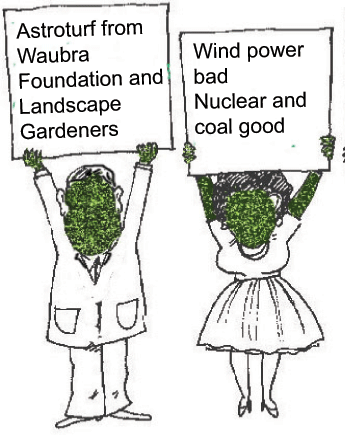 There are two main anti-wind farm groups in Australia busily fomenting anxiety and opposition. One is the Waubra Foundation, a group of mainly wealthy individuals, none of whom live in or near the town of Waubra, near Ballarat. Several of them, NIMBY style, have opposed turbines near their own properties elsewhere. They are led by an unregistered doctor, Sarah Laurie, and a wealthy mining investor, Peter Mitchell who also has connections to the Landscape Guardians. Despite their name, the Guardians have never attempted to guard our landscape from over-zealous residential developers, open cut coal or coal seam gas mining. They only target wind farm developments. All three – Waubra, the Guardians and Mitchell’s mining investment company share a South Melbourne post office box.
Wind turbine syndrome: a classic ‘communicated’ disease , by Simon Chapman https://theconversation.edu.au/wind-turbine-syndrome-a-classic-communicated-disease-8318?utm_medium=email&utm_campaign=Latest+from+The+Conversation+for+20+July+2012&utm_content=Latest+from+The+Conversation+for+20+July+2012+CID_be7f8aff1000afd17cabaf558b629431&utm_source=campaign_monitor&utm_term=Simon+Chapman+investigates At the beginning of this year I started collecting examples of health problems some people were attributing to wind turbine exposure. I had noticed a growing number of such claims on the internet and was curious about how many I could find. Within an hour or two I had found nearly 50 and today the number has grown to an astonishing 155.
I have worked in public health on three continents since the mid 1970s. In all this time, I have never encountered anything in the history of disease that is said to cause even a fraction of the list of problems I have collected.
The list of 155 problems includes “deaths, many deaths”, none of which have ever been brought to the attention of a coroner. It includes several types of cancer, and both losing weight and gaining weight. You name it. Haemorrhoids have not yet been named, but nothing would surprise me. Continue reading
Battery storage of energy poised to increase renewable energy systems, especially in remote areas
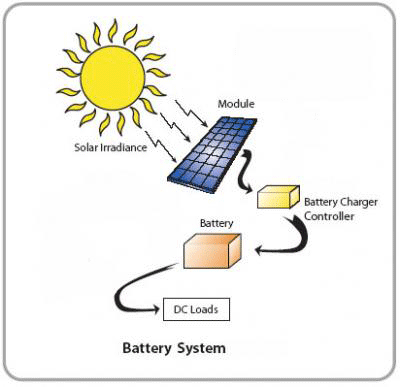 the way the world generates electricity and delivers it to customers is undergoing fundamental change, be it towards smart grids or green grids, and scalable energy storage solutions, such as batteries, will be a key part of the industry in the future.
Redflow is one of only a handful of manufacturers of “flow” batteries, which Winter says are better able to manage long-term storage than lithium ion or other battery standards…..
Energy storage group Redflow works to recharge batteries BY: GILES PARKINSON The Australian July 20, 2012 WHEN Brisbane-based battery storage developer Redflow listed on the Australian Stock Exchange in November 2010, it quickly became a market darling: the prospect of a cost-effective battery in a market increasingly hungry for storage capacity to manage demand peaks and the influx of renewables seemed irresistible.
Redflow shares quickly jumped to a peak of $1.70 for a market capitalisation of well more than $100 million before enthusiasm began to wane. Earlier this year, the bottom fell out when the company admitted its business plan was overly optimistic and any manufacturing deals would have to be put on hold……Chris Winter, who co-invented the company’s key product, a zinc-bromine “flow” battery in a Brisbane back yard in 2001, took the reins again. Continue reading
Australia top in solar radiation, may soon be top in solar energy market.
Yingli Green Energy, a Chinese solar panel manufacturer, believes that the potential for solar energy in Australia is so high that it may become the leader of the photovoltaic mass market by the end of the year.

Yingli notes the number of solar energy projects that are taking root in the country. Some researchers and solar energy market analysts have suggested that Australia may be the first to reach grid-parity with its solar energy initiatives. If this is accomplished within the next five years, the country could be home to the most active solar energy markets in the world.
Australia poised to take the lead in solar energy market http://www.hydrogenfuelnews.com/australia-poised-to-take-the-lead-in-solar-energy-market/854766/ BY ANGIE BERGENSON – JULY 16, 2012 ingli Green Energy notes the solar energy potential of the country
Over the past decade, Australia has shown modest support for alternative energy. In recent years, this support has been growing at a rapid pace, with the country now showing major interest in solar energy. Because of Australia’s exposure to solar radiation, it is one of the most attractive locations in terms of a solar energy market. Continue reading
1 This month
15 April – Zoom –Nuclear Power is Not the Solution
Apr 15, 2026 01:00 AM in Canberra, Melbourne, Sydney

Join the International Physicians for the Prevention of Nuclear War (IPPNW) on Tuesday, April 14th for a timely webinar exploring the risks associated with nuclear power and challenging the myth that it offers a simple, safe, carbon-free solution to the climate crisis

of the week – Australians for War Powers Reform (AWPR)
To see nuclear-related stories in greater depth and intensity
 Antinuclear