1.2 million solar installations already in Australia
 Australia Home To More Than 1.2 Million Solar Installations http://www.energymatters.com.au/index.php?main_page=news_article&article_id=3186, by Energy Matters,2 May 12
Either Australia is chock-full of tree-hugging hippies, or the average Aussie is increasingly understanding how much money can be saved by making the switch to solar… and yes, it’s the latter. According to statistics published by the newly-formed REC Agents Association (RAA), 665,215 solar power systems for which certificates have been registered were installed between 2001 to the end of March this year, representing an installed capacity of 1.431 gigawatts. Add to that 574,503 solar hot water systems and throw in 149,420 air source heat pumps (arguably also a solar technology) for good measure and the total figure is actually closer to 1.4 million systems.
The RAA says 20% of Australian households that could have a PV or solar hot water system installed have done so, thanks largely to support provided under Australia’s Renewable Energy Target (RET), which has helped reduce the installed cost of a PV system 75% over last 5 years. Continue reading
Australian-owned and developed in launching Western Australia’s wave energy project
 WA to launch world-first wave energy project, WA Today, Pamela Mirghani May 1, 2012 – The first wave energy project in the Southern Hemisphere is set to commence operation in Western Australia next year, with the federal government announcing almost $10 million in funding today. Continue reading
Victoria’s Baillieu government YES to coal, NO to wind – despite the facts
— A wind farm cannot be built within two kilometres of a person’s home without their consent. But a coal mine can be opened within 100 meters of a home without the owner’s consent.
— Wind farms are now excluded from ‘no go’ zones stretching across the state. But coal mines face no such ‘no go’ zones: the only place they are excluded from is national parks (for now).
— All wind farms require planning approval from the local council. Coal projects, on the other hand, can avoid the need to obtain certain planning approvals at all in some cases.
— Wind farms must comply with environmental laws like any other project. Coal projects, on the other hand, are exempt from parts of key laws like the Environment Protection Act 1970 (Vic).
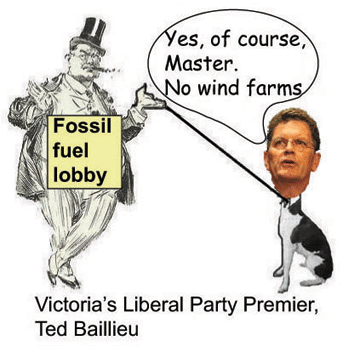
 Coal or wind in your backyard? http://www.climatespectator.com.au/commentary/coal-or-wind-your-backyard Michael Power, 30 April 12, If you’re going to ‘pick winners’ from the energy market, you at least want to choose wisely. So it’s hard to see why Victorian laws treat coal and coal seam gas more favourably than renewable energy.
The Environment Defenders Office (Victoria) (EDO) released a report last week that finds Victoria’s laws give the mining industry privileged treatment that few other industries enjoy. In particular, they now make it easier to obtain approval for a coal mine than a wind farm in Victoria.
The planning rules for wind farms introduced by the state government last year are some of the toughest that apply to any type of development anywhere in the country. No new wind projects have been proposed in Victoria since they have been introduced.
At the same time, the government has moved to relax the laws that apply to new mining projects, developing a strategy to encourage brown coal export in Victoria, and initiating a Parliamentary Inquiry to identify and remove barriers to further ‘Greenfields’ minerals exploration and mining. Continue reading
The facts on wind power in Australia
Although the cost of wind energy continues to fall, government support such as the Renewable Energy Target (RET) Scheme is crucial to support investment in the industry and enables the wind power sector to play a major role in helping Australia’s transition to a low carbon economy. The introduction of a price on carbon, which is anticipated for
mid-2012, will provide the focal point of the government’s strategy to reduce emissions.
 Five new wind farm projects were commissioned in 2011 in Australia, Reve April 23, 2012 At the end of 2011, Australia had 1,211 operating wind turbines across 58 wind power plants with a total installed wind energy capacity of 2,224 MW.
Australia’s exceptional wind resources have allowed wind energy to make an increasing contribution to Australia’s energy mix. Although it is still a relatively new industry, wind farm supplies over 6,400 GWh annually, which represents more than 2% of national electricity consumption.
At the end of 2011, Australia had 1,211 operating wind turbines across 58 wind power plants with a total installed wind energy capacity of 2,224 MW. The total installed capacity of wind power has grown by an average of 35% per year over the past five years.
Although the cost of wind energy continues to fall, government support such as the Renewable Energy Target (RET) Scheme is crucial to support investment in the industry and enables the wind power sector to play a major role in helping Australia’s transition to a low carbon economy. The introduction of a price on carbon, which is anticipated for
mid-2012, will provide the focal point of the government’s strategy to reduce emissions. Continue reading
Australia needs Renewable Energy Target for financial reasons, as well as for jobs, and climate action
 But one of the most important reasons for the RET has nothing to do with reducing carbon emissions, nor the $20 billion of investment and 30,000 jobs it would secure in rural and regional Australia where most of our renewable resources are found.
It is the need to make sure we’ve got lots of renewable energy to call on in the future as we face the spiralling costs of fossil-fuelled electricity….
Let’s keep our power pants on, SMH, Kane Thornton, April 20, 2012 Suggesting we don’t need a Renewable Energy Target because we have a carbon price is like suggesting you don’t need pants because you have a jacket. Sure there’s a little overlap, but heading boldly into the world without your pants isn’t going to earn you any respect – particularly when just about everyone else is wearing them.
Over the last week, both the Business Council of Australia and the NSW Government have argued against our 20 per cent Renewable Energy Target (RET). While the cost of renewable energy is falling quickly, the carbon price alone is not high enough to generate sufficient investment in renewable energy projects. That’s why we need the RET too. Each also has a role to play in reducing our carbon emissions.
Both sides of Australian politics understand the importance of the RET. It was established by Liberal Prime Minister John Howard, and Labor’s Kevin Rudd increased it to 20 per cent with the support of the Coalition and Greens in 2009. In recent weeks, both Climate Change Minister Greg Combet and his opposition counterpart, Greg Hunt, have
restated their support for the policy. Continue reading
Port Augusta South Australia ideal for a renewable energy revolution
 Repowering Port Augusta With Solar And Wind – Blueprint http://www.energymatters.com.au/index.php?main_page=news_article&article_id=3171 by Energy Matters 20 April 12, Non-profit think-tank Beyond Zero Emissions (BZE) has released ‘Repowering Port Augusta’; a blueprint for replacing South Australia’s emissions intensive Northern and Playford B brown coal-fired power stations with wind power and solar energy facilities. Continue reading
Expert panel reviews the Clean Energy Finance Corporation
the panel has recognised the significance and the potential for new technologies to transform Australia’s energy system and ensure it remains competitive with other countries.
Now, however, just watch the Opposition attack it, along with the usual suspects among the established energy generators and emitters. The key themes of this report – investment for long-term gains over short term costs, the “external” benefits which are overlooked by banks and statutory authorities, and the issue of future competitiveness – will no doubt be lost in the shouting.
 Ten things you should know about the CEFC REneweconomy, By Giles Parkinson 17 April 2012 The long-awaited “experts review” into the proposed $10 billion Clean Energy Finance Corporation has been delivered to – and accepted by – the federal government.
The CEFC is seen as one of the most critical elements of the Clean Energy Future package by large parts of the clean energy industry, particularly those trying to introduce new technologies. It will certainly be one of the political hot potatoes going into the next election. The federal Government says it intends to introduce legislation into the Budget sittings of parliament which begin in May. The Opposition calls it a “slush fund.”
Here are some highlights from review by the team led by Reserve Bankboard member Jillian Broadbent, and supported by funds manager David Paradice and former banker Ian Moore. Continue reading
Tony Abbott will not be able to destroy the Clean Energy Finance Corporation
 Abbott-proof fence around clean-energy funds, The Age, David Wroe April 18, 2012 THE Gillard government will fireproof its $10 billion green technology fund against an attack from any future Coalition government by forcing Tony Abbott to repeal legislation in order to shut down the flow of money.
Ensuring its clean energy policies are carved in stone even if it loses next year’s election, Labor indicated yesterday that the funding for the Clean Energy Finance Corporation would be ”specifically appropriated” in legislation to be introduced to Parliament next month. Continue reading
Australian Government set to launch Clean Energy Finance Corporation (CEFC)
$10b fund for renewable energy firms http://www.perthnow.com.au/business/b-fund-for-renewable-energy-firms/story-e6frg2r3-1226330084361 AAP April 17, 2012 COMPANIES involved in renewable energy will soon be able to tap into a $10 billion federal pool. The Gillard government released today an independent review into the Clean Energy Finance Corporation (CEFC), which is due to start operating from July 2013.
The government accepted all recommendations made by the review.
The CEFC will provide $10 billion worth of financing to companies involved in renewable energy, low-emissions and energy efficiency technology. The review was led by Reserve Bank of Australia board member Jillian Broadbent.
The CEFC will encourage private investment and help overcome capital market barriers for cleaner energy technologies, the government said in a statement today.
The fund will apply “commercial rigor” to its investment decisions to make sure companies have a positive rate of return and are able to repay the loans.
In Western Australia – a window in Australia’s solar future
“[It’s] a window into Australia’s solar future,” – Australian Solar Energy Society chief executive John Grimes
“Big solar makes sense in the Mid West. The region’s enormous appetite for energy is matched by some of the best sunshine in the world.
“Solar increasingly makes economic sense in the Mid West, with a dramatic fall in the price of solar PV countering a significant rise in the cost of electricity.”
Mr Grimes said there was no reason why solar could not provide a significant amount of Austral’s electricity needs by 2020, particularly with the introduction of the carbon tax from July 1 and the national 20 per cent renewable energy target.
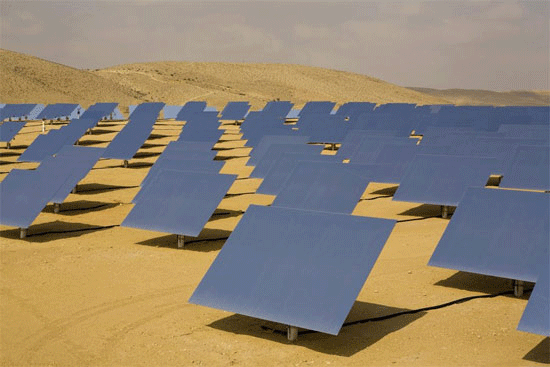
Historic solar farm transforms WA landscape http://www.watoday.com.au/wa-news/historic-solar-farm-transforms-wa-landscape-20120412-1ww3t.html#ixzz1s49L4pPw WA Today, Courtney Trenwith April 12, 2012 WA’s historic solar power farm will soon be glistening in the outback, with the first panel installed today. In what will be the largest solar energy generator in the country, the farm will house 150,000 panels across 80 hectares, creating a remarkable sight and producing an environmental feat.
The 10 megawatt Greenough River Solar Farm is being built 50 kilometres south of Geraldton, with 100 construction jobs created. It is expected to generate enough electricity for 3,000 average homes while displacing 20,000 tonnes of greenhouse gas each year – the equivalent of taking 4000 vehicles off the road. Continue reading
Residents near Windy Hill, Queensland, speak about wind energy
(includes video) Winds of change generating a powerful debate over Mt Emerald The Cairns Post Tony Stickley, April 14, 2012 The proposal of a wind farm at Mt Emerald has created a strong debate over noise issues for residential properties nearby. The Cairns Post explored how residents at Windy Hill feel about the wind farm noise. CLEAN, green renewable energy powering 60 per cent of Cairns and the whole of the Tableland shines like the holy grail of electricity generation. Could you live next door to a windfarm? Listen to Windy Hill residents and make up your own mind. Continue reading
Australia’s lost opportunities in solar power
 the big dish was by-passed in the Federal Government’s Solar Flagships program. The claim that it was not “commercially ready” is directly contradicted by the creation of the Solar Oasis consortium that is now building a 40 MW big dish solar power generator at Whyalla, in South Australia.
Solar lessons from Korea, Daily Mercury, John Mathews | 14th April 2012 “……. [Korea] is streamlining investment into the new green sectors, that so far run to financing of nearly $50 billion. That’s billion, not million – compared with Australia’s much-touted Solar Flagship program which is funded at the level of millions.
………the Korean approach will be – mark my words – to turn the solar dish concept into a central component of their new green growth industrial strategy. They will be expected to acquire rights to the technology, and then adapt it through the intervention of Hyundai or LG or Samsung (the Korean innovation champions). They will mass produce the dishes in the thousands and then promote use of the technology throughout the world, providing all the components and materials from Korean sources.
The contrast with our approach in Australia could not be more stark. So far, we have seen two major solar technologies starved of funds and shipped offshore. There was thin-film solar photovoltaic technology, developed at the University of NSW under Professor Martin Green, that became a political football and a casualty of NSW state politics (when Bob Carr was premier). It was eventually sold off to Germany. Continue reading
Solar powered air conditioning – the answer to Australia’s electricity peak load
 How solar air-con could avoid costly network upgrades http://reneweconomy.com.au/2012/how-solar-air-con-could-avoid-costly-network-upgrades-46101 REneweconomy By Giles Parkinson 13 April 2012 The biggest strain on our electricity networks right now – and the cause for at least one third of the $45 billion network upgrades, and at least half of the recently announced tariff increases – are the “super” peak demand periods triggered when everyone returns home from work and flicks on their air conditioning.
In some states this might only occur for a few hours a year, more in others, but network operators have been at a loss to address the issue, apart from building more capacity. Other solutions have been offered – demand management being one of them – but what if the network operators could turn to solar-powered air conditioners as the solution to reduce peak load? Continue reading
BHP’s Marius Kloppers leads the fight against renewable energy
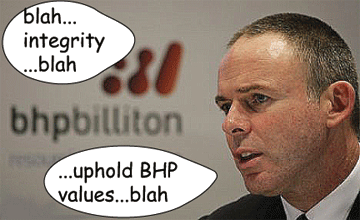 Renewables target under fire , The Australian BY: ANNABEL HEPWORTH, DAVID CROWE April 13, 2012
LABOR faces growing business pressure to scale back its renewable energy target when it is reviewed this year, with BHP chief executive Marius Kloppers urging the Gillard government to “take a cold, hard look” at how it will interact with the carbon tax. …
Rural communities like Broken Hill keenly taking up solar energy
Broken Hill embraces solar power, Margaret Paul, ABC News, April 12, 2012 The peak body representing renewable energy in Australia says regional New South Wales is leading the way in terms of the number of households installing solar panels.
The Federal Government’s Renewable Energy Regulator office has released the latest figures which show 19 per cent of properties in Broken Hill have installed solar panels….. Russel Marsh, policy director with the clean energy council, says it is no surprise to see regional areas ranked highly. “Increasingly, the people and the households who are installing solar
panels are not those who live in the urban areas, but those who live in regional areas who tend to be on lower incomes.
“We think that’s because they have the most to gain from installing solar panels on their roof, in terms of the savings they can make on their electricity bill as a result of generating their own electricity from the sun.”….
http://www.abc.net.au/news/2012-04-12/solar-postcodes/3945504
1 This month
15 April – Zoom –Nuclear Power is Not the Solution
Apr 15, 2026 01:00 AM in Canberra, Melbourne, Sydney

Join the International Physicians for the Prevention of Nuclear War (IPPNW) on Tuesday, April 14th for a timely webinar exploring the risks associated with nuclear power and challenging the myth that it offers a simple, safe, carbon-free solution to the climate crisis

of the week – Australians for War Powers Reform (AWPR)
To see nuclear-related stories in greater depth and intensity
 Antinuclear