Whisper quiet wind turbines for Australia
 Newly-introduced policy regulations in states such as Victoria and South Australia have seen a number of changes to the zoning of wind farms. According to Mr Le Messurier, however, the Eco Whisper Turbine does not face the same limitations as larger turbines.
“One of the major concerns from a community standpoint around wind turbines is the issue of noise. The planning response we have had from the Victorian government, however, is that [the wind legislation] doesn’t apply to us, given that the Eco Whisper is virtually silent,” Mr Le Messurier said.
“The quietness of the wind turbine and its ability to operate effectively in a range of wind conditions makes it well-suited for organisations seeking to reduce their greenhouse gas emissions and the impact of the Federal Government’s carbon pricing mechanism.”.
 Quiet as a Whisper Ecogeneration, 12 Jan 12, The Eco Whisper Turbine, recently released by Renewable Energy Solutions Australia Holdings Limited, is believed to be the world’s quietest 20 kilowatt wind turbine. Due to its unique design, which sees the Eco Whisper Turbine’s blades housed within a cowl that sits around the outside of the turbine, the 20 kilowatt (kW) product is virtually silent. Continue reading
Solar energy can power your electronic book, iPad, iPhone, other mobile phones and USB devices
 Solar Panel Cover For The Kindle E-reader, by Energy Matters, 9 Jan 12 Using solar energy to provide power for hand-held devices has huge potential and while solar panels embedded in mobile phones mightn’t be much chop (yet) in terms of performance; it seems a new solar cover for the Kindle e-reader delivers.
The SolarKindle, weighing just 215 grams, incorporates a flexible, lightweight triple junction amorphous solar panel and is able to provide some level of charging even in the shade. A one hour charge in direct sunlight can provide almost three days worth of reading time according to the company that created the device, SolarFocus Technology.
After fully charging the Kindle, the solar panel automatically switches to charge the SolarKindle’s 1500mA reserve battery. A fully charged reserve battery requires around eight hours of direct sunlight and provides up to 80% of backup power to the Kindle.
However, bearing in mind that Australia’s sunshine and temperatures can be extreme during summer, perhaps sticking your SolarKindle enshrouded e-reader out in the sun on a 40 degree day for extended periods may be unwise.
The SolarKindle also incorporates an 800 lux LED reading lamp. If the reserve battery is used for lighting alone, it can power the light for up to 50 hours. An LED indicator incorporated in the SolarKindle shows battery power level and status of charging and discharging.
The SolarKindle can be purchased online for around AUD $80, plus delivery.
SolarFocus was named an International CES Innovations 2012 Design and Engineering Awards Honoree for its SolarKindle Lighted Cover. The company says it holds several solar technology patents with their products used in extreme environments such as the Himalayas and the North Pole.
SolarFocus also manufactures a folding solar charger for the iPad, iPhone, other mobile phones and USB devices called the SolarMio Pro. While certainly not as compact as the embedded solar panel Nokia recently trialed, the 5 watt SolarMio Pro watt system can provide 6 hours of talk time on the iPhone 3Gs with just an hour of solar charging.. http://www.energymatters.com.au/index.php?main_page=news_article&article_id=1972
Australia’s carbon tax can benefit commercial electricity consumers
 Australia’s Carbon Tax And Commercial Electricity Customers , Energy Matters, 4 Jan 12, “……..While carbon tax relief for Australian households has been well publicised, the situation for commercial customers has received less coverage.
Commercial electricity customers often pay a lower rate for power than residential users; so the carbon tax will in effect see electricity costs increase by a greater degree for some enterprises from July 1, 2012. According to some estimates, the jump could be as much as 19 percent for big power users.
In terms of government support, the manufacturing sector will be able to benefit from the $800 million Clean Technology Investment Program, which will provide grants to manufacturers to support investments in energy-efficient capital equipment and low-pollution technologies, such as commercial solar power systems. ….
Small businesses can also take advantage of the Solar Credits scheme to purchase a solar power system right now. For just a few thousand dollars, even an entry-level rooftop solar panel array can slash power bills by a significant amount. The Solar Credits rebate will be further reduced from July 1 this year.
Other forms of carbon tax relief will be available for small and large enterprises, the details of which can be viewed on the Australian Government’s Clean Energy Future web site.
The carbon tax isn’t the only power bill bogeyman on the horizon – frequent electricity price rises in the years ahead due to other factors will become the norm rather than the exception. For businesses in Australia, energy efficiency and the implementation of on-site alternative energy generation will become an increasingly pressing issue and an important part of maintaining profitable enterprises. http://www.energymatters.com.au/index.php?main_page=news_article&article_id=1966
Australia’s largest renewable energy fund kicks off
$200 million in seed money will kick-start the fund, half coming from the Australian government and half coming from Softbank China Venture Capital.
The money comes from the Australian Renewable Energy Agency, which is funded at $3.2 billion a year.
Australia Seeds Largest Renewable Energy Fund, Flagship Raises VC Fund SustainableBusiness.com News, 12 Jan 12, In a difficult environment for fundraising, especially for funds that invest in early stage companies, venture capital firm Flagship Ventures closed its fourth fund, a $270 million fund.
Flagship says they exceeded their target of $250 million for the fund, which will invest in healthcare and cleantech/ sustainability. Investors in Flagship Ventures Fund IV include pension funds, foundations, fund-of-funds, corporations and individuals. Its previous fund, launched in 2007, was $235 million, which invested in 24 companies. Continue reading
Wind farming an economic opportunity for Australia’s struggling farmers
Wind farms in Australia face the toughest guidelines in the world in relation to their siting, operation and permissible 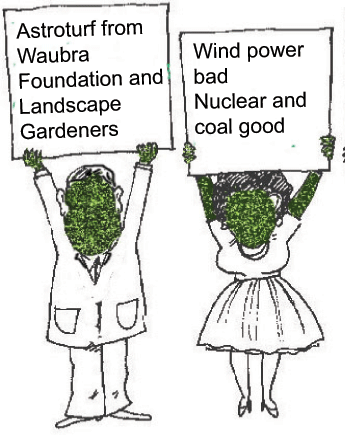
noise levels.
opponents of renewable energy seem determined to use wind farms as political footballs, fuelling community divisions they claim they want to avoid. They make inflammatory claims about noise – when a wealth of scientific research shows that noise from wind farms does not have a harmful effect on people.
Thornton: Winds of change for farmers Adelaide Now, by: Kane Thornton January 11, 2012 WIND turbines can help save struggling farms, argues Kane Thornton. LIFE on the land has only become tougher. The cruel effects of drought, fires and floods, along with the strong Aussie dollar and challenging global markets, have pushed farming families to the limit.
In many cases, diversification has been the key to their survival. Responding to changing market dynamics, consumer demands and weather conditions by moving into different crops, livestock and land uses, is helping save the family farm.

It would be a brave outsider who demanded the removal of the farmer’s right to make those choices for themselves.
Yet that is what the activists opposed to wind farms are doing.
They are saying that individual farmers should not have the right to choose wind farming to help them drought-proof their properties, make better use of marginal farming land, or insure against market downturns. But for those farmers fortunate enough to live in some of the windiest places in the world, farming wind can be the best option. Continue reading
Community solar energy for Australia – Mallacoota shows the way
 While these types of schemes are still relatively uncommon in Australia, a popular method of using the power of collaboration to install solar here is the solar buyers group. Consisting of people within a local area, these groups use their collective clout to secure better pricing for installing solar panels on their own rooftops…
In an initiative led by local resident Jim Sakkas, the community banded together to form a solar buyers group and since that time, close to one hundred solar power systems have been installed in Mallacoota by national solar solutions provider Energy Matters under the model.
A Co-operative Approach To Going Solar, by Energy Matters, 6 Jan 12, A growing number of people are starting renewable energy schemes in their communities through co-operatives and other forms of collaboration. A recent report from Co-operatives UK and The Co-operative Group states 43 communities are in the process of or already producing renewable energy by investing money to install solar panels, large wind turbines or hydro-electric power in their area.
£16 million has been invested by over 7,000 people in these schemes, which include a £2 million wind farm and a 98kW solar photovoltaic installation on the roof of a brewery.
The report says green economy co-operatives are the most rapidly growing part of the UK co-op sector, jumping 24% since 2008. In addition to these co-operatives’ efforts seeing clean, renewable energy being supplied to their communities, there is also a financial return to participants through the sale of electricity produced.
The co-operative approach covered in the report basically works like this: Continue reading
Wave Energy for Australia – the Island Continent
recent technological innovations may make that coastline as attractive to renewable energy investors as to sunbathers.
A new wave energy project is being planned for development off the coast of Garden Island in Western Australia, near Perth
 Australia Developing Wave Power, Oil Price.com by John Daly, 02 January 2012 Consider. Australia’s 2,966,140 square-mile landmass is ringed by 16,006 miles of coastline. Most of the population is concentrated along the southeast coast of the country, in an arc running from Brisbane to Adelaide along the “boomerang coast.”
Virtually all of Australia’s large cities – Sydney, Melbourne, Brisbane, Perth, and Adelaide – are on the coast. About 80 percent of Australia’s population lives within 30 miles of the coast.
So, where do the Aussies get their energy to support their affluent lifestyles? Continue reading
Solar energy costs, especially small scale, overestimated by 2 Australian agencies
renewable energy is coming down in price and fossil fuels are going up. In a carbon-constrained world, renewable energy is an investment in a lower electricity cost future for all Australians compared to the one they would face without it. Solar power will cost far less and provide far greater benefits over the medium term.”
 Productivity Commission And EUAA Blinkered On Solar by Energy Matters, 3 Jan 2012, Two Australian bodies criticising the cost of solar power have again failed to factor in all the benefits of the technology.
A Productivity Commission report from June this year was widely criticised by the solar power industry and supporters for stating rooftop solar has “generated little abatement for substantially higher cost”.
According to a recent article in The Australian, the backlash saw the Productivity Commission check over its figures recently and the Commissions has revised the cost of the small-scale component of the federal government’s Renewable Energy Target and state-based feed-in tariffs downwards – by tens of millions of dollars.
However, the Productivity Commission continues to dig its heels in relating to small scale solar’s cost generally. Continue reading
Success for Australia’s coal lobby, with new laws against wind farms in N.S.W. and Victoria
The state’s conservative Premier, Barry O’Farrell, .. has said that he personally opposes any no new wind farms.
public concerns about turbines have been “aided and abetted” by climate sceptics who have launched a Tea Party-style fear campaign. The campaign has featured local lobby groups protesting under the banner of “landscape guardians” – believed to be based on Britain’s Country Guardian.
The NSW Greens said the proposal would kill off the wind-generation sector in favour of coal seam gas projects
Australian state launches world’s toughest wind turbine laws, Telegraph UK 24 Dec 11 Australia’s most populus state has proposed the world’s toughest laws on wind turbines, with a plan to give all residents within 1.25 miles a veto over new projects.By Jonathan Pearlman in Sydney 23 Dec 20111. The New South Wales Government proposed the new rules following controversial rural wind farms which angered residents over noise and raised claims the vibrations cause stress and illness.
Under the proposals, turbines will be subject to a noise limit of 35 decibels, five decibels less than in the state of Victoria, which has similar guidelines. The NSW planning minister, Brad Hazzard, said the measures were “some of the toughest wind-farm guidelines in the country, possibly the world”. “One hundred per cent of neighbours have to be happy within that
two-kilometre zone,” he said. Continue reading
New report shows steady growth of renewable energy in Victoria, despite Baillieu govt
Sustainability Victoria reports wind generation from the existing 432MW of installed capacity has increased to 1,280GWh on a 12 month rolling basis to September 2011. Another 537 MW of capacity is under construction at three locations and due to be on line by 2013. Unfortunately these projects are likely to be the last to make it out of the planning pipeline due to the draconian new rules introduced by the Baillieu government to give a veto to any resident within 2km of a proposed wind project.
The whole story on Victorian renewables Climate Spectator, Andrew Herington, 22 Dec 11 In April 2011, the Victorian Auditor-General tabled a report Facilitating Renewable Energy Development which took a dim view of the potential of renewable energy.
There was widespread media coverage of this report, which focussed heavily on his finding that the proportion of electricity from renewable sources has only increased from 3.6 per cent in 2002 to 3.9 per cent in 2009. This was widely taken as proof that attempts to expand renewable energy had failed and is now often quoted by renewable opponents.
A new Clean Energy Australia 2011 report from the Clean Energy Council demonstrates the Auditor General’s conclusions were flawed and that renewable energy is strongly growing and is now providing around 11 per cent of Victoria’s electricity consumption. Continue reading
Martin Ferguson’s Energy White Paper got renewable and other energy costs wrong
 Draft Energy White Paper Gets Renewables Cost Wrong – Bloomberg , Energy Matters, 20 Dec 11 It’s a good thing the Australian Government’s recent Energy White Paper was a draft, because it appears they will be busy rewriting it. According to an article on The Australian, analysis by Bloomberg reveals figures in the Draft Energy White Paper overestimated the cost of solar power threefold and wind power by 50 per cent. Bloomberg says the paper has also underestimated the price of geothermal energy.
Bloomberg points out, as others have done, that some analysts fail to understand just how fast the cost of renewables is dropping. While calculations may be based on figures just a few years old, such data is ancient history given the evolutionary pace in the renewables sector. The Draft Energy White Paper has been widely panned by those committed to a renewable energy future for Australia and Energy Minister Martin Ferguson’s apparent enthusiasm for nuclear power has been treated with suspicion.
The increase in nuclear costs has been attributed to subsidies to nuclear-hosting communities and expenses related to the Fukushima Daiichi nuclear disaster, although whether the increase is sufficient to account for the unsettled costs of the disaster is being questioned by some.
While the Draft Energy White Paper played down the role of renewable energy, it also attempted to bolster the reputation of fossil fuel sources such as coal seam gas (CSG). Greens Senator and environmental lawyer Larissa Waters last week claimed the White Paper sung the praises of coal seam gas without recognising any of its devastating costs.
“This paper appears to have been written by someone living in a last-century bubble, with no consideration of the impacts of coal seam gas beyond the industry spin,” Senator Waters said. “How can you possibly plan for Australia’s energy future without factoring in the true costs of this energy source – the costs to water, to land, the environment and the climate, as well as the economic impacts on other industries?” http://www.energymatters.com.au/index.php?main_page=news_article&article_id=1942
Government of Australia’s URANIUM STATE, South Australia doing its best to kill renewable energy
 Green energy fund gets the chop BY: MICHAEL OWEN The Australian, December 16, 2011 A FUND to create a green energy industry will be axed in a cost-cutting measure by the South Australian government….. One of the most significant programs to be cut will be the Renewable Energy Fund, to deliver savings of more than $10 million a year. The
move will threaten the future of the five-member RenewablesSA board, chaired by prominent businessman Bruce Carter, and the role of the Commissioner for Renewable Energy, Tim O’Loughlin…..
Ousted premier Mike Rann launched the South Australian fund with an initial $20m in 2009 as the centrepiece of state Labor’s plan to become Australia’s green energy powerhouse.
It was to help the government reach its target of 33 per cent of renewable electricity generation by 2020 using wind, solar, geothermal and wave power. According to its website, the latest big announcement from the fund was a joint plan with new federal Industry Minister Greg Combet to use the fund to “create significant new job opportunities in
SA’s manufacturing sector”.
Mr Snelling refused to comment last night. Labor sources said cabinet chose to abolish the fund as it was hoped federal moves to invest in renewable energy because of the carbon tax would help reduce any political backlash.
Budget figures show that of the $10m allocated in 2009-10, just $2.7m had been spent by the fund, while last financial year just $2.9m of another $10m allocation had been
used…..http://www.theaustralian.com.au/national-affairs/climate/green-energy-fund-gets-the-chop/story-e6frg6xf-1226223413572
Australia’s fossil fuel industries determined to kill the Large Scale Renewable Energy Target (LRET)
what really scares the fossil fuel generators is the potential impact of a widespread deployment of solar, which some analysts predict could dominate the LRET rollout post 2015, as the cost of large-scale solar PV matches that of wind.
It is clear that there is a big push from industry and from the established generators to remove all “complementary measures” now that a carbon price has been implemented, and this includes the LRET – which, incidentally, is up for review next year.
 Why big energy wants to kill the Large Scale Renewable Energy Target (LRET) Climate Spectator, Giles Parkinson, , 16 Dec 2011 Ever heard of the merit order effect? Readers of this column may be familiar with it, because it is emerging as a key issue in the Australian electricity sector, and a flashpoint between the established fossil fuel generators and the new wave of renewable energy technologies, and a conflict between short term profits and long term gains.
The National Electricity Market, like many around in the world, is based on a merit order, where the plants with the cheapest marginal cost of fuel get preference. They bid into an energy stack until demand is filled. The price of electricity for that period is set by the bid of the last generator into the stack.
For decades, this has meant that the brown coal generators in Victoria, shoveling in cheap and dirty coal from their doorstep, go first, followed by black coal, gas, and then gas peaking stations when demand is really high. But the rollout of renewables has changed those dynamics, because their marginal cost of generation is next to nil, so they go first, forcing other generators further up the stack, meaning prices are pushed down, and some fossil fuel generators miss out altogether.
This has been a well documented effect in Europe and elsewhere, and is considered a virtue by the International Energy Agency, which says the merit order effect has meant that cost savings on wholesale energy prices have, in some cases, more than compensated for the cost of the subsidies that got the renewables built in the first place. Continue reading
Australia’s Energy Minister subtly sabotages photovolcaic solar energy
 Ferguson labeled all clean technologies as expensive and requiring subsidies, however the figures in the white paper, concerning photovoltaics, are more than 12 months old and do not reflect the rapidly falling cost of photovoltaics.
Australian energy “white paper” neglects PV potential, PV Magazine, 14. DECEMBER  2011, BY: JONATHAN GIFFORD A strategy document released this week, on Australia’s energy future, seems to have
  overlooked the potential of photovoltaics in the country. Instead the report focused on unproven technology, like carbon capture and storage, and leaving the door open for thedevelopment of nuclear power stations.
The Australian Federal Government has released a draft energy “white paper” in an attempt to develop a clearer energy policy direction for the nation. While “accelerating cleaner energy outcomes” is identified as one of the policy priorities, it appears that a major role for photovoltaics has been eschewed in favor of alternative “cleaner” energy technologies, such as carbon capture and storage – forcoal-fired power plants, nuclear and geothermal power. Continue reading
Venture Capital Fund launched by Australian Government
Australian Government Launches A$200 Million Venture Capital Fund, WSJ, DECEMBER 15, 2011, By Gillian Tan The Australian Government has appointed Southern Cross Venture Partners as fund manager of the nation’s largest renewable energy venture capital fund, valued at 200 million Australian dollars (US$198 million).
Softbank China Venture Capital will match the Government’s A$100 million commitment and the pooled funds will assist high potential Australian renewable energy start-up companies by making early-stage, critical equity investments beginning in 2012.
Southern Cross Venture Partners has offices in Sydney as well as Palo Alto and Shanghai and according to its website, a typical initial investment will be between A$2 million and A$5 million with additional cash injections in later rounds……The Southern Cross Renewable Energy Fund forms part of the Australian Government’s $3.2 billion Australian Renewable Energy Agency.
http://blogs.wsj.com/dealjournalaustralia/2011/12/15/australian-government-launches-a200-million-venture-capital-fund/?mod=google_news_blog
1 This month
7 April – WEBINAR – Australia and the Doomsday Clock – Preventing nuclear war through NoFirstUse and other policies
Online | Tuesday April 7, 4:00-5:30pm, Australian Eastern Time / 8:00-9:30am Central Europe Time
– Access the registration link
15 April – Zoom –Nuclear Power is Not the Solution
Apr 15, 2026 01:00 AM in Canberra, Melbourne, Sydney

Join the International Physicians for the Prevention of Nuclear War (IPPNW) on Tuesday, April 14th for a timely webinar exploring the risks associated with nuclear power and challenging the myth that it offers a simple, safe, carbon-free solution to the climate crisis

21 April Webinar: No Nuclear Weapons in Australia
Start: 2026-04-21 18:00:00 UTC Canberra, Melbourne, Sydney (GMT+10:00)
End: 2026-04-21 19:30:00 UTC Canberra, Melbourne, Sydney (GMT+10:00)
Event Type: Virtual
A virtual link will be communicated before the event.
Host Contact Info: australia@icanw.org

of the week – Australians for War Powers Reform (AWPR)
To see nuclear-related stories in greater depth and intensity
 Antinuclear