Big energy purchase deal for New South Wales wind farm
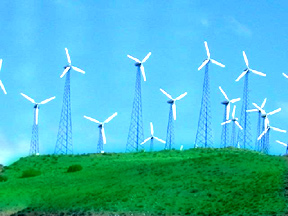 Origin Energy Buying Electricity From Gunning Wind Farm by Energy Matters, 24 Nov 11 Origin Energy has expanded its renewable energy portfolio, entering into a long-term power purchase agreement to buy electricity from Acciona’s Gunning Wind Farm.
Under the deal, Origin will initially purchase federal government issued Large-Scale Renewable Energy Certificates (LSREC) from Acciona for a period of two years, beginning January 2012. From January 1st 2014, the agreement allows Origin to buy both the LSRECs and the power generated by the wind farm for a further eight years; with an option to extend. Continue reading
In China, wind power racing ahead, while nuclear power declines
Nuclear power, on the other hand, is a tale of decline. China’s wind sector overshadows the 11GW worth of nuclear in their electricity supply. In only six years, wind has blossomed to deliver 55 per cent more electricity to the grid each year than nuclear – an energy source the Chinese have been building for the last 26 years.
The growth of nuclear in China, although slow, has slowed further
China’s massive deployments will be driving renewables down the cost curve, so Australia can invest in wind today with certainty that the technology is a wise long-term investment.
China’s path to renewable superpower Climate Spectator, Matthew Wright, 23 Nov 11 Comparing China’s wind and nuclear power sectors reveal much about the fortunes of new and old energy technologies. Wind power in China is growing at a blinding pace. China commenced construction of its first wind turbines in 2005 and in just six years has installed 58GW worth of wind power, which now contributes 128TWh to its grid. This is enough renewable electricity to power Australia’s most populous states – NSW and Victoria combined. Continue reading
Australia’s electric transport future – powered by sun and wind
 Australia needs to begin a deliberate and widespread push into electrifying its transport
  network, which means a big push for electric vehicles, but also a much higher ambition for renewable energy deployment. Siemens, Europe’s biggest supplier of energy equipment, which recently dumped nuclear from its portfolio after Germany’s withdrawal, suggests 40 per cent of Australia’s power generation should come from renewables – particularly solar and wind – by 2030.
An electric dream for transport, Climate Spectator Giles Parkinson, 23 Nov 11 Imagine an Australia with fast trains linking the major capital cities, diesel/electric trucks equipped with pantographs following overhead wires like trams in the inner city, electric vehicles dominating the passenger vehicle market, and 40 per cent of our electricity coming from renewable energy. Imagine, also, a smart phone-style “mobility manager” that allows you to make transport choices that can generate carbon credits, that can be accumulated and redeemed for restaurant vouchers, movie tickets and free travel. And all this by 2030. Continue reading
Small solar power thriving in Australia – the top 10 solar postcodes
 Australia’s Top 10 Small Scale Solar Power System Postcodes, by Energy Matters, 21 Nov 11 Over half a million small scale solar power systems are now installed around Australia, adding up to more than a million kilowatts of solar electricity generation capacity. Is your postcode among the top ten for solar in the country?
In May this year we reported on Australia’s top solar towns and suburbs in terms of system installations as a percentage of households. We’ve compiled the following new top 10 list based on figures extracted from data recently released by the Office Of The Renewable Energy Regulator (ORER), showing the Australian postcodes with the largest numbers of small scale solar energy systems* installed.
The top 10 small scale solar power Australian postcodes as of September 2011 are (in descending order of number of systems installed):
1. Postcode 6210 – Western Australia – 3,643 systems – 6,270.317 kW capacity
Postcode 6210 incorporates Coodanup, Dudley Park, Erskine, Falcon, Greenfields, Halls Head, Madorah Bay, Mandurah (+ DC, East and North), Meadows Springs, San Remo, Silver Sands and Wannanup.
2. Postcode 4551 – Queensland – 3,184 systems – 5,545.973 kW capacity
Postcode 4551 incorporates Aroona, Battery Hill, Bells Creek, Caloundra (+ BC, DC and West), Currimundi, Dicky Beach, Golden Beach, Kings Beach, Little Mountain, Meridan Plains, Moffat Beach, Pelican Waters and Shelly Beach)
3. Postcode 2830 – New South Wales – 3,141 systems – 5,672.010 kW capacity
Postcode 2830 incorporates Ballimore, Barbigal, Beni, Boothenba, Brocklehurst, Bruah, Bunglegumbie, Burrabadine, Butler Falls, CoolBaggie, Cumboogle, Dubbo (+DC, Grove, East and West), Eschol, EuloMogo, Glengerra and Goonoo Forest.
4. Postcode 4655 – Queensland – 3,036 systems – 6,243.677 kW capacity…….
http://www.energymatters.com.au/index.php?main_page=news_article&article_id=1886
An unexpected green upside to new USA military base in Australia?
 When the case for renewables is made on the grounds of national security, the arguments of climate denialists and delay merchants are bombed back to the Stone Age. ….
as the U.S. Marine Corps demonstrates, energy conservation and renewable energy are now critical national security concerns.
 Will President Obama Send Green Marines to Darwin?, Renewable Energy World, By Dan Cass ,November 18, 2011 President Barack Obama was in Australia this week and upset China and Indonesia with the annoucement of an increased military presence in this country, including 2500 US Marines to train and provision equipment in Darwin.
When the U.S. Marine Corp establish themselves a new home in Darwin, they will bring some seriously green equipment and ideas to our shores. This is because in the three years of his Presidency, Barack Obama has actively led the U.S. Department of Defense to embrace renewable energy and a strategic awareness of climate change…. Continue reading
Rapidly falling costs for rooftop solar PV mean that Australia is poised for a solar boom
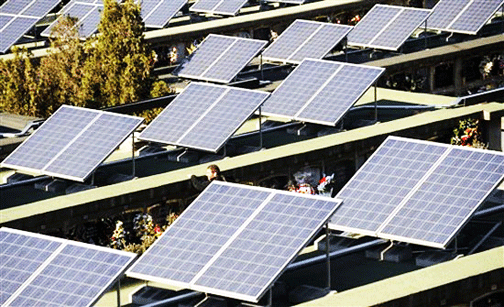 a significant threat to the energy incumbents, particularly in the coal and gas industries, because it would reduce opportunities for new deployment and eat into their earnings because of the impact of solar and other short run marginal cost technologies in the so-called merit order effect (more on that tomorrow). It would also come as a shock to the government,
Suntech calls an Australian solar boom, Climate Spectator, Giles Parkinson, 17 Nov 11 Suntech, the world’s largest solar manufacturing company, has produced stunning forecasts for the solar PV industry in Australia – saying it could supply 5 per cent of the nation’s power demand by the end of this decade, reaching the target three decades ahead of the federal government’s most recent forecast.
Stefan Jarnason, the technical director of Suntech Australia, says solar PV capacity in Australia could reach 10 gigawatts by 2020, when it would be growing at a phenomenal 2GW a year. He bases these forecasts on rapidly declining costs, which mean electricity from rooftop PV that is already cheaper than coal-fired energy delivered by energy retailers in some parts of the country, will reach parity for commercial users around 2015, and parity for utility-scale developments towards the end of the decade.
It’s just a forecast, but it represents a growing realisation within and without the industry that in a very few years the rollout of solar PV will be dictated less by the scale of financial incentives – because it might not need much – but by the scale of regulatory protection for the current energy suppliers, because they might need all the help they can get. Continue reading
Renewable energy going ahead in Australia, attractive to investors
 Winds of change for new energy investment, SMH 17 Nov 11 CANBERRA: Australia’s gradual shift away from coal and towards cleaner energy has begun, government figures released yesterday showed, with nearly half of new energy investment being in wind, hydro and solar projects. The Bureau of Resources and Energy Economics reported that new wind farms alone made up 41 per cent of the new energy investment either begun or committed in the year to October……
The director of emissions and environment at Westpac, Emma Herd, said the passage of the carbon pricing legislation would help investors make long-term decisions about energy projects. ”Renewable energy will become more attractive as the carbon price improves the economics of deploying renewable energy,” she said. ”In the short to medium term, we also expect gas to be a transitional energy source and expect more gas-fired electricity generation projects to be developed.”
The Clean Energy Council policy manager, Tim Sonnreich, said: ”Plenty of people still have the view that renewable energy is a very small percentage of our energy mix. ‘But in South Australia it’s already 20 per cent and that will be the model for the country by the end of the decade.”: http://www.smh.com.au/environment/winds-of-change-for-new-energy-investment-20111116-1njds.html#ixzz1e01bdjUy
Australian Capital Territory will have solar feed in tariff for both small and commercial systems
Small scale solar power in Canberra is also still being supported through a 1:1feed in tariff. Solar households in Canberra and the A.C.T are rewarded for any surplus electricity generated by their systems; which is purchased by ActewAGL Retail at the customer’s electricity tariff rate.
Big Solar To Benefit From Feed In Tariffs In Canberra, by Energy Matters, 17 Nov 11 The ACT Labor Government will today table legislation in the Territory’s Legislative Assembly to support development of large scale solar power facilities in Canberra. Minister for Environment and Sustainable Development Simon Corbell says the Electricity Feed In (Large Scale Renewable Energy Generation) Bill 2011 is the first time a feed in tariff for commercial scale solar power has been proposed by an Australian government.
“The Bill establishes the framework for a feed in tariff ‘reverse auction’ to award support for at least two large scale solar generation plants capable of powering 7000 Canberra homes. This reverse auction process will require companies to provide a detailed proposal to the ACT Government about how they can provide the greatest amount of renewable energy at the lowest cost to Canberrans.” Continue reading
Hepburn Community Wind farm – a first for Australia
Its dream is for Australia to build dozens of community wind farms and solar parks over the next several years. One of the key measures in Australia’s new carbon price package is the Clean Energy Finance Corporation (CEFC), which has AU$10 billion for renewable energy and “clean” energy finance. Community energy projects should have access to funds from the CEFC, which will rapidly accelerate the growth of the sector.
Community owned energy is the one of the most powerful ways to build the social licence of renewables and counter the extremists. This makes Hepburn Wind an achievement not just for the locals and others directly involved, but for the entire country.
 Australia’s Carbon Price Should Support the New Community Energy Sector, Renewable Energy World, By Dan Cass , November 14, 2011 Australia is in the global spotlight for passing its new renewable energy package. A few days before the new measures passed, the senate saw a historic moment for community energy with the opening of Australia’s first citizen-funded wind farm.
(Watch the ABC TV story.) Continue reading
Community owned, community funded, renewable energy getting a boost in Bendigo
Bendigo to host sustainability conference, Bendigo Advertiser, ROSA ELLEN, 14 Nov, 2011 COMMUNITY-owned energy projects from across Australia will meet in Bendigo today as part of a two-day national conference. Community Power Conference convener Professor John Martin said representatives would show what could be achieved despite a lack of political leadership on renewable energy.
“Bendigo needs to know that renewable energy driven by community is possible,” Professor Martin said. Hepburn Wind, whose chairman Simon Holmes a Court will be one of the presenters at the event, is a “clear example” of what could be achieved by community owned and invested projects, he said.
“For me it’s a no-brainer. The hurt will come as electricity prices go up and people will say ‘why didn’t we do anything about it?’” he said.
“All governments can worry about is the bloody carbon tax. There’s lots of news around on community action and we see no action from the government.
All we see them doing is banning wind farms.”
Professor Martin said it appeared politicians were more likely to follow the campaign for clean energy once it gained ground, rather than lead the way.
“There’s great enthusiasm from communities across Australia who want to do something,” he said. Among the projects presenting at the conference is the Warbuton Micro-Hydro project, a small hydro electric system set to power 50 to 60 homes when it starts in about three weeks.
Warburton Micro-Hydro project leader Luke Whiteside will be speaking about the financing of the project, which has its community bank as a major shareholder. Mr Whiteside said he would be interested to learn from other community run projects during the two-day event.
The conference at The Capital theatre is being held by La Trobe University’s Centre for Sustainable Regional Communities, and the Central Victoria Solar City project with the City of Greater Bendigo. It will also address managing peak energy demands and developing local renewable energy generators for the national distribution network.
Renewables plus energy efficiency can bring Australia to 100% energy
100% renewables, no hot air, Climate Spectator, Matthew Wright, 10 Nov 11 The Zero Carbon Australia Stationary Energy project has paved the way for Australian researchers to contribute their best scenarios for transitioning to a 21st century renewable powered economy in a decade….. We congratulate UNSW for being the first institution to take up the challenge.
As the community partner in the ZCA project, Beyond Zero Emissions welcomes the UNSW’s contribution with its soon to be released scenario for taking the economy to 100 per cent renewable energy.
Before we can discuss the merits of their proposal, we need to consider the two schools of thought on how to achieve a completely decarbonised economy: those who think we should have a fossil fuel powered “transition;” and those who think that transition using fossil fuel “lite” technologies – namely fossil gas – is a diversion, not a shortcut. Beyond Zero Emissions fit into the latter category while the UNSW fit somewhere in between……
Gas generation is the most notable difference between the Zero Carbon Australia plan and the UNSW scenario but it’s not the only one.
 The ZCA included a significant energy efficiency program, the most ambitious one proposed to date, which shows how we can deliver half the end use energy we currently deliver. How we do that is being comprehensively detailed in the work of the Zero Carbon Australia Buildings plan, which will be published in February next year.
Then there’s our plan to link the main electricity grids in Australia: the Mount Isa mine grid in the north and the eastern seaboard grid with the West Australian grids. This proposed updating of infrastructure is on par with what’s happening in China, in South America, and serious plans to connect North Africa and the Middle East to Europe. Our plan to link eastern and Western Australia with HVDC, creating a national grid, is consistent with the recommendation of Siemens Australia. The cost of this technology has come down since we researched and produced our report……
Beyond Zero Emissions welcomes the UNSW study and looks forward to the ensuing debate on the proposal once it is released……. http://www.climatespectator.com.au/commentary/100-renewables-no-hot-air
Well planned feed in tariffs are the way to promote renewable energy
 a number of studies, including those carried out for the European Commission, have found well-designed and well-implemented feed in tariffs are the most efficient and effective support policies for promoting renewable energy generated electricity.
IPCC Report Supports Feed-In Tariffs, Renewable Energy news, by Energy Matters 08 NOVEMBER, 2011 Australian states without solid feed in tariff programs or reviewing their current arrangements should take note of the Special Report on Renewable Energy Sources and Climate Change Mitigation published by the Intergovernmental Panel on Climate Change (IPCC).
Small scale solar energy farms the obvious choice for rural Western Australia
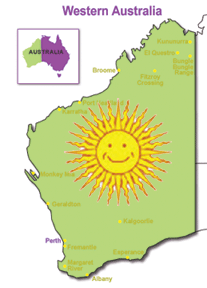 Sun to rise on solar farms, ABC Rural News, By Jo Prendergast , 08/11/2011 The increasing cost-effectiveness of solar energy could see more solar power plants established in regional Australia. The nation’s first utility-scale solar farm is under construction near Geraldton in Western Australia.
Rob Bartrop, from developer First Solar, says decreasing set-up costs mean solar has become competitive with other renewable forms of energy. “A lot of smaller communities throughout Western Australia and indeed Australia rely on diesel generation, which aside from being a very high emitter of greenhouse gases is roughly twice as expensive as solar electricity today,” he said.
“So we see that small scale solar farm market as really the low hanging fruit and the obvious choice.” http://www.abc.net.au/rural/news/content/201111/s3359039.htm
NSW wind farm plan to power 80,000 homes, save 10 million tonnes of greenhouse gas
Seventy new turbines planned for Collector, Goulburn Post, BY MADELINE HAYMAN,07 Nov, 2011 A SYDNEY company has planned the construction of almost 70 wind turbines in the vicinity of Collector. Brochures from energy provider RATCH Australia state that the Collector wind farm is now at stage five of the 10 stage approval process, and is currently being assessed under part 3A of the Environmental Planning and Assessment Act 1979.
“The proposed Collector wind farm is an important renewable energy project that will bring benefits to Collector, NSW and Australia,” RATCH Australia CEO Steve Loxton said. “The proposal is to build 69 wind turbines and associated electrical connections on the hills to the west of Collector. “Wind turbines are an efficient and cost effective way of generating clean, renewable electricity.
“Over its operating life the wind farm is expected to generate more than 10,000 gigawatt hours of renewable energy, equivalent to powering 80,000 homes per year for 25 years,” he said. Mr Loxton also said that the wind farm would save more than 10 million tonnes of greenhouse gas emissions over its life time…..
“Economic benefits include the revenues earned by the businesses that we will rely on during the construction and operation of the project and by local landholders who are hosting turbines…..
“The local community will directly benefit through the employment opportunities that are generated by the project.”… Mr Loxton said. “As with any new development, there will be some aspects of the proposal that some people will object to. We are working with the community to minimise the impact of these aspects.” http://www.goulburnpost.com.au/news/local/news/general/seventy-new-turbines-planned-for-collector/2348948.aspx
Fossil fuel subsidies prevent the development of renewable energy – says IAE
Renewable Energy Being Held Back by Fossil Fuel Subsidies – IEA. Oil Price.com by By. Carin Hall,Energy Digital, 01 November 2011‘ Recent reports show a massive increase in coal dependency caused by fossil fuel subsidies to be addressed at World Climate Summit.
According to the International Energy Agency’s (IEA) latest findings, coal and oil subsidies pose the greatest challenge to the renewable energy market. As the world’s largest exporter of coal, Australia’s carbon emissions have grown nearly 300 percent since 1970, according to the IEA’s last annual report on CO2 emissions. Worse, that percentage is regional, excluding the huge amounts of coal shipped overseas to some 20 dependent countries. Continue reading
1 This month



Help Aunty Sue Protect Her Land and Sacred Sites From Destructive Rocket Testing.
.

Australians deserve the truth
about
AUKUS – https://aukuspublicinquiry.com/

PETITION – To: Prime Minister Anthony Albanese and the Australian Labor Government

of the week – Australians for War Powers Reform (AWPR)
To see nuclear-related stories in greater depth and intensity

