Queensland government adopts most recommendations for renewable energy development
 Qld considers green power, 9 News, 11 Aug 11, The Queensland government hopes to increase the state’s use of renewable energy with new measures such as introducing it to all indigenous communities. The parliament’s Environment and Resources Committee released its report into powering more of the state with renewable energy sources in May.
Noting around 30 per cent of the nation’s greenhouse gas emissions come from Queensland, it made 14 recommendations to drive an increase in green power sources.
The Queensland government this week responded to the report and has accepted 10 of those recommendationsQueensland will now aspire to the federal government target of sourcing 20 per cent of the state’s electricity from renewable energy by 2020, and will consider using upfront subsidies or interest-free loans to encourage customers to switch to renewable energy sources such as solar power.
The government also gave in-principle support for a plan to introduce renewable energy systems into 34 remote indigenous communities that rely on diesel generators for power….http://news.ninemsn.com.au/national/8284274/qld-considers-green-power
Australia’s soldiers going solar
 Super slim solar cell a success, The Age, Ben Cubby August 12, 2011 ‘A typical solar cell is about 0.2 millimetres thick, which is 200 micrometres thinner than a human hair or a sheet of paper, will soon be used by Australian soldiers on patrol in Afghanistan as a portable power source. The solar cells, invented by researchers at the Australian National University, can be used to cover helmets, tents or clothing and recharge electronic gear such as night vision goggles.
They also have extensive potential in civilian applications, including recharging phones and computers, because a square metre of lightweight solar panel can generate 140 watts of power and yet be rolled up into a ball afterwards. ‘A typical solar cell is about 0.2 millimetres thick, which is 200 micrometres – that’s too thick to bend, it would shatter,” the project’s chief investigator, Andrew Blakers, said. ”But these cells are about 45 microns thick, so they are flexible and also about the same efficiency as commercial solar cells. By comparison, really fine quality merino wool is about 18 microns thick.” In practice, many square metres of panel could be unfurled from a box about the same size as a wine cask http://www.theage.com.au/national/super-slim-solar-cell-a-success-20110811-1iot3.html
Mount Gambier leads in renewable energy training
 Solar & wind power facility best in Australia, ABC Radio Adelaide, 10/08/2011 by Alan Richardson Mount Gambier can now boast that it has the very best facility in Australia for training technicians and installers involved in domestic renewable energy systems.
The $150,000 “Solar & domestic wind turbine installation and grid conect training centre” was built by TAFE students and largely financed by industry sponsors. It has attracted sponsorship and interest from around Australia in fact. The site features a ground level roof structure which has a tiled section, a currugated iron section and a Trimdeck section so students can practice installing solar panels on all roof types. There are also separate controllers and electronics for each set of installed panels , and their output can be monitored remotely via the internet.
Promising economic future for Queensland with renewable energy
|
Eco Business, , August 9th, 2011
|
A coalition of social, union, environmental and research organisations today said the federal government’s clean energy future plan would provide unprecedented investment in Australia’s renewable energy resources and energy efficiency, with the potential for major job creation, especially in Queensland.
The Southern Cross Climate Coalition, comprising The Australian Conservation Foundation, The Australian Council of Trade Unions, the Australian Council of Social Services and The Climate Institute, made the claims in an analysis that also urges the federal government to release measures to meet Australia’s international climate finance obligations, in advance of the next round of climate negotiations in Durban in December. Continue reading
Sydney-siders go solar
 Solar use in Sydney soars, SYDNEY, Aug. 8 (UPI) –– Beset by rising consumer energy prices, consumers in Sydney, Australia’s most populous city, are looking to solar energy. In 2010 the city introduced a solar bonus scheme, which was very popular in Sydney’s more prosperous suburbs, with more than 14 percent of homes installing rooftop solar panels, compared with a New South Wales statewide average of about 3 percent…..
the number of private dwellings with solar panels had increased from 2,000 18 months ago to 46,000 after the former New South Wales Labor government introduced a solar bonus rebate scheme.
That plan allowed for a 60-cents-per-kilowatt-hour feed-in tariff for consumers utilizing solar panels, The Sydney Morning Herald reported….
Bowing to increasing public interest in the issue, Ausgrid has begun publishing details of solar panel installations and other data on its Web site to allow councils, consumers and other interested parties to evaluate patterns of electricity usage…http://www.upi.com/Business_News/Energy-Resources/2011/08/08/Solar-use-in-Sydney-soars/UPI-88871312819223/?spt=hs&or=er
Victorian solar cell initiative
 AUSTRALIA TO MANUFACTURE SOLAR CELLS WITH NEW PRINTING MACHINE, FEN, By Annie Dang on 1 August 2011 Producing solar cells with zero-emissions electricity will provide new manufacturing opportunities for local industries.
Australian solar researchers and industry have partnered to develop innovative ways of generating zero-emissions electricity using a printing machine to produce solar cells.
The $7.2 million project will see the development of a possible alternative solar cell technology compared with more conventional photovoltaic systems. It is expected that the products will provide Australia industries the opportunity to commercialise and produce the cells competitively. The Federal Government will contribute a $1.7 million grant through the Australian Solar Institute with the Victorian Government providing funding of equal amount.
Launched in Melbourne yesterday, Minister for Resources and Energy, Martin Ferguson AM MP said the project was aimed at developing efficient solar cells using organic materials and conventional printing methods.
The project will see researchers at the University of Melbourne, the CSIRO Future Manufacturing Flagship, and Monash University collaborate with industry partners BlueScope Steel, Innovia Films and Robert Bosch to take commercialese their printing machine innovation…. http://www.myfen.com.au/news/australia-to-manufacture-solar-cells-with-new-prin
Daylesford shows the way, for Australian community owned wind power
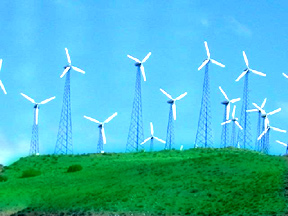 Community-owned wind powers up, ABC Environment | 2 AUG 2011 BY SUE WHITE With profits to be made from the provision of renewable electricity, an increasing number of savvy community groups around the world are pooling their resources to get in on the action.
The newly-installed turbines started generating on June 22, as Hepburn Wind begins its quest to create 12,200 megawatt hours (MWh) over the next 12 months – the equivalent of powering 2,300 homes. Hepburn Wind’s journey began in 2005….. Continue reading
Too much success for household solar power in Western Australia
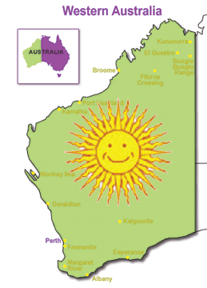 WA solar rebate scheme too popular to continue, SMH, Courtney Trenwith, August 1, 2011, The WA government has axed one of the most successful household environmental programs – the solar panel rebate scheme – precisely because it was too popular.
No new applications will be accepted from today. More than 65,000 household solar panels have been installed since the scheme started in 2009…WA solar rebate scheme too popular to continue
Future for decentralised solar power in Australia
”grid parity” – when unsubsidised solar energy becomes cost-competitive with power from the electricity grid – is getting devilishly close as the cost of photovoltaics (PV) falls…..
”If you can spend $500 and get $700 to $800 back, there won’t be a person in Australia that would ignore that,” Newman says. ”The PV [photovoltaic] retailers will be all over them, and the smart energy retailers will of course step into the game.” It might not be the cheapest form of abatement available to the economy but it’s money in the bank for the punter.
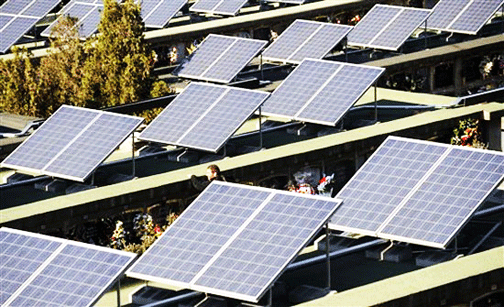
Future lies in power to (and from) the people, Sydney Morning Herald,Paddy Manning, July 30, 2011 It’s hard to tell whether the glass is half full or half empty for Australia’s solar industry right now…….. Continue reading
South Australia’s bright future for renewable energy jobs
 Renewable Energy Jobs For South Australia, Renewable Energy News, by Energy Matters, 26 July 11 A visit by the federal Minister for Climate Change and Energy Efficiency Greg Combet and South Australian Premier Mike Rann to a wind turbine tower manufacturing plant in suburban Adelaide has highlighted the economic benefits from growth in renewable energy in the state.
Mr Combet said the recently announced new Clean Energy Finance Corporation will play a vital role in unlocking significant new private investment into clean energy projects and may include assistance for businesses manufacturing components for clean energy projects…..
Clean Energy Finance Corporation a business plus for Australia
…Far from being a slush fund for the ALP, the proposed CEFC would be a commercially-minded independent authority enabling Australian businesses to commercialise and deploy Aussie renewable energy innovations…..The CEFC is a critical institution for driving Australia’s long-term reductions in emissions at least cost with maximum economic benefit. …
 Why we need the Clean Energy Finance Corporation CEFC, Climate Spectator, Simon O’Connor. 22 July 11“……The Export Finance and Insurance Corporation (EFIC) has enabled Australian businesses to overcome financial barriers to doing business by bridging market gaps the commercial banks dared not bridge.
Far from being a risky strategy, this commercially-oriented authority has delivered to government dividends totalling more than $100 million in the last decade. Continue reading
On solar energy – Victoria, wind power -New South Wales
5MW Solar Farm Constructed In 6 Weeks, Energy Matters, Renewable Energy News, 20 July 11, “….Last week, the UK’s largest solar farm was fully commissioned and connected to the mains grid. The 4.9MW station was developed by Lark Energy and is located at Hawton in Nottinghamshire. The project consisted of 21,000 solar panels situated on 30 acres of former quarry land and will provide enough energy for the electricity needs of 1,300 homes. As Australia finally begins the journey towards a low-carbon economy in earnest, it’s reassuring to know that solar power can quickly replace a substantial amount of coal-fired capacity. While a 4.9MW solar farm is by no means enough to make up the shortfall created by an early closure of Hazelwood, Environment Victoria recently pointed out there is currently 3,000 megawatts of renewable energy projects approved in Victoria, along with thousands of megawatts of gas projects that could be constructed in two to four years.
How fast Victoria will be able to make the switch away from coal will be largely dependent on the political will to make it happen….
http://www.energymatters.com.au/index.php?main_page=news_article&article_id=1640
 Acciona’s third wind farm in Australia, reve, july 20, 2011, The Gunning Wind Farm, 46,5 MW, is located in New South Wales and represents a 107 million € investment. Acciona’s Chairman, José Manuel Entrecanales, congratulates the Government of Australia for its initiatives to increase the development of renewable sources of energy.

The Gunning Wind Farm is a 46.5 MW wind power plant consisting of 31 Windpower AW-1500 wind turbines. The wind energy project represents an AUD $147 million investment (107 million euros)…..http://www.evwind.es/noticias.php?id_not=12528
—
New South Wales country businesses profiting from energy efficiency
Country areas stand out for the highest number of businesses who are participating, with only North Sydney, Sydney and Marrickville making it into the top 10 regions….
”NSW’s energy-efficiency programs are already helping businesses save over $56 million a year, but we haven’t even started to scratch the surface,” the council’s chief executive, Rob Murray-Leach, said.
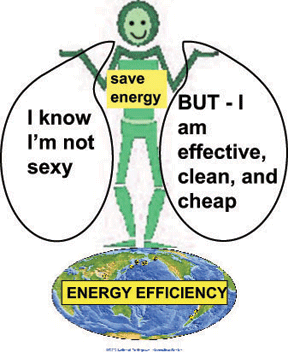
”Energy efficiency could save the economy over $5 billion a year … These programs show that people who claim the carbon price will damage the economy are talking pure rubbish.”
NSW businesses cashing in on drive for energy efficiency, Sydney Morning Herald, Ben Cubby, July 16, 2011, THE state’s small- and medium-sized businesses are reaping the benefits of government energy-efficiency programs, saving a combined $70 million in power costs for about $8 million in government subsidies in the past two years, new data shows. Continue reading
Plan for Australia’s Clean Energy Future
Clean Energy Future plan, Sydney Morning Herald, 16 July 11 — A clean energy future is part of a long term plan to reshape our economy, cut carbon pollution, drive innovation, and help avoid the increased costs of delaying action on climate change. Continue reading
Queensland University leads in research for solar distributed energy
“In future, it will need to accommodate many, many more, smaller input sources in diverse locations, from renewable resources such as solar, geothermal and wind,” Professor Meredith says.
He says mid-size, commercial-scale renewable power generating systems like UQ’s will become increasingly common in urban and remote areas.
UQ powers up $7m solar array QBR, July 15, 2011, Brisbane has today stepped up its renewable energy research capabilities with the official launch of the University of Queensland’s $7.75 million solar array – the largest power system of its kind in Australia. Continue reading
1 This month
7 April – WEBINAR – Australia and the Doomsday Clock – Preventing nuclear war through NoFirstUse and other policies
Online | Tuesday April 7, 4:00-5:30pm, Australian Eastern Time / 8:00-9:30am Central Europe Time
– Access the registration link
15 April – Zoom –Nuclear Power is Not the Solution
Apr 15, 2026 01:00 AM in Canberra, Melbourne, Sydney

Join the International Physicians for the Prevention of Nuclear War (IPPNW) on Tuesday, April 14th for a timely webinar exploring the risks associated with nuclear power and challenging the myth that it offers a simple, safe, carbon-free solution to the climate crisis

21 April Webinar: No Nuclear Weapons in Australia
Start: 2026-04-21 18:00:00 UTC Canberra, Melbourne, Sydney (GMT+10:00)
End: 2026-04-21 19:30:00 UTC Canberra, Melbourne, Sydney (GMT+10:00)
Event Type: Virtual
A virtual link will be communicated before the event.
Host Contact Info: australia@icanw.org

of the week – Australians for War Powers Reform (AWPR)
To see nuclear-related stories in greater depth and intensity
 Antinuclear