Renewable energy plan for North Queensland
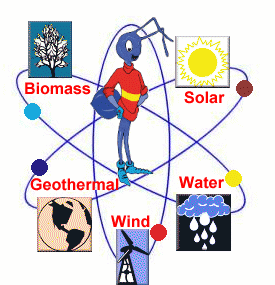 The construction phase will see investment of up to $A1.5bn, generating up to 1,000 jobs…….”The Queensland government has stimulated significant activity in renewable-energy projects in the clean-energy corridor, particularly through its investigation of large-scale solar in conjunction with the Clinton [Global] Initiative.
In depth: Australia’s $1.6bn plan to turn the outback green – Recharge ,by Oliver Wagg,14 June 11 Northern Queensland may become home to one of Australia’s major clean-energy hubs if a proposal to connect the remote mining region to the national grid gets the green light. Continue reading
Renewable energy, electric cars,it’s all happening in Australian Capital Territory
 ….. Canberra is also expected to become home to electric cars, with charging points to be installed around the ACT, ActewAGL and Better Place Australia signed an agreement worth about $60 million over 10 years during the week, sealing the largest renewable energy deal of its kind in Australia. The energy will be drawn from generation sources such as wind, hydro and solar.
 Boom in renewable energy, Waste management World, The Canberra Times (Australia), June 12, 2011 The ACT region is leading the way in innovative power generation, JULIEANNE STRACHAN and MICHAEL INMAN write, CANBERRA has the potential to claim the crown as the renewable energy capital of Australia, but the rewards will need to be there for consumers and big businesses to make it happen, industry experts say. Continue reading
Australian govt energy policy results in drop in renewable energy investment
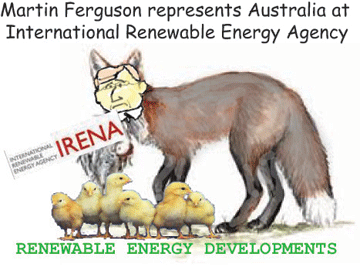 Australia Drops In Renewable Energy Attractiveness Rankings (Again), Renewable Energy News,by Energy Matters, 9 June 11 The latest Ernst & Young Renewable Energy Country Attractiveness Indices have seen Australia drop in ranking for the second time this year……Ernst & Young says Australia’s latest decreased ranking was due to a reduction in Government spending on renewable energy by AU$1.8b. The major cut to clean energy spending will reduce investment demand for wind power in Australia says the company, which has fallen four points in the wind index.
Australia also lost two points in the solar index after the Government announced plans to reduce the Solar Flagships Program by AU$250m and the capping of the Renewable Energy Bonus Scheme that provides incentives for solar hot water systems, saving AU$160m…….http://www.energymatters.com.au/index.php?main_page=news_article&article_id=1561
Explaining Australia’s ineffective solar energy policies
Australia has no policies to build the market for large-scale solar power.The carbon price, if it is ever introduced, will be too low for at least a decade to assist significantly….
Flagships will subsidise initially only one large CPV and one large CST power station by 2014.
Cuts to this program in the 2011 federal budget make it unlikely that a second round of grants will be made….
There is really only one plausible explanation for Australia’s piecemeal and ineffective set of solar policies: the immense political power of Australia’s big greenhouse polluters.
Australia’s confused solar policy June 1, 2011, PHYSORG.com By Mark Diesendorf Solar collectors spread out over a square 50 km could generate all of Australia’s current electricity demand. Continue reading
How Australia could be powered by solar technology
 Australia’s confused solar policy June 1, 2011 PHYSORG.com By Mark Diesendorf “…….Scaling up to industrial-size solar The residential and commercial sectors are together responsible for about half of Australia’s electricity consumption. Almost the entire other half is industrial.If this demand were supplied by solar, it would need large solar power stations. Continue reading
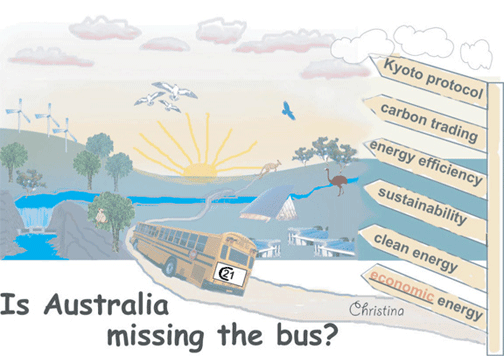
Australian government missing the bus on renewable energy development?
Two-thirds of this investment would need to be in wind energy, for which no federal funding provision has been made so far. In fact, government funding allocated to proposed renewable capacity is negligible when compared to the total amount of capital necessary. …..Without clear and stable long-term incentives from policymakers for financiers to invest, Australia’s renewable energy reality may fall significantly short of all predictions.
Australia: renewable energy investment will grow strongly in the coming years, IStock Analyst May 27, 2011 (Source: Datamonitor)
Renewable energy revolution – the timing is critical for Australia
 The Critical Decade reinforces the science behind the United Nations Intergovernmental Panel on Climate Change’s (IPCC) 2007 judgement that global warming is caused by burning fossil-fuels for energy, and raises the question of possible links between recent severe floods and bushfires around Australia with human-induced climate change.
Australian Renewable Energy Revolution Critical By 2020, Renewable Energy News, by Energy Matters, 24 May 11, The author of a new report from the Climate Commission, “The Critical Decade: Climate science, risks and responses,” says the world is running out of time to prevent serious climate events caused by global warming and warns Australia should embrace a renewable energy revolution by 2020 to offset irreversible damage from climate change.
Rural Australia’s enthusiasm for solar and for feed-in tariff
 “A sensibly designed scheme would make Australia a world leader in solar power.”…The feed-in tariff scheme’s cancellation comes despite huge interest in solar power across the State.
Wanted: sensible solar, The Land RICHARD FOX, 21 May, 2011 “…….“Australia has an excellent resource for solar, particularly west of the Dividing Range, and consumers have an enthusiasm for renewable energy. Continue reading
New South Wales rally for solar feed in tariff to re-open

 Australian Solar Energy Society holds rally to demand re-opening of New South Wales feed-in tariff Solar Server 20 May 11 On May 18th, 2011, the Australian Solar Energy Society (AuSES) organized a rally in Sydney, Australia to ask the New South Wales (NSW) Government to re-open its Solar Bonus program.The NSW Government has announced that it will not accept applications to the program filed after April 28th, 2011, and has reduced the existing feed-in tariff level for the highest tier.
“AuSES and NSW homeowners are calling for certainty and security,” stated AuSES CEO John Grimes. “The rally is the last chance for solar, because businesses and livelihoods are on the line.”…KW20 | Australian Solar Energy Society holds rally to demand re-opening of New South Wales feed-in tariff – SolarServer
Western Australia and NSW govts strike down solar power
 Western Australia FiT chopped in half, PV-Tech By Emma Hughes – 19 May 2011, Less than a week after the shock closure of the feed-in tariff scheme in New South Wales, the Government of Western Australia has cut the subsidy rate for new residential applications submitted after June 30. The state will also be subject to a cap on installations, putting a halt to progress just one year after the scheme was introduced.
The feed-in tariff rate for new installations will now be cut in half, with applicants receiving AUD$0.20/kWh instead of the AUD$0.40/kWh rate that was introduced in July last year. All existing customers will continue to receive the higher tariff rate for the originally-proposed 10 years.
Alongside the tariff cuts Western Australia will also be hit with a 150MW cap, which when reached, will mark the end of the program, when no further applications will be received….Western Australia FiT chopped in half | PV-Tech
Wind Energy Set to Boom inWestern Australia
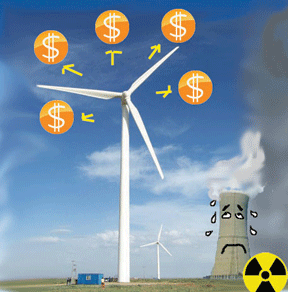 The proposals are the latest in a number of wind-energy projects on the ground or in the pipeline
New bid to harvest Wheatbelt wind – The West Australian, 17 May 11, .In dusty back paddocks and weathered coastal landscapes across WA, a transformation is taking place.A wind-farm investment drive is to become a multi-billion-dollar boom and nowhere is that boom likely to be bigger than in the small Wheatbelt town of Williams, about 150km south-east of Perth. Continue reading
Solar energy in Australia – whacked by the power of polluter lobbyists
 The situation in Australia is problematic because renewables, and climate policies in general, are clearly a political football.
A solar policy of ill repute | Climate Spectator, Giles Parkinson, 17 May 11, “…….The renewables industry has experienced multiple policy convulsions over the past decade that have stalled its development, but none may be so damaging as the decision last week by the NSW government to make retrospective changes to its feed-in tariffs. Continue reading
Australia’s Minister For Nuclear Energy squashes solar power’s prospects
 the budget cuts come as solar policy is in turmoil, as feed-in-tariffs, introduced over the past few years to support the installation of rooftop solar, are set to be wound back or abolished.
Spending, like meters, goes backwards and forwards, Sydney Morning Herald, Paddy Manning, May 14, 2011 The budget was dismal for the renewable energy industry and the Energy Minister just doesn’t get it.
MORE proof ricocheted through Twitter this week that federal Energy Minister Martin Ferguson doesn’t ”get” renewables. Continue reading
Globally nuclear is failing, Australia needs renewables
Globally, investment is flowing to renewables. The difficulty in delivering a nuclear plant on time and budget is perhaps the reason Areva has diversified its energy portfolio…..
Given Australia has the best solar radiation of any developed country, we are better suited to building commercially available base-load solar thermal and other renewable technologies, which can be completed in two to four years.
If we move now, we can develop the expertise and jobs locally. Delay further, and we’ll be buying clean technologies from overseas…
Best option for Australia is renewable technologies, Herald Sun, Patrick Hearps , May 06, 2011, JAPAN’S ongoing nuclear crisis has re-ignited debate about Australia jumping on the nuclear power bandwagon. Nuclear proponents continue to support the technology although the full impacts of the Fukushima disaster are unknown…. we should step back and ask whether Australia needs to consider nuclear power.
The answer is a simple “no”. Nuclear power is not necessary to solve Australia’s climate and energy challenges. Continue reading
Australia’s CSIRO – cutting edge solar energy research
CSIRO is progressing world-class technology, combining two of Australia’s largest energy resources– solar energy with natural gas. The resulting product is SolarGas….CSIRO is undertaking a solar energy storage research project to be conducted in Australia.
CST projects: CSIRO, EcoGeneration — May/June 2011, CSIRO has the largest concentrated solar thermal research team in Australia; there currently are approximately 30 scientists, engineers and technicians working on research projects in the industry. Continue reading
1 This month
7 April – WEBINAR – Australia and the Doomsday Clock – Preventing nuclear war through NoFirstUse and other policies
Online | Tuesday April 7, 4:00-5:30pm, Australian Eastern Time / 8:00-9:30am Central Europe Time
– Access the registration link
15 April – Zoom –Nuclear Power is Not the Solution
Apr 15, 2026 01:00 AM in Canberra, Melbourne, Sydney

Join the International Physicians for the Prevention of Nuclear War (IPPNW) on Tuesday, April 14th for a timely webinar exploring the risks associated with nuclear power and challenging the myth that it offers a simple, safe, carbon-free solution to the climate crisis

21 April Webinar: No Nuclear Weapons in Australia
Start: 2026-04-21 18:00:00 UTC Canberra, Melbourne, Sydney (GMT+10:00)
End: 2026-04-21 19:30:00 UTC Canberra, Melbourne, Sydney (GMT+10:00)
Event Type: Virtual
A virtual link will be communicated before the event.
Host Contact Info: australia@icanw.org

of the week – Australians for War Powers Reform (AWPR)
To see nuclear-related stories in greater depth and intensity
 Antinuclear