Massive jump in solar energy roll-out means scarcity fears unfounded: council
Official estimates of the risk of an electricity shortfall this summer are exaggerated because much more solar energy – as much as six times current large-scale capacity – is ready to be built, the Australian Solar Council says…….
http://www.smh.com.au/environment/climate-change/massive-jump-in-solar-energy-rollout-means-scarcity-fears-unfounded-council-20170914-gyhd8k.html
Australian government aims to get rid of Renewable Energy Target
No RET changes in overhaul
The government is aiming to exclude the renewable energy target from its looming overhaul of the nation’s power supply. .. (subscribers only)
http://www.theaustralian.com.au/business/mining-energy/no-changes-to-ret-in-looming-power-supply-overhaul/news-story/8606b86fc5bdc8343adc47c979f525fa
After Australian Energy Market Operator’s initiatives, South Australia defers energy security target
S.A. puts energy security target on back-burner after AEMO steps in http://reneweconomy.com.au/s-a-puts-energy-security-target-on-back-burner-after-aemo-steps-in-86049/ By Giles Parkinson on 11 September 2017 South Australia has abandoned plans to have its state-based energy security target in place this summer after conceding is could have little impact given the new initiatives by the Australian Energy Market Operator and the lack of competition in the local grid.
Officially, South Australia has decided to “defer” the start date of the EST until 2020, having already deferred it from a July 1 start to a January 1, 2018 start. But given the state poll in 2018, and the new initiatives taking place in the broader market, it seems unlikely to ever see the light of day.
The EST was a key component of the $550 million Energy Security Plan the S.A, government unveiled earlier this year following its dismay at the forced load shedding in February and other incidents.
But it seems likely that the only two components to have a lasting impact will be the Tesla big battery, which is due to come into service on December 1, and the 150MW solar tower and molten salt storage facility in Port Augusta, which will contract to supply the government’s own electricity needs.
The EST was to be one of the centerpieces of the plan, aiming to ensure that 50 per cent of demand was met by S.A.-based “dispatchable” generation by 2025.
The original structure of the EST was harshly criticised because it was thought it would favour gas plants over battery storage, would not reduce prices and could end up as a $3.5 billion subsidy to the gas industry.
But it appears to have been made redundant by AEMO’s decision – explained here – to require that at least three gas generators operate at all times, and more if the wind output from the state’s wind farms is more than 1200MW.
That guarantees the presence of gas-fired generation, but it also means that because three gas units are generating at the same time, and therefore sets the price, the chances of a reduction in wholesale prices are effectively removed.
The impact of the curtailment was made evident last week, when the wind output ran at a steady 1200MW for three days, with no significant fall in prices – apart from when the link to Victoria was constrained – because gas generators had to continue generating.
The S.A. government says that modelling from Frontier Economics, one of the architects of the EST, indicates that if the scheme was to lower power prices it requires the operation of a more competitive energy market.
It suggests that may not occur till 2020, when the solar tower and storage facility, and new facilities supported by the $150 million Renewable Technology Fund are built.
“Since we announced the EST a number of changes in the National Electricity Market have delivered system security outcomes similar to those the EST would seek to achieve,” energy minister Tom Koutsantonis said, noting also AGL’s decision to invest in a new gas generator and the implementation of 49 out of 50 Finkel recommendations.
What the Australian Energy Market Operator actually did advise the government
AEMO: Our advice was pretty straight forward, we need dispatchability http://reneweconomy.com.au/aemo-advice-pretty-straight-forward-need-dispatchability-13353/
“We need flexible capacity that can be switched on and off, and we need to transition to a new generation of Australia’s principal energy market institutions, and the newly-formed Energy Security Board.
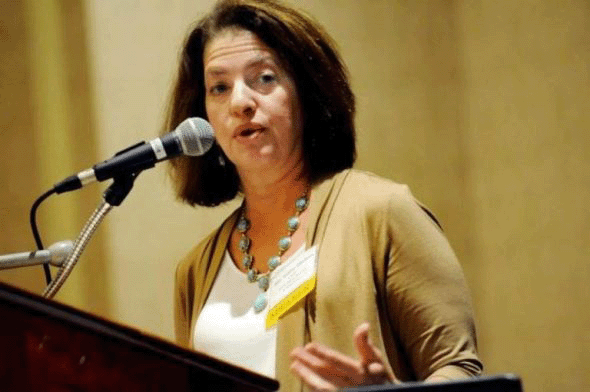 “Our advice was fairly pragmatic,” Zibelman said. “We are concerned that on a 45°C day if we lose a generator (which AEMO has said is quite likely) we want reserves in the system to be able to respond.
“In our report we identified the fact that with amount of variability (from solar and wind energy and electricity usage) is changing rapidly, we need resources that can change rapidly.
“That may be different to traditional baseload resources, which do not move a lot. It doesn’t mean baseload is bad, it’s just that we need a different portfolio. (Baseload) may not be able respond in the time period we need it to respond.”
Sound like Liddell? Not really. The plant owner AGL Energy has made it clear that Liddell is old, increasingly unreliable, expensive to maintain, prone to unexpected outages and can’t be relied upon at times of peak demand, particularly as temperatures rise.
Zibelman’s comments, like the two AEMO reports it released last week, contrast starkly with the Coalition government’s contention that AEMO had insisted that rapid action was needed, and that that rapid action must mean that Liddell’s life span must be extended.
Zibelman made it absolutely clear that her preference was for fast, flexible technologies, both in supply and demand, and bother in front and behind the meter. Importantly, it had to be technology that the market operator could rely upon.
“The system is changing,” Zibelman said. “That’s not a bad thing. What we need to do is to start saying we have to think about next the generation of technologies, the next generation of markets and how to take advantage of it.”
Earlier, she noted: “The power system works best when we can operate it in accordance with the law of physics. (That means) we need to make sure we have sufficient tools to respond in a real time system.”
She noted that a focus was needed on system services such as inertia, voltage and frequency, which came as “ancillary services” to thermal generators, but now had to be sought elsewhere. This was not a reason not to evolve, just a reason to focus on how to set a market to encourage these technologies and capacities.
“Our advice was pretty straight forward,” she said: “As system has a higher level of (renewable) penetration, issues like frequency, violate and inertia needs to be addressed – not because it a bad thing, but because it was bundled previously with the big generators ….
“It’s not just having enough of these resources, it’s about having enough of these resources at the time and the place you need them. At all times AEMO needs the ability to turn something on and something off to maintain system balance,” Zibelman said.
She spoke of demand management, one of her favourite topics and preferred mechanisms in the US, but said it had been communicated badly and misunderstood – particularly the idea that the market operator would turn off the lights or the air-conditioning.
“What we are talking bout is being able to use rotating mass, use battery storage, electric vehicles, and create a more integrated system.”
She said it was clear that the Australian market was heading towards 30-40 per cent “distributed generation”, which means mostly solar and storage behind the meter. These technologies can and needed to be harnessed to ensure that they contribute to grid security.
Asked specifically about Liddell, Zibelman said choosing that as a preference would require an analysis to determine its level of dispatchability and its flexibility, and its ability to deal with reliability concerns.
“What do we want to do is to make sure we are riding the technology innovation curve in the right way…. it all has to fit. We’re thinking about what do we need, what do we have, and then what are the right mechanisms to get the best outcomes that are economically sound.”
She said it was clear that the Australian market was heading towards 30-40 per cent “distributed generation”, which means mostly solar and storage behind the meter. These technologies can and needed to be harnessed to ensure that they contribute to grid security.
Asked specifically about Liddell, Zibelman said choosing that as a preference would require an analysis to determine its level of dispatchability and its flexibility, and its ability to deal with reliability concerns.
“What do we want to do is to make sure we are riding the technology innovation curve in the right way…. it all has to fit. We’re thinking about what do we need, what do we have, and then what are the right mechanisms to get the best outcomes that are economically sound.”
13 September More REneweconomy news
 RenewEconomy
-
Networks ‘push back’ on more small-scale solar. But why?Culture wars: It may explain the continued efforts of some network operators to push back against the installation of more rooftop solar.
-
An end to blackouts? Demand management success depends on collaborationAs national debate over energy supply reaches fever pitch, more attention is now being paid to the role of demand management, a weapon of last resort in Australia.
-
Know your NEM: Corporate PPAs only movement in flat marketIn a week where energy politics took centre state over market news, the most interesting development was the signing by retailer Flow Energy of a 10-year 50MW PPA with Ararat wind farm in Victoria.
13 September REneweconomy news
RenewEconomy-
-
AGL debunks Coalition myths on Liddell, saying it is unreliable and costly, and money is best invested in wind, solar, battery storage and other dispatchable generation.NSW government weighs proposal for 146MW solar farm near BathurstPhoton Energy Australia plans to develop 146MW solar farm on outskirts of Bathurst have gone before NSW Department of Planning for approval.
Five companies in running to build huge solar farm in Qld coal centreFive companies short-listed to tender for job developing up to 450MW renewable energy hub in Qld coal centre of Gladstone. -
-
Big utilities about to pay price of saying no to coal and COALitionCoalition has known about bidding practices for years, but it has taken AGL’s refusal to play ball on Liddell to prompt it into action.
Giles Parkinson on Australia’s Energy Comedy Show
 Nationals demand “coal target” as energy politics spirals into loony fog, REneweconomy By Giles Parkinson on 11 September 2017 It barely seems believable, but the politics of energy has just gotten worse. A week that began with a bizarre push to extend the life of a decrepit, 50-year-old power plant in the hope of keeping the lights on, finished with the Nationals demanding that no further subsidies be given to renewable energy.
Instead, they said, they should be given to last century’s technology: coal. At their annual conference on the weekend, the National voted, in effect, for a coal energy target. It wants the federal government to give out loans to support the coal industry.
Nationals leader and deputy prime minister Barnaby Joyce continued his bizarre riff about people being stuck in lifts, desperate to go to the loo, if the energy system had too much wind and solar. He seemed to think that closing Liddell in 2022 would cause the lights to go out in 2017.
Former resources minister, and Joyce’s ex chief of staff Matt Canavan, joined in, describing renewables as a “short term sugar hit” for jobs….
One sane voice at The Australian is Alan Kohler, who points out that despite the bluster of the Nationals and the conservatives within the Liberal Party, everybody knows coal-fired power stations must close if Australia is to meet the 2 degree commitment that everybody agreed to in 2015.
“The task of leadership is to prepare for that, not yearn for coal,” he writes.
“The Australian Energy Market Operator has made it clear the closures can be handled through demand management and some NEM redesign, with even more renewables and batteries, which is what’s happening anyway because that’s what businesses and investors want to invest in.
“There won’t be any new coal power stations, and the lives of existing ones won’t be extended unless the government, bizarrely and unnecessarily, pays for it.
“If that happened, it would bring about the final divorce of business and the Coalition, and the final retreat by Malcolm Turnbull into the loony fog inhabited by Donald Trump and the coal dancers on the Coalition’s right.” http://reneweconomy.com.au/nationals-demand-coal-target-energy-politics-spirals-loony-fog-37878/
Turnbull government grossly misuses report by Australian Energy Market Operator
 The Turnbull-Frydenberg investment bank: Bullying, cronyism and
  Captain’s picks http://reneweconomy.com.au/turnbull-frydenberg-investment-bank-bullying-cronyism-captains-picks-46765/ By David Leitch on 11 September 2017 Bullying, cronyism and Captain’s picks instead of policyThere is almost universal agreement that carbon policy is or should be a Federal issue.
That is clearly something that the Federal Government should be involved in as it involves Australia’s international status and obligations. But that is the one area that the Federal Government is not touching.
Despite Finkel, despite our COP 21 obligations, the Federal Government does nothing. No electricity policy, no vehicle emission standards, no policy in other areas of the economy responsible for half of Australia’s emissions.
Gross misuse of AEMO report for political purposes
Perhaps the very worst thing, of the many to choose from, about the Liddell negotiation is the gross misuse of the AEMO report. This is only possible because the media is too busy, to put it kindly, to do its homework.
The definition of a “problem” is when forecast “Unserved Energy (blackouts)” exceeds the desired reliability standard. That is not the whole story, but if you want one metric, it’s that.
Unfortunately, AEMO didn’t draw its graph relating to NSW all that clearly. We have attempted to do better, [graph on original] using the .xls data that AEMO provides. AEMO does not forecast a problem and if more renewables are built, the standard will be easily met.
Liddell move emboldens the pro coal, pro socialization, anti private enterprise groups – i.e. the National party and right of the Liberals
Turnbull’s naked interference, partly symbolic, has emboldened the anti-climate change cheer lobby. Examples include:
Over the weekend we saw The National Party has passed a motion that is essentially anti a Clean Energy Target.
In NSW energy minister Don Harwin’s public statements about the need for more renewables, see this article and the NSW Government’s “aspirational” zero carbon policy by 2050 have been shown up in their true light by Premier Gladys Berijiklian’s statement that NSW is “not ruling out a new coal fired power station”
“Asked if the state government will pay to keep Liddell open beyond 2022, Mr Berejiklian said: “We’ve not come to any conclusions regarding that. Obviously we are interested in the federal government’s announcements.”
Ms Berejiklian lashed South Australia for going rogue and piling into renewables, despite their inability to cope with peak demands.
A third option, which many believe is the only viable alternative, is for NSW to build its own new coal-fired power station.
“I’m not going to rule it out,” the Premier said yesterday.” Source: Daily Telegraph, Sep 10
Interference in the market using Federal money instead of policy development
Despite the virtually universal endorsement of the “Finkel Report”, despite the electricity industry, including the large coal generators, and also the growing band of renewable investors and consumers, in coalition with many but not all energy consumers the Federal Govt has been unable to progress industry policy in a way that provides an investment confidence.
It has been unable to form policy consistent with our international obligations.
So what is the alternative? It’s to be populist and interfere in the market – similar to say Venezuala’s recent policy developments – or as if Turnbull had Russian Presidential powers.
It’s not as if Turnbull has a great record on micro managing public investment, you can find plenty of critics of the NBN for instance. Let’s look at some of the “Captain’s picks” that are just announced on the floor of parliament as “done deals”
Snowy 2.0: $8-$10 billion
The Federal Govt’s only historic investment in electricity was its 13% investment in Snowy Hydro. Now in order to subsidize a minimum $2 bn, and likely more, investment in pumped hydro, the Federal Govt is proposing to spend $5bn-$6bn buying the NSW Govt and Vic Govt out of Snowy.
The Federal Govt has no experience in electricity generation. Snowy is also the 4th largest retailer by customer numbers and the Federal Govt has no experience in electricity retailing.
The pumped hydro project has not gone through any competitive process for funding in the way that say CSP or nearly anything has to.
Our studies of pumped hydro show that it needs about $90 MWh differential between peak and offpeak to be profitable. How can anyone really know whether that will be on offer when this plant is built?
No private sector operator would do it now. This purchase and the subsequent investment should be open to far more public scrutiny. At least $2 bn of transmission will be needed to support the investment.
However, as large as that investment is, and as risky as it is, a case can be made that in a world of high renewables where there was lots of zero marginal cost PV in the middle of the day a pumped hydro investment could be of use.
We are not in that world today and there is no plan to get to that world in the future. Pumped hydro, like batteries, consume about 25% more electricity than they produce. If that electricity is being produced by coal there is little more that can be said.
Snowy is a gamble with taxpayer funds, Liddell is a gift of taxpayer funds to one private sector operator
Snowy 2.0 is an $8 billion plus gamble with Federal money, but subsidizing Liddell using Federal money to enrich one private sector operator as an effective massive bonus to entice them to buy and take over a coal fired station is basically disgraceful. We list some of the issues below.
All we can say though is it leaves a bad smell. If Turnbull thinks these investments are such a good idea, raise some private capital and do it yourself. Or at least get the States to do it. It is just not a Federal issue to be running State power stations and interfering in the market.
Meddling in business because you can’t do politics
The proposed Federal subsidy to one private sector operator to keep a coal fired generator open in NSW is open to criticism on many grounds. The list includes.
- It’s totally incompatible with Australia’s international COP 21 commitment to reduce emissions by 28% by 2030. How can keeping a coal station power station going from 2022-2027 or 2032 do anything other than harm that goal.
- It potentially hands say West Australian GST proceeds to one private sector operator to build a bigger position in the Australian electricity market. Kerry Packer RIP, once famously said on selling Channel 9, that you only get one Alan Bond. Trevor St Baker must be thinking you only get one Malcolm Turnbull. Turnbull and St Baker do share one thing in common. They both live in houses with lots of PV and batteries. And yet exploit everyone else to sell them coal fired electricity.
- It potentially changes the sale of Loy Yang B. According to press reports one of about 2 bidders left for LYB was Delta’s owner, Sunset Power. Press reports state Sunset was having some difficulty getting bank finance. This could play out as Sunset finding it easier to get bank finance if its backed by the Federal Government Turnbull/Fydenberg investment bank, or it could lead Sunset to say, we won’t bother with LYB and the private sector we’ll just take the Government money and run Liddell.
- Maybe the Federal Govt could buy LYB as well? If you are going to nationalize the electricity industry why stop with just Snowy and Liddell, surely you need a position in Victoria? After all there are endless free taxpayer dollars to be used.
- It will make new generation investment in NSW less likely. If the Government is prepared to do all the work and increase private sector risk why invest. High prices at present, and the expected closure of Liddell are creating a strong investment incentive in NSW.
- Ditto, it makes the job of getting the 1 GW capacity reserve built
- There is no identified need to keep Liddell open. AEMO does not forecast an energy supply issue in NSW.
In any case forecasting the post 2022 electricity market is just a guess. We all know that.- It totally hands all the cards to AGL. AGL has been a good steward of the Macgen and LYA coal assets. Its worked hard on their costs and reliability, it’s come to the party on bailing out Portland smelter and it is doing a bit, albeit not a big bit, to get some new renewables built. Its also potentially helping with gas by getting Cribb Point on the agenda.
- AGL will not want to sell Liddell to a competitor. Never mind the potential increase in competition, it will also complicated the coal position. AGL’s coal supply is set up on the assumption Liddell will close. Its and everyone else’s coal prices will be higher if Liddell stays open. How much higher, hard to say, but we think there are escalators in some of the Macgen contracts which would drive conservation of coal all else being equal.
Time for the Australian government to plan sensibly for the electricity market
Time for pragmatism, not panic, for the electricity market, http://reneweconomy.com.au/time-pragmatism-not-panic-electricity-market-65155/, By David Blowers on 11 September 2017 The Conversation
There was a familiar kneejerk reaction to last week’s announcement by the Australian Energy Market Operator (AEMO) that there are risks to our electricity supply after the scheduled closure of the Liddell coal-fired power station in New South Wales in 2022.
The sight of the Prime Minister looking for options to keep Liddell open raises the spectre of further reflexive government intervention that can’t end well.
Governments, understandably, want to make sure the lights stay on. But now is the time for perspective, not panic.
The NEM is an energy-only market. This means that generators only get revenue when they sell their electricity into the market.
All costs – including the capital costs of building the plant – need to be covered by the revenue they make when they sell electricity. Anyone who wants to build new generation capacity wants to be pretty certain that the market is going to deliver the revenue they need to cover their costs.
But right now no one is building any generation, unless it is government-backed renewables. This is despite a ripe environment for investment: high current and future prices in the wholesale market and the closure of old power stations.
The result, as AEMO pointed out last week, is potential shortfalls in generation and potential blackouts in South Australia, Victoria and NSW over the next few years.
Much of the blame for this investment hiatus can be placed on politicians and the climate change policy mess that is creating so much uncertainty for potential investors.
But the rise of wind and solar power is also causing problems. Wind and solar energy have zero marginal cost: once the facility is built, the energy produced is essentially free. And they are intermittent suppliers: they don’t produce energy unless the wind is blowing or the sun is shining.
So when wind and solar plants are operating, the wholesale price of electricity is forced down. This means there needs to be high prices – sometimes very high – when wind and solar are not operating. This price volatility makes investors nervous that they will not be able to cover the costs of building new generation.
Governments may be tempted to conclude that the market has failed. But intervention may be premature.
There are still five years until Liddell is scheduled to close. Just because a new coal-fired power station will not be built in time to fill the gap doesn’t mean the market cannot respond.
Coal was never going to be the market response, given climate change risks. But new gas-fired generators, or batteries to store electricity, could be built in this time frame.
Or the market could finally get its act together on what is called demand-response: that is, paying consumers to reduce their electricity consumption during periods of peak demand, so that less new generation is required.
There are no guarantees for government, however. The risks that the market won’t deliver the new generation that is needed are increasing. If nothing changes, Australia will need, in the words of AEMO, “a longer-term approach to retain existing investment and incentivise new investment in flexible dispatchable capability in the NEM”.
Many countries have responded to these same pressures by introducing a capacity mechanism. A capacity mechanism pays generators for being available, regardless of whether they actually sell electricity.
Payments for capacity provide extra income for generators, giving them greater assurance that they will make enough revenue to cover their costs.
Any new market-based mechanism in Australia is likely to be better than the scattergun approach of various governments in recent years.
Building Snowy 2.0, extending Liddell’s life, or providing state-based backing for new renewable generation might deliver the results needed. But the lack of coordination, planning and strategic thought that sits behind these policies means they probably won’t.
Getting it right Continue reading
South Australia’s energy security target deferred
 S.A. put energy security target on back-burner after AEMO steps in, REneweconomy By Giles Parkinson on 11 September 2017 South Australia has abandoned plans to have its state-based energy security target in place this summer after conceding is could have little impact given the new initiatives by the Australian Energy Market Operator and the lack of competition in the local grid.
Officially, South Australia has decided to “defer” the start date of the EST until 2020, having already deferred it from a July 1 start to a January 1, 2018 start. But given the state poll in 2018, and the new initiatives taking place in the broader market, it seems unlikely to ever see the light of day.
The EST was a key component of the $550 million Energy Security Plan the S.A, government unveiled earlier this year following its dismay at the forced load shedding in February and other incidents.
But it seems likely that the only two components to have a lasting impact will be the Tesla big battery, which is due to come into service on December 1, and the 150MW solar tower and molten salt storage facility in Port Augusta, which will contract to supply the government’s own electricity needs……..http://reneweconomy.com.au/s-a-put-energy-security-target-on-back-burner-after-aemo-steps-in-86049/
Australian Renewable Energy Agency (ARENA) supports incentives for households to cut power this summer
 Renewable energy agency assesses incentives for households to cut power this summer, ABC News, By Melissa Brown, 8 Sept 17, Twenty-four electricity retailers and tech companies have applied to be part of a scheme the Australian Renewable Energy Agency (ARENA) says will help the country avoid looming blackouts this summer.
Under the scheme, large groups of households or business will be offered incentives, such as payments, to cut their electricity usage when the grid comes under stress.
ARENA business development manager Phil Cohn said, as an example, participating customers could be sent messages, telling them a high-stress period was expected at the next day, and asking them to switch of their air conditioner or pool pump for 30 minutes.
The agency and the Australian Energy Market Operator (AEMO) announced their Demand Response trial program in May.
Mr Cohn said ARENA was now examining proposed projects under the scheme.
“We’re going through our assessment and contracting process at the moment with the successful projects,” he said.
“We got a wide range of energy retailers come in the door, from energy retailers through to new technology start-ups that are looking to utilise things in people’s homes to control appliances and help manage energy use.”
Summer blackouts looming
Experts have warned there is a high chance of blackouts this summer, partly caused by the closure of Hazelwood Power Station in Victoria.
Mr Cohn said the successful projects would be announced in October and they would need to be up and running by December, so the energy savings could be used in summer.
He said they would be in New South Wales, where the State Government is contributing funds, and in Victoria and South Australia…….http://www.abc.net.au/news/2017-09-08/agency-says-trial-will-help-grid-avoid-summer-blackouts/8886702
9 September REneweconomy news
RenewEconomy-
Results Announced for 2017 Dow Jones Sustainability Indices ReviewThe results of the annual Dow Jones Sustainability Indices (DJSI) review.
-
Australia installs 98MW rooftop solar in August – soaring above 6GW totalSolar party continues. Latest data show 98MW of rooftop solar PV was installed on Australian homes and businesses in August.
-
Telstra, Macquarie looking to build new wind and solar farmsTelstra and Macquarie Group looking to build new solar and wind farms in Australia in further signs of strong corporate investment.
-
South Australia launches tender for hydrogen plant, busesSA govt seeks proposals to build hydrogen production facility and refuelling station, and supply at least six hydrogen cell buses.
-
Blockchain energy trader Power Ledger raises $17m in “coin offering”Perth blockchain-based renewables trading start-up, Power Ledger, raising tens of millions of dollars in Australia’s first “initial coin offering” in energy space.
-
AEMO explains caution on S.A. wind: We’re first in the worldAEMO explains caution of grid operations in South Australia, saying it is way out front of rest of the world and in virgin territory. But there is debate on grid weakness is due to wind farms or ageing gas units with the wrong settings.
Australian Energy Market Operator focuses on dispatchable and flexible energy generation
AEMO switches focus to dispatchable generation over baseload http://reneweconomy.com.au/aemo-switches-focus-dispatchable-generation-baseload-75800/, By Giles Parkinson on 6 September 2017 The Australian Energy Market Operator has sought to switch the debate about Australia’s energy future, saying it is critical to focus on dispatchable and flexible generation rather than baseload, and it wants to create a short-term “strategic reserve” and long-term changes to market design to ensure this need is met. Continue reading
8 September REneweconomy news
RenewEconomy-
AGL bought Liddell for nothing, but would cost Turnbull a small fortune, and his credibilityLiddell was bought for nothing and for good reason – “it’s clapped out”. Turnbull’s intervention raises probity issues and could have as devastating an impact on new technology as canning of the carbon price and the attempt to kill the RET.
-
Barnaby Joyce’s bizarre call to arms against “green peril”Joyce says Australia under attack from “green peril”, that will only become apparent to all when the power goes out, leaving people stuck in a lift, busting for a pee. Oh, and he doesn’t think India will want Australia’s thermal coal. Say, what?Energy Efficiency market – commercial lighting takes centre stageWhatever the recent VEEC market volatility may imply, it seems clear that the intent exists within government to bring about change, the question now remains what will the end result be?What does Hurricane Harvey mean for your super?Though the awareness of climate risk disclosure has become more prevalent, such disclosures by Australian companies are still the exception rather than the norm.
South Australia’s Tesla big battery can stop the price gouging by Australia’s major energy players
 How Tesla’s big battery can smash Australia’s energy cartel, REneweconomy, By Giles Parkinson on 4 September 2017 A series of reports from Australia’s Energy Regulator has illustrated how Australia’s big energy players have taken advantage of their market dominance to push up prices for critical grid services, and underline why South Australia was so keen to support the new Tesla big battery.
The Tesla battery, due to be installed by December 1, has been derided by the federal government as too small to do much and about as useful as a Big Banana or Big Pineapple.
But going by the AER reports, it could completely puncture the price gouging (which, we should point out, is perfectly legal according to the market rules) by major energy players that is costing consumers $60 million a year. Continue reading
1 This month
Chernobyl: The Lost Tapes – A good documentary on Chernobyl on SBS available On Demand for the next 3 weeks– https://www.sbs.com.au/ondemand/tv-program/chernobyl-the-lost-tapes/2352741955560
15 April – Zoom –Nuclear Power is Not the Solution
Apr 15, 2026 01:00 AM in Canberra, Melbourne, Sydney

Join the International Physicians for the Prevention of Nuclear War (IPPNW) on Tuesday, April 14th for a timely webinar exploring the risks associated with nuclear power and challenging the myth that it offers a simple, safe, carbon-free solution to the climate crisis

21 April Webinar: No Nuclear Weapons in Australia
Start: 2026-04-21 18:00:00 UTC Canberra, Melbourne, Sydney (GMT+10:00)
End: 2026-04-21 19:30:00 UTC Canberra, Melbourne, Sydney (GMT+10:00)
Event Type: Virtual
A virtual link will be communicated before the event.
Host Contact Info: australia@icanw.org

of the week – Australians for War Powers Reform (AWPR)
To see nuclear-related stories in greater depth and intensity
 Antinuclear