The last thing Australia energy market needs is nuclear power. The data is clear – more renewables will lead to cheaper electricity.
Tomorrow the opposition leader, Peter Dutton, is discussing his plans to introduce nuclear power with anti-renewable energy commentator, Chris Uhlmann. No doubt we will hear the same claims about renewable energy causing electricity prices to be high and the need for nuclear power to keep prices down that both men have said in the past.
And just as was the case in the past, such claims will again be wrong.
The increased use of renewables in supplying electricity is not the cause of higher retail electricity prices – and it is clear that more renewables will lead to lower prices.
Research and data from the Australian Competition and Consumer Commission (ACCC), the Australian Energy Market Operator (AEMO), the Australian Energy Regulator (AER) and the CSIRO all make it abundantly clear that renewables are the cheapest form of electricity, and that the high cost of energy is driven by the cost of gas and coal produced electricity.
It is not surprising that people can be misled about the cause of electricity prices. Australia’s National Electricity Market (NEM) is a complex market stretching to 1,925 pages of rules and regulations such that any explanation of price determination will be greatly simplified.
So let us set out the two key issues to understanding retail electricity prices:
1. The cost of generating electricity (the wholesale price) is a surprisingly small component of the many costs that contribute to household electricity prices.
2. The wholesale price is rarely determined by the costs of generating electricity from wind and solar. Wholesale prices are most often determined by other forms of power generation, mainly fossil fuel sources, that are more expensive than most renewable generation.
According to the ACCC the wholesale price makes up only 33% of retail electricity prices. The other components that make up the retail price of electricity include network costs (transmission and distribution), retail costs and margins, and environmental costs
If wholesale electricity prices were to double then retail prices would increase a maximum of only 33% per cent. According to earlier ACCC research about two thirds of the increase in electricity prices over the last ten years caused the increase in transmission costs.
Renewables Do NOT SET Wholesale prices
Perhaps the most confusing aspect of the NEM is how prices are set (so much so that websites like Wattclarity can devote themselves to disentangling what is going on!)………………………………………………………………………
the best way to reduce electricity prices is to:
reduce demand for electricity through energy savings measures that reduces the periods when the wholesale price is set by expensive fossil-fuel generation such as gas.
increase production of renewables – so that it can more regularly be the price setter in the system.
Despite what you might hear tomorrow, or from others, the key to lower energy prices is not nuclear, let alone more gas, but much, much more renewable energy. While the energy market continues to rely on gas and coal, Australians will continue to pay higher prices for their electricity, and if nuclear were ever to come into the system, the price would jump even higher. https://australiainstitute.org.au/post/we-dont-need-nuclear-power-the-path-to-cheaper-electricity-is-renewables/
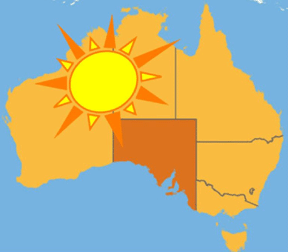
South Australia has joined an elite global club, after being listed alongside Denmark as the only other energy system in the world to be successfully managing significant volumes of surplus variable renewable energy across the year – albeit with a lot of hard work ahead.
In its latest global stocktake of variable renewable energy (VRE) integration across 50 power systems, the International Energy Agency says South Australia has joined the ranks of grids with the highest share of solar and wind in the world.
On the IEA’s scale, this puts South Australia in Phase 5 of the integration of renewables (Phase 6 is the top ranking), managing a share of solar and wind that averages out to be higher than fossil fuels over most of the year and at times surpasses 100% of local demand.
And while this is an achievement to be extremely proud of – of the 50 systems analysed by the IEA, 25 are in Phases 1 or 2, representing around 60% of global electricity generation – it also puts South Australia at the pointy end of renewable energy integration, where big changes need to happen fast, to keep the transition on track.
“A growing number of power systems are pushing the boundaries of VRE integration, successfully managing very high shares of variable renewables,” the report says.
But these “frontrunner systems” face complex challenges related to stability and flexibility, which the IEA says call for a transformation of how power systems are operated, planned and financed.
Certainly, South Australia is facing numerous challenges to get its grid from where it is now, to net 100 per cent renewables. And, as the report notes, some of these challenges are uniquely complex.
“In contrast to the case of Denmark, South Australia has limited interconnections with its neighbours, and the impact of solar PV on the net load is more visible,” it says.
“High VRE periods resulting in surplus generation are managed by a combination of measures including energy exports via interconnection to the neighbouring state, storage with battery energy storage systems (BESS), demand response and curtailment.
“High ramps at sunrise and sunset hours resulting from solar PV generation are managed predominantly by fast-acting gas turbines and the BESS, as well as accessible resources in the rest of the NEM through the interconnector.”
To this end, Project EnergyConnect – a “nation critical” new transmission project that will join up key renewable energy zones in South Australia, New South Wales and Victoria – is expected to help.
Meanwhile, other parts of Australia are not far behind – the IEA says Australia, as a nation, should be well into Phase 4 by 2030, where it will face “key operational challenges” to the way the power system responds to maintain stability immediately following disruptions in supply or demand.
Just this week in New South Wales, the state’s “potential output” of renewables – that is, the amount available for use or storage in ideal circumstances – was clocked at 99.8 per cent of native demand just before 11am on Sunday, with a combination of sunny weather and strong winds across most of the state.
But, as Renew Economy editor Giles Parkinson notes here, that level of variable renewables currently can’t be accommodated on the NSW system, for a combination of technical and economic reasons. And it is precisely this problem that the IEA report is hoping to address.
“By 2028 the main case of our renewables forecast shows that a range of countries …reach unprecedented annual shares of generation originating from wind and solar power plants – some above 65%,” the report says.
“This development calls for a better understanding of how this could affect electricity systems even further, and what measures can be taken on several fronts to ensure that those higher levels of VRE are integrated in an affordable and secure manner.”
And it warns that a failure to solve these challenges could derail the global climate effort.
“Should integration measures fail to be implemented in line with a scenario aligned with national climate targets, up to 2,000 terawatt-hours (TWh) of global VRE generation would be at risk by 2030, endangering achieving national energy and climate pledges,” the report says.
“This potential loss – equivalent to the combined VRE output of China and the United States in 2023 – stems from possible increases in technical and economic curtailment, as well as potential project connection delays.
“Consequently, the share of solar PV and wind in the global electricity mix in 2030 would reach 30%, lower than the 35% in the case where integration measures are implemented on time. If this decrease is compensated by increased reliance on fossil fuels, it could lead to up to a 20% smaller reduction of carbon dioxide (CO 2) emissions in the power sector.”
It is comforting to note, however, that Australia is not alone in the challenges it faces – even if it is at the leading edge of some of them.
The IEA says successfully integrating higher levels of solar and wind energy into the grid will increasingly rely on measures taken to meet two “critical requirements:” electricity grids, and procuring flexibility from a broad range of assets.
Grid congestion is a worldwide issue, the IEA notes, considering that global investment in renewables almost doubled between 2010 and 2023, while from 2015 grid investment has stagnated at $US300 billion a year until 2024, when it rose to $US400 billion.
“As a result of insufficient grid investment, at least 1,500 GW of solar and wind projects at an advanced stage were waiting for grid connection as of mid-2023,” the report says.
“Further, many countries are facing grid congestion issues, which are expensive to address due to the high cost of dispatching power plants to overcome immediate issues and because of the large amount of investment necessary to overcome congestion in the future.
“It is crucial for countries to accelerate grid expansion and upgrades, as it enables benefits beyond solely integrating VRE, such as improved electricity access and supporting overall demand growth.”
But, as Australia is experiencing, grid development takes a long time to materialise, the report adds, which means any and all complementary solutions with shorter lead times must be tapped to improve the integration of solar and wind.
On power system flexibility, the IEA says most of these needs will be met by solutions that are already in use, such as batteries, demand response and, to a smaller extent, curtailment.
Flexibility also extends beyond conventional generators, the report adds, encompassing storage, new electricity-based end uses, and grid infrastructure, all of which vary regionally.
“This report calls for strategic government action, enhanced infrastructure, and regulatory reforms to ensure the successful large-scale integration of solar PV and wind in order to meet global energy transition targets,” the IEA says.
“Robust data, stakeholder collaboration and government prioritisation of integration measures are essential for overcoming these challenges and achieving a sustainable energy future.”
Energy minister Chris Bowen says Peter Dutton must explain what happens to national grid over next decade if opposition stops building renewables
Guardian, Adam Morton Climate and environment editor, 20 Sept,24
The Coalition’s proposal to cap large-scale renewable energy and eventually build nuclear power plants would lead to “massive” electricity supply shortages risking blackouts, according to analysis released by the federal government.
The climate change and energy minister, Chris Bowen, released the findings of an energy department analysis that suggested electricity supply could be at least 18% less than what will be needed in 2035 under a scenario that reflects the few details of the Coalition plan that have been released.
Those details include the country building fewer solar and wind farms, the cancellation of the “rewiring the nation” policy to build transmission lines, extending the life of ageing coal plants and building nuclear plants at seven sites.
The Coalition’s proposal to cap large-scale renewable energy and eventually build nuclear power plants would lead to “massive” electricity supply shortages risking blackouts, according to analysis released by the federal government.
Under a scenario in which about 90% of remaining coal generation closes by 2035 – consistent with what the Australian Energy Market Operator (Aemo) projects – the gap between demand and supply could be 49%, according to the analysis.
Bowen said it showed Peter Dutton would “take to our finely tuned electricity system planning with a sledgehammer” and cause “massive supply shortages over the next decade”.
“The question that Mr Dutton has to answer is: where would the electricity come from if we stop building renewables now and nuclear takes so long?” Bowen said at a media conference. “He wanders around making outrageous accusations about blackouts under this government when in fact it’s his own scheme [that] is the biggest risk to reliability in Australia.”
The analysis, released via an opinion piece in The Australian, is timed to precede a speech by Dutton on Monday on whether nuclear power could work in Australia.
Dutton and the opposition treasury spokesman, Angus Taylor, rejected Bowen’s analysis in TV interviews on Friday, but declined to release details of their proposal. Speaking on Sky News Australia, Taylor said Bowen was “full of nonsense” and Labor’s policies would “always cost Australians more than our alternative policies”.
The Coalition has said if elected it would use public money to build nuclear plants at seven sites. It has suggested it would also cap investment in large-scale renewable energy and back more gas, a fossil fuel responsible for 21% of Australia’s climate pollution.
It has not released the expected cost of the plants, explained how the Coalition would lift legislated bans on nuclear power, or said why he believed the first two plants could be operating by 2035 or 2037 – a much faster timeframe than experts say would be possible.
Government agencies and independent analysts have found nuclear and more gas would be more expensive for households and businesses than Labor’s plan of running on variable renewable energy backed by “firming” from batteries, pumped hydro, more transmission lines and some gas.
The record high of low-cost wind and solar in the grid comes as we are still waiting for the costing on the Coalition’s plan to nationalise the eye-watering cost of seven nuclear plants.
It’s been a red-letter few weeks for renewables in Australia. In the last week of August, coal dropped below 50 per cent of electricity generation for the first time, as renewables’ share rose to a record high 48.7 per cent, boosted by windy conditions and low grid demand.
In August last year, coal contributed 57 per cent and renewable energy held a 37 per cent share
As in the US and Britain, where zero-emissions supply is burgeoning as fossil fuels’ contribution to generation falls, this threshold moment in Australia symbolises that the inevitable shift to clean energy is well under way and accelerating here and globally. China is deploying 23 gigawatts of renewables every month, four times what Australia does in a year.
The record-high renewable energy penetration in our national electricity market was accompanied by near record-low wholesale prices, averaging $57 per megawatt hour in the last week of August, versus $91 in August last year. This shows that more renewables equals cheaper power.
South Australia is the standard-bearer for Australia’s renewable energy future. In the past seven days, more than 75 per cent of its power use was generated by renewables, at average wholesale prices of just $37 per megawatt hour, way below the $123 average over the past year.
South Australian Energy Minister Tom Koutsantonis has revised the state’s renewables target to 100 per cent by 2027, off the back of the continued rollout of clean energy infrastructure.
This includes three big batteries announced last week under Federal Energy Minister Chris Bowen’s flagship Capacity Investment Scheme – a key driver of investment momentum underpinning the renewables build-out nationally – and major grid developments, with concomitant projected residential and business energy bill savings.
The federal government and its state counterparts are getting on with the job of accelerating our national energy transition, working to deliver the federal 82 per cent renewables by 2030 target and the resulting energy bill relief. The lower house passed the Future Made in Australia Act this week, key to the government’s vision for a renewables-powered economy.
Still no nuclear costings
Meanwhile, the federal Coalition continues to perpetuate its nuclear con, designed to blow up progress on the transformation of our energy system to low-cost, reliable firmed renewables and entrench decades more of volatile, expensive fossil fuel-based power while we wait … and wait.
Next week marks three months since Opposition Leader Peter Dutton and chief nuclear spruiker Ted O’Brien released their fact- and costings-free, one-page nuclear memo, effectively a note proposing to nationalise the eye-watering cost of construction of seven nuclear plants nationwide – in a country with zero history and expertise in nuclear power generation, on a timeframe that, by all expert accounts, will not result in any material delivery before the mid-2040s. We’re still waiting for their budget projections on this excuse for a policy.
Only this week, Dutton was reported as dismissing questions about budget impacts because he didn’t want to overload Australians with too much information, as the government released an ad citing calculation by industry body the Smart Energy Council that the nuclear energy build would cost up to $600 billion and add $1000 annually to household electricity bills.
Our estimate is that the public cost would be a minimum of $100 billion, and this would inevitably be taxpayer-funded because, unlike firmed renewables, into which private capital is increasingly flowing, there is zero investor interest in nuclear in Australia without massive government subsidies, risk transfer and guarantees.
The Coalition plan involves a fiscally negligent impost on consumers already struggling with cost-of-living pressures. The global history of huge cost blowouts and bailouts in every Western economy building nuclear exacerbates this, and should discourage even the most credulous believer.
This alone makes nuclear unviable here. But the clincher is ongoing generation costs feeding into retail prices. The 2024 GenCost report by the CSIRO and the Australian Energy Market Operator prices large-scale nuclear energy at $155 to $252 a megawatt hour. That is double their estimate of the cost of fully firmed renewable energy of $90 to $100, even after factoring in grid transmission, curtailment and battery firming costs.
The renewables surge is the way of the future. We cannot afford to entertain the Coalition’s damaging nuclear distraction.
Any government proposing nuclear here would be robbing Australians three times: once via a $100 billion public capital subsidy for nuclear reactors; again by locking in long-term hyperinflated energy prices; and third to compensate owners of the former coal power sites the Coalition has slated for nuclear, which have already built new clean energy assets, such as batteries onsite.
Progress is building on transforming our grid with superabundant wind and solar energy, distributed across rooftops and utility-scale, backed up by battery storage and modernised transmission. This now needs further acceleration, particularly given looming closures of breakdown-prone, expensive end-of-life coal power clunkers.
The evidence that firmed renewables win on cost is irrefutable, and double-digit annual deflation of battery and solar costs widens this advantage every year. The energy market operator last month confirmed it sees no energy supply reliability gaps to 2030 in the national electricity market, assuming planned renewables projects proceed on time and at the targeted scale.
The renewables surge we have experienced is the way of the future. We cannot afford to entertain the Coalition’s damaging nuclear distraction. For the sake of Australia, let’s hope that as the renewables reality rises, the Coalition’s domestic nuclear pipe dream is consigned to oblivion, where it belongs.
Any government proposing nuclear here would be robbing Australians three times: once via a $100 billion public capital subsidy for nuclear reactors; again by locking in long-term hyperinflated energy prices; and third to compensate owners of the former coal power sites the Coalition has slated for nuclear, which have already built new clean energy assets, such as batteries onsite.
Progress is building on transforming our grid with superabundant wind and solar energy, distributed across rooftops and utility-scale, backed up by battery storage and modernised transmission. This now needs further acceleration, particularly given looming closures of breakdown-prone, expensive end-of-life coal power clunkers.
The evidence that firmed renewables win on cost is irrefutable, and double-digit annual deflation of battery and solar costs widens this advantage every year. The energy market operator last month confirmed it sees no energy supply reliability gaps to 2030 in the national electricity market, assuming planned renewables projects proceed on time and at the targeted scale.
The renewables surge we have experienced is the way of the future. We cannot afford to entertain the Coalition’s damaging nuclear distraction. For the sake of Australia, let’s hope that as the renewables reality rises, the Coalition’s domestic nuclear pipe dream is consigned to oblivion, where it belongs.
On 28 September 2016, a catastrophic weather event sent the entire state into system black. Around 4pm, some 850,000 homes and businesses lost power as supercell thunderstorms and destructive winds – some travelling up to 260km/h – crumpled transmission towers, causing three major power lines to trip.
The International Energy Agency says demonstrating the ability to power a large grid with wind and solar is crucial in the context of climate change, and South Australia’s share is “remarkable”.
The state government is now attempting to legislate a target of 100% renewable energy by 2027. Experts say the state’s approach could provide a template for what can be achieved elsewhere.
Energy specialist Dr Gabrielle Kuiper says powering a jurisdiction of almost 2 million people with majority wind and solar is a globally significant achievement.
“One of the most impressive things about that feat, from a technical point of view, is there have also been periods, starting in September last year, where the entire state was powered by rooftop solar alone,” Kuiper says.
On New Year’s Eve 2023, rooftop solar met 101.7% of South Australia’s energy needs for 30 minutes. Australia’s energy operator says that’s a world record for a grid of that size. Its engineering roadmap seeks to enable similar milestones throughout the national grid.
Daniel Westerman, chief executive of the Australian Energy Market Operator, says the “world-leading” rooftop solar contribution is made possible by power system equipment providing security, smarter connections between rooftop solar and the grid, and policies which protect consumers from unwanted disruptions.
Dr Susan Close, South Australia’s deputy premier and climate change minister, was a government minister during the 2016 statewide blackout. She believes the then federal government’s reaction at the time, blaming the state’s renewable energy, was “unfair and unsubstantiated”.
But if anything, she says the unhelpful response from Canberra hardened the state’s resolve. “In South Australia, the vast majority of people were proud of what we were doing, and simply wanted us to make sure that it was as secure and stable as possible,” Close says.
Close says the state’s energy shift hasn’t happened by chance. World-leading climate laws, consistent policy and a supportive planning system attracted investment and helped the state gain an early advantage under federal renewable energy targets. High retail power prices combined with a generous feed-in tariff scheme (now finished) to drive early uptake in rooftop solar. Now every second home in the state has solar installed.
Johanna Bowyer, lead analyst at the Institute for Energy Economics and Financial Analysis, said while South Australia does have fantastic wind and solar resources, “that’s the case for a lot of Australia”. Crucially, coal power stations were allowed to close under market conditions, she said. “They didn’t subsidise it to stay open for longer, like what is happening in New South Wales with Eraring.”
As coal generation was phased out, renewable energy grew to fill the gap.
Proposed changes to South Australia’s Climate Change Act include a 100% net renewable energy target, formalising statements by the energy minister earlier in the year.
The “net” terminology recognises that interstate transmission lines – connecting South Australia to Victoria and eventually NSW – will continue to share electricity across state borders.
The amendments also include a 60% emissions reduction target by 2030 – compared to 43% federally, and 50% in Queensland, NSW and Victoria – and a framework for timely updates along the pathway to net zero by 2050.
Kirsty Bevan, chief executive of the Conservation Council of SA, says the state’s “trailblazing renewable energy transition” puts it in a unique position to adopt much stronger emissions targets than other state governments. The council supports the renewable energy and 2030 emissions targets, but is keen to see the net zero target date brought forward.
“We should be proud of our past renewable energy accomplishments, but also build upon and capitalise on those accomplishments – to the benefit of all South Australians, our nature, and our shared planet,” Bevan said.
The state government’s focus is on stability, flexibility and reliability, with more large-scale battery storage following in the footsteps of the Hornsdale battery (the world’s biggest when it was activated), and hydrogen part of the plan to soak up excess wind and sun.
Kuiper says the secure and reliable system is made possible thanks to investment in storage, smarter management and grid flexibility. But the key to SA’s success isn’t merely technical, she says, it’s also political.
“The bipartisan support for renewable energy in South Australia has been really significant. It’s given investors a sense of certainty,” Kuiper said.
“I think there are lessons at a federal level, particularly for the federal opposition, about what can be achieved if you provide consistent support to this vitally important industry – that’s important for the domestic economy and for Australia’s development of export industries into the future.”
The aim of 100% net renewables was initially set under the Marshall Liberal government, with the Malinauskas Labor government bringing the date forward.
Close acknowledges the opposition’s part in supporting the state’s decarbonisation, adding that the current bill protects to a degree from “a sudden shift in temperament from the other side of politics.”
She says there’s no reason the energy and cultural transition in South Australia couldn’t be replicated in other parts of the country.
“The sooner you start, the easier it is,” she said. “The real cost is in being the last ones to make the change. And so we wish our interstate colleagues well in making that shift.”
The Federal Opposition’s energy policy includes the construction of nuclear power plants. Peter Dutton says that we need them because Australia’s emissions reduction target of 43% on 2005 levels by 2030 is unachievable. Is this true? We argue that it is not – and especially if the Australian Government works with state and territory governments to stop native forest logging and land clearing.
Ending land clearing and halting logging of native forests would achieve a reduction of between 14.5 million and 37.5 million tonnes of carbon dioxide equivalent a year. This is greater than the annual reduction of 14.2 million tonnes of carbon dioxide equivalent needed to meet Australia’s 2030 target. A major reduction in emissions from logging and clearing forests would be sit admirably along Australia’s efforts to transition from fossil fuels to clean energy – which is now 40% of the electricity market (up from 15% a decade ago).
This is an entirely feasible proposition, as ending native forest logging will serve to further stimulate investment in the plantation sector – where there are the most jobs and the best profits in the forest industry. Indeed, 90% of all sawn timber in Australia (to make roof trusses, floorboards and furniture) already comes from plantations. Native forest logging generates predominantly woodchips, paper pulp and packaging (and not high-quality timber products). Plantations employ, on average, three times more people per ha of trees than do native forests. In addition, the capital investment needed for one full-time equivalent position in a native forest logging operation is almost 10 times that needed for a full-time equivalent in a plantation…………………………………………………………….. more https://johnmenadue.com/for-australia-to-meet-emissions-reduction-targets-we-dont-need-nuclear-energy/
The season of renewable records has begun early in Australia, sending average coal power down below 50 per cent for the first time, establishing new records for wind output, and sending grid demand to new lows across the main grid.
The state at the forefront of the country’s energy transition is, without a shadow of a doubt, South Australia. It kicked out coal in 2016, and is steadily reducing its dependence on gas. When a new transmission link to NSW is completed in the next two years, the state expects to run at 100 per cent net renewables – reducing gas to a support role and becoming the first multi-gigawatt scale grid in the world to reach such a milestone through wind and solar, rather than more conventional renewable sources.
Big industry is lining up to build new factories and production facilities to take advantage of cleaner power and lower wholesale prices, and BHP is talking of doubling its mining production at the giant Olympic Dam – and its smelting and refining capacity. The latest data shows that wind and solar provided enough power to meet more than 70 per cent of the state’s electricity demand in the last 12 months – although the government says it is 75 per cent.
Over the past 30 days it has been 86.4 per cent, and over the past week it has been more than 105 per cent. Rooftop solar now supplies the equivalent of all state demand on occasions, presenting a complication for the market operator which prefers to run the grid with assets it can control. It’s working on that solution with new inverter standards and grid protocols, including solar switch-offs. South Australia also led the country, and the world, in the installation of the first big battery, the original “Tesla Big Battery” now properly known as the Hornsdale Power Reserve.
Illawarra Mercury, By Marion Rae, August 14 2024 –
AGL Energy has staked millions more on the clean energy transition as higher power prices and fewer outages generate stellar profit growth and spare cash.
Australia’s biggest emitter announced on Wednesday the $250 million acquisition of Firm Power and Terrain Solar, adding solar power and battery storage across all states.
Their combined projects, at 8.1 gigawatts, will add to renewable sources of electricity as coal-fired power plants close from coast to coast.
However, recent polls show that many Australians don’t believe the transition is feasible or on track for the national target of 82 per cent renewable energy by 2030.
“We’re investing back into the transition … it’s well underway,” AGL managing director Damien Nicks told AAP.
He said big batteries would ultimately assist renewable generation by responding to market demand in milliseconds, along with pumped hydro and other firming assets including fast-start gas.
“It is the most complex transition this country has seen but you’re right, community engagement through this time is going to be critical … whether that’s on our sites or outside of our sites,” Mr Nicks said.
“We’re also trying to utilise the infrastructure and grid that’s available to us today, whilst the transmission gets built out around the rest of the country – that’s incredibly important.”
But he dismissed the option of nuclear reactors, which the coalition has promised to build if it wins power in 2025.
“Nuclear is not part of our plans, nor our strategy … we cannot sit around and wait for nuclear,” Mr Nicks said.
“The rationale for that is both cost and time to get there.
“We need to find 12 gigawatts of renewable and firming assets by 2035.”
AGL earlier posted an underlying net profit of $812 million for the year to June 30, up 189 per cent, while underlying earnings rose 63 per cent to $2.22 billion.
Federal Opposition Leader Peter Dutton has been in regional Queensland this week promoting hi nuclear plan, which claims nuclear and solar both have a future in Australia’s energy mix.
Yeah, nah.
A new report released this week by the Queensland Conservation Council has revealed building a 1,000 MW nuclear power station in Queensland in 2040 would knock out 3,700 GWh of cheap renewable energy from the grid.
It is the equivalent of shutting an average of 45,000 Queensland household solar systems every day, according to the new analysis.
The report reinforces what other experts are saying – that rooftop solar and nuclear cannot co-exist – and reveals just how detrimental any proposal for nuclear would be for Queensland solar homeowners’ hip pockets.
To make nuclear power plants economically viable, nuclear must run at full capacity. That means a direct clash with rooftop solar whenever the sun is up, and to enable nuclear power production during the day they’ll have to stop rooftop solar panels from exporting to the grid.
The simple truth is adding nuclear power to the Australian energy mix will undermine the interest of rooftop solar owners.
Australia has an abundance of sunshine and renewable resources. Queensland already leads the world with uptake of household-scale solar, with the Sunshine State reaching a record 1 million rooftop solar installations earlier this year.
The second, third, fourth and fifth highest rates of rooftop solar output in Australia are in Bundaberg, Mackay, Toowoomba and Hervey Bay. These communities have the most to lose if their solar output is shut off during the day by nuclear.
With more Australian households nationwide having rooftop solar than swimming pools, it’s time for the Liberals and Nationals to start listening and stop ignoring people power, literally and politically.
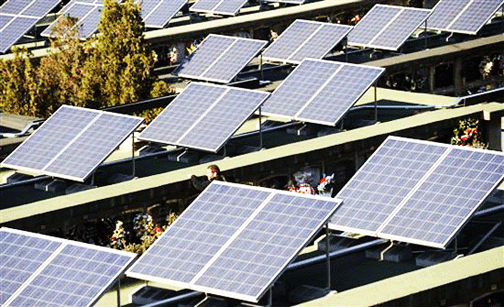
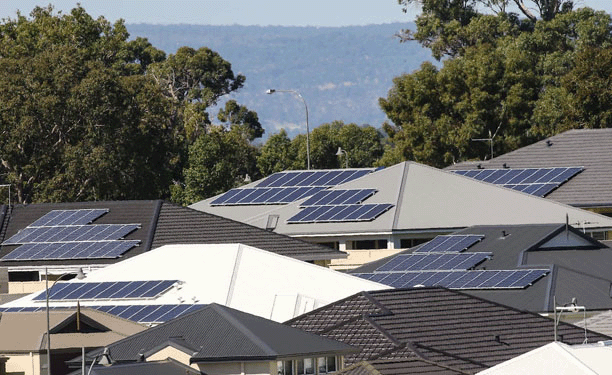
Australians have already voted with their rooftops for cheaper, cleaner solar energy, with more than three million rooftop solar installations. Australians have a strong and abiding love of the cost saving, independence and security that comes from making their own solar power.
In fact we’ve invested $25 billion of our own money into rooftop solar, and are the envy of the eye worldwide for our home-grown renewable energy.
Everyday Australians are world leading energy producers – not just energy consumers. Every home solar rooftop should be treated with the respect of being a sustainable home solar energy “farmer”, bringing the cost of power down for all Australians, and simultaebously reducing our carbon emissions.
At Solar Citizens we work with community members from across the political spectrum who, time and again, have been vocal in support of solar because they are empowered by rooftop solar. We know how strong this movement of solar homeowners is. And it would be unwise for political leaders to forget it.
A smarter government investment would be to grow access to rooftop solar for households currently locked out of the benefits of clean energy including renters, people living in apartments or social housing and low-income households. And provide Australian households with assistance for a battery rebate, like the highly succcessful solar rebate.
Enabling more people to install home batteries will mean we can store cleaner, cheaper energy during the day and use it at night or when needed most. This would provide long term energy relief for households, improve our power network reliability and help cut network costs for all by avoiding transmission costs.
Rooftop solar coupled with home batteries delivers the win-win of cost-of-living relief with cheaper power and less climate pollution.
Put simply, solar and renewables would not happily co-exist in a toxic ‘frenemy” relationship’ with nuclear. Instead, we urgently need a great Aussie marriage of home solar with home batteries.
Heidi Lee Douglas is CEO of Solar Citizens, an independent, community-based organisation working to protect and grow solar and renewable energy and clean transport in Australia.
Australian solar innovator 5B says the plunging price of photovoltaic technology has made the company’s prefabricated Maverick arrays cost-competitive with single axis tracking solar plants – and in some cases cheaper, depending on the quality of the solar resource.
In a presentation to the Large-scale Renewable Generation & Storage Summit in Sydney on Thursday, 5B deputy CEO Nicole Kuepper-Russell said the company’s value proposition was “really singing” since module prices fell to just over 10 cents per watt in China in March.
The low cost of solar was a hot topic at the conference, as was the falling cost of storage.
In a presentation by former Clean Energy Finance Corporation chief Oliver Yates, the renewables investment guru argued cheaper batteries mean most existing government and industry plans should be “shredded and start again” to account for the “new solar/battery economic frontier.”
Representing Valent Energy – the energy storage focused joint venture between Gaw Capital and BW ESS – Yates said the cost of dispatchable renewables was now around $200/MWh – $65/MWh for solar production and $135/MWh for battery storage – and “anything producing power higher than that is ridiculous.”
THE clean energy industry has accused nuclear energy proponents of threatening the nation’s fragile hold on vital economic reform with “mistruths and outright disinformation”.
“The Australian public are being confused and misled,” Clean Energy Council chief executive Kane Thornton told the industry’s annual summit in Sydney on Tuesday.
“We need to remember the vast majority want wind and solar and hydro to be central to our energy future,” he told business leaders and investors.
He accused “bad faith actors” of preying on anxious communities who feared uncertainty after an energy crisis and amid ongoing cost-of-living pressures, which could be alleviated by cheaper renewable power.
“Vested interests are stepping up to tell their story and peppering it with mistruths and outright disinformation,” Mr Thornton said.
Nuclear power was the “battering ram of bad faith actors” despite it being more expensive and two decades away at best, he said.
Australia has doubled its amount of renewable energy in the past five years and must again by 2030, as coal-fired power plants are phased out and new electrified industries grow.
Coalition energy spokesman Keith Pitt, who says nuclear is the “only option” to achieve net zero emissions and keep the lights on, is due to address the summit on Wednesday.
Dismissing the nuclear debate as a “distraction”, Assistant Minister for Climate Change and Energy Jenny McAllister said it would leave “a pretty big gap” if the coalition pressed pause on renewables now to install nuclear power in the 2040s.
Announcing the fast-tracking of a certification scheme for new exports, Senator McAllister said it would become increasingly important for businesses to be able to account for their products’ emissions intensity to retain access to major markets.
“The guarantee of origin scheme will give Australian companies a competitive advantage by providing government-backed certification of the carbon intensity of key green products,” she said.
A crucial component of the $22.7 billion Future Made in Australia program, the scheme begins with renewable hydrogen in 2025 before expanding to sustainable aviation fuel, green steel and aluminium, and biomethane and biogas.
As the climate-accounting backbone of new green industries, it is designed to allow producers, exporters and users to prove where a product was made and the emissions associated with its production and transport.
Digital certificates, backed by proof of renewable energy use, will be used to establish eligibility for tax credits under the $6.7 billion Hydrogen Production Tax Credit announced in the May budget, and trigger the development of other new industries.
As almost all of Australia’s trading partners have net-zero commitments, official proof of emissions could avoid costly tariffs or trade bans on hydrogen or ammonia production that relies on coal or gas-fired electricity rather than renewable energy.
“Guarantee of origin is a key to new market opportunities for Australian energy exporters in the race to net-zero,” Senator McAllister said.
The first Australia-India renewable energy dialogue was held alongside the Australian Clean Energy Summit, with India aiming for 50 percent renewable energy by 2030.
Despite being big coal and gas exporters and users, the two countries say they share a net zero commitment.
The extent to which the federal Coalition’s nuclear power plans clash with Australia’s world-leading rooftop solar uptake has been highlighted by new analysis that estimates tens of thousands of residential PV systems would have to be shut off on a daily basis to allow just one nuclear plant to operate.
The Queensland Conservation Council report models the potential impact of nuclear power on the Sunshine State’s future grid by measuring it against the latest projections of the Australian Energy Market Operator’ in its’s 2024 Integrated System Plan.
The ISP sets out a detailed 20 year plan for how Australia will meet its energy needs while retiring all coal fired power stations by 2040, using mostly renewable energy and storage. Nuclear is not a part of this plan.
Using the most likely scenario of the ISP, the Step Change, the QCC finds that adding just one, 1GW nuclear plant to the equation in 2040 would displace more than 3,700 GWh of cheap renewables, due to the inflexible nature of “always on” nuclear power generation.
“A [1,000MW] nuclear power station, which can only run down to 500 MW …would usually be supplying more energy than the system needs (Figure 6),” the report says.
“This means the equivalent of an average of 45,000 Queensland household solar systems would need to be shut off every day. We would be shutting off cheap energy, like people’s rooftop solar, to allow expensive nuclear power to run.
“This report shows that, even if large-scale nuclear energy can be built in 15 years in Australia, we won’t need it.”
The new data supports what just about every other informed participant in Australia’s energy transition – from the market operator, to regulators, policy makers, utilities and the energy market itself – understand, and have been saying, about what will and won’t work in a grid that is changing dramatically.
And just last week, the University of Western Australia’s Bill Grace gave his own detailed analysis of why the sort of baseload power nuclear provides “is no longer necessary or commercially viable.”
QCC energy strategist Claire Silcock says this week’s report confirms that nuclear power has no place on Australia’s grid and isn’t what is needed to meet future energy demands at least cost.
“What we need is flexible generation and storage which can move energy from when we have lots of it, in the middle of the day, to when we need it overnight,” Silcock says. “That is not how nuclear power stations work.
“The earliest we could possibly build a nuclear power plant in Australia is 2040 – by then we will have abundant renewable energy and technology like batteries and pumped hydro will be providing the flexible storage we need to support that renewable energy.
“Nuclear is also much more expensive than renewable energy backed by storage,” she adds.
“It’s as clear as day that the federal Coalition’s nuclear plan is a fantasy to delay the closure of Australia’s polluting coal-fired power stations.
“We would like to see the federal opposition focus on a real plan for bringing down emissions and power prices and that would mean backing renewable energy and storage.”
In this, the first in an occasional series about nuclear power in Australia, Peter Farley says the claim of nuclear reliability is vastly overstated.
“No amount of experimentation can ever prove me right; a single experiment can prove me wrong,” – Albert Einstein.
As a student in the late 60’s I watched a training film which assured us that nuclear power was available every hour of every day and it would soon be ‘too cheap to meter’ (Chairman of US Atomic Energy Commission 1954).
In the seventies the nuclear story began to unravel – nuclear plants were nowhere near as reliable as claimed.
Nuclear plants must be shut down for maintenance and refuelling which takes 4-6 weeks every 1-3 years.
An additional complication is that due to the huge thermal mass and the risk of fuel containment failing with rapid operating changes, a nominal two-hour repair of a simple wiring fault requires a 48–72-hour power down/power up process.
Consequently, in the seventies and eighties nuclear availability was in the 70-80% range, not the claimed 95%.
Later it was realised that an emergency shutdown due to an external issue such as a turbine fault, loss of transmission etc., xenon gas was generated within the reactor and stopped the nuclear reaction.
Xenon, which itself is radioactive, must be carefully and thoroughly extracted from the reactor before restart.
After the Great Northeast blackout in the US in 1965 some reactors took two weeks to return to service.
Then it became clear that the benefits of a common design had their downsides.
In Canada in 1998 it was discovered that their design led to premature failure of cooling tubes, so 8 of 22 reactors were shut down. It took until 2006 for production to fully recover.
Then by 2014 a series of upgrades began with one to three reactors offline for 24-30 months each. 2023 output was still 16% down on 2014. France had a similar experience in 2020 and 2022.
The British Magnox reactors had problems with graphite blocks. There wasn’t a single year where nuclear output in the UK was above 86% of capacity.
In Switzerland in 2015 for a brief period all five reactors were off-line.
In Belgium in 2015, output was down 46% on the 2000-2012 average. Worse, for six weeks late in 2018, four of five reactors were offline and for the whole second half of 2018 nuclear output was 61% down on historical levels.
Fortunately for Belgium, they burned a lot of cheap gas. More significantly, they imported an average of 24% and up to 44% of their electricity for the half.
Before turning to the big producers, France and the US, let’s check the latest nuclear champion, Finland.
In winter 23/24 nuclear power ran faultlessly but load varies, so its contribution varied between 23% and 48% of the load.
But by March for long periods, imports were larger than nuclear power output. In May, nuclear output was 40% down on January.
While France is a nuclear success story, it is not without significant problems. Nuclear output peaked in France in 2005 at 450 TWh, 79% share of generation and 81% capacity factor.
By 2016-17 problems began to appear and nuclear output dropped below 400 TWh, then by 2020 around 350 TWh and 67.5% market share.
Then in 2022 disaster struck. A new form of stress corrosion was discovered in Civaux-1 which was only 20 years old.
Further, a record drought meant cooling water was restricted at another six reactors halving power output there, even after a temporary suspension of environmental regulations.
Soon half of France’s reactors were offline. The result was that in the midst of the global gas crisis, France’s 2022 nuclear output was 182 TWh below 2005.
That is the equivalent to 520 Snowy 2.0s. Relative to the NEM, the reduction is equivalent to quadrupling our 2022 gas output and completely draining seventy Snowy 2.0.
The NEM was in near crisis when coal output fell by 4.8% between winter 2021 and winter 2022. In July to September 2022 French nuclear output was down 43% from historical levels so instead of exporting 14% of its electricity for those months it imported 10%. Who will we import from?
While the US nuclear system is more productive with 93% Capacity Factor, it also has 870 GW of fossil fuels and hydro/pumped hydro and import capacity to back up the 97 GW of nuclear.
That is equivalent to increasing our existing coal, gas and hydro capacity by 50% to back up 7 GW of nuclear.
Alternatively, US nuclear power works because it only supplies 18% of US grid electricity from 91 reactors.
If we only want 20% of grid supply from nuclear, that means just four or five conventional reactors.
With 43 coal generators we still have problems when there are clusters of outages. If a large number of reactors is required so that the loss of three to five at once, as has happened in Belgium, Switzerland, Sweden, and Canada is not a problem, we need a number about where the US is now, meaning roughly a hundred 80-120 MW reactors.
But even then, it is no guarantee – in April 2023 nuclear output in the US was down 20% on January
In conclusion, a feasible number of nuclear reactors in Australia would not guarantee reliability, regardless of cost.
Peter Farley holds an engineering degree and is a manufacturing leader who built pioneering CNC machine tools for export winning many export and engineering awards. Peter has been studying the electricity sector since his 2012 Election to the Victorian Committee of Engineers Australia.
Clare Silcock, 21 July 2024, https://www.queenslandconservation.org.au/nuclear_option_shutting_off_cheap_solar Queensland Conservation Council (QCC) has today released a new analysis showing that the equivalent of 45,000 Queensland household solar systems would need to be shut off every day to allow just one nuclear power station to operate in 2040. With the renewable energy rollout well underway, by the time we have built a nuclear power station in Queensland, we won’t have the need for it.
Clare Silcock, Energy Strategist at QCC, said:
Nuclear power stations can’t easily turn off, which means by 2040, we’d have to turn off a staggering 3,700 GWh of cheap renewable energy every year just to run one nuclear power station. We would be shutting off cheap energy to allow expensive nuclear power to run.
This report shows that nuclear power simply doesn’t fit into a modern grid and isn’t what we need to meet our future energy demands at the least cost.
Our energy system is changing rapidly. We’ve nearly doubled renewable energy in Queensland in five years. A large part of this has been from rooftop solar systems which have fundamentally changed when we need energy to support the grid.
Baseload generation is what our power system was built on, but it’s not what we need in the future. Saying that we need baseload generation is like saying that we need floppy disks to transfer files between computers.
What we need is flexible generation and storage which can move energy from when we have lots of it, in the middle of the day, to when we need it overnight. That is not how nuclear power stations work.
The earliest we could possibly build a nuclear power plant in Australia is 2040 – by then we will have abundant renewable energy and technology like batteries and pumped hydro will be providing the flexible storage we need to support that renewable energy.
Nuclear is also much more expensive than renewable energy backed by storage. CSIRO estimates nuclear could be up to four times more expensive to build. It’s as clear as day that the Federal Coalition’s nuclear plan is a fantasy to delay the closure of Australia’s polluting coal-fired power stations.
We would like to see the Federal Opposition focus on a real plan for bringing down emissions and power prices and that would mean backing renewable energy and storage.
The head of the Australian Energy Market Operator, Daniel Westerman, has rejected nuclear power as an option to replace Australia’s ageing coal fleet, saying it is too slow and expensive, and that baseload power sources in any case won’t be able to compete in a grid dominated by wind and solar.
The comments by Westerman at the Clean Energy Summit in Sydney on Tuesday, come as the federal Coalition intensifies its push for nuclear power, outlining plans to build nuclear facilities at seven current and former coal generation sites across the country.
Westerman says the updated roadmap released by AEMO last month, known as the 2024 Integrated System Plan, does not consider nuclear because it remains outlawed in Australia and is not part of any government policy package. But he said it was clear from AEMO’s work with CSIRO in the GenCost report that nuclear was expensive, and too slow.
“To be clear, AEMO does not form the view that one form of energy is ‘good’ and another ‘bad’,” Westerman said.
“Our engineers and economists are focused on finding the least-cost path to reliable and affordable energy for Australian consumers.
“Even on the most optimistic outlook, nuclear power won’t be ready in time for the exit of Australia’s coal-fired power stations. And the imperative to replace that retiring coal generation is with us now.
“In fact, the old notion of “baseload” generation which runs constantly, then supplemented with “peaking generation” for the daily peaks in demand, simply does not reflect the way our power system works today, or into the future.
“When the sun is shining and wind is blowing, renewable generation produces energy at zero marginal cost, and “baseload” energy simply can’t compete. It is either pushed out of the market entirely, or has to sell its energy at a loss if it can’t flex up and down to absorb the peaks and troughs of variable renewable supply.
Westerman’s comments were echoed by Damien Nicks, the CEO of AGL Energy which is the country’s biggest producer of coal power, all of which will close by 2035.
“We haven’t got time to wait,” Nicks said. We need to build 12 GW of both firming and renewables over that period of time and we have to get on with it. Nuclear is not part of our strategy.”
Rob Wheals, the former head of gas company APA who now heads iron ore billionaire Andrew Forrest’s renewable investor Squadron Energy, agreed. “Nuclear does not actually solve the problem(of impending coal closures) …. we’ve got to get on with the job of building and rebuilding Australia’s energy system.”
The AEMO ISP outlines plans to deal with the expected retirement of all of Australia’s coal fleet over the next 10 to 15 years, and the costs involved to build new wind, solar and storage, as well as transmission lines – which AEMO puts at $122 billion.
That figure – along with the conclusions from the GenCost report – have been repeatedly attacked by the federal Coalition, right wing “think tanks” and mainstream media outlets. They claim that the ISP ignores costs such as networks, and consumer energy resources, which will be one of the major components of the transition.
Westerman rejected this. “It does not include the cost of distribution networks whose plans are made at a local level…and it does not include the cost of consumer devices like rooftop solar systems, because those investment decisions are made by consumers themselves,” he said.
The ISP maps out a dramatic transition in Australia’s main electricity grid, from around 60 gigawatts (GW) now, including 20 GW of rooftop solar, to more than 300 GW and more than 86 GW of rooftop solar, with demand doubling as a result of economic growth and electrification in homes, industry and transport.
This will require 60 GW of large scale wind (up from 12 GW now), 58 GW of large scale solar (up from 10 GW), and 44 GW of battery storage capacity.
It will also need 15 GW of gas capacity, up from 11.5 GW now, but that meant that around 13 GW of new capacity would be needed as much of existing capacity is ageing and will need to be replaced.
He said gas will not be used much – maybe just 5 per cent of the time – but it will be important to meet demand peaks, and also to fill gaps in so-called “dunkelflaute” the German word for extended wind and solar droughts which may be apparent in states like Victoria, particularly in winter.
One of the biggest challenges remains the management of consumer energy resources, particularly rooftop solar, which are largely uncontrolled. This meant that protocols had to be introduced to protect “minimum load” levels which would enable AEMO to remain control of the grid and keep the lights on.
Westerman said the overall pace of investment needs to increase, and the connections process – cited by investors as one of the biggest causes of project delays – also needs to be streamlined.
He said the capacity of new generation and storage projects in various stages of the connection process in the National Electricity Market had grown to close to 43 GW from 30 GW a year ago.
AEMO is also working on the engineering requirements to accommodate periods of 100 per cent renewables on the main grid. Already new milestones had been reached, including renewables reaching more than 70 per cent of NEM demand, rooftop solar alone providing 50 per cent of the NEM, and more than 100 per cent in South Australia.
He noted that South Australia, which leads the country and the world with a 70 per cent renewable share – wind and solar – over the past year, had also met more than 90 per cent of its supply with wind and solar, mostly rooftop PV, even when the state grid was electrically separated from the rest of the NEM as a result of a storm last year.
“Australia is leading the world in proving how to reliably source the majority of electricity for a developed economy from the wind and the sun.
Apr 15, 2026 01:00 AM in Canberra, Melbourne, Sydney
Join the International Physicians for the Prevention of Nuclear War (IPPNW) on Tuesday, April 14th for a timely webinar exploring the risks associated with nuclear power and challenging the myth that it offers a simple, safe, carbon-free solution to the climate crisis
21 April Webinar: No Nuclear Weapons in Australia
Start: 2026-04-21 18:00:00 UTC Canberra, Melbourne, Sydney (GMT+10:00)
End: 2026-04-21 19:30:00 UTC Canberra, Melbourne, Sydney (GMT+10:00)
Event Type: Virtual A virtual link will be communicated before the event.







 Antinuclear