“Small” rooftop solar is driving Australia’s solar energy boom
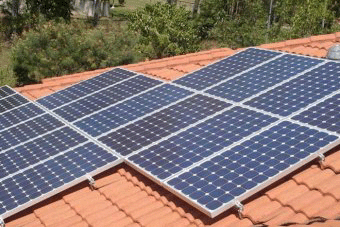 Regional home and business owners driving Australia’s solar energy boom ABC, PM By Angela Lavoipierre 22 Mar 17 When you think of solar, you probably think of vast fields of black panels at large-scale solar farms, producing enormous quantities of power.
Key points:
- The highest uptake of rooftop solar is in the regional and urban fringe areas
- Moree, NSW is a perfect example, with 19 per cent of homes sporting rooftop panels
- The cost of installing solar systems has decreased by around 80 per cent in the last decade
But Australia’s real solar engine, at least for the time being, is a much more humble sight. It is small collections of solar panels on ordinary homes and businesses around the country.
At 2.8 per cent, rooftop solar contributes far more to Australia’s total energy mix than largescale solar, which currently comes in at around a quarter of a per cent.
Claire O’Rourke is the national director of Solar Citizens, a group which lobbies for private solar owners.
“It’s not the inner-city latte-sippers who are going solar,” she said.
“It’s definitely the highest uptake around those urban fringe areas and in regional areas as well where you’ll see in some areas 30-40 per cent of homes with solar on rooftops.”
There are nearly 1.6 million Australian homes with solar panels on their rooftops. To put it in perspective, 1.4 million of those homes took up solar installations in the last decade.
“These are kind of remarkable figures for an industry that was seen as more of a cottage industry 15 or 20 years ago where it was kind of off-grid hippies that were taking it up,” Ms O’Rourke said.
“But it’s very much a mainstream option for people to manage their energy use and also to take control of their rising power bills.”
According to the Grattan Institute, consumers in Melbourne, Sydney, Brisbane and Adelaide are paying nearly twice as much for electricity as they were a decade ago. Ms O’Rourke said that was part of the reason rooftop solar had been booming. “Prices have gone up, bills have gone up, and the other contributing factor is that the costs of solar has rapidly decreased,” she said. “So if you look at a bit of technical analysis, it’s dropped from $9-a-watt for out-of-pocket expenses on installing a solar system, to $1.60.”So it’s like an 80 per cent decrease in out-of-pocket installation costs in only a decade.”
Moree embraces solar….. http://www.abc.net.au/news/2017-03-23/regional-australia-drives-solar-boom/8377670
Rooftop solar the unsung hero in recent South Australia blackouts.
Regional home and business owners driving Australia’s solar energy boom, ABC PM By Angela Lavoipierre , 23 Mar 17
“……….Rooftop solar panels do not necessarily power the buildings they are attached to.Most of the time, the power generated by those panels is sold straight back to the energy market.
Generous state-based schemes designed to tempt people into the market paid handsomely for that energy in the past, but those deals all but disappeared.
At another time in Australian history, that change might have had a chilling effect on solar uptake, but soaring energy prices have made sure that is not the case. To those who own their own homes, with mounting power bills, solar still looks pretty tempting, even if it is just for your own personal use. The rapid pace of growth in rooftop solar has slowed.
But Hugh Saddler, an energy analyst based at the Australian National University, said Australia could expect to see an ongoing boom in the uptake of small-scale solar for businesses.
“The steady or in more case rapid increase in the commercial sector is being driven to a significant degree by the steadily falling cost of installing a solar system,” Dr Saddler said.
There are currently industry-based schemes, paid for by consumers, to encourage businesses to go solar.
Dr Saddler predicts those schemes, once they end, could prove to be a hiccup in the growth of Australia’s solar industry, but little more. “I suppose one challenge will be whether it will still be an attractive investment when the small renewable energy scheme comes to an end and I’m sure that it will be because the prices are coming down all the time,” he said.
If 2.8 per cent does not sound like much, Dr Saddler makes the case that rooftop solar was the unsung hero in recent SA black outs. “If it hadn’t been for the rooftop solar making a very large contribution at about 4 o’clock in the afternoon … then that peak would have been about 7 per cent higher than the peak demand on the grid two hours later,” he said.
“And that would have roughly doubled the number of consumers that had to be cut off for load shedding.” http://www.abc.net.au/news/2017-03-23/regional-australia-drives-solar-boom/8377670
Huge savings predicted from Tasmania’s largest solar rooftop farm.
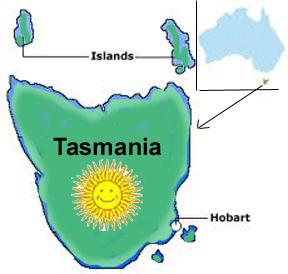 Proponents predict big savings from 4000-panel solar farm http://www.themercury.com.au/news/tasmania/proponents-predict-big-savings-from-4000panel-solar-farm/news-story/d6d5333b757f4cc6f33fecad23dcdc20 NICK CLARK, Mercury March 23, 2017 A $2 million solar farm, Tasmania’s largest, will inject power into the state’s grid during summer and save thousands of tonnes of greenhouse gases.
Proponent Nest Energy will place 4000 solar panels on the sawtooth roof of a former wool store in the Launceston suburb of Kings Meadows. Partner Mark Barnett said 15 people would be employed during construction with the project anticipated to be running by August. He said the privately funded project would produce about 1GWh of electricity a year – enough to fully power 200 homes.
It would reduce greenhouse gas emissions by 20,000 tonnes over the 35-year project life.
Mr Barnett said in winter the panels would produce enough for several businesses while in summer there would be 30 per cent excess electricity, which would be injected into the grid with the company receiving a feed-in tariff. “The building tenants will receive their power at a significant discount while the building owner will realise an improved building value so it’s a fabulous win/win” he said.
Mr Barnett said the project had been two years in the planning. He said a drop in the price of renewable components coinciding with a trend of rising power prices, meant there was plenty of opportunity for further projects, especially in agriculture. Treasurer Peter Gutwein said the project demonstrated an increased level of confidence in the northern Tasmanian economy.
Victoria and South Australia embrace grid-scale storage for power reliability
Two Australian states embrace grid-scale storage for power reliability, http://www.utilitydive.com/news/two-australian-states-embrace-grid-scale-storage-for-power-reliability/438073/ Peter MaloneyDive Brief:
- Two Australian states are ramping up energy storage to address rising electricity costs and rolling blackouts, according to media reports.
- In South Australia, the government says it will hold a competitive solicitation for a 100 MW battery storage installation and construct a 250 MW gas plant, according to Energy Storage News reports.
- The state of Victoria is also investing $20 million in an effort to boost energy storage to 100 MW by the end of next year, ABC News reports.


South Australia has been suffering from rolling blackouts brought about by high heat and a lack of baseload power. The situation has attracted developers like ZEN Energy and Tesla, who say that battery storage could go a long way toward integrating renewables into the state’s grid and solving grid instability problems.
South Australia officials also announced plans for a 250 MW gas-fired generator to act as backup for intermittent renewables.
Officials said the gas plant would be turned on only when power shortfalls are forecasted, according to ABC. A bill is reportedly in the works to give the state energy minister more control over power dispatch, after criticisms of the Australian grid operator stemming from the power outages.
Victoria, meanwhile, is looking at a range of energy storage solutions, including batteries, pumped hydro storage and solar thermal technology. The $20 million investment will come on top of a separate $5 million solicitation for a 20 MW energy storage system issued last month.
Solar energy should be priced fairly, recognising its many benefits
 Avoided transmission costs…… Reduced distribution costs… Reduced CO2 emissions…. Health benefits…… Retailing costs….. Additional benefits…
A fair price for rooftop solar? Try 10-18c/kWh REnedweconomy, By Jack Gilding on 20 March 2017
This is the first of a series of articles produced by the fair value for distributed generation project. In this article we explain the background to the project and the basis for our calculation that local rooftop solar is currently worth in the range of 10-18c/kWh when all the network, environmental and health benefits are taken into account. Continue reading
First Nations Renewable Energy Alliance- a formidable lobby group takes off
Whereas high energy prices often drive Indigenous people off their traditional lands, lower-cost renewables can help communities to thrive no matter how remote.
“We can build a power station where the community exists,” .. “so people are able to successfully live in the environment the way they want to live and have access to power which enables them to better determine their economic future.”
How an Indigenous renewable energy alliance aims to cut power costs and disadvantage
First Nations lobby group will support remote communities looking to make transition – and tackle climate change, Guardian, Dyani Lewis, 17 Mar 17
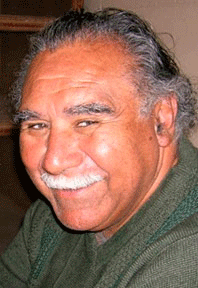 Like so many of the Indigenous communities dotted across the Australian continent, the remote communities in north-west New South Wales are struggling. “These are not happy places,” says the Euahlayi elder Ghillar Michael Anderson.
Many of the 300 or so residents of Anderson’s hometown of Goodooga rely on welfare, he says. Exorbitant electricity bills – up to $3,000 a quarter for some households – further exacerbate the poverty. “We’re always at the end of the power line, so the service that is there is quite extraordinary in terms of cost.”
Many other communities rely on expensive, emissions-intensive diesel-powered generators to meet their electricity demands. “It’s a real problem and we need to make sure that we fix this,” Anderson says.
To that end, Anderson and 24 other Indigenous leaders have formed the First Nations Renewable Energy Alliance, which aims to tackle high power costs and entrenched disadvantage – along with climate change – by pushing for renewable energy in Indigenous communities. Continue reading
Australian householders turning to energy independence with solar and battery storage
Households abandoning the grid have ‘lost faith’ , The Age, Brian Robins, 17 Mar 17 The federal government has been warned that the rise in spending on solar energy systems is clear evidence households have “lost faith” in their energy suppliers, as they move to get greater control over the cost of their electricity bill.
In its submission to the Finkel Review which is being conducted into the future security of the electricity market, Energy Consumers Australia said its research has highlighted the shift that is now emerging.
“While assumptions are often made that generous feed-in-tariffs and solar PV’s clean attributes have been the primary motivators for their uptake, our research indicates that the primary reasons consumers are investing in this technology is to manage consumption and gain control of costs. The desire for independence from the grid is a particularly strong driver for early interest in battery storage,” it says.
“We see this as a clear indication that consumers have lost faith in the traditional market’s capacity to deliver value for money, and are taking matters into their own hands.”
Energy Consumers Australia undertakes regular detailed surveys of household attitudes to their energy supplies and while most households are not actively engaged in the retail market for electricity, due to a variety of factors, as many as 1.5 million households have engaged by making a significant investment in solar rooftop photo voltaic systems, it said.
And even as the historically generous subsidies supporting the installation of these systems is being wound down, its research has found that a third of households are considering installing these systems over the next five years, with as many as 27 per cent considering installing battery storage systems. But these options are more limited for households which rent or live in accommodation which is unsuitable for the installation of these systems.
“This risks the costs of building and maintaining the [national electricity market] being increasingly recovered from a subset of consumers who are on lower incomes, haven’t been able to break into the housing market, or small businesses in commercial premises subject to investment decisions by owners,” it noted in its submission to the review.
Similarly, its community consultations have found more consumers want to be able to trade or share electricity at the local level……. http://www.theage.com.au/business/energy/households-abandoning-the-grid-have-lost-faith-20170316-gv07mz.html
Snowy Hydro plan – Turnbull camouflaging its renewable energy side from his colleagues
sometimes the leader of the nation can join the policy discussion only by disguising his good ideas in a drizabone and bush hat, lest they be recognised for what they are by his own colleagues.
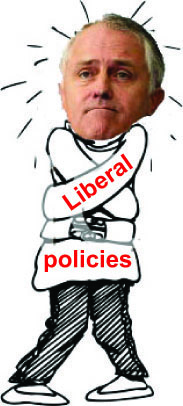 It’s great news – but sadly, Turnbull’s hiding the greens under the mash, Guardian, 18 Mar 17 Lenore Taylor
Huge potential of pumped hydro at Snowy Mountains could pave the way for a 100% renewable energy grid, but don’t tell the prime minister’s colleagues “……This week the prime minister announced some details of a big idea he has been hinting at all year – the massive potential of pumped hydro to help solve Australia’s energy crisis.
But like a parent hiding the nutritious goodness of veggies under the familiar stodge of gravy and mash, he covered the truly exciting potential of his plan under the reassuring nostalgia of a revived “nation-building” Snowy Mountains scheme, complete with hard hat and hi-vis vest.
It was duly reported as a “blast from the past” and a “trip down memory lane” with much reassuring emphasis on the jobs that could be created and file footage of hard-working post-war immigrants.
But – if it works – this revived Snowy Mountains scheme could actually pave the way for a reliable 100% renewable energy grid. It could end all that talk about how we need super-duper extremely “clean” coal for “baseload” power. Once you can store and dispatch power at this scale, the whole idea of “baseload” has been overtaken. And this latest “push” for nuclear energy will be dead before the mining industry has a chance to wind up another million-dollar advertising campaign. If the feasibility studies are positive, it won’t be a “blast from the past” at all, it will be a big leap into the future. Continue reading
73% of Australians want investment in solar, not coal
Ian Chappell stands by Adani mine letter despite being called ‘elitist’ by Coalition MPAdani ‘categorically’ rejects letter signed by 91 prominent Australians as protesters confront Queensland premier during tour of Adani’s Indian HQ, Guardian, Joshua Robertson, 17 Mar 17 “……A new ReachTel poll has found 73% of Australians agree that “the best thing for Australia would be for Adani to invest in large-scale solar power stations, rather than a new coalmine”.
The poll, commissioned by the Australian Marine Conservation Society, surveyed 2,134 Australian residents on Tuesday.
They were also asked whether the Queensland premier, Annastacia Palaszczuk, and regional mayors currently on a trade mission to India should be “seeking investment in clean energy solutions like new solar power stations or in coalmines”.
It found 72.1% preferred solar while 14.6% preferred coal.
A copy of the open letter shows 91 signatories, including former Australian environment minister Peter Garrett, Perth-based UK-born comedian and author Ben Elton and investment banker Mark Burrows.
It “respectfully” called on Adani’s billionaire chairman, Gautam Adani, to drop the mine plan for three reasons. It would drive global warming that threatened the Great Barrier Reef nearby, it loomed as a “public health disaster” according to the medical journal Lancet; and it “does not have wide public support in Australia”, the letter said.
ACF is appealing a federal court finding against its challenge to commonwealth approval of the Adani mine on the grounds it did not account for climate change impacts on the Great Barrier Reef through carbon emissions.
The court ruled the federal environment minister was entitled to find that if Adani did not go ahead, emissions would come from coal sourced elsewhere. The ACF argues this is “the drug dealer’s defence”.https://www.theguardian.com/environment/2017/mar/17/ian-chappell-stands-by-adani-mine-letter-despite-being-called-elitist-by-coalition-mp
Australia’s unstoppable transition to renewable energy
The question is whether the Coalition really is prepared to do something about bringing electricity prices down, or just wants to keep talking rubbish about how renewables will drive them up.
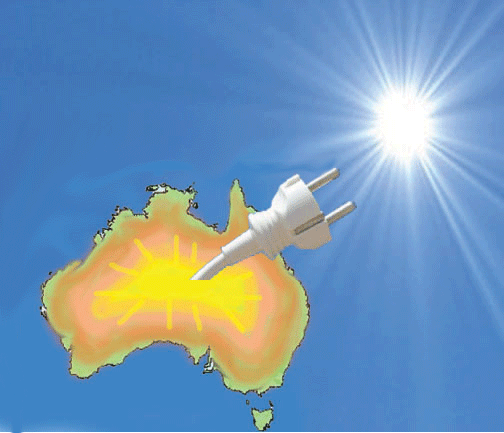 Swing to renewables will be unstoppable, THE AUSTRALIAN, ALAN KOHLER 18 Mar 17 Out of the thick haze of energy politics, something clearly significant emerged this week.
The expansion of Snowy Hydro is a very surprising, genuine game-changer: it shifts the power balance in Australian policy decisively towards renewables. If the project happens, a big if, the last fossil fuel electricity generator in this country has already been built.
It was possible because Snowy Hydro is the acceptable face of renewable energy, allowing, a heroic, soaring prime ministerial doorstop: “These are big dreams in these mountains, real courage, a belief in the future, a confidence in Australia.”
But the important point is that the Coalition’s electricity solution no longer seems to involve “clean coal” or gas.
There’s still a long way to go — after all, Malcolm Turnbull announced only a feasibility study, and then appeared to confirm that it was a stunt by using the press release to one-up South Australia’s battery plan: “My energy storage is bigger than yours.”
So the whole thing could turn into a pointless pissing contest between hydro and solar/wind/batteries. In fact, let’s face it — it probably will.
But even if that happens, and even if energy policy descends once more into political farce, at least the thermal power oligopoly would be out of the game, no longer exerting its hold over policy with the aim of maintaining margins.
And that is the significance of this Snowy Hydro expansion: it marks the end of thermal power. From here the swing to renewables will be fast, unstoppable and eventually complete….. Continue reading
Malcolm Turnbull’s desperate Snow job – as he pushes a hydro power renewable energy solution
Turnbull’s desperation … is driven by the knowledge that his government will carry the can if the spiralling problems are not addressed. He also knows his options on electricity are limited by the powerful reactionary rump within his government.
Among other things, it [the Snowy pumped hydro scheme] would make the government’s flirtation with funding a new “clean” coal plant – still being spruiked this week by Resources Minister Matt Canavan – much harder to justify……
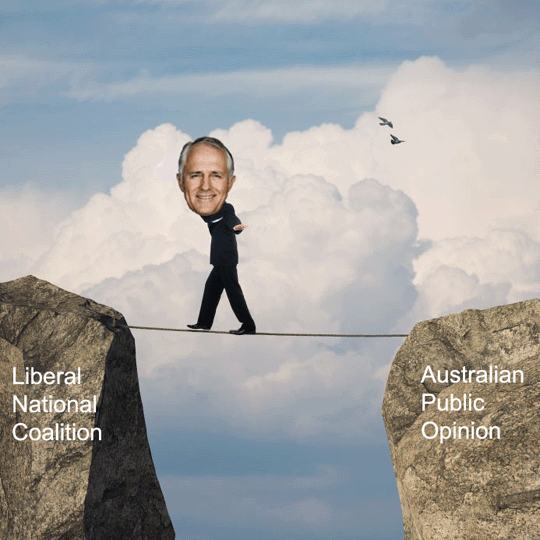
plenty of questions remain unanswered. It is not clear how long the Snowy plan will take to get up –  Turnbull says within four years, but the Australian Renewable Energy Agency has said this sort of project could take up to seven. It is not clear what it would cost, or who will pay for it. A feasibility study is yet to be completed. Its impact on the environment has not yet been assessed. We don’t know if its viability in a projected future climate with reduced river flows has been considered.
Is Malcolm Turnbull’s Snowy Hydro 2.0 a breakthrough, a distraction or both?, The Age, 18 Mar Adam Morton “…. Depending on who you listen to, Malcolm Turnbull’s proposed $2 billion expansion of the Snowy Hydro Scheme is a bold piece of nation-building by a Prime Minister who had found his mojo, or a cynically timed thought-bubble that is years away at best……
“I am a nation-building Prime Minister and this is a nation-building project,” he said …… Continue reading
Virtual power plant achievable within 5 years – AGL Energy’s Andy Vesey
‘Virtual power plant’ is here, says AGL Energy’s Andy Vesey, AFR, 17 Mar 17 Home storage batteries will be cheap enough within five years to make the “virtual power plant” achievable, revolutionising energy and making investment in traditional plant harder to justify, AGL Energy chief executive Andy Vesey says.

Mr Vesey said that batteries would be about the same $3500 price that AGL is charging 1000 Adelaide householders for its virtual power plant trial, a fraction of the $16,000 full price of the Sunverge batteries used in the trial. They could pay themselves off in about five years.
“It’s coming,” he told an American Chamber of Commerce lunch. He said grid scale batteries proposed by Tesla and others already offer value in the right circumstances.
Virtual power plants – “behind the meter” energy resources such as batteries, solar panels, software and smart thermometers managing power-hungry appliances – are one way to ease pressure on the grid and help prevent blackouts such as those plaguing South Australia. ….
Mr Vesey said on Friday that adding storage to solar homes was like adding refrigeration to agriculture, changing the way consumers interact with the power grid and the investment equation for energy companies….
He said when you put 1000 rooftop solar households with batteries together and control them in the cloud “you fundamentally have a 5 megawatt peaking plant on the edge of the grid. It changes everything”. …… http://www.afr.com/news/economy/virtual-power-plant-is-here-says-agl-energys-andy-vesey-20170316-gv0564
Seawater pumped hydro could help South Australia
Snowy Hydro gets a boost, but seawater hydro could help South Australia, ABC News, 17 Mar 17 The Conversation By Roger Dargaville, University of Melbourne “………could this technology help to ease South Australia’s energy crisis?
The Melbourne Energy Institute (MEI) report on Pumped Hydro Opportunities identifies several potential seawater PHES locations in South Australia.
This includes a very promising site at the northern end of the Spencer Gulf, with significant elevation close to the coast and close to high-capacity transmission lines.
The Department of Defence manages this land, and discussions are ongoing as to how the project might be designed to not interfere with the department’s operations on the site. A win–win development is the primary design aim.
The MEI study suggests that PHES could be delivered at around $250 per kWh of storage.
This compares well with utility-scale lithium ion battery storage, which currently costs of the order of $800 per kWh, although recent announcements on Twitter from Elon Musk suggest this might be coming down towards $500 per kWh.
The Spencer Gulf site has the potential to provide at least 100 megawatts of dispatchable generation, effectively making the wind and solar generation in South Australia significantly more reliable.
The Australian Renewable Energy Agency (ARENA) will help fund a feasibility study into the technology, working with partners Energy Australia, Arup and MEI.
If the facility is ultimately built, it could become a key element in SA’s bid to avoid future power blackouts.
Dr Roger Dargaville is the Deputy Director of the Melbourne Energy Institute. He is an expert in energy systems and climate change.
Originally published in The Conversation http://www.abc.net.au/news/2017-03-17/how-seawater-hydro-could-help-south-australia/8363054

South Australia’s energy policy
Instead of the gas plant, Saddler wants to see the government back solar thermal with storage, even if existing proposals sit at a significantly higher price bracket, such as the $1.2 billion 170MW solar thermal tower proposal for Port Augusta
Renewables and South Australia’s power policy, The Saturday Paper, Max Opray , 18 Mar 17 “……Weatherill said the Frydenberg announcement of a reinvigorated Snowy Mountains hydro scheme showed the federal government was in a “white-knuckled panic” about energy policy. “It is a $2 billion admission that the national energy market has broken and there needs to be public investments to actually fix it up.”
And later, in the same answer: “It is a disgrace the way in which your government has treated our state.”
The showdown came after a week in which the Weatherill government had broken ranks with the National Electricity Market in declaring a “South Australia first” energy policy.
The state has endured a cursed run when it comes to keeping the lights on……
Most of these issues were not the fault of the South Australian energy grid’s high level of renewable energy penetration, but that hasn’t stopped the Turnbull government and other clean coal cheerleaders using the state as a cautionary tale about green energy. Continue reading
New South Wales electricity prices make household solar and storage look good
 Solar and storage boost? NSW households face 5c/kWh price rise http://reneweconomy.com.au/solar-storage-boost-nsw-households-face-5ckwh-price-rise-99553/ By Giles Parkinson on 17 March 2017 The continuing surge in New South Wales wholesale electricity costs – and in other states for that matter – is likely to add even more incentive for households and business to turn to rooftop solar and battery storage. NSW baseload futures prices for 2018 have jumped another $10/MWh to $115/MWh in the last two weeks, meaning that a rooftop solar system is cheaper than the wholesale price of the coal-fired grid, let alone retail prices which are more than twice as high.
Analysts at Morgan Stanley say that if the wholesale price increase was to be fully captured by energy retailers, then the retail price would need to rise by around 5c/kWh, or about 20-25 per cent.
This scale of rise, shocking as it would be, is unlikely to happen because most retailers will have a rolling hedge book that will mitigate part of the cost increase.
Still, Morgan Stanley expects that retail prices will still have to increase around 10 per cent from July 1, which would add at least 2c/kWh on to energy costs, which are currently 21c/kWh to 24c/kWh, not including hefty network charges of up to $1.50/day.
This should be yet another incentive for NSW households to invest in rooftop solar. The state trails most other states on solar penetration, with around 15 per cent of homes, compared to nearly 30 per cent in Queensland and South Australia.
And the fact that NSW retailers offer such a small amount on solar exports (most at around 6c/8c/kWh, with a couple of outliers on 12c/kWh) this should increase the attraction of battery storage.
NSW is already seen as the best state for battery storage because of the recent expiry of premium feed-in tariffs.
1 This month
Chernobyl: The Lost Tapes – A good documentary on Chernobyl on SBS available On Demand for the next 3 weeks– https://www.sbs.com.au/ondemand/tv-program/chernobyl-the-lost-tapes/2352741955560
15 April – Zoom –Nuclear Power is Not the Solution
Apr 15, 2026 01:00 AM in Canberra, Melbourne, Sydney

Join the International Physicians for the Prevention of Nuclear War (IPPNW) on Tuesday, April 14th for a timely webinar exploring the risks associated with nuclear power and challenging the myth that it offers a simple, safe, carbon-free solution to the climate crisis

21 April Webinar: No Nuclear Weapons in Australia
Start: 2026-04-21 18:00:00 UTC Canberra, Melbourne, Sydney (GMT+10:00)
End: 2026-04-21 19:30:00 UTC Canberra, Melbourne, Sydney (GMT+10:00)
Event Type: Virtual
A virtual link will be communicated before the event.
Host Contact Info: australia@icanw.org

of the week – Australians for War Powers Reform (AWPR)
To see nuclear-related stories in greater depth and intensity
 Antinuclear