At least in the State of South Australia there is a plan for energy self sufficiency
At least there is a plan in South Australia, albeit one that will place its drive for self-sufficiency in conflict with the operation of the National Electricity Market.
Provided there is decent backup power generation there shouldn’t be an issue with developing VPPs and new forms of energy storage so that they can be refined and more affordable in time.
 Role of batteries provides aspirational charge to energy debate , The Australian, 16 Mar 17 CHRIS GRIFFITH Technology reporter Sydney @chris_griffith Call it battery fetishism if you must, but batteries are going to play an even bigger role in power sources being tested in Australia. Take for example the virtual power plant concept which has gone live in South Australia.
A VPP comprises hundreds, maybe thousands, of homes each with solar panels where excess energy is stored in batteries. Instead of operating as separate entities, energy stored in those batteries is made available in unison to the grid at times of peak load or an outage.
An outside body such as an energy retailer co-ordinates the flow of battery power back to the grid. For the rest of the time, consumers self-manage their stored solar power. Continue reading
South Australian govt calls for battery storage offers within two weeks
 S.A. wants first round battery storage offers within two weeks http://reneweconomy.com.au/s-a-wants-first-round-battery-storage-offers-within-two-weeks-92337/ By Giles Parkinson on 15 March 2017
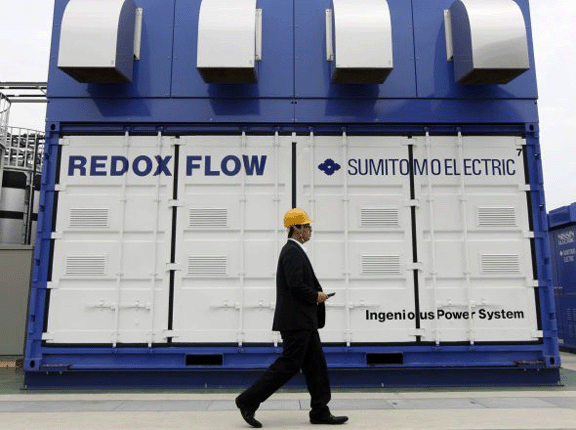
Snowy Hydro a “thought bubble” – not a solution to present energy problems
 Snowy Hydro expansion won’t be ‘magical’ solution to power problems, experts say, ABC Radio The World Today By Nick Grimm 16 Mar 17 Engineering experts are less critical than the South Australian Premier but some are warning that the expansion of the hydro-electric scheme won’t be a “magical” solution to Australia’s power problems.
And they point out that it is an old idea that has previously been ruled out as too expensive…….
Max Talbot, the former executive officer of Strategic Engineering at the Snowy Hydro Scheme, told ABC Local Radio previous expansion plans had proved too expensive.”We did look at that prospect briefly, expanding the scheme goes back nearly 20 years ago,” he said. “If he’s [Malcolm Turnbull] talking about what I think he’s talking about, then that was considered a feasible but far too expensive at the time…….
Energy experts wary over hydro expansion But with the details of the plan yet to be resolved, energy experts are inclined to reserve judgement on whether the plan is the answer to Australia’s looming power shortage.
The Grattan Institute’s Tony Wood said the project faced so many stumbling blocks and was unlikely to be a “magical panacea”. “The real question here is the economics,” Mr Wood said. “And whether it’s privately owned or publicly owned, is this a good use of public funds? That’s going to be the trick for the feasibility of the study to determine.
“And that would also be therefore the reason why no-one has leapt into this before. “To be fair some of the really sharp issues only started to crystallise in the last six months or so, particularly for example with the announced shut down of the Hazelwood power station.”
That is echoed by another energy economist — Danny Price from Frontier Economics.As he told RN Breakfast, he is sceptical about the plan’s viability, especially given the shared ownership of the scheme, split between the Commonwealth, Victorian and New South Wales governments.
“I’ve worked on the Snowy Hydro corporation over many years, and let me say getting anything done in the Snowy is extremely difficult as it involves the three governments that own it,” he said.
“So at this stage I would regard the Snowy proposal as a thought bubble, and it’s a bit like saying ‘I’m about to begin building a boat and rescue someone’ — it will be years off before anything happens.“…..http://www.abc.net.au/news/2017-03-16/snowy-hydro-expansion-wont-be-magical-solution-to-power-problems/8360320
Malcolm Turnbull talks up his grand Snowy Hydro energy scheme, “better than solar and batteries”
Malcolm Turnbull says Snowy Hydro plan will outdo South Australian battery storage
PM says plan would turn Snowy Hydro into energy storage system but Labor says proposal leaves unanswered questions, Guardian, Gabrielle Chan, 16 Mar 17, Malcolm Turnbull has used his expansion plans for the Snowy Hydro to try to outdo South Australia on battery storage, saying it would provide 20 times the capacity of the battery system proposed by the premier, Jay Weatherill. Continue reading
Daylesford’s community renewable energy success
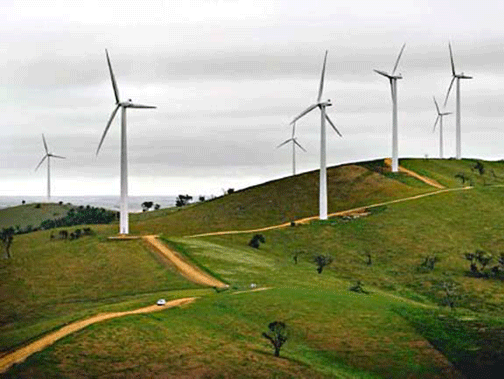 Renewables roadshow: how Daylesford’s windfarm took back the power
In the first of a series about Australian communities building renewable energy projects, we look at how Victoria’s Hepburn Shire overcame local opposition to deliver a new homegrown, community-owned generator, Guardian, Michael Slezak, 15 Mar 17 From the fertile spud-growing country of Hepburn Shire, 90km northwest of Melbourne, has sprung what many hope will become a revolution in renewable energy in Australia.
On Leonards Hill, just outside the town of Daylesford – famed for its natural springs – stand two wind turbines that not only power the local area, but have also added substantial power to the community-owned renewable energy movement in Australia.
The turbines, cheesily called Gusto and Gale, constitute the very first community-owned windfarm in Australia. It borrows the idea from a long tradition of community-owned power that was forgotten in Australia, but lives on strongly in Denmark.
“In Denmark there’s over 2,100 versions of this,” says Taryn Lane, the community manager for Hepburn Wind, the cooperative that owns and operates the windfarm. “Their model – this way of owning your own energy generator locally – emerged in the late 70s, so they have been doing it for decades.” .
It was at a community meeting for a large corporate-owned windfarm, like the one near Hepburn, that the idea for Hepburn Wind emerged…….
the group had overwhelming local support. “We are a cooperative of 2,007 members,” says Lane. “They’ve contributed just under $10m.”
The majority of the investors are from the local region, something the cooperative has written into its rules.Paul Howden is one of them. As with most investors in community-owned renewable energy, his motivations were a mix of hard-nosed financial ones, and the desire to do a bit of good. “Partly, obviously because it’s a renewable energy project,” he says, explaining his investment. “But also because we thought it was a good and wise investment for our super fund.
“This is a win-win for both the environment [and] the community.”
One of the things that made him confident that the project was a good investment, he says, was the level of community support it received, and the passion of the people running it.
But beyond the construction of the 4.1MW windfarm – enough to power about 2,300 households – Hepburn Wind pioneered the modern large-scale community-ownership model of renewable energy in Australia, which is now being replicated around the country.
Simon Holmes à Court was the founding chairman of Hepburn Wind. And after spending years developing a model that worked, and navigating the various logistical potholes in getting it up and running, he set up Embark, a non-profit company dedicated to helping other community energy projects adopt the Hepburn model.
Several projects around the country have received advice and support from Embark, including Pingala, which gathered locals in Sydney’s Newtown to build a solar array on the top of a brewery, and the Sydney Renewable Power Company, which recently built Australia’s largest CBD solar farm.
But back in Hepburn shire, not satisfied with the windfarm, the residents are expanding the renewables in their area.
By a picturesque lake in Daylesford, where locals go to swim and cool off, is an antique hydro generator, which used to power a few homes around the lake, and the lake’s lights. “It kept the lake area electrified,” says Lane.
In February, that was made possible when the energy retailer that buys Hepburn Wind’s electricity – Powershop – announced it had crowdfunded more than $100,000 for community-owned renewable energy projects, and one project that would receive a slice of it was Hepburn Wind’s hydro project.
“The original size was 13kWs or just under,” says Lane. “And we will look to somewhere between there and maybe up to 40kWs if we can put a side-by-side motor next to it.”
She says that will be enough to power about eight to 12 houses – not a huge amount, but it’s an easy win.
And with Hepburn shire adding its name to a growing list of councils shooting to reduce their emissions to zero, every bit counts. Says Lane: “At Hepburn Wind we really want to play our role in helping our community reach zero net emissions.” https://www.theguardian.com/environment/2017/mar/15/renewables-roadshow-community-owned-windfarm-daylesford-hepburn-australia
‘World’s largest virtual power plant’ now working in West Lakes in Adelaide
SA power: ‘World’s largest virtual power plant’ switched on at West Lakes in Adelaide, ABC News By Matt Coleman, 16 Mar 17, What is being called the world’s largest residential virtual power plant (VPP) has gone live in suburban Adelaide, where reliability of power supply is the dominant public policy issue.
The VPP is an initiative of power company AGL and involves solar panels and battery storage at hundreds of properties being linked together to form a five-megawatt virtual solar power station.”Our South Australian VPP demonstration is a practical example of the new energy future,” AGL’s managing director and CEO Andy Vesey said.
“We believe the VPP will deliver benefits … .by providing another source of generation to deploy into the network.”
He said the environment would also benefit from reduced emissions.
AGL said the Federal Government, through the Australian Renewable Energy Agency (ARENA), was providing up to $5 million to support the $20 million project.
The project is different to standard home battery storage because the batteries’ operation can be directed remotely.
As well as being used to help power the home they are in, they can also be directed — all at once — to service the grid when overall system stability or reliability is under pressure…….http://www.abc.net.au/news/2017-03-16/virtual-power-plant/8358894
Big Solar is coming to Australia
Big solar interview: Impact Investment’s Lane Crockett http://reneweconomy.com.au/big-solar-interview-impact-investments-lane-crockett-91334/ By Giles Parkinson on 15 March 2017
Its head of renewables, Lane Crockett, a former head of Pacific Hydro’s Australian operations, is to speak at the Large Scale Solar Conference to be jointly hosted by RenewEconomy and Informa early next month.
Here, he shares his thoughts about the industry, including opportunities, solar costs and battery storage.
RE: Lane, what’s attracted you (personally) to the large scale solar industry.
Crockett: There are four main factors that attract me to large scale solar:
- The speed to market (less planning time and takes half the time to build a solar farm relative to a wind farm);
- Fewer complicated community issues in the planning and development phases;
- The price of solar farms has fallen considerably, making it the most competitive new build power in some jurisdictions; and
- The time of day generation highly correlates with demand.
RE: What specifically is Impact Investment Group’s goal?
Crockett: Impact Investment Group is aiming to have a pipeline of $1BN of renewable infrastructure investment by 2020. We want to direct large amounts of capital towards investments with positive impacts.
RE: Why the interest in the 1MW to 30MW market?
Crockett: Whilst we are now looking at bigger facilities, we find that we are most competitive in the small to medium range of utility scale plants.
RE: Will there be enough choice of assets? is there really that many being built?
Crockett: Yes; there are many projects being developed. The most challenging part is designing the final commercial arrangements which underpin the building and operation of new projects.
RE: Are there any announcements imminent?
Crockett: Yes, but we’re not going to break news right now. Investors should keep an eye out.
RE: Where is the price of solar going?
Crockett: Solar continues to defy expectations as it continues to fall in cost. Not only are equipment costs continuing to fall but the construction market in Australia has become more competitive as contractors become more confident in their delivery methods and costs.
RE: Are you considering storage?
Crockett: Yes, but investment in storage remains problematic as there is no market mechanism to underpin that investment, except the spot price arbitrage, which is a risky strategy.
RE: How far are we from having a grid dominated by solar (and wind) instead of coal and gas?
Crockett: I think 5 – 10 years. It’s certainly feasible and Australia must do it to meet our international obligations to keep global warming under 2 degrees. If you consider the benefits that its a healthier form of electricity production and financially compelling for investors and consumers alike, then it’s a compelling case.
RenewEconomy and Informa’s jointly hosted Big Solar conference will be held in Sydney on April 6 and 7. More details can be found here.
South Australian govt releases new plan for reliable, affordable and clean power.
 South Australia’s new energy plan released http://www.transcontinental.com.au/story/4529329/south-australias-new-energy-plan-released/?cs=4180 A $550 million energy plan unveiled by the South Australian government will aim to improve the reliability of statewide power.Premier Jay Weatherill released details of the plan on Tuesday, March 14, saying the goal was delivering “reliable, affordable and clean” power.
The state government expects the plan to create 630 new jobs in South Australia. South Australian Power for South Australians will ensure more of the State’s power is sourced, generated and controlled in South Australia.
The plan will include:
- Building Australia’s largest battery to store energy from the wind and sun, part of a new Renewable Technology Fund that supports clean, dispatchable and affordable power
- Building a government-owned 250MW gas-fired power plant to provide emergency back-up power and system stability services for South Australians, in the meantime procuring temporary back-up generation if necessary
- Introducing new Ministerial powers to direct the market to operate in the interests of South Australians
- Incentivising increased gas production to ensure more of our State’s gas is sourced and used in South Australia
- Introducing an Energy Security Target to ensure our power system uses more clean, secure energy generated in South Australia
- Using the Government’s purchasing power through its own electricity contract to attract a new power generator, increasing competition in the marketThe new gas-fired power plant is budgeted to cost $360 million, $150 million will be committed to the SA Renewable Technology Fund and new PACE grants are worth $24 million.
Commenting on the plan, Mr Weatherill said coal-fired power stations closing across Australia, no “coherent” national energy policy and “ideological attacks on renewable energy” had led to under-investment in new energy sources.
“The privatisation of our state’s energy assets has placed an enormous amount of power in the hands of a few energy companies,” he said. “These factors, together, have led to too little competition in our national energy market. It is a market that benefits the owners of the privatised assets, rather than the people and businesses who depend on this essential service.” He said the plan’s goal is to make the state more self-reliant. “Our plan will make our power supply more reliable, put downward pressure on prices and create jobs,”
“In the longer term, South Australia will become more self-reliant for its power supply. “As a state that has built its reputation on its clean green environment, this plan recognises that clean energy is our future.”
The South Australian Liberal party has not responded to the plan yet.
A cutting edge, dual-fuel power station ould be operating in the Upper Spencer Gulf region within months.
ZEN Energy and Santos push new solar, gas power station in Upper Spencer Gulf Daniel Wills, State Political Editor, The Advertiser March 13, 2017 CLEAN solar power would be backed up by reliable gas energy in a cutting edge, dual-fuel power station for SA that could be operating in the Upper Spencer Gulf region within months.
Malcolm Turnbull should encourage Australia’s battery energy storage industry
Battery-makers on Turnbull’s Tesla chat: ‘Give Australian companies a fair go’
Industry wants more support from federal government now prime minister has ‘taken interest in the tweets of an American billionaire’, Guardian, Melissa Davey, 13 Mar 17, Malcolm Turnbull should encourage Australia’s battery energy storage industry now he has “taken interest in the tweets of an American billionaire”, Zen Energy chairman Ross Garnaut says.
Garnaut was referring to Elon Musk, the billionaire co-founder of electric car giant Tesla, who tweeted that Tesla could solve the power shortage issue causing price spikes and blackouts in South Australia within 100 days by installing 100-300 megawatt hours of battery storage.
Turnbull subsequently tweeted that he had phoned Musk and enjoyed a “great, in-depth” conversation.
But Australian companies had been working on large battery projects for years, Garnaut said, including one by Zen Energy in the upper gulf of South Australia which it had discussed with the market. Continue reading
Clean Energy Finance Corporation funding 3 big solar energy projects
 CEFC tips another $70m into big solar, as market confidence soars, REneweconomy,
The three projects, which are being developed by Edify Energy alongside international renewable energy investor Wirsol, include the Whitsunday and Hamilton Solar Farms in Queensland, both 57.5MW, and the Gannawarra Solar Farm in Victoria, at 50MW.
The “benchmark” financing deal – announced on Monday – commits the CEFC, the Commonwealth Bank and Germany’s NORD/LB to a syndicated senior debt facility to support the three projects, with Edify and Wirsol are providing equity. Continue reading
Western Australia’s Wave Energy Project is a winner from Labor’s election victory
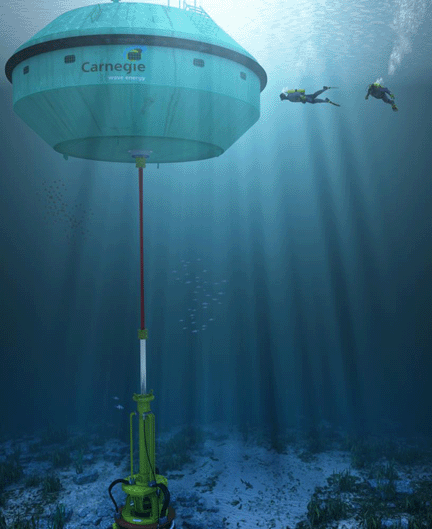 WA election delivers win for Carnegie 20MW Albany Wave Project http://reneweconomy.com.au/wa-election-delivers-win-for-carnegie-20mw-albany-wave-project-97139/ By Sophie Vorrath on 13 March 2017
ASX listed wave power and microgrid specialist Carnegie Clean Energy said on Monday that the election of the Labor McGowan government had confirmed the party’s $19.5 million funding commitment for Carnegie’s Albany Wave Energy Project.
The project, flagged by the company last month as contingent on a Labor Party win, aims to develop a 20MW wave energy farm off the coast of Albany, using its CETO 6 technology, pictured above.
According to Carnegie, Albany has one of the most consistent wave energy resources in the world, experiencing greater than 1 metre swell, 100 per cent of the time.
The project – which would likely have its beginning as a 1MW pilot – would be aligned with the regions existing infrastructure, including an existing wind farm.
At 20MW, the project would be Australia’s first commercial scale wave farm, demonstrating the potential to deliver 24/7 renewable energy into the grid. From there, Carnegie says, the 20MW farm could spin out to a 100MW facility.
All this is not new – Carnegie has been working on plans for a wave farm in Albany for nearly a decade and has spent over $1 million on studies, surveys and designs for the region, including site assessment, wave resource mapping, licensing and site design.
Now, it can also tick off a state government that is committed to back the project, after Western Australia’s Coalition government was convincingly beaten at the polls by the Labor party led by Premier elect, Mark McGowan.
Like other state Labor governments around the country, McGowan’s team promises to be more supportive of renewable energy development than its predecessor – although the party has recently backtracked plans to introduce a 50 per cent renewable energy target for the state.
Having revealed plans to draw at least half of the state’s energy from renewable sources by 2030 at a National Environmental Law Association conference in Perth in October, Labor energy spokesman Bill Johnston now says the party won’t introduce a target, but will have more ambition on renewables than the LNP.
“After the election, we will sit down with industry and the community to see what is achievable and affordable,” Johnston said in early February.
While many have criticised the party for its apparent backflip, Carnegie CEO Michael Ottaviano says his company is delighted to be working with the state’s newly elected government to deliver on the potential of wave energy at Albany.
“Wave energy justifiably demands the sort of investment that other power technologies, whether fossil fuel or renewable, have benefited from and the government’s $19.5million commitment is a strong step towards this,” he said.
Tesla batteries to the rescue for South Australia’s electricity system?
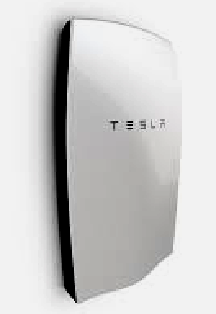 Greens say Elon Musk’s plan is a game changer Australian
  Greens Senator for South Australia Sarah Hanson-Young says Elon Musk’s proposal to solve South Australia’s energy crisis with battery storage is the game changer our state needs to switch back on.
“We live in the perfect state for wind and solar. Battery technology allows us to make hay while the sun shines, storing the power so we can use it when we want and need. While chairing a senate inquiry into battery storage, I’ve heard evidence that if 20,000 homes with solar panels had a battery as well, the load shedding that cut off the air conditioning when we needed it most last month wouldn’t have happened.
“This is the innovation Malcolm Turnbull promised when he declared he would be the ‘Innovation Prime Minister’
Elon Musk says his Tesla battery company could solve South Australia’s energy crisis in 100 days Luke Griffiths, Lauren Novak, The Advertiser March 11, 2017 TECH billionaire Elon Musk on Saturday confirmed he’s spoken personally with Jay Weatherill to discuss his company’s plans to build a battery farm to help SA solve its power woes – amid support from the Australian Greens, who say his plan to build a batter farm could be “game changer”.
Michio Kaku – Musk & Game Changing Tesla Powerwall Battery
Elon Musk in talks with Malcolm Turnbull on energy storage
 Elon Musk, Malcolm Turnbull in talks on renewables after billionaire’s ‘100 days or it’s free’ pledge http://www.abc.net.au/news/2017-03-12/elon-musk-malcolm-turnbull-in-talks-on-renewables/8347554 Prime Minister Malcolm Turnbull says he has held a “great, in-depth discussion” with Elon Musk, after the billionaire tech entrepreneur offered to fix South Australia’s energy problems within 100 days.
On Friday, Mr Musk said energy storage could solve the state’s electricity problems with a Tesla battery farm, and work could be completed within 100 days, or it would be free.
He followed that up in talks with South Australia’s Premier Jay Weatherill, later tweeting that he was impressed by the State Government’s commitment to a “smart, quick solution”.
Twitter was again the preferred medium of communication on Sunday, with Mr Musk and Mr Turnbull swapping appreciative tweets after speaking for nearly an hour.
Tesla’s energy storage could be the answer to South Australia’s electricity problems
Tesla’s offer: How SA’s power network could benefit from energy storage, ABC News, By Michael Collett 11 Mar 17 South Australia’s energy network has been struggling of late — there were forced blackouts for tens of thousands of homes during a heatwave last month because there wasn’t enough power to meet demand.
But Tesla thinks it has a solution. The company’s billionaire boss Elon Musk says he could install a battery farm capable of fixing the system within 100 days of signing a contract.
It’s a suggestion that the Grattan Institute’s energy expert Tony Wood says should be taken seriously, but it’s not the only electricity storage option that’s available.
What’s the advantage of electricity storage? The idea is that energy storage technologies can take power during off-peak hours and put it back into the grid when it’s needed.
As well, wind and solar are intermittent sources of electricity generation, so this power needs to be stored if the grid is to rely entirely on renewables. (Keep in mind that South Australia already gets about 50 per cent of its energy from renewables, mostly wind and solar.)
One storage technology that’s getting a lot of press is Tesla’s Powerpack.
Tesla says this battery is “infinitely scalable” — that means a business could buy a single Powerpack so that it still has power during a blackout, while a city, state or country could install hundreds, thousands or even millions of them in order to support an entire grid.
In 2015, Musk said you’d be able to transition the United States to renewable energy with 160 million of them, and the entire world with 900 million……
1 This month
Chernobyl: The Lost Tapes – A good documentary on Chernobyl on SBS available On Demand for the next 3 weeks– https://www.sbs.com.au/ondemand/tv-program/chernobyl-the-lost-tapes/2352741955560
15 April – Zoom –Nuclear Power is Not the Solution
Apr 15, 2026 01:00 AM in Canberra, Melbourne, Sydney

Join the International Physicians for the Prevention of Nuclear War (IPPNW) on Tuesday, April 14th for a timely webinar exploring the risks associated with nuclear power and challenging the myth that it offers a simple, safe, carbon-free solution to the climate crisis

21 April Webinar: No Nuclear Weapons in Australia
Start: 2026-04-21 18:00:00 UTC Canberra, Melbourne, Sydney (GMT+10:00)
End: 2026-04-21 19:30:00 UTC Canberra, Melbourne, Sydney (GMT+10:00)
Event Type: Virtual
A virtual link will be communicated before the event.
Host Contact Info: australia@icanw.org

of the week – Australians for War Powers Reform (AWPR)
To see nuclear-related stories in greater depth and intensity
 Antinuclear