Rooftop solar installs up 43% in 2017, on back of power market woes, REneweconomyBy Sophie Vorrath on 10 March 2017
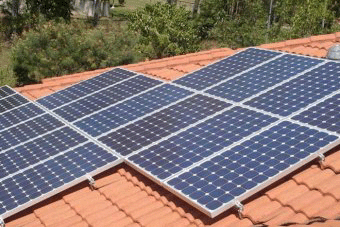
A summer of record high temperatures, heat waves and unplanned electricity outages appears to have put a rocket under the Australian rooftop solar market in 2017, with installations at end of February nearly 50 per cent up on the same time last year.
According to the latest monthly insights report from SunWiz – based on data from Solar Choice – February was an excellent month for solar PV growth, and registrations have been clocked at 43 per cent better than 2016 YTD, driven largely by residential installs.
Renewable energy spike led to sharp drop in emissions in Australia, study shows [excellent graphs] Surge in October last year helped greenhouse gas emissions fall by 3.57m tonnes in December quarter, Guardian, Joshua Robertson and Nick Evershed, 10 Mar 17 A sharp drop in Australia’s greenhouse gas emissions at the end of last year came courtesy of a spike in renewable energy generation in a single month, according to a new study.
Australia’s emissions fell by 3.57m tonnes in the three months to December, putting them back on track to meet quarterly commitments made in Paris after a blowout the previous quarter.
The fall is the largest for the quarter since the government began recording emissions in 2001. The report’s authors said this was entirely due to record levels of hydro and wind generation in October. This brought emissions for the year to December to below the year to December 2015.
But projected emissions for the December quarter were still 6.89m tonnes over levels demanded by scientifically based targets set by the government’s Climate Change Authority.
And, long term, the results show Australia is set to run more than 300m tonnes over what is required to meet its Paris targets in 2030.
The analysis was produced by Ndevr Environmental, which analyses data for all Australia’s major emissions sources and compares the results with the government’s commitments made in Paris and the cuts recommended by the Climate Change Authority.
It aims to produce a more timely account than the government’s, which is six to nine months behind.
In the four years to December 2016, Australia emitted 20.7% of its share of what the world can emit between 2013 and 2050 if it intends to maintain a good chance of keeping warming to below 2C.
If Australia continues to emit carbon pollution at the average rate of the past year, it will spend its entire carbon budget by December 2031. Projected to the current second, the graphic shows how much of the carbon budget has been spent.
Matt Drum, the managing director of Ndevr Environmental, said the figures showed renewable energy was “the only thing that’s keeping us in the ballgame” of meeting climate commitments……..
Direct Action is the federal government’s primary carbon reduction tool, which pays polluters to pollute less through a reverse auction – the emissions reduction fund.
LG Chem, the South Korean battery storage maker that has so far claimed the biggest share of the nascent Australian market, says that solar and battery storage is already beating grid power in most states.
The assessment by LG Chem follows similar analysis by private energy consultants, and suggests that the market for battery storage could be about to take off, even with looming threats of restrictions.
According to Jamie Allen, the marketing head in Australia for LG Chem, a 5kW rooftop solar system and a 10kWh battery storage device (such as LG Chem’s own 9.8kWh offering) can be purchased and installed for around $15,000.
Based on the assumed output of around 22kWh a day from the solar array, that makes the cost per kWh of solar power at around 22c/kWh over 10 years.
Given that most flat rate per kWh tariffs start at around 23c/kWh or 24c/kWh – even in NSW where there are high fixed network charges on top of that – the solar power is still on the money, although the battery storage is essential to ensure that much of that output is used directly, or stored for later use at night.
Of course, the actual cost per kWh of the solar output would be less than half the 22c/kWh cited here, because the panels would last well beyond 20 years.
But the 10 year time frame is used because that is the warranty period for most battery storage and it is the “combo” package that is being promoted. And without storage, then much of the output would have to be exported, with tariffs in NSW as low as 6c/kWh or non-existent for some.
What does this tell us? Allen says it is that storage is crucial to maximize the value of that solar output. Every kWh that can be consumed on site will beat the cost of production.
Of course, this is not the only benefit. Allen notes that the solar system will likely last at least another decade, possibly two, and the cost of battery storage to replace the current system will also be cheaper, while grid costs are likely to rise.
REneweconomy, By Giles Parkinson on 6 March 2017, It didn’t take long after the failure of South Australia’s two biggest gas plants late on Friday afternoon for the abuse to start flowing. “Renewables, absolute frigging BS,” wrote one correspondent in an email to RenewEconomy within a few hours of the sudden loss of 600MW of gas-fired generation. “What a lot of crap this renewable story is.”
It happens all the time.
+ When a storm knocks down three power lines in September, the immediate reaction is to blame renewables;
+ when a condenser in Victoria hits the ground and takes out the main inter-connector, forcing rolling stoppages in South Australia, the immediate reaction is to blame renewables;
+ when more storms take down power lines after Christmas, causing more outages in South Australia, the blame is put on wind and solar;
+ and when the market operators turn out to be the only people in South Australia unaware of a pending heat wave, forcing them to miscalculate a demand surge and impose rolling stoppages, it was once again the fault of renewable energy.
Friday’s events, however, took this blame game to a new level. Some sort of explosion occurred at the Torrens Island gas plant, starting fires and causing three units (totalling 400MW) to suddenly trip off and lose power, and causing the Pelican Point gas generator (210MW) to do the same.
In response, the market operator asked some other gas generators to fire up, and it and the government asked consumers to reduce their power load where they could, particularly with air conditioning.
The very same approach had been taken by the NSW government with their coal-fired grid a few weeks earlier when two units at one of the state’s biggest coal generators packed up and the two biggest gas generators either tripped or failed to start when needed.
And, as occurred in NSW, solar and wind played a critical role in keeping the power on. Energy minister Tom Koutsantonis said that if it wasn’t for wind and solar then the lights would have gone out on Friday. Indeed, rooftop solar PV was providing 13.5 per cent of the state’s electricity demand when the gas plants tripped.
Apparently, though, it’s all the fault of renewables, a conclusion drawn from the same twisted logic that supports the gun lobby in the US. As Don Russell wrote in The Monthly, guns killed 301,797 people in the US between 2005, and 2015 (and terrorists killed 95), but it wasn’t guns but restrictions on guns that was cited as being the fourth greatest fear in the US.
And the most worrying part of this reaction is that it is not just the province of the unhinged and uninformed individual. Were this the response of an isolated few, it could be safely ignored. But it hasn’t been, and many people are under the same myths and misapprehensions.
Indeed, the campaign against renewables has been led by the federal government, from prime minister Malcolm Turnbull all the way down, and reached new levels of stupidity on the weekend when the Coalition repeated its desire to build a new coal-fired power station in Queensland because, wait for it, the current coal-fired power station was not cheap enough………
the spot wholesale price of electricity has averaged more than $200/MWh in Queensland this year. The state’s future prices for 2018 is around $110-120/MWh. That’s more than the cost of a new solar plant.
So, perhaps it could take a leaf out of another major power user in Queensland, the Sun Metals zinc refinery near Townsville, which has also been struggling to deal with high power prices in the huge coal dependent state.
Sun Metals has taken matters into its own hands. Not only has it led the push for a change in market rules to try dilute the power of the fossil fuel generators, whose dominance of the market allows them to set high prices without censure, it has also decided to build its own solar farm.
That project, now a 116MW facility, will provide not only cheaper power than Sun Metals can source from the coal-fired grid, it will lock in costs for at least 20 years. That will give the company the certainty to upgrade and expand its refining operations. Don’t expect to read about this in mainstream media though.
Canavan, meanwhile, continues to push his crazy idea of adding new coal. “We would not be building a new coal-fired power station because we like looking at smoke stacks on the horizon, but I do find power stations inspiring,” he told The Australian newspaper, before confirming that taxpayer funds could be used for such a project.
As the CEFC chief executive Oliver Yates has made abundantly clear, it would not just require taxpayer subsidies and finance to build a coal-fired power station, but billions of dollars in indemnities and guarantees on the off-chance that an Australian government might one day get serious about climate change and impose a carbon price and/or a meaningful emissions reduction target. http://reneweconomy.com.au/fear-and-ignorance-gas-plant-explodes-renewables-blamed-11917/
The tragedy is that all this could have been avoided if we had seized the opportunity in the 1990s to build a unified national grid, with a single authority running transmission networks and the interconnectors between them. This would still allow competition in generation, but would abandon the idea of market incentives in the provision of network services.
The question has been addressed by pollsters in Britain, which provided the model for Australia’s energy reforms. The results show overwhelming public support for renationalisation, even though the electricity industry has been in private ownership for decades. Even a majority of Conservative voters support public ownership.
The issue will have its next electoral test in Western Australia, where the Barnett government is proposing to sell its majority interest in its electricity distribution enterprise Western Power. While nothing is ever certain in politics, current polls suggest the government is headed for defeat.
The case for renationalising Australia’s electricity grid https://theconversation.com/the-case-for-renationalising-australias-electricity-grid-73951John QuigginProfessor, School of Economics, The University of Queensland March 6, 2017The public debate over the problems of electricity supply displays a curious disconnect. On the one hand, there is virtually universal agreement that the system is in crisis. After 25 years, the promised outcomes of reform – cheaper and more reliable electricity, competitive markets and rational investment decisions – are further away than ever.
On the other hand, proposals to change the situation range from marginal tweaks to politically motivated mischief-making. The preliminary report of the Independent Review into the Future Security of the National Electricity Market, released last year, canvasses such options as the introduction of capacity markets for reserve power, which have done little to resolve problems overseas.
Meanwhile, the Turnbull government has used recent failures to score points against renewable energy (hated, for obscure historical-cultural reasons, by its right-wing base) and to promote the absurd idea of new coal-fired power stations.
A sorry state
This debate might make sense if the system had worked well in the past. In reality, however, the National Electricity Market (NEM) never produced lower prices or more reliable power for households. Continue reading →
Energy executives say gas market – not windfarms – to blame for South Australia’s woes
Main problem afflicting country’s grid is the lack of clear policy direction from Canberra, witnesses tell Senate inquiry, Guardian, Katherine Murphy, 7 Mar 17, Senior executives from AGL Energy have given evidence that the main issue causing problems with reliable energy supply in South Australia is “dysfunction” in the gas market – not too many windfarms making the grid unreliable.Executives from AGL told a Senate inquiry in Melbourne on Tuesday they would like to build a new gas-fired power station in South Australia to increase base load capacity in the state, but gas supply was chronically unreliable in the eastern states.
Richard Wrightson, AGL’s general manager of wholesale markets, told Tuesday’s hearing the problem was so dire the company was contemplating building its own LNG hub in Queensland to help secure reliable supply downstream.
“Dysfunction in the gas market is causing most of the systemic problems we are seeing in South Australia,” Wrightson told the Senate select committee into resilience of electricity infrastructure in a warming world.
“We would love to be able to contract more in that marketplace but the main restriction on being able to do that is access to flexible gas contracts that we are able to trade in an out of.”
The Turnbull government has argued that ambitious state-based renewable energy targets are driving too large a share of low-emissions technologies, such as wind power, into the grid, and that is a significant factor behind the unreliable conditions in South Australia.
But a number of witnesses appearing before the Senate committee on Tuesday said the main problem afflicting Australia’s energy grid was not proliferating renewables, but a lack of a clear policy direction from Canberra. The policy vacuum had created a damaging investment strike in new assets at a time when old coal-fired power generators had reached their natural age of retirement.
Ross Garnaut, the economics professor who led the climate change policy review for the Rudd government and was the independent expert adviser to the multi-party climate change committee that developed the carbon pricing scheme subsequently repealed by Tony Abbott, said the political debate about climate and energy policy in Australia was “incoherent”……
The chief scientist, Alan Finkel – the official leading the energy review – has already provided implicit support for an emissions intensity scheme in his preliminary report to the government, saying it would integrate best “with the electricity market’s pricing and risk management framework” and “had the lowest economic costs and the lowest impact on electricity prices”.
SA power: Taxpayers should buy gas-fired electricity generator, top economic advisor says, ABC News 8 Mar 17 By political reporter Nick Harmsen The South Australian Government should consider buying or leasing a gas-fired electricity generator to help stabilise the state’s expensive and unreliable power supply, South Australia’s influential Economic Development Board says.
The recommendation was made to the Government late last month, according to evidence given to the SA Parliament’s Statutory Authorities Review Committee.
Board member Goran Roos told the committee in the absence of progress on energy policy at a national level, South Australia should consider going it alone.
“In the medium term, which is one to two years, the South Australian Government should consider direct control of electrical generation facilities either through acquisition or leasing arrangements coupled with long-term back-to-back take-or-pay contracts with end users,” Professor Roos told the committee.
“A suitable facility could be the second … Pelican Point gas turbine.”
The second unit at Pelican Point was mothballed in 2013, and was seldom used until the second half of last year.
“ENGIE has argued that the second Pelican Point gas turbine cannot compete with cheaper wind energy and it is commercially unviable to occasionally switch on the gas-fired power plant to meet requirements for a few high-demand days across the year,” Professor Roos said.
“As such, the acquisition costs or lease costs for the second gas turbine should be minimal on an NPD basis, should the Government choose to acquire or lease this facility.
This Alliance initiative is directed at ensuring remote and isolated communities are sufficiently catered for in respect to their energy needs …
“Grassroots energy enterprises, which numbered more than 80 people nation-wide formed an alliance to harness the power of communities to increase local energy security, bolster regional development partnerships, enhance community cohesion, reduce carbon emissions and
work towards a just energy transition. … ”
First Nations Renewable Energy Alliance
“Ghillar, Michael Anderson, Convenor of the Sovereign Union, last surviving member of the founding four of the Aboriginal Embassy and Head of State of the Euahlayi Peoples Republic said from Melbourne:
““Members from First Nations across the continent successfully participated in the Coalition for Community Energy held in Melbourne Town Hall on 27 – 28 February 2017 …
““This Alliance initiative is directed at ensuring remote and isolated communities are sufficiently catered for in respect to their energy needs. The current Australian corrupt system of energy delivery is controlled at the top level by government officials and politicians, who gain a lot of private funding for their political campaigns, in other words:
‘You scratch our backs and we’ll scratch yours.’ The level of corruption in Australian politics is so entrenched that the equity in engagement in respect of sustainable energy strategies is not possible under the current regime.
“We will direct our energies now and in the future to ensure that this corruption does not continue
and thereby give direction to secure certainly for those who seek to partner with us to provide for the development of sustainable communities.” … ”
Renewable power to the people could reap profits in Victoria, The Age, Benjamin Preiss , 6 Mar 17 Electricity bill shock has become a distant problem for residents in Soren Hermansen’s hometown in Denmark. It is far more likely they will receive a cheque in the mail for their power on Samso Island. The island is carbon neutral and runs on renewable energy, with power and profits flowing back into the community.
Now Mr Hermansen travels the world championing community-owned power generation methods. Most recently he was in Victoria discussing with local communities how they can harness the power of the sun, wind and other renewable sources.
Last week Mr Hermansen spent a day in the Latrobe Valley meeting with residents who are concerned about how their communities will cope once the Hazelwood power station and mine close at the end of this month.
On Samso most of the wind turbines are mostly owned by locals. The island is powered by 11 onshore and 10 offshore wind power turbines, a solar plant and three straw-fired plants………..
Mr Hermansen believes Victoria is ripe with opportunities for community renewable energy generation, including the Latrobe Valley.
He suggested the Latrobe Valley could form part of a renewable energy distribution hub, capitalising on existing infrastructure and skills.
Latrobe City mayor Kellie O’Callaghan said Mr Hermansen’s visit was a “natural extension” of discussions already taking place in the community.
She agreed the Latrobe Valley already offered sound energy distribution infrastructure and expertise that could translate well into the community renewable energy projects.
Cr O’Callaghan said an “employee transition centre” set up to deal with the looming closure of Hazelwood had already included a “vision” for community-owned and operated energy generation.
“It is based in a firm belief community ownership means no longer being subject to the commercial whims of a large multinational company,” she said.
Coal mining town Collinsville vies to become Australia’s solar capital, ABC By Ben Millington, 5 Mar 17, While many of Australia’s mining regions have been hit hard by the resources sector downturn, solar is providing rays of hope for the small town of Collinsville in north Queensland.
Three hours south of Townsville, Collinsville has a proud, long history of coal mining, boasting it had the last working pit ponies in Australia — up until 1990.
But this coal-fired town is poised for a rebrand. Solar companies are vying to take advantage of the region’s 300 days a year of perfect sunshine.
In August, the Australian Renewable Energy Agency announced it would provide $9.5 million to both Edify Energy’s 70MW Whitsunday Solar Farm and RATCH Australia Corporation’s 43MW Collinsville Solar Project.
“It’s a very good place for solar because of the radiation levels in north Queensland,” he said. “For example, our site in Collinsville will produce double the amount of power than a project in the UK, and about 5 to 10 per cent more than in New South Wales or Victoria.”
Plan to pump energy into Queensland grid Another advantage in Collinsville is a decommissioned power station that sits on its outskirts. Both projects plan to utilise the infrastructure to pump energy straight into the Queensland grid.
Farmers plant paddocks in smart houses to safeguard against climate change ABC
Landline By Pip Courtney 4 Mar 17 Farmers are predicting a Canadian super house will be a game changer for Australian horticulture, giving growers control over the weather on a scale and at a cost they have never had before.
The house has climate-controlled retractable roof panels and walls which shield vulnerable crops from volatile and destructive weather, or open them up to sun and rain.
Bundaberg agronomist Jack Millbank said crop protection could now be measured in hectares rather than square metres, with the houses providing glass house type protection at nearly half the price.
“I think this is going to be a watershed in the high-value horticultural market, in that suddenly this is not a cost, it’s a necessary investment,” he said.
The structures were originally for small high-value operations like nurseries, but recent advances made them cheaper, making it feasible for larger-scale growers to cover whole paddocks or orchards.
Mr Millbank said a Cravo house turned around the financial fortunes of one of his big Bundaberg clients who was preparing to quit the region after five years of crop-destroying weather……..
While Queensland producers were the first to use the houses, growers as far south as Tasmania are now putting them up.
The new $2.5 million house will protect four hectares of cherries from frost, hail rain and humidity.
“It could nearly pay for itself in a year, certainly in two years of poor crops we could get our money back, but year on year we are going to get improved pack outs so that’s going to contribute to repaying us every year,” he said.
It argues the electricity grid, including physical transmission networks in each state and interconnectors linking them, should instead be publicly owned.
And it says that “renationalised” grid should be responsible for maintaining a secure power supply and moving towards a zero emissions industry.
Quiggin said minor changes to the current national electricity market would not be able to resolve the “energy instability” that was holding Australia back.
“The price increases of the past decades and the series of recent breakdowns reflect systemic design flaws, exacerbated by the failure to take appropriate account of the implications of climate change,” he said in a statement on Friday.
He said some believed a publicly owned power grid was “unthinkable” but recent political upheavals were proof unthinkable ideas should not be dismissed.
“It is the only coherent response to the failure of neoliberal electricity reform, just as the establishment of a publicly owned national broadband network was the only feasible response to the failure of telecommunications reform,” he said.
The director of Flinders University’s Australian industrial transformation institute, which has released the paper, said it laid down a challenge to governments of all persuasions to create a policy in the nation’s interest.
“It is clear that the current system is unreliable and untenable,” Prof John Spoehr said. “This is a discussion we have to have, as a catalyst for genuine, nation building reform.”
CEFC plans to repeat solar success in battery storage, REneweconomy, By Sophie Vorrath on 2 March 2017 Clean Energy Finance Corporation chair, Jillian Broadbent, says Australia’s energy system can safely accommodate significantly higher levels of renewable energy, as long as this was “planned and coordinated” with the rollout of smart technologies, including demand management and battery storage.
Speaking on the subject of Australia’s Energy Future, at a conference hosted by UTS, ISF and BNEF on Thursday, Broadbent outlined the kind of technological solutions the green bank would be backing to help achieve what the PM likes to call the “energy trifecta” of security, sustainability and affordability.
Instead, Broadbent used the Sydney event to highlight the organisation’s plans to fast-track the roll-out of large-scale energy storage in Australia, in the same way its $250 million large-scale solar financing program boosted big solar development by bringing down costs.
“We’re close to finalising the transactions under our (large-scale solar) program, and we’re seeing falling technology costs,” she told the conference.
“Now we’re looking to have the same impact with large-scale storage, also working alongside ARENA to support the accelerated deployment of batteries and pumped hydro.
“Just this week we had a roomful of investors meet with 10 clean energy entrepreneurs seeking finance in our first Innovators Demo Day. One strong theme was the focus on the integration of sustainable energy production and storage at the household level, fortifying the grid’s stability and making energy more affordable.”
Further focuses for CEFC funds, Broadbent said, would include strengthened transmission infrastructure, behind-the-meter solutions, innovative business models to get more value from distributed energy resources, and frequency control services including hardware, data collection and control software……http://reneweconomy.com.au/cefc-plans-repeat-solar-success-battery-storage-78533/






 Antinuclear