Shell’s solar plant plans – with gas as backup
Shell plans Australian solar plants that can switch to gas The Anglo-Dutch oil giant is looking to invest in Australian solar plants that can switch to gas when needed. THE AUSTRALIAN, MATT CHAMBERS, 4 Feb 17
Anglo-Dutch oil giant Shell is looking to invest in Australian solar plants that can switch to gas when needed to deliver baseload power supply as debate rages over renewable energy security in the wake of South Australia’s crippling power outages.
Shell, which is Australia’s biggest LNG exporter and one of the world’s largest oil companies, has revealed that Australia was one of three global locations, along with Oman and Brunei, where it was studying pairing renewable energy with gas, after last year flagging “new energies” would be a potential major source of growth for the fossil fuel company beyond 2020.
“We believe we are in the middle of an energy transition that is unstoppable and we want to be in the vanguard of that,” Shell’s global chief Ben van Beurden said after the company’s fourth-quarter earnings release in Britain on Thursday.
He said renewables alone would not be enough to provide the world with cleaner power.
“An integrated offering of gas and renewables, which cannot only deal with interruptibility and everything else of renewables but also give that second leg that a growing economy needs, is a sensible offering,” Mr van Beurden said.
Chief financial officer Simon Henry confirmed Australia was one of the regions where combined gas and renewables were being studied……..
Shell’s plan, to develop economically viable renewable power stations where a gas switch could be flicked when needed, could reduce the need for both coal-baseload power and expensive gas-only peaking plants…….
While Shell’s renewables focus has been on wind farms so far —,it won a bid in December to build a 700MW wind farm off the coast of Holland — it is understood Shell is investigating solar power, paired with gas, in Australia……. http://www.theaustralian.com.au/business/mining-energy/shell-plans-australian-solar-plants-that-can-switch-to-gas/news-story/1ea4416426893074645c45215d3781ea
Chief Scientist Alan Finkel – an intelligent voice for Australia’s energy future
 Eight reasons why Dr Finkel is great news for Australia’s energy future http://reneweconomy.com.au/eight-reasons-why-dr-finkel-is-great-news-for-australias-energy-future-70270/ By Valdis Dunis on 1 February 2017
1. Dr Finkel and SA’s Chief Scientist Leanna Read both see the grid becoming 100% renewable powered as the end point. Continue reading
South Australia in position to be renewable leader, stabilise Australia’s energy system with supergrid
 SA in ‘pivotal position’ to harness sun and wind to stabilise our energy system, says expert. Tory Shepherd, Political Editor, The Advertiser,February 2, 2017 A SUPERGRID connecting South Australia to the west and the east to harness and transport sun and wind could stabilise our energy system, one of the nation’s top experts says.
And because the sun is shining in Western Australia after it has gone dark in SA, and its rays hit SA when it is still dark in WA, supply and demand would be evened out.
Professor Andrew Blakers from the Australian National University is working on supergrids and ideas for energy storage in SA. He said there were no financial figures yet, but that SA was in a “pivotal position”.
“An HVDC (high-voltage, direct-current) cable across the desert west to Perth would stabilise the SA system and allow time-shifting … WA is two or three hours behind,” he said. “That would reduce the storage.
“The idea would be you run west. There’s great sun and wind all the way from the head of (Spencer) Gulf to Perth. You’d pick up wind and solar farms along the way.”
The interconnector could then be connected to a new interconnector to the east coast, an option currently under discussion.
Prof Blakers, a professor of engineering, is also talking to the State Government about energy storage through pumped hydro. He says the technology – where water is pumped up to a small reservoir when energy is cheap then released when demand is high – could see SA powered by renewables alone.
Federal opposition energy spokesman Mark Butler has described pumped hydro as one of a number of “exciting” technologies that could transform the market. “There’s a really exciting race on between different technologies that are all being supported at different stages here in Australia and all around the world,” he said.
State Energy Minister Tom Koutsantonis said any extra interconnector would need approval, but that the Government was in favour of the east coast leg.
“The State Government believes a new interconnector to New South Wales would put downward pressure on prices and improve grid security, while at the same time allowing more renewables to be exported to the east coast,” he said……..http://www.adelaidenow.com.au/news/south-australia/sa-in-pivotal-position-to-harness-sun-and-wind-to-stabilise-our-energy-system-says-expert/news-story/4fcf455f7e6f4883eeed3a93f7283319
Solar power now taking off in a big way in Western Australia
 West Australians embrace solar panels at record rate http://www.abc.net.au/news/2017-01-31/solar-power-embraced-by-west-australians-at-record-rate/8227194 By Kathryn Diss WA households and businesses are installing solar panels at a record rate, with installations up 33 per cent last year, driven by rising power prices and the falling cost of the technology, new research has found.
The data, compiled by solar industry consultancy SunWiz, also revealed ten of the nation’s top 20 solar-adopting suburbs were in WA, with Wanneroo, Mandurah and Armadale leading the way.
Sunwiz managing director Warwick Johnston said two factors were driving the uptake in WA.
“We’re seeing solar prices have come down to levels they’ve never been before — prices in Perth are at their lowest compared to the eastern states — and we’re also seeing the electricity price rises really kicking in in Western Australia”, he said.
“In Perth electricity prices started climbing again and [are] expected to do so for a number of years, so I think that’s in people’s minds, in people’s consciousness when they’re thinking about solar power.
“Those factors are really making solar something people are interested in.”
The huge uptake in solar panels during 2016 provided a boon for solar installers across the state.
Solargain WA sales manager James Baverstock has been selling solar panels since 2008 but 2016 was his best year yet, with unprecedented sales during the last three months of the year.
“Towards the end of 2016 we saw record numbers — we were 80 per cent up compared to the same time during the previous year,” he said.
“The average size of the system has also gone up, we’ve seen that go up a kilowatt to a kilowatt and a half. That’s been a steady increase and [it has] certainly accelerated a little bit more recently.
Leading change
The research came as more than 40 interest groups joined forces in WA to call for action on climate change. Headed by doctors, farmers and church groups, the coalition wants the government to commit to an ambitious renewable energy target of 100 per cent by 2030.
General practitioner Richard Yin spoke on behalf of the coalition and said a shift towards renewable energy was essential. “We understand the target is ambitious but it’s been modelled as being possible and it’s been modelled in such a way we believe it can achieved,” he said.
“Everything has a cost. To not proceed down this line has an effect on our climate, to not proceed has a health impact, the combustion from coal kills many thousands of people in Australia each year and the estimated cost is about $2.6 billion in terms of our health cost.” Former WA doctor and surgeon Kingsley Faulkner is also behind the movement.
He now chairs Doctors for the Environment and said climate change was having a big impact on public health.
“In medicine we have a real responsibility to not only treat individual patients but to be involved with public health matters, and climate change and other environmental challenges are amongst the biggest of those matters,” he said.
Increasing use of solar panels has come at a time when, according to the state’s economic watchdog, households are increasingly struggling to pay their power bills on time.
Jobs booster for South Australia, as Snowy Hydro joins Equis to build Australia’s largest solar farm
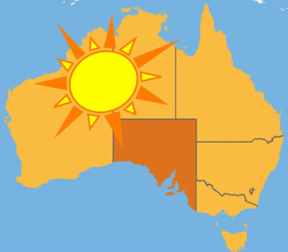 Jobs boost as Snowy Hydro and Equis to build $200m solar power plant near Tailem Bend, Daily Telegraph David Nankervis, The Advertiser January 31, 2017 SOUTH AUSTRALIA’s largest solar farm — with capacity for battery storage back up — will be built at a cost of more than $200 million at Tailem Bend this year.
Tony Abbott renews attack on Turnbull, calls for scrapping Renewable Energy Tareget
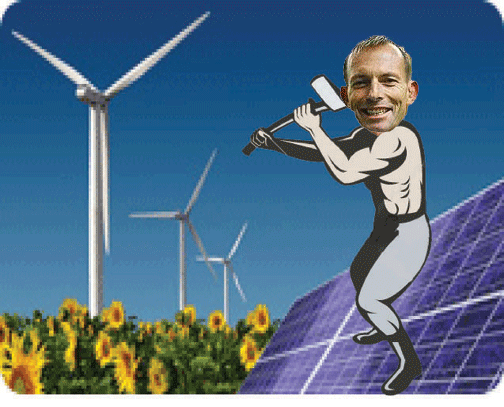 Abbott to PM: scrap RET or face fury SIMON BENSON The Australian January 30, 2017
Tony Abbott has unleashed another critique on Malcolm Turnbull’s leadership, using his Achilles heel — climate change — to accuse the government of treating voters like “mugs” if it did not scrap the renewable energy target.
In his second swipe at the Prime Minister in as many weeks, his predecessor said the Coalition would lose all credibility if it did not move to quickly rein in the push to generate more renewable energy.
In a speech yesterday to a Young Liberals conference in Adelaide, Mr Abbott accused the government of “losing touch” with its traditional supporters. The escalation of rhetoric contained a charge that the government not only lacked leadership in Mr Turnbull but that the Coalition was at risk of electoral collapse. It also reveals Mr Abbott is willing to risk further alienation from his own government….
“……our first big fight this year must be to stop any further mandatory use of renewable power.”
The comments build on remarks Mr Abbott made two weeks ago but indicate that he has no intention of remaining silent as the government struggles to regain momentum after a horror start to the year.
They come as Mr Turnbull is due to deliver a major speech to the National Press Club in Canberra on Wednesday.
The Prime Minister will becoming increasingly frustrated with Mr Abbott’s intervention on the RET, knowing that the government is unlikely to go as far as Mr Abbott is suggesting……
“Australia has almost limitless reserves of clean coal and gas. We should have the world’s lowest power prices. Instead, we’re making it harder and harder to use coal and gas through the renewable energy target — so that power is getting more expensive and less reliable,” he said…..
“Alcoa is in trouble, Arrium is in trouble, Port Pirie is in trouble, even Roxby Downs has a problem.
……….“What used to be called the silent majority, Hillary Clinton’s ‘deplorables’, might often lack a voice but they sure haven’t lost their vote.
“Voters will punish governments and parties that they think have lost the plot — and so they should.
“So that’s our challenge for 2017: to tackle real problems in a meaningful way so that people’s lives get better, not worse — and to do so in ways that make sense to our strongest supporters.” fury http://www.theaustralian.com.au/news/nation/abbott-to-pm-scrap-ret-or-face-fury/news-story/944645cff4bbaff67fb4ee5da6980dde

Renewable energy future for Tasmania
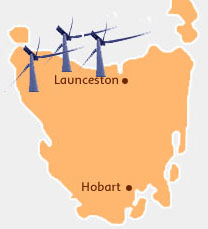 “The absolute beauty of Tasmania’s situation is that anything you do with solar or wind, we don’t need to worry too much about the intermittent nature of it,” he said.
“We’ve got the hydro which can generate a lot of electricity but it can’t do it all the time.
“Any time of the day that you generate electricity with solar or wind is saving running water out of the dams and then that gives you energy security.”
The expansion of renewable energy in Tasmania,  Examiner, 29 Jan 2017 Tasmania has the potential to become the envy of the world when it comes to renewable energy, according to our leaders.
There is no doubt energy was a hot topic in 2016. This time last year, Tasmania had a broken Basslink cable and it would not be fixed for another five months. Hydro Tasmania’s water storage levels were down to 19 per cent, but had dipped lower in previous months.
Not long before the Basslink cable broke, the government had given approval for Hydro Tasmania to decommission and sell the combined cycle gas turbine at the Tamar Valley Power Station, which would later become an essential piece of infrastructure.
As the crisis unfolded, the importance of the power station became clear, it was not sold, and was eventually up and running again.
This crisis led to the establishment of an Energy Security Taskforce which, in its interim report, found the state had a deficit of renewable energy generation and that more on-island hydro-electric and wind generation was needed.
“A more secure setting would be created if this deficit was reduced or eliminated by new entrant renewable energy developments,” the report said.
Already, renewable energy is meeting an average of 80 per cent of Tasmania’s energy demands.
But questions have been raised over whether enough is being done to attract further renewable energy investment into the state. Continue reading
New “clean coal” plants would cost Australia twice as much as renewable energy
Neither Canavan nor Frydenberg responded to questions about the costs of building new coal power stations
Australia’s coal power plan twice as costly as renewables route, report finds
Researcher says new coal plants aimed at reducing emissions would cost $62b, while the cost using renewables would be $24-$34bn, Guardian Michael Slezak, 27 Jan 17, A plan for new coal power plants, which government ministers say could reduce emissions from coal-generated electricity by 27%, would cost more than $60bn, a new analysis has found.
 Achieving the same reduction using only renewable energy would cost just half
as much – between $24bn and $34bn – the report found.
The resources minister, Matthew Canavan, and the energy and environment minister, Josh Frydenberg, have been arguing for new coal power plants to be built in Australia. Continue reading
Renewable energy groups mobilise as ERM’s RET shortfall looms as major test
 REneweconomy By Jonathan Gifford on 25 January 2017 Peak renewables bodies are looking to mount a campaign to highlight the troubling implications of ERM Energy’s decision to pay shortfall penalties rather than purchase and surrender the certificates for which it is liable under the Renewable Energy Target (RET).
While ERM maintains it is meeting its formal obligations, critics counter that it is acting against the spirit and intent of the legislation and fear that other electricity retailers may follow suit.
ERM’s decision, announced on Tuesday, to pay a $123 million penalty rather than surrender its required number of large scale renewable (LGC) certificates is looming as a major challenge to the Renewable Energy Target and enabling legislation.
ERM predicts that RET compliance levels from electricity retailers may fall from the current and previous levels of 99%, to something like 80% this year, indicating that other retailers are looking to follow suit and pay penalties rather than acquire LGCs.
In short, it is looking increasingly apparent that due to unintended consequences of RET legislation, money meant to go towards renewable energy projects will instead go directly into government coffers, in the form of penalty payments.
“This is a litmus test, it’s a setup,” says the Australian Solar Council’s John Grimes. “I talked in detail at the time of the efforts of the Abbott Government to abolish to the RET that this issue was the ‘Cuckoo egg’ in the nest and the trigger for the government to re-litigate and abolish the RET entirely.”
Grimes says that as a likely shortage of large scale renewable projects and then LGCs – the result of the Abbott government’s “disruption” of the RET and sector – has directly lead to the decision by ERM and others to make penalty payments.
“The [federal] government can then say that this is an expensive scheme, that it costs money but doesn’t deliver renewable energy,” says Grimes.
The ASC says that it plans to “shine a spotlight on the commercial entities looking to skirt their obligations under the RET legislation.”
Grimes notes that as ERM serves commercial customers, it does not have a large residential customer base that could potentially make a switch of retailer on the basis of this week’s decision. The company is the fourth biggest retailer and the second biggest provider of electricity to the business sector.
The ASC has named the ANZ Bank as a major ERM Energy client and is looking to build a larger list of customers on which to put pressure.
The Clean Energy Council also notes that big customers of ERM Power include the New South Wales and Queensland Governments.
“These governments and other customers should be asking why ERM has made a decision not to meet their obligations or support renewable energy projects which will deliver major economic benefits to regional parts of Queensland and New South Wales,” said the CEC’s Kane Thornton, in a statement.
Clean Energy Regulator chairwoman Chloe Munro said it viewed the “intentional failure” to surrender certificates “as a failure to comply with the spirit of the law and an undermining of the objectives of the scheme.” She said the money would be better spent as an investment in a growing industry rather than a financial penalty that has no return.
We believe many customers would be disappointed to know that this money has not been used for the intended purpose,” she said…….http://reneweconomy.com.au/renewable-energy-groups-mobilise-as-erms-ret-shortfall-looms-as-major-test-51422/
Victoria – a world leader in energy efficiency
 VICTORIA ENGAGING WITH SMES ON RESOURCE EFFICIENCY https://www.theclimategroup.org/news/victoria-engaging-smes-resource-efficiency
New case study shows how the Australian state is supporting businesses on energy and materials efficiency by Virginia Bagnoli 24 January 2017 LONDON: The Climate Group has published a new case study, showing how the Australian state of Victoria is engaging small and medium sized enterprises (SMEs) to support them in improving energy and materials efficiency.
The new study demonstrates how SMEs can significantly reduce greenhouse gas (GHG) emissions while substantially improving energy efficiency by applying sustainable resource management and energy efficient production processes.
The state of Victoria identified these gaps and designed a new program tailored to SMEs to help them change inefficient practices, save money and increase productivity through energy and materials efficiency measures.
VICTORIA’S APPROACH
SMEs have historically been difficult to reach and engage with on environmental programs due to company priorities and a traditional focus on shorter-term business requirements. Victoria understood that the program needed to align with fundamental business needs and provide multiple points of entry to make participation accessible.
Victoria’s program is also being viewed as particularly innovative due to its multi-faceted approach to addressing the challenges of information, understanding the business case and accessing capital. This approach was delivered by assessing and understanding the barriers for SMEs, communicating effectively to channel the multiple benefits associated with energy and materials savings, and leveraging existing policies and programs.
The program components targeted businesses at different stages of ‘readiness’ – ranging from businesses at an exploratory stage wanting to determine how they could benefit from energy and/or materials efficiency, through to businesses ready to implement specific projects.
Eligible businesses could apply for a grant to partly cover the cost of a materials efficiency or energy efficiency assessment. A competitive, merit‑based application process provided three rounds of grants of up to A$50,000 to support businesses in managing the costs of implementing materials efficiency projects. Grants of up to A$25,000 were available for energy efficiency projects (with businesses contributing at least half the cost of the project).
MAKING THE BUSINESS CASE FOR ENERGY EFFICIENCY
The program ran from 2012 to 2016 and since its launch it has achieved tangible results: three rounds of grants over the past two years have provided A$3.8 million in funding to over 140 projects and these businesses are expected to save a combined A$4.74 million a year.
Recruiting businesses to the program was the greatest challenge encountered. According to the Victorian government, SMEs typically have little time to devote to what is not seen as a strategic priority for them. The key solution to this has been to convince businesses that energy and materials efficiency will help with business-critical issues and to provide financial support in order to create efficiency change and transform business performance.
Through the program, Victoria has implemented an effective method of approaching businesses and making the program attractive to them; a considerable challenge giving that materials efficiency in particular is a new concept to most businesses and service providers.
Using what was learned from the program, Victoria also recently embarked on a new initiative for SMEs, SV Business – Boosting Productivity, which will work with an additional 1,000 SMEs.
Download the Victoria case study here and find all the Policy Innovation program case studies here.
The Climate Group supports state and regional governments in developing effective climate change and clean energy policies through its Policy Innovation program. State and regional governments around the world are developing a new generation of innovative climate and energy policies and our Policy Innovation program showcases and explores these emerging models, working closely with governments for them to scale globally.
A new, intelligent renewable energy culture for Australian Energy Market Operator (AEMO) ?
 AEMO hires New York energy reformer as new CEO, REneweconomy By Jonathan Gifford on 23 January 2017 The Australian Energy Market Operator (AEMO) has hired Audrey Zibelman, one of the leading players in New York’s ground-breaking “Reforming the Energy Vision” (REV), as its new chief executive. The appointment of Zibelman follows the death last year of her predecessor Matt Zema, and could signal the biggest ever shift in culture and technology of the AEMO, which is responsible for the operation of Australia’s main grids, but which has been criticised in some quarters for its slow response to renewable energy and other new technologies.
The Reform the Energy Vision plan, launched by New York in the wake of Superstorm Sandy, in which thousands of New York State residents were left without power for weeks, is considered to be the most ground-breaking and progressive in the world.
The REV seeks to increase energy security, through a range of measures including smart grid technology, battery storage and distributed generation strategically placed throughout its network.
The New York REV has been a difficult process given its scale and ambition and has drawn some criticism from some participants. However, it has also taken an innovative approach to strengthening electricity networks in light of the new energy paradigm of smart grids, economically competitive distributed generation and battery storage.
That Zibelman, who headed up the New York REV efforts, will assume leadership at AEMO, could have a significant impact on Australia’s urgently needed electricity market reforms, particularly in the light of the reports by the CSIRO and the energy networks, which mapped out a path to a cheaper and cleaner energy grid, and the work being done by chief scientist Alan Finkel, which has sought to address some of the myth-making about renewable energy created by fossil fuel industry and conservatives.
AEMO Chair Tony Marxsen said that Zibelman has the vision to guide the body and energy industry through the reform process, “as we transition our energy markets and reform power systems planning and management.”
“Audrey’s vast experience in creating and managing new wholesale electricity markets, and transforming existing energy markets and large power systems will further strengthen the work that AEMO has undertaken to support Australia’s energy industry transformation,” said Marxen in a statement.
Before chairing the New York State Public Service Commission (NYPSC), Zibelman founded and commercial energy software provider Viridity Energy, and was an executive on U.S. utility Xcel Energy.
Zibelman will be relocating to Melbourne, and take over as AEMO CEO own March…….. http://reneweconomy.com.au/aemo-hires-new-york-energy-reformer-as-new-ceo-52577/
Australian conservative MPs, Cory Bernardi etc, urge Turnbull to scrap the Renewable Energy Target
 ‘Dump RET when America walks away from Paris’ The Australian, January 23, 2017, A growing number of government MPs, including some on Malcolm Turnbull’s front bench, say Australia should dump the Renewable Energy Target and its carbon emissions reduction commitments under the Paris climate agreement if Donald Trump walks away from the deal.
Conservative MPs have told The Australian they believe there is no point in remaining committed to the Paris accord without the US locked into action on climate change, a phenomenon the new President has previously labelled a Chinese “hoax”.
Former prime minister Tony Abbott and South Australian senator Cory Bernardi have both publicly argued for the scrapping of renewable energy targets, saying that would allow the government to campaign more forcefully against Labor on energy policy.
One conservative MP said the view was “getting a lot of traction very quickly”, while another said that opinion was already “widespread” within the Coalition partyroom. The push comes as many MPs express frustration that the government has made little political mileage out of Labor’s policy to lift the renewable target to 50 per cent by 2030……
But MPs said Mr Abbott’s opinion piece published in The Weekend Australian this month advocating a shift in policy was “not helpful”, saying it would make it more difficult to convince the Prime Minister of the merits of the political strategy.
Another said that regardless of the RET target, the government would seek to incentivise the building of new coal-fired power stations…… http://www.theaustralian.com.au/news/nation/dump-ret-when-america-walks-away-from-paris/news-story/c6863739afb25e205d67a321ce70b954
Turnbull government is not convincing Australians in its attack on renewable energy
 Why the public is not buying Coalition attack on wind and solar, REneweconomy By Jonathan Gifford on 20 January 2017 What is it that the general public appears knows about renewables and electricity prices that much in the conservative side of politics, and the federal energy minister Josh Frydenberg, do not?
2017 has kicked off with another round of attacks on renewable energy targets, both state and federal. They display fundamental misunderstandings of renewable energy, its deployment capabilities, costs and impacts on electricity prices. The good news: the public isn’t buying it.
As working life, business and the public debate gets back into full swing after the holiday period, attacks on renewable energy and targets have, unfortunately, also resumed. The Australian, unsurprisingly, is leading the charge, and elected officials have added their voices to the unrelenting campaign of misinformation.
Most worryingly Energy and Environment Minister Josh Frydenberg is playing a prominent role. On Wednesday he penned an OpEd in the Australian Financial Review in which he got stuck into the Victorian and Queensland state governments’ RETs.
On Friday, The Australian gave him a platform to attack renewable energy by way of a rebuttal to the Labor opposition climate change spokesman Mark Butler’s arguments for a 50 per cent by 2030 RET.
While Frydenberg’s argumentation in today’s Australian specifically addresses the Labor 50% RET, it is riddled with direct attacks on renewable energy itself.
Frydenberg argues that RETs lead to higher power prices. To support this he says that power prices rose rapidly under Labor, that a 50% RET will drive out coal generation – implicitly increasing prices – and that it will require $48 billion in new investment in generation capacity.
The Energy Minister then cites AEMC findings that the RET will have “the highest cost of abatement,” that it does not encourage emissions reductions beyond renewable generation.
(RenewEconomy editor Giles Parkinson has already pointed out that the AEMC modelling actually shows the opposite, that the RET is actually a cheaper option, even given the AEMC modelling’s ridiculously expensive costing of wind and solar).
Despite this and other lines of argument, it appears that the Australian public is just not buying it. There continues to be evidence that renewable energy remains widely popular with Australians, to which their continued adoption of rooftop solar and increasingly battery storage attests. And polling continues to confirm this.
GetUp released the findings of a ReachTEL poll it conducted on January 12 today, in which it asked 2,126 householders what they believe are behind rising power prices.
The leading response, with 58%, was that “privatization and the lack of competition between the big energy companies” were behind the price hikes. The next response was “undecided,” with 24.2% and renewable energy in third place, with 17.7%.
“The owners of the poles and wires have been gold-plating the grid, spending billions of their customers’ money building far more grid infrastructure than we needed.”
Taking the RET in isolation, as a policy to drive the shift towards less emission intensive electricity generation as Frydenburg does, is also mischevious.
In combination with overdue electricity market reforms and the pricing of externalities, such as carbon pricing, in combination with renewable targets has repeatedly been shown to deliver a lower-cost energy transition……..
GetUp’s Miriam Lyons weighs in on the South Australia debate, saying that it is indeed “an example of what’s wrong with the current system” with its botched electric utility privatisation and the lack of competition.
“The Liberal Olsen government didn’t break up the generators when it privatized electricity – they chose to make as much from the sell-off as possible in the short term, rather than creating a genuinely competitive market,” says Lyons. “The price-gouging by gas companies that we saw in South Australia last year is a direct result of that.”
GetUp notes that it is encouraging to see public support for renewables and RETs hold fast, but that the battle against the demonization of renewables on the basis that they leads to higher electricity prices is far from over.
“This polling shows that the fossil fuel lobby’s campaign isn’t convincing most Australians – yet.” http://reneweconomy.com.au/public-not-buying-coalition-attack-wind-solar-36457/
Energy Minister Frydenberg ignores rapid price developments of large scale solar and wind
Why the public is not buying Coalition attack on wind and solar, REneweconomy By Jonathan Gifford on 20 January 2017 “…….The Energy Minister is clearly also ignoring the rapid price developments of large scale solar and wind, in his advocacy for “supercritical coal and gas” generation. Whether these lowe(er) emission generation sources can compete in the coming years given current large scale renewable cost trajectories is highly debateable.
Frydenberg, in his Australian opinion piece, then turns his attention to South Australia. He argues that the “forced” closure of coal in South Australia is behind high electricity prices and then says that low-income households are bearing the brunt of additional costs.
Strangely, Frydenberg didn’t mention Queensland. He should have, because then he would have understood that the issue is not about renewable energy, but market rules and market competition.
Queensland is similar to South Australia in that the wholesale electricity market is dominated by just a few companies who control some two thirds of the generation. In Queensland, the owners are government owned, and it has not yet got any large scale renewables to provide competition.
So the predictions for this summer was that prices in South Australia would soar, proving that renewables were a dangerous and costly diversion.
But wholesale prices in January in South Australia have been less than NSW, little more than in Victoria and Tasmania, and less than half what they have been in Queensland, where the lack of competition to the coal and gas generators (apart from rooftop solar) has meant prices have average more than $200/MWh.
There have been numerous spikes above $13,000MWh, which the regulator is to investigate, and days when the price has average near $500/MWh. The smelter in Gladstone is so appalled it has flagged possible downsizing.
There is a lot more to be written about Queensland, and its focus on LNG exports, the extra 1GW of demand that that is sucking from the grid.
The Labor government is trying to address that issue by encouraging 5,000MW of wind and solar in its own 50 per cent renewable target, a move it says will result in lower costs to consumers.
And while the Coalition carps on about the high cost of wind and solar, with the wholesale prices at their current levels, there is really no argument, which is why the likes of Sun Metals have decided to built their own large scale solar plants.….. ” http://reneweconomy.com.au/public-not-buying-coalition-attack-wind-solar-36457/
Utility scale investment marks the surge in wind and solar power in Australia
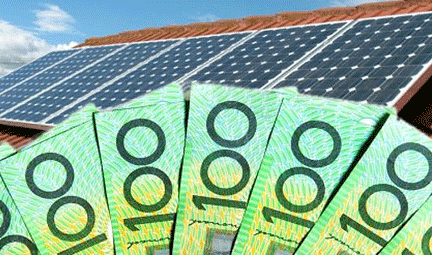 Wind, solar investment surge “the start of bigger things to come” REneweconomy By Jonathan Gifford on 18 January 2017 The strong growth in large scale renewable project financing in Australia in 2016 could be just the beginning of a major wave of investment.
This is the prognosis of Bloomberg New Energy Finance associate Leonard Quong, who adds that if key policy settings remain in place the $2.5 billion in annual large scale project investment required for Australia to meet its Renewable Energy Target could be achieved through to 2020.
“We have seen a new sense of momentum and energy in the market,” Quong told RenewEconomy, speaking of the latter stages of 2016. “If some of the fundamentals looking forward are to be believed, this is the start of bigger things to come.”
Quong explains that the stage is set for a large number of utility scale wind and solar PV projects to attract financing and get off the ground in 2017.
This is due in a large part to the “paralysis” the large scale renewable market experienced in 2014 and 2015, itself brought on by the Abbott Government’s Renewable Energy Target (RET) review. This paralysis is the primary cause of the large scale generation certificates (LGCs) shortfall likely to eventuate in 2018.
The BNEF analyst notes that the RET reduction agreed to by the major political parties, a position advocated by the Clean Energy Council aimed at breaking the paralyzing deadlock, laid the groundwork behind the recent growth in project financing.
The significant factor being that as it was achieved in a bipartisan fashion, investors gained confidence that the policy will be in place over the mid-to- long term.
As to whether Australia can achieve the reduced RET, Quong is quietly optimistic…….
A major trend set to emerge strongly in 2017, according to BNEF analysis, is the rise of utility scale solar. While wind project investments far exceeded utility scale solar in Australia in 2016, rapid price declines and solar PV’s inherent advantages in terms of project execution should see large scale solar take off.
“Given the shortfall in certificates now expected to happen in 2018, it gives quite an incentive for investors to look at solar,” says Quong. “With the shorter build times, potentially shorter development times, and with certificate prices now above $80/MWh, it certainly makes it quite attractive.” ……http://reneweconomy.com.au/wind-solar-investment-surge-start-bigger-things-come-57167/
1 This month



Help Aunty Sue Protect Her Land and Sacred Sites From Destructive Rocket Testing.
.

Australians deserve the truth
about
AUKUS – https://aukuspublicinquiry.com/

PETITION – To: Prime Minister Anthony Albanese and the Australian Labor Government

of the week – Australians for War Powers Reform (AWPR)
To see nuclear-related stories in greater depth and intensity

