World first wave/solar power grid for Western Australia
WA firm’s world first wave/solar power grid https://au.news.yahoo.com/thewest/wa/a/32755148/wa-power-firm-to-integrate-solar-wave-and-batteries/#page1 – on September 29, 2016,
The new features will be integrated with Carnegie’s CETO 6 wave technology which uses wave action to drive turbines and create electricity.
The Australian Renewable Energy Agency will kick in $2.5 million and construction will start by the end of the year.
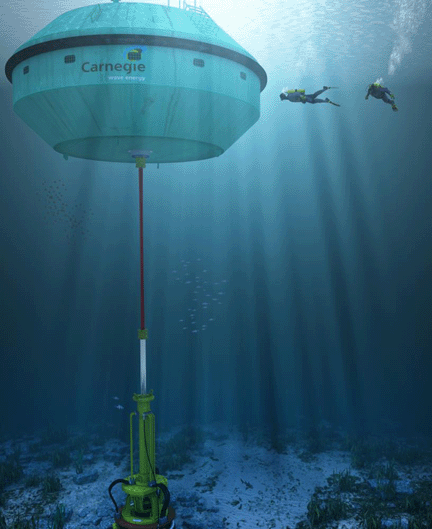
The company is aiming to start commissioning in the first half of next year. “The Garden Island Microgrid Project will be the first time anywhere in the world that wave energy will be combined with solar and batteries in a microgrid configuration,” Carnegie’s managing director and chief executive Michael Ottaviano said.
“The demonstration of this microgrid project will help drive the commercialisation of CETO and will be a model we will roll out to island nations around the world.
“Island nations are desperate for an energy innovation to replace their current reliance on electricity generated using imported fossil fuels, which is extremely expensive and has a large environmental footprint.
“Now Carnegie presents an effective green alternative, with the GIMG project acting as a template for remote island and grid communities globally.”
Carnegie’s CETO technology is different from other wave energy devices as it operates under water.
A new political low: Politicians use S.A. blackout to attack renewable eneregy
 Is this a new low: politicians using a natural disaster to push a fact-free agenda?, Guardian, Matt Grudnoff, 29 Sept 16
Unburdened by evidence, anti-wind campaigners used the South Australian blackout to kick off a debate about renewables while others waited for facts Normally natural disasters are off limits to politicking, at least in the period straight after the event. So it was pretty awful watching politicians and commentators pushing their anti-renewables message on the back of aonce in 50 year storm that hit South Australia and knocked out the electricity grid.
The outage is more likely to have something to do with the 80,000 lightning strikes and the winds that knocked over 22 transmission poles. Who knew violent storms could knock the power out?
It’s hard to imagine how coal fired power would have remained on without a grid for the electricity to flow through.
Just before the grid shut down, renewables were not offline. Wind energy was busy producing almost 1,000 Megawatts of electricity. The problem was not a lack of renewable power but a storm-ravaged grid that couldn’t get it to the consumers…….
Resilient renewables
The real irony is that an electricity system that has decentralised renewable energy with battery storage would be more resilient to these kinds of storms. Houses and businesses with their own batteries could have kept the lights on even when the grid went down.
In the past, renewables were more expensive – but those days are over.Renewable energy has fallen in price and battery storage is close behind. Change in how we produce electricity is coming and an anti-renewables campaign will only slow it and make the transition more difficult.
Rather than attack renewables, the government should be putting in place policies that help with the transition. The economics of renewable energy and the reality of climate change mean that it is inevitable that we will leave fossil fuel electricity generation behind. The question is how can we move to the new energy future in the smoothest way possible?
Renewable energy targets, system changes that make it easier to install battery storage, and a moratorium on new coal mines will all help.
Attacking renewables in the wake of a massive storm might help some people’s political agenda but it will do nothing to help South Australians build a reliable and resilient energy system.
Matt Grudnoff is the Senior Economist for The Australia Institute. https://www.theguardian.com/commentisfree/2016/sep/29/is-this-a-new-low-politicians-using-a-natural-disaster-to-push-a-fact-free-agenda?CMP=soc_568
Business Investment in Renewable Energy hit by government cuts to Australian Renewable Energy Agency.
 ARENA Cuts Impact Renewable Energy Businesses
  Business investment in Australia’s renewable energy sector will take a direct hit, with up to $5 billion of private funding at risk, as a result of the federal government’s decision to cut half a billion dollars from the Australian Renewable Energy Agency. Pro Bono, Wednesday, 21st September 2016 Ellie Cooper, Journalist Future Business Council executive director Tom Quinn said the government’s decision to cut funding to ARENA in the budget savings bill could have run-on effects on matched private-sector funding for renewable energy.
ARENA was saved from a worse fate, with the Coalition originally planning to strip $1.3 billion from the agency. Negotiations with the opposition secured $800 million in funding over the next five years.
But Quinn said the damage to the renewable energy sector would still be significant.
“The cuts to ARENA are shaking business confidence even further in the renewable energy space. This is a boom sector of this century, Australia’s got natural advantages in this space,” Quinn told Pro Bono Australia News.
“But the one thing holding back the industry is policy uncertainty created by hostile government actions.”
He said demand for renewable energy technology was “enormous”, with $329 billion invested globally in the sector last year.
But he said the role of ARENA was critical in launching renewable startups, growing viable businesses, and attracting local and international investment.
“If we’re talking about innovation in any new technology then early stage investment is critical, and that’s really where government comes in. Government has the ability to invest where the private sector can’t, and all too often that’s where Australia has let down its innovators and entrepreneurs,” he said.
“We haven’t got a good track record of backing early-stage innovation, and this is where ARENA was critical…….https://probonoaustralia.com.au/news/2016/09/arena-cuts-impact-renewable-energy-businesses/
Moratorium on fracking now in place in Northern Territory
Fracking moratorium takes effect in NT, Chief Minister Michael Gunner says, By Avani Dias A moratorium on hydraulic fracturing, or fracking, begins today, with Northern Territory Chief Minister Michael Gunner announcing the move at an oil and gas summit in Darwin.
“I announce that the Government will as of today implement this election commitment to introduce a moratorium of hydraulic fracturing of the Territory’s unconventional gas resources,” Mr Gunner told the South East Asia Australia Offshore and Onshore Conference…….http://www.abc.net.au/news/2016-09-14/nt-government-introduces-fracking-moratorium/7843502
Finance Minister Mathias Cormann says new cut to Clean Energy Fund , in exchange for saving Australian Renewable Energy Agency (Arena)
 Coalition says deal with Labor to save Arena funding will lead to new clean energy cut
Mathias Cormann tells Sky News that the capital available to Clean Energy Innovation Fund will be reduced, Guardian, Michael Slezak, 13 Sept 16, The finance minister, Mathias Cormann, has said the Coalition’s deal with Labor to save some funding for the Australian Renewable Energy Agency (Arena) will be balanced by a new cut to the Clean Energy Innovation Fund – but Labor has denied that was the agreement.
Speaking on Sky News, Cormann said: “Labor has asked for us to restore $800m of that for grants funding so we will do that but the capital available to the Clean Energy Innovation Fund will be reduced accordingly.”
It is understood that would in effect be cutting the Clean Energy Finance Corporation (CEFC) by $800m, because the innovation fund is part of the CEFC……..
The Greens’ climate and energy spokesman, Adam Bandt, called on Labor and theCoalition to clarify what the finance minister meant.
“It seems the finance minister thinks the government still gets to rip over a billion dollars from clean energy and that Labor has been outplayed,” Bandt said. “Far from saving clean energy, Labor just did a dirty deal with the Liberals to gut renewables.” https://www.theguardian.com/australia-news/2016/sep/13/coalition-says-deal-with-labor-to-save-arena-funding-will-lead-to-new-clean-energy-cut
With careful planning, Kangaroo Island could be independent with renewable energy
A balanced local electricity supply solution and a transition to 100% renewable power could deliver a range of economic development and other benefits to the local community.
 Kangaroo Island’s choice: a new cable to the mainland, or renewable power, The Conversation, Chris Dunstan September 16, 2016 South Australia’s iconic Kangaroo Island, the site of Australia’s first free settled colony, could pioneer a new age of renewable energy, according to our new research.
The first hardy settlers in 1836 had to decide whether to go it alone with a settlement on the island or revert to the mainland. Today, the 4,400 or so people who call the island home face a similarly stark choice: energy independence, or continued reliance on the mainland.
On one hand, the ageing existing cable could simply be replaced, at a cost of between A$22 million and A$50 million. This is the “preferred network option” proposed by the local electricity distribution network, SA Power Networks (SAPN).
On the other hand, SAPN is also currently considering an alternative mix of local wind, solar and biomass generation, complemented by diesel generation, battery storage and demand management. Continue reading
Turnbull govt slashes half-a-billion dollars from the Australian Renewable Energy Agency,but doesn’t actually kill it
Australian Renewable Energy Agency saved but with reduced funding – experts react, The Conversation, September 13, 2016 The Australian Renewable Energy Agency (ARENA) has been granted a funding lifeline of A$800 million over the next five years, after the federal government and opposition came to an agreement that will save the agency.
ARENA had faced being wound down as a result of the government’s earlier proposal to strip A$1.3 billion from the agency. This was part of a wider package of measures designed to save the federal budget more than A$6 billion.
Renewable energy researchers had reacted with dismay to that proposal. An open letter to the government in defence of the agency attracted 190 signatures.
Below, our experts react to the news.
Nicky Ison, Senior Research Consultant, Institute for Sustainable Futures, University of Technology Sydney
Today the Coalition government and the Labor Party struck a deal to:
- slash half-a-billion dollars from the Australian Renewable Energy Agency; and
- save the Australian Renewable Energy Agency (ARENA).
These statements seem like a contradiction, but both are true. However, it is also true that the need to save ARENA exists because of the Coalition government’s efforts over the past three years to dismantle Australia’s renewable energy policy. If the benchmark is that we keep our existing renewable energy institutions, today was a win. However, if the benchmark is that we have institutions and policies that have sufficient funding and scope to tackle the policy challenges of climate change, our changing energy system and driving innovation, then today was a loss.
Andrew Blakers, Professor of Engineering, Australian National University
The Australian research community is pleased that the government’s proposal to debilitate ARENA by removing A$1.3 billion and ending its granting function will not go ahead. At the same time, we are disappointed that yet again ARENA is subject to huge funding cuts.
The fastest and surest way to reduce greenhouse gas emissions is to accelerate the introduction of renewable energy into the electricity system. ARENA has focused heavily in this area (among others), covering the full gamut from support for early-stage research, through grants to young renewable energy companies, to acceleration of deployment of large-scale solar photovoltaic systems.
ARENA will need to heavily prune its activities to cope with a A$500 million budget cut. We look forward to restoration of ARENA funding, and to a concerted effort at the national level to move rapidly to 50-100% renewable electricity……https://theconversation.com/australian-renewable-energy-agency-saved-but-with-reduced-funding-experts-react-65334
Community Power Agency urges Victorian govt to establish “clean energy community hubs”
 Everybody needs good neighbours … to produce renewable energy, Benjamin Preiss The Age, 12 Sept 16 Linda Parlane got more than energy from the sun when she installed solar panels on her roof. She harnessed the power of her community. Ms Parlane bought her solar panels back in 2009 through a bulk-buy community scheme in Coburg………
She is now a board member of the Moreland Community Solar co-operative and wants to see more local projects, including ventures established through community investment. But she fears community energy projects have come unstuck in recent years after running into legal and administrative hurdles.
Moreland Community Solar is among a collection of environment, energy and lobby groups calling on the state government to ensure small to medium-scale community projects play a bigger role in reducing carbon emissions.
A submission to the government prepared by the Community Power Agency is urging it to establish “clean energy community hubs” that can provide advice to local groups and help them strike up relationships with renewable energy developers. It also recommends financial support for community-produced energy.
The state government has called for submissions as part of its plan to have 40 per cent renewable energy by 2025. NSW has a 20 per cent target by 2020-21. The government will use a “competitive auction process” in which renewable energy developers can bid for contracts to run their projects. The Community Power Agency wants community energy projects to account for up to 10 per cent of the overall renewable energy target.
Community energy projects take many different forms. Several years ago residents in Daylesford and Hepburn set up a community co-operative to establish a two-turbine wind farm that now produces enough energy to power more than 2000 homes.
In Bendigo a crowdfunding campaign was launched to buy solar panels for a local library.
Community Power Agency director Nicky Ison said many Victorians wanted to produce renewable energy at a local level. “Community groups have great ideas,” she said. “Once they’ve turned those ideas into something financially viable there are so many people who want to invest in these projects.”Ms Ison said community energy projects also resulted in stronger relationships within communities. “It’s bringing neighbours together.”
The groups supporting the submission include progressive lobby group Getup, Solar Citizens, Yarra Community Solar, Moreland Community Solar co-operative and the Central Victoria Greenhouse Alliance. http://www.theage.com.au/victoria/everybody-needs-good-neighbours–to-produce-renewable-energy-20160911-grdp6z.html
Nick Xenophon Team will block cuts to Australian Renewable Energy Agency: What About Labor?
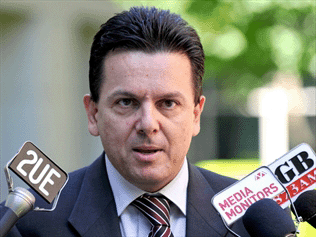 Nick Xenophon Team’s decision to block ARENA cuts puts pressure on Labor http://www.abc.net.au/news/2016-09-10/labor-under-pressure-amid-renewable-energy-funding-cuts/7832656 AM By political reporter Naomi Woodley The fate of future funding for the Australian Renewable Energy Agency (ARENA) now rests firmly with the Federal Opposition, after the Nick Xenophon Team (NXT) confirmed it would block the Government’s proposed budget cut.
Key points:
- $1.3bn cut is contained in Government’s omnibus savings bill
- Passing of bill to devastate renewable energy industry, Nick Xenophon says
- Labor caucus expected to consider funding cut on Tuesday
The $1.3 billion cut is contained in the Government’s omnibus savings bill, which is currently before Parliament.
Senator Xenophon said if the bill was passed it would devastate the renewable energy industry in Australia.
The real risk of the Government’s slashing of the renewable energy fund, ARENA, is that we will see a brain drain of our best and brightest leaving this country,” he said.
The Government wants to cut ARENA’s funding as part of plans to set up a Clean Energy Innovation Fund that would hand out loans instead of direct grants.
Senator Xenophon said while his team would not support the funding cut, there was scope to change the way ARENA worked.
“There ought to be a change in the funding mechanism to ensure that if a renewable energy technology has commercial success then the grant ought to be repaid, and there ought to be the ability for ARENA to take an equity in that project so it can reap the benefit of that,” he said.
He will ask Labor to support such an amendment when the bill reaches the Senate.
‘Acid is now on Labor’
The NXT’s decision to block the funding cut puts more pressure on Labor to decide how it will vote. Continue reading
Banks ready to back big solar projects: renewable energy jobs on the rise

 Banks looking even closer at backing big solar projects: Clean Energy Council, Brisbane Times, Tony Moore , 8 Sept 16, Australian banks will invest more heavily in solar energy projects within the next 12 months, Clean Energy Council chief executive Kane Thornton said after Thursday’s announcement that 12 new solar farms Australia-wide had been backed by $100 million from the federal government.
The federal government’s Australian Renewable Energy Agency on Thursday announced 12 large-scale solar projects – six in Queensland – had received federal support.
ARENA chief executive Ivor Frischknecht said improved efficiencies had meant solar energy producers were getting much more bang for their funding buck than they were even two years ago. “In 2014, the grant funding needed for large-scale solar projects was $1.60 a watt,” Mr Frischknecht said.”In 2015, this dropped to 43 cents at the EOI stage of ARENA’s $100 million large-scale solar funding round; and to an average of 28 cents in June 2016 when full applications were submitted,” he said.
“The average requirement of the projects we are taking forward today is an incredible 19 cents a watt.”
Mr Thornton said solar projects would soon begin to rely less on federal government for funding to begin operations. “We really at the threshold of saying that once we see another round of these of these projects we are going to see the costs decline to the point when they are built on their own, without the government support,” he said. “I think it is months, if not maybe a year or so, before we can expect them to go ahead without further funding.”
Mr Thornton said banks were now closely examining the viability of investing more heavily in solar and renewable energy projects in Australia.
The first major investment in solar energy by Australian banks came in 2013 when NAB and ANZ invested in a 20 megawatt solar plant in Canberra. More investment in solar plants followed, while banks have questioned some large new coal projects……….
Mr Thornton said scale of new solar farm plants was lowering production costs to the point where it was “cost comparative’ with coal and gas.
Mr Thornton said it was now time to begin training workforces that worked in traditional energy supply companies to work in renewable energy. http://www.brisbanetimes.com.au/queensland/banks-looking-even-closer-at-backing-big-solar-projects-clean-energy-council-20160908-grc5ol.html
South Australian govt makes a change- to purchase 75 per cent of its long-term electricity needs
 SA Government to purchase 75 per cent of its long-term electricity needs, ABC News, 7 Sept 16 By Nick Harmsen and staff The South Australian Government says it will launch a tender to buy 75 per cent of its long-term electricity needs in an effort to increase competition.
SA has been hit hard by spiralling electricity costs over recent years and the Government wants to introduce a new competitor to the market.
Premier Jay Weatherill said current rules allowed private electricity companies to drive “prices higher by withholding supply”. “A small number of energy suppliers in South Australia have too much power,” he said. “If we increase competition, we will put the power back into the hands of consumers.”
South Australia’s electricity provider, the Electricity Trust of South Australia, was privatised in 1999.It changed its name to SA Power Networks in 2012……..
Carbon emissions scheme on the cards The SA Government also wants to “explore” an Emissions Intensity Scheme (EIS) that would trade credits between energy companies at a national level…….
“[This] means no coal-fired power generation and the only way you’re going to do that is through an emissions trading scheme or an emissions intensity scheme,” he said.
Independent senator for SA Nick Xenophon said an EIS was a “breakthrough” that would increase power reliability, reduce costs and bring about good environmental outcomes. He said that under an EIS, “dirty generators” that emit above a baseline emission rate would have to pay for the pollution while those below it would be credited.
Senator Xenophon said he proposed it at a federal level with the then opposition leader Malcolm Turnbull in 2009. “It seems that after seven long years of skyrocketing power prices that the ‘mongrel scheme’ that I proposed with Malcolm Turnbull has now become the ‘top dog’,” he said.
Yesterday, Port Augusta residents lobbied Mr Weatherill to commit to purchase the power from a proposed solar thermal project in the state’s north.
Mr Weatherill said the tender would not specify which power plant technology should be used…….http://www.abc.net.au/news/2016-09-08/sa-government-to-purchase-75pc-of-electricity-needs/7825852
Australian Renewable Energy Agency (ARENA) funding 12 large scale solar projects
 12 large scale solar projects to get ARENA funding. And the winners are … REneweconomy, By Giles Parkinson on 7 September 2016 All eyes are on the Pullman Hotel in Sydney, where on Thursday, 12 out of the 20 large-scale solar projects shortlisted for the Australian Renewable Energy Agency’s $100 million funding round are expected to be announced as winners of federal government grants.
The announcements are expected to trigger the biggest single investment surge in any renewable energy technology in Australia to date, even outpacing investment in rooftop solar at the height of the premium feed-in tariffs.
Apart from the projects set to go ahead directly from the ARENA tender, the results are also expected to trigger financing commitments for other large-scale solar projects, many of which are keen to cash in on high prices for renewable energy certificates, surging interest in financing from local and international funders, as well as another big slump in the cost of solar modules on international markets.
RenewEconomy understands that 12 of the 20 projects that made the final short list (out of 77 initial inquiries) will get some sort of funding.
The fact that more than half the projects will be helped by ARENA is not unexpected, given the huge reduction in the project costs elicited during the tendering process. It will mean that the ARENA funding round will produce around double the 200MW of large-scale solar capacity that it originally targeted.
It is thought that nine of these 12 projects will be using single axis tracking technology, which a recent study suggests – see our article Solar does work, and a lot better than we thought – provides the best outcome in terms of output and returns on investment.
The tender result is also expected to show that the levellised cost of energy for large-scale solar has fallen to around $100/MWh for the best projects, well below the $135/MWh targeted by ARENA when it started the process.
A lot of this cost reduction is credited to the competitive nature of the bidding process. Last week ARENA chairman Martijn Wilder told ABC Radio the process had knocked down the amount of assistance needed to 10 per cent of project costs from the near 50 per cent needed to get the Nyngan and Broken Hill solar farms built.
It also appears that large energy retailers – under pressure to meet their renewable energy targets,but lately on a capital strike – are prepared to offer around $80-$85/MWh for long-term contracts………..http://reneweconomy.com.au/2016/12-large-scale-solar-projects-to-get-arena-funding-and-the-winners-are-23169
Australian Renewable Energy Agency negotiating with govt, trying to save its funding
ARENA board seeks compromise on funding with government, REneweconomy By Giles Parkinson on 7 September 2016 The board of the Australian Renewable Energy Agency is believed to have proposed a compromise on its funding position, in an effort to continue its support of critical research and early stage development in new renewable energy and storage technologies.
The Coalition government is seeking to strip $1 billion in funds from ARENA, which was created by the Labor government in 2012, but the conservatives need the support of parliament, and Labor in particular, to pass legislation to do that.
ARENA currently has $1.3 billion in legislated funding in future years and would be left with just $300 million or so after the current $100 million funding round for large-scale solar, the results of which will be announced tomorrow.
The funding move has been included as part of the Turnbull government’s budget repair “omnibus package” that has attempted to wedge Labor by including initiatives that the opposition supported during the recent election campaign.
Labor has found itself in a tricky position on ARENA, having abandoned support of the agency in a fit of pique over the nature of NGO press releases that responded to Malcolm Turnbull’s announcement of a new clean energy innovation fund, which was really nothing more than a trick.
Labor has since tried to row back, but unless it refuses the whole package then ARENA appears doomed.
Current and former board members are apparently lobbying the Coalition government to abandon the proposed cuts, but in an attempt at compromise are suggesting that the scale of the funding cuts could be reduced.
They have outlined several scenarios where the cuts are reduced to $300 million or $500 million, and what that would mean for new projects, investments and jobs (remember the jobs and growth mantra).
It has also been suggested that ARENA funding could come from the so-called “penalty” prices that will be paid if large energy retailers fail to meet their obligations under the renewable energy target.
Currently, there is no penalty imposed on retailers if they fail to build or contract enough renewable energy to meet their obligations. The “penalty price” is paid by the consumer, and the money passed through to government coffers……….
What will be impacted by the savage ARENA cuts will be funding to the next generation of technologies, such as large-scale solar towers and storage, which attracted a response from the South Australian Labor government this week.
Storage technologies are seen as critical to supporting increased use of wind and solar in the grid, particularly with the cost of gas rising and the market controlled by just a few dominant players who have been allowed to exploit their market power and push prices higher.
ARENA funding has also been critical to development of battery storage technologies and discovering their use and value in the electricity network, either in homes and in peer-to-peer trading, or at grid level. It is also supporting many off-grid and edge-of-grid projects to use renewables and storage to slash the cost of diesel.
And, of course, there are hundreds of researchers whose jobs are at risk. It is believed the ARENA submission has made it clear to the government exactly what is at risk under the various funding cut scenarios. http://reneweconomy.com.au/2016/arena-board-seeks-compromise-on-funding-with-government-31836
Farmers get economic safety net, thanks to wind farms
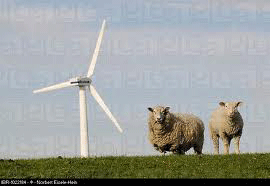 How wind farms provide a safety net for farmers, communities http://www.examiner.com.au/story/4136408/wind-turbines-can-power-a-bright-new-era-for-rural-areas/?cs=97 Charlie Prell 5 Sep 2016, In the 1950s, Australia “rode on the sheep’s back”. Wool was commanding obscene amounts of money, and farmers experienced a period of prosperity that hasn’t been seen since. It helped make Australia one of the wealthiest countries in the world.
Renewable energy promises to create a new “wool boom”. But, unlike the 1950s, the boost from the clean energy revolution will last decades, possibly generations.
Farmers, large and small, can grasp this once-in-a-lifetime opportunity that will breathe new life into struggling rural communities. That’s why I’ve signed up to host wind turbines on my sheep farm.
Wind farms offer both environmental and financial benefits. Turbines quietly produce clean, renewable electricity, replacing power from ageing, inefficient coal-fired generators that are driving climate change.
Each turbine generates a steady income of tens of thousands of dollars a year for the farmers who host them, as well as their neighbours. The community doesn’t miss out, with wind proponents promising thousands of dollars a year to projects like supporting local sporting teams, rejuvenating halls and providing community transport. This is on top of locals being employed to manage and maintain the turbines.
Despite record commodity prices, farmers are still doing it tough. As droughts and floods become more common, the stable income generated by turbines can make the difference between floating into sustainability or drowning in debt.
Instead of needing financial support from governments, farmers can become self sufficient for decades and generations. Wind turbines do more than change the landscape – they reinvigorate the economic and social fabric of rural communities for the better. Charlie Prell is a fourth-generation farmer from Crookwell, NSW and organiser for the Australian Wind Alliance.
Solar power in Australia working better than expected
Solar Power Does Work, Even Better Than Expected, Clean Technica, September 2nd, 2016 by Giles Parkinson Originally published on RenewEconomy. [excellent graphs]
One of the prices we have to pay for our ideological divide on renewable energy is that we have to read headlines like this, particularly in the Murdoch media: “Solar and wind power simply don’t work, not here, not anywhere”. It was written by the former chairman of a coal mining company, in case you were wondering.
Solar doesn’t work? New analysis of Australia’s first large-scale solar farms shows that solar actually does work, and rather better than expected. And the findings should make it a lot easier for future projects to get the backing of equity investors and bankers, if not the owners of coal fired generators desperately protecting their turf.
The research has been produced by US-based solar module manufacturer First Solar, whose panels have been used for around three quarters of the large-scale solar projects built in Australia to date, by capacity.
Its study shows that at all the solar farms built by First Solar – in western NSW, north Queensland and Western Australia – the output has been higher than forecast. Collectively, the Australian solar plants using First Solar thin-film PV modules are performing above expectations by an average of 3.2 per cent.
The best result has been produced by Broken Hill, the 53MW plant built near the iconic mining town in western NSW, which is so far delivering 4.2 per cent above expectations.
(Spectral advantage, btw, is a measure that First Solar uses to show how much better their panels work in humid conditions than silicon-based rivals).
Now, this might not sound like ground-breaking news – forecast production broken by a few percentage points.
But people in suits are very conservative types, and investment in renewable energy in Australia, both in wind and solar, has been hampered by the fact that bankers won’t finance investments unless they can actually touch, feel and watch the technology, and have proof that it actually works.
This data, Curtis says, is proof that the projects are, indeed, bankable. And that’s more important than it might sound.
Curtis says that even though large-scale solar has been proved in many international locations, local investors still wanted proof that it would work in Australia, even though it does have some of the best solar conditions in the world. Such, perhaps, is the insular nature and/or inherent conservatism of Australia’s banking system.
But Curtis is reassured, not just by the release of the production statistics, but also by the attitude of equity investors and financiers in the local market………
……Dylan McConnell, from the Melbourne Energy Institute, emailed through a production chart from the 102MW Nyngan solar farm, which also used First Solar technology.
McConnell pointed out that, indeed, Nyngan was producing at a capacity factor of 25 to 26 per cent. This, he said, was far higher than official forecasts relied upon for the Australian Power generation Technologies Report, which estimated the average capacity factor of large-scale solar PV at 19-22 per cent.
That, says McConnell, suggests that the forecasts relied upon by the federal government underestimate the output of solar farms by between 15 and 35 per cent.
Little wonder that the government can’t make any sensible decisions about large-scale solar, and why it insists on defunding the agency that has brought about most of the cost reductions in the past year, ARENA. https://cleantechnica.com/2016/09/02/solar-power-work-even-better-expected/
1 This month



Help Aunty Sue Protect Her Land and Sacred Sites From Destructive Rocket Testing.
.

Australians deserve the truth
about
AUKUS – https://aukuspublicinquiry.com/

PETITION – To: Prime Minister Anthony Albanese and the Australian Labor Government

of the week – Australians for War Powers Reform (AWPR)
To see nuclear-related stories in greater depth and intensity

