Record wind energy output last month kept electricity prices down
 Wind energy’s biggest month, and how it keeps prices down REneweconomy, EBy Giles Parkinson on 8 June 2016 Wind energy in Australia has enjoyed its biggest every month in May, producing nearly a quarter more electricity than its previous record month, and overtaking hydro to provide 8.5 per cent of electricity demand in the country’s main grid.
The record output came, coincidentally, in the same month that the last coal fired power station in South Australia was closed (May 9). And a new analysis from energy consultants Pitt & Sherry points to how wind generation is keeping a lid on wholesale electricity prices.
The Pitt & Sherry analysis notes that four states recorded record monthly totals in May – South Australia (where wind met 49 per cent of demand), Victoria, New South Wales and Tasmania. (There is only one very small wind farm in Queensland and Western Australia operates on a separate grid).
The 3.9GW of wind generation in the month of May operated at a capacity factor of 49 per cent, according to Pitt & Sherry, meaning that it produced 22 per cent more than it did in its previous record month (July, 2015). (See this story for more details, and how most wind farms in NSW operated at a higher capacity factor than some of the biggest coal plants).
South Australia has the biggest share of wind farms, with 1.5GW, and this accounted for 49 per cent of its electricity demend in the month. On some occasions, wind energy provided more than 100 per cent of electricity demand in the state.…….http://reneweconomy.com.au/2016/wind-energys-biggest-month-and-how-it-keeps-prices-down-69687
Totally Renewable Yackandandah leading Victorian town to 100% renewable energy
 A Yack attack on climate in Yackandandah, TUCKED away in a picturesque nook of Victoria’s North East is a small town doing big things.June 7, 2016
Yackandandah — home to between 700 and 2200 people, depending on where you draw the town border — is one of dozens of communities across the country leading the way on renewable energy.
Its goal is ambitious: to be 100 per cent reliant on renewable energy sources by 2022.
At the helm is Matthew Charles-Jones, an environmental education teacher and former university lecturer who runs an education and accommodation facility at Falls Creek.
He’s a co-chair of Totally Renewable Yackandandah, or TRY as it is more familiarly known, a committee of about half a dozen passionate locals promoting the renewable energy message……
Although Matthew is quick to clarify the 100 per cent target is TRY’s goal and not the official town plan, if the yellow cardboard yaks popping up across the district are any indication, plenty of locals are signing up to the vision.
The Australian PV Institute tracks solar power installations across the country. Its most recent data shows 249 dwellings within the 3749 postcode (taking in Yackandah and Bruarong, a hamlet about 13km south) are producing their own solar energy, about 35 per cent of a combined 700 homes.
This, says Matthew, is up from 24 per cent when TRY entered the scene.
Yackandandah Health, a facility that provides aged care as well as a host of primary health services, was one of the first organisations to take up the mantle.
It has installed 348 solar panels to provide 90kW of power and reduce its annual greenhouse gas emissions by 115 tonnes — in real terms, the equivalent of taking 23 cars permanently off the road.
The system, which produces about a quarter of their electricity consumption, is also expected to save the non-profit, community-owned organisation $1 million over the next 25 years…….
While it is not uncommon for town-folk to be perceived as more progressive than their farming neighbours, around Yackandandah, farmers are also jumping on the bandwagon…….
Firm believers in solar energy’s ability to give a financial return to home and business owners, the TRY committee has established a “perpetual energy fund” to help further ease the cost concern, offering loans for people to install solar systems and then make repayments with the savings off their electricity bill.
It’s an initiative designed to fill the gap left by changes to Australian energy policy that have put solar energy, and renewables in general, on the back burner.
“We need such a massive amount of change in this sector and for me, our traditional institutions aren’t doing enough about it,” Matthew says.
“Around the world countries, communities and business are investing heavily in renewable energy but because there hasn’t been a clear, enduring policy in Australia and in that absence, investment in renewable energy collapsed…….
Yackandandah is not alone.
Matthew estimates there are nearly 80 communities across Victoria leading the way in renewable and community energy.
Closest to home is Newstead, a small town about a 15-minute drive from Castlemaine in central Victoria. Six years ago it announced its goal to be Australia’s first 100 per cent renewable energy town by 2021.
“They’re doing remarkable work,” says Matthew, while noting the town has been helped along by significant financial input from the Victorian Government…….http://www.weeklytimesnow.com.au/country-living/a-yack-attack-on-climate-in-yackandandah/news-story/92775dad3e4dd28f80e052c40668e766
Hi-tech renewable energy jobs reviving south-west Victoria’s economy
 High-tech, clean energy jobs key to future of Geelong, south-west Victoria, ABC News, 5 June 16 By Cameron Best Steve Garner understands how important his wind farm manufacturing business is for the town of Portland in south-west Victoria.
As the state’s traditional manufacturing base continues to decline, jobseekers and the wider economy are looking for the jobs of the future.
Six months ago, Mr Garner’s Keppel Prince Engineering facility lay idle under the Federal Government’s freeze on new wind energy investment and former prime minister Tony Abbott’s desire to reduce the growth rate of what he labelled as “visually awful” wind farms.
Now, under a new Clean Energy Finance Corporation mandate, the production line at Keppel Prince is back up and running with about 300 workers making towers for a project near Ararat.
It has come just in time for Portland, which is facing the possibility of life without its major employer……
“the stronger we can grow something like this [facility], that actually does create a lot of jobs, the better off we’re going to be.
“And if we get government support to do that, we’ve then got a sustainable business for a long period of time.”…
New-wave tech replacing manufacturing of old
High-tech industries are springing up to utilise some of the skilled workers coming out of the automotive industry but in order to remain globally competitive, this new wave of advanced manufacturers cannot afford to be as labour-intensive as the companies of old…….http://www.abc.net.au/news/2016-06-05/high-tech,-clean-energy-jobs-the-key-to-geelong-future/7476816
Fantastic news! Port Augusta’s opportunity to become a world class solar energy hub
Revealed: Proposal for $1.2bn solar thermal power plant at Port Augusta June 4, 2016 http://www.adelaidenow.com.au/news/south-australia/revealed-proposal-for-12bn-solar-thermal-power-plant-at-port-augusta/news-story/58e18b826e4ecedfb57a9d11dc5fe7ba Sheradyn Holderhead Tory Shepherd A NEW proposal for a $1.2 billion solar thermal plant at Port Augusta, backed by former federal Liberal leader Dr John Hewson, can be revealed by The Advertiser just weeks after the city was hit with the closure of its power station.
Solastor Australia will next week unveil its plans to build a solar thermal power station with a generation capacity up to 170 megawatts and energy storage capabilities, The Advertiser has discovered.
While details of the project remain secret until an official announcement on Tuesday, a similar proposal from US company SolarReserve would create up to 1000 jobs during construction and about 50 permanent jobs.
Solastor Australia chairman Dr Hewson will reveal the company intends to build a fully integrated, solar thermal power station and energy storage system to provide SA with “24/7 base load and peak load generation”.
“We’ll be announcing it all on Tuesday,” he said last night. “This is world-class. We think this is something we can roll out not only across Australia but internationally. It’s Australian technology, it gives Australia a real edge … in actually being able to turn sunlight into effective baseload energy.”
The Advertiser understands behind-the-scenes work on the proposal has been underway for months. The company has a plant in China and has been working in the Middle East.
And Solastor believes that it can produce affordable energy from the plant. In a statement, Solastor Australia said the proposed power station would cost about $1.2 billion and would have a generation capacity of 110mW in winter and 170mW in summer.
“Once completed, it will generate approximately 1.25 billion kilowatt hours of electricity per annum, which is sufficient to provide power to more than 200,000 Australian homes,” the statement said.
Both Federal and State governments are aware of the plans — and consider it to be a legitimate proposal.
Last month, Federal Environment Minister Greg Hunt promised financial support for the 110mW SolarReserve project, which until now was the only publicly known proposal for a solar thermal plant at Port Augusta.
Port Augusta mayor Sam Johnson said the second proposal was “fantastic news” and, along with four other renewable energy projects, was the “saving grace” for the town and the state’s economy.
“This reinforces comments in the past that Port Augusta will be the renewable capital of Australia,” he said. “This would be South Australia and Australia transitioning to a new world and would be a saving grace for Port Augusta and the SA economy.”
Mr Johnson said this proposal was the fifth renewable energy power station plan, which also included two 100mW solar panel farms, and a combined wind turbine and solar panel farm, the approval of which was expected to be announced next week
These projects will support Arrium and the skilled workforce we have, as well as benefiting small business throughout the region,” Mr Johnson said. “All up these projects would replace the generation from the coal-powered plant.” Repower Port Augusta campaigner Dan Spencer said it was great news that more companies were coming forward with proposals.
“Port Augusta really has the opportunity to become a renewable energy hub,” he said.
“More and more proponents are coming forward and saying they want to invest which is really exciting.
“There’s no reason we couldn’t see both these solar projects get built. The more projects, the more investment, the more clean energy.”
In April a Repower Port Augusta-commissioned ReachTEL poll of 1195 people showed that three-quarters believed the Federal Government should help fund the construction of a solar thermal power plant at Port Augusta.
Labor’s community solar hubs would benefit renters and pensioners
As of February this year, more than 1.5 million Australian homes had rooftop solar panels. But Labor believes gaps exist among households unable to access the technology, such as renters, public housing tenants and apartment dwellers.
The community power hubs would work with communities to develop renewable projects by providing legal and technical expertise and start-up funding.

Projects might include community wind farms, “solar gardens” or shared arrays of solar panels for groups of renters, retrofitting social housing to promote energy efficiency and encouraging solar rooftop installations on social housing and aged-care properties.
The hubs may also provide finance for low-income earners and pensioners, such as by using council rates as financial contributions for projects.
 ‘Solar revolution’: Labor climate plan warms up to renters, pensioners http://www.theage.com.au/federal-politics/political-news/solar-revolution-labor-climate-plan-warms-up-to-renters-pensioners-20160601-gp8sc8.html June 1, 2016 Nicole Hasham Environment and immigration correspondent Groups of renters could share a “garden” of solar panels and the technology would be encouraged in public housing and aged-care homes in a $98.7 million Labor push to bring the “solar revolution” to those who do not own their homes.
The details came as the Greens announced a plan to double the number of paid firefighters to battle extreme bushfires, saying renewable energy is important but the effects of global warming are already being felt.
Fairfax Media polling this month showed two-thirds of voters believe the federal government is doing “not very much” or “nothing at all” to combat climate change, and Prime Minister Malcolm Turnbull’s adherence to policies of the former Abbott administration has been interpreted as a trigger for a fall in his popular appeal ahead of the July 2 election.
In Brisbane on Wednesday, Opposition Leader Bill Shorten spruiked a Labor plan to create up to 10 “community power hubs” to allow more people to access renewable energy. Labor previously flagged the measure in the release of its broader climate election policies in April. Continue reading
Climate Council reports on Australia’s top solar states and suburbs
 Australia’s top solar states and suburbs http://onestepoffthegrid.com.au/australias-top-solar-states-and-suburbs/ By Sophie Vorrath on May 25, 2016
Rooftop solar is becoming as “common as insulation” in some parts of Australia, a new report has found, with 14 suburbs now recording penetration above 50 per cent, and many others recording uptake far above their state’s average, sometimes as high as 65 per cent.
The report is the Climate Council’s latest round-up of data on the performance of renewable energy in Australia’s states and territories. . As you can see in the table below, at the state and territory level, South Australia, Queensland, and Western Australia all have a higher share of Australia’s solar PV installations than their share of the population [Table 3 on original]
But in terms of the percentage of households with solar PV, South Australia and Queensland are still leading the country, with PV penetration levels fast approaching one-third of all households. Western Australia comes in at third place, with solar PV panels on one in five households.
In the suburbs of Australia, the data tells a slightly different story, with some postcodes charting a solar PV penetration rate much higher than the average of the state or territory they are located in. Continue reading
Despite our solar resources, Australia way behind Britain in solar energy
Australia 10th in global solar capacity as industry looks ahead to sunnier times http://www.smh.com.au/environment/climate-change/australia-10th-in-global-solar-capacity-as-industry-looks-ahead-to-sunnier-times-20160531-gp83t6.html June 1, 201 Peter Hannam Environment Editor, The Sydney Morning Herald Australia installed almost 1 gigawatt of new solar capacity last year but was easily eclipsed by cloudy nations such as the United Kingdom, which installed about four times as much, according to the REN21 Global Status report on renewable energy.
Investment in new renewable energy and energy efficiency programs rose to a record $US286 billion ($396 billion) even as prices for most technologies, such as solar and wind energy, fell. Growth also came despite falling prices for rival fuel sources, such as coal and oil.
“Renewables are now cost-competitive with fossil fuels in many markets and are established around the world as mainstream sources of energy,” Arthouros Zervos, chairman of REN21, said in the report.
Globally solar PV capacity added 50 gigawatts to reach 227 GW of capacity. New wind power capacity rose even more, adding 63 GW of new capacity to reach 433 GW.
Australia added 900 MW of new solar PV last year – the eighth-most in the world – to reach 5.1 GW of capacity.
That total, though, ranked Australia 10th in the world, trailing nations not known for their sunshine, such as the UK, South Korea and Germany. The UK added 3.7 GW alone last year to reach 9.1 GW of capacity, or almost twice Australia’s tally.
Kane Thornton, chief executive of the Clean Energy Council, said it was “obviously disappointing that the UK had almost twice as much solar power as Australia by the end of 2015, given we have some of the strongest sunshine in the world.” Continue reading
Coober Pedy headed for 70% renewable energy
 Local jobs out of Hydro Tasmania project in Coober Pedy http://www.examiner.com.au/story/3934449/local-jobs-out-of-hydro-project/ Toli Papadopoulos 29 May 16.
A new project will inject millions into the Tasmanian economy and create local jobs, according to Hydro Tasmania CEO Steve Davy.
Mr Davy said the new project will use local manufacturing suppliers, and aims to turn South Australia’s Coober Pedy into a renewable township.
Hydro Tasmania’s manager off-grid solutions Simon Gamble said a number of Tasmanian companies would be involved in the project, including Doric engineering and Southern Prospect out in Wynyard.
He said the containerised systems and electrical equipment would be designed and tested in Tasmania.
Hydro said it was engaged by project developer Energy Developments Limited to develop technologies previously used in King Island.
They said Energy Developments Limited received a grant of $18.4 million by the Australian Renewable Energy Agency for the project.
“This is second project using this containerised modular system, the first was Flinders Island, but this one is by far the largest project we’ve done,” Mr Gamble said.
Mr Gamble said Hydro had already invested in projects in South-East Asia and the Pacific, and this was really just the beginning.
Hydro said 70 per cent of the town’s energy will be drawn from renewable sources once the technology is in place, with a goal of eventually making Coober Pedy completely renewable.
Queensland wind farm creating jobs, powering a city
 Wind farm at Mount Emerald, near Cairns, set to create 150 jobs http://www.couriermail.com.au/news/queensland/wind-farm-at-mount-emerald-near-cairns-set-to-create-150-jobs/news-story/6ddd2419660c8f1666822dfde3024a8f May 27, 2016 A WIND farm to be built in far north Queensland will generate enough renewable energy to power a regional city. Ergon Energy and proponents Ratch Australia and Port Bajool on Friday signed a power purchase agreement to build the 170 megawatt Mount Emerald Wind Farm, near Cairns.
About $400 million in total expenditure is projected during the project’s two-year construction phase and 25-year operational period.
The project is also expected to boost the region’s economy by $900 million through direct and indirect flow-on impacts.
Energy Minister Mark Bailey said the project would mean the state’s wind energy production, which sat at 12 megawatts, would be increased by 15 times.
Australia – free of coal-fired electricity by 2030 – it can be done
How Australia can eliminate coal-fired electricity by 203 0 Canberra Times, May 26 2016 Andrew Blakers Australia has agreed to limit global temperature rise to “well below” 2 degrees Celsius. The replacement of fossil fuels with renewable energy sources will be much easier, quicker and cheaper than many people realise because the technologies required – solar photovoltaics (PV), wind power and pumped hydro energy storage (PHES) – are affordable and are already deployed on a large scale.
PV and wind energy are price competitive with new-build fossil and nuclear power in most parts of the world, and price reductions continue. PV and wind constitute all new electrical generation capacity installed in Australia, and half of new generation capacity installed each year worldwide, more than fossil, nuclear and hydro power combined.
PV and wind are being installed at 20 times the annual rate worldwide of all other non-hydro renewables combined. Other low emission energy technologies will require heroic technical breakthroughs and growth rates to catch up. Continue reading
New South Wales lags behind in renewable energy use
NSW last in class on Climate Council report card for renewable energy use
South Australia and the Australian Capital Territory take the green podium for their efforts and policies pushing renewable energy targets, Guardian, Michael Slezak, 26 May 16. New South Wales is the worst Australian state at driving renewable energy, and South Australia and the ACT lead the pack, a report produced by the Climate Council has found.
The results came just weeks after South Australia closed its last coal power station, and the ACT announced a target to source 100% of its energy from renewable sources by 2020.
The report examined state and territory percentages of renewable electricity, the amount of large-scale renewable capacity per capita and the policy settings driving renewables.
NSW was bottom of the class in every category except rooftop solar. But it beat only Tasmania, which receives less solar radiation than any state or territory.
The territories had no comparable data for the percentage of their electricity that came from renewables, so they were scored separately. But the ACT was singled out as a leader for its 100% renewable energy target, which it will achieve using reverse auctions for large-scale renewable energy.
In the middle of the pack were Queensland, Western Australia and Victoria, although Queensland recently overtook South Australia with rooftop solar, now at 29.6% of households.
NSW and Victoria were the only states to have decreased the percentage of their electricity sourced from renewables. Between 2013 and 2014, NSW’s share of renewable energy dropped from 7% to 6% and Victoria’s from 12% to 10%. The Northern Territory was highlighted as lagging, along with NSW, with no specific renewable energy targets or policies and a low uptake of rooftop solar……http://www.theguardian.com/environment/2016/may/25/nsw-last-in-class-on-climate-council-report-card-for-renewable-energy-use
South Australia runs over 50% on renewable energy
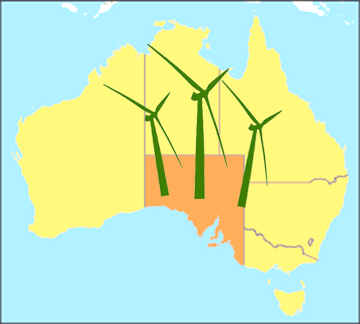 South Australia runs mainly on renewable energy following coal plant closure, The Independent, Gabriel Samuels 12 May 16 Majority of energy comes from solar and wind but the transition has been fraught with difficulties South Australia now gets the bulk of its electricity from wind and solar power, following the closure of its last coal-fired power station.
The state, which includes the city of Adelaide, exclusively has gas generators, solar panels and wind turbines serving a population of 1.7 million.
More than 50% of the region’s electricity stems from wind and solar with the remainder coming from energy efficient combined cycle gas plants.
The final coal station still in operation in Port Augusta closed down on May 9 after operating for 31 years. It generated 520 megawatts of power from coal but failed to compete with the falling price of clean renewable energy. Its closure produced a brief faltering in wholesale energy prices across the state.
The RenewablesSA transition initiative was established by the state govenment in late 2009 with a promise of $10 billion invested in low carbon generation by 2025…….
The state plans to become Australia’s wind and solar capital and is working towards complete reliance on natural sources
The state’s leading electricity provider, SA Power Networks, yesterday announced it will undertake Australia’s largest trial of storage batteries in solar homes in a bid to defer a $3 million network upgrade.
Meanwhile, last week Portugal ran entirely on renewable energy for four consecutive days between Saturday and Wednesday, in a bid to become completely reliant on natural resources.
The Independent has contacted RenewablesSA for comment. http://www.independent.co.uk/news/world/australasia/south-australia-runs-entirely-renewable-energy-following-coal-plant-closure-a7037646.html
University of New South Wales team sets new world record for converting sunlight to electricity
 New world record set for converting sunlight to electricity http://www.gizmag.com/solar-cell-electricity-efficiency-world-record-unsw/43384/ Eric Mack May 17, 2016 An Australian team has set a new record for squeezing as much electricity as possible out of direct, unfocused sunlight via a new solar cell configuration. Engineers at the University of New South Wales (UNSW) achieved 34.5 percent sunlight-to-electricity conversion efficiency, a new mark that also comes closer than ever to the theoretical limits of such a system.
UNSW’s Dr. Mark Keevers and Professor Martin Green set the record with a 28 centimeter-square (4.3 sq in), four-junction mini-module embedded in a prism. This new configuration allows the sun’s rays to be split into four bands so that a higher amount of energy can be extracted from each beam.
The same team reached an even higher level of efficiency a few years back using mirrored concentrators that were able to convert 40 percent of incoming sunlight to electricity. However, this new record is the highest level achieved without the use of concentrators.
“What’s remarkable is that this level of efficiency had not been expected for many years,” said Green, citing a German study that set a goal of 35 percent efficiency to be reached by 2050.
The team does not expect that its record-breaking cell configuration will find its way on to home or office rooftops anytime soon, as they are more costly to manufacture. The group is working to reduce the complexity to make them cheaper to produce and sees a future for them on solar towers that make use of concentrating mirrors.
Meanwhile, efficiency gains are also being made in the development of organic solar cells that are cheaper and more flexible. There’s still a long way to go though, as the most recent record for organic photovoltaics set in February was 13.2 percent efficiency. Source: University of New South Wales
South Australia – “base load” power from wind and solar – Giles Parkinson
 Wind and solar become new “base load” power for South Australia http://reneweconomy.com.au/2016/wind-and-solar-become-new-base-load-power-for-south-australia-99364 [good graphs] By Giles Parkinson on 16 May 2016
This is expected to be the pattern of the future, as energy systems with high renewable energy penetration rely first on variable energy providers such as wind and solar, and then on “flexible” or “dispatchable” energy from the likes of gas, but ultimately hydro, solar towers with storage, and emerging technologies such as geothermal and ocean energy and battery and other energy storage. Continue reading
Wind and hydro providing 100% renewable energy to Tasmania
Tasmania completely powered by renewable energy as rainfall boosts hydro dams ABC News 12 May 16, Tasmania is being completely powered by renewable energy for the first time this year, Hydro Tasmania says.
Key points:
- Sustained rainfall fills dams by more than 3 per cent over 10 days
- All diesel generators and gas power stations have been turned off
- Rough weather hampers repairs to Basslink cable
The state has been in crisis for several months with dam levels at record lows after unprecedented dry weather…….
Hydro Tasmania CEO Stephen Davy said the state’s emergency diesel generators had been switched off through the week and the gas fired Tamar Valley Power Station was turned off yesterday.
“The past 10 days have been very positive,” he said.
“We’ve had more rain than predicted and our storages have risen strongly.
“There’s currently enough hydro and wind energy available to meet all Tasmanian demand.
“For the first time in months, our island is being powered solely by renewable energy.”…..http://www.abc.net.au/news/2016-05-12/tasmania-completely-powered-by-renewable-energy/7408148
1 This month



Help Aunty Sue Protect Her Land and Sacred Sites From Destructive Rocket Testing.
.

Australians deserve the truth
about
AUKUS – https://aukuspublicinquiry.com/

PETITION – To: Prime Minister Anthony Albanese and the Australian Labor Government

of the week – Australians for War Powers Reform (AWPR)
To see nuclear-related stories in greater depth and intensity

