Utility scale solar projects to benefit from ARENA funding as solar costs have fallen
 Cost cuts set solar on track to capture share of RET http://www.smh.com.au/business/energy/cost-cuts-set-solar-on-track-to-capture-share-of-ret-20160209-gmp73f.html February 11, 2016 Angela Macdonald-Smith Energy Reporter Rapid cost reductions have put solar power on a fast-track to capturing at least some of the 2020 Renewable Energy Target market for large-scale projects and are attracting a new breed of player into the local sector.
Last month’s short-listing by the Australian Renewable Energy Association of 22 projects for funding under its $100 million grant round featured a number of names new to Australia, as well as many taking their first foray into solar. Indian conglomerate Adani, better known for its controversial Galilee coal ambitions, also revealed its local solar ambitions this week.
Australia’s wealth of sunshine sets it up to become a leading player in large-scale solar, according to ARENA chief executive Ivor Frischknecht, in a logical follow-on from our enthusiastic adoption of rooftop solar.
Frischknecht points to startling progress on the cost front over the past few years for utility-scale solar projects. Continue reading
Telstra to rollout solar and battery storage technologies
 Telstra takes on energy utilities with home solar and storage plan, Independent Australia Giles Parkinson 11 February 2016 Telstra’s rollout of solar and battery storage looks to be a game-changer in the home energy market. RenewEconomy‘sGiles Parkinson reports.
AUSTRALIA TELECOMMUNICATIONS giant Telstra plans to accelerate the rollout of solar and battery storage technologies, and is looking to offer home energy services to millions of consumers in the first sign it will take on the major energy utilities.
Telstra has established a dedicated project team to be led by Ben Burge, the feisty CEO of Powershop and Meridian Energy Australia,which has made major inroads into the Australian energy oligopoly, and which has been a keen proponent of wireless technology and smart-phone apps.
The arrival of a giant corporation such as Telstra into the home energy market signals massive change in the industry, as new technologies such as solar and battery storage, and the “internet of things” offer new avenues to the consumer market.
Telstra is flagging the possibility of offering home energy services – including solar and battery storage – as part of its bundled services that includes internet and telephone.
Telstra’s head of new business, Cynthia Whelan says in her corporate blog:
We see energy as relevant to our Connected Home strategy, where more and more machines are connected in what is called the Internet of Things.
We are looking at the opportunities to help customers monitor and manage many different aspects of the home, including energy……..
Analysts have predicted for several years now that the traditional energy industry would come under attack from new players such as telcos, and IT giants such as Google.
Mark Coughlin, the head of utilities at PwC, says electricity utilities, are facing their “Kodak moment” as the emergence of rooftop solar, in combination with battery storage and smart software, shift the power from the utility to the customer.
And, he says, telcos such as Telstra are better at consumer service than energy utilities, which will struggle to maintain their right to survive. …….https://independentaustralia.net/environment/environment-display/telstra-takes-on-energy-utilities-with-home-solar-and-storage-plan,8666
Companies like AGL waiting for government clarity on renewable energy policy
 AGL puts an each-way bet on renewable energy, The Age February 11,
  2016 Elizabeth Knight AGL:Environmental terrorist or evangelist? Take your pick but financial pragmatist is probably the best description.
The fact is that this company makes most of its earnings off the back of carbon producing coal-fired energy production and is using the proceeds to seed a $3 billion renewable energy fund that will invest in clean sources of power like solar and wind.
There is nothing new age environmentally conscious in this. Like any corporation that is looking to maximise returns, AGL (like several others) understands that the writing is on the wall for the the production of dirty energy – in the longer term. Thus it is making an each-way bet on the future.
Make no mistake, companies like AGL make investment decisions primarily with reference to investment returns rather than environmental outcomes – regardless of the rhetoric. This is the company that last week announced it was winding down its interest in the coal seam gas industry.
Once again it was influenced by community uproar and protests about fracking in their back yards but the decision was one centred on the the gas supply/demand equation and the capital costs of firming up an unreliable coal seam gas resource……..
Renewables tipped to pay off
Longer term it is clear that AGL is taking a punt that the balance will ultimately move between clean renewable energy and the dirty stuff which earns its healthy profits today – hence this week’s creations of the renewables fund.
One of its existing clean energy assets will be effectively vended into this new renewables fund…….
To really move the dial towards producing cleaner energy, companies like AGL need stronger support from the government which under the Abbott government gave them little certainty about how much support and financial incentive would be given to green policies.
And AGL is the first to admit that the changes in government policies over the past 4 -5 years has made investment decisions difficult.
Ultimately AGL, which is the country’s largest generator, its largest emitter of greenhouse gases and the largest builder and operator of renewable energy is a particularly important part of the conversation about Australia’s energy use and generation.
And as such the allocation of its investment should exert some influence on government policy. But it is limited in how fulsome any commitment to investment in clean energy can be until it can be secure with the level and the timing it will receive from legislators. : http://www.theage.com.au/business/comment-and-analysis/agl-puts-an-eachway-bet-on-renewable-energy-20160210-gmqh1t#ixzz3zu51N8JO
Big Electricity Company AGL launches $3b renewable energy fund
AGL Energy going greener with launch of $3b renewable energy fund, SMH February 10, 2016 Angela Macdonald-Smith Electricity major AGL Energy has taken its most decisive steps yet to reposition itself for a lower-carbon future, launching a $3 billion renewable energy project fund and investing $US20 million ($28.4 million) in a Californian solar and battery storage developer.
The latest moves come less than a week after the country’s largest emitter of greenhouse gases announced it would quit natural gas production and caps what chief executive Andy Vesey describes as a “very significant strategic pivot” during his first 12 months in the role.
The new unlisted fund will hold AGL’s recently completed solar power projects in western NSW and will be partly owned by AGL, which will contribute $200 million in equity, alongside partners which are likely to be local infrastructure funds.
AGL’s exit from gas production incurred a $640 million after-tax write-down, as flagged last week, which drove the company into the red in the first half……..
Mr Vesey said the strong performance of AGL’s core business “highlights that we are well positioned to capitalise on the evolution occurring in the energy sector”, leading to the launch of the Powering Australian Renewables Fund, which he had hinted at late last year.
The fund will aim to develop at least 1000 megawatts of large-scale renewables projects, about 20 per cent of capacity needed to meet the 2020 Renewable Energy Target, at a cost of $2 billion to $3 billion.
Feedback from “soft soundings” among potential co-investors has been positive, with the line-up of partners likely to be finalised towards the end of June, Mr Vesey said. Australia’s large banks are likely to contribute senior debt, while mezzanine financing could also be involved, said chief financial officer Brett Redman.
Green welcomeGreen groups welcomed news of the fund, with Clean Energy Council head Kane Thornton describing it as the sort of move that is “crucial to unlocking the many thousands of megawatts of renewable energy projects that are ready and waiting to be built around Australia.” http://www.smh.com.au/business/energy/agl-energy-going-greener-with-launch-of-3b-renewable-energy-fund-20160209-gmq2in.html#ixzz3zu38xisy
Adani going for solar energy project in Australia
Adani pursuing solar energy project February 10, 2016 Indian mining giant Adani is pursuing a solar power project in Australia after years of delays in building a mega coalmine in central Queensland.
The company has confirmed it is chasing investment opportunities in Australia’s solar generation sector, saying it is focusing on potential opportunities in Queensland and South Australia……. http://www.brisbanetimes.com.au/queensland/adani-pursuing-solar-energy-project-20160210-gmqj19.html#ixzz3ztbMquoa
In bushfire season, Solar microgrids and batteries are safer than conventional grid
 Turner says his company has been in productive talks with Victorian energy minister Lily D’Ambrosio over the prospect of subsidising Zen Energy systems capable of running as a localised backup for periods when the grid needs to be switched off
|
Solar microgrids and batteries could prevent another Black Saturday bushfire, Guardian, Max Opray 9 Feb 16, The cause of the Kilmore East fires that contributed to Victoria’s 2009 Black Saturday bushfires was found to be an ageing SP AusNet power line
Smaller sustainable energy systems are a better option than trying to maintain ageing Australian energy infrastructure, say experts On 7 February, Australia solemnly marked the anniversary of an electrical fault.It was on this date in 2009 that Melbourne endured its hottest conditions on record – a sweltering 46.4C. To make matters worse, hot winds blasted through the region at speeds in excess of 100km/h. In Kilmore East, just north of Melbourne, a critical failure in a 43-year-old power line caused bursts of 5000C plasma to arc out and ignite the tinder-dry vegetation in the gully below. Fanned by such extreme winds, the fast-growing inferno would by the end of the day be responsible for the majority of the 173 lives lost in the dozens of fires that engulfed Victoria on Black Saturday, Australia’s worst bushfire disaster. Several of the other blazes that day were started by felled power poles and other electrical issues. This was also the case for many other fires before and since, including Australia’s previous-worst bushfire tragedy, the 1983 Ash Wednesday fires, which claimed 75 lives. Richard Turner, director of South Australian renewable energy powerhouse Zen Energy, has a plan to stop such a thing happening again. Continue reading |
South Australia Riverland farmers get new crop – harvesting the sun
 Solar venture in SA Riverland aims to make abandoned crop land productive again, ABC News, 10 Feb 16 By Isabel Dayman Solar energy might be a saviour for some South Australian Riverland fruit growers who abandoned their crops and land during severe drought late last decade.
Key points:
- Solar test site has 800 panels on the roof of an old storage depot
- Proponent Mark Yates says all profits would stay in the local community
- Many fruit blocks were abandoned at the end of last decade due to severe drought
A test site with 800 solar panels on the roof of an old storage depot at Renmark has been set up by Yates Electrical Services director Mark Yates to show what might be possible.
“We wanted to use this as a test case to see what the viability of the small-scale generation plants could be and whether they could be implemented in a community,” he said.
“We’d like to get 12 months of full data — that way we can draw a really clear picture and be really transparent to show people what the costs are and what the returns are.”
Mr Yates said the owners of vacant fruit blocks might be able to generate a profit from the abandoned land, which he said would be preferable to letting big investors set up large-scale solar operations and take any profits elsewhere.
“With our small-scale solar farms, 100 per cent of the profits that the system generates can be retained by the local community,” he said.
“Traditional methods of generating income are always going to [be there], but I suppose this is just a way we can introduce a completely new market to the area.”…….. The Renmark solar test site is expected to start generating power from the region’s abundant sunshine by the end of this month, and it is planned to be sold into the electricity grid. http://www.abc.net.au/news/2016-02-08/solar-plan-a-ray-of-hope-for-riverland’s-former-fruit-growers/7149150
Clean Energy Finance Corporation funds Energy-efficient housing
 Energy-efficient housing to get $250m boost from Clean Energy Finance Corporation, Guardian, Lenore Taylor, 8 Feb 16
The agency, which the government is still seeking to abolish, will fund up to 1,000 homes for low-income earners. The Turnbull government will announce $250m in loans for energy-efficient public housing on Tuesday, funded by an agency it is still seeking to abolish.
The $250m will be provided by the Clean Energy Finance Corporation (CEFC) to community housing providers to fund up to 1,000 new energy-efficient homes for low-income earners.
The government says it would still like to abolish the CEFC but cannot get the legislation through the Senate. Instead it is merging the body into a new division in the environment department called “climate change and renewables innovation”, apparently to reassure Coalition MPs sceptical about the CEFC’s operations that it is working in coordination with Coalition policy……..
Under Tony Abbott, the Coalition sought to ban the CEFC from investing in windfarms and the former treasurer Joe Hockey labelled it a “giant $10bn slush fund”.
After Malcolm Turnbull became prime minister that directive was softened to a request that it focus on “offshore wind technologies” as well as cities and the built environment. Hunt says abolishing the investment bank is still his “long-term” policy…… http://www.theguardian.com/australia-news/2016/feb/08/energy-efficient-public-housing-to-get-250m-boost-from-clean-energy-finance-corporation
Renewable energy an economic boon for Australia’s drought affected rural communities
Renewable energy drought-proofing our farms http://www.weeklytimesnow.com.au/news/opinion/renewable-energy-droughtproofing-our-farms/news-story/558287ca3caffe6c939d83ad1de43e1a February 3, 2016 ANDREW THOMSON The Weekly Times Renewable energy is not only a tool to provide clean energy and control the emissions that are changing our climate. It is also a growth industry offering employment and revenue opportunities almost exclusively in regional and rural communities.
For many farming landowners, such as Peter, Leigh and David Watts, of Yeungroon, featured in The Weekly Times last week, lease payments from turbines are a way to drought-proof farms by ensuring ongoing income in tough times.
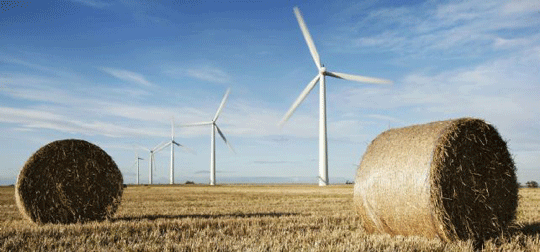
There is enormous potential to grow the partnerships between rural communities and renewable energy providers.
Prime Minister Malcolm Turnbull has signalled a new approach to renewable energy and this has given businesses such as energy company Acciona the confidence to make major investments in Australia.
Last month, it announced plans to progress the Mt Gellibrand wind farm proposal, which would provide clean power to more than 100,000 households. The project would create more than 100 jobs in the building phase, about 10 ongoing roles, and deliver substantial revenue for the life of the wind farm to landowners, council and the wider community.
Australia’s Renewable Energy Target has generated $18.5 billion of investment and, under the revised target, we expect to see at least another $10 billion by 2020.
Today the industry employs more people than the coal-generation sector in Australia. With stable policy settings, a clear direction on emissions targets and an understanding that Australia requires a more sophisticated approach to energy policy, the renewables sector is well placed to innovate and grow.
Improving technology in the wind sector means we can now generate more electricity from fewer turbines and maintain an income stream for landowners, councils and community organisations in regional and rural communities. It is my hope regional Australia and the renewables sector can grow together. Andrew Thomson is managing director of energy company Acciona
Port Augusta Council to consider DP Energy’s big solar/wind project
 DP Energy seeks approval for big solar/wind project near Port Augusta as public urged to have say ABC News2 Feb 16 Port Augusta’s council is encouraging the public to share their views on a renewable energy park proposed to the south of the city, along the Augusta Highway.
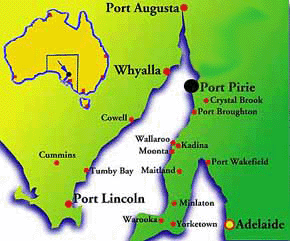 DP Energy has submitted an application to the state Development Assessment Committee for the project, which contains up to 59 wind turbines and 1.6 million solar panels, to be built in stages south of Port Augusta.
Port Augusta Mayor Sam Johnson said the project fits in well in the region, which aims to be a centre for renewable energy.
“It’s been demonstrated in Port Augusta through Sundrop Farms using the technology which they’re using, in this case yes we know that wind turbines do exist around the world and around the countryside and in South Australia as well as solar PV [photovoltaic], but this one is the first of its kind in linking the two together,” he said.
The proposal is now out for public consultation and councillor Johnson is encouraging people to have a say……..http://www.abc.net.au/news/2016-02-02/dp-energy-seeks-nod-for-solar-wind-project-near-port-augusta/7133076
Turnbull copying Abbott as destroyer of renewables, stripping Australian Renewable Energy Agency
“The fact that Arena and the CEFC are still on the chopping block shows that the Liberals’ attacks on renewables hasn’t stopped under Malcolm Turnbull. Greg Hunt has confirmed that these two agencies will remain in the Turnbull Liberal government’s sites.”
Renewables agency stripped of members and run by bureaucrat http://www.theguardian.com/australia-news/2016/feb/02/australian-renewables-energy-agency-arena-board-terms-expire-bureaucrat
Board terms expire, leaving body tasked with investing in emerging technology in hands of department secretary for second time in two years. ll appointed board members of the Australian Renewable Energy Agency have had their terms expire and have not been replaced, leaving it governed by the secretary of the Department of the Environment, Guardian Australia has learned.
The same thing happened in 2014 while Tony Abbott was prime minister, and the move has now been criticised as an attempt by the Turnbull government to remove the independence of the agency.

According to legislation, the board must consist of the secretary of the Department of the Environment and up to six others appointed by the minister. The agency can operate with the secretary being the only board member, since it reaches quorum when a majority of the board members are present, which now occurs with one.
Parliament sits for the first time in 2016 on Tuesday, with bills abolishing both the renewable energy agency (Arena) and the Clean Energy Finance Corporation still before parliament, despite having been rejected by the Senate. Signs indicate the Turnbull government intends to keep them. Continue reading
Queensland disused coal power site could be solar station this year
Solar power station in Collinsville could be under construction this year, ABC News  (includes Audio) 2 Feb 16 QLD Country Hour By David Sparkes Construction of a $100 million solar power station in Collinsville, North Queensland, could begin this year if a deal is struck for selling the electricity.

Ratch Australia plans to build the station on the site of the disused coal power station it purchased in 2011.
Business development executive general manager Anthony Yeates said the company had been short-listed in an tender process with Ergon Energy and, failing that, there were other potential clients for an off-take agreement.
“The bulk of the development activities are all completed, so it’s a fairly advanced project and it’s really just awaiting us to close out some of the important commercial arrangements,” he said………http://www.abc.net.au/news/2016-02-02/ratch-australia-collinsville-solar-project-could-begin-this-year/7132424
Energy self sufficiency- battery storage and solar getting cheaper
The latest report shows that almost two-thirds of Australians want to be self-sufficient in meeting their energy needs and while battery systems will not give complete independence for most consumers, it does offer a bit more control.
Costs of battery storage systems have been falling at a rapid rate and forecasts are for this trend to continue as more and more households adopt them. It is expected that prices will halve again within the next five years.
Solar panels have also gotten cheaper, with the Climate Council reporting a 75 per cent drop in price over the past five years.
Companies such as Reposit, an ACT-based start-up, are using the grid’s infrastructure to allow people to trade their energy directly on the wholesale market, effectively acting like a mini power station in everybody’s backyard.
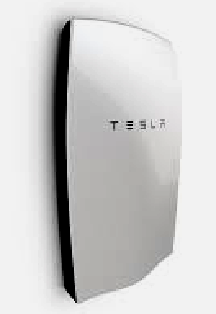 Explained: The Tesla Powerwall and what it means for Australia’s energy market, ABC News, 2 Feb 16, The Powerwall, a lithium-ion battery system designed to store electricity generated from rooftop solar panels, is widely considered to be a game-changer for the electricity industry. 7.30 has asked consumer group Choice to crunch the numbers. Here’s what they found.
What is the Tesla Powerwall?While the concept of a home battery storage system is not new to Australians, the Tesla Powerwall unit has been highly anticipated. Continue reading
AFL Footee Chief Gillon McLachlan a neanderthal anti-wind crusader
 AFL chief executive Gillon McLachlan to fight massive Mid Murray wind farm development in court, Th eAdvertiser January 30, 2016 9:50pm
Mr McLachlan has appealed against the approval of the $700 million wind farm, to feature 114 turbines standing up to 165m high dotted along the ranges between Palmer, Tungkillo and Sanderston.
The appeal is listed against wind farm developers Trustpower, the Mid Murray Council, Environment Protection Agency, the Planning Department and the Environment Minister.
A preliminary conference is scheduled to be heard in the Environment, Resources and Development Court by Commissioner Lolita Mohyla at 3.30pm tomorrow.
Mr McLachlan’s is one of four appeals filed against the wind farm, which was approved by the Mid Murray Council’s development assessment panel on December 18. He yesterday declined to comment about the appeal.
In December, he submitted a video message to the development assessment panel opposing the wind farm being built.
Even if it were to be conclusively established wind farms do not produce health problems, it’s annoying and affects quality of life,” he said.
“I was frankly heartbroken that this land will be forever marred by enormous man-made structures.”
Canberra’s Williamsdale Solar Farm approved
Green Light For Canberra’s Williamsdale Solar Farm http://www.energymatters.com.au/renewable-news/williamsdale-solar-farm-em5315/ February 1, 2016 Energy Matters
The proposal was “called in”, meaning the Minister assumed the role of assessment manager for the development application. The Minister is able to call in a project if a development is considered a major policy issue, has a major effect on government objectives and provides a substantial benefit.
“Once completed, the solar farm will power more than 2500 homes, contributing to the Territory’s renewable energy and greenhouse gas reduction targets,” said Minister Mick Gentleman.
“Under the Territory’s greenhouse gas reduction strategy, renewable energy will account for roughly 73 per cent of the emission reductions needed if the ACT is to reach its legislated 2020 target.”
The solar farm will be situated on farmland near the Monaro Highway and Angle Crossing Road in Tuggeranong, at a site just a couple of hundred metres from the ACT’s border with New South Wales. The new solar power station will be around 10 kilometres from the 24MW Royalla Solar Farm.
Minister Gentleman stated he has imposed strict conditions on the development as part of his decision, in order to address concerns raised in four submissions by members of the community. One of those conditions is that non-glare materials be used. Appropriate landscaping works will also be carried out and sufficient bushfire management measures put in place.
Even with the conditions imposed on the Williamsdale project, some still aren’t happy the project is going ahead and feel the consultation process was lacking.
The Williamsdale site wasn’t the first choice for the solar farm. It was originally proposed to be built adjacent to Uriarra Village. However, many Uriarra Village residents were strongly opposed to the project; primarily on the basis of aesthetics and what they stated was a lack of procedural fairness.
The ACT has a legislated target of 90% renewable energy by 2020; a goal it appears it will reach. In August, ACT Labor proposed an even more ambitious renewables target – 100% by 2025.
1 This month

of the week – Australians for War Powers Reform (AWPR)
To see nuclear-related stories in greater depth and intensity
 Antinuclear