Australian Parliament House will soon be 100 per cent renewably powered.
 Tom Swann says ACT government will have last laugh at climate sceptics, Canberra Times, November 13, 2015 John Thistleton Reporter for The Canberra Times. “…..researcher and campaigner Tom Swann says whether the former treasurer or prime minister or anyone else in Federal Parliament likes it or not, the Australian Parliament House will soon be 100 per cent renewably powered.
This is one of the implications of the ACT government’s clean energy policies, the most ambitious in Australia, which Mr Swann will explain at the Progressive Canberra Summit on Saturday morning, at a gathering of people discussing energy, housing, social justice and sustainability in this city and globally.
Mr Swann will point out the ACT government plans to completely decarbonise the territory’s electricity system and its moves to decarbonise its investments, by starting to divest from fossil fuels.
He will ask a group of people how can Canberra make the most of this leadership? “How do we ensure this transition engages all of Canberra, using local energy and expertise and providing options to those on lower incomes?” Mr Swann said.
He will present research from public policy think tank Australian Institute which shows three in four Canberrans surveyed (78 per cent) support the 100 per cent renewables target, a majority strongly supporting it. The polling also found an interesting national perspective.
“Canberra’s leading position on renewables is the envy of the rest of the country,” Mr Swann said.
The research is based on two polls in September, one by ReachTEL of 731 residents in Fraser electorate and 717 residents in Canberra electorate, while a separate poll by Research Now surveyed 1407 people across Australia.
Three in four Canberrans (75 per cent) said they were willing to pay more on their bills to achieve the 100 per cent renewables target and almost two in three (62 per cent) said they would be willing to pay at least $5 per week more on household electricity.
Almost three in four Australians from outside of Canberra (72 per cent) said they wanted a similar policy in their own state……..http://www.canberratimes.com.au/act-news/tom-swann-says-act-government-will-have-last-laugh-at-climate-sceptics-20151113-gky8vd.html
Council approval for central Queensland solar farm near Baralaba
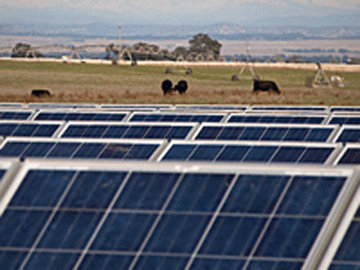 Solar farm proposal near Baralaba in central Queensland gets Banana Shire approval, ABC News, 2 Nov 15 By Jessica Lodge and Jacquie Mackay The Banana Shire Council has given approval to the solar energy company FRV to develop a solar farm near Baralaba in central Queensland. In September, the Central Highlands Regional Council gave the same company approval to develop solar operations at Tieri.
Banana Shire Mayor Ron Carige said the project could create up to 200 jobs during the construction phase.”It’s a great opportunity for not only for the shire but for the community around Baralaba itself,” he said.
“So it’s right near the substation at Baralaba and the total area is 730 hectares but the panels will take up approximately 660 hectares, so it’s quite a large project.”
Councillor Carige said it was a great opportunity for the region moving forward………..http://www.abc.net.au/news/2015-11-02/green-light-for-solar-farm-near-baralaba-in-central-qld/6904428
The Balunu Foundation’s healing programme of green energy with Aboriginal people
For solar energy in Australia, the future is looking bright

 Here comes the sun: funding for solar energy will fast-track Australia’s renewable future http://www.lexology.com/library/detail.aspx?g=ca54c642-afdb-4d23-9fd2-f63db9bd992c Corrs Chambers Westgarth A global surge in solar investment is driving new growth in Australia’s solar sector. Costs are falling and storage technology is improving, making solar energy an emerging force in Australia’s clean energy future.
At a global level, energy experts are predicting large-scale solar photovoltaics (PV) to be the least-cost option for power generation almost universally by 2030.[1]
Locally, investment in Australia’s renewable energy industry is forecast to exceed A$40 billion over coming years. This translates to an estimated 30-50 major projects comprising at least 6000MW of new generating capacity to be built by 2020.[2]
Australia’s solar industry is also backed by a number of key funding initiatives. The result is a bankable investment environment that will enable investors and project proponents to harness Australia’s abundant solar resource.
THE RENEWABLE ENERGY TARGET (RET) Continue reading
Sunshine in your beer in Sydney
 Pingala community-owned solar project to hit the roof of Young Henrys brewery, SMH, 2 November Lucy Cormack Environment Reporter
Imagine if there was sunshine in your beer. With a plan to build a solar farm atop the Young Henrys brewery in the heart of Sydney’s inner west, there soon could be.
Community members can become shareholders in the project – a collaboration with community energy organisation Pingala – and therefore, part owners of a future local solar farm. “When the Pingala guys came and spoke to us about it, we hadn’t had an interest in solar. Being able to put enough aside for large-scale solar wasn’t something we could afford,” said brewery part-owner Oscar McMahon.
“This was the perfect thing for us. We will start buying the power from the Pingala solar system on our roof, repaying people’s local investment into that system … we start buying renewable energy from our community.”
Electricity from the system will be used to power brewing processes, avoiding around 127 tonnes greenhouse gas emissions a year…….
The project will be the first for Pingala, part of a plan to start building community-owned solar farms on businesses and organisations across Sydney. The first stages have been realised with approval for a $40,000 innovation grant from the City of Sydney. Pingala volunteer Tom Nockolds said the renewable energy movement can no longer be ignored. “This idea, [it’s] time has really come. We’re opening up a new way for people to invest in renewable energy.” He said the project is directed at everyday “mums and dads who are struggling to find an opportunity to invest in renewables”. “Particularly in Sydney, where a high proportion of people live in apartments, are renters, or don’t have roof [space],” he said.
The Pingala initiative will aim for a 6 per cent to 8 per cent return for investors. After they have been paid back, the panels are gifted to the business to continue using. The first stages have been realised with approval for a $40,000 innovation grant from the City of Sydney.
Pingala volunteer Tom Nockolds said the renewable energy movement can no longer be ignored. “This idea, [it’s] time has really come. We’re opening up a new way for people to invest in renewable energy.”He said the project is directed at everyday “mums and dads who are struggling to find an opportunity to invest in renewables”. “Particularly in Sydney, where a high proportion of people live in apartments, are renters, or don’t have roof [space],” he said.
The Pingala initiative will aim for a 6 per cent to 8 per cent return for investors. After they have been paid back, the panels are gifted to the business to continue using
The Young Henrys project has the nod from Lord Mayor Clover Moore, who said it shows how Sydney “can make the shift to renewable energy even faster”. While Pingala is still obtaining financial and legal advice for the project, Mr Nockolds said in the early new year solar panels will be appearing on the Young Henrys roof…..http://www.smh.com.au/environment/pingala-communityowned-solar-project-to-hit-the-roof-of-young-henrys-brewery-20151029-gkltqu.html#ixzz3qIlYu8Jj
McKinley Shire, Queensland, promotes local business with renewable energy initiative
 McKinlay Shire in north-west Queensland sheds light on solar cost-saving plans for council, traders http://www.abc.net.au/news/2015-10-30/mckinlay-shire-sheds-light-on-solar-panels-plan/6898430 By Zara Margolis A north-west Queensland council has begun the second stage of a plan to help local businesses reduce their power bills. The McKinlay Shire has awarded a contract to a renewable energy company to install solar panels on nine local businesses and some council buildings.
Mayor Belinda Murphy said the company was finalising the solar designs, which should be installed by the end of the year. “The whole aim of council’s approach with this was really triggered by drought initially as well,” she said. “As I’ve said before, there is help for landholders but there has certainly been no direct help and support for businesses in these rural towns. “We identified this about 18 months ago and they were the ones who told us their biggest impacts are freight and power.”
Councillor Murphy said the panels would also be installed at a number of council assets. “Even just from a council perspective we’re going to have a projected power cost saving of around $60,000 per annum,” she said.
“Now we have a power cost annually of around $340,000, so that’s nearly a 20 per cent saving which council can then use to put back into other services, the community, other assets or into reserve.”
Western Australia’s wave power microgrid – a world first
 World-first wave power microgrid to be trialled in WA http://www.abc.net.au/news/2015-10-29/world-first-wave-power-microgrid-to-be-trialled-in-wa/6896994 By Emily Piess A WA energy company is about to trial the world’s first renewable microgrid power station using wave energy as one of its sources.
Perth-based Carnegie Wave Energy will build the pilot project on Garden Island, using wave and solar energy to supply power to the Defence Department and a desalination plant. Chief executive Michael Ottaviano said the technology could be used to provide power to regional townships near the coast, as well as island communities. “This is a model for islands to move away from diesel-power generation into a combination of renewables,” Mr Ottaviano said.
“It’s also [a model for] regional towns in Western Australia, particularly those that are either off-grid and also running on diesel, or those that are on the so-called fringes of a grid, typically on the end of long transmission lines.”
Mr Ottaviano said the technology could reduce WA’s reliance on transmission lines that are expensive to maintain and upgrade. “It can cost hundreds of millions of dollars to upgrade, so as a way to avoid that sort of large expense, embedding renewable microgrids on the end of those transmission lines will be the future of clean power in Western Australia,” he said.
“The Garden Island microgrid project will do the equivalent amount of power for about 2,000 to 3,000 households, so it’s already of commercial scale.” Western Power is partnering with Carnegie and will provide technical expertise on the project.The microgrid, which will cost up to $10 million to build, will produce about five megawatts of energy, a significant portion of the Defence Department’s electricity use on Garden Island.
If the trial is successful, Mr Ottaviano said the microgrid model could be used in regional centres such as Albany and Geraldton. “This potentially could be rolled out to thousands and millions of households across Western Australia and beyond that really across the globe,” he said. “The potential for these sorts of projects is enormous.”Carnegie will undertake a detailed design phase before construction begins next year.
The microgrid is due to be completed by the end of 2016.
Karoonda Council, South Australia, considering floating solar plant
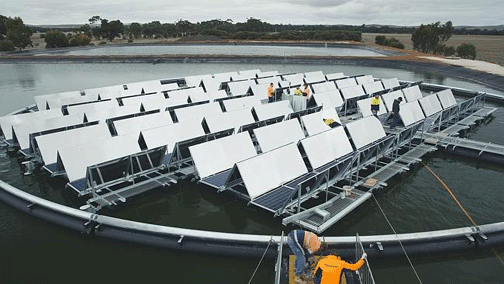 Floating solar power plant mooted for Karoonda to power waste management pump station http://www.abc.net.au/news/2015-10-30/floating-solar-power-plant-mooted-for-karoonda/6899436 The District Council of Karoonda-East Murray says it will look into the possibility of a floating solar power plant at Karoonda in South Australia’s Murray-Mallee region.
Council CEO Peter Smithson said the floating solar plant would provide power for the waste management pump station next to the stormwater dam.
A similar plant is already operating at Jamestown in the state’s mid-north.
Mr Smithson said the council had committed to undertake further due diligence about the green power opportunity.
“We’ve been approached by a company about the possibility of a solar generating power plant at Karoonda which would provide power to our CWMS [Community Wastewater Management System] pumps,” he said.
“We’ve gone and looked at Jamestown.
“There’s quite a long resolution because it really details the fact that there’s no capital outlay by council and it really looks at the fact that we’ve done due diligence and we’ve asked the company to come and address the next council meeting.
Opportunity for Port Augusta to be repowered with solar thermal energy
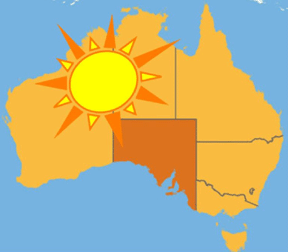 Repower Port Augusta, 30 Oct 15 In incredibly exciting news, after returning from a visit to a massive solar thermal plant in the United States, the federal local member for Port Augusta Rowan Ramsey has revealed to The Transcontinental that US solar thermal giant SolarReserve have made a bid to build solar thermal with storage in Port Augusta!
After a long running community campaign, numerous studies and actions from people like you this revelation is a huge step forward in the community driven push to Repower Port Augusta with solar thermal.
So, what does this mean?
The ACT Government are using a policy called a reverse auction to help them meet their 100% renewable energy target by 2025. This is a policy where they effectively bid for projects to buy renewable power from and early this year they called for bids from projects across the country from solar with stoage.
This is the policy we called on the SA Government to adopt in our submission to the state government that many of you signed onto.
We are still waiting on the result of the bid, but we know the bid for solar thermal from Port Augusta is one of thirty from across the country.
It’s a huge step forward and a testament to the community campaign backed by people across the country that SolarReserve are ready to build solar thermal in Port Augusta.
100% renewable energy electricity company launched in South Australia
South Australian company to launch country’s first 100 per cent renewable energy utility provider, ABC News By Alex Mann, 26 Oct 15 A South Australian company will launch the country’s first 100 per cent renewable energy utility company, with the author of the 2008 Climate Change Review signalling his support.
Professor Ross Garnaut has been appointed chairman of Zen Energy and said the company’s launch would be a game changer.
“I’ve been disappointed that the established energy companies have not taken the opportunity that’s there,” he said.
The company will use a combination of solar power generation, battery storage, and localised energy grids to create self-sustained communities that will buy back the power they generate.
For years, Zen Energy has been putting battery units in people’s homes.
Now its chief executive Richard Turner plans to take entire communities off the grid — from social housing stock, to apartment buildings and regional communities.
He said he will generate the power, then sell it back to users at a fraction of the current costs.
“We’re looking at a spot in the market very soon where we’re going to be almost half the cost of the grid,” he said.
It could be the end of the power grid as we know it
It is just the latest disruption in an energy revolution sweeping across Australia which could spell the end of the power grid as we know it……….http://www.abc.net.au/news/2015-10-26/sa-company-launch-renewable-energy-utility-company/6886578
Queensland’s huge wind solar plant goes ahead
Australia’s First Wind/Solar Plant To Be Built In Queensland October 28, 2015 Energy Matters Construction of a $140 million combined wind and solar energy facility in North Queensland is expected to begin within a year.
Kennedy Energy Park will go ahead as a result of a 50/50 joint venture agreement between Canberra-based Windlab Limited and Japan’s Eurus Energy Holdings Corporation.
The first stage of the Kennedy Energy Park will see 6 wind turbines and 64,000 solar panels installed. The wind turbines used will have the largest span in Australia – 136 metres in diameter. The first stage of the park will generate enough power to supply more than 25,000 Queensland homes.
The second stage will involve 1200 MW of renewable energy capacity; enough to meet most of the state’s contribution to Australia’s Renewable Energy Target.
Windlab Chief Executive Officer, Roger Price, says Kennedy Energy Park will be able to match North Queensland’s’ current energy demand profile more than 80% of the time.
“This particular site has been carefully mapped and we know it is predominantly windy through the afternoon and into the evening, and obviously experiences sunlight during daylight hours. This resource profile ensures almost constant energy production,” he said.
Flinders Shire Council has backed the project…….. http://www.energymatters.com.au/renewable-news/kennedy-energy-park-em5153/
Poll shows Australians overwhelmingly reject coal and nuclear- solar is tops
“Most (84 per cent, up 2 points) prefer solar amongst their top three energy sources, followed by wind (69 per cent, up 5 points). Gas and nuclear both crashed 7 points to 21 and 13 per cent respectively, with nuclear and coal now tied as least preferred,” said John Connor, CEO of The Climate Institute in a press release.
 Australians support renewables? Absolutely, all we need now is a federal government that reflects the electorate’s view. The survey shows both the government and the Opposition need to “join mainstream Australian attitudes with climate commitments and policies” that promote clean energy
Climate Institute poll finds Australians support renewables August 18, 2015 Rich Bowden http://www.solarquotes.com.au/blog/climate-institute-poll-finds-australians-support-renewables/
Renewables appear to be a vote winner. Someone may want to tell our government. Continue reading
Western Australia’s Wave powered Desalination Plant Now Operational
ASX Announcement Friday, 23rd October, 2015 Wave Powered Desalination Plant • Wave powered desalination plant operational • First bottle presented to WA Water Minister Hon Mia Davies at AWA Conference http://carnegiewave.com/wp-content/uploads/2015/10/151023_DPP-ASX.pdf • MAK Water agency agreement extended to remote islands, first opportunities underway
Wave energy developer Carnegie Wave Energy Limited (ASX: CWE) is pleased to announce the world’s first wave energy powered seawater reverse osmosis desalination plant is fully integrated and operational. Carnegie’s desalination pilot plant on Garden Island (co-located with the Perth Wave Energy Project) was successfully commissioned off the electricity grid earlier this year, and is now fully integrated with the CETO wave energy power plant, meaning that the desalination plant is capable of running both off the grid and directly off hydraulic power from Carnegie’s wave project, or a combination of both.
The first bottle of wave-powered desalinated water produced was presented by Carnegie’s Chief Operating Officer, Greg Allen, to the Western Australian Minister for Water the Honourable Mia Davies MLA at the Australian Water Association’s (AWA) Annual Western Australian Conference today. Mr Allen presented on wave energy integrated desalination at the Conference timed to coincide with National Water Week (presentation attached). Carnegie’s Wave Powered Desalination Project won the 2014 AWA Innovation award.
Queensland’s revolutionary solar energy systems – on carparks and other commercial buildings
Are these solar panels the setting of the sun for coal mines? Brisbane Times October 22, Tony Moore Solar energy systems on top of shopping centres, car park shade covers, hospitals, airports and other commercial buildings are the beginning of the end for large scale coal power stations, one alternative energy developer will explain on Friday.

Shakra Energy managing director Sam Khalil will on Friday outline how the solar energy system his company has installed as a “shade cover” over carparking at Buranda is now doubling as a solar energy generator. He says the system cut energy costs for the owner by between 30 to 40 per cent.
Mr Khalil believes companies and big energy users – like hospitals and huge retailers – are beginning to wake up the potential solar energy from their rooftops, completely separate to solar energy from homes.
It generates 147MW and save 122 tonnes of CO2 emissions from the environment each year.
“If we can save them 30 to 40 per cent on electricity bills that are $10 million, $20 million, $30 million a year, why wouldn’t you do it?” Mr Khalil argues.
“We are right at the forefront of where the future of energy production has to be in Australia,” he said.
“Right at the forefront of the job creation for making business more efficient so they can employ more people.”……..
Shakra Energy has placed solar energy panels on top of shade cloth covers that shade cars on top of PA Central on Ipswich Road at Buranda, directly opposite the Princess Alexandra Hospital.
It generates 100 kilowatts of energy, enough to power the shops and business in the Ipswich Road building, plus run the car park operations.
One hundred kilowatts – depending on what is in the house or the business and the size of the house of the business – could power between five and 30 homes or premises……..
Mr Khalil says their Buranda plant was the first commercial solar production facility in Queensland, outside a similar scheme on the rooftop at one building of the University of Queensland.
He said his company has recently been invited to lodge tenders for similar schemes at large commercial properties.
“Let’s just say hospitals, airports, major shopping centres,” he said.
Oxley Federal MP Bernie Ripoll and Greens Senator Larissa Waters will be at the launch on Friday……..
Greens Senator Larissa Waters praised the concept.
“This is just the kind of innovation that our Sunshine State needs to shine as a leader in the clean energy future,” Senator Waters said.
“The Palaszczuk Government needs to hurry up and implement the 50 per cent renewable energy target it promised in the election, instead of pushing ahead with coal exports through the Great Barrier Reef,” she said. http://www.brisbanetimes.com.au/queensland/are-these-solar-panels-the-setting-of-the-sun-for-coal-mines-20151022-gkg8nc.html#ixzz3pcc0G4N0
Australia’s chance to become a renewable energy superpower
For Australia, “abundant, low-cost renewable energy, land availability, and proximity to the emerging Asian region,” make it a perfect fit.
“Managed well, the transition to renewable energy will restore and enhance former strengths, this time built on sustainable foundations,” the report says.
How Australia can become a renewable energy superpower http://reneweconomy.com.au/2015/how-australia-can-become-a-renewable-energy-superpower-35215 By Sophie Vorrath on 19 October 2015 (EXCELLENT TABLES and GRAPHS) Australia has the opportunity to become a renewable energy superpower – giving it a global economic advantage much greater than that ever gained from fossil fuels – a new report has suggested, but only if it seizes three key areas of opportunity, based heavily on innovation; and only if it acts quickly and doesn’t miss the wave.
The report, published on Monday by Beyond Zero Emissions, notes that Australia – despite having one of the best renewable energy resources in the world – is currently on the back foot in the global energy stakes.
Its “fossil fuel advantage” is fast disappearing , and it has an outdated and gold-plated electricity network that has acted as a ball and chain to progress. But it also suggests that Australia could turn this position around, by building an industry that supplies the renewable and energy efficiency market; by assisting the migration of energy intensive industries to renewables; and by harnessing the trade of renewable energy commodities.
The global shift to renewable energy – while largely a democratising force – will still bring advantages to some nations, the report says.
“The value associated with renewable energy is largely accounted for by the harvesting equipment, with very little ongoing costs and zero fuel costs. This is completely different to fossil energy where the majority of the value is in the ongoing consumption of fuel. Continue reading
1 This month

of the week – Australians for War Powers Reform (AWPR)
To see nuclear-related stories in greater depth and intensity
 Antinuclear