Abbott’s latest attack on the wind power industry
 Abbott passes new wind war http://www.macrobusiness.com.au/2015/07/abbott-passes-new-wind-war/ By Houses and Holes From The Australian:
The Abbott government is being urged to strip billions more from subsidies to wind farms in the final report of a Senate committee that has already pushed renewable energy investment to favour solar.
In its recommendations, the committee says renewable energy subsidies for new wind farms should be limited to five years from more than 20.
It also wants the issue of renewable energy certificates restricted to projects in states that adopt federal regulations on infrasound and low frequency noise.
Why not adopt regulations on unicorns and bunyips?
Working people benefit from Labort’s energy policy
It was the first time an Australian political party has got serious about designing a plan to support electricity workers and their communities with the transition from a coal-fired electricity system to a future where renewables play an increasing role in powering our homes and workplaces……….
So Labor’s plan for the electricity sector is an Australian first. It establishes a dedicated agency to manage any transition and oversee redeployment, retraining and income support. This has budget implications but it is the only way forward.
We need a clear industry adjustment package and workforce plan. The approach to retraining and redeployment requires a serious analysis of growth industries where energy and mining workers’ skills are transferable, combined with government intervention and financial support to help individual workers make a transition.
With thermal electricity plants closing one by one, we need a clear focus on redeploying workers to jobs in the energy and mining sector, including to remaining plants with continuous vacancies due to their age profile………
Labor’s electricity modernisation strategy announced on Saturday charts the way forward. It is designed to manage necessary industry restructure and support workers and their communities, while reducing emissions. It deserves broad support but, make no mistake, if Labor in government doesn’t deliver for workers, we will wage a concerted campaign to get what has been promised.
Tony Maher is national president of the Construction Forestry Mining and Energy Union http://www.theaustralian.com.au/opinion/labors-energy-policy-an-australian-first-in-supporting-workers/story-e6frg6zo-1227462344435
Port Augusta coal-fired power stations to close early
Alinta Energy to close Port Augusta power stations and Leigh Creek coal mine early, ABC News 30 July 15 Alinta Energy has brought forward its deadline to close its power stations in Port Augusta and coal mine at Leigh Creek.
The company announced last month it would close the power stations and mine at some point between next March and March 2018…….http://www.abc.net.au/news/2015-07-30/alinta-energy-brings-forward-closure-power-station/6661082
50% renewable energy goal will effectively bring Australia up with world leaders
 50% renewable energy would put Australia in line with leading nations, The Conversation, John Mathews Professor of Strategic Management, Macquarie Graduate School of Management at Macquarie University, 25 July 15, Opposition leader Bill Shorten told the Labor Party conference this morning that the party’s policy should be for 50% of electricity to come from renewables by 2030.
This would bring Australia abreast with its international competitors such as California, with its recently announced target of 50% of electricity from renewables by 2030, and Germany, where the Energiewende(“energy transformation”) will see the country commit to 40-45% non-nuclear green power by 2020, and 55-60% by 2035.
Shorten’s move is a major break with previous ALP policy, and promises to be so effective in building a new power sector to eclipse the present fossil-fuelled sector that it already has the conservative side of politics foaming at the mouth. Continue reading
Labor Leader Bill Shorten to announce 50% renewable energy target at Labor conference
Bill Shorten to unveil 50% renewable energy target at Labor conference, SMH July 22, 2015 Mark Kenny Chief political correspondent Opposition Leader Bill Shorten is set to unveil a bold climate policy goal requiring half of Australia’s large-scale energy production to be generated using renewable sources within 15 years.
Fairfax Media has learnt that despite Labor’s humiliating 2013 election defeat caused in part by voter contempt for its carbon tax, Mr Shorten will use this weekend’s ALP national conference in Melbourne to announce the even more ambitious goal, dramatically beefing up Labor’s renewable energy target.
The policy shift is designed to recover green support, sharpen the contrast with Prime Minister Tony Abbott over climate change and make global warming the defining battleground of the next federal election……….
The target of at least 50 per cent renewable energy by 2030 is in contrast to Labor’s current platform, which is silent on the subject. Both sides of politics committed only to the current benchmark of a minimum 33,000 gigawatt hours of renewable energy by 2020………
The Abbott government is yet to announce its post-2020 emissions reduction target but that is expected in August.
The Shorten approach follows a strong and well-co-ordinated campaign inside the ALP by a group calling itself the Environment Action Network and backing a “50/50” campaign in favour of 50 per cent renewable energy by 2030. http://www.smh.com.au/federal-politics/political-news/bill-shorten-to-unveil-50-renewable-energy-target-at-labor-conference-20150721-gih4bp.html#ixzz3gZ7IS5o5
Industry under attack, as Tony Abbott hacks into Clean Energy Finance Corporation
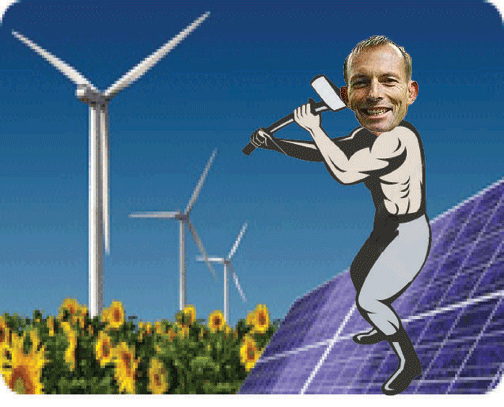 Australia Renewable Energy Gets Hacked & Attacked, Clean Technica July 21st, 2015 by Steve Hanley Originally published on Solar Love.
Australia is bathed in sunlight like few other places on earth. It, among all countries, has the highest potential to generate all the electricity it needs from renewable sources, principally the sun and wind.
But the prime minister doesn’t care about clean, renewable energy in Australia. All he cares about is doing the bidding of the wealthy coal owners who bought and paid for his election win in 2013. Since he took office, Australia’s investment in clean energy projects has fallen 70%, according to Bloomberg New Energy Finance.
Government Says No to Solar Investment
Now Abbott has issued instructions to the Clean Energy Finance Corporation (CEFC) prohibiting it from investing in wind farms or small-scale solar projects. Opposition leaders and solar energy supporters say the government directive prohibiting CEFC from investing in rooftop solar will cripple the industry and further diminish Australia’s chances of transitioning to a clean energy economy.
“I don’t agree with the prime minister that if you just don’t have any government support for the future of renewable energy, that the renewable energy will just miraculously grow and increase in Australia,” opposition leader Bill Shorten told the Australian Broadcasting Corporation. He said that striking wind farms and rooftop solar from the CEFC will mean that “the only thing the CEFC can invest in is flying saucers.”
The Role of the Clean Energy Finance Corporation
How federal govt changes to Clean Energy Finance Corporation will affect Australian househholds
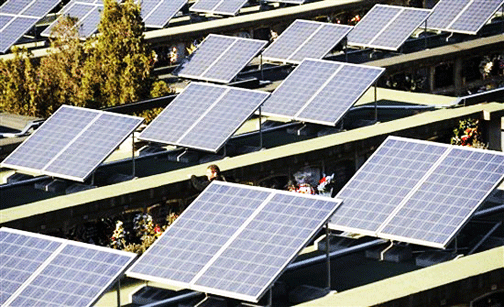 Solar panels: What do the federal government changes mean for households, SMH July 19, 2015 Peter Hannam
Environment Editor, The Sydney Morning Herald The Clean Energy Finance Corporation has been told not to invest in rooftop solar. What does that mean for me?
The CEFC is the “green investment bank” set up by the Gillard Labor government that the Abbott government wants to scrap. It has been blocked in the Senate so instead it wants to narrow the CEFC’s mandate by blocking investment in “mature” technologies such as wind farms and solar panels.
The fund, though, exists mainly to find ways to boost the competitiveness of all renewable technologies, from large-scale solar plants to wave and geothermal sources, and energy-efficiency measures.
Earlier this month, for instance, the CEFC joined in a 12-year, $100 million venture with Origin. The energy giant will own, install and maintain solar PV systems for households and businesses. Customers get a fixed energy price for a longer term than would typically have been offered by banks.
What is this large-scale solar we’re hearing about?……… http://www.smh.com.au/environment/climate-change/solar-panels-what-do-the-federal-government-changes-mean-for-households-20150718-giewy8.html#ixzz3gZupHfyv
National Australia Bank to invest more in renewable energy
 NAB maintains its faith in renewable energy, SMH, July 19, 2015 James Eyers Senior Reporter The country’s largest financier of renewable energy projects, National Australia Bank, has said it plans to lend more to the sector despite it being thrown into turmoil last week when Prime Minster Tony Abbott ordered the Clean Energy Finance Corporation (CEFC) to stop putting funds into wind power.
NAB’s head of debt capital markets, Steve Lambert, said the domestic politics around wind power is “noise, but you have to try to look [past that]” and said in the absence of local deals, NAB will continue to back projects overseas, and intends to become one of the world’s leading banks in renewable energy financing. …….
“Is the renewable energy industry supported by long-term fundamentals? Both public opinion and demand suggest yes, it is. Is there money flowing into the industry? Yes, there is. So our thinking is: how do we help facilitate that? We want to stay there and at the same time try some new things.”
NAB has been working with the CEFC to provide Australian businesses with access to discounted funding for energy efficiency and renewable energy upgrades. It was also the first Australian bank to issue a “green bond”, where proceeds are used for an environmentally sustainable purpose. …….. http://www.smh.com.au/business/banking-and-finance/nab-maintains-its-faith-in-renewable-energy-20150719-gieq5g.html#ixzz3gZ5w596X
Tony Abbott’s vindictive war against renewable energy
 Abbott’s war on renewable energy has been protracted and aggressive. It has destabilised investment. It has been fought through an attrition of uncertainty. This week, one wonders if he has entered the final campaign
Clean Energy Finance Corporation is the key to Australia’s chance to be Renewable Energy Superpower
despite the higher investment hurdle to be cleared when the CEFC makes any new loan, it has managed to continue to unveil new projects such as the launch this month of a $100 million, 12-year fund with Origin Energy to promote more commercial use of solar panels, with more to be announced within days
 Australia can be a global solar and wind superpower, and the CEFC is the key July 13, 2015 Peter Hannam Environment Editor, The Sydney Morning Herald
Australia is perfectly placed to become the next global superpower of renewable energy, the “Saudi Arabia of solar” for the coming century.
While Saudi Arabia has barrels of oil, we have an abundance of sunlight to fuel solar power and wind to power turbines, plus enough geographical space, modern infrastructure and a stable political system to house such an industry on a massive scale.
But if Australia is to realise its remarkable renewable energy wealth, (see chart below, published by the Melbourne Energy Institute, revealing its world-beating solar exposure as indicated by the lighter colours on the map), banks and investors will need to active players.
Australia’s government not stopping Sydney IKEA’s renewable energy project
The world’s biggest furniture retailer, which has annual sales of €30 billion ($44 billion), is aiming to be energy neutral by 2020, with 100 per cent of its energy needs coming from renewable sources.
IKEA’s Australian business took the first steps last year, installing 16,000 solar panels on the roofs of six stores, including almost 4000 panels at its flagship store at Tempe, near Sydney Airport.
“It’s really cool,” says Wilson, who gave up his job running Randwick Council’s Sustaining Our City program almost three years ago to join the Swedish retailer, attracted to the company by its ambitious long-term environmental targets.
“When they do have bold ambitions it makes things happen,” says Wilson. “It was the 100 per cent renewable energy targets that got me excited about working for IKEA – I want to be on that journey.”
It’s a journey that may not have got off the ground if not for Labor’s now defunct carbon tax. When electricity was cheap and solar panels expensive, the business case simply did not stack up.
The company pressed ahead after the carbon tax was scrapped by the Abbott government last year and now expects to achieve payback in less than 10 years, in line with its parent’s relatively generous return on investment hurdles……….http://www.afr.com/business/energy/solar-energy/ikea-backs-renewable-energy-targets-despite-government-changes-20150717-gid4gu
Tasmanina farm introduces Indian renewable energy technology
India’s renewable energy technology inspires Tasmanian tomato business ABC Rural By Laurissa Smith, 17 July 15 A tomato farm in Tasmania’s north-west is turning to India’s latest technology in renewable energy to reduce its power bills and improve yields.
The Brandsema’s at Turners Beach plan to install a biomass gasifier to power its greenhouses. The gasification system, built in India, turns agricultural or forest waste into energy and as a by-product, creates CO2 for plants.
Grower Marcus Brandsema recently travelled to India. He met with manufacturers and engineers to watch the biomass plants in action.
“What happens is the organic material goes into a gasifier,” he said. “It’s operating at a reasonably high temperature, around 800 degrees Celsius or thereabouts, in a reduced oxygen atmosphere.
“The organic material doesn’t actually burn, but it oxidises and gives off a gas which is useful to use downstream.
Once the gas is produced we can then use it to fire a boiler to create hot water, which is what we need, especially in Tassie’, to grow tomatoes
Marcus Brandsema, tomato grower
“They clean it and use it in an engine, which can drive a generator, or a pump, or alternatively the gas can be used as fuel source.”
Mr Brandsema is particularly attracted to the system’s ability to generate additional CO2 for the greenhouse to enhance photosynthesis.
“Once the gas is produced we can then use it to fire a boiler to create hot water, which is what we need, especially in Tassie’, to grow tomatoes,” he said.
“But the by-product of that is CO2, which would normally go up the flue as an emission, we could extract from the flue and introduce it into the greenhouse.”……..http://www.abc.net.au/news/2015-07-17/renewable-energy-gassification-plant-1707/6627444
Australia losing its great wind power opportunity
Wind power: European renewable energy expert warns Australia risks missing out on cheaper and cleaner electricity, ABC Radio, 16 July 15 AM By Michael Edwards A European expert on renewable energy says Australia risks missing out on a huge opportunity for cheaper and cleaner electricity if it does not encourage investment in wind power.
Oliver Joy, from the European Wind Energy Association — the peak body guiding wind power projects across Europe — said a huge shift towards renewable energies were underway in the continent with wind power leading the charge.
He said Europe was on track to get half of its electricity from renewable sources such as wind power by 2050 and had big ambitions when it came to reducing its carbon footprint.
The eurozone has committed to cutting greenhouse gas emissions by as much as 95 per cent by 2050 and says this can only be done with all of its electricity coming from renewable sources, with wind power providing the lion’s share.
The Federal Government has ordered the Clean Energy Finance Corporation not to invest in wind farms, with Prime Minister Tony Abbott saying he finds the giant turbines “visually awful……..
Wind ‘cheaper than fossil fuels’
According to the European Wind Energy Association, wind power is a cheaper way to produce electricity than fossil fuels.
Mr Joy said it also had long-term savings for taxpayers.
“Cheaper than nuclear and gas and almost on a par with coal — that’s purely based on generating electricity,” he said. http://www.abc.net.au/news/2015-07-15/euro-wind-power/6620936
South Australian government says wind and solar power are sources of jobs
 Wind and solar a source of jobs in SA http://www.heraldsun.com.au/news/breaking-news/wind-and-solar-a-source-of-jobs-in-sa/story-fni0xqi4-1227439666671
JULY 13, 2015 THE South Australian government says a commonwealth ban on supporting solar and wind energy scheme will make it harder to create jobs.
THE commonwealth has directed the Clean Energy Finance Corporation not to back any further wind energy projects as well as rooftop solar schemes.
But South Australian Treasurer Tom Koutsantonis says wind energy is a source of immediate and future jobs and putting barriers in the way of investment will make it more difficult to cut SA’s unemployment rate, which climbed to 8.2 per cent in June.
“South Australians are told by the commonwealth government that we are not allowed to build cars, we’re told we are not allowed to build submarines, now we are being told we shouldn’t build wind farms when we have investors ready to spend their money and create jobs now,” he said.

Climate Change Minister Ian Hunter will meet his interstate counterparts this week and says they will call on the federal government to end its ideological opposition to renewable energy.
“The message being sent to renewable energy investors by our federal government is `look elsewhere – don’t spend your money in Australia and don’t create jobs here’,” he said.
Concentrated Solar Power pre-feasibility study now being finalised at Port Augusta
The transition from fossil to renewable energy The Fifth Estate, Graham Davies, Engineers Australia | 13 July 2015“…………It is encouraging that Alinta, with financial support from ARENA and the SA Government, is currently finalising a pre-feasibility study into concentrated solar thermal power at Port Augusta – a project that has the full support of the community. At present the capex of CSP is too high for a company to meet what is required for shareholder returns, but costs will decrease as the technology develops further. If government were to contribute an amount equivalent to saved externalities (such as adverse health effects associated with continuing the coal power station) it is probable that the project would be economically viable now.
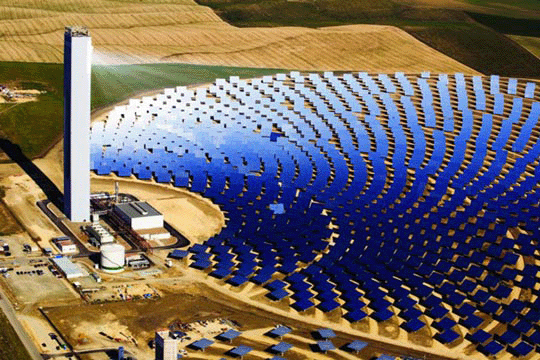
CSP is of particular value to a renewable grid, as it has the ability to efficiently store energy, be despatchable and provide synchronous generation and grid stability. These capabilities will circumvent the need for inflexible base load generators such as coal, CCGT and nuclear, with their many externalities. Port Augusta is an ideal location for CSP and presents a great opportunity for the future.
The closure of the Port Augusta Power Station may initially appear as bad news, but it may galvanise South Australia in becoming the iconic turning point for a new future – a future in which Australia again leads in solar development and export; where energy security is based on the sun and not the fossil reserves; where long-term thinking is built into economic analysis; and where prosperity is not measured by GDP but by net wealth and wellbeing.
Graham Davies is incoming chair of Engineers Australia’s Sustainable Engineering Society. http://www.thefifthestate.com.au/spinifex/the-transition-from-fossil-to-renewable-energy/75484
1 This month

of the week – Australians for War Powers Reform (AWPR)
To see nuclear-related stories in greater depth and intensity
 Antinuclear