Controversial Senators Madigan, Lambie and Leyonhjelm now determining Australia’s Energy Policy?
It seems to be the case of the mad right wagging the tail of the ultra conservative dog on energy policies. Senators Madigan, Lambie and Leyonhjelm all hold controversial views about climate science and wind farms – all being advised by noted long-term anti-wind activists.
 Abbott promises to Do Something about wind turbines http://reneweconomy.com.au/2015/abbott-promises-to-do-something-about-wind-turbines-24423 By Giles Parkinson on 18 June 2015 The fate of Australia’s renewable energy target – and the wind industry in particular – is once again in the balance, after Prime Minister Tony Abbott promised anti-wind cross-bench Senators that he would take action to restrict or monitor wind farms.
Legislation cutting the RET to 33,000GWh from 41,000GWh had been expected to pass the Senate this week, finally giving the industry some certainty to invest, albeit in a much reduced target.
But Abbott’s refusal to cut a deal with Labor over the controversial issue of native wood waste has seen him turn instead – as predicted two days ago – to the senators who have already decided – like Abbott – that wind farms are ugly, dangerous to health, not very effective, and possibly constitute an act of treason.
Abbott – whose opinions on wind farms have been shaped by advisors who do not accept the science of climate change and his one encounter with a single turbine on Rottnest Island – met with Senator David Leyonhjelm and other cross-benchers this week.
He told the environment minister Greg Hunt – who told a radio station this week that “I know what you mean” when told that a single turbine in his electorate was “ugly” – to draft a letter to the cross benchers, outlining his commitments to get tough on wind farms.
The letter, according the The Guardian, includes a promise to appoint a wind-farm “commissioner” to monitor and act on complaints, an “independent” scientific committee (perhaps like the Warburton RET review) to liase with the Senate inquiry, and an undertaking to act on the Senate inquiry’s recommendations. Continue reading
Rooftop solar taking over in South Australia – the test State for Renewable Energy
Rooftop solar to cut total grid demand to zero in South Australia,  REneweconomy By Giles Parkinson on 18 June 2015 See also Rooftop solar to overtake coal capacity before 2030
The Australian Energy Market Operator predicts that the growing uptake of rooftop solar by homes and businesses will reduce grid demand in South Australia on certain occasions to zero by 2023, highlighting the rapid change in the nature of energy markets, and the growing shift from centralised baseload generation.
The predictions from AEMO came in its 2015 National Electricity Forecasting Report, released on 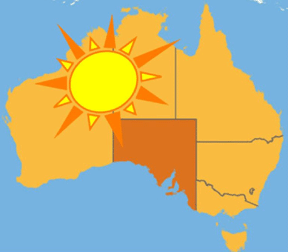 Thursday. It says that the near 575MW of rooftop solar is already accounting for one-third of total grid demand on certain days in the state.
But within a decade this total could treble, pushing minimum demand required from the grid in the whole state to below 0MW (zero) on some occasions in 2023-24, and for several hours at a time by 2024/25 – when AEMO expects 1864MW of rooftop solar.
It says zero demand from the grid could last from 11.30am to 2.30pm local time on some days………..
South Australia will be a test case for Australia, and indeed the world, because of its high level of “variable renewables” such as wind and solar in its energy mix. Continue reading
Solar panels with battery storage: Western Australia’s White Gum Valley project
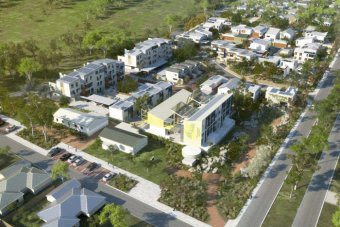 Green energy for White Gum Valley development ‘an Australian first’, to benefit residents and investors, ABC News By Kathryn Diss, 19 June 15 A new residential complex south of Perth will feature solar panels and battery storage technology, providing financial benefits for tenants and investors.
Landcorp’s White Gum Valley project will include apartments, townhouses, maisonettes and single home sites, housing more than 150 people on the former Kim Beazley school site.
The WA Government said the use of renewable energy technology would cut energy and water bills by about $1,200 a year for tenants in the complex, which will feature a demonstration housing project managed as a strata development………
Overcoming barriers to solar technology Ms Green said the new business model overcomes several barriers which have prevented solar technology from taking off on strata developments.
“Barriers include getting approvals from Western Power, designing the system so that it is compliant with strata laws is really important, and also designing a system which is going to charge no more than what [residents] would pay from Synergy,” she said.
What has been designed here is something that should be affordable to the Gen Y marketplace
Ms Green said the project would be the focus of a four-year study at Curtin University into low carbon living, and is confident it will succeed.
“People are willing to buy apartments that perhaps cost a bit more, but the pay-off is they don’t pay the electricity bill,” Ms Green said………http://www.abc.net.au/news/2015-06-17/green-energy-for-new-white-gum-valley-residents/6553896
100% renewable energy will power Canberra’s light rail
Canberra light rail to run on 100pc renewable energy, Capital Metro Minister says, ABC News 20 June 15 Stage one of Canberra’s light rail network will be powered by 100 per cent renewable energy, according to Capital Metro Minister Simon Corbell.
Mr Corbell said the multi-million-dollar transport project, linking Civic to Gungahlin in Canberra’s north, provided a significant opportunity to reduce greenhouse gas emissions in the territory…….http://www.abc.net.au/news/2015-06-20/light-rail-network-to-run-on-100-per-cent-renewable-energy/6560498
Australia’s Wind Farm Commissioner to investigate a Non Disease!
 This Public Health Expert Has A Hilarious Response To Our New National Windfarm Commissioner He’s not a fan. Jun. 18, 2015, Mark Di Stefano BuzzFeed News Report, Australia
Australia’s national fear of windfarms is being taken up a notch, with reports the government will appoint a “national windfarm commissioner” to deal with health complaints caused by wind turbines.
“This will be a world first commissioner for a non-disease. It’s like having a commissioner into reports of leprechauns,” said Sydney University’s Professor Simon Chapman.
“Is it going to be somebody who is qualified to diagnose medical issues? If so, they’re going to have a hard time doing their job.”Guardian Australia revealed the government will appoint the commissioner as part of a deal with cross-bench MPs on renewable energy.
It comes just a week after prime minister Tony Abbott said he acknowledged the health effects of wind turbines and described wind farms as “visually awful”.
Professor Chapman is from the school of public health at the University of Sydney and has published nearly 500 articles in peer reviewed journals. He echoed the thoughts of scientist Dr Karl Kruszelnicki who called the comments embarrassing.
“Wind turbine syndrome has never been diagnosed anywhere in the world. There is no medical case report of it anywhere in the world,” said Professor Chapman. “If you trace it back it goes back to not liking wind turbines, or people who have classic problems like sleep problems and they are trying to attribute their condition to something.”……http://www.buzzfeed.com/markdistefano/commissioner-for-wind#.wjVll9e1o
Victorian government concerned about Abbott’s anti wind energy position
Victoria baffled by Prime Minister’s comments on wind turbines http://www.abc.net.au/news/2015-06-16/wind-energy-turbine-investment-in-victoria/6550822 Vic Country Hour By James Jooste The Victorian Labor Government says it will be a “one stop shop” for investment in renewable energy by building more wind farms across the state.
But recent efforts by the State Government to underwrite Victoria’s energy production with renewables has been stifled by a reduction in the Renewable Energy Target (RET) to 33,000 gigawatt hours by 2020 and negative comments by the Prime Minister.
Victorian Minister for Planning Richard Wynne said recent remarks by Prime Minister Tony Abbott, where he called wind turbines “visually awful”, were sending mixed messages to industry.
“Well I think people we’ll be looking very curiously and saying, ‘Well where does the Federal Government stand in terms of renewable energy and climate change?'” he said.
The State Government wants to scrap section 7c of the Renewable Energy (Electricity) Act which prevents states fromreinstating independent targets for renewable energy.
Port Augusta the right place for concentrated solar power
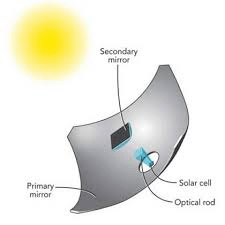 Ingo Weber: After Alinta, here’s a new future for Port Augusta, Adelaide Advertiser, 15 June 15 IN Australia air pollution kills more than double the number of people who die in road deaths. We need to change our dependency on coal, and Port Augusta is the place to start.
There are at least two large international companies currently building concentrated solar thermal power plants (in Spain and the US) keen to build CST right here and now in Port Augusta. We just need political vision.(subscribers only) http://www.adelaidenow.com.au/news/opinion/ingo-weber-port-augusta-ideal-for-a-solar-powered-future/story-fni6unxq-1227400879688
AGL’s Utility-scale Solar Photovoltaic plants in New South Wales
Utility-scale PV in Australia: AGL’s 102 MW Nyngan solar plant achieves full generation Solar Server 15 June 15 AGL Energy Limited (AGL, St Leonards, North Sydney Council, Australia) on June 9th, 2015 confirmed that the Nyngan solar photovoltaic (PV) plant in western New South Wales (NSW) has achieved full generation, sending 102 MW of solar power into the National Electricity Market.
The 250 hectare Nyngan PV plant together with its sister solar plant in Broken Hill, will have a combined capacity of 155 MW, bolstering AGL’s credentials as the largest ASX-listed owner, operator and developer of renewable energy generation in Australia. In the last decade AGL has invested more than USD 3 billion in renewable energy projects.
AGL Project Manager for both the Nyngan and Broken Hill Solar Plants, Adam Mackett, said the team has been working very closely with the Australian Energy Market Operator (AEMO) and local distributor Essential Energy (EE) to make sure testing and commissioning was satisfactory to enable 100 percent generation. Largest utility-scale solar PV plant ever built in Australia
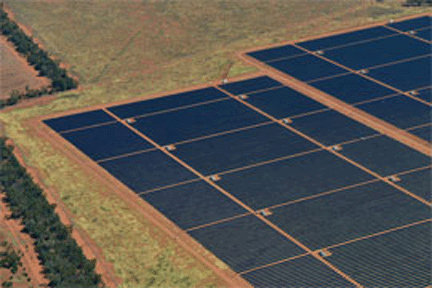
AGL’s 140 hectare Broken Hill plant has also reached a significant construction milestone, with 35 percent of the 650,000 solar PV modules installed……..
“This new Australian record sends a strong signal to the energy industry that utility-scale solar PV plants can be constructed on time and on budget,” said Australian Renewable Energy Agency (ARENA) CEO Ivor Frischknecht, adding, “ARENA is pleased to support this landmark project, which will greatly increase market confidence in future solar PV projects, bringing down the cost of planning, construction and finance.”……
Nyngan and Broken Hill PV plants to produce 360,000 megawatt hours of solar power annually……..AGL will deliver the solar plants in partnership with local councils and communities, project partner First Solar, as well ARENA and the NSW Government. http://www.solarserver.com/solar-magazine/solar-news/current/2015/kw25/utility-scale-pv-in-australia-agls-102-mw-nyngan-solar-plant-achieves-full-generation.html
Electricity utilities scramble now to embrace domestic solar and storage systems
 Energy companies embracing domestic solar and storage systems in scramble to protect profits, ABC News 14 June By business reporter Stephen Letts The battle lines in the fight to power the nation are rapidly being redrawn as the emergence of domestic solar and storage systems have forced the big utilities to scramble to protect their shrinking fiefdoms.
Six months ago, the big three power companies – AGL, Origin and EnergyAustralia – were spending considerable time and resources fighting to have both large and small scale Renewable Energy Targets (LRET and SRES) either cut or abolished.
In the past few weeks the rhetoric has been all about the lucrative growth opportunities for their small residential solar businesses.
Both the big listed Australian utilities – AGL and Origin – have told their recent investor briefings that their traditional businesses in the National Electricity Market (NEM) do not exactly have bright prospects.
Coal fired generation in decline; demand and prices hit Continue reading
Australian Technologies Competition (ATC) dominated by renewable energy solutions
Smart grid, renewable energy solutions dominate Australian tech comp shortlist, REneweconomy, By Sophie Vorrath on 15 June 2015 A pre-fab, portable solar power solution; peak energy load predicting software; and inverter/charger grid balancing technology for network operators. These are just three of a range of home-grown, new clean technologies to make the shortlist for this year’s Australian Technologies Competition (ATC), announced on Monday………
This year’s Semi Finalists includes NSW-based 5B Australia, for its prefabricated, portable, modular solar PV power system for use where energy needs are changeable, short-term or over multiple sites; Queensland’s Renewable Energy Solutions Australia (RESA) for its VoltLogic inverter/charger technology that can be used for power factor correction and phase balancing in grid networks, where renewables capacity is being added; and a retrofittable hybrid heating, ventilating, and air conditioning unit that delivers an average a 30-40 per cent energy reduction on costs compared to conventional HVAC units, from Victorian company Independent Products.
There is also “CloudCAM”, by NSW company Fulcrum3D – an advanced, ground-based sky imaging system that identifies, categorizes, tracks
and predictscloud movement and shadow for solar power stations; and a product that reduces network, customer and generation peaks to
provide energy optimisation and demand management, by Victoria-based company, GreenSync…………http://reneweconomy.com.au/2015/smart-grid-renewable-energy-solutions-dominate-australian-tech-comp-shortlist-19161
Victorian government moves to speed up wind farm projects
 Streamlined Victorian wind farm planning laws promise more regional renewable energy investment ABC News, 12 June 15, The Victorian Government says changes to wind farm planning laws will drive renewable energy investment in the state.
New changes mean the Planning Minister will assess wind farm applications and their infrastructure together.
Previously, developers had to submit multiple applications to local and state governments.
Planning Minister Richard Wynne said it made the application process easier for investors.
“What we are saying is that the doors are open, we are unambiguously in the space of wind farms, we are encouraging investment and the decisions that we reach today around the planning considerations give a streamlined outcome for anyone who wants to invest in wind farms in Victoria,” he said.
He said the move would create jobs in country Victoria.
“Investment in wind farms just makes tremendous sense in terms of employment outcomes for regional communities, it makes tremendous sense in terms of climate change and it’s a great win for regional economies right across regional Victoria,” he said.
Meanwhile, the Australian Wind Alliance said it has concerns for south-west Victoria’s renewables sector, in the wake of comments made by the Prime Minister……http://www.abc.net.au/news/2015-06-12/victorian-wind-farm-planning-laws-streamlined/6540634
South Australia’s great opportunity to transition from coal to 100% renewable energy
Bye bye baseload Our calculations show that SA does not need any baseload power stations, such as coal or nuclear. Indeed, the lack of operational flexibility of coal and nuclear makes them poor partners for high penetrations of variable renewable energy. The SA system has already operated reliably for long periods without its coal-fired stations, as last weekend’s incident demonstrated. Moving fully to renewable energy will deliver environmental, social and economic benefits. The transition would reduce SA’s greenhouse gas emissions, air pollution and associated respiratory diseases. It would cap electricity prices.
SA could create a wide range of new jobs in manufacturing, installation, grid connection, technical support and sales, which could help to compensate for the forthcoming job losses in its coal industry.
As for the nuclear question, the multinational financial analyst Lazard estimates the average costs of subsidized new nuclear energy in the United States in 2017 to be 12.4–13.2 US cents per kilowatt hour (kWh), compared with unsubsidized costs of 3.7–8.1 c/kWh for onshore wind, and 7.2–8.6 c/kWh for large-scale solar PV
 Coal closures give South Australia the chance to go 100% renewable https://theconversation.com/coal-closures-give-south-australia-the-chance-to-go-100-renewable-43182 June 12, 2015 Mark Diesendorf Associate Professor and Deputy Director, Institute of Environmental Studies, UNSW at UNSW Australia South Australia is facing the closure of its Northern and Playford B power stations and Leigh Creek coal mine, after Alinta Energy yesterday announced plans to shut them ahead of schedule. It will cost 438 jobs in the coal-mining and coal-fired electricity industries. But this threat to employment could be transformed into an opportunity for creating many new jobs in renewable energy.
The South Australian electricity system could be operated entirely on scaled-up, commercially available, renewable energy sources. This is the conclusion of my forthcoming report (to be published next week) to the Conservation Council of South Australia. Continue reading
How wind and solar power provided South Australia’s electricity when coal power stopped
the chief qualities of the energy system of the future will not be baseload, but flexibility. This will likely be delivered by the quick-start gas generators that already exist in the system to back up fossil fuels, but also the grid and household-based storage that will be installed in coming years.
How South Australia coped without any baseload power http://reneweconomy.com.au/2015/how-south-australia-coped-without-any-baseload-power-65138 By Giles Parkinson on 9 June 2015 South Australia’s electricity system was put the test over the long weekend when the state’s only baseload power contributor, the brown coal Northern power station near Augusta, suddenly tripped and stopped providing power.
The incident was caused by a fire that caused several injuries, including one serious injury to a worker still in hospital. This is not the first time that South Australia has been without baseload coal power, of course. Northern was mothballed for nearly a year because of the declining economics of the coal generator. The difference with this event is that it came unannounced.
While declines and increases in the output of wind and solar are quite predictable, sudden outages in baseload fossil fuels are not, which is why the energy system needs a large amount of redundancy to support large centralised generation.
So how did the South Australian energy market cope? Quite well, as it turns out. There was a lot of wind blowing at the time, so it was a while before the Torrens gas plant was needed. Most of the gas came from the Osborne plant.
There was so much wind – more than 1GW through most of the day – that electricity prices dived into negative territory on several occasions during the day, which means that the gas generators were not making any money.
Indeed, for most of the day South Australia had the cheapest wholesale electricity prices in the country. Continue reading
Australia’s Prime Minister Tony Abbott boasts of his plan to restrict renewable energy
Mr Abbott had exposed the government’s true intentions on the renewable energy target.
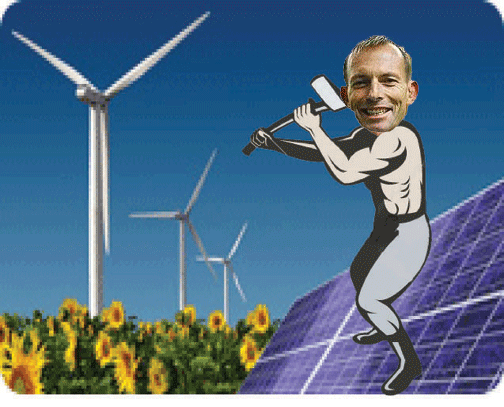 ‘Noisy compared to what?’: Tony Abbott’s claim wind farms awful and noisy dismissed, The Age June 11, 2015 Lisa Cox National political reporter Prime Minister Tony Abbott has described wind farms as “visually awful” and boasted slashing the Renewable Energy Target will restrict growth in the industry.
Mr Abbott also said the Howard government would never have introduced the clean energy policy if it had its time over again.
 Victorian cattle farmer Hamish Officer lives a good deal closer to wind turbines than most people.”You don’t need to lift your voice to have a conversation under a wind turbine nearly as much as you would in a city street,” Mr Officer said.
“For someone like the Prime Minister to stand there and say they’re noisy – it’s a very blanket statement. Noisy compared to what?”
Western Australian Liberal Senator Chris Back rejects medical expertise on wind farms
A Sydney University review of 25 studies into the possible health effects of wind turbines found none had produced evidence they were detrimental to human health and in 2014 the Australian Medical Association issued a statement saying the available evidence did not support the idea that windfarm noise harmed human health
Liberal senator wants windfarm inquiry to recognise ‘adverse health effects‘, Guardian, Lenore Taylor Political Editor, 12 June 15
Coalition figures want inquiry to acknowledge alleged health impacts and support more checks by the regulator A new federal inquiry could call for commonwealth oversight of windfarm regulations and demand recognition of the alleged health impacts of turbines on people living near them, according to Coalition senators.
The prime minister, Tony Abbott, dismayed the wind industry on Thursday when he told Sydney radio announcer Alan Jones that he wished the government had been able to reduce the number of new windfarms more than was possible in a recent renewable energy deal with Labor, and agreed windfarms had “potential health impacts”. Continue reading
1 This month

of the week – Australians for War Powers Reform (AWPR)
To see nuclear-related stories in greater depth and intensity
 Antinuclear