Offgrid solar power an economic winner for Western Australian farming family
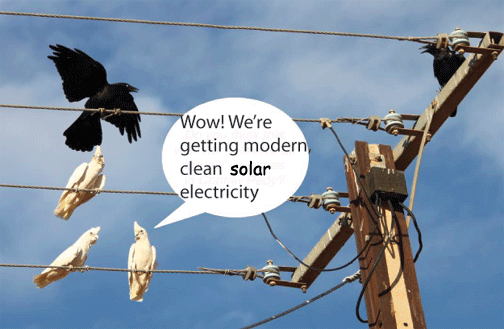 WA farming family opts for solar power battery system over costly grid connection, ABC News By Kathryn Diss 3 June 15 When Katherine Naughton’s family moved to a farm in Northam, north-east of Perth, it was going to cost them up to $60,000 to connect their house to the power grid.
But for just two thirds of that cost they have been able to install a solar power storage system, harnessing all of their electrical needs from the sun.”Not having that $400 bill every three months is just fantastic,” Ms Naughton said.
Perth-based company Solar Balance designed the system with Chinese battery manufacturer BYD.The batteries charge from rooftop solar panels during the day and store the energy for use when the sun goes down.
And unlike connecting to the grid, it is an investment that pays for itself. “With the cost of power going up, it’s quite scary how much it keeps going up by every single year, and you don’t know how much it’s going to be in the next five years,” Ms Naughton said. “So if we can go solar then we don’t have to worry about that bill.”
Battery storage an affordable option
With the entry of new players it will put downward pressure on battery costs which is going to be good for everyone over time because it will become more and more affordable. – Rod Hayes
The power revolution may be taking place slowly, just one household at a time, but the industry believes that is set to change………..
Curtin University’s Sustainability Policy Institute’s Jemma Green said the power grid will become less relevant.
“The grid will have a place but it will become more of a back up system as electricity prices go up even further and the price of solar and batteries decline further, the economics of grid defection are going to stack up sooner.
“This is going to have an impact on the utilisation of the grid and therefore the revenue that the government currently derives from using it.
“I think the grid and the business models of the utilities, that is the generators and the poles and wires will need to evolve to deal with this changing energy system which is effectively a centralised and decentralised energy model,” Ms Green said.
Bosche, LG and Samsung have also indicated they plan to enter the market. http://www.abc.net.au/news/2015-06-03/farming-family-opts-for-solar-power-battery-system/6519960
2014 Clean Energy Australia Report released
 Clean Energy Australia Report 2014 Released http://www.energymatters.com.au/renewable-news/clean-energy-australia-em4854/ June 4, 2015 2014 was a difficult year for renewable energy in Australia with the grim reaper looming over the RET for much of it – but it wasn’t without its bright spots.
Clean Energy Australia Report 2014 states more than 230,000 households and businesses installed either solar power systems or solar hot water last year.
While this may be down on previous years; the average size of each system installed continued to increase (nudging 4.5kW on average), thanks to the plummeting cost of solar panels, other components and increased competition.
More businesses are switching on to solar savings and by the end of 2014, 15,000 commercial enterprises across Australia had installed solar panels; collectively saving more than $64 million on their power bills.
All up, 823.42 MW capacity of residential and commercial solar installs up to 100kW occurred during 2014.
Only two large-scale solar power stations were commissioned in 2014, totaling 23.5 MW. However, 5 new plants with a collective capacity of 258.275 MW were under construction at the end of last year.
The majority of the 16 wind farms under construction in 2014 were on hold by the end of the year due to policy uncertainty. Three wind farms with a combined capacity of 566.7 megawatts were completed in 2014; Snowtown II in South Australia, Gullen Range in New South Wales and Mount Mercer in Victoria. Five wind farms remained in progress early this year and five and are expected to be completed in 2015.
By the end of 2014, there were 71 wind farms Australia-wide, consisting of 1,866 wind turbines in total and with a collective output capacity of 3807MW.
Overall, 13.47 per cent of Australia’s electricity came from renewables last year, enough to power 4.5 million average homes . While dropping from 2013 (14.76 per cent), this was mainly due to reduced rainfall in hydro catchments.
There was a huge difference in renewables use between the states – around 95 per cent of the electricity consumed in Tasmania came from renewables last year (primarily hydro) and approximately 40 per cent of South Australia’s power (primarily wind power). The next best was Western Australia at 13 per cent.
While investment in new large-scale renewable energy fell 88 per cent in 2014 compared to the year before due to policy uncertainty, with bipartisan backed legislation now being considered by Parliament, the CEC says the outlook for the sector is looking more positive.
The Clean Energy Australia 2014 Report was produced with the support of the Australian Renewable Energy Agency and can be downloaded here (PDF).
Home energy storage is bringing solar power to the people
What is certain is that the electricity equation will look very different in a few short years, and it looks like, for the first time in many years, that ordinary consumers will hold a bit more of the power
How home energy storage is going to change the way we think about power, Adelaide Now, CAMERON ENGLAND SUNDAY MAIL (SA) MAY 31, 2015 WHEN Elon Musk launched the Tesla Power Wall earlier this month, it was done in true Silicon Valley style.
The charismatic chief executive enters stage right, sans tie, and makes a pronouncement that his new product will change the world — cue rapturous applause from the audience and because this is the United States, whooping.
The thing about Musk’s pronouncement is that it’s most likely true.
It might not necessarily be his company — critics are divided as to whether Tesla will be the market leader it’s portraying itself as — but home and business energy storage is soon to change the way energy utilities, homes and governments think about power……..
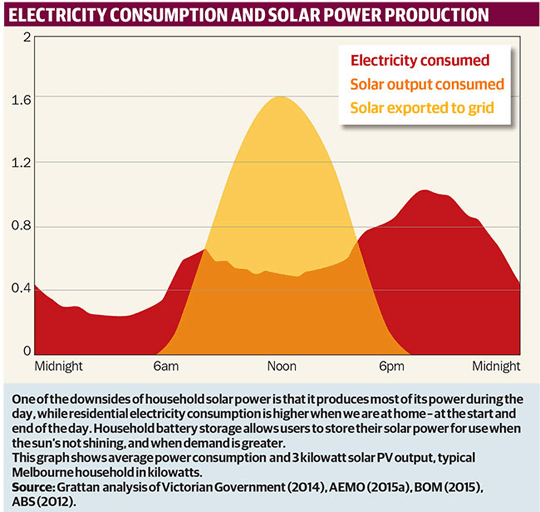
Batteries allow homes and especially businesses to employ “peak shaving” — if power prices spike, flick over to using your own solar power and save money, or if the grid power is cheap, suck it out and sell it back later at a higher price.
Or simply save up the solar power your rooftop panels produce during the day for use in the evening, when your demand might be higher……..
Tesla Power builds on the Tesla Motors technology — relatively standard lithium ion batteries with smart software to help them interact with the grid. The initial interest has been huge. The company recently reported early orders of 50,000 to 60,000 batteries, or as Musk put it, “It’s like crazy off-the-hook”.
Effectively the company is sold out until the middle of next year and its huge new factory will not be big enough to keep up with demand.
At $US3000 for the battery and $US7000 installed with solar panels (US prices) the system makes it economic for houses to become much less dependent on grid power.
UBS estimates that in Australia, the system would pay itself back in six years.
But Tesla is not the only game in town — although it almost certainly has the best PR machine. Continue reading
Australian Renewable Energy Agency sets out conditions for large scale solar
 Establishing the social licence to operate large scale solar facilities in Australia: insights from social research for industry http://apo.org.au/research/establishing-social-licence-operate-large-scale-solar-facilities-australia-insights-social
Introduction
The main objective of the research was to identify the preconditions necessary for utility-scale solar installations to have a social licence to operate in Australia. Specifically, the research set out to understand general attitudes towards solar energy and the acceptability of large scale solar energy facilities with a view to creating this report.
The research consisted of three key components:
• Quantitative phase: a survey of a representative sample of 1,197 Australians.
• Qualitative phase: a series of 15 group discussions held in capital cities, regional centres and communities near large scale solar facilities. Research to investigate perceptions of the desirability of utility-scale solar facilities.
• Review phase: a review of the factors that influence social licence to operate solar facilities, conducted via in-depth interviews and covered in the group discussions with stakeholders in communities living near large scale solar facilities.
The quantitative survey included testing the impact of exposure to two sets of stimuli (consisting of images and information about large scale solar facilities) through asking survey participants about their attitudes towards large scale solar facilities relating to land use; efficiency; reliability; visual impacts; economic impacts; environmental impacts; health impacts and the cost of electricity before and after seeing the stimulus materials.
Perth wave energy project producing power and fresh water

Carnegie Wave Energy based in Perth is a world leader in wave energy technology. In 2014 the company began deployment of three wave energy converters at the Garden Island naval base off the coast near Perth. Large buoys rise and fall with passing waves. Each is tied by rope to the sea floor. As waves pass, the buoys rise, the ropes tighten and extremely high pressure is created in a water-based fluid. This is piped to shore where the pressure powers water desalination and the production of electricity. This technology, known as CETO, has application for small coastal towns and remote islands where oil or diesel is often used in generators. The Perth project is the first demonstration of a complete grid-connected CETO system anywhere in the world.
Western Australian gas company planning to sell solar panels and batteries
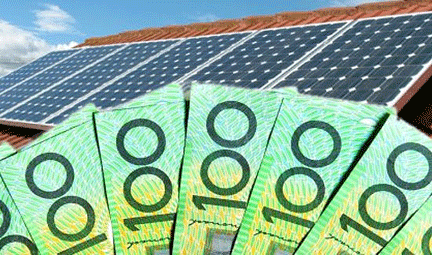 Alinta’s solar plan to cut bills, The West Australian Daniel Mercer June 1, 2015 Gas giant Alinta is hatching a plan to sell solar panels and batteries to households, allowing them to slash power bills by reducing reliance on the electricity grid.
Alinta is also weighing the idea of offering micro gas generators, which could pave the way for households to disconnect from the grid altogether.
The plan looms as a direct challenge to taxpayer-owned electricity provider Synergy, which has been losing millions of dollars as customers switch to solar en masse.
There are about 170,000 households in the South West grid alone which have photovoltaic cells on their roofs, and this figure is expected to soar by the end of the decade.
Under Alinta’s plan, tipped to start this year, it would lease solar panels to residential customers, who would then provide any power they did not use back to Alinta to sell into the market.
The Sydney-based company would also offer batteries to store surplus solar power and small gas-fired generators that could be used as a backup in the event it was cloudy for days.
Efficient and affordable battery storage has long been regarded as the holy grail of renewable energy and US firm Tesla announced last month it was on the verge of being able to produce it………https://au.news.yahoo.com/thewest/a/28289418/alintas-solar-plan-to-cut-bills/
Solar testing laboratory: CSIRO helps investor confidence in large-scale solar
 CSIRO establishes solar testing laboratory http://www.dailytelegraph.com.au/business/breaking-news/csiro-establishes-solar-testing-laboratory/story-fnn9c0gv-1227375518543 JOHN CONROY MAY 30, 2015
CSIRO is set to increase confidence in large-scale solar by more accurately predicting how different solar photovoltaic (PV) systems will perform on Australian shores.
Over the course of a 32-month project supported by $1.3 million Australian Renewable Energy Agency (ARENA) funding, CSIRO successfully established unique indoor and outdoor testing capabilities that are now accessible to PV researchers and industry.
ARENA CEO Ivor Frischknecht said these new facilities would allow different solar panels and cells to be scrutinised, assessing how they respond to Australian conditions and predicting their output over time.
“Accurately predicting the energy output of a solar PV power plant is critical throughout its lifecycle, from forecasting future revenue and determining commercial viability to day-to-day operation on the electricity grid,” Mr Frischknecht said.
 “Effective forecasting is particularly important for investor confidence and risk mitigation as the cost of new plants is mostly up-front.
Clean Energy Finance Corporation helping irrigators to buy renewable energy
 Funding for irrigators to buy renewable energy made available through Clean Energy Finance Corporation ABC Rural By Sarina Locke , 29 May 15 Irrigators, furious with power price rises, are pushing hard to install renewable energy on their farms.
To date the financial backing from banks has been largely missing.
Now the Government backed Clean Energy Finance Corporation is poised to announce a partnership with a major bank, to help irrigators invest in more efficient energy. It is just the tip of renewable energy projects in agriculture, worth $3 billion that will need financial assistance from the Corporation in future……..
The Clean Energy Finance Corporation is responding. It has a program with the Commonwealth Bank, called the energy efficient loan for mid-sized companies, available nationwide. It offers small loans of $100,000 up to $5 million plus.
But the CEFC is poised to rollout more programs with other banks offering a similar product for irrigators. Continue reading
The ANZ Bank’s first green bond issuance a resounding success
 Australian investors lap up ANZ green bonds THE AUSTRALIAN JOHN CONROY MAY 28, 2015 The ANZ Bank’s first green bond issuance – and Australia’s largest – has been a “resounding success”, the Clean Energy Finance Corporation said, with the CEFC not needing to provide the $75m it had committed to back the issuance.
The $600m ANZ green bond issuance – which has been certified by the Climate Bonds Initiative – was fully subscribed by private sector investors and will back investment in utility-scale wind and solar as well as green buildings.
About 40% of the green bond funds will go into green building projects in Australian and New Zealand, as well as some parts of Asia, with the remaining 60% to be invested in renewable energy, largely wind and solar, The Fifth Estate reports, with Australian institutional investors making up the majority of subscribers.
The five-year fixed rate bond had a coupon of 3.25% and was rated AA-, the website said. The Fifth Estate also quotes CBI as saying the issuance was actually oversubscribed, at $725m. CEFC CEO Oliver Yates said the “high quality” bonds would expand and diversify the investor base for clean energy.
“Green bonds provide investors with a unique opportunity to invest in renewable energy and energy efficiency through a low-risk, high quality fixed-income product. At the same time, green bonds support long term investment in important low carbon infrastructure projects which can benefit the broader economy,” he said.
He said investors were increasingly seeking additional benefits, such as an environmental or social return……..http://www.theaustralian.com.au/business/latest/australian-investors-lap-up-anz-green-bonds/story-e6frg90f-1227372751422
BHP funded Grattan Institute unfairly critical of solar energy

Solar Industry Hits Back At Report Critical Of Roof-Top Solar, New Matilda, By Thom Mitchell, 27 May 15 A report by a respected think-tank is being slammed by key players in the solar energy industry. Thom MItchell reports.
A report published by the Grattan Institute on Monday has been dismissed by the solar industry, which argues its critique of generous state and federal government subsidy schemes misrepresents their true value and ignores important flow-on benefits. Continue reading
Small scale solar power from Australian company transforms slum life in India
Australian solar company Pollinate Energy brings light to slums of India ABC Foreign Correspondent By South Asia correspondent Stephanie March 26 May 15 With indoor air pollution from kerosene lamps and stoves the second largest cause of death in India, one company, founded by Australians, has come up with a solution to the problem.
Every night in the sprawling shanty towns of the country of 1.2 billion people, the air fills with dense, black smoke.
“We used to get oil from the market and pour it into the lamp and light it; the house used to get full of soot and dirt,” said Abdul, a slum-dweller in Bangalore who lives in a hut made of wooden board and tarpaulin.
That was until Abdul bought a portable solar light from a company called Pollinate Energy, founded by five young Australians.
“After we got this solar lamp a lot of things improved,” Abdul said. “Now we don’t worry that there will be a fire.” Continue reading
Australians overwhelmingly prefer solar energy – survey results
Survey Says Australians Prefer Solar Power Sputnik News 25 May 15 Australians strongly support the use of renewable energy, according to Ipsos research company’s survey. Some 87 percent of respondents were strongly in favor of solar panels on homes and 78 percent supported large-scale solar energy facilities.MOSCOW (Sputnik) — Solar power is considered the most efficient source of energy by an overwhelming majority of Australians, Ipsos research company stated Monday.
Earlier in May, following months of negotiations, Australia’s current government and the primary opposition party reached an agreement to scale back its Renewable Energy Target (RET) by almost 20 percent by 2020, due to declining power demand.
A recent Ipsos report based on a poll of nearly 1200 people funded by Australian Renewable Energy Agency (ARENA) revealed that Australians responding to the poll strongly support the use of renewable energy. Some 87 percent of respondents were strongly in favor of solar panels on homes and 78 percent supported large-scale solar energy facilities.
An overall 72 percent of respondents from across Australia said they supported wind farms and hydro energy, while tidal and geothermal energy was favored by 52 and 45 percent respectively……..
Since coming to power in 2013, Prime Minister Tony Abbott has repealed a tax on carbon emissions and eliminated the post of science minister……… http://sputniknews.com/environment/20150525/1022530489.html#ixzz3bHKV5Rpu
Senator Leyonhjelm – Nuclear power is fine: wind power is the danger!
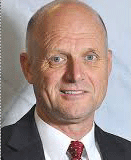 Senator David Leyonhjelm wants government to monitor wind turbine noise, The Age, May 24, 2015 Adam Gartre It seems the only thing colourful crossbench senator David Leyonhjelm hates more than red tape is wind farming.
Despite typically being a fierce opponent of new government regulation, the Liberal Democrat is calling on the government to set up a new regulator to monitor noise levels near wind turbines.
He claims a Senate inquiry he set up has uncovered “credible evidence” that some people are suffering  health concerns caused by low frequency noise and vibrations known as infrasound.
Australia’s peak medical agency this year concluded there is no direct or consistent evidence that wind farms damage human health, after conducting a year-long study into so-called “wind turbine syndrome”.
The solar revolution that is coming to Australia’s homes
 Could solar power be about to transform the electricity industry and drive prices down? http://www.abc.net.au/7.30/content/2015/s4240286.htm Australian Broadcasting Corporation Broadcast: 21/05/2015 Reporter: Matt Peacock A revolution driven by solar panels and cheaper batteries is transforming Australia’s electricity industry and promising to drive power prices down.
Transcript
LEIGH SALES, PRESENTER: Imagine life without that dreaded quarterly power bill. That could be around the corner for people with solar panels. Until now, solar energy couldn’t be stored efficiently and people who had it relied on the electricity grid for backup. Now, new battery technology means that could change. Matt Peacock reports. Continue reading
Funding method to help off-grid renewable energy take off in rural Australia
CLOSING THE GAP
Renewable energy sources (in particular, solar and wind) have a significant relevance in the off-grid setting of Australia’s remote rural and indigenous communities.
At present these communities are serviced almost exclusively by off-grid diesel and gas. While these traditional fuels haven’t yet become prohibitively expensive, they are subject to price fluctuations and, in the case of diesel, affordable only as a result of government subsidies.
Fuel subsidies are also regularly under threat of repeal; and yet renewable energy has made enormous progress in providing an environmentally-friendly alternative which is competitive in terms of price and efficiency.
Taking diesel and solar powered energy as examples: while the cost of diesel generation has remained stable at around the $220-$300/MWh mark, the cost of solar energy is now about $200-$240/MWh; drastically down from $600/MWh in 2008 and likely to get cheaper with evolving technology and economies of scale.
Combine the comparative cost with the obvious environmental benefits of solar or wind and the case for their adoption looks compelling.
Renewable energy for remote Australia – can our rural and indigenous communities go off-grid?http://www.lexology.com/library/detail.aspx?g=1d65ab6f-6d9c-4499-abd7-de3a45c72191 Corrs Chambers Westgarth Australia May 21 2015
THE PRESENT DILEMMA
The renewable energy industry in Australia has taken more hits in recent years than a punch-drunk boxer. It may be uncharitable to say that Australia’s politicians were the only ones throwing the upper-cuts, but there’s little doubt they’ve played a significant role.
The current state of the renewable energy industry in Australia can be traced back to the repeal of the carbon price mechanism and has been further compounded by the prolonged political impasse surrounding the future of the Renewable Energy Target (RET).[1].
Running parallel to the renewable energy sector’s struggles, is the pressure on governments to reduce spending in the face of an undiminished social imperative to service the energy (and wider infrastructure) needs of remote rural and indigenous communities across the country.
In light of technological advances, off-grid renewable energy should be a key part of the solution to energy security.
In funding such a solution, debt-funded models could be a more practical way for industry to raise the capital it needs than waiting for government funding.
For government, private capital investment has long been an attractive funding solution for infrastructure projects as it allows for the deferral of upfront capital costs.
Equally, financiers benefit from the certainty that comes with government-sourced revenue streams – in this way circumventing the uncertainty that has so severely hamstrung renewable energy investment in recent years.
If a debt-funded model is to be pursued, the real question then becomes: how to structure that funding to make it attractive for all parties concerned? Continue reading
1 This month


Help Aunty Sue Protect Her Land and Sacred Sites From Destructive Rocket Testing.
.

Australians deserve the truth
about
AUKUS – https://aukuspublicinquiry.com/

PETITION – To: Prime Minister Anthony Albanese and the Australian Labor Government

of the week – Australians for War Powers Reform (AWPR)
To see nuclear-related stories in greater depth and intensity

