GetUp and Powershop join forces to switch Australia to renewable energy
 Powershop was ranked by Greenpeace as the greenest power company in Australia. As a generator, the company only produces renewable energy through its wind farms in Victoria and South Australia. It buys carbon offsets from UN-certified projects for all the electricity it creates and sells at no additional cost to the end user. It also lets consumers buy certified Green Power from projects such as the Hepburn Wind Farm (a community project in Victoria), LMS Energy (which creates gas from landfill), and CSR’s renewable energy project.
Powershop is a disruptive player because it offers customers greater visibility and control over their electricity use with no lock-in contracts.
Why GetUp activists are the new sales agents for electricity retailer Powershop Business Review Weekly Caitlin Fitzsimmons Online editor 26 March 2015 Online electricity retailer Powershop has a novel way of winning new customers – getting online activist group GetUp to do the sales and marketing for them.
Powershop Australia chief executive Ben Burge says more than 6,000 of Powershop’s 38,000 Australian customers – about 16 per cent – have come directly via GetUp to date.
“Of course it’s helpful to have someone other than the power company talking to customers about what’s a good choice of power company,” Burge says. “The great thing about working with GetUp is they are incredibly enthusiastic and that passion comes through – we don’t ever want it to be a scripted thing.”
GetUp chief executive Sam McLean says the goal is to get 50,000 people to switch before the annual general meetings of the big three power companies, Origin, Energy Australia and AGL, later this year. As of 11.30am on Thursday, GetUp’s internal figures showed it had switched 6,902 customers in total and was adding about 150 a day via both online and telesales.
The switching campaign is part of GetUp’s Better Power push to champion climate change action and renewable energy. The big three energy companies, which control 75 per cent of the energy retail market between them, are campaigning heavily to abolish or reduce the Renewable Energy Target. By contrast, Powershop strongly supported retaining the target in its submission to the recent government review. Continue reading
John Hewson calls on Australians to switch from Origin, AGL and Energy Australia electricity companies
The more of us that switch to companies that genuinely support the RET and oppose CSG, the better we will make things for all Australian consumers, our communities and our environment
 Extensive ‘advice’ from AGL, Energy Australia and Origin on the Renewable Energy Target has been a disaster – except for the companies’ profits “……Let’s hope Bill Shorten and the opposition have the courage to stand firm. The Greens and most of the Senate crossbenchers would back them to block the government’s attempts to make the necessary legislative amendments to the RET.
The real villains here, however, are Australia’s three biggest energy companies: AGL, Energy Australia and Origin.
Abbott has been extensively “advised” by these companies. Surely it is in no small part their influence that led to the coalition setting up an inquiry into the RET, headed by climate change sceptic Dick Warburton.
Interestingly, the inquiry found that the RET will drive down the price of power for consumers. Continue reading
New South Wales govt funds Byron Bay’s renewable energy trading plan.
 NSW Govt tips $15,000 into Byron renewable energy trading , Courier Mail, JOHN CONROY MARCH 25, 2015 The Baird Government in NSW has announced $15,000 in funding to back Byron Bay’s renewable energy trading plan.
The Byron Bay council trial in collaboration with the Australian Renewable Energy Agency, the Institute of Sustainable Futures at the University of Technology Sydney and the NSW Renewable Energy Advocate, will allow the allow the local sports centre to sell renewable energy generated by their solar panel array to the council’s sewage treatment plant.
“This trial will mean we have two facilities using renewable energy from one site, allowing the sewage plant to run off clean, sustainable power and achieving greater use of energy generated by the sports centre’s solar panels,” Environment Minister Rob Stokes said……
Abbott government intransigent on its plan to weaken Renewable Energy Target
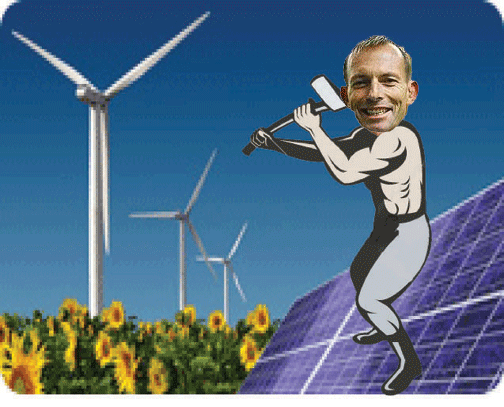 ‘Take it or leave it’, government tells renewable energy industry in latest RET talks, SMH March 24, 2015 Lisa Cox National political reporter Industry Minister Ian Macfarlane has told the clean energy industry that the government’s latest offer on the renewable energy target is a “take it or leave it” position.
In a fresh round of talks with unions and representatives for the clean energy and aluminium industries on Monday, Mr Macfarlane said the government would not budge from a figure of 32,000 gigawatt hours of renewable energy production by 2020.
The number represents a substantial reduction from the existing large scale target of 41,000 gigawatt hours and both Labor and the clean energy industry have said it is unacceptable…….
Australian Solar Council chief executive John Grimes said “we are now at the end point”.
Mr Grimes said his organisation was shut out of Monday’s talks.
“This is not a process and the end point is perpetual uncertainty,” he said. http://www.smh.com.au/federal-politics/political-news/take-it-or-leave-it-government-tells-renewable-energy-industry-in-latest-ret-talks-20150324-1m5ql8.html
Mildura’s solar farm – successful without a cent of government money
what makes the Mildura plant so special is that it was built without a cent of government grants being tipped in.
helps illustrate how solar’s smaller, highly modular scale and fast construction time could allow it to play a far greater role in ensuring the target for the large-scale RET is met
Belectric have a developed a standardised 3MW solar power installation system they call the 3.0 MegaWattBlock (pictured below) which they roll-out across the globe.
Australia’s biggest solar farm powers-up but solar’s potential shines elsewhere, Business Spectator, TRISTAN EDIS 23 MAR
Australia’s largest ever solar power plant, AGL’s 102 megawatt Nyngan – has begun feeding power into the grid. But there’s a far more interesting solar power plant no one is talking about in Mildura.
The Nyngan plant in Western NSW now has its first 25MW of capacity, involving 350,000 solar modules made by First Solar, generating power that is exporting power to the grid. Further generation will progressively be brought online over the next three months as the remaining three sections of the plant are individually commissioned.
It’s unambiguously good news, yet I’m far more excited about the solar power plant in Mildura even though it’s substantially smaller – 3MW of capacity versus Nyngan’s 102MW. In fact it’s quite astounding that the completion of the Mildura plant has received no press whatsoever, because when it started feeding power to the grid in April last year it was the second largest operational solar power plant in the country at the time, and remains comfortably the largest in Victoria. Continue reading
ACT solar farm project will go ahead – in a different location
ACT solar farm project moved from controversial Uriarra site to Williamsdale
666 ABC Canberra 24 Mar 15 A controversial project to build a solar farm next to the rural village of Uriarra has been dumped by the ACT Government after fierce opposition from local residents.
Plans by Elementus Energy to build a 26,000-panel solar farm that could power more than 1,400 homes will now be moved to Williamsdale in the Territory’s south.
Environment Minister Simon Corbell told 666 ABC Canberra the Government would now license parts of blocks 1470 and 1471 in the district of Tuggeranong (Williamsdale) for the OneSun Capital solar project.
But an approval process would still be necessary for the new location.
“The ACT Government is proposing to enter into a rental arrangement with the developer for a new site on land the Government now owns at Williamsdale, on the Monaro Highway,” Mr Corbell said.
“And it will occur without any change to the tariff feed-in price that the developer bid in the reverse auction for the solar farm project.
“What this means is a clearer path. We can get on and hopefully see that project built and it also addresses the concerns raised by Uriarra residents.”……http://www.abc.net.au/news/2015-03-24/act-solar-farm-project-to-move-from-controversial-uriarra-site/6342900
Victorian Labor government makes regulations easier for wind farms
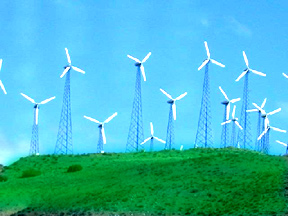 Australian state of Victoria open for wind energy business http://www.renewableenergymagazine.com/article/australian-state-of-victoria-open-for-wind-20150320 Robin Whitlock Friday, 20 March 2015 The Victorian State Government in Australia has made some regulatory changes in order to make the state more attractive to wind farm developers.The changes will help to unlock billions of dollars in investment, providing a bipartisan deal can be reached on Australia’s Renewable Energy Target (RET). The director of the Clean Energy Council (CEC), Russell Marsh, said that under restrictive rules introduced by the previous government, a coal mine could be built closer to homes in the state than a wind turbine.
“It is important to get the balance right between attracting renewable energy investment to Victoria and ensuring that the voice of communities is heard when building a wind farm” Mr Marsh said. “But the restrictions introduced by the previous government simply drove wind farm companies to other states and robbed Victoria of investment and job opportunities in regional communities. New wind farm applications virtually dried up after these new measures were introduced.”
Mr Marsh added that it is fantastic to see the Andrews Government recognising the need for change and acting to address some of the most draconian parts of the former governmental legislation, which is clearly a step in the right direction.
The changes will mean that the 2 kilometre setback distance between houses and wind turbines will be reduced to 1 kilometre. The Planning Minister will decide on wind farm applications and local councils will be responsible for regulating new and existing wind farms. The ongoing review of the national RET by the Federal Government has led to an 88 percent reduction in investment in large renewable energy projects such as wind farms across the country over the course of last year. The RET remains the industry’s highest priority and bipartisan support for a strong RET needs to be secured in order to return investment and stability to the renewable energy industry. According to Mr Marsh, once this happens, the industry can look forward to working with the Victorian Government to build renewable energy infrastructure and pass the many benefits of that onto rural and regional parts of the state.
In turn, this will provide direct employment and will also provide flow-on benefits to local contractors, suppliers, shops, restaurants, accommodation providers and much more while wind farms are being constructed.
For additional information: Clean Energy Council Victorian Government
Prices of solar battery systems set to plunge

Munson sees Australia as one of the most prospective markets in the world. That’s because of its high electricity costs, huge grid, expansive geography, excellent solar resources, and the penetration of rooftop solar PV.
But it’s also because the industry – from regulators down to networks and retailers, partly as a result from the boom in rooftop solar and the prospects for battery storage – are beginning to rethink their business.
Why battery system costs may fall 3x faster than solar PV http://reneweconomy.com.au/2015/why-battery-system-costs-may-fall-3x-faster-than-solar-pv-84344 By Giles Parkinson on 20 March 2015 Everyone, it seems, agrees that battery storage is the next big thing to affect global energy markets. What is not agreed upon is the timing. Some think this may happen in a few years, others in a decade or more. Some think it is happening now.
The big question for many is how quickly battery storage costs will fall in coming years. Will it be as dramatic as that of solar PV, which took everyone but a few solar savants off-guard and cut costs 80 per cent over a five-year period? Some – such as investment banking giants Deutsche Bank and UBS – say it will. Others say it is not possible.
Ken Munson, the founder and head of smart energy systems start-up Sunverge – which is backed by an Australian government-funded investor – is in no doubt that storage costs will fall. In fact, he thinks they could fall three times as fast as solar costs did. Continue reading
VIDEO: Greens’ Larissa Waters strongly defends current Renewable Energy Target
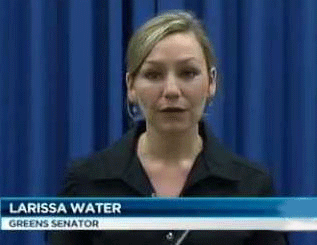 Greens savage Labor over RET deal http://media.theage.com.au/news/federal-politics/greens-savage-labor-over-ret-deal-6366253.html A report that shows power companies are the worst polluters underscores the need to retain the renewable energy target in its current form says Greens environment spokesperson Larissa Waters.
Australian Senate votes to back councils’ solar initiatives in western New South Wales.
 Senate shines a light on bright solar initiative in western NSW http://www.abc.net.au/news/2015-03-18/senate-solar/6327952 The Senate has passed a motion calling on all levels of government to back a solar powered initiative in western New South Wales.
The Greens put forward the motion in the Upper House yesterday about the solar energy exchange initiative which involves 24 council areas throughout the state’s west.
The program is also known as SEXI. Each council is installing photo-voltaic panels as part of the initiative.
Greens Senator Lee Rhiannon said the motion was a significant show of support in the project and its ambition to provide cleaner energy. “There is nothing binding on this motion on anybody,” the Senator said. “However it clearly carries weight when the national parliament of the country comes behind a project in one specific region.”
Senator Rhiannon said the project set an example for other councils around the nation to follow.
“To have the support of the Senate clearly adds weight to this important project for solar energy in western New South Wales,” she said. The councils involved in the initiative include Balranald, Bourke, Mid-Western and Narrabri.
Western Australia’s huge wind power potential blocked by Federal and State governments
While there are only three large-scale wind farms in WA, smaller community-based operations have been successful at locations including Denmark, Bremer Bay, Rottnest Island, Kalbarri, Denham and Coral Bay.
An expansion of the Albany wind farm means it meets 80 per cent of the town’s power needs.
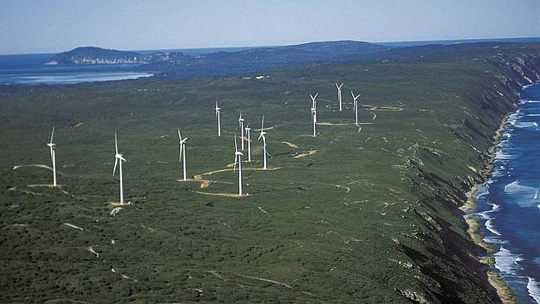
Wind power: WA wind farms ineffective for renewable energy TREVOR PADDENBURG PERTHNOW MARCH 16, 2015 WA is one of the windiest places on the planet with wide open spaces for wind farms, yet the state remains a renewable energy backwater, latest figures reveal.
Clean Energy Council data for significant wind farm projects shows WA generates less than 500MW of power from a total of 308 turbines around the state.
That’s half of Victoria’s wind generation at 939MW from 454 turbines and well below South Australia, which generates 1205MW of electricity from 561 turbines.
One reason is debate about health effects and noise emissions from wind turbines, even though numerous studies including a recent National Health and Medical Research Council review ruled there was no truth to claims that turbines cause health effects.
Aside from the question of health effects, the wind energy industry in WA is in crisis from a political double whammy, with the Federal Government signalling it wants to scrap Australia’s renewable energy target and the WA Government signing new contracts that tie electricity production to coal.
Estimates put investment in large-scale renewable energy projects in 2014 at 10 per cent of the figure for 2013.
That’s despite the Australian Institute saying wind had the potential to supply 40 per cent of Australia’s energy needs and was now cheaper to produce than coal.
Clean Energy Council policy director Russell Marsh said WA should be a world leader but it remained in the doldrums, underfunded and undervalued by governments fixated on coal.
“WA has a great wind resource and the space. But the review of the renewable energy target has basically closed the industry down,” he said. Continue reading
A new project off the coast of Australia may make wave power a reality
Renewable energy Looks swell, The Economist 14 Mar 15 A new project off the coast of Australia may make wave power a reality
Mar 14th 2015 NO LAND stands between Antarctica and Australia’s west coast—just a vast ocean, rippled and rocked by the Roaring Forties. For centuries these westerlies, which blow between latitudes 40° S and 50° S, powered ships sailing from Europe to Asia. These days, they are also creating waves in the world of renewable energy. At the end of February, a demonstration project designed to use the ocean swell they produce went live. As a result Australia’s largest naval base now gets part of both its electricity and its fresh water courtesy of the ’Forties.

Carnegie Wave Energy, in Perth, has been working since 1999 on what it calls CETO technology. Ceto was the ancient Greek goddess of sea monsters, and Carnegie’s particular monsters are buoys that resemble giant macaroons. They float a metre or two below the ocean’s surface, bobbing up and down in the swell and generating electricity as they do so. The current version, CETO 5, has a capacity of 240kW per buoy. Three of the beasts are now tethered to the sea bed 3km from HMAS Stirling, on Garden Island. They also help to run a desalination plant on the base, for fresh water is a valuable commodity in Western Australia’s arid climate………
Carnegie aspires to bigger and better buoys it hopes will generate a megawatt each when launched in 2017. These versions, CETO 6, will be 20 metres across and will produce electricity inside themselves instead of at an onshore power plant. That means no pipe is needed; a submarine power cable will do instead……….
Carnegie also has its sights on markets farther afield. Military bases around the world need secure supplies of energy and water. And wave energy is attractive to island countries like the Maldives that must, at the moment, import fossil fuel at some expense. Whether submarine wave power of this sort will ever become truly mainstream is moot. But Carnegie is showing that, in appropriate circumstances, it could indeed have the wind behind it. http://www.economist.com/news/science-and-technology/21646176-new-project-coast-australia-may-make-wave-power-reality-looks-swell
Community renewable energy taking off rapidly in Australia
Communities take lead on renewable energy as big projects stall http://reneweconomy.com.au/2015/communities-take-lead-on-renewable-energy-as-big-projects-stall-81109 By Giles Parkinson on 10 March 2015
 Dozens of projects have emerged as state governments tap into local ideas, offering grants for innovative projects that allow solar and other renewables to be developed at a local level, for innovative financing packages, and even the development of localised smart grid.
It’s a crucial step. Australia has nearly two million homes with some sort of solar appliance – rooftop PV arrays or solar hot water – and is probably leading the world in residential solar, with some 4,000MW of rooftop arrays, penetration rates of more than 25 per cent. It is at the forefront of the rise of the so-called “energy prosumer”.
The CSIRO last year predicted that up to one-half of total electricity needs will be generated locally, either on households rooftops, by business, or in community-owned or sponsored arrays.
What has been missing from the emergence of this “decentralized” energy system – which will ultimately turn the current centralised economic model on its head – has been concrete action at community level.
This is important because it will not just build up scale, it will also offer solutions to those not yet able to take part in the solar revolution, including low-income housing, apartment dwellers and renters.
And it will allow whole communities to look after their own energy needs, as some network operators are even encouraging. And, as pointed out by Beyond Zero Emissions Stephen Bygrave earlier this week, “all revolutions need to start from the bottom up,” as they had in Germany and Denmark in the energy space. There’s not much hope of leadership at the federal level in Australia.
Apart from a few groundbreaking projects, such as the Hepburn wind farm and a few smaller community-funded solar arrays, little has been done so far in Australia, although there have been plenty of ideas and aspiration of how to match the achievements in Europe, where much of the renewable energy is owned at community level in some form.
That is now starting to change rapidly. Continue reading
Tadmanian govt, Workers Union, Clean Energy Council push for decision on Renewable Energy Target
Pressure Builds For Renewable Energy Target Resolution http://www.energymatters.com.au/renewable-news/ret-resolution-urged-em4722/ March 11, 2015
February 17 marked a year of wrangling over the Renewable Energy Target, a situation that resulted in investment in large-scale renewable energy projects such as wind and solar farms plummet 88 per cent; putting Australia behind some developing nations.
Yesterday, the Tasmanian Government demanded certainty from the Commonwealth, stating the ongoing issue hurt Tasmania more than the other states due to its reliance on hydroelectric power.
The Australian Workers Union has also repeated its calls for an immediate resolution, stating tens of thousands of jobs are at risk. The AWU has a special focus on the exemption of the aluminium industry under the RET and says an exemption has been agreed upon by both major parties.
So, is there light at the end of the tunnel given all the competing interests? Yes, but the more pessimistic might say it still remains to be seen if that will be an oncoming train for some sectors. One thing is certain, the Clean Energy Council is fighting hard for its members; wanting a target somewhere in the mid to high 30,000GWh range and Labor is supporting this stance.
On the weekend, Environment Minister Greg Hunt held discussions with the Clean Energy Council and the Australian Industry Group, saying ‘huge progress’ had been made. It’s understood the Federal Government wants the impasse resolved by Easter.
The Australian Industry Group is very conscious of the fact things have dragged on for far too long.
“I think what you’ve got now is a sense of urgency and a recognition that this needs to be done quickly if it’s to be done at all with any sort of reasonable outcome to give industry the certainty needs, so the time for sitting on the fence is pretty much over and this deal just needs to be done,” said chief executive of the Australian Industry Group, Innes Willox.
A strong Renewable Energy Target isn’t just about overseas investment, jobs or environmental benefits – it’s been shown the RET will reduce electricity prices. A 2013 report stated that even by that point in time, Australia’s rooftop solar power systems alone were saving between $300 million and $670 million each year in wholesale electricity costs.
Government in no hurry to reach agreement on Renewable Energy Target?
Renewable energy target compromise deal within reach but no time frame set, Greg Hunt says ABC News PM By David Mark 6 Mar 15 Environment Minister Greg Hunt says an agreement with Labor and the renewable energy industry on the renewable energy target (RET) is “within reach”, but it seems there are still sticking points and different views from within Government. Continue reading
1 This month
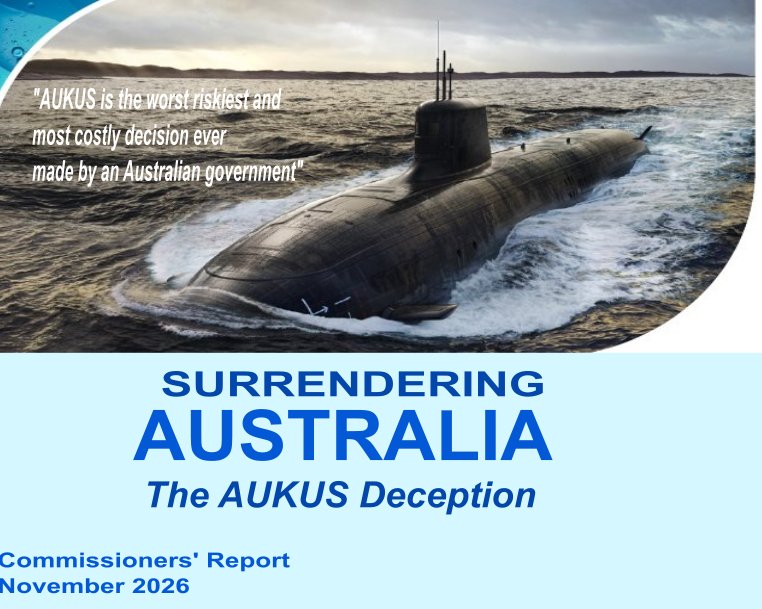
Read the Public Inquiry Report, the Commissioners’ report, Surrendering Australia: The AUKUS Deception is available to download for free at aukuspublicinquiry.com. Or just watch the replay of the National Press Club Luncheon.

4 November – Will AUKUS keep us safe – at what cost?
the Commissioners of the AUKUS Public Inquiry present their findings at the National Press Club of Australia in Canberra. iview.abc.net.au/show/national-press-club-address
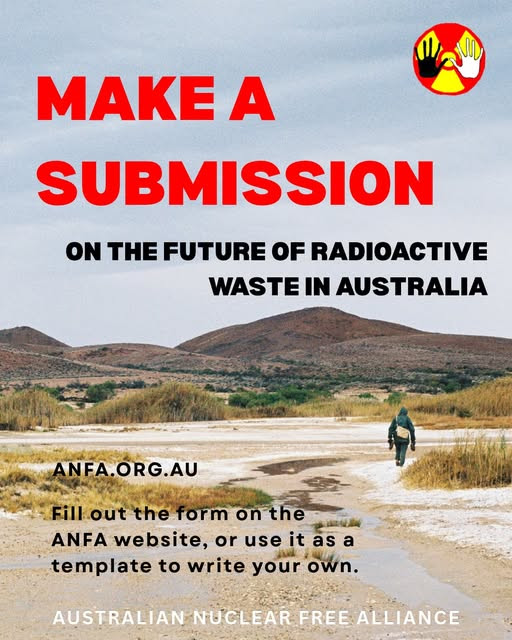
Submissions to the federal government’s new draft framework close on the 13th November 2026.
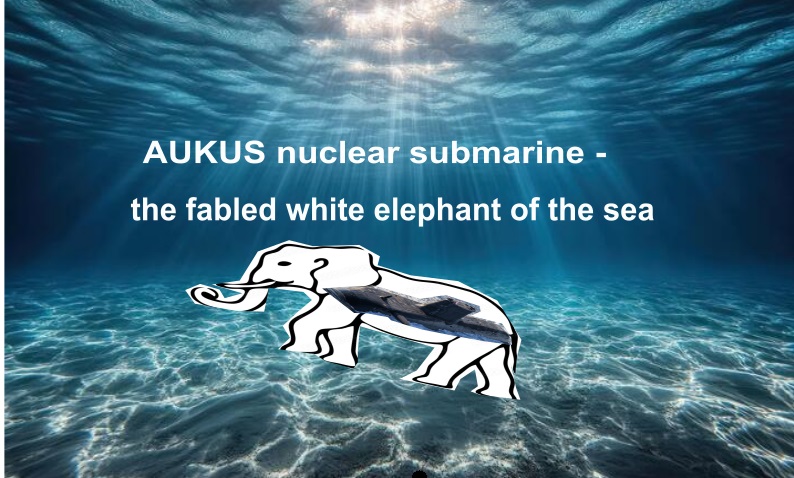
Australians deserve the truth
about
AUKUS – https://aukuspublicinquiry.com/

PETITION – To: Prime Minister Anthony Albanese and the Australian Labor Government

of the week – Australians for War Powers Reform (AWPR)
To see nuclear-related stories in greater depth and intensity

