Australi’s electricity utilities making it as hard as they can for the renewable energy industry
 Utilities hold renewables to ransom over coal pay-outs, REneweconomy By Giles Parkinson on 12 February 2015 Australia’s largest utilities are being accused of holding the renewable energy industry to ransom, by suggesting that they will not sign contracts for new large-scale renewable energy projects unless they are paid to close excess coal capacity. Continue reading
$1 billion solar farm for Toowoomba, Queensland
 Toowoomba council approves $1bn solar farm STAFF WRITERS, JOHN CONROY FEBRUARY 12, 2015 http://www.couriermail.com.au/news/queensland/toowoomba-council-approves-1bn-solar-farm/story-fnn8dlfs-1227216531992 APPROVAL has been given for the largest solar farm in the country — and possibly the largest proposed in the world — to be built in Queensland.
Construction on the 13,000-acre Bulli Creek site near Powerlink’s substation near Millmerran, southwest of Toowoomba, is expected to start next year. It will be on cleared, flat cattle grazing land.
Developer Solar Choice has received approval from Toowoomba Regional Council for a total footprint of up to 2 gigawatts over the next eight years.
The solar farm will be built in stages of multiple 100MW-plus phases, within a total planning approved envelope of 2GW.
“The Bulli Creek project is attracting attention from a range of global investors prepared to take a medium- and long-term view,” Solar Choice said, stating it remained open to a large-scale investor.
“The Bulli Creek Solar Farm is one of a very small and select number of mega-scale solar projects that Solar Choice has strategically located at transmission nodes on broad-acre lands with high solar irradiation.”
Solar Choice said the approval of the potential 2GW farm shows claims the 2020 Renewable Energy Target can’t be met are false.
Managing director Angus Gemmell said if the farm reached its full potential it would take Australia 25 per cent closer to achieving the mandated 41,000GWh target by 2020.
“There are a lot of people saying there’s not enough of a pipeline to reach the target. This project shows it could absolutely be reached,” Mr Gemmell said.
“We need 8GW by 2020 to reach the target and this project could represent one quarter of that.”
Mr Gemmell called on the Federal Government to end the uncertainty around the large-scale RET, saying that ‘big solar’ had strong support among regional communities.
“The (Toowoomba) council decision is an exciting milestone, we’re a third of the way there,” he said.
‘Wind Turbine Sickness’ -National Health and Medical Research Council (NHMRC) to do yet another study!
 Research council calls for further study into ‘wind turbine sickness’, sets aside $500,000 in grants, ABC News 12 Feb 15 By online environment editor Sara Phillips The National Health and Medical Research Council (NHMRC), Australia’s premier health research body, has called for Australian scientists to look into so-called “wind turbine sickness”, saying that very few scientifically rigorous studies have been done.
The council has set aside $500,000 in funding grants for the research.
Wind turbine sickness is a list of medical complaints that includes headaches, nausea and anxiety and depression. It is said to be caused by proximity to wind turbines, as well as the sound and inaudible “infrasound” they produce.
After a comprehensive review of publications about wind turbine sickness, in which it amassed more than 4,000 documents from across the world, the council concluded there was “no direct evidence that exposure to wind farm noise affects physical or mental health”.
But Professor Warwick Anderson, chief executive of the NHMRC, said it was “terribly hard to prove a negative”.
Concerns about wind turbine sickness led to the Victorian Government’s introduction of a two-kilometre buffer between new wind turbines and houses in 2011.
The New South Wales Government later followed suit………
The NHRMC released the final version of the report on Wednesday. A draft was released last year and opened for public comment.
The review also considered related reports into noise, such as road traffic or industrial noise.
Based on these studies, the council concluded that noise effects from wind farms are unlikely to be felt or heard more than 1,500 metres away.
“At this distance, wind farm noise is usually below 30-35dBA, below the noise levels of household devices and similar to a quiet residential area,” the report said.
Infrasound was at “levels are similar to those at other locations (for example, at the beach, in the vicinity of a coastal cliff, near a gas-fired power station and in a city centre away from major roads).”…….
The Clean Energy Council welcomed the findings of the report, but questioned the need for further research.
“While the NHMRC has called for more research into potential health impacts within 1,500 metres of a wind farm, the evidence to support this is weak,” policy director Russell Marsh said.
“Australia already has some of the world’s strictest regulations for wind farms, and we know that further scientific research will only reinforce the fact that wind energy is one of the safest and cleanest forms of energy generation in the world.”……http://www.abc.net.au/news/2015-02-11/research-council-calls-for-study-of-wind-turbine-sickness/6086546
Australia’s political deadlock is financially hurting windfarm companies
Some 44 Australian windfarm projects, about half overseas-funded, have been shelved since a new conservative government said it wanted to cut state support for the industry a year ago, with investors and operators saying they are considering either downscaling or leaving the country altogether if it succeeds.
Even Australian windfarm companies such as Infigen and Pacific Hydro have effectively shelved their Australian operations, with Infigen saying it plans to pour all its financial muscle into the more amenable U.S. market.
“It’s a difficult time at the moment, and the policy uncertainty is the main cause of it,” said Shaq Mohajerani, an Australian spokesman for wind farm company Union Fenosa, owned by Spanish energy giant Gas Natural.
“We’re still considering all options on how to proceed. The parent company will provide us with the strategy.”
A Gas Natural spokesperson said the firm had an “attractive backlog” in Australia but “we are waiting for the whole development of the new framework for renewable energy and hope our presence … in the country can be maintained”.
Wind power in Australia is not the only renewable energy sector to be affected by uncertainty over government subsidies or actual cuts. ……
Windfarms are Australia’s No. 2 renewable energy source, behind hydropower but ahead of solar, providing a quarter of the country’s clean energy and 4 percent of its total energy demand.
But while households can collect rebates for installing their own rooftop solar panels, windfarms rely on “certificates”, or tradeable securities handed out by the government, to offset costs.
That support hit a roadblock a year ago when new conservative prime minister Tony Abbott ordered a review of the country’s target for clean energy use by 2020, which ultimately recommended slashing it by a third, in line with falling overall energy demand. A lower target would mean a lower certificate price……..
A spokeswoman for U.S.-owned GE Australia & New Zealand, which has stakes in several renewable energy projects, said further investment “will only occur once investor confidence in the policy environment is restored. For this to happen, bipartisan support regarding the future of the renewable energy target is essential.”
The Australian arm of Spanish infrastructure group Acciona, the world’s largest renewable energy firm, has frozen about A$750 million of windfarm projects because of the stalemate, said local managing director Andrew Thomson.
“When you’re a subsidiary (of a global business), you’re competing for capital, you’re competing for your budget allocation next year,” he said.
“If the parent company can’t see that there’s a stable environment it becomes really difficult to get traction. For us at the moment it’s a really difficult sell.”
If the renewable energy target is cut, “it’s the type of jolt to industry that basically would create such an upheaval that you would have a mass exodus”, said Alex Hewitt, managing director of Bulgarian-Polish-U.S.-backed windfarm operator CWP Renewables, which has A$1.5 billion of projects on ice.
“I can’t say whether we’d completely exit the country, but you would be looking at such a level of reduction in the level of investment into people in the company that it would be very significant,” Hewitt said. http://www.sbs.com.au/news/article/2015/02/08/australian-windfarms-face-13-billion-wipe-out-political-impasse
South Australia held to ransom with privatised electricity distribution
Dennis Matthews , 7 February, 2015 South Australia’s electricity consumers have been held to ransom ever since the Olsen Government privatised the monopoly electricity distribution arm of ETSA and Rob Lucas gave the new owners a guaranteed return on investment. Chief beneficiary of this folly is a billionaire Chinese businessman (The Advertiser, 2/2/15) who must be wishing the whole of Australia was as naive.
It’s time to do a Playford and nationalise monopoly essential services that are holding SA to ransom. Sure, the SA Government might try to do the same as a private owner but there is a big difference. The SA Government is answerable to the consumer every four years and, as shown by the defeat of the Olsen Government and two successive Queensland governments, the public will not stand for such ideologically-driven nonsense.
The sooner we buy back the monopoly electricity distribution system the sooner confidence will return to both public and private consumers.
Residential solar PV is on a good wicket, but in Australia large scale renewables need the RET
How power companies, not the carbon tax, kept your electricity prices high
The tax arrangements keeping electricity prices high. This story starts with a tax and the fact that power companies have been allowed to invoice you for it, even though they do not necessarily pay it. It is a story, largely untold, about why power prices are still high despite the axing of the carbon tax – certainly much higher than they were five years ago.
By the end of 2015, Broken Hill’s huge solar energy plant will be completed
Broken Hill solar plant on track to complete at end of 2015, change of community engagement approach ABC News By Gavin Coote The company developing the $200 million Broken Hill solar plant says the project is on track to be complete at the end of this year.
The 140 hectare development will be the second largest in Australia, trailing the sister project in Nyngan, and began construction last October.
AGL project manager Adam Mackett said it was set to employ 150 people in the peak phase of construction, and currently 60 per cent of the employees were local……http://www.abc.net.au/news/2015-02-03/broken-hill-solar-plant-on-track-for-completion-by-end-of-2015/6064714
South Australia and ACT are ahead in renewable energy
Hitting the Renewable Energy Target, Robin Mellon Chief Operating Officer, Green Building Council of Australia Souceable, 3 Feb 15 “……..The Climate Council’s recent report, The Australian Renewable Energy Race, finds that those states with a favourable policy environment and with established renewable energy targets winning the renewables race. South Australia, having already met its 2020 renewable energy target of 33 per cent, now sources more than a third of electricity from renewable sources and a quarter of homes have solar PV panels. South Australia has installed more large-scale renewable capacity since 2001 than any other state, and has now set a 50 per cent target.
The report finds the ACT is also “punching above its weight” with a target of 90 per cent renewable energy by 2020, and a feed-in tariff scheme attracting investment in large-scale project Continue reading
Massive Upper Hunter wind and solar farm underway, despite Abbott govt
Upper Hunter wind and solar farm operator undeterred by RET changes http://www.abc.net.au/news/2015-01-31/upper-hunter-wind-and-solar-farm-operator-undeterred-by-ret-cha/6059566 The company behind a massive Upper Hunter wind and solar farm has not been deterred by renewable energy target changes, with work on its project now underway.
Pamada plans to have 34 wind turbines, along with its solar plant and associated substations, at its Kyoto energy Park near Scone. Access roads have been constructed, ahead of work starting on a site compound.

Reductions in the Renewable Energy Target (RET) have hampered the project, but project director Mark Sydney said he is determined to push ahead. “We’ve got a lot of support in the community, for a whole lot of reasons,” he said. “Yes we have started work.
“We have access happening, but we will then continue in a measured way to do everything we can until hopefully government policy changes a little bit better for investor outlook in renewables.”
Mr Sydney said his company is undeterred by the RET changes, mindful of the benefits the project could have. “With the new technology, if you just looked at the residences and businesses aside, probably the Upper Hunter, the Hunter and half of Newcastle would come from just the wind turbines themselves,” he said. “Most of the Hunter could easily be served by just the wind farm.”
Victorian government seeking federal climate money for energy efficiency programs
Schools and hospitals could win from climate-fund bid, The Age February 1, 2015 Jason Dowling and Tom Arup School buildings and hospitals could be upgraded to save power and reduce emissions under a potential bid from Victoria for a slice of the Abbott government’s multibillion-dollar climate-change fund.Victorian school buildings and hospitals could be upgraded to save power and reduce greenhouse gas emissions under a state government bid for a slice of the Abbott government’s multibillion-dollar climate-change fund.
Environment Minister Lisa Neville met her federal counterpart Greg Hunt to discuss how Victoria could access the $2.55 billion emissions reduction fund – the central pillar of the Coalition’s “direct action” policy.
She said while it had previously been unclear how states could win federal funding to reduce emissions, the conversation with Mr Hunt had been encouraging that it would be possible to get support to introduce energy efficiency measures across a series of schools and hospitals.
“He was saying we could do that, so hopefully that’s right,” she said.
Under the federal policy, companies and governments can bid for funding to cut emissions. Funding will go to projects that show through an auction process that they can cut emissions at lowest cost.
On other climate change policies, Ms Neville told Fairfax Media the Andrews government would review the state Climate Change Act and would look at reintroducing a state emissions reduction target. The former Labor Brumby government introduced a target of a 20 per cent emissions cut by 2020, but it was scrapped by the Coalition………
Ms Neville said South Australia was also reviewing its climate change laws and she hoped the two states could work together to become an investment target for renewable energy. A joint emissions reduction target with South Australia was not out of the question.
Environment Victoria chief executive Mark Wakeham said he would also like to see the state government explore ways to use the federal emissions reduction fund to shut some of the state’s high-emissions brown coal power generation.
On a new emissions reduction state target, Mr Wakeham called for a body such as the federal Climate Change Authority to be given the job of advising Victoria on targets.
He said Labor’s previous state target should be the starting point, and that targets should be short term to remain front of mind for politicians. ……..http://www.theage.com.au/environment/schools-and-hospitals-could-win-from-climatefund-bid-20150131-13277i.html
Solar power systems in Australia save money for households, businesses, schools and community organisations
 Solar power systems can contribute significantly to reducing energy costs for a household, business, school or community organisation. And with consistent rising electricity prices, the benefits of solar will only continue to accumulate over the 25 year life of an installed system. “The benefits of solar can be multiplied when used in conjunction with other energy-saving measures
Instead of making it difficult, the Government should be making it easier for educational institutions, religious organisations and small businesses to cut their power bills,”
Why Supporting Renewable Energy in Australia Will Save Both Money and the Environment: Geelong Solar Power Company Reveals http://www.webwire.com/ViewPressRel.asp?aId=195168#.VMvuodKUcnk WEBWIRE – Tuesday, January 27, 2015
VICTORIA, Australia January 2015 – When Tony Abbot took his seat as Australian Prime Minister in September 2013, the Liberal Party took a conscious step away from prioritising climate change on the political agenda and backing the Renewable Energy Target scheme (RET scheme). Since then, it has become increasingly clear that the coalition is hesitant to support environmental progression in commercial industries, evidenced by the most recent proposal to cut the solar rebate to small and medium sized businesses, including schools and churches. Continue reading
Over 230 excellent business projects funded by Australian Renewable Energy Agency
 Australian Renewable Energy Agency Funding More Than 230 Projects http://cleantechnica.com/2015/01/30/australian-renewable-energy-agency-funding-230-projects/ January 30th, 2015 by Joshua S Hill
The Australian Renewable Energy Agency has invested $1 billion into more than 230 projects, fellowships, and scholarships throughout the country “that are paving the way for a more diverse energy future for Australia.”
In a press release on its website, the government agency publicized their efforts, despite the obvious roadblocks currently in place in Australian energy politics.
The news comes only a few days after the country’s Bureau of Meteorology and science agency, CSIRO, released a report which claimed Australia will be subject to massive current and future climate impacts.
According to the Australian Renewable Energy Agency (ARENA), it has invested $1 billion in a number of projects, of which 31 are already complete, and “with many more scheduled to reach key milestones and/or completion in 2015.”
“Each of these projects is producing valuable knowledge and outcomes that are being shared with the energy industry to help overcome challenges and advance renewable energy in Australia,” according to its site. Continue reading
Australian entrepreneurs ready for the solar energy revolution: let’s keep Renewable Energy Target
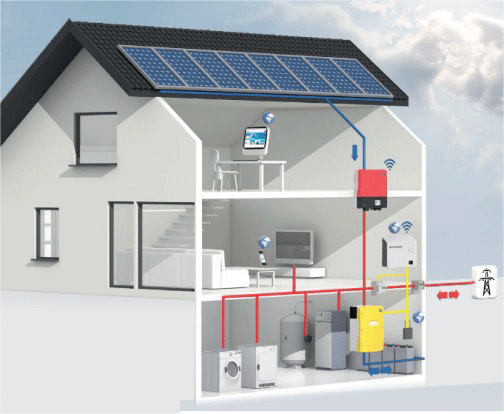 There are over 2 million homes with solar PV or solar water heating installed on their homes, which equates to 24 per cent of all Australian homes. This growth, the shift in consumption patterns and changing paradigm of how our electricity industry delivers energy is a direct result of the Renewable Energy Target. It is making Australians more personally responsible for the way they consume electricity. The “age of entitlement” is over and the Renewable Energy Target is a positive driver.
A Labor win in Queensland will be a win for solar energy

 Queensland Labor Promises Solar Support http://www.energymatters.com.au/renewable-news/queensland-labor-solar-em4657/ January 26, 2015 Queensland Opposition Leader Annastacia Palaszczuk has committed Labor to boosting the state’s renewable energy sector if it wins the election.
“In office Labor will call for proposals to generate 40-megawatts of base-load renewable energy including solar power. This will be used as a trial for more renewable power plants,” said Ms. Palaszczuk.
Labor would also investigate introducing competition in the power sector by enabling remote area councils to generate electricity from renewables to be sold at a lower cost to consumers.
“We will also initiate a renewable energy study to investigate measures to create an export-orientated renewable energy economy here in Queensland,” said Ms. Palaszczuk; who additionally promised an independent review to determine a fair price for a solar feed-in tariff based on all the benefits it provides, “rather than the requirements of large companies.”
Ms. Palaszczuk accused the LNP of being stuck in the past and pointed out after the last election Campbell Newman reneged on promises on renewable energy; cutting $660 million in related programs.
Clean Energy Council Chief Executive Kane Thornton said while Queensland has seen a huge number of households install solar power systems, the state trails behind others when it comes to new large-scale renewable energy developments.
“The Queensland Opposition’s plan to generate 40 megawatts of power from solar and other renewable sources is a welcome move, particularly in light of the ongoing review of the federal Renewable Energy Target – which has caused investment in the sector to collapse,” said Mr Thornton.
The Australian Solar Council also welcomed Labor’s announcement.
“Labor has released a solar plan for the Sunshine State, which is responsible and affordable and will restore confidence in a battered solar industry,” said Australian Solar Council CEO John Grimes.
“Labor’s solar policy stands in stark contrast to the contempt shown by the Newman and Abbott Governments towards solar families and workers.”
If the Council’s Save Solar Community Forum in Townsville last week is anything to go by, the LNP should be very worried – it was a standing room only event. The next forum is at Springwood on Thursday, January 29.
Last week the Greens also unveiled their solar policy, which would ensure all Queensland solar households are paid a fair price for their electricity exports. The policy would also provide 100,000 extra households the opportunity to control their power bills by installing solar.
1 This month


Help Aunty Sue Protect Her Land and Sacred Sites From Destructive Rocket Testing.
.

Australians deserve the truth
about
AUKUS – https://aukuspublicinquiry.com/

PETITION – To: Prime Minister Anthony Albanese and the Australian Labor Government

of the week – Australians for War Powers Reform (AWPR)
To see nuclear-related stories in greater depth and intensity

