South Australia scaling back feed -in solar payments to householders
 Payments slashed for solar homes that feed into grid in SA
But if you installed the same sized system before October 2011 you would potentially be pulling in $4836 per year.
Those payments will continue until June 30, 2028.
The retailer feed-in tariff, which must be paid by your energy provider, was set at 7.6c/kWh last year but fell to 6c once the carbon price was removed.
The Essential Services Commission of South Australia has further reduced it to 5.3c/kWh because it “reflects the forecast wholesale market value of photovoltaic (solar) electricity in the coming year’’.
“The proposed value is lower than the 2014 retailer feed-in tariff of 6.0 cents/kWh, due to the lower forecast wholesale market price of electricity,’’ ESCOSA says.
Individual energy retailers can elect to pay householders more for their power.
The original 44c/kWh feed-in tariff was taken up by more than 100,000 householders before it was closed by the Government in September 2011, and reduced to 16c/kWh. Householders who receive these payments are also eligible for the 5.3c payment which is paid by energy retailers.
Those who signed up before the cut-off receive the higher tariff until the scheme expires in 2028, costing an estimated $1.425 billion — an amount recovered through fees charged to all electricity customers.
The initially generous scheme was designed to foster the growth of the solar industry.
Solar panel prices have plummeted since then, with larger systems much more affordable now.
Victory for science and public health in removal of Waubra Foundation’s health charity status
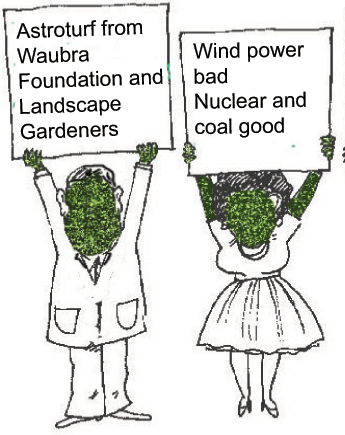 Removal of anti-windfarm group’s charity status is a ‘victory for science’, Shalailah Medhora, Guardian 19 Dec 14 Greens say decision by regulator to remove Waubra Foundation’s tax-deductible status is ‘a victory for science and a victory for public health’……..“The Waubra foundation should never have been granted status as health promotion charity, and the fact that it has now lost that status is a victory for science and a victory for public health,” Greens senator Richard di Natale said.
“I’m glad that we will no longer be lending legitimacy to an organisation that may be harming people in an effort to undermine an important source of clean and renewable energy.”……..
Simon Chapman, a professor of public health at Sydney University, said the foundation had “made it their business” to spread fear and mistrust of wind turbines……..
The Waubra foundation is named after the Victorian town of Waubra, which has become a hub for wind-powered energy, with 128 turbines in the area.
Many of the town’s inhabitants have distanced themselves from the group, and called on it to remove the town’s name from its title…….http://www.theguardian.com/environment/2014/dec/19/removal-of-anti-windfarm-groups-charity-status-is-a-victory-for-science
New technology will double savings for solar panel owners in Canberra
“Unlike traditional generators, consumers who become prosumers can can flip, so when electricity prices are low they will be consumers, when prices are high they will be generators.

Reposit Power’s GridCredit technology a game changer for energy market, Canberra Times, December 14, 2014 – John Thistleton Solar panel owners will more than double their savings with new technology being launched today. Owners of solar panels in Canberra will be offered new technology from Monday, which will more than double their savings on electricity prices.
A group of investors and electricity industry specialists are investing almost $100,000 to commercial the system, which they believe will be a game changer for the energy market.
Our goal is to get their bill as low as possible. Luke Osborne
The Australian Renewable Energy Agency will announce $445,000 funding for Canberra technology company Reposit Power to trial the solar storage and trading system, ahead of a national roll-out next year.
Reposit director Luke Osborne says for the first time solar customers can store their renewable energy and sell it back to the grid for a profit. Continue reading
Perth council wants renewable energy to be a requirement in home building plans
 Perth council to seek mandate on renewable energy for new homes, ABC News, 10 Dec 14 720 ABC Perth By Emma Wynne A Perth council is hoping to radically alter its planning scheme to require new homes to have their own energy supply.
Nedlands council, which covers some of Perth’s wealthiest suburbs, will apply to the WA Planning Commission to alter their planning scheme to require installation of onsite power generations, such as solar panels or wind power, in all new home building…….http://www.abc.net.au/news/2014-12-10/perth-council-hopes-to-mandate-renewable-energy/5954842
Huge majority of Australians back solar and wind energy
 Solar and wind energy backed by huge majority of Australians, poll shows, The Guardian, Oliver Milman, 9 Dec 14 Renewables among top three energy choices and a separate review debunks fears of health damage from wind turbines Solar and wind energy enjoy strong support from the Australian public, with 80% of people putting them both among their top three energy choices in a poll for the Australia Institute.
By contrast, coal and coal seam gas were chosen by 35% and 38% of those polled as being among the best three future energy sources.
A separate review of medical literature by the Australia Institute debunked the fear that wind power damaged people’s health, finding “no credible evidence” directly linking exposure to turbines with negative health effects.
The poll of more than 1,400 people showed that solar was the popular energy choice of the future, cited by 63% of respondents. Nine out of 10 people said they wanted more solar energy. Six in 10 people said they were concerned about the impact of coal and coal seam gas on the landscape.
Despite this apparent desire for renewables – as well as the country’s vast capacity for such energy – the Australia Institute report states that Australia now produces “only the world average level” of solar energy.
While the production of solar PV panels is relatively energy intensive, the report concedes, solar’s output of greenhouse gases, and its impact on air quality, is completely overshadowed by the burning of coal.
Wind has the potential to supply 40% of Australia’s energy needs, the report says, but the industry has been blighted by the “considerable attention” placed on the perceived health effects of wind turbines.
The Australia Institute points out that the National Health and Medical Research Council recently conducted a review of the scientific literature on the connection between windfarms and health and found there was “no consistent association between adverse health effects and estimated noise from wind turbines”……….http://www.theguardian.com/environment/2014/dec/08/solar-wind-energy-sources-huge-majority-australians-poll-shows
Australian businesses lose $millions as action on renewable energy is delayed
 RET Impasse Costing Australian Renewables Millions http://www.energymatters.com.au/renewable-news/ret-impasse-cost-em4594/ December 11, 2014 Energy Matters The Federal Government’s drawn-out review of Australia’s Renewable Energy Target is costing the sector between $400 and $500 million a year in lost investment, according to the Clean Energy Council.
An analysis by the CEC says the ongoing impasse will continue to wreak more than $400 million of damage every year to renewable energy projects already operating.
CEC Chief Executive Kane Thornton said the RET had delivered $10 billion worth of investment in large-scale projects to date; investments made in good faith that the legislated target would continue unchanged.
“A breakdown in that bipartisanship has had a material impact on the market confidence in the policy and is affecting the revenue that flows to those projects,” Mr Thornton said.
“We are staring down the barrel of job losses, business closures, negative financial effects on the $10 billion of renewable energy projects already operating, and a halt in the development of new large-scale renewable energy projects across the country.”
Referring to 2014 as a dark year for large scale renewables, Mr. Thornton points out more than $2 billion was invested in 2013, but the first three quarters of this year has seen a comparatively paltry $238 million invested – directly the result of the Federal Government’s apparent determination to gut the RET.
“If the government is genuine about its intent to resolve the current political impasse, move beyond its previous position and support a target that delivers a strong future for renewable energy in Australia, we would encourage Labor to return to negotiations,” said Mr. Thornton.n November, the ALP walked away from negotiations with the Federal Government that would have resulted in the dilution of the RET.
The CEC briefing paper “Lost opportunity and big costs: The impact of an unresolved RET review” can be downloaded here.
A very recent example of the impact the situation is having is in the NSW Southern Tablelands where a fourth generation farmer had hit tough times – and wind turbines were to be his saviour. However, with the continuing RET uncertainty,the farmer may still have to sell his property – one that has been in his family for four generations. This particular situation goes beyond this single farmer’s woes, with jobs and investment in the local region also at stake.
In October, a major wind turbine tower manufacturer in Victoria announced it will be shedding 100 jobs; partly due to the RET situation.
Even where concessions have been made concerning the RET, there still appears to be a great deal of devil in the detail. Yesterday, ClimateSpectator reported Environment Minister Hunt’s office communicated that “solar up to 100kw is proposed to stay in the SRES due to the red tape that would be involved if it moved into the LRET.”
There had been fears commercial solar would be lumped in with the large-scale target. Even this good news came with a potential barb. It’s unclear if up-front deeming will remain; i.e. whether the full government subsidy will continue to be made available upfront when a system is installed; rather than incrementally as the power is generated – as is the case with projects under the LRET
Australian Renewable Energy Agency (ARENA) survives and thrives
 ARENA was set up in 2012 by the Gillard government to boost the competitiveness of renewable energy technologies in Australia, and to increase the supply of renewable energy
Having announced $2 million funding for a renewable biomass project last week, ARENA’s CEO says the organisation has no intention of stopping any time soon.
Prime Minister Tony Abbott announced in the May budget that the government would axe the statutory organisation, grab its unallocated $1.3 billion project funding and roll any of its leftover functions into the Department of Industry.
Since then, the organisation — which can only be dismantled by repealing the Australian Renewable Energy Agency Act 2011 — has been fighting for its life.
Australia’s federal Lower House voted on September 1 to repeal the act and abolish ARENA, but the ensuing stalemate in the Senate has meant a stay of execution for the ardent champion of renewable energy.
Indeed while the government’s original plan might have been to eliminate ARENA, expectations of its death now appear exaggerated. The body was granted a last minute reprieve after Palmer United Party Senator Clive Palmer struck a deal with the government to retain ARENA; but to cut its project funding by $435 million – which also covers some of the organisation’s operating costs – and defer $370 million, in return for backing the carbon tax repeal.
 The effect is that the public service now has what amounts to zombie agency: Finance Minister Mathias Cormann has made no bones about the fact he wants to see ARENA scrapped, he just doesn’t have the numbers in the Senate to do it.……………
When Government News spoke to ARENA chief executive Ivor Frischknecht, he said the organisation was still firing on all cylinders.
“We still have the money. We are still accepting applications and making grant awards,” Mr Frischknecht said.
“We’re very much in business. Continue reading
Clean energy industry wants a renewable energy target that will ensure a business future for clean energy
Clean energy industry urges Labor to resume RET talks, The Age December 10, 2014 – Lisa Cox National political reporter Clean energy companies are urging Labor to resume talks with the government over Australia’s renewable energy target to try to break an impasse they say is crippling the industry.
It comes as the Clean Energy Council publishes a report that says the breakdown of bipartisanship will strip existing investments in the clean energy sector of hundreds of millions of dollars each year.
The Clean Energy Council’s report finds that if bipartisanship is not restored, “an unresolved RET review would cause a further collapse in the value of Renewable Energy Certificates” leading to annual revenue losses of $400 to $500 million for existing renewable energy projects.
In some cases this would lead to the collapse and closure of businesses, significant job losses from an industry that directly employs 21,000 people, and the “loss or postponement of more than $14.5 billion in future investment out to 2020”, according to the study…………….
The government has not budged from its starting point, which would reduce the target from 41,000 gigawatt hours of baseline power by 2020, to about 27,000 gigawatt hours – a so called “real 20 per cent”……………….
Clean Energy Council chief executive Kane Thornton said a possible deal with the cross bench would not restore investment certainty and both major parties would have to find an acceptable compromise.
“We’re encouraged from the sentiment from the government to want to move forward and resolve this,” Mr Thornton said.
“Our assumption is that the government is therefore prepared to move from its previously stated position of real 20 per cent.
“Clearly that proposal was entirely unacceptable for the industry.
“If they are we’d encourage Labor to return to the negotiations to achieve an outcome that guarantees a strong future.” Since the government launched its review of Australia’s target, headed by climate sceptic and businessman Dick Warburton, investment in renewable energy has stalled.
Bloomberg New Energy Finance reported that investment for the first three quarters of 2014 was just $238 million, compared to $2 billion for the whole of 2013.
Mr Thornton said a target in the twenties or low thirties would destroy investment in the sector, but the industry was “open to talking about trajectory and numbers” in the mid-thirties range.
Mr Butler said on Tuesday: “We haven’t seen any commitment from the Government that they’re moving from their position of a 40 per cent cut to the RET.
“We’re up for a discussion if they are prepared to shift their position but this industry has said no deal is better than a bad deal.” http://www.theage.com.au/federal-politics/political-news/clean-energy-industry-urges-labor-to-resume-ret-talks-20141209-123kkj.html
World first – Australian breakthrough in solar energy efficiency
Solar energy world first in Australia http://www.brisbanetimes.com.au/environment/climate-change/solar-energy-world-first-in-australia-20141207-121w8n.html December 8, 2014 Peter Hannam
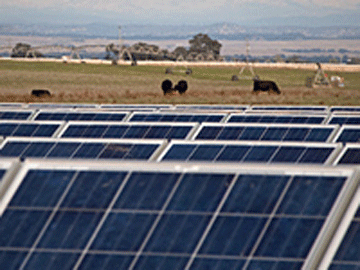 Australian solar power researchers have achieved world-beating levels of efficiency, potentially making large solar plants more competitive with other energy sources such as coal.
A team from the Australian Centre for Advanced Photovoltaics (PV) at the University of NSW has achieved 40.4 per cent “conversion efficiency” by using commercially available solar cells combined with a mirror and filters that reduce wasted energy.
Martin Green, the centre’s director, said the independently verified breakthrough eclipsed previous records without resorting to special laboratory PV cells that “you’ve got no chance of buying commercially”. Other top-performing solar panels convert about 36 per cent of the sunlight that falls on them into electricity.
The advance involved two steps. Three solar panels were stacked to capture energy from different wave lengths of sunlight, and then excess light from the stacked panels was directed by a mirror and filters to a fourth PV cell, making use of energy previously discarded.
“This is our first re-emergence into the focused-sunlight area,” said Professor Green, who pioneered 20 per cent-efficiency levels in similar technology in 1989.
The institute was prompted to revisit the technology in part because of Australian companies’ efforts to develop large-scale solar towers using arrays of mirrors to focus sunlight on PV cells.
One of those firms, Melbourne-based RayGen, collaborated with UNSW on the project. It is building a plant in China with an solar conversion rate of about 28 per cent. “We’d take them to the mid-30s” for future projects with the technology jump, Professor Green said.
Professor Green was critical of the federal government’s efforts to scrap the Australian Renewable Energy Agency – which chipped in $550,000 to the $1.3 million Power Cube project – and for its ongoing attempts to reduce the Renewable Energy Target set for 2020.
“A positive attitude to renewables would boost all these initiatives, a negative attitude will suppress them,” he said. “Clamping down on deployment of renewables will make it more difficult for developments like this to see the light of day.”
The next goal is to raise efficiency levels to 42 per cent next year, about half way to the theoretical maximum level of 86 per cent.
“It’s horse and buggy days as far as solar is concerned at the moment. There’s just this enormous potential for improvement in efficiency,” Professor Green said.
“To turn your back on those types of developments doesn’t seem to me to be a very sensible strategy.”
The university’s Mark Keevers led the engineering work on the so-called high efficiency spectrum splitting prototype, and its results were confirmed by the National Renewable Energy Laboratory (NREL) at its outdoor test facility in the US.
Need to be alert on solar panel safety, too
Solar panel safety warning http://www.watoday.com.au/wa-news/solar-panel-safety-warning-20141206-121n4t.html December 6, 2014 The state’s energy safety watchdog has issued a warning about solar panels installed during the past year.
The Director of Energy Safety, Ken Bowron, said some of the systems had used dangerous power switches.
“The switches are used to disconnect the current produced by solar panels so electricians can work safely on a home or business,” he said. The defective switches are NHP dc Solar Isolator Swtiches KDA-432 and KDM-432. The supplier of the switches has issued a product recall.
“The defective switches were sold between July 2013 and October 2014. It is important that anyone who had a solar system installed between these dates checks if any of the defective switches have been fitted to the installation,” Mr Bowron said.
City of Sydney’s Renewable Energy Master Plan has won the European Solar Prize 2014 award
 Sydney gets international recognition for renewable energy plan http://www.thefifthestate.com.au/politics/local-government/sydney-gets-international-recognition-for-renewable-energy-plan/70135 2 December 2014
The City of Sydney’s Renewable Energy Master Plan has won the European Solar Prize 2014 award for excellence and innovation.
The award from not-for-profit organisation EUROSOLAR recognises outstanding commitment and contributions to the renewable energy sector.
“Our Renewable Energy Master Plan will help us transform Sydney into a city run entirely on renewable energy by 2030,” Lord Mayor Clover Moore said.
“The City is Australia’s first carbon-neutral government with ambitious targets to reduce emissions by 70 per cent by 2030. We are delighted that our renewable energy master plan has received this prestigious recognition on a global scale.”
The City’s renewable energy master plan was nominated by renewable expert and president of EUROSOLAR Peter Droege.
“The City of Sydney’s renewable energy master plan demonstrates civic vision, technological leadership and political courage,” Mr Droege said.
“The plan demonstrates a commitment to a fully renewable energy based community and is a stellar model for other communities around the world to aspire to.”
South Australia’s innovative solar powered farm Sundrop goes from strength to strength
Sundrop gets $100m injection from KKR to grow tomatoes in SA desert http://www.theage.com.au/business/sundrop-gets-100m-injection-from-kkr-to-grow-tomatoes-in-sa-desert-20141204-1208fm.html December 4, 2014 Simon Evans
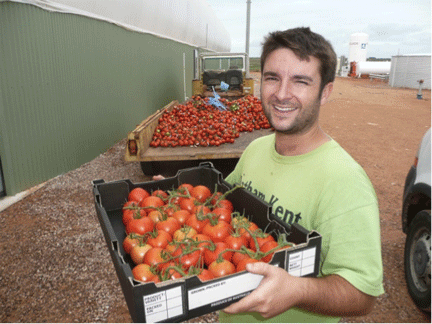
Sundrop Farms has received a capital injection from private equity firm Kohlberg Kravis Roberts to aggressively expand its operations, which grow tomatoes on desert land north of Port Augusta in South Australia using solar thermal energy and desalination. Continue reading
Success of solar energy plus storage in remote and rural Australia
Solar plus storage becoming “new normal” in rural and remote Australia, pv magazine, 03. DECEMBER 2014 | BY: JONATHAN GIFFORD
PV arrays coupled with battery storage systems are becoming the “new normal” in Australia’s wide-open spaces. The number of installations continue to increase as governments and businesses begin to realize the new reality of off or edge-of-grid solar+storage affordability.
Rapidly falling costs in solar and battery storage technology, coupled with an increasing familiarity with the technology is driving these solutions into the mainstream in remote areas of Australia. In Western Australia a growing number of innovative solutions are providing proof of the technological solution and its economic advantages.
In a demonstration of the shift in thinking that is taking place, the state’s Minister of Energy Mike Nahan has acknowledged the strong economic case for solar+storage and has called for the state’s rural and remote utility to accelerate its uptake. Nahan has previously expressed doubts about renewable energy and, as a strong advocate of free-market principals, is not a supporter of subsidies for renewable deployment.
In response to questions raised in the WA parliament last week about the poor level electricity supply to the remote mining town of Ravensthorpe, Nahan said that the local utility Horizon is investigating a number of solutions including a micro-grid with decentralized solar component.
“I am not a technologist,” Nahan initially cautioned. “[However] we could tell everybody in Ravensthorpe to put in solar and have a wind–diesel–solar combination. They already have a micro-grid. These are the things that Horizon is supposed to look at, and we will go down and discuss it.”
Nahan continued that he had “entrusted” the utility to come up with alternative electricity solutions for supplies to remote towns such as Ravensthorpe. He has also appointed a renewable energy expert, Ray Wills, to the board of the utility. Wills is the former head of the now-defunct Sustainable Energy Association.
The parliamentary exchange was reported by the leading Australian cleantech site RenewEconomy.
This shift in thinking comes after a UBS report last month that solar+storage is already economic in some parts of Australia.
Real-world applications
While the apparent about-face of the WA Energy Minister is impressive, solar+storage arrays are going into remote Australian communities on an increasingly regular basis.
In the mid-west region of Western Australia, the Meta Maya Regional Aboriginal Corporation has announced that it will install a 100 kW solar+storage system at its headquarters in Wedgefield, Port Hedland. The array will be coupled with a 76 kWh lithium ion battery bank and backed up by a 40 kW diesel generator………….http://www.pv-magazine.com/news/details/beitrag/solar-plus-storage-becoming-new-normal-in-rural-and-remote-australia_100017360/#axzz3L3cb1lHh
89% of Australians support Renewable Energy Target
Almost 90% of Australians support renewable energy target, says poll, Guardian, Lenore Taylor, political editor Tuesday 2 December WWF poll finds overwhelming support for RET, particularly in Victoria, South Australia and Tasmania, as senators consider deal. Almost 89% of Australians want the renewable energy target increased or kept the same, according to new polling designed to shore up Senate opposition to plans by the government and some crossbench senators to wind back the policy.
The polling found support for the policy – which requires that 41,000 gigawatt hours of electricity be sourced from renewables in 2020 – was even higher in Victoria, South Australia and Tasmania, the home states of crossbench senators Ricky Muir, Nick Xenophon and Jacqui Lambie who hold deciding votes on any attempt to push RET change through the Senate.
Commissioned by WWF, the Reachtel polling found a strong majority of voters in the three states thought it was “very important” for the federal government to invest in renewable energy (60% in South Australia and 62.4% in Victoria and Tasmania, compared with 59.8% nationally).
Talks between the Abbott government and the Labor opposition to find a bipartisan agreement on the RET have broken down and a “compromise” plancirculated by Liberal Democrat senator David Leyonhjelm is understood not to have the support of senators Bob Day, John Madigan and Jacqui Lambie.
The government had originally signalled it wanted very deep cuts to the target – and commissioned the businessman and self-professed climate sceptic Dick Warburton to undertake a review, which recommended it be slashed to about 16,000 gigawatt hours……..
The poll found very high support for the RET among swing voters – those considering changing their voting preference from 2013. Some 88% of those voters think the RET should be increased or stay the same and 64% of those considering a change in vote supported an increase to the RET, with only 12% supporting a decrease. And 62% were more likely to vote for a party that supports keeping or increasing the current RET.
“Cutting the RET makes no sense. It will see Australia’s carbon pollution go up, sustainable energy jobs lost and investment shut out. It’s also out of line with public sentiment which is clearly in favour of supporting growth in Australia’s renewable energy sector, including wind and solar,” said WWF spokeswoman Kellie Caught.
Polling has repeatedly found very strong voter support for renewables. Another recent poll by the Australia Institute found 64% of self-identified Liberal voters supported an increased target.
But the current impasse has seen investment dry up, and if it is not resolved, electricity retailers will run out of new renewable energy to buy to meet their legislated requirements – forcing them to pay a “penalty” price.
The Reachtel poll, conducted on 26 November, contacted 5,036 voters around Australia, including 1216 in Victoria, 934 in Tasmania and 873 in South Australia. http://www.theguardian.com/environment/2014/dec/02/almost-90-of-australians-support-renewable-energy-target-says-poll
Byron Bay to get Australia’s first community-owned clean energy generator?
 Byron Bay residents push for Australia’s first community-owned clean energy generator, ABC News By Kerry Brewster , 26 Nov 14 Australia’s first community-owned clean energy generator and retailer is taking shape in the counter-culture capital of Australia.
Known for its alternative lifestyles, the Northern Rivers region of New South Wales is hoping to establish a not-for-profit energy company – Northern Rivers Energy – to rival the big retailers………
Northern Rivers Energy wants to attract 20,000 members, who would be able to buy, generate or invest in the enterprise.
After a feasibility study funded by the NSW Government is completed, a series of public meetings will begin.
Ms Crook has little doubt the people of the Northern Rivers will seize the opportunity to take control of their energy production………..
Rooftop solar and other renewables attractive for communities
With a surge predicted in rooftop solar and other power sources, renewable energy expert Giles Parkinson said consumers should expect profound change to electricity systems.
“The traditional domination by the three big retailers, that’s something of the past. How it evolves will be very interesting to see but certainly community ownership and the community-owned retailer is one of those options and we’ve seen it happen in Germany and other parts of Europe where it’s very powerful because you have people grouping together,” Mr Parkinson said.
“They’re not trying to make massive profits and they’re responding to what the people want to do.”……..
John Truman, manager of civil services for Ballina Shire Council, said his was one local council keen to get involved.
“We’re very interested in renewable energy sources so the opportunity to talk to anybody to assist in our future projects is something we’d be very interested in,” Mr Truman said. http://www.abc.net.au/news/2014-11-27/byron-bay-pushes-for-community-owned-clean-energy/5920272
1 This month



Help Aunty Sue Protect Her Land and Sacred Sites From Destructive Rocket Testing.
.

Australians deserve the truth
about
AUKUS – https://aukuspublicinquiry.com/

PETITION – To: Prime Minister Anthony Albanese and the Australian Labor Government

of the week – Australians for War Powers Reform (AWPR)
To see nuclear-related stories in greater depth and intensity

