Wind power surging ahead in South Australia
The $450 million addition of 90 turbines increases the farm’s capacity from Sunday by 1350 gigawatt hours a year, enough to power 230,000 homes.
The wind farm in the state’s mid-north is now the largest in the state, the government says.
The Premier has also warned projects such as the Snowtown wind farm are at risk if the federal government scaled back the Renewable Energy Target.
Mr Weatherill told media the project is creating ‘a new future for this region in South Australia’, but a scaling back of the RET would see large scale renewable initiatives become unviable.
Clean Energy Finance Corporation’s success – making money, cutting greenhouse emissions
Green bank makes money, cuts emissions http://www.heraldsun.com.au/news/breaking-news/green-bank-makes-money-cuts-emissions/story-fni0xqi4-1227108689612?nk=0c29fda6cefe7b7916e293378f3d795c PAUL OSBORNE, AAP SENIOR POLITICAL WRITER OCTOBER 31, 2014
IT may be able to cut carbon emissions for $2.40 a tonne, but the Clean Energy Finance Corporation still faces the government axe.
THE CEFC, set up by Labor to leverage investment in a wide range of clean energy projects, has built a $931 million portfolio in its first full year of operation.
- Chairwoman Jillian Broadbent said in the corporation’s annual report it had leveraged $2.20 for every $1 to produce projects valued at over $3.2 billion.Once the projects are running they will abate 4.2 million tonnes of carbon dioxide, achieving an effective “carbon price” of $2.40 a tonne.However, the CEFC has been asked by Treasury to prepare its accounts for the mid-year economic and fiscal outlook due in December on the basis that it will stop making investments on December 31 and cease operating on June 30, 2015.The one thing standing in the way of this is the Senate, with the Palmer United Party, Greens and Labor opposed to the corporation’s abolition.The annual report is expected to give further ammunition to their argument to keep it running for the long-term.
The CEFC reported its portfolio would return an average seven per cent, or 3.5 per cent above the government rate.Across its portfolio are wind, solar and bioenergy projects, innovative energy efficiency programs and low emissions technology in manufacturing, building and local government.Despite uncertainty about its future, the CEFC is in talks with more than 30 project backers seeking $1.2 billion in finance for total project costs of over $3 billion.It is understood there are discussions within the government on how the CEFC could co-operate with the government’s $2.55 billion emissions reduction fund passed by the Senate on Thursday.
Renewable energy projects funded by community action
 Citizen funded renewable energy projects EcoGeneration — April 2014
Margaret Hender from the Citizens Own Renewable Energy Network Australia explains the citizen owned renewables funding mechanism and highlights what is needed to encourage uptake of the concept.
The Citizens Own Renewable Energy Network Australia (CORENA) brings together people in the community who are keen to contribute to action on climate change and that technology by enabling people to help collectively fund practical renewable energy projects.
Passing on the benefits of renewables
At first glance there is nothing particularly unusual about the 7 kilowatt high quality solar photovoltaic (PV) system that was installed in November 2013 on the roof of Tulgeen Disability Services in Bega, New South Wales. It will provide 58 per cent of the electricity used by the Tulgeen cheese packaging facility, which employs people with disabilities, and 21 per cent of the usage at the Training and Education Services day programs centre.
The novel element is the mechanism used to fund the project. CORENA gave Tulgeen an interest free loan of $12,000, funded entirely by voluntary contributions from citizens across Australia. Tulgeen CEO Pete Gordon plans to repay the zero interest loan in three years from the savings in power bills, however, the system will be generating electricity for 25 years. This translates into reduced costs for Tulgeen’s clients and a greater range of services able to be offered by the centre.
This represents a win-win scenario. Tulgeen chose to cover part of the cost themselves, but typical solar PV installations funded by CORENA don’t cost community organisations a cent, and their loan repayments help to fund installations for other organisations.
How CORENA began………..
Quick Small Projects
CORENA’s donated seed funds allow us to pursue what is needed, rather than being bound by conventional financial constraints.
CORENA’s Quick Small Projects take the capital expense out of energy efficiency and solar installations for community serving organisations by using donated funds to give interest free loans. As the loans are repaid out of savings from power bills, the funds then revolve into the next project, and then the next. When approximately 120 projects are funded, there will be enough revolving seed money to fund one new project per month on an ongoing basis. Our Quick Small Projects will then essentially cost nothing. To reach this point, we will need around $2.4 million in seed funds, or $24 from each of 100,000 people.
Solar thermal: the Big Win Project
Similarly, all income generated by CORENA’s solar thermal Big Win Project will be paid forward to help build additional utility-scale projects…….http://ecogeneration.com.au/news/citizen_funded_renewable_energy_projects/089762/
Some more community renewables organisations
Citizen funded renewable energy projects EcoGeneration — April 2014
Embark (Aus)
Embark works to shift the community energy sector into the mainstream, as a proven and financially viable model capable of attracting large-scale investment and growing to meet its full potential.
Hepburn Wind (Aus)
Hepburn Wind is the owner and operator of Australia’s first community owned wind farm, at Leonards Hill, just south of Daylesford, Victoria. The 4.1 MW wind farm comprises two turbines and is approximately 100 km north-west of Melbourne.
The Community Power Agency (Aus)
The Community Power Agency was set up to support community groups in navigating the complex process of setting up a community owned renewable energy project.
Ranges Energy (Aus)
Ranges Energy is a community co-operative managed by a volunteer board of directors elected by shareholders. Ranges Energy grew out of a joint initiative of engineer Antony Howard of Sustainability Engineering and the Dandenong Ranges Renewable Energy Association. The project was inspired by similar community energy projects around the world.
Denmark Community Wind Farm (WA, Aus)
Denmark Community Wind Farm Incorporated is a non-profit community group, incorporated in September 2003 to progress legal and financial structures for an organisation to own and operate Denmark’s community wind farm project in Denmark, Western Australia, as a local response to the global challenge of climate change.
Burger Windpark Gehlenberg GmbH and Co KG (Germany)
The Burger Windpark, located in Lower Saxony, Germany, includes 19 turbines each of 1.5 MW capacity and is a successful community owned wind farm. The project was initiated by the local farmers’ association and the manager of the local farmers’ bank, Raiffeisenbank.
RE-volv (US)
RE-volv is building a citizens movement for solar energy by helping people to invest in solar, building solar projects in communities, and educating people about the benefits of solar in the US.http://ecogeneration.com.au/news/citizen_funded_renewable_energy_projects/089762/
AGL electricity utility wants complete scrapping of Renewable Energy Target!
 AGL Energy calls for renewables target to be scrapped completely Echo Net Daily 28 Oct 14, RenewEconomy, by Giles Parkinson
AGL Energy – once the ‘greenest’ retailer in the country and now the largest producer of coal-fired energy – has called for the renewable energy target to be scrapped altogether.
As speculation increased in Canberra and media circles that the Abbott government and Labor would agree on a compromise that would result in a significant hair-cut to the current 41,000GWh target, AGL intervened in the debate by saying that was not good enough – the RET should be dumped completely.
Chief executive Michael Fraser, who has overseen the change in AGL Energy’s business model fromgreen to black, says the RET policy is broken. He endorses the controversial Warburton Review’s more extreme finding that the target should be dumped altogether.……..
There are a couple of issues with what Fraser has said. For a start, as all the inquiries to date have found, the RET has actually worked very well. It spurred billions of dollars of investment, thousands of jobs, and in states such as South Australia has caused dramatic falls in emissions.
What has caused the hiatus in the last two years is the uncertainty caused by the Abbott government’s review, and the inability of developers to get power purchase agreements from the likes of AGL Energy and others, and therefore to get finance. Still, the government likes to use the ‘target is impossible’ argument – despite its own modelling rejecting the idea. ……
AGL Energy has an interest in not having a carbon price, or a renewable energy target, particularly since its purchase of the 2.2GW Loy Yang A brown coal generator, and the 4.6GW Bayswater and Liddell coal-fired generators in NSW. That changed the colour of its revenues to $12 black for every $1 of green energy.
As it made clear in July, its long-term business interests now lie firmly in removing environmental policies such as the carbon price and renewables:
‘While the removal of the carbon tax and associated transitional assistance has a negative impact on the short-term earnings of the Loy Yang A power station, it has a materially positive impact on its long-term value. Any reduction in the Renewable Energy Target would also have a positive impact on the value of Loy Yang A.’ Ditto for Macquarie Generation.
AGL Energy, therefore, has an interest in ensuring that carbon and renewables do not trouble its business plan. ………http://www.echo.net.au/2014/10/agl-energy-calls-renewables-target-scrapped-completely/
Esperance ideal area for localised, distributed renewable energy generation
 Report finds renewable energy supply critical to Esperance future By JESSE McCARTHY-PRICEhttp://www.esperanceexpress.com.au/story/2645482/renewable-energy-key-to-esperance-development/?cs=1268 Oct. 23, 2014 ESPERANCE’S economic future would be bolstered by investment in renewable energy, according to a report Esperance Region Economic Development Strategy.
It identifies Esperance as a viable place for renewable energy generation opportunities due to an abundance of natural assets, available land and being close to infrastructure. “Esperance has a strong history of embracing renewable technology with the Ten Mile Lagoon wind farm one of the state’s first commercial-scale renewable projects,” the report said.
“Energy cost and access is currently a critical barrier to economic development for a significant proportion of the Esperance region. “Enabling reliable access to cost-effective energy will greatly enhance the viability of new and existing operations and make the region more competitive with alternative residential and investment destinations.”
Not being connected to the South West Interconnected System power grid prevented large scale energy generation and export for the region.
“However, the isolation of the region may make it attractive as a trial area for new renewable technologies given appropriate marketing, incentive and inducement,” it said.
“The isolation also makes the region ideal for localised, distributed generation.” Esperance Chamber of Commerce and Industry chief executive Grant Shipp said lowering energy costs would benefit local business.
Australian Progressive Party bats for renewable energy, puts coal-fired power generation industry on notice
 New Renewable Energy Policy seeks Industry Certainty http://www.newsmaker.com.au/news/32830/new-renewable-energy-policy-seeks-industry-certainty#.VE6nPCLF8nk October 27th, 2014 – Australian Progressive Party
The Australian Progressive Party has released a confident renewable energy policy that seeks to provide certainty for an industry that is currently suffering from the inconsistency and short-sightedness of successive Australian governments.
The policy commits to maintaining the current 41,000GWh National Renewable Energy Target currently at risk due to the Abbott government. At the same time, the party proposes Australia’s emissions reductions targets will increase to a 15% reduction on 2000 levels by 2020, compared with the current 5% commitment, and a cap and trade emissions trading system will be reintroduced. Continue reading
Australian government sticking to its guns, on shooting down renewable energy
 Ian Macfarlane: Coalition is sticking to reduction in renewable energy target theguardian.com, Sunday 26 October 2014 Industry minister says that because electricity consumption has fallen 15%, the RET must be reduced by the same amount The government is sticking to its proposed reduction in the renewable energy target (RET), saying that “nothing has changed” in terms of its climate policy.
Industry minister Ian Macfarlane has told the ABC that cutting the renewable energy target from 41,000 gigawatt hour to 27,000 gigawatt hours is reflective of a fall in household energy consumption………
The Greens leader, Christine Milne, told Sky News that keeping the original 41,000 gigawatt target would drive down energy costs.
“Renewable energy is undermining the business case for the old fossil fuel generators,” she said………
The government can bypass negotiations with Palmer United on the RET if Labor agrees to the changes.
Negotiations on the policy are underway. http://www.theguardian.com/environment/2014/oct/26/ian-macfarlane-coalition-is-sticking-to-reduction-in-renewable-energy-target
Abbott’s costly mistake in gutting the popular Renewable Energy Target
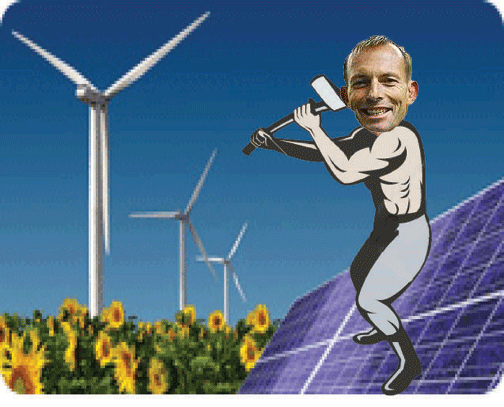 the government doesn’t need to change the laws to damage the renewables industry. The ongoing uncertainty of the policy environment, and the sheer hostility of the Abbott government to renewables of any kind, are already having an effect.
Undermining the Renewable Energy Target Is A Costly Mistake New Matilda, By Ben Eltham 26 Oct 14 Too popular to be dismantled entirely, the RET is being carefully undermined by the government. Aside from the environmental damage we’ll also take a hit to the hip pocket, writes Ben Eltham.
If there was any doubt that the Abbott government wants to destroy the renewable energy industry in Australia, this week’s announcement of its plans for the Renewable Energy Target (RET) has cleared things up. Continue reading
General Electric a “massive investor” in renewable energy worried about changes to Renewable Energy Target
General Electric boss calls for certainty over renewable energy target, SMH, October 23, 2014 Anne Hyland Jeff Immelt, the chief executive of General Electric, one of the world’s largest investors in clean energy, has demanded the federal government provide certainty around its renewable energy target.
Mr Immelt in an interview with The Australian Financial Review said a “certainty of rules” was crucial for investment.
“These debates are all natural that are taking place in Australia and people can understand those,” he said. “But it’s important to know what the rules will be so people can invest around it.”
He said the sooner the uncertainty was resolved around the RET, the “better for everybody”………
General Electric has about $US10 billion ($12.6 billion) in cumulative investments in renewable energy assets globally, which are predominantly in wind and solar.
On its Australian website, GE had noted Australia was leading the world in its renewable energy policy and, as a result, wind energy in Australia was projected to the most commercially viable form of renewable energy over the next five to 10 years.
However, this could change under the government’s plans to alter the RET.
Mr Immelt said GE “began to invest massively” in clean energy after 2004 when it concluded that climate change was real…..
.The federal government’s proposal to almost halve the amount of renewable energy legislated to be to be produced by 2020 has been rejected by the Labor Party after it dismissed it as “completely unacceptable”…..http://www.smh.com.au/business/general-electric-boss-calls-for-certainty-over-renewable-energy-target-20141023-11aoc3.html
Queensland’s solar industry, jobs, on North Coast threatened by changes to Renewable Energy Target
 North Coast solar industry worried by changes to Renewable Energy Target ABC News 23 Oct 2014, The North Coast solar industry says it will be impacted by changes to the Federal Government’s changes to the renewable energy target (RET).
The target is currently set at 41,000 kilowatts of renewable energy by 2020, but the Government wants to reduce that to 26,000 to reflect falling demand for power.
The changes would only impact large-scale RET projects directly, with the small-scale scheme excluded………
Geoff Tosio from Bellingen Solar Depot said the even with the small-scale target excluded, his business will still suffer if the target is lowered.
“In regards to the renewable energy target being chopped down to a “real” 20 percent, if that’s going to happen, then how is that going to happen?” he asked.
“To say that’s not going to affect household solar is quite disingenuous.”
Mr Tosio said a particular concern is that large-scale contracts will be impacted.
“We would see a dramatic reduction in the medium size, commercial size, systems that we sell,” he said.
“So while I think it’s better than the previous position, we’ll probably still see a quarter of the industry go very, very quiet.
“And that will definitely have an impact on employment.”http://www.abc.net.au/news/2014-10-24/north-coast-solar-industry-worried-by-changes-to-renewable-ener/5839124
Hydro Tasmania soon to release its King Island wind energy feasibility study
 King Island’s wind farm fate closes in http://www.themercury.com.au/king-islands-wind-farm-fate-closes-in/story-fnj3twbb-1227095516599 HELEN KEMPTON MERCURY OCTOBER 20, 2014
THE King Island community should know by early next year if their remote Bass Strait home will also become home to the biggest wind farm in the southern hemisphere.
Hydro Tasmania has almost completed a feasibility study into its $2 billion, 200-turbine proposal and is expected to announce early next year if the project will go ahead.
The decision also hinges on the Federal Government not scrapping the Renewable Energy Target. Hydro Tasmania is one of 16 major renewable energy companies who have argued for the retention of the present RET.
The TasWind project is forecast to pump more than $7 million a year into the island economy and provide an estimated $220 million annual revenue boost to the state’s coffers.
Debate over the pros and cons of the proposal has divided the small community and Hydro Tasmania started its feasibility study after 58 per cent of residents indicated they wanted to move on to the assessment stage.
South Australia’s leading renewable energy system
Graph of the Day: Australia’s renewable energy generation, REneweconomy, By Giles Parkinson on 20 October 2014 “…………As RenewEconomy has noted on many occasions, South Australia has the highest level of variable renewable energy in Australia – quite possibly the world (in major economies), with an average 43 per cent wind generation in July, and days in September when wind and solar provided all of the state’s electricity demand, and more.
The AEMO study says that the SA power system can operate securely and reliably with a high percentage of wind and PV generation, including in situations where wind generation comprises more than 100 per cent of SA demand, as long as one of the following two key factors apply:
a) The Heywood Interconnector linking SA and Victoria is operational.
b) Sufficient synchronous generation is connected and operating on the SA power system.
The AEMO study notes that South Australia already has the highest wind and PV generator penetration of any NEM region. As the graph shows, it has 1,470 MW of installed wind generation and 540 MW of PV generation. This represents about 50 per cent and 17 per cent of total installed wind and PV capacity in the NEM respectively.
In terms of residential rooftop PV installations, SA leads the NEM with a penetration rate of almost one in four of all rooftops. And the rate of penetration is likely to grow: the AEMO says that under favourable market and policy scenarios, it is projected that at least 1,000 MW of wind and 500 MW of PV capacity will be added in SA by 2020 – doubling the amount of rooftop solar, and lifting the amount of wind by two-thirds.
The AEMO notes that these developments are a “benefit” to both SA and the NEM. But it also underlines the importance of a strong interconnector with the rest of the NEM – for obvious reasons. Without it, the state would have issues with the required controls to ensure system security. (The report does not address this issue, but Germany is rolling out battery technologies that assume the role of “synchronous” generators and could usurp the primacy of fossil fuel generation. AEMO says the chance of a disconnection is so low is it rated as a “non-credible” event – but just in case ….http://reneweconomy.com.au/2014/graph-of-the-day-australias-renewable-energy-generation-88841
Australian Renewable Energy Agency funding online grid maps to boost renewables
 Grid maps to ‘boost renewables’: ARENA https://www.businessspectator.com.au/news/2014/10/17/renewable-energy/grid-maps-boost-renewables-arena JOHN CONROY ARENA yesterday announced $425,000 funding to create online maps of electricity network constraints to help better inform network investments and increase the use of renewable energy. (EDIS on renewable energy’s crucial new tool, October 17)
ARENA CEO Ivor Frischknecht said the Institute for Sustainable Futures (ISF) at the University of Technology Sydney (UTS) would develop annually updated maps and make them freely available online.
“Currently there is a lack of clear, accessible and timely network information across the National Electricity Market,” Mr Frischknecht said.
“A consistent, standardised approach will be developed with Australia’s poles and wires businesses to make data more accessible and easier to understand and use.
“The maps will help renewable energy and demand management project developers to anticipate network constraints, reduce the need for new grid infrastructure and lower electricity bills. “The new maps may also enable faster development of renewable energy by showing where renewables and demand management can be more cost effective than network upgrades.” ISF Research Director Chris Dunstan said the energy sector is changing quickly and new tools are needed to manage this transition.
“The rapid rise of rooftop solar, local generation, energy efficient equipment and battery storage means managing networks is becoming both more challenging and more collaborative,” Mr Dunstan said.
“The three year project will provide a key resource for developing this collaboration between networks, customer and renewable energy providers.
“It has the potential to lower electricity costs, improve energy services and develop new markets for networks and renewable energy.”
Energy manager of demand management at state-owned Queensland network company, Glenn Dahlenburg, said the network is providing full support to the project to complement its existing efforts to engage broad market participation for developing alternatives to network upgrades.
“Ergon Energy sees these maps as a valuable tool to provide customers and stakeholders with information on the location and value of network improvement opportunities,” Mr Dahlenburg said.
The project has strong support from the network industry through partnerships with Ergon Energy, ElectraNet and TransGrid. Other project partners include ARENA, ISF, NSW Department of Trade and Investment
Biofuels conference October 31 – impportance of biofuels for Australia
Biofuels: the forgotten element in Australia’s renewable energy sector, Transport & Logistics News, October 16, 2014 On 31 October, the Biofuels Association of Australia will hold its annual conference ‘A New Energy for Biofuels’, which will serve as a timely platform for discussion regarding the fragile state of Australia’s developing biofuels industry.
With the future of the biofuels industry under threat as a result of the Australian Government’s about face on the excise tax on biofuels and the dumping of unsustainably-sourced Australian government subsidised foreign biofuels, this conference is set against the backdrop of ever-increasing costs of energy and fuel in Australia.
Australia is the world’s leading per capita contributor to greenhouse gas emissions, with emissions from electricity production currently on the rise for the first time after six years of consistent reductions. The necessity of adopting policies mandating the development and implementation of renewable energy schemes was discussed at the recent UN Climate Summit in New York.
“While countries across the globe have embraced biofuels, Australia is reducing support for our own fledgling biofuels industry, backing away from an energy option which not only guarantees significant economic, environmental and public health benefits but which limits our dependence on foreign imported fuels and creates employment in rural areas,” said Gavin Hughes, CEO of the Biofuels Association of Australia.
In 2001 the then Howard coalition government laid down a world leading vision for growing the renewable sector, putting in place a target for Australian biofuel consumption and setting a Mandatory Renewable Energy Target (now RET) for clean power generation. Both the RET and the Biofuels target were designed to diversify Australia’s energy production mix to include greater investment in clean energy sources. Recommendations such as those contained in the RET review- if implemented – and the changes to biofuels excise support – will have a devastating effect on existing investments in Australia’s renewable energy sector, including the loss of thousands of jobs in the solar, wind and biofuels industries.
Today, a staggering 90% of Australia’s liquid fuel requirement is imported- a dramatic leap from 60% in 2000- and continues to increase despite advances in the potential to use domestically-produced renewable options such as biofuels. This near-total dependence poses a threat to national security as Australia would only be able to independently sustain its energy needs for three weeks without imported fuels.
While many of Australia’s leading trade partners such as China and India have enacted mandates to grow investment in biofuel utilisation, Australia is falling behind global trends as there are no government mandates in place to support the biofuels industry………….
Benefits of biofuels
The advantages of biofuels are extensive and well-known; they encompass benefits impacting the economy, the environment and public health. These include:
- Reduced greenhouse gas emissions; lessened reliance on fossil fuels.
- Economic development opportunities.
- Energy independence and enhanced energy security.
- Improved air quality and associated public health benefits. (According to the OECD, deaths associated with ambient air pollution in Australia have risen from 882 to 1483 over the period of 2005-2010.)
- Job creation, especially in rural areas.
Speaking at the event will be:………http://www.tandlnews.com.au/2014/10/16/article/biofuels-forgotten-element-australias-renewable-energy-sector/
1 This month



Help Aunty Sue Protect Her Land and Sacred Sites From Destructive Rocket Testing.
.

Australians deserve the truth
about
AUKUS – https://aukuspublicinquiry.com/

PETITION – To: Prime Minister Anthony Albanese and the Australian Labor Government

of the week – Australians for War Powers Reform (AWPR)
To see nuclear-related stories in greater depth and intensity

