Australian Renewable Energy Agency (ARENA) funding large solar farm at Moree
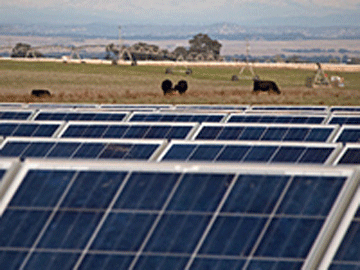 Moree Solar Farm puts big solar in big sky country 4 Aug 14 The Australian Renewable Energy Agency (ARENA) today announced $101.7 million of support for Moree Solar Farm, which upon completion will be one of the largest solar plants in Australia.
ARENA CEO Ivor Frischknecht congratulated renewable energy company Fotowatio Renewable Ventures (FRV) who are set to begin construction on the project shortly. “Moree Solar Farm will be the first large-scale solar plant in Australia to use a single-axis horizontal tracking system, where panels follow the sun across the sky to capturesunlight and maximise power output,” Mr Frischknecht said.
“The 56MWac (70MWp) farm will produce enough electricity to power the equivalent of 15,000 average New South Wales homes.”
Mr Frischknecht said the Moree community would benefit from the project and had been keen supporters, along with the Moree Plains Shire Council, for several years. “The $164 million Moree Solar Farm will benefit the local economy and will also deliver an estimated 130 local jobs during the construction phase over 2014–2016.
“More than 50 locations around Australia were investigated before the developers selected the site 10 kilometres out of Moree in NSW’s northern wheat belt, an area known as ‘big sky country’. “The location benefits from high levels of solar radiation and also allows the solar farm to connect to the national electricity grid.”
Mr Frischknecht said the project, which is also being supported by the Clean Energy Finance Corporation, would aim to demonstrate that large-scale solar power plants can be constructed and operated within Australia’s major electricity grids.
“ARENA will work with FRV to share the valuable knowledge gained in delivering the Moree Solar Farm with the rest of the industry,” Mr Frischknecht said. “We recognise reducing early mover disadvantage and supporting the transfer ofinformation will help advance development of more utility scale solar plants in Australia.”
Moree Solar Farm is a solar flagship project ARENA inherited when it was established in July 2012. Last week, another former flagship project supported by ARENA, reached a major milestone when the first of approximately 1.35 million panels were installed at AGL’s large-scale solar plant in Nyngan, NSW.
Renewable energy should be the ‘norm’ say Queenslanders

 Queenslanders want renewables to become the ‘norm’ http://reneweconomy.com.au/2014/queenslanders-want-renewables-to-become-the-norm-89672 By Giles Parkinson on 1 August 2014
That would mean that “alternative, renewable energy is a Queensland commodity. It is affordable, commercially viable and available to all Queenslanders. Our infrastructure supports these renewable energy solutions.”
The document also states: “Increasingly, Queenslanders are turning to renewable energy alternatives. In the coming decades, as new technologies emerge, cleaner alternative energy sources may help us become better and wiser at using natural resources so they are protected and last longer.”
Premier Campbell Newman hailed the plan as “a massive and exemplary exercise in listening and consulting which involved various discussion forums from summits and community think tanks to boardroom workshops and robust family debates.”
But Queenslanders shouldn’t get too excited about Newman’s LNP government making a sudden lunge towards clean energy.
Queensland may well have more rooftop solar PV than any other state – 1.1GW out of a country total of 3.4GW – but it has very few large scale renewable energy projects, and little prospect of more in the near term. Network operators have also introduced new rules that may prevent new solar installations from exporting their output back into the grid.
The Newman Government has constantly derided “green schemes”, such as the solar feed-in tariff, for contributing towards higher power prices, even though it has benefited from a huge increase in dividends from the state owned network operators derived from big increases in network costs.
The government also wants the renewable energy target brought to a halt, rather than expanded. This appears designed to accommodate the needs of the state-owned fossil fuel generators, Stanwell Corp and CS Energy, which have called for renewable support schemes to end.
Stanwell Corp, in particular, has been critical of the role that rooftop solar has played in lowering wholesale electricity prices and forcing its books into the red.
The Queensland Energy Minister, Mick McArdle, said in his submission to the RET Review panel, that efforts to reduce emissions should be delayed until the state is rich enough.
So, how will the Newman government respond to the desire of its constituents expressed in the Queensland Plan?
The document includes some suggestions about how Queenslanders can “turn their ideas into action” and “make our vision a reality”.
Specifically, the document recommends:
“Subscribe to local and international think tanks and keep up to date about alternative energy solutions and environmental issues.”
Well, that’s a start. We trust, however, that the Newman government is not suggesting the Institute of Public Affairs. We’d recommend The Australian Institute, or the Centre for Policy Development. And RenewEconomy.
Uncertainty over Renewable Energy Target is hurting South Australia’s economy
Renewable Energy Projects at Risk Across Australia http://www.businessreviewaustralia.com/finance/1209/Renewable-Energy-Projects-at-Risk-Across-Australia Laura Close – Finance – Jul 20, 2014 With the uncertainty over the Renewable Energy Target renewal, several project meant to add hundreds of jobs and millions of investment dollars for South Australia are on hold or at risk of getting shut down. The Renewable Energy Target’s goal was to increase renewable energy generation to 20 percent by 2020. This included energy produced from sources like wind, solar or geothermal.
Companies involved in the renewable energy game have been reconsidering their plans eversince the Federal Government decided to review the RET. The review is expected to be completed soon – sometime by the middle of this year – but it has left several companies with an unsure future.
Pacific Hydro, a clean power firm has made it clear that shelving their 42-turbine, $240 million project near Keyneton is having a negative effect on several players. With the ability to power 68,000 homes a year and provide 500 construction jobs, the hit to the region is noticeable.
In a letter to Premier Jay Weatherill, the company says it has $550 million in South Australian projects “ready to go if the current renewable energy target is retained.” “These projects could provide hundreds of jobs in construction and deliver around $260,000 annually through community fund grants,” the letter says. “While the RET review uncertainty continues these projects will remain on the shelf, depriving the state of potential jobs and investment.”
Energy Minister Tom Koutsantonis has been lobbying for the RET to remain, but to instead make changes like extending the timeline and cutting compliance costs. He has also made the request that the scheme should not be reviewed more than once every four years.
A decision is expected in the next couple months, but until then several companies are left waiting to move forward with millions of dollars worth of projects.
Coober Pedy a great test case for off-grid renewable energy
 Coober Pedy Converts to Renewable Energy http://sourceable.net/coober-pedy-converts-to-renewable-energy/ Marc Howe 31 July 14 A new renewable energy project in outback South Australia is set to prove the viability of solar and wind power for remote locations.The project calls for the widespread deployment of solar and wind power in the outback town of Coober Pedy and promises to radically increase the community’s usage of renewable energy, thus reducing its dependence upon costly fossil fuels trucked in from afar.
It is being developed by Clean Energy Council member Energy Developments Limited with funding from the Australian Renewable Energy Agency (ARENA) and is expected to supply as much as 70 per cent of Coober Pedy’s electricity needs.
The EDL project will see the construction of a two-megawatt solar photovoltaic installation and three megawatts in wind power installation, as well as a short-term energy storage facility. These extensive renewable energy facilities provide will take significant pressure off of Coober Pedy’s 3.9-megawatt diesel power station, which is currently the mining town’s chief source of electricity.
According to Clean Energy Council acting chief executive Kane Thornton, Coober Pedy’s sustainability experiment will prove the viability of solar and wind power for outback communities and mining operations in remote areas.
Thornton hailed the project for providing “clean and reliable power to an outback opal mining community which has to weather the constant challenges of extreme heat and dust.”
He pointed in particular to reduction in dependence on diesel fuels, which must be trucked in from elsewhere at significant cost, as a major advantage of renewable energy in remote locations.
“Reducing the amount of expensive diesel that needs to be used is a big win for these communities,” he said. “It will also show other outback towns and remote mining operations what is now possible using renewable energy.”
Thornton said the EDL project is part of a rising trend of mixed energy portfolios which make use of multiple supply sources.
“As renewable energy gets cheaper and fossil fuels such as diesel become more expensive, these kinds of hybrid renewable-diesel projects start to make more and more sense,” he said.
Coober Pedy’s EDL project arrives just as leading figures in the mining industry advocate the increased usage of renewable energy to deal with the remote and power-intensive nature of many operations in the resources sector.
Forget Australia’s Abbott government – Capital cities are going ahead with renewable energy!
Sydney and Melbourne going green despite uncertainty over future of Renewable Energy Target
http://www.abc.net.au/news/2014-07-26/sydney-and-melbourne-going-green-despite-ret-uncertainty/5625976 By Lisa Tucker Australia’s biggest cities are setting ambitious targets to cut carbon emissions despite signs the Federal Government will wind back the Renewable Energy Target (RET).
The review into the country’s RET is expected to make its recommendations next week.
But when it comes to going green, Melbourne and Sydney are on the same page and are determined to make it happen, whatever direction Canberra takes.
The cities are rolling out solar panels, installing LED light systems and designing energy efficient buildings.
Sydney plans to reduce its emissions by 70 per cent by 2030 while Melbourne aims to have zero net emissions in just five-and-a-half years.
City of Melbourne Councillor, Arron Wood, says environmental action is at the forefront of everything the council is doing.
“We’re certainly making big inroads, but to reach that goal by 2020, there’s some pretty big numbers,” he said.
“[But] I am absolutely vehemently opposed to any relaxing of the renewable energy target. It’s done wonderful things in terms of renewable energy investment.
“Interestingly enough we talk about the cost that renewable energy targets add to people’s bills, but when you look at the wholesale cost, it’s one of the only measures which is actually putting pressure on wholesale electricity prices.”
Renewable energy key factor in reducing emissions.
Sydney’s goal is to produce 70 per cent of its electricity needs from tri-generation, a more environmentally friendly, low-carbon production method with solar and wind power making up the rest.
Melbourne is aiming for a renewable energy contribution of 50 per cent.
“Really, you do have to have a large proportion of your energy mix coming from renewable to have a hope of reaching that target,” Cr Wood said.
“Even the Urban Forest Strategy, which is about cooling our city: we’ve got a target of doubling the canopy cover in the city by 2040.
“That’s really about decreasing ambient temperatures and meeting the urban heat effect. But what it does is, it also makes the city look good.”
Sydney’s Lord Mayor Clover Moore says any change to the target will make Sydney’s goal more difficult to achieve.
“It’s much better if the national Government is also committed to taking action on climate change,” Ms Moore said.
“We already know with the winding back of the carbon pricing that it’s making it harder to achieve our tri-generation precincts in Sydney. So that would have an effect.”
Ms Moore says the steps being taken have the community’s full support.
“We are the most urbanised country in the world and we know that our cities are where 70 per cent of emissions occur,” she said.
“I think it’s really incumbent upon city leaders to commit to taking this action and follow through on it.”
Australian Renewable Energy Agency (ARENA) funding Lord Howe Island’s hybrid renewable energy project
Lord Howe Island’s Clean, Renewable Energy Future http://www.energymatters.com.au/index.php?main_page=news_article&article_id=4411 25 July 14 The Australian Renewable Energy Agency (ARENA) is helping to fund a hybrid renewable energy project on Lord Howe Island that will include energy storage.
ARENA will contribute $4.5 million in support for the 1 MW, $11.6 million wind, solar, storage and diesel hybrid system that will reduce the Island’s consumption of diesel by 70%.
“Lord Howe Island is 600 km off the east coast of Australia and, like other remote off-grid communities across the country, is heavily reliant on diesel generators that are costly to run and subject to volatile fuel prices,” said ARENA CEO Ivor Frischknech.
“It is another significant project to come out of ARENA’s Regional Australia’s Renewables Initiative, which is focused on increasing the uptake of renewables in offgrid Australia.”
It’s been a long road to reach this point according to Lord Howe Island Board CEO Penny Holloway; who said said the community had been working towards a renewable energy future for more than ten years and ARENA’s support means it can now become a reality.
The Lord Howe Island Group is part of the state of New South Wales; administered by the Lord Howe Island Board.
NSW Environment and Heritage Minister Rob Stokes congratulated ARENA and the Lord Howe Island Board for their vision and commitment.
“Lord Howe Island was included on the World Heritage List because of its unique natural and heritage values and this initiative is a powerful way of protecting these into the future,” he said.
In other recent news from ARENA, the body announced it is also providing $500,000 to the Clean Energy Council (CEC) to support the execution of the first stage of a project to future-proof Australia’s energy system and improve the electricity grid to support the growth of clean energy.
The CEC will be working with industry, government, regulators and consumers and commissioning various related analyses; with the first stage of the future proofing project due to be completed by the middle of next year.
New South Wales on the way to renewable energy success
Renewable energy: NSW to be ‘Australia’s answer to California’, SMH, July 22, 2014 Peter Hannam Environment Editor, The Sydney Morning Herald New South Wales aims to be “Australia’s answer to California”, accelerating the use of renewable energy and finding new ways to curb waste, in a push that puts it at odds with Coalition counterparts in other states and at the federal level.
The Baird government says it plans to adorn as many of its buildings with solar panels as possible and ease the way for more wind farms.
The announcement comes days after the Abbott government secured its almost five-year quest to axe the carbon price and amid ongoing signs it will weaken the national renewable energy target (RET), “We are making NSW number one in energy and environmental policy,” Environment Minister Rob Stokes told the Clean Energy Week gathering in Sydney……….
Mr Stokes said NSW was committed to the 41,000 GW-h goal – a target that was the federal Coalition’s pre-election commitment. Maverick MP Clive Palmer has said his party will use its balance of power in the Senate to block any effort by the Abbott government to cut the renewable energy target.
Star watch
The NSW Resource Efficiency Policy will take advantage of the government’s scale – with more than half a billion dollars spent on energy, water and waste each year – to demand savings.
Investment over the next decade is likely to reach $290 million and deliver savings to energy bills of $55 million a year by then, Mr Stokes said.“We are the country’s largest employer,” he said of the NSW government. “We purchase 1 per cent of all new cars in Australia and we own half of all the land in the state – around 400,000 square kilometres.”
All new electrical equipment bought by the state will have to meet at least the average energy efficiency star rating for each appliance. For dishwashers that means 4 stars or higher and 3.5 stars for small air conditioners.
The Energy Efficiency Council said it applauded NSW’s leadership.
“Other governments around Australia should watch what NSW is doing and follow its lead,” said chief executive Rob Murray-Leach.
Improving energy performance was “a no-brainer”, strengthening the budget, as well as forcing through higher standards that build industry capacity, benefiting other parts of the economy, Mr Murray-Leach said. Mr Stokes told Fairfax Media: “It’s never been anyone’s job in the Department of Health or Department of Education to go and look at these efficiency opportunities.
“It’s a big opportunity, we’ve got a vast building stock, and there’s been nothing to activate it.”
As part of the policy, the Health Department will be required to audit energy use for 55 per cent of their power bills by June 2018; other departments will have to audit 40 per cent of their bills. The rate will rise to 90 per cent by 2024.
Wind-farm noise
In a separate nod to the renewable energy sector, Mr Stokes said he has recommended that the Environment Protection Authority treat noise from wind farms as it would noise from other mining and resources projects.
“I’ve asked the NSW EPA to consider the inclusion of the draft noise standards for wind energy projects into the Industrial Noise Policy, which is due to be finalised by December,” Mr Stokes said.
“This will provide clarity and certainty for wind farm operators, and will facilitate appropriate and responsible siting of wind farms in regional and rural areas,” he said……. http://www.smh.com.au/environment/renewable-energy-nsw-to-be-australias-answer-to-california-20140722-zvl60.html#ixzz38YKi2HqG
Despite Tony Abbott, Solar Power is shining in Alice Springs
Red Centre keeps shining as solar technology hub http://www.abc.net.au/news/2014-07-22/alice-springs-solar-hub-technology/5613534 ABC Rural By Lauren Fitzgerald Central Australia is continuing to attract international investment from the solar industry, despite the Alice Solar City initiative wrapping up more than a year ago. In its five-year history, the program helped hundreds of homes and businesses install solar panels and solar hot water systems.
The general manager of the Centre for Appropriate Technology (CAT), Lyndon Frearson, says Alice Springs now also has a reputation as a hub for developing technology.
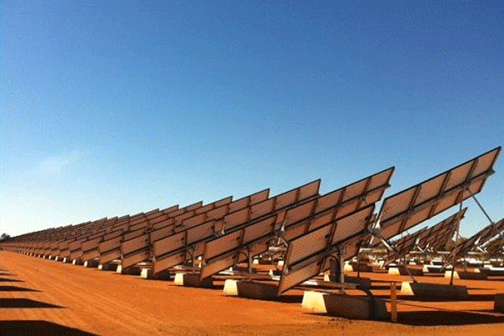
He says companies from China, Japan, Taiwan, Germany, Switzerland and America are all installing different solar PV modules at the CAT site. “The range of their investment varies depending on the size of the facility that they want to put in,” he said.
“Some of them are putting in little five-kilowatt systems as a test site, where they might be putting a number of small test sites around the world, through to a Swiss-based company which only has three R & D [research and development] facilities in the world, and they chose to build one of them here.
“And certainly those investments are in the order of hundreds of thousands of dollars.”
Mr Frearson says local businesses like the Alice Springs Airport are also demonstrating an ongoing commitment to solar. “They received a subsidy to do their original project, but they’ve just [installed] 320 kilowatts off their own bat, completely their own investment. “And that’s both a maturing of the economics, that the solar panels are cheaper and the energy prices have changed.
“But it also shows a degree of confidence that they as an organisation and their board have in the technology to better run their business. “And there are a number of examples within Alice and broader afield throughout central Australia where different entities are making those decisions.
“So I think the legacy of Alice Solar City in central Australia is strong. “Certainly it’s something we see people talking about with pride, and we still see people outside of Alice focus very heavily on and see Alice Springs as a leader in this space.”
Victoria’s wind farms may be able to expand, after all
 Wind companies question planning office response ENERGY companies will be allowed to make minor changes to wind farm planning permits from next month. Weekly Times 22 July 14, The move — which will pave the way for up to 964 turbines to be built across the state creating up to 2376 megawatts of wind energy — has been labelled a “change of heart” by Greens leader Greg Barber.
Planning Minister Matthew Guy said “we’re making a small adjustment to the planning scheme to allow existing wind farm planning permits to be amended, which may assist with upgrading turbine technology”……….http://www.weeklytimesnow.com.au/news/politics/wind-companies-question-planning-office-response/story-fnkerdda-1226997709510
Australia’s Clean Energy Finance Corporation doing well, expanding
Clean Energy Finance Corporation plans expansion after dodging axe http://www.smh.com.au/business/clean-energy-finance-corporation-plans-expansion-after-dodging-axe-20140721-zvdhg.html#ixzz38MD2vaOK July 22, 2014 Peter Hannam Environment Editor, The Sydney Morning Herald The Clean Energy Finance Corporation has capped its first year of operations, managing to avoid the federal government’s axe and generating more than $3 billion in investment in renewable energy and energy efficiency projects.
The CEFC issued more than $900 million in loans in the year to June 30 – backed by the private sector at the rate of $2.20 for each of its own dollars – securing the annual abatement of at least 4.2 million tonnes of carbon dioxide in the process.
Chief executive Oliver Yates said the fund generated a “reasonable return” for the taxpayer, raising funds at the government rate of about 3.5 per cent and lending under commercial terms at about 7 per cent.
The CEFC aims to at least match last year’s investments this financial year, with many of the projects “very complementary” to the government’s $2.55 billion Direct Action plan to pay polluters, Mr Yates said.
“Our numbers to date are that energy efficiency upgrades to buildings are saving about 45 per cent in energy costs,” Mr Yates said. “The challenge for Direct Action is that you need to fund all the action before you get paid for it, and that comes down to who actually funds these projects.”
In its first year, the CEFC’s investments were split about 60-40 in favour of renewable energy – largely solar – over energy efficiency projects.
Insiders say morale remains high among the 50 or so staff despite the Coalition’s vow to scrap the fund, a move blocked by Labor, the Greens and lately the Palmer United Party.
“It’s a game of snakes and ladders and has been for a while,” Mr Yates said, noting the regular policy shifts including last week’s repeal of the carbon price and uncertainty over the government’s support for large-scale renewable energy target.
Despite that uncertainty, companies and banks continue to line up for new investment, particularly in small-scale solar photovoltaics (PV).
The CEFC announced on Tuesday it will provide as much as $120 million for three new solar PV financing programs, including $70 million for US-based SunEdison. Tindo Solar, the country’s only solar PV panel maker, will also get $20 million in loans.
The fund will also provide up to $80 million as part of a cornerstone investment with a unit of Colonial First State to create Australia’s first unlisted clean energy investment platform for institutional investors. Colonial First State will aim to raise as much as $500 million for investments.
Falling solar PV prices have made panels more attractive for residential and commercial users alike. Globally, solar PV investment fell 22 per cent last year but actual new capacity rose 27 per cent because of tumbling costs, according to the Renewable Energy Policy Network.
In Australia rooftop solar is starving profits from coal power
 Game-changing rooftop solar boom is squeezing the profits out of coal power in Australia http://www.treehugger.com/renewable-energy/rooftop-solar-boom-squeezing-profits-coal-power-autralia.html Michael Graham Richard (@Michael_GR) 14 July 14
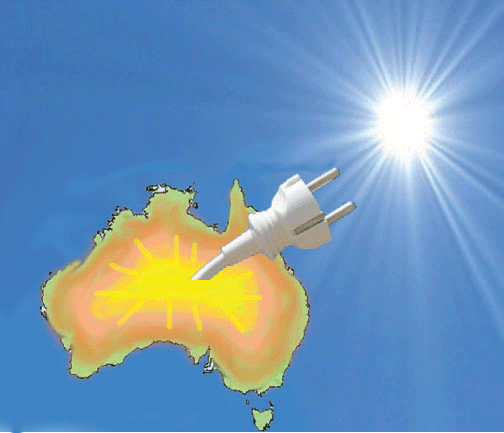
Solar power briefly turned electricity prices negative in Queensland Australia is known for its coal, which provides over 80% of its electricity and is a big export, but someday soon it might be known for its solar power. Thanks to rapidly falling solar PV prices, there’s been a rooftop solar boom in Australia. It’s now reaching a point where few coal generators made money last year, and even fewer will make profits this year… Wholesale energy pricing even briefly went negative in the middle of the day (see graph below) recently in the middle of the day in Queensland where there is 1.1 gigawatt of solar spread over more than 350,000 buildings.
Australia as a whole has about 3.4GW on 1.2 million buildings! Eventually, coal won’t be able to compete with solar at any price:
let’s imagine that the wholesale price of electricity fell to zero and stayed there, and that the benefits were passed on to consumers. In effect, that coal-fired energy suddenly became free. Could it then compete with rooftop solar?
The answer is no. Just the network charges and the retailer charges alone add up to more than 19c/kWh, according to estimates by the Australian energy market commissioner. According to industry estimates, solar ranges from 12c/kWh to 18c/kWh, depending on solar resources of the area, Those costs are forecast to come down even further, to around 10c/kWh and lower. (source)
The next step will be for people to get some storage and go off the grid to avoid having to pay these network charges. Australian solar installers are already reporting that “between 15 and 20 per cent of solar customers are asking about storage, and that rate is increasing each month.”
With companies like Tesla having ambitious goals to cut battery prices down over the next few years with gigafactories, the combo of cheap solar PV + cheap battery storage will be hard to beat. Dirty power sources will simply stop being competitive. Australia has lots of sun and high network costs, so it’s at the forefront of this movement. But most other countries will follow at their own pace. The best things we can do to accelerate the switch over to clean energy is to stop subsidizing fossil fuels, create regulation that is more friendly to rooftop solar (net-metering, for example), and put a price on carbon emissions.
Solar battery hybrid storage system for Muswellbrook, New South Wales
Photon to build solar plus storage unit for NSW broadcast tower REneweconmy, By Giles Parkinson on 15 July 2014 German-based solar group Photon Energy is to install a large scale solar plus battery storage hybrid power system at a telecommunications tower in New South Wales that it says could be the fore-runner of thousands of such installations across the country.
The system, to be installed at a broadcast tower operated by BAI near Muswellbrook, will provide 24/7 power through a 39kW solar array and a 215kWh battery storage installation. An 8kW diesel generator will provide standby in emergencies.
Photon Energy says once successfully tested the concept could be implemented on thousands of sites across Australia.
Michael Gartner, the head of Photon Energy‘s Australian operations, said the project was a great step forward“ for solar power to provide clean and economically viable power supply for remote sites.
“The potential for solar PV in the replacement of conventional energy sources is substantial and will bring cost benefits and emissions savings for Australia in the coming years and decades.“
“… We can show how to incorporate solar PV into any given energy system and prove that using abundant sunlight for your own power consumption is the way forward.”……..http://reneweconomy.com.au/2014/photon-build-solar-plus-storage-nsw-broadcast-tower-37262
Axing of carbon tax will not really help your power bills
The Carbon Tax Is Dead, Long Live the ..? http://www.energymatters.com.au/index.php?main_page=news_article&article_id=4399 18 July 14 The carbon tax is dead; but don’t expect to see a major difference in power bills – or for too long.
It doesn’t matter that many households were compensated for any impact of the scheme under the Household Assistance Package, or that the carbon tax prevented 11 to 17 million tonnes of carbon emissions.
Nor does it matter higher it resulted in some filthy brown-coal fired power stations being mothballed.
Like it or loathe it, it’s kaput. Spin bettered substance and Thursday’s passing of the repeal turned Australia from a leader to laggard.
“The repeal of Australia’s carbon price is a tragedy, not a triumph” said Michael Raupach Director, Climate Change Institute, Australian National University.
“It flies in the face of three giant realities: human-induced climate change, the proper role of government as a defender of the common good, and the emerging quiet energy-carbon revolution”.
According to the ABC, , consumers can expect to save between 20 and 50 cents each day on their electricity bills now the carbon tax has been repealed.
However, any financial benefit relating to power bills could quickly be eaten up by increases in other charges.For example, in New South Wales, Ausgrid wants increases of around 2 per cent a year over the next five years and TransGrid wants to raise prices by almost 4 per cent – this is just in relation to network charges.
Other states including South Australia have just implemented more electricity price rises. The average South Australian household will pay around $85 a year more.
In Queensland, households were recently hit with a 13.6 per cent increase, expected to cost the average household an extra $190 a year.
Depending what end of the scale of carbon tax savings are to be had, any relief may have already been gobbled up before many will receive their post-carbon tax bill. Anyone planning to do something other than pay power bills with the perceived windfall may need to re-evaluate those plans.
Murky dealings in Australian government’s “clean coal” fantasy
 The search for the clean coal holy grail http://www.abc.net.au/radionational/programs/backgroundbriefing/ The Abbott government and a group of investors are pinning
  their environmental hopes on a clean coal technology that is still in the very early stages of development. Paddy Manning tracks the quest for the clean coal holy grail and investigates the men getting unspeakably rich from the search.
The federal government is pinning its hopes of cleaning up Australia’s electricity  sector on a new clean coal technology that is still at the laboratory stage.
Environment Minister Greg Hunt has made clear that a key plank of the government’s plan to tackle climate change is reducing emissions from existing black and brown coal-fired power stations……
Ignite Energy Resources, a member of the DICE network, recently recieved a $20 million grant to produce liquid fuel for DICE engines from brown coal, among other things………
photo – Dr John White Executive Director, Ignite Energy Resources
South Australia now punishing domestic solar generators?
 Dennis Matthews 18 July 14 Electricity retailers in SA are required by law to pay domestic solar electricity generators only 7.6c a kWh (the minimum retailer payment) and this will automatically decrease to 6c/kWh now that the carbon pricing legislation has been repealed by the Abbott government. Yes, no ifs or buts, automatically!
Given the grossly unequal lobbying and market power of electricity retailers versus domestic solar generators then this can only be described as a travesty. And things are only going to get worse for the household consumer with price increases already flagged by retailers and the monopoly network provider.
Whilst we wait with bated breath to see what happens to what retailers are going to charge us, thanks to Essential Services Commission (ESCOSA), retailers already know that they will pay 20% less to domestic solar generators.
1 This month

of the week – Australians for War Powers Reform (AWPR)
To see nuclear-related stories in greater depth and intensity
 Antinuclear